Part 2: Quiet Paperwork Revealed How Deep Their Plan Had Gone
When Simone wanted to open her boutique in Fern’s old store space, I had been the one who encouraged her.
Fern’s shop had sat mostly untouched after she died. Dresses still hung on rolling racks. Her little brass bell was still above the front door. I couldn’t bring myself to rent the space to strangers, so when Simone said she wanted to build something of her own, it felt almost right.
I loaned Bradley and Simone $28,000.
Not with a handshake.
Dutch insisted on a promissory note and a security agreement. The debt was secured by the boutique’s fixtures, inventory, and improvements, and we filed the proper UCC financing statement with the state.
Fern used to tease me because I saved receipts for ten years.
“One day,” she’d say, “you’re going to drown under paperwork.”
Turns out paper was the only thing keeping me above water.
I pulled the boutique ledger from my filing cabinet.
April payment: missed.
May: missed.
June: missed.
Three consecutive defaults.
I didn’t call Bradley.
For nineteen days, I acted like nothing had happened.
That was harder than I expected.
Bradley texted me twice.
Dad, you good?
Then two days later:
Did you think about the ring? Buyer is waiting.
I left both messages unanswered.
Fern used to say my silence was louder than my temper. I never understood why until those weeks.
Dutch requested the notary’s journal and the recorder’s submission information. He also told me to find proof of where I had been on May 8, the date I supposedly appeared before the notary.
I remembered May 8 immediately.
My older brother Raymond’s memorial luncheon.
There was nothing cinematic about my evidence. No security camera footage of someone forging my name. No secret recording.
I had a funeral-home sign-in sheet.
A gas-station receipt from Highway 32 at 8:14 that morning.
And a text from Earl at 2:07 p.m.
Still at the church basement? Bring that potato salad home.
Three boring pieces of evidence.
Three things I never would have saved if I hadn’t spent a lifetime believing paper mattered.
On the twentieth day, Dutch called.
“Come in.”
That was all.
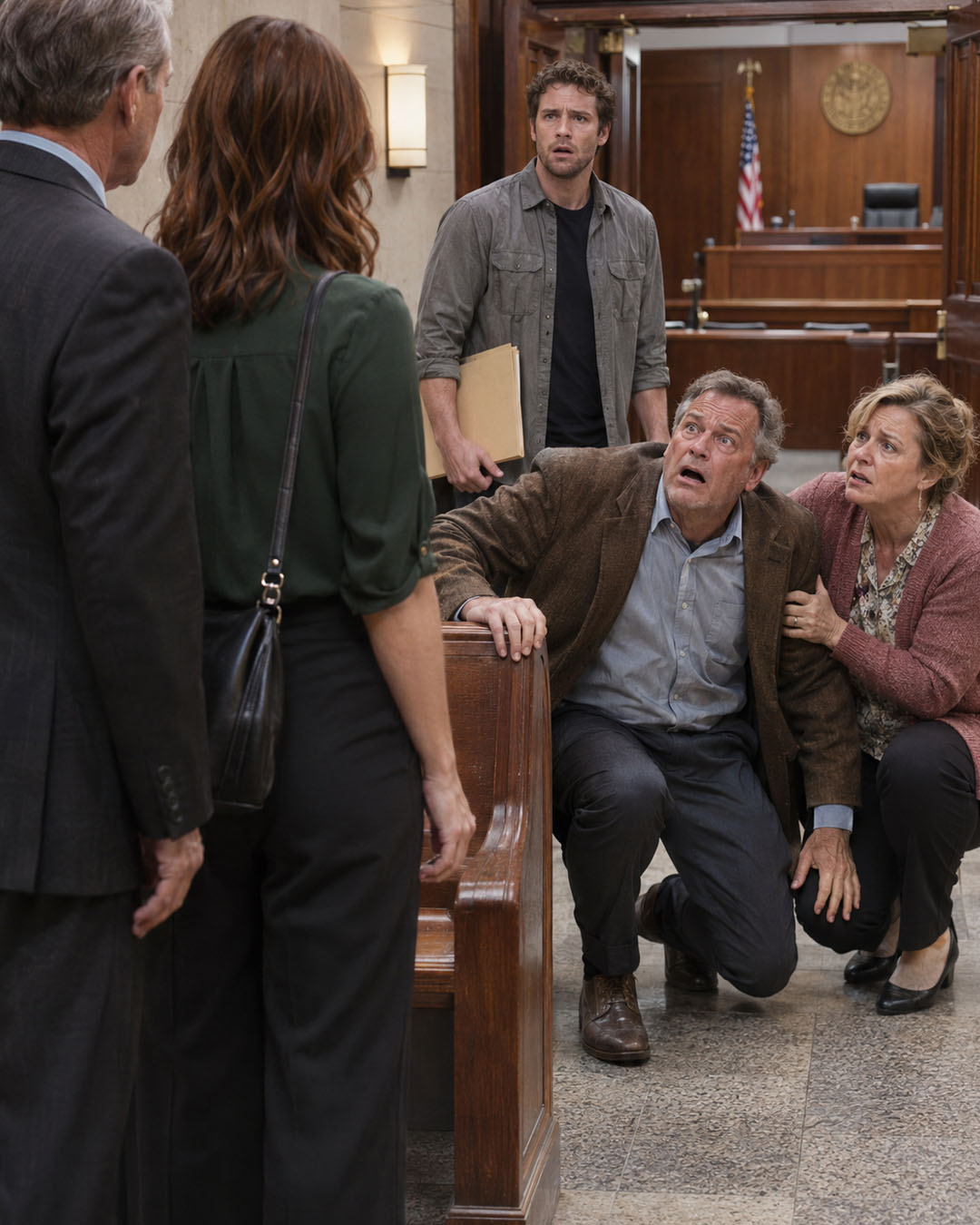
When I reached his office, the quickclaim deed was enlarged on his desk beside the insurance form Bradley had brought me months earlier.
Dutch pointed at my signature on the insurance page.
Then at the signature on the deed.
“They appear to match unusually closely.”
I bent over the pages.
Same slope.
Same hesitation where the V crossed into the o.
Even the little upward hook at the end.
Dutch tapped the dates.
“This is the document you remember signing?”
“Yes.”
“And you never signed this deed?”
“No.”
“The dates don’t line up cleanly, either. And the notary journal should establish whether you appeared.”
I stared at my own name until it stopped looking like mine.
“Bradley copied my signature.”
Dutch didn’t answer that directly.
He didn’t need to.
Instead, he said, “We’re challenging the deed.”
I sat back.
“Why would he do this?”
Dutch folded his hands.
“Money usually gets a vote.”
The answer came later.
The boutique was failing.
Bradley had also bought a CNC machine on credit, convinced he could use it to make custom store fixtures and bring in extra income. Bills stacked up faster than orders came in. The bank wouldn’t extend enough credit.
My house had equity.
Bradley saw the house not as the place where his mother had raised him, but as collateral he couldn’t access.
He was drowning.
And instead of asking for a rope, he’d decided my roof belonged in the water with him.
Dutch prepared two notices.
The first challenged the deed and started the process of correcting the public record.
The second ended Bradley and Simone’s permission to live in the house.
Thirty days.
He also sent formal notice that the boutique loan was in default.
When Simone received the letters, she called me.
I held the phone several inches from my ear.
“You’re evicting us?” she shouted. “Over paperwork?”
“No.”
“Then what is this?”
“Read the letter.”
“Oh, I read it. Believe me.”
Bradley’s voice appeared faintly in the background.
Then he came on the line.
“Dad.”
He sounded tired.
Not angry.
Somehow that was worse.
“We were going to pay you back.”
“You transferred my house into your names.”
“We needed collateral.”
“You didn’t ask.”
“The bank would’ve said no.”
“I didn’t ask what the bank would’ve said.”
He sighed. “You always said the house would be mine someday.”
“Someday.”
I stood in Fern’s old shop while we spoke. Afternoon sunlight fell across the empty corner where her dressing mirror used to stand.
Bradley said, “What’s the difference?”
I looked through the front window toward Walnut Street.
“The difference is I’m still alive.”
Nothing came through the phone for several seconds.
Then Simone’s voice broke in again.
“We have a daughter, Elmer. What are we supposed to do?”
That question stayed with me after the call ended.
Not because I didn’t know the answer.
Because once, I had trusted them enough to believe they would never force me to give it.
Part 3: I Took Back My Home Without Raising My Voice
I did not change the locks.
I did not shut off utilities.
I did not show up with Earl and a pickup truck and start throwing boxes onto the lawn.
Dutch had been explicit.
“We do this by the book.”
So we did.
Bradley and Simone had thirty days to leave voluntarily.
They didn’t.
Whenever I drove past the house, Bradley’s truck was still in the driveway. Simone’s curtains still hung in Fern’s front windows. Once I saw Kayla sitting on the porch steps doing homework, and I kept driving.
She wasn’t responsible for any of it.
A week before the deadline, Bradley came to the hardware store.
He stood near the counter where he used to do homework as a boy.
“Can’t we work something out?”
“What does that mean?”
“I refinance something. Simone sells inventory. We catch up.”
“And the deed?”
His eyes shifted toward the floor.
“We made a bad decision.”
“You forged a transfer of my home.”
He rubbed his neck.
“Dad, I panicked.”
That was the first truthful sentence he’d given me.
I waited.
He swallowed.
“The boutique was behind. The machine payment was killing me. Simone thought we’d lose everything. I thought if the house was in my name, I could get a line of credit, clean everything up, put the house back later.”
“Before or after you sold my wedding ring?”
His face tightened.
“That wasn’t connected.”
“You asked me for nine hundred dollars in gold while you were trying to borrow against a two-hundred-thousand-dollar house.”
“We needed cash that week.”
I nodded slowly.
“That’s connected enough for me.”
He looked around the store.
“I wasn’t trying to steal from you.”
“What do you call taking something without permission?”
His jaw moved, but no words came.
I didn’t enjoy that moment.
He was still my son.
I could still see the eight-year-old who used to sit on upside-down paint buckets while Fern made him grilled cheese on a hot plate in the stockroom.
But loving somebody doesn’t require pretending they didn’t do what they did.
On September 12 at 6:07 in the morning, a sheriff’s deputy arrived with the court order authorizing possession.
I came after the deputy.
Bradley carried clothes out in a laundry basket.
Simone moved quickly between the house and their borrowed SUV without looking at me.
Kayla came down the steps last.
Her backpack was over one shoulder.
She stopped beside me.
“I’m sorry, Papa.”
I opened my arms.
She hugged me hard.
“You don’t apologize for grown people,” I whispered.
She nodded against my chest.
When she pulled away, I saw Bradley watching us from beside the truck.
For half a second, he looked like he wanted to come over.
He didn’t.
The deputy completed the turnover.
I stepped into my house after they drove away.
It smelled different.
Not bad.
Just not mine.
Simone’s candles had covered the faint cedar-and-coffee smell I associated with Fern. The living room walls were a color she would have hated. The pantry had been reorganized.
I walked upstairs and stood in the bedroom Fern and I shared for thirty-eight years.
On the closet shelf sat one of her old hatboxes.
Empty.
I sat on the edge of the bed platform they’d left behind and finally took my wedding ring from my pocket.
I’d carried it almost every day since Bradley asked for it.
The metal was warm from my hand.
A few weeks later, their attorney reviewed the original deed records, the disputed document, and the notary evidence.
They stopped fighting the challenge.
The county record was corrected.
The house was mine again.
My name only.
Bradley eventually faced criminal charges related to the forged paperwork. He had no prior record, and the matter ended with probation and restitution rather than prison.
That mattered to me.
I wanted accountability.
I did not want my son’s life destroyed.
There is a difference, even when you’re furious.
The boutique was another matter.
Because my loan was properly secured, the inventory and fixtures were appraised and sold through a lawful liquidation process.
Fern’s old shop emptied piece by piece.
Clothing racks.
Display tables.
Mirrors.
Register.
Decorations Simone had chosen.
The sale brought in about $18,700.
After crediting the payments they had already made and applying the permitted charges, roughly $7,700 remained.
Dutch asked me what I wanted to do.
I looked around the empty shop.
Sunlight came through the front windows and caught dust floating where racks had once stood.
“Write it off.”
Dutch glanced at me.
“You can pursue the balance.”
“I know.”
“You don’t have to forgive it.”
“I know.”
“Then why?”
I looked at the little brass bell still hanging over the door.
“Because I want them out of Fern’s space.”
He studied me for a moment, then nodded.
I forgave the remaining balance in writing.
That was the last money I ever intended to give them.
Part 4: The Papers Spoke, But Family Never Sounded The Same
People imagine winning feels clean.
It doesn’t.
The house was back in my name. The fraudulent transfer was gone. The boutique debt was settled. Bradley was out.
And some mornings, I still reached for my phone when I saw a tool on sale because for forty years my first instinct had been to tell my son about things he might need.
We still spoke.
Just differently.
Short calls.
Practical things.
“Furnace running okay?”
“Yeah.”
“You get that gutter fixed?”
“Thursday.”
“Kayla need anything?”
“No, she’s good.”
Simone stopped coming around.
That was probably best.
I don’t hate her. Hate takes more daily effort than I’m willing to spend. I think she was frightened, ambitious, and convinced that if they could survive one more month, one more loan, one more rearranged bill, everything would finally work.
Bradley believed it too.
That was how they justified each step.
First the late payment.
Then the missing tax bill.
Then the signature.
Then the house.
People rarely wake up and decide to become villains in somebody else’s life.
Usually they tell themselves they’re solving a temporary problem.
Kayla still visits me most Saturdays.
She quit helping at the boutique before it closed and got a part-time job at the library.
One afternoon, she sat at my kitchen table doing homework while I replaced a loose cabinet hinge.
“Papa?”
“Yeah?”
“Was it something I said?”
I looked over.
She was staring at her notebook.
“What do you mean?”
“Mom and Dad used to argue after I told you about the cash envelope.”
There it was.
That little thread.
The comment she had made without understanding its importance.
I tightened the screw and closed the cabinet door.
“Adults leave clues all over the place, sweetheart.”
She looked up.
“So I caused trouble?”
“No.”
I put the screwdriver down.
“You told your grandfather about your Saturday at work. That’s all.”
She watched me for another second.
Then she nodded and went back to her homework.
I will never tell her that her innocent chatter helped me notice the larger pattern.
She doesn’t need to carry that.
Last Sunday, after Kayla left, I swept the front room twice.
It didn’t need sweeping even once.
Old habits.
The late-afternoon sun came through the tall windows Fern and I installed in 1998 after arguing for three months about whether we could afford them.
She won.
She usually did when windows were involved.
I made coffee and stood at the kitchen sink.
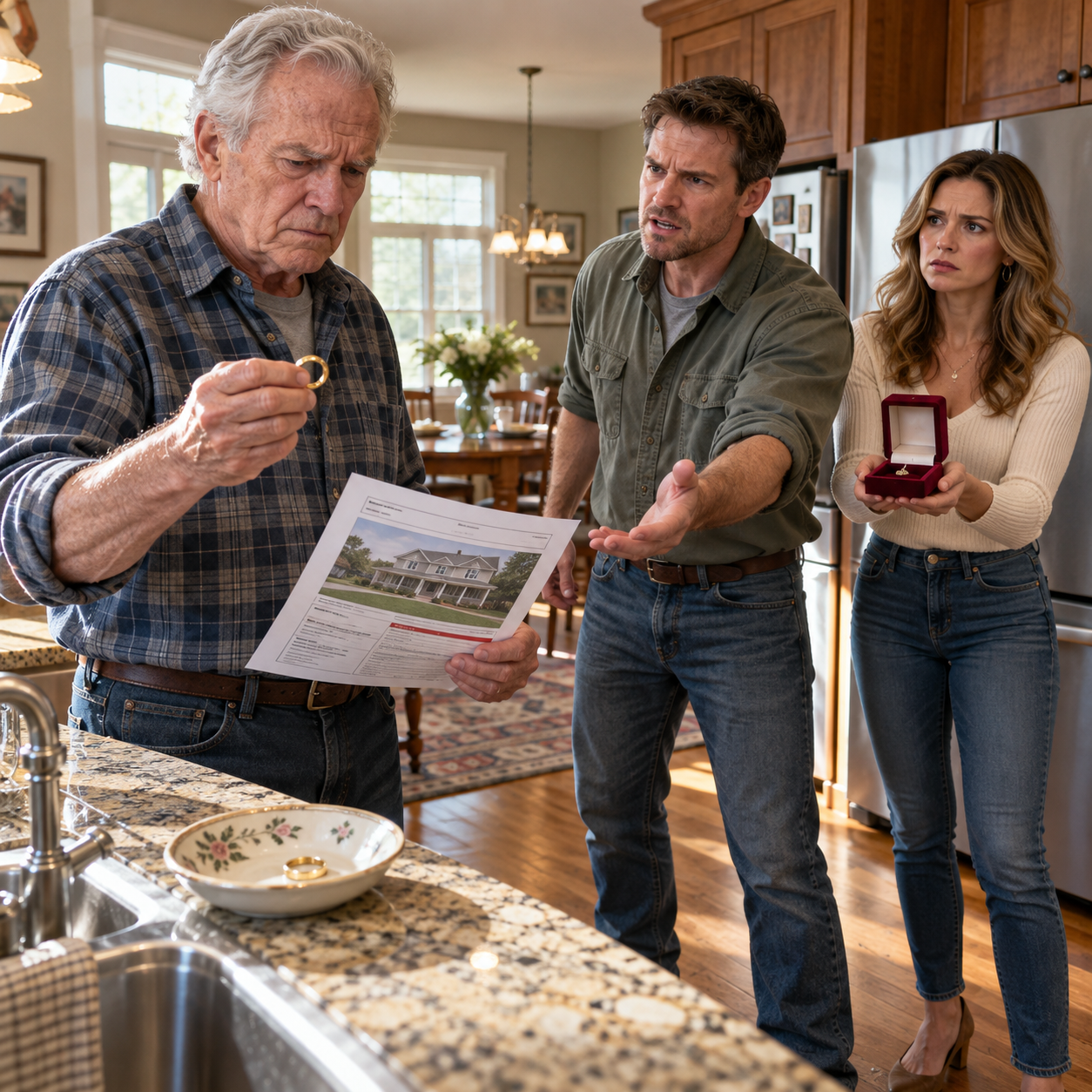
The ceramic dish was still there.
Fern’s ring rested inside it.
Mine had been in a drawer since the legal mess ended.
For a long time, I had kept it hidden because Bradley’s request had changed what the ring felt like. It had gone from memory to evidence, from marriage to money.
I opened the drawer.
Picked it up.
The gold was scratched from four decades of work, home repairs, carrying boxes, holding babies, and gripping Fern’s hand through hospital visits we both pretended weren’t frightening.
Nine hundred dollars, Simone had said.
I almost laughed.
Then I placed it back in the ceramic dish beside Fern’s.
It fit exactly where it always had.
I thought about that county letter and Earl’s coffee and Dutch’s red glasses. The funeral-home sign-in sheet. The gas receipt. The ridiculous potato-salad text.
None of it looked powerful.
That’s the thing about evidence.
It doesn’t need to look powerful.
It only needs to be true.
Bradley had assumed age made me easier to move around. Maybe I had helped create that belief. I had let him live in my house without a formal lease. I had loaned him money. I had trusted him with a clipboard because he was my son.
Trust isn’t foolishness.
But trust without boundaries can become an invitation to people who are frightened enough to stop seeing where you end and they begin.
I still love my son.
I don’t trust him the way I once did.
Both things can be true.
There are mornings when that hurts more than losing the house ever would have.
But the house is standing.
Fern’s windows still catch the afternoon sun.
Kayla still lets herself in without knocking and complains that I buy terrible cereal.
And my wedding ring still sits beside my wife’s, exactly where Bradley found it on the morning he decided I didn’t need it anymore.
He was wrong.
Not because I needed the gold.
Because some things don’t become yours simply because somebody else is old, grieving, generous, or quiet.
I learned that at seventy-one.
You cannot force people to respect what you built.
But you can keep good records.
You can refuse to confuse forgiveness with permission.
And sometimes, when everybody expects you to shout, the strongest thing you can do is stay quiet long enough for the truth to speak first.
The End .
All characters and events in this story are fictional, created for storytelling and entertainment purposes. Thank you sincerely for reading. Your feedback and support are invaluable and motivate me to continue sharing more stories with you.