Part 2: Guilt Put Three Spoonfuls Between Me And An Ambulance
By September, throwing away Clare’s meals no longer felt funny. Every Tuesday I pictured her leaving a ten-hour workday, stopping at the grocery store, chopping vegetables, washing pans, and carefully packing dinner for a woman she believed appreciated it. She was not malicious or controlling; she was generous, proud, and spectacularly untalented in a kitchen.
Then came the beef stew.
The note said she had simmered it seven hours with fresh beets and bone broth “for my red blood cells.” The stew was an alarming purple-brown, thick enough to hold a spoon upright. Buster took one look at the bowl and turned his head away.
“We are not doing this again,” I told him. “She worked seven hours.”
I heated a small portion. The smell was metallic and sweet, and huge chunks of raw ginger floated among pieces of beef that were somehow tough and slippery at the same time. I took one bite, then another, then a third, as if six months of dishonesty could be paid off spoonful by spoonful.
“It’s food,” I said to Buster, eyes watering. “Just food.”
At two in the morning, pain woke me sharply. By five, I could barely stand without my vision darkening, so I called 911. The next clear image I have is an IV taped to each arm beneath the white lights of St. Jude’s Medical Center.
The doctor studied my lab results. “Severe bacterial food poisoning. Possibly salmonella. Any meat left sitting out?”
“Beef stew,” I rasped.
David arrived just after seven in work boots and an unbuttoned flannel shirt. Clare had driven north for an early job-site inspection, so he came alone. He took my hand and said, “Mom, what happened?”
I motioned him closer. “The beets and beef. Your wife’s Tuesday special.”
His face answered before his mouth did.
He closed his eyes, rubbed both temples, and whispered, “Please tell me you didn’t actually eat it.”
I stared at him. “What did you think I did with it?”
David pulled a vinyl chair beside the bed and sat down heavily. “I thought you dumped it. Like I do.”
For several seconds, all I could hear was the monitor beside me.
“You dump her food?”
“Mom, Clare can’t cook.”
“You think?”
He winced. “She leaves chicken on the counter. She doesn’t believe in meat thermometers. She once put cinnamon, vanilla, and scrambled eggs in beef gravy. I’ve been buying protein bars and eating them in the garage before I come inside.”
“You knew this and let her bring food to me every week?”
“I thought you knew too.” He lowered his voice. “Her dad used to tear into her mom if dinner wasn’t perfect. Clare swore she’d never have a house like that. She wants cooking to mean something different.”
There it was: two cowards with good intentions and a woman trying to repair an old wound with a casserole dish.
Before David left, we made a foolish pact: tell Clare I had caught a stomach virus at the clinic, then somehow discuss food safety later.
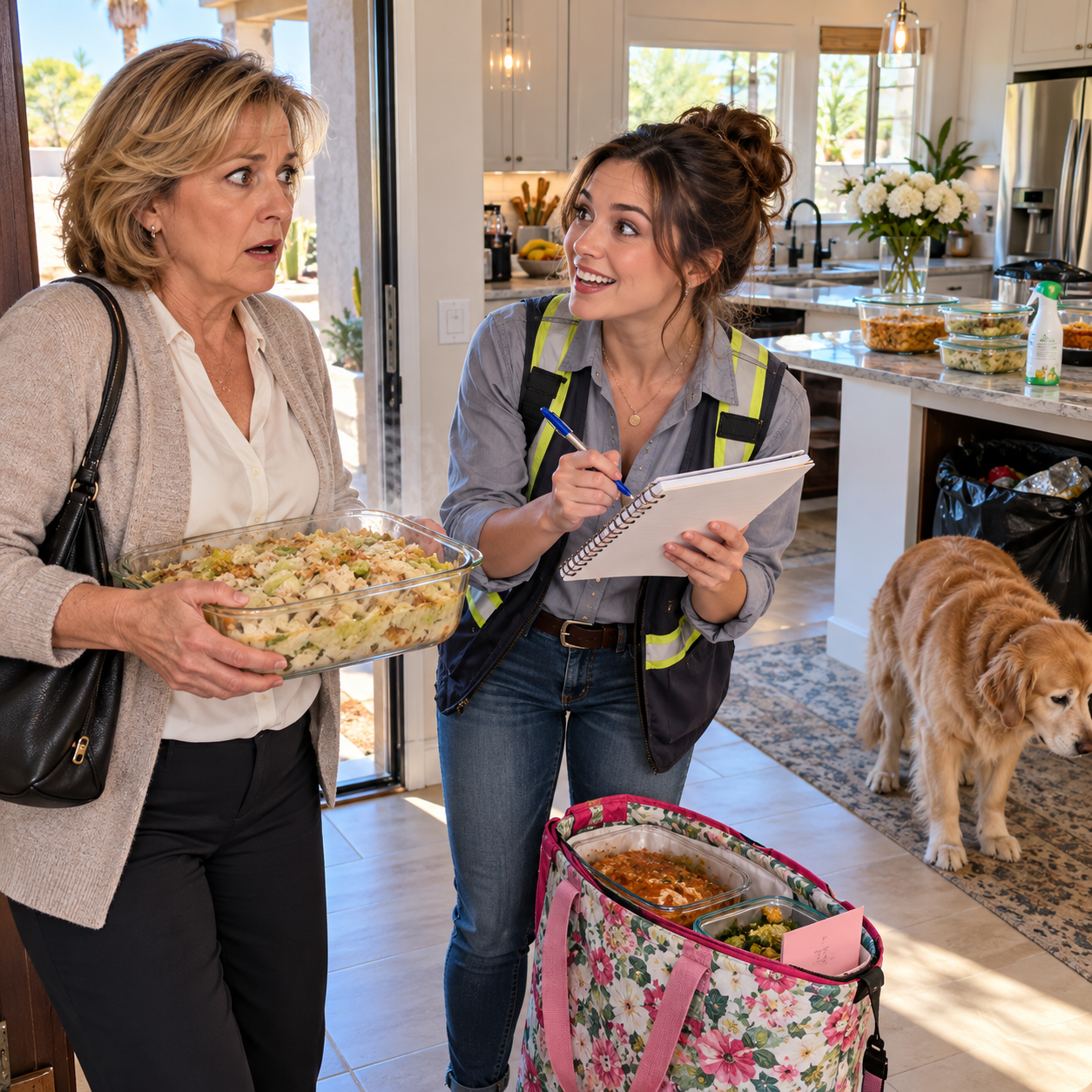
Two weeks later, the floral tote returned. Inside was “post-recovery green power soup,” a murky blend that smelled like wet grass. Clare’s card promised it would clean out the last of the stomach bug and ended, Love you to pieces.
Something in me finally refused to keep performing.
I poured the green mixture into a black contractor bag near the patio door, rinsed the Pyrex, dried it, and set it on the rack. I was tying the bag shut when my front door opened.
“Surprise, Mom!” Clare called.
Part 3: One Torn Trash Bag Exposed Two Years Of Lies
Clare entered with carnations. David followed carrying groceries and the guilty face of a man who understood, one second too late, what was about to happen.
I stood by the patio door gripping the black trash bag.
“Oh, let me get that,” Clare said. “You shouldn’t be hauling yard waste after being sick.”
“No, honey, I’ve got it.”
She reached. I pulled back.
The plastic snagged on the metal track beneath the sliding door and split open.
Green soup slid across my pale kitchen tile and pooled around Clare’s white sneakers. In the middle of the mess floated her pink card, the words Love you to pieces bleeding slightly at the edges.
Clare stared down. Then she looked at the spotless Pyrex on the drying rack.
“You threw it away.”
Her voice was so soft that shouting would have been easier to hear.
“Clare, sweetheart—”
“You didn’t even taste it.”
She looked from me to David. Tears gathered, but her face had gone rigid. “You washed the dish so you could pretend you ate it.”
David set the grocery bags down. “Honey, don’t—”
“Don’t what?”
He stopped.
“How long?” Clare asked me.
There was no useful lie left. “Six months.”
She stepped backward as if she needed space to understand the number. “Every Monday night I shop. Every Tuesday I cook before my site walk. I thought I was helping you.”
“I know.”
“If you hated it, why didn’t you say so?”
I picked up the dripping pink card and set it on the counter. “Because I confused protecting your feelings with respecting you.”
Her mouth tightened. “That sounds very nice now.”
“You’re right.”
She wiped her cheeks with the heel of one hand. “So the stomach virus…”
David looked at me.
I said, “It wasn’t a virus.”
Clare stopped moving.
“The beef stew put me in the hospital. The doctor said bacterial food poisoning.”
Her eyes widened. “No. David eats my food.”
Neither of us answered quickly enough.
Clare turned toward her husband. “Tell her.”
David’s shoulders sagged.
“David.”
He rubbed a hand over the back of his neck. “Your mom is telling the truth.”
“My mother-in-law.”
“Sorry. Mom is telling the truth.”
She stared at him.
“And,” he said, then exhaled, “I don’t really eat your cooking either.”
Clare blinked once. “What do you mean, ‘really’?”
“I keep protein bars in the spare-tire compartment.”
“How many?”
“Yesterday?”
“David.”
“Six.”
“Six protein bars?”
“You were simmering the green soup.”
I pressed my lips together.
David, perhaps sensing he had already fallen off the cliff, kept going. “You’re brilliant at your job. You’re kind. You remember everyone’s birthdays. But your salmon smells like wet cardboard, and you season beef with peppermint. Sometimes I’m afraid of what’s in the refrigerator.”
Clare’s eyes narrowed. “Afraid?”
Buster wandered into the kitchen, approached the green puddle, sniffed from several feet away, gave a low dissatisfied whine, and retreated to his rug.
Clare watched him go.
David said, “Even the dog has boundaries.”
A sound escaped Clare’s throat. Then she covered her face and laughed.
It came out in broken bursts, half humiliation and half disbelief. She sat on my kitchen step stool, tears running between her fingers. “The spare tire? You coward.”
“Yes,” David said.
I started laughing too, not because any of it had been harmless, but because for the first time in two years, nobody was pretending.
Then Clare looked up at both of us.
“I am still furious.”
“That’s fair,” I said.
“Good. Get paper towels.”
Part 4: The Truth Hurt First Then Finally Made Us Family
We cleaned the floor together until the laughter gave way to harder conversation. Clare asked which meals I had thrown away, and I answered until the list became too long to enjoy.
“The pumpkin pasta too?”
“Especially the pumpkin pasta.”
She closed her eyes. “I brought that to the church potluck.”
David muttered, “That explains the pizza.”
Eventually, Clare sat at the island with a glass of water. “My dad made dinner feel like a test,” she said. “Mom would cook all afternoon, and he’d always find something wrong. After she died, I promised nobody in my family would sit at my table afraid.”
David pulled out the stool beside her. “So I made you think everything was perfect.”
“You both did.”
I sat across from her. “We thought silence was kinder than criticism.”
“It wasn’t.” She looked at the damp pink card drying beside the sink. “You let me spend six months doing something dangerous because you were worried I’d be embarrassed.”
That landed harder than any accusation she could have shouted.
“You’re right,” I said. “I treated you like you were too fragile to hear the truth.”
David nodded. “Me too.”
Clare studied us for a moment. “For the record, I would have cried.”
“I assumed so.”
“I might have been mad.”
“Also assumed.”
“I might not have spoken to you for a day.”
David raised a hand. “That part frightened me most.”
She gave him a look, but the corner of her mouth moved.
The next Sunday, Clare came over with groceries instead of prepared food and placed a brand-new digital meat thermometer on my counter.
“I read the instructions,” she said.
“Already an improvement.”
“Careful,” she warned.
So we began again.
I taught her cross-contamination, heat, salt, acid, and why creativity did not mean emptying random seasonings into a saucepan. David offered commentary until Clare handed him an onion and told him participation was the price of survival.
Some Sundays were still terrible. Clare once burned garlic so badly Buster sneezed from the hallway, and another time she overcooked pork chops into roofing material.
But nobody lied. If soup needed salt, I said so. When she made a lemon-rosemary roast that was genuinely good, she believed our praise because our compliments finally had weight.
Months later, I found one of her old pastel cards tucked behind a drawer in my kitchen. Hope you enjoy dinner, Mom. Made with all my love.
I stood there thinking about how easily love becomes dishonest when fear gets involved. Clare had tried to care for us; David and I had tried to protect her. Good motives did not excuse what we did, but they helped us understand what needed repairing.
Real kindness is not smiling while resentment piles up in the garbage. It is trusting someone enough to risk an uncomfortable truth before a small problem becomes an ambulance ride.
Now every Sunday evening, David and Clare come to my house. Clare sits at the island with sweet tea while we cook, and Buster stations himself beneath the table like a health inspector waiting for samples.
Her cooking has improved from hazardous to respectable. Some dishes are even excellent.
And when I say, “Clare, honey, this is delicious,” she smiles.
Not because she needs me to protect her.
Because she knows I mean it.
The End .
All characters and events in this story are fictional, created for storytelling and entertainment purposes. Thank you sincerely for reading. Your feedback and support are invaluable and motivate me to continue sharing more stories with you.