
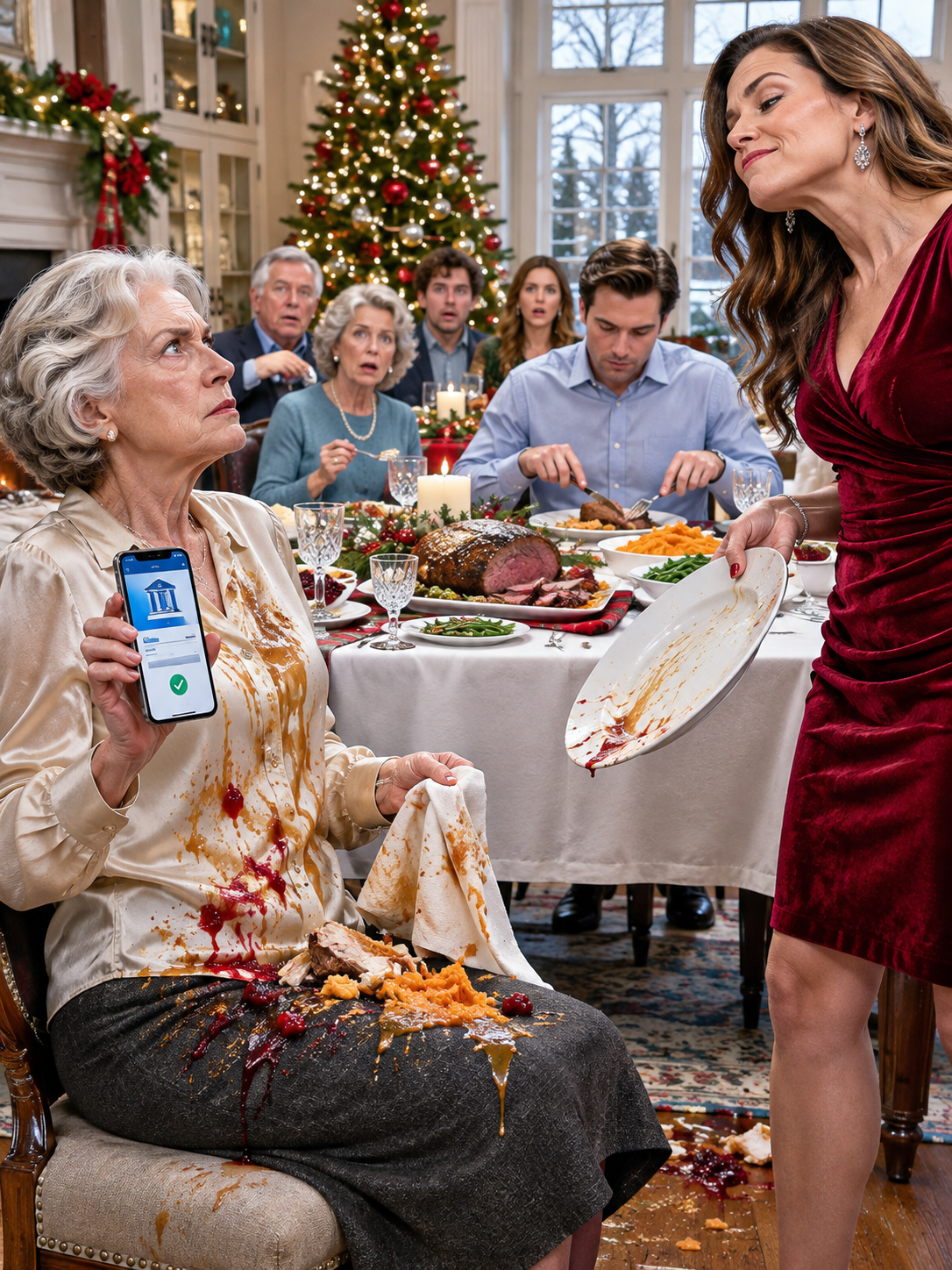
## Part 2: My son’s financial panic revealed what my love had funded.
My daughter Jennifer answered before the second ring finished. She lived forty minutes away, near Columbus’s Short North neighborhood, and had refused to attend family holidays for two years because she couldn’t tolerate watching Alyssa belittle me. I had repeatedly accused her of exaggerating. Now, driving toward her apartment beneath the blinking Christmas lights, I knew exactly how wrong I’d been.
“Mom, what’s happened?” she asked.
“Alyssa emptied her dinner into my lap, and your brother kept eating. I’ve stopped paying their bills, sweetheart. Could I stay with you?”
There was a long silence before Jennifer answered. “The guest room is ready whenever you are. I’ll make tea.”
An hour later, I sat in her warm kitchen holding a mug of chamomile when my phone vibrated against the counter. Blake had sent a message asking why Alyssa’s credit card had been declined during an online shopping attempt. Another followed minutes later, demanding to know where the household money had gone.
Jennifer read the messages over my shoulder. “Not one question about whether you’re okay.”
Before I could answer, Alyssa called.
I let it ring.
Her voicemail arrived almost immediately. “Barbara, you canceled the Tahoe payment? Are you serious? We can’t afford that truck without your help!”
I placed the phone facedown.
Jennifer looked at me, expecting the familiar expression of guilt that usually sent me rushing to fix Blake’s problems. Instead, I asked whether she had an extra blanket for the guest bed.
That night, I slept without waking once.
At nine the following morning, I discovered twenty-two missed calls and a flood of increasingly desperate messages. I ignored them and contacted the wireless provider to separate Blake and Alyssa’s phone lines from my family account. I also began arranging for the household utilities to be transferred properly rather than continuing indefinitely under my name.
By noon, I had changed the Wi-Fi password and signed my streaming accounts out of their devices.
Jennifer watched me from the doorway as I closed my laptop.
“Are you sure you want to do all this at once?”
“If I leave one door open,” I answered, “they’ll spend the next three years walking through it.”
Shortly after two, someone pounded on her apartment door.
Blake stood outside wearing an unzipped winter coat, his face flushed from the cold. Jennifer tried to block his entrance, but I stepped forward and asked her to let him speak. He barely acknowledged his sister before turning toward me.
“Mom, this has gone far enough. Our phones stopped working, the internet’s down, and the lender says we’re behind on the Tahoe. You need to put everything back.”
I folded my hands.
“No, Blake.”
He blinked as if he hadn’t understood.
“We cannot afford those bills,” he said, raising his voice. “You know my studio hasn’t taken off. Alyssa barely makes enough to cover groceries.”
“Then you can return to steady employment, and Alyssa can request additional shifts.”
His expression tightened. “So you’re punishing us because of one accident?”
I held his gaze. “You didn’t even ask whether that hot food burned me.”
For a moment, he seemed ready to argue. Instead, his eyes dropped to the floor.
“I’m your son,” he whispered.
“Yes,” I replied. “And I love you. But I can love you without financing your life.”
He left without saying goodbye.
Two days later, Jennifer introduced me to her friend Wendy, a real estate agent with a firm handshake and a remarkably straightforward manner. We met at a downtown coffee shop, where I showed her the deed and explained that Leonard’s life insurance had paid off the mortgage. The property belonged solely to me.
Wendy studied the photographs of my four-bedroom colonial. “Are you certain you want to sell?”
I pictured Alyssa standing above me with that empty plate.
“Completely.”
We discussed the required notice and proper procedures for ending Blake and Alyssa’s occupancy. Once the arrangements were prepared, I signed the listing agreement.
That afternoon, I sent one message to my son and daughter-in-law explaining that the house would be listed Monday, the photographer would arrive at ten, and they had thirty days to move out under the notice being provided.
Alyssa called almost immediately from a borrowed telephone.
“You can’t do this!” she shouted. “We don’t even have enough saved for an apartment deposit!”
“Then you’ll need to make a plan.”
“We’re family, Barbara! Families don’t throw each other away!”
I stared at Jennifer’s small Christmas tree, decorated with handmade ornaments from her childhood.
“Families don’t deliberately humiliate one another at dinner, either.”
Alyssa began shouting again, but I ended the call.
The following morning, Gloria telephoned.
“Barbara,” she said, her voice trembling, “I’ve been thinking about Christmas. I should have said something. I’m ashamed I sat there.”
I told her I appreciated her honesty.
Then she revealed something unexpected.
After I left, Alyssa’s own mother had confronted her in the driveway, demanding to know why she had intentionally embarrassed me in front of everyone. According to Gloria, Alyssa hadn’t denied doing it.
I sat quietly after that call, staring at Leonard’s wedding photograph on Jennifer’s bookshelf.
For three years, I had wondered whether I was imagining the cruelty.
Now I knew that other people had seen it, too.
And the one person who should have defended me had chosen not to.
## Part 3: Selling my home forced my son to confront his silence.
The house sold in less than three weeks.
Wendy called on a bright January morning with an offer slightly above our asking price. The buyers were a young married couple expecting their first child, and they had fallen in love with the wide staircase, the old fireplace, and the backyard Leonard had planted with flowering trees. They wanted to close on February first.
For a moment, I couldn’t speak.
I had imagined growing old in that house. Leonard and I had painted its bedrooms, celebrated birthdays beneath its roof, and watched our children run down those stairs on Christmas morning. But the memories belonged to us, not to the building, and keeping the building had nearly cost me my dignity.
“I’ll accept,” I told Wendy.
Jennifer squeezed my shoulder.
When the thirty-day notice period ended in late January, I returned with Jennifer and two movers to collect my remaining belongings. The sky hung low and gray over the neighborhood, and patches of old snow covered the lawn. I slowed my car when I saw the white Chevrolet Tahoe parked in the driveway.
Behind it stood a tow truck.
A man wearing a reflective vest was checking paperwork beside the vehicle.
I had spent the previous week speaking with the lender about the loan I had foolishly co-signed. With Blake and Alyssa unable to maintain payments, the account had become a serious financial liability. After discussing the options, the lender had arranged to recover the vehicle, though I understood that surrendering it would not automatically erase my obligations.
Alyssa appeared on the front lawn in slippers, her hair twisted into a loose clip. She looked nothing like the polished woman who had presided over my Christmas table.
“You called them!” she shouted, pointing toward the truck.
“Yes.”
“That vehicle is mine!”
I stepped out of my car. “The loan has my name on it, Alyssa. I’ve paid fourteen months of installments, and neither of you can afford the rest.”
Her face reddened.
“We found an apartment,” she announced bitterly. “One bedroom. Barely enough room for our furniture. Do you have any idea how embarrassing that is?”
I looked past her at the home I had paid for, cleaned, and slowly surrendered one room at a time.
“Yes,” I said. “I know something about embarrassment.”
Blake came down the porch steps carrying a cardboard box.
I almost didn’t recognize him.
He had lost weight, his cheeks were thinner, and the sleeves of his work jacket carried the embroidered name of a warehouse company. His hands looked rough, with small red marks across his knuckles from lifting and stacking cartons.
He set the box down and approached cautiously.
“Hi, Mom.”
“Hello, Blake.”
He glanced toward Jennifer, then back at me.
“I started working nights,” he said. “At the distribution warehouse off Route 23. It’s not what I wanted, but the pay is regular.”
“That’s good.”
He nodded, then stared at the ground.
“There’s something I need to tell you.”
Alyssa was arguing with the tow truck driver, but Blake no longer seemed interested in rescuing her from the consequences.
He took a breath.
“I knew.”
I felt my stomach tighten.
“About Christmas,” he continued. “I knew she hadn’t dropped that plate by accident.”
For several seconds, the only sound between us was the idling tow truck.
Blake rubbed his palms against his jeans.
“I saw her watching you before she stood up. She was angry because you told her to stop criticizing the dinner you’d spent all day cooking. When she picked up her plate, I knew what she was going to do.”
I looked directly into his eyes.
“Then why didn’t you stop her?”
His mouth trembled.
“Because I didn’t want another fight. Because she gets furious when I disagree with her. And because I figured you’d forgive us, the way you always did.”
The truth struck harder than any insult Alyssa had ever delivered.
My son hadn’t misunderstood what happened.
He had understood perfectly and decided that my humiliation was easier to endure than his wife’s anger.
“I’ve spent a month thinking about that,” he said. “I kept remembering you sitting there while I kept eating. I told myself you were helping us because you wanted to, but I knew we were taking advantage. I just didn’t want the arrangement to end.”
I felt tears gathering, but I refused to look away.
“I’m sorry, Mom,” he whispered. “I’m not asking you for money. I know I don’t deserve to ask for anything.”
Behind him, the tow truck winch began pulling the Tahoe onto its platform.
Alyssa turned at the sound of her husband’s apology.
“Blake!” she snapped. “Stop humiliating yourself in front of your mother!”
He turned toward her.
“No.”
The single word seemed to surprise everyone.
Alyssa stared at him.
“What did you say?”
Blake straightened his shoulders.
“I said no. I should have spoken up on Christmas, and I’m speaking up now.”
She looked from him to me, searching for someone willing to take her side.
Nobody moved.
Then Blake said the words I had waited three years to hear.
“Alyssa, you owe my mother an apology.”
## Part 4: One overdue apology restored the family bonds money had destroyed.
Alyssa stood motionless while the tow truck pulled away from the curb. She had always been able to redirect Blake with a sharp glance or an irritated sigh, but something about his expression told her those familiar tactics would not work this time. Jennifer leaned against my car, watching in silence, while the movers waited near the porch.
“I already said it was an accident,” Alyssa muttered.
Blake shook his head.
“You told me afterward that you wanted Mom to know who was in charge of the house.”
My breath caught.
There it was, the final piece of the truth, spoken aloud in the driveway where Leonard had once taught Blake to ride a bicycle.
Alyssa’s cheeks flushed.
“That was said in anger.”
“Then apologize for what you actually did,” Blake replied.
She turned toward me, and for one brief instant I recognized the same defiant expression I’d seen across the Christmas table. Then she looked at the empty driveway where her Tahoe had been and seemed to understand that the familiar arrangement was over.
“I’m sorry I dumped my dinner on you,” she said quietly.
I waited.
“I’m sorry I did it on purpose.”
“Thank you, Alyssa.”
Her shoulders relaxed slightly, perhaps because she expected forgiveness to restore everything she had lost.
I continued before she could speak.
“I accept your apology. But the house is sold, the accounts are separate, and I will not be paying your bills again.”
Her eyes filled with angry tears.
“So that’s it?”
“That’s it.”
The movers began carrying my furniture outside, while Blake and Alyssa returned to loading their rented van. A light winter rain started falling as I walked toward the garage to check for anything they might have overlooked.
Beside a stack of old paint cans, I noticed a familiar canvas donation bag.
I pulled it open.
Inside lay my mother’s cast-iron skillet, darkened by decades of cooking and wrapped in a faded dish towel. Alyssa had declared it worthless two years earlier, and I had assumed it was gone forever. I lifted it carefully, feeling the smooth wooden handle my mother had held while making cornbread every Sunday.
My mother used to say that a family dinner wasn’t about the cost of the food. It was about whether everyone at the table felt welcome.
I stood there holding her skillet and remembered how unwelcome I’d become at my own.
Outside, a cardboard box split open on the wet porch steps.
Several pairs of Alyssa’s designer shoes tumbled onto the pavement, landing in a shallow puddle. She stared helplessly at the ruined packaging before turning toward me.
For a moment, I saw the familiar expectation in her eyes.
She was waiting for me to rush over, find another box, and solve the problem.
Instead, I continued walking toward my car.
Blake followed me, stopping a few feet away.
“Mom?”
I turned.
He looked at the skillet in my arms, then at the boxes being loaded into the van.
“Do you think we’ll ever have dinner together again?”
I thought about the Christmases when he was small, when Leonard carved the roast and Jennifer insisted on lighting every candle herself. I thought about how much of my son’s behavior I had excused because I couldn’t bear the possibility of losing him, too.
“Yes,” I said finally. “But things will be different.”
He nodded.
“Sunday dinners can happen at Jennifer’s apartment or at my new place. You’ll bring something to share, and you’ll pay for it yourself. I won’t lend you money, cover your debts, or rescue you whenever life becomes uncomfortable.”
“I understand.”
“And Alyssa may join us when she’s ready to treat me with respect without needing you to remind her.”
He rubbed his eyes.
“That’s fair, Mom.”
I studied him for a moment.
For the first time in years, he looked less like a man waiting for someone to solve his problems and more like someone beginning to understand how to solve them himself.
Then he said something that surprised me.
“I thought you were selling the house to punish us. But I think you were trying to save yourself.”
I swallowed against the tightness in my throat.
“Yes, sweetheart,” I said. “I was.”
We didn’t embrace. Not yet.
Some relationships need more than one apology before an embrace feels natural again.
I drove away carrying my mother’s skillet in the passenger seat, with Jennifer following behind me. At the end of the street, I unblocked Blake’s telephone number. I wasn’t inviting him to depend on me again, but I was leaving a door open for the man he might become.
The sale closed on February first.
With the proceeds, I bought a bright two-bedroom condominium ten minutes from Jennifer. My new kitchen has white cabinets, wide windows, and a little breakfast table overlooking a balcony where I drink my coffee each morning. Nobody rearranges my belongings, questions my grocery purchases, or tells me when I’m allowed to cook.
Jennifer comes over for Sunday supper.
Some weeks, Blake joins us.
He arrives in his warehouse work boots, carrying bread or vegetables he purchased with his own wages. He asks whether I need help setting the table, listens when his sister speaks, and washes the dishes without waiting to be told.
Alyssa hasn’t joined us.
I don’t ask why.
I have learned that forgiveness and reconciliation are not the same thing, and neither requires me to surrender my peace.
One Sunday evening, Blake arrived with a grocery bag and an envelope. He placed the envelope beside my plate and explained that it contained the first payment toward money he believed he owed me. I hadn’t requested it, and the amount was modest.
“There’s more I need to make right,” he said. “I can’t do everything at once.”
I looked at the envelope, then at my son.
For years, I had given him money because I was afraid that saying no would make him stop loving me.
Now, for the first time, he was offering something without expecting anything in return.
That was the Christmas gift I had wanted all along.
Later that evening, after Jennifer and Blake had gone home, I washed my mother’s skillet and dried it carefully with a clean towel. I set it on the stove, turned off the kitchen light, and stepped onto my balcony.
The evening air was cool and peaceful.
I thought of Leonard, of our old house, and of the woman I had become during the lonely years after his death. I had confused being needed with being loved, and protecting my grown son with protecting our family.
But Blake hadn’t become stronger because I kept paying his bills. He had begun changing only when I finally allowed him to face his own choices.
And I hadn’t lost my family by standing up for myself.
I had given us a chance to build something healthier.
At sixty-eight years old, I no longer need a crowded house to feel less alone. I have my daughter, a son learning to take responsibility, and a home where every room belongs to me.
Sometimes I still remember that Christmas dinner, the hot gravy soaking through my skirt, Alyssa’s satisfied smile, and the sound of Blake’s knife scraping against his plate.
But those memories no longer make me feel helpless.
Because the night my daughter-in-law emptied her plate into my lap, she expected me to clean up the mess, apologize for upsetting everyone, and continue paying for her comfortable life.
Instead, I stood up.
And that one decision gave me back everything I had slowly forgotten I was allowed to have.
My dignity.
My independence.
And the simple, extraordinary peace of belonging to myself.
THE END.
All characters and events in this story are fictional, created for storytelling and entertainment purposes. Thank you sincerely for reading. Your feedback and support are invaluable and motivate me to continue sharing more stories with you.


