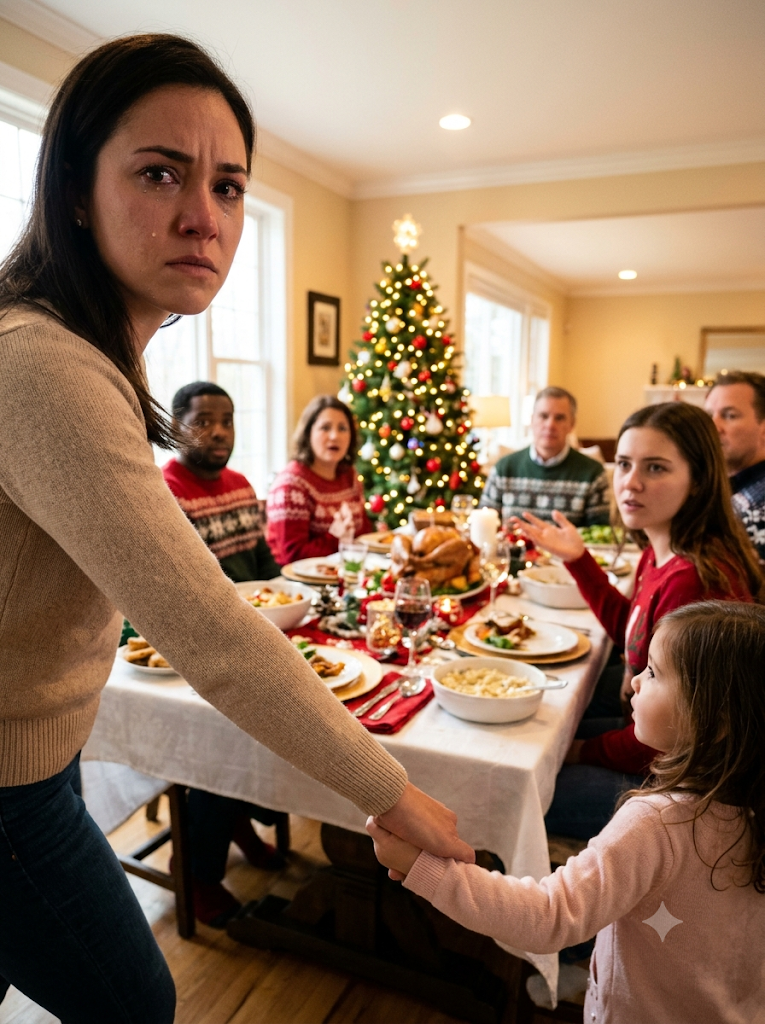
Chapter 2
Mom sat near the foot of my bed while Dad remained standing.
“Ryan is devastated,” he began.
I stared at him.
“He pushed me down the stairs.”
Dad exhaled.
“Things got heated. You both said things you shouldn’t have.”
“He pushed me.”
“He lost his temper. It was one terrible mistake.”
Mom reached for my ankle through the blanket.
“Claire, your brother could lose everything.”
I looked at her hand.
“What exactly did you tell the police?”
Neither answered immediately.
Finally, Dad said, “We told them you fell during an argument.”
My chest tightened.
“You told them I fell?”
“You were both upset. Nobody saw everything clearly.”
“I saw him.”
Mom’s eyes filled with tears.
“Your father was trying to keep things from getting worse.”
I looked directly at her.
“Did you see what happened?”
She lowered her eyes.
Dad stepped closer.
“You were provoking him. You know how much pressure he’s under. Destroying his life won’t undo what happened to you.”
For a moment, I couldn’t believe what I was hearing.
My wrist was broken. My ribs hurt every time I breathed. I had spent days unconscious, and my own father was explaining why the person who pushed me deserved protection.
Then he said something that made the situation even clearer.
“When the detective comes back, tell him you’re not sure what happened. With the head injury, nobody will blame you for being confused.”
I looked at my mother.
She said nothing.
“Dad,” I whispered, “I remember exactly what Ryan did.”
His expression changed.
“Claire, don’t make a decision you’ll regret.”
“I already made one.”
“What?”
“I’m telling the truth.”
The detective returned the following morning.
His name was Morales. He pulled a chair beside my bed, introduced himself again, and told me there was no rush.
So I took my time.
I explained the business contract, Ryan’s request for $200,000, my father’s suggestion that I borrow against the company, and the argument near the staircase.
I described Ryan moving toward me.
Then I described the shove.
Detective Morales listened without interrupting.
When I finished, he asked three questions.
“Did you lose your footing before he touched you?”
“No.”
“Did he attempt to catch you?”
“No.”
“Did he push you?”
“Yes.”
He wrote down my answer.
It was such a small movement, his pen touching a page. But something inside me shifted.
My family had spent years changing the meaning of things.
Ryan wasn’t irresponsible. He was overwhelmed.
Dad wasn’t controlling. He was protective.
Mom wasn’t taking sides. She was keeping the peace.
But on that page, a push was a push.
After the detective left, Naomi returned.
“Your parents called the office again,” she said.
I turned toward her.
“What did they want?”
She hesitated.
“That’s not the worst thing. Ryan contacted Meridian while you were unconscious.”
I thought I had misunderstood.
“Why would he call Meridian?”
“He didn’t call you. He contacted their contract administration department, then procurement, and finally someone in executive relations.”
My skin went cold.
“What did he say?”
Naomi opened her phone and read from the notes she had made after speaking with Meridian’s legal department.
Ryan had identified himself as my brother. He explained that I was incapacitated and asked whether a family member could discuss the contract on my behalf.
He wanted to know whether any signing payment had been released.
He asked whether the agreement could be accelerated.
He also asked what authority someone would need to act for me if my condition lasted longer than expected.
I stared at Naomi.
“He asked about the money?”
“Yes.”
“While I was unconscious?”
She nodded.
Meridian had refused to discuss any confidential information and documented every contact.
I closed my eyes.
My brother had shoved me because I wouldn’t turn my company into his personal rescue fund.
Then, while I couldn’t even open my eyes, he had tried to find another way to get access to that money.
I couldn’t decide which part hurt more.
Two days later, my attorney, Daniel Reeves, met me at the hospital.
He was calm, practical, and careful about what he promised.
“No case is won by outrage,” he told me. “We deal with what can be documented.”
For once, that was exactly what I needed to hear.
Daniel helped me request a no-contact order and coordinated with Detective Morales.
He also instructed CareGrid’s legal team to preserve every communication involving Ryan, my parents, and Meridian.
The reaction from my family was immediate.
My aunt called Naomi because I had stopped answering relatives. My cousin sent me a message saying Ryan had made one mistake and I was turning it into a public execution.
Mom left three voicemails.
Dad left seven.
In the final message, he said, “You are not the only person who got hurt here.”
I listened twice.
Then I sent the recording to Daniel so it could be preserved.
Two days after I returned to my apartment, Mom appeared without warning.
Naomi was helping me organize medication and meals. When Mom realized I wasn’t alone, she asked whether we could have five minutes as a family.
“Naomi stays,” I said.
Mom flinched.
She sat across from me and folded her hands.
“Your father thinks the lawyers are making everything worse.”
“Ryan made everything worse.”
“I know you’re angry.”
“I was unconscious for days, Mom.”
Her eyes dropped.
“We thought you were stable.”
“That isn’t the same as staying.”
She began to cry.
She explained that Dad had been terrified, Ryan had panicked, and nobody had known what would happen.
I listened.
Then I said something I had never dared say to her before.
“Somehow, the person in the hospital became the least important person in the emergency.”
Mom looked offended.
“That’s not fair.”
“It’s exactly what happened.”
She left without asking me to change my statement.
An hour later, Dad texted me that I had humiliated her.
The following morning, my aunt Laura called.
“I’m not taking sides,” she began.
I almost laughed.
She told me Ryan had always looked up to me. My success had made him feel small, and a criminal conviction could destroy his future.
I asked one question.
“What do you think falling down a staircase did to me?”
Silence.
Then she said, “You survived.”
I closed my eyes.
There it was again.
Survival being treated as proof that the damage didn’t matter.
I ended the call.
After that, I stopped defending myself to relatives.
For the first time, I understood that silence could mean two very different things.
The silence my parents wanted would have protected Ryan.
The silence I chose would protect me.
Chapter 3
Recovery was not nearly as inspiring as people imagine.
My wrist remained in a brace. My ribs hurt when I laughed or coughed, and the headaches came in unpredictable waves.
Some afternoons, I could work for forty minutes before exhaustion forced me to lie down for two hours.
The stairs were the worst.
My physical therapist had a short practice staircase with three shallow steps and metal rails on both sides.
The first time she asked me to climb them, my hands started shaking.
I hated that reaction.
I had built a company from nothing. I had negotiated with hospital executives, managed payroll during difficult months, and convinced investors to take a chance on an idea nobody understood.
Yet three ordinary steps made my body forget all of that.
My therapist didn’t tell me to be brave.
She simply said, “Put your hand on the rail.”
So I did.
One step.
Then another.
Then I stopped.
That was all I could manage that afternoon.
At home, I sat at my kitchen table with my laptop open and nothing written on the screen.
Naomi arrived carrying groceries.
“You know recovery isn’t a performance review, right?”
I gave her a look.
She put the bag down.
“That look is exactly why I said it.”
I started laughing and immediately grabbed my ribs.
“Don’t make me laugh.”
“Then stop being ridiculous.”
Naomi had a way of making me feel normal without pretending everything was fine.
CareGrid was surviving better than I expected. She had taken over daily operations, our employees were working together, and Meridian had agreed to adjust the implementation schedule while I recovered.
A week later, I joined my first project call from the couch.
Afterward, I apologized for missing so much work.
Naomi stared at me through the screen.
“Claire, nobody here is measuring your value by how quickly you recover.”
I didn’t know what to say.
At home, usefulness had always been my safest role. If I performed well, caused little trouble, and recovered quickly, everyone could continue calling me strong.
But CareGrid didn’t need that version of me.
Naomi needed me to make decisions when I could and admit when I couldn’t.
So I started saying, “I’m done for today,” before my body forced me to stop.
At first, it felt like failure.
Eventually, it began to feel like good judgment.
Meanwhile, Meridian’s legal department produced the records Daniel had requested.
Ryan’s communications were worse than Naomi’s initial summary.
He had asked whether the contract included any personal guarantee.
He had asked whether future revenue could be assigned.
He had also asked whether the family of an incapacitated company founder could participate in business decisions.
Daniel placed the printed records on his desk.
“This doesn’t prove the assault by itself,” he explained. “But it helps establish what he was focused on afterward.”
I looked at Ryan’s name at the top of the contact log.
For years, my parents had told me I misunderstood my brother because I was too judgmental.
Now strangers had carefully recorded his own questions.
The first hearing connected to my request for a no-contact order was scheduled several weeks later.
By then, I could walk normally on flat ground. My wrist was healing, and the headaches were becoming less frequent.
I still hated stairs.
On the morning of the hearing, Naomi accompanied me to the courthouse.
Daniel was waiting outside the courtroom with another man.
I recognized him immediately.
Elliot Mercer, the chief executive of Meridian Health Network.
I had met Elliot four times during the contract negotiations. He was formal, precise, and almost aggressively uninterested in small talk.
I stopped walking.
“What are you doing here?”
He glanced at Daniel.
“Meridian received a subpoena concerning communications made after your hospitalization. Our counsel asked me to authenticate certain business records if necessary.”
That sounded exactly like Elliot.
No dramatic promises. No unnecessary speeches.
Just business.
I nodded.
“Thank you.”
He gave me a small nod in return.
“Your team is performing well.”
For some reason, those words nearly brought me to tears.
My company was still being judged by its work.
We entered the courthouse together.
And then I saw my family.
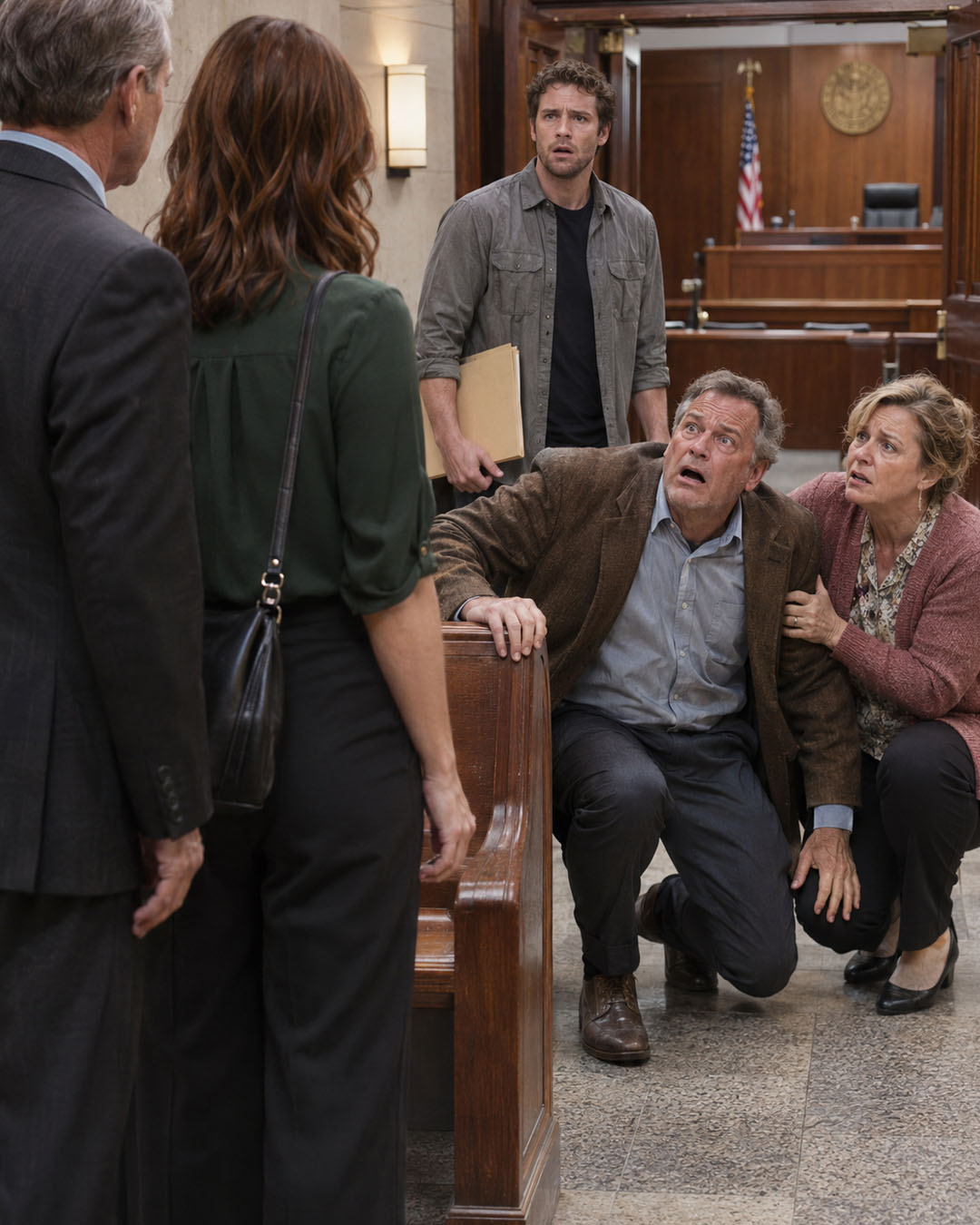
Dad stood near the benches with Mom. Ryan was beside them, wearing a dark suit. My aunt Laura and two cousins had also come.
Dad looked at my wrist brace.
His mouth tightened.
Then he noticed Daniel, Naomi, and the man standing beside me.
“This is what she wanted,” he said loudly enough for everyone to hear. “An audience.”
I kept walking.
Then his eyes moved past me.
They landed on Elliot Mercer.
Everything changed.
Dad’s shoulders dropped. His face lost its color. He reached backward for the wooden bench.
Mom followed his stare.
“Richard?”
Dad’s lips parted.
“Oh, my God.”
His knees buckled.
Mom grabbed his sleeve and went down beside him.
Ryan looked from his father to Elliot, suddenly frightened.
For several seconds, nobody moved.
Elliot remained standing, his expression controlled.
“Richard Bennett,” he said.
My father stared at him.
I looked between them.
“You know each other?”
Dad answered too quickly.
“No.”
Elliot turned his eyes toward me.
“Yes.”
And I realized that the family secret I had spent my life trying to understand might be much older than the staircase.
Chapter 4
The hearing itself was nothing like the dramatic courtroom scenes people imagine.
Daniel had made it clear that we were there for a specific legal purpose. The judge wanted to determine whether I had reasonable grounds to fear further contact from Ryan and whether his behavior after the assault supported continuing restrictions.
Ryan’s attorney argued that Ryan had only been trying to help the family understand my business affairs while I was hospitalized.
Daniel asked why that help had required questions about assigning company revenue and accessing contractual payments.
Ryan had no convincing answer.
The Meridian records were entered into the proceedings, and the judge kept the temporary no-contact restrictions in place.
That should have been enough for one morning.
But outside the courtroom, Mom caught up with me.
“What did Elliot mean?”
Dad was standing a few feet behind her.
“Diane, not here,” he muttered.
She turned toward him.
“I asked Claire.”
I looked at both of them.
“I don’t know. I was about to ask you the same thing.”
Elliot had remained near the courtroom speaking with Meridian’s attorney.
Later that afternoon, he agreed to meet with Daniel and me.
He didn’t offer rumors or personal opinions.
He offered history.
Fourteen years earlier, my father had worked in procurement at Meridian Health Network.
He had been responsible for evaluating vendors and reviewing purchasing decisions.
An internal investigation had eventually discovered that he had altered vendor evaluation documents to favor a company owned by someone he knew.
The changes had made the vendor appear more qualified than it was.
Elliot had been one of the executives responsible for reviewing the investigation.
He had approved my father’s termination.
I sat completely still.
“My father told us his department was restructured.”
Elliot nodded.
“I can’t speak to what he told his family. I can tell you why Meridian ended his employment.”
Daniel asked whether the records could be authenticated.
Elliot confirmed that they could.
Then he explained that the company had retained the relevant employment documentation.
I thought about every lecture Dad had ever given me about responsibility.
Every time he had told me Ryan needed compassion while I needed discipline.
Every time he had insisted that his interpretation of a situation was the only reasonable one.
I had spent years believing he was the person in our family who understood right and wrong.
Now I was learning that he had once rewritten his own professional failures rather than face them.
When I told Mom what Elliot had explained, she didn’t believe me.
“Your father lost his position because of a restructuring,” she insisted.
Daniel showed her the employment records Meridian was legally permitted to provide.
She read them once.
Then she read them again.
Finally, she sat down.
“He told me they eliminated his position.”
“I know.”
“For fourteen years?”
I nodded.
Mom covered her mouth.
I watched her struggle with the realization that the man whose judgment she had trusted for so long had hidden the truth about his own past.
The same man who had been asking me to accept a different version of Ryan’s violence.
Then something happened that I hadn’t expected.
Mom looked at me.
“I saw him.”
I stopped breathing.
“What?”
“Ryan. I saw him push you.”
My hands became cold.
Mom began crying.
“I was standing near the dining room. I saw him put both hands on you. I saw you go backward.”
For several seconds, I couldn’t speak.
“Then why did you tell the police I fell?”
She looked down.
“Because I was scared for Ryan.”
The answer hurt more because she didn’t try to disguise it.
She explained that Dad had insisted Ryan’s life would be over if the police treated the incident as an assault.
She imagined prison, financial ruin, shame, and the destruction of her family.
So she had chosen to protect her son.
Even if it meant allowing her daughter to carry the blame.
She had decided I could survive one more thing.
“Claire, please,” she whispered. “I need you to understand.”
“Telling the truth now doesn’t erase what you did then.”
“I know.”
“No, Mom. I don’t think you do.”
She looked at me for a long moment.
Then she nodded.
“You’re right.”
It was the first time anyone in my family had said those words without adding an excuse.
Three days later, Diane Bennett returned to the investigators.
She corrected her earlier statement.
She admitted that she had witnessed Ryan intentionally shove me.
Dad called her betrayal unforgivable.
Mom moved into her sister’s guest room that weekend.
The criminal case continued.
There were no sudden confessions, no dramatic courtroom speeches, and no single moment when everything was resolved.
There was evidence.
My statement remained consistent. Mom’s corrected account supported it. The medical findings were consistent with the fall.
Ryan’s financial difficulties were documented, and his calls to Meridian showed what he had been trying to accomplish while I was unconscious.
The family’s earlier explanations no longer matched one another.
Ryan eventually accepted a plea agreement involving a serious assault charge.
There would be custodial time and restitution.
The no-contact restrictions remained in place.
His renovation business collapsed under the weight of debts, missed work, and consequences that had been building long before the day he pushed me.
When Daniel called with the final disposition, I was sitting alone in my office.
I expected to feel satisfied.
Instead, I felt grief.
Ryan was still my little brother.
I remembered teaching him to ride a bicycle in our driveway. I remembered splitting Halloween candy with him and defending him in middle school when older boys made fun of him for struggling in class.
Those memories were real.
So was the staircase.
For the first time, I understood something that had taken me far too long to learn.
A person doesn’t have to be cruel in every memory to become unsafe in your life.
And loving someone doesn’t require you to deny what they have done.
Chapter 5
Several months passed before Mom asked to meet me.
I agreed, but I chose a coffee shop between our neighborhoods.
Not her house.
Not mine.
Neutral ground.
She looked older than I remembered. Her hair had more gray, and she kept turning her coffee cup between her hands.
“I’m not asking you to forgive me,” she said.
“Good.”
A sad smile crossed her face.
“I deserved that.”
She told me she was still living separately from Dad. He continued to insist that she had destroyed the family by changing her statement.
Ryan barely spoke to her.
She said she understood if I wanted nothing more to do with her.
I looked at the woman who had held my hand when I was sick as a child and had abandoned my side when I needed her most as an adult.
“I don’t know what our relationship becomes,” I said.
She nodded.
“But if there is one, it cannot be built around pretending.”
“I understand.”
“I need distance.”
“I understand that, too.”
This time, I believed she might.
Dad never reached that point.
His messages alternated between anger and wounded disbelief.
Sometimes he accused me of destroying the family. Other times he wrote about how much he missed the daughter he used to know.
He never admitted that protecting Ryan had meant sacrificing me.
He never apologized for asking me to question my own memory.
And he never explained directly why he had lied about his employment history at Meridian.
Eventually, I blocked his number.
It wasn’t an act of revenge.
It was simply the boundary I needed.
At CareGrid, life slowly returned to something resembling normal.
The Meridian contract remained intact. Naomi continued managing operations while I recovered, and our employees handled the challenges of implementation with patience and professionalism.
Seven months after the fall, our first major Meridian deployment went live.
I attended in person.
Naomi stood beside a conference room screen while hospital staff reviewed the first inventory forecasts generated by our software.
There were problems, naturally.
One data feed needed correction. A department had mapped several supplies incorrectly. Our support team stayed late to resolve the issues.
It wasn’t perfect.
But it worked.
And that mattered more to me than I could explain.
We had built something real, something that could continue functioning even when the people behind it were struggling.
At the end of the day, Naomi packed her laptop and looked at me.
“Ready to head down?”
I glanced toward the elevators.
Then I noticed the stairwell door about twenty feet away.
My ribs had healed. My wrist was strong again. The headaches had become rare.
But the fear hadn’t disappeared completely.
I could still remember the feeling of losing my balance. Sometimes, even the sound of footsteps behind me made my shoulders tighten.
Naomi followed my gaze.
“You want the elevator?”
I considered it.
Then I shook my head.
“I’ll take the stairs.”
She looked at me for a moment.
“Okay. See you downstairs.”
She didn’t congratulate me. She didn’t turn the moment into a speech about courage.
She simply walked toward the elevator.
I pushed open the stairwell door.
The air smelled faintly of concrete and disinfectant.
My hand found the railing.
For half a second, I was back in my parents’ house.
Ryan was standing in front of me. My father was somewhere behind us. My mother’s voice echoed from the dining room.
And there was empty space behind my back.
I took a breath.
Then I looked down.
One step.
Then another.
I moved slowly, giving myself permission to stop if I needed to.
Halfway down, I realized my fingers were no longer gripping the railing.
I reached the next floor, opened the door, and heard my team laughing somewhere ahead of me.
I kept walking.
Later that evening, I sat alone in my apartment and thought about the family I had once believed I needed to keep together.
For most of my life, I had confused love with responsibility.
If Ryan made a mistake, I was supposed to help him.
If Dad became angry, I was supposed to calm him down.
If Mom was unhappy, I was supposed to make things easier.
And if I was hurt, I was expected to recover quickly enough that nobody else had to feel uncomfortable.
I had been praised for being independent, dependable, and strong.
But sometimes those compliments were simply another way of telling me not to ask for anything.
I used to believe that being the strong child meant I needed less protection.
Now I understood how wrong that was.
I could remember the good things about my family without pretending the bad things never happened.
I could love my mother without giving her immediate access to my life.
I could remember the little boy Ryan had once been without allowing the man he became to hurt me again.
And I could stop waiting for my father to admit what he had done.
Some apologies never come.
Some people would rather protect their version of the past than face the truth.
That was no longer something I could control.
What I could control was what happened next.
I returned to work. I rebuilt my health. I kept the people who respected my boundaries close, and I stopped treating other people’s disappointment as an emergency I was responsible for fixing.
The most important thing I recovered wasn’t my business, my money, or even my ability to walk down a staircase without fear.
It was the belief that my life mattered just as much as everyone else’s.
For years, I thought strength meant being the person who could absorb whatever everyone else needed to give away.
Their disappointment.
Their debt.
Their anger.
Their consequences.
I know better now.
Strength was never about how much damage I could carry for the people I loved.
It was finally deciding that what happened to me counted, even when the people who hurt me wished it didn’t.
THE END.
⚠️ All characters and events are fictional. Do not imitate or apply them in real life. 😌😌😌