My house key stopped halfway inside the lock. I twisted it again, harder, until a sharp pain pulled across the surgical scar beneath my shirt. A black electronic keypad blinked red above my hand. Thirty-one days earlier, I’d trusted my son with the keys to my life. Now I couldn’t even open my own front door.
Part 1: Thirty-One Days In A Hospital Revealed My Son’s Cruel Betrayal
The last time I saw my son, Blake, he was standing beside my hospital bed, promising to take care of everything. He squeezed my shoulder, smiled that confident smile I’d admired since he was a boy, and said, “Don’t worry about the house or the company, Dad. Just concentrate on getting better.” That was September 9, the morning I underwent triple bypass surgery at Halton Lakeshore Hospital. I didn’t see him again during the thirty-one days I spent recovering.
On the Friday before Canadian Thanksgiving, I sat on the edge of my hospital bed, gripping my cane while a young nurse named Justin Coleman checked my discharge papers. “Your son’s picking you up, right?” he asked, though we both knew the answer. “He’s away on business,” I said, repeating the excuse Blake had texted me weeks earlier. Justin looked toward the empty visitor’s chair, then quietly placed my coat across my shoulders.
Justin was twenty-nine, with tired brown eyes and the gentle patience of someone who understood loneliness. During my recovery, he’d brought me tea, read hockey scores aloud, and stayed beside me through several frightening nights when my heartbeat wouldn’t settle. Once, he’d confessed that he’d grown up moving between foster homes, learning early how much an empty doorway could hurt. As he wheeled me toward the elevator, he pressed a piece of paper into my hand. “My personal number, Donald. Call me if you need anything.”
I almost laughed at the kindness of a stranger until the hospital pharmacy refused my debit card. The pharmacist tried it twice, then shook her head apologetically, and my credit card failed just as quickly. Sitting on a bench near the entrance, I called my bank while Justin stood beside me, watching the wind scatter yellow leaves across the pavement. When my branch manager, Shannon Singh, finally returned to the telephone, her voice sounded frighteningly careful.
“Mr. Bryant, your checking and savings accounts have a combined balance of fourteen dollars and sixty cents.”
I gripped the telephone so tightly my fingers cramped. “That’s impossible, Shannon. There should be more than four hundred thousand dollars.” She explained that three transfers totaling $412,000 had been authorized through a continuing power of attorney for property. My son, Blake Bryant, was the appointed agent.
I remembered the August evening Blake had brought those papers to my kitchen table, explaining that someone needed authority to handle emergencies while I underwent surgery. He’d pushed a pen toward me, pointing to four places where my signature was required. I’d signed without reading because he was my only child, and because my late wife, Barbara, had always taught me that family should trust one another. Now Justin was kneeling in front of me, asking me to breathe slowly while my world tilted sideways.
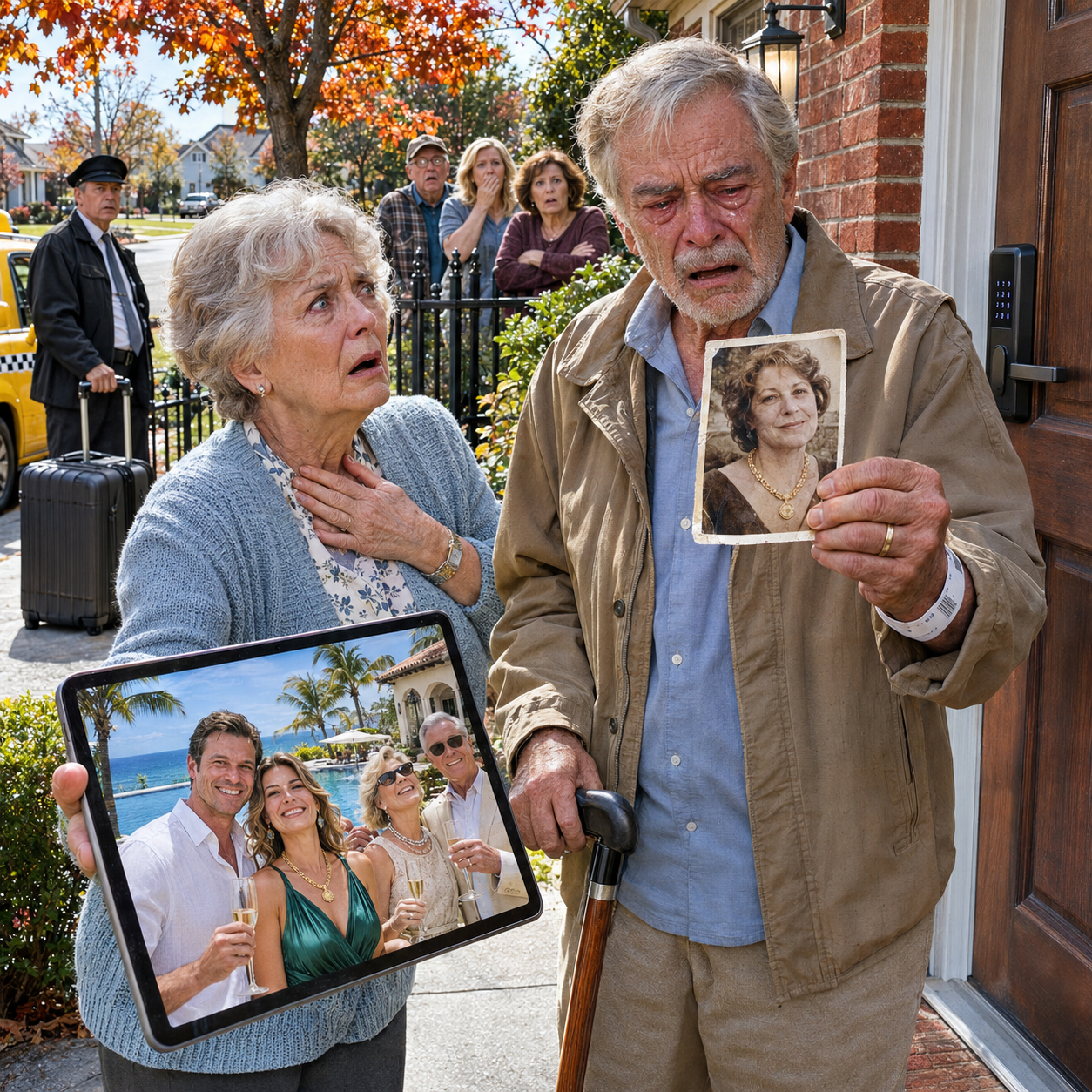
A taxi carried me to our redbrick house on Old Mill Road. Barbara’s climbing roses still covered the porch, and for one foolish second, I believed everything might somehow be all right. Then I discovered the new electronic lock, the disabled gate code, and the unmistakable evidence that someone had deliberately locked me out. I was still struggling with the door when my seventy-four-year-old neighbor, Nancy Tucker, hurried across her lawn.
“Donald? They told us you weren’t coming home!”
Nancy guided me to her porch and explained that Blake had hired a locksmith shortly after my hospitalization. His wife, Haley, had told the neighbors I’d developed advanced dementia and had been transferred permanently to Willow Creek Lodge, a long-term care facility. When Nancy questioned the story, Haley claimed I no longer recognized my family. “I even baked you a lemon loaf,” Nancy whispered, wiping her eyes. “She told me you wouldn’t know the difference.”
My knees weakened beneath me. The house belonged exclusively to me, inherited through Barbara’s estate, and nobody had permission to surrender it. Yet my daughter-in-law had convinced an entire neighborhood that I was disappearing mentally while I lay fully conscious in a hospital room. Nancy hesitated, then brought out her tablet. “There’s something else you need to see.”
Haley’s Instagram page showed photographs from a luxurious beachfront villa in Turks and Caicos. Her parents, Ronald and Judy Edwards, were drinking champagne beside an infinity pool, while Blake laughed in a white linen shirt and my five-year-old granddaughter, Piper, played nearby. The caption celebrated a wonderful family vacation. I stared at my son’s smiling face, remembering the nights I’d waited for him to walk through my hospital door.
Then I noticed the necklace around Haley’s throat.
I enlarged the photograph with trembling fingers. The gold clasp bore two tiny intertwined initials, B and D, engraved by hand more than forty years earlier. It was Barbara’s anniversary necklace, the last gift I’d given her before cancer took her from me. I’d locked it inside a concealed safe in my garage, and only three living people knew the combination.
One of them was my son.
Part 2: A Hidden Camera Exposed The Conspiracy Behind My Stolen Home
My attorney, Jerry Myers, arrived that evening with a locksmith and a police officer. Jerry had handled my family’s affairs for twenty-five years, and I’d never seen him look so angry. He presented certified ownership records confirming that the house was mine alone, while Constable Mike Dillon stood by as the locksmith removed the electronic deadbolt. When the door finally swung open, I stepped into a house that no longer smelled like home.
Barbara’s portrait had disappeared from the staircase, and our old hall table had been replaced by expensive furniture I didn’t recognize. Vanilla candles burned where the familiar scent of lemon furniture polish once lingered. I stood in the hallway, staring at the empty space where my wife’s picture had hung for thirty years, until Jerry gently touched my elbow. “Let’s find out what else they’ve done, Donald.”
In the garage, I opened the concealed safe behind my old workshop pegboard. Barbara’s leather jewelry box sat on the middle shelf, but its velvet lining was empty. Then I remembered the small security camera I’d installed beneath a wooden birdhouse after a break-in two winters earlier. I had never told Blake about it, and its recordings were still stored online.
Jerry opened the footage on his tablet.
At 7:52 p.m. on September 11, Blake entered the workshop with Haley beside him. He read the safe combination from his phone, and Haley removed the necklace, fastening it around her neck while admiring herself in a small mirror. “Once Willow Creek has him and the paperwork clears, this house is ours,” she said. Blake smiled and answered, “The old man won’t see Christmas anyway.”
I heard myself make a sound I’d never heard come from another human being. My forehead dropped against the workbench, and Jerry’s hand rested heavily on my shoulder. I’d imagined my son feeling frightened by my surgery, perhaps unable to face the possibility of losing me. Instead, he’d been planning his inheritance while I was struggling to survive.
Justin appeared at my hotel room the following morning, carrying the prescriptions I couldn’t afford to collect. When I showed him the footage, his face tightened, and he sat silently for a long moment before reaching into his jacket. “There’s something I should have told you,” he said, unfolding a photocopied document. “Haley contacted the hospital social worker on September twelfth and asked to have you transferred straight into long-term care.”
At the bottom of the placement consent form was a signature resembling mine, except the letter D carried a distinctive hook I’d never written. Justin explained that the hospital had questioned the request, and Dr. Jackson had formally assessed my decision-making capacity with a patient advocate present. The doctor had found me capable of managing my own affairs, preventing the proposed placement. “They couldn’t legally send you there against your wishes,” Justin said, “but Donald, somebody tried.”
I stared at that forged signature until the ink blurred. It wasn’t enough for Blake and Haley to take my savings and jewelry; they had tried to take my freedom to make decisions. When I finally looked up, Justin was still sitting beside me. “I’m only your nurse,” he whispered, and I caught his hand. “You’re the only person who came when I needed somebody.”
At Jerry’s Toronto office, we signed documents revoking Blake’s financial authority and prepared immediate notices for every institution involved. Jerry also brought in a forensic accountant to examine Carter Group, the distribution company I’d spent four decades building. The first records showed four supplementary corporate credit cards, issued to Blake, Haley, Ronald, and Judy Edwards. The Edwardses alone had charged approximately $1.6 million over fourteen months on luxurious travel, jewelry, restaurants, and shopping.
Their polished lifestyle concealed a mountain of unpaid business debts and failing ventures. Ronald’s marine supply company was facing creditors, and Judy’s boutique had closed months earlier. While they entertained wealthy friends and toasted my generosity, my company had been paying for the illusion. I could scarcely bear to look at the statements, but Jerry turned another page.
Eleven unexplained transfers totaling $3.1 million had gone from Carter Group to a numbered corporation called Ridgeway 2318 Inc. No goods had been delivered, no contracts existed, and the authorization came from an executive account with extraordinary financial privileges. The login belonged to Keith Thompson, my oldest business partner and the man who’d helped carry Barbara’s coffin.
I called Keith with Jerry listening. “I’m home,” I told him, keeping my voice deliberately weak. “Please freeze the outgoing transfers until I can meet with the board.” Keith sounded relieved and affectionate, promising to handle everything personally. Minutes after we disconnected, our forensic consultant uncovered an internal message Keith had sent to Blake.
“The old man’s up and moving. Pull what you can tonight.”
Blake replied that he understood and would transfer the remainder before Monday.
For the first time since leaving the hospital, I stopped wondering whether my family had misunderstood my intentions. The evidence showed people who knew exactly what they were doing. Jerry contacted Detective Sergeant Tracy Lane of the Halton Fraud Unit, preserved the records, and arranged for the suspicious accounts to be monitored. I wanted to confront Blake immediately, but Jerry warned me that an angry telephone call could destroy our chance of recovering the money.
So I remained silent.
My son believed silence meant weakness. He was about to discover what it meant when the person he’d underestimated still owned everything.
Part 3: I Reclaimed My Company And Ended Their Luxury Vacation
On Sunday morning, I met realtor Paula Whitaker outside my home while the climbing roses brushed against my coat. Comparable properties were worth around $3.1 million, but I authorized a faster sale at $2.6 million, accepting that peace would cost me something. By afternoon, a cash buyer had submitted an acceptable offer, and Jerry prepared a closing agreement. I signed with Barbara’s old fountain pen, then instructed movers to inventory and store every possession belonging to Blake and Haley.
I wouldn’t give them a single legitimate reason to accuse me of stealing.
Monday morning, I walked into the Carter Group boardroom with my cane tapping against the polished floor. Twelve executives stared as Keith approached with open arms, pretending to be delighted by my recovery. I allowed him to embrace me, then took my seat beside Jerry and our general counsel, Ruth Callaway. She announced that I remained the sole shareholder and Blake owned no equity in the company.
The room fell silent as I signed the resolution removing Blake as chief executive officer and director. I also authorized an immediate investigation into the unexplained transfers and demanded repayment of the $1.8 million loan I’d personally advanced to Blake’s separate company, Hicks Analytics, under its contractual default provisions. The money that had sustained his business was no longer available for him to squander. Keith watched my pen move across the documents, his face slowly losing its color.
That evening, Justin sat beside me in my hotel suite while Jerry verified the final banking instructions. At nine o’clock, I authorized the permanent closure of the supplementary corporate cards and restrictions on the accounts that had funded the vacation. The confirmation appeared on my screen, and I expected to feel victorious. Instead, I remembered teaching Blake to ride a bicycle, running behind him with one hand on the seat until he learned to balance.
“You’re allowed to miss the boy you raised,” Justin said quietly, “even when you have to stop the man he’s become.”
At two o’clock Thursday morning, my telephone rang.
“Dad, help me.”
Blake’s voice was breathless and strained, nothing like the confident executive I’d heard in countless business meetings. The villa had canceled their reservation, the airline tickets were useless, and the rental agency had taken back the car. Ronald and Judy had disappeared, leaving him without enough money to pay for a hotel. “Please, Dad. Whatever you think happened, there’s an explanation.”
I closed my eyes as he begged me to wire him money. For an instant, I saw a frightened seven-year-old boy calling from school after missing his bus, certain his father would rescue him. That memory hurt more than the surgical scar stretching across my chest. “Take your time and enjoy your vacation, son,” I said, and ended the call.
Within hours, eleven voicemails filled my telephone. Blake’s anger turned to panic when Ronald, Judy, and Haley used their remaining travel points to fly home, leaving him behind with Piper. He described sitting on an airport floor while my granddaughter slept against his jacket, and for the first time I heard genuine fear beneath his excuses. The child was innocent, and I immediately asked Jerry to help arrange safe travel for her without restoring Blake’s access to my accounts.
One voicemail contained a detail that changed the investigation. Blake said he’d repeatedly called Keith for emergency money but couldn’t reach him. He didn’t know that Detective Lane’s team had arrested Keith at his Mississauga home on Tuesday morning and seized his electronic devices. Investigators had located approximately $2.8 million connected to Ridgeway 2318, and court orders were preserving those funds while the larger financial trail was examined.
I listened to Blake’s final message while standing beside my hotel window. “I’m sorry, Dad,” he said, before adding, “but you didn’t have to ruin everything.” There it was again, the belief that his suffering had begun when I stopped paying rather than when he’d started stealing. I deleted none of the recordings, because evidence had become the one thing I could trust.
On Saturday, Blake finally boarded a flight to Toronto with Piper, using tickets arranged through relatives. I went to Pearson Airport with Justin, watching from behind a glass partition as my son emerged wearing a wrinkled shirt and holding his daughter’s little hand. Detective Lane stepped toward him with two uniformed officers. When she announced his arrest for financial fraud and offenses involving the forged documents, Blake’s expression collapsed.
Through the glass, his eyes found mine.
His mouth formed one word.
“Dad.”
For thirty-one days, I’d stared at a hospital doorway, waiting for that same man to appear. Now he was standing only yards away, and I couldn’t move toward him.
Part 4: The Final Courtroom Revelation Changed What Family Meant Forever
A social worker gently took Piper aside before the officers escorted Blake away. My granddaughter looked frightened, but when she spotted me through the glass, she lifted her little hand and waved. I pressed two fingers against the partition, struggling to smile until she turned toward the woman beside her. Only after she disappeared did I allow Justin to guide me to a chair.
Haley was arrested that same morning at her parents’ Burlington home, where officers found her packing a suitcase. Ronald and Judy were already facing creditor proceedings, and their lavish lifestyle was collapsing beneath debts they’d concealed for years. Meanwhile, investigators traced company funds through Keith’s accounts and connected the forged care-home document to the larger scheme to control my property. The necklace was recovered as part of the investigation, its engraved clasp still carrying Barbara’s initials.
Seven weeks later, snow drifted against the courthouse windows in Milton as I took my seat beside Jerry and Justin. Blake had pleaded guilty to fraud, theft, and offenses involving forged documents, while Haley entered guilty pleas for her part in the deception. Keith admitted participating in the diversion and laundering of corporate funds. The prosecution described a coordinated scheme that depended on my illness, my trust, and the expectation that I would never return to manage my own affairs.
When the judge invited me to speak, I stood slowly, leaning on my cane. “For thirty-one days, I lay in a hospital bed waiting for my family,” I said, my voice echoing through the courtroom. “When I came home, they’d changed my locks, taken my savings, stolen my wife’s necklace, and told my neighbors I was losing my mind.” I looked toward Blake, but he stared at the table.
“I haven’t come here to ask for cruelty,” I continued. “I want my wife’s memory protected and my remaining years to belong to me. And I ask that everyone remember there’s a little girl named Piper who didn’t choose any of this.” My hands were trembling when I returned to my seat, but Justin steadied the cane before it slipped.
The court imposed prison sentences of four years for Blake, three and a half for Haley, and six for Keith. Restitution orders accompanied the convictions, and assets linked to the wrongdoing were directed toward repayment, including property associated with Ronald’s debts. Hearing the sentences didn’t make me happy. It merely ended the terrible uncertainty of whether the people who’d betrayed me would ever acknowledge what they’d done.
Before sentencing, Blake had requested a private meeting in a small room with a steel table. He looked older than I’d ever seen him, his hands resting awkwardly in front of him as he pushed a visitation request across the surface. “Once a month, Dad,” he whispered. “That’s all I’m asking. I don’t have anyone else.”
I picked up the pen and held it over the signature line. I remembered Barbara brushing his hair before his first day of school, his little fingers clutching mine at the funeral, and the pride I’d felt when he accepted responsibility for the family company. Then I heard the voice from the workshop recording, casually declaring that I wouldn’t live until Christmas. I placed the pen on the table without signing.
“I’ll always love the boy you were, Blake,” I told him. “But I can’t sit across from the man who tried to take away my freedom and waited for me to die.” His shoulders folded, and he began to cry. I left before he could ask again, because another minute might have broken the resolve I’d spent weeks rebuilding.
The house sale closed, and I moved into a smaller home where I could manage the stairs and garden without assistance. Piper went to live with Haley’s sister in Ancaster, where she had a stable routine and people who cared for her. With her guardian’s agreement, I began visiting every second Sunday, bringing coloring books and sometimes a small pastry from the bakery Barbara had loved. Jerry helped establish an education savings plan protected from the adults who had misused our family’s money.
Justin continued visiting long after my medical recovery ended. When he told me he’d been accepted into a nurse practitioner program, I offered to contribute toward his tuition. He refused until I reminded him how fiercely Barbara had believed in education and how much kindness he’d shown when he had nothing to gain. Eventually he accepted, on the condition that I stop calling it repayment.
One Sunday, I watched Piper coloring at the kitchen table while Justin struggled to assemble a bookshelf I’d ordered. He had the instructions upside down, and Piper giggled every time he fitted a piece backward. The sound filled the room with a warmth I hadn’t known since Barbara died. I realized I’d spent months mourning the family I’d lost while barely noticing the new one forming around me.
In January, a letter arrived from Blake’s prison.
I recognized his handwriting immediately, especially the looping capital B he’d used since childhood. I held the envelope beside the fireplace for several minutes, wondering whether it contained an apology or another request, and whether I was ready to discover the difference. Then I set it in a drawer instead of opening it. I wasn’t ready to read his words, but I no longer needed to destroy them to prove I could live without his permission.
Later that evening, Jerry delivered the final accounting of the recovered assets and the remaining restitution process. Inside his folder was Barbara’s necklace, released after its documentation as evidence. I fastened it around the neck of the small portrait we’d rescued from the house, exactly where its gold caught the afternoon sunlight. For the first time, looking at her face didn’t make me feel that everything we’d built together had been stolen.
I had made mistakes. I’d spent too many years believing that providing money was the same as giving my son the attention he needed, and I’d signed documents without reading them because trust seemed easier than asking questions. But those failures did not excuse his choices, and loving someone did not require surrendering the rest of my life to them.
That Sunday, Justin arrived carrying groceries while Piper hurried ahead of him with a drawing she’d made. In crooked blue letters above three figures holding hands, she’d written, “Our Family.” I taped it to the refrigerator, then opened the door wider so they could both come inside.
For thirty-one days, I’d waited for family to walk through a hospital doorway.
Now, at sixty-nine, I finally understood that the people who truly loved me were the ones who showed up.
THE END.
All characters and events in this story are fictional, created for storytelling and entertainment purposes. Thank you sincerely for reading. Your feedback and support are invaluable and motivate me to continue sharing more stories with you.