I pressed the knife into my husband’s birthday cake just as a woman in a white satin dress lifted the DJ’s microphone. “Joel and I are engaged,” she announced. Sixty guests turned toward me. My husband stared at her diamond ring, went pale, and walked out. Then his mother asked a question that changed everything.
Part 1: A Stranger’s Engagement Announcement Exposes My Husband’s Buried Secret
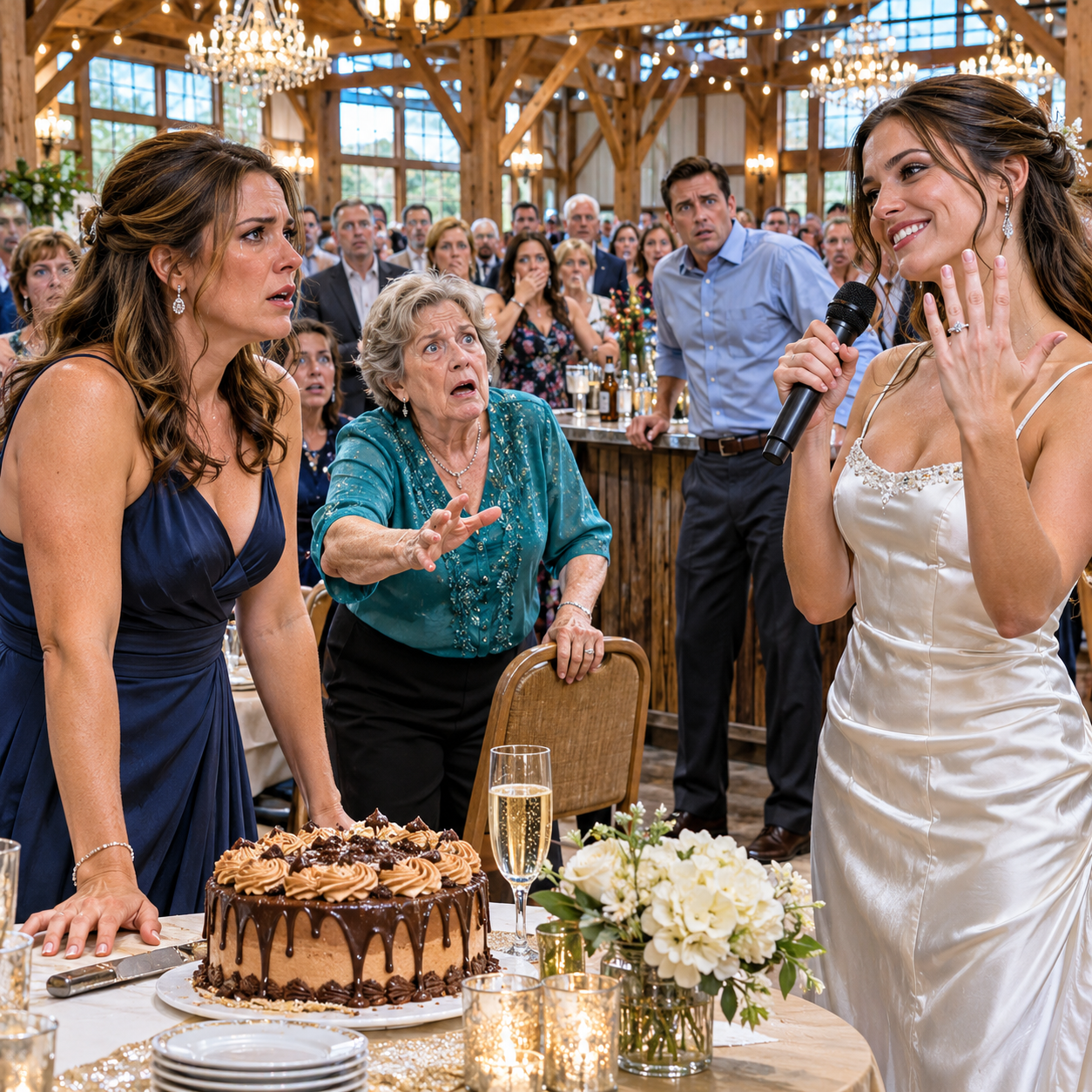
The music stopped so abruptly that I could hear ice dropping into a bucket behind the bar. I stood beside the cake table, my hand still wrapped around the knife, watching a beautiful young woman smile beneath the string lights of a rented event barn outside Lubbock, Texas. Her white satin dress had delicate straps and tiny beads along the neckline, an old-fashioned design that seemed strangely out of place at a fortieth birthday party. She raised her left hand, displaying a narrow gold ring with a diamond barely large enough to catch the light. “I know this is a surprise,” she said brightly, “but Joel and I have been keeping something wonderful to ourselves.”
My name is Ria Castellano, and until that Saturday evening, I believed my eleven-year marriage was built on honesty. I was thirty-eight, a high school counselor accustomed to recognizing lies in teenagers, yet I couldn’t understand what I was seeing in my own husband’s face. Joel stood beside the bar with a beer in his hand, staring not at the woman’s smile but at her ring. His expression changed from confusion to something resembling terror, and he slowly set his bottle on the counter as though his fingers had stopped working.
Before I could speak, my mother-in-law rose from her folding chair near the dance floor. Inez Castellano was sixty-six, barely five feet tall, and had spent the evening happily clapping along to songs she remembered from her youth. Now her turquoise blouse trembled against her chest as she stared at the woman holding the microphone. “Sweetheart,” she asked, her voice carrying through the silent barn, “would you tell me your full name?”
The woman smiled wider. “Breanna Yancey,” she answered, clearly enjoying the attention. Inez gripped the back of her chair, missed the seat when she tried to sit, and collapsed awkwardly against the metal frame. Joel turned toward the exit without a word, pushed through the barn doors, and disappeared into the darkness while sixty people watched their guest of honor abandon his own birthday celebration.
Breanna had joined the parts department at Caprock Implement in March 2024, where Joel had worked for fifteen years and managed operations. He mentioned her occasionally, usually because she brought Friday morning kolaches and remembered everyone’s favorite filling. At the previous company Christmas party, I had noticed her standing close to him, laughing at jokes that weren’t particularly funny, but Joel seemed almost unaware of her attention. When an anonymous text arrived in June saying, “Ask your husband about B,” he dismissed it as someone trying to cause trouble.
I had believed him. Joel was the man who fixed our kitchen cabinets without being asked, remembered my mother’s birthday, and cried at the endings of sentimental football movies. He had one peculiar habit, though: every December, around the nineteenth, he became withdrawn and spent long evenings alone in the garage. Years earlier, he had mentioned losing a high school friend in a car accident, but when I asked for details, he turned up the truck radio and never spoke of it again.
I found him outside in his pickup, the driver’s door hanging open, both hands shaking against the steering wheel. “Joel, who is that woman?” I demanded, trying to keep my voice steady. He stared through the windshield, swallowed, and whispered, “That’s Hannah’s ring.” When I asked who Hannah was, tears filled his eyes, and he shook his head. “I can’t do this here, Ria,” he said before closing the door and driving away.
Inside, the DJ had restarted the music, though nobody was dancing. Breanna stood near the bar sipping champagne, wearing the satisfied expression of someone who had completed a carefully rehearsed performance. I knelt beside Inez, whose hands were cold when she grasped mine, and asked what she knew. “Please take me home, mija,” she whispered, refusing to explain during the drive except to say that the truth belonged to Joel.
At eleven that night, I found my husband sitting at our kitchen table beneath the yellow overhead light. An old wallet-sized photograph rested between his hands, its corners worn almost transparent from years of handling. The girl pictured had long brown hair, braces, and a wonderfully unguarded smile. Joel slid the photograph toward me and finally looked into my eyes. “Her name was Hannah Yancey,” he said. “She was Breanna’s older sister, and she died in my truck.”
Part 2: An Old Photograph Reveals the Tragedy Behind the Betrayal
Joel spoke for nearly two hours while the birthday decorations remained unopened in the back of my car. In December 2003, he had been a seventeen-year-old junior at Lubbock High, in love with Hannah Yancey, a sixteen-year-old sophomore who played flute in the marching band and dreamed of becoming a veterinarian. They had dated for a year, and he had saved eighty-nine dollars from his after-school job at an auto parts store to buy her a promise ring. He gave it to her on December first, a thin gold band with a tiny diamond and a date engraved inside, and she cried because nobody had ever given her something so precious.
On December nineteenth, they attended a Christmas party at a friend’s house south of town. Joel was the designated driver, hadn’t touched alcohol, and had already taken three other teenagers home when he and Hannah started along a dark farm road shortly before eleven. Earlier sleet had frozen into a nearly invisible sheet of ice, and his father’s pickup suddenly lost traction on a curve. The truck spun toward a field, rolled twice, and came to rest on its side in a ditch. Joel survived with a broken collarbone, but Hannah never came home.
The accident report documented a blood alcohol level of zero and identified black ice and speed unsafe for conditions, despite Joel traveling below the posted limit. No criminal charges were filed, but Hannah’s father stood during the funeral, pointed at the seventeen-year-old boy sitting in the back pew with his arm in a sling, and shouted that he had killed his daughter. In 2005, the Yanceys sued Joel’s parents, and their insurance company settled for the policy limit of one hundred thousand dollars. The following year, Hannah’s parents divorced, and her mother moved to Odessa with eight-year-old Breanna, who had thrown a white rose at Joel during the funeral.
“Why did you marry me without telling me any of this?” I asked when he finished. Joel rubbed the edges of Hannah’s photograph and said he had spent years trying to escape the frightened boy everyone blamed, and he couldn’t bear the possibility that I might see him the same way. I slept in our guest room that night, not because I thought he had deliberately caused Hannah’s death, but because I suddenly understood how much of his heart had remained locked away from me. Eleven years of marriage had not brought us close enough for him to trust me with his greatest sorrow.
By morning, Breanna had posted a photograph of Hannah’s ring against the white satin of her dress, alongside a cropped picture of Joel smiling at a company picnic. Her caption suggested that he had finally acknowledged their relationship, and congratulations appeared beneath it before people began asking uncomfortable questions. On Tuesday, August eleventh, Joel returned from work carrying his lunch box and announced that Caprock had suspended him with pay. Breanna had filed a formal complaint accusing him of pressuring her into a relationship, promising to leave me, and threatening her job when she tried to end things.
The screenshots attached to her complaint made my stomach turn. They showed long exchanges in which someone appearing to be Joel confessed his feelings, discussed leaving our marriage, and arranged private meetings with Breanna. The wording sounded painfully familiar, and when Joel offered me his unlocked phone, I pushed it away. He didn’t argue, but quietly told me to examine the actual telephone number in the screenshots rather than the contact name.
The following morning, I enlarged the images on my computer. One screenshot exposed a number with a Lubbock area code, but it wasn’t Joel’s number, which he’d used since 2008. When I called, I heard the same generic voicemail that had answered my attempt to contact the person who sent June’s anonymous warning. Then I noticed a message supposedly sent on June ninth at 2:14 p.m., while Joel and I were sitting in a bank office refinancing our mortgage. I distinctly remembered holding his phone in my purse during that appointment because he had been tired of receiving work calls.
I printed the bank records and returned to Breanna’s social media page. Every December nineteenth, she posted Hannah’s photograph beneath demands for justice, and a 2021 post displayed Joel’s high school portrait alongside an accusation that he had escaped consequences and built a happy life. Another photograph showed Hannah’s old formal dress hanging in her mother’s closet, white satin with thin straps and beading around the neckline. I stared at it, recognizing the dress from the party, and understood that Breanna hadn’t dressed like a bride because she wanted my husband. She had dressed like her dead sister because she wanted the entire room to witness his punishment.
Part 3: A Hidden Letter Changes Everything the Grieving Family Believed
When I showed Joel what I’d discovered, he sat on the edge of our bed, holding Hannah’s photograph as if it might crumble. “Maybe I should resign,” he murmured, “leave Caprock, maybe leave Lubbock altogether.” I sat beside him and reminded him that seventeen-year-old boys could make terrible mistakes without becoming monsters, and that a frozen road had taken Hannah’s life. “You can be sorry forever,” I told him, “but you cannot surrender every good thing that happens afterward.”
That Friday, I visited Inez with the photographs and telephone records spread across her dining table. She listened without interrupting, then disappeared into her bedroom and returned carrying an old white Bible. Inside was a yellowed envelope addressed to Joel, postmarked Odessa, Texas, in 2009. Her eyes filled as she admitted the letter had arrived when Joel was beginning to rebuild his life, and she had hidden it because she feared another emotional collapse. “I thought I was protecting him,” she whispered. “Then so much time passed that I couldn’t admit what I’d done.”
The letter was from Hannah’s mother, Patricia Yancey. She wrote that she had been sober for a year, had reread the accident report, and could finally acknowledge that Joel hadn’t been drinking or recklessly trying to hurt anyone. She confessed that blaming him had been easier than accepting a senseless accident, apologized for her husband’s accusation at the funeral, and offered forgiveness. Her final request was devastatingly simple: Hannah had loved him, and Patricia wanted him to allow himself a good life.
I folded the letter with trembling hands. For seventeen years, Joel had been carrying the belief that Hannah’s mother despised him, while Inez had possessed the words that might have helped him begin healing. I asked to take the envelope, and she nodded, crying quietly into a tissue. Before giving it to Joel, however, I needed to understand how Hannah’s dress and ring had ended up in Breanna’s hands.
On Saturday, August fifteenth, I drove to Odessa and knocked on Patricia’s door. She was older than I’d imagined, with tired eyes and an extraordinary resemblance to the girl in Joel’s photograph. After hearing what Breanna had done, she led me into Hannah’s preserved bedroom and opened a closet containing an empty garment bag. Breanna had visited in July and taken the dress, promising to have it professionally cleaned and preserved. Patricia then opened a jewelry box and showed me the vacant space where Hannah’s ring had rested since police returned her belongings.
“I thought Joel hated us,” Patricia said when I explained the missing letter. “I waited years for an answer and decided his silence meant he didn’t care.” I told her how Joel still withdrew every December and how he had recognized Hannah’s ring instantly after twenty-three years. Patricia closed the jewelry box, reached for her coat, and said she was coming to Lubbock.
Breanna continued tormenting us while we prepared to challenge her complaint. She left a cake on our porch decorated with the words “Happy 40th, my love,” then sent messages claiming Joel had planned to abandon me for a year. I forwarded the messages, the bank appointment records, and my statement about his telephone to Caprock’s human resources department and Joel’s attorney. Patricia called shortly afterward to warn me that Breanna was boasting about another announcement, though she refused to tell her mother what it involved.
The following Saturday morning, the doorbell rang while Joel was in the garage. Breanna stood outside holding a black-and-white ultrasound image, her expression almost triumphant. “I’m eight weeks pregnant,” she announced, raising the picture between us. “It’s Joel’s baby, and I thought you deserved to know before he lies again.”
I stepped aside, revealing Patricia standing in our hallway. Breanna’s smile vanished, and her hand tightened around the photograph as she whispered, “Mom?” Patricia approached slowly, her eyes moving from the ultrasound to the white dress folded over Breanna’s arm. “Honey,” she asked, “what have you done?” Breanna stared at her, and for the first time since the birthday party, she appeared genuinely frightened.
Part 4: A Mother’s Forgiveness Finally Ends Twenty-Three Years of Pain
Breanna looked toward the driveway as if searching for an escape, then turned back with tears gathering in her eyes. “He killed Hannah, Mom,” she said, her voice rising. “He gets to have birthday parties and a wife and a beautiful house, while she doesn’t even get to grow up.” Patricia reached for her daughter’s hand, but Breanna pulled away and demanded to know why her mother was defending the man responsible for destroying their family.
I looked at the ultrasound still trembling in Breanna’s fingers and realized that arguing about Joel would only deepen the anger she’d carried since childhood. “Breanna,” I said gently, “tell me your sister’s name.” She frowned, confused by the question, and I asked again, this time telling her to forget Joel and me for a moment. Her lips moved before any sound emerged, and finally she whispered, “Hannah.”
Something inside her gave way. The ultrasound slipped onto our welcome mat as Breanna sank onto the porch, covering her face with both hands. “I miss her, Mom,” she sobbed. “I can’t remember what her voice sounded like anymore.” Patricia knelt beside her and gathered her into an embrace, holding the thirty-year-old woman as though she were still the little girl who had lost her sister before she understood what death meant.
Joel appeared from the garage and stopped when he saw them. He approached slowly, knelt a few feet away, and told Breanna he was sorry for the accident, for Hannah’s death, and for all the birthdays and ordinary family moments her sister had never experienced. “I’ve been sorry every day since that night,” he said, tears falling onto his work shirt. Breanna looked at him and answered, “You never told us that.”
Patricia explained that she had written Joel a letter seventeen years earlier, but he had never received it. I took the yellowed envelope from my pocket and handed it to my husband, whose expression changed when he recognized his mother’s handwriting on a small note attached to the back. He unfolded Patricia’s letter and read slowly, stopping twice to wipe his eyes. When he reached the words offering forgiveness, he bowed his head and cried with an intensity I had never witnessed, as if the frightened teenager inside him had finally been allowed to come home.
Monday brought the first practical consequences. Breanna withdrew her complaint in writing and admitted that she had used a second telephone and an application to fabricate the conversations presented to Caprock. The company dismissed her, and Joel was reinstated Tuesday with an apology from the owner. Breanna also admitted that the ultrasound was printed from the internet and that there had never been a pregnancy.
Patricia took her daughter back to Odessa, where Breanna began attending grief counseling. She returned Hannah’s ring to its jewelry box, and the white satin dress was cleaned and pressed before being restored to the closet. None of that excused the lies or the damage she’d caused, but I understood that her anger had grown around a childhood wound everyone had discussed without ever helping her heal. For years, people had told Breanna whom to blame, but nobody had asked how much she missed the sister she barely remembered.
Inez came to our house carrying her old Bible and apologized to Joel for keeping Patricia’s letter hidden. He listened without interrupting, then took her hands and told her he knew she’d acted out of love, even though she’d made a painful mistake. Watching them, I thought about my own anger over the years Joel had concealed Hannah from me. Forgiveness didn’t mean pretending those secrets were harmless, and we began talking about them honestly, sometimes painfully, until I felt ready to move back into our bedroom.
At the end of August, I drove Joel to the city cemetery where Hannah was buried beneath a live oak near the back fence. Patricia was waiting beside the headstone with a small bouquet of white roses, and I remained in the truck because some conversations belonged to the people who had spent decades needing them. Through the windshield, I watched my husband cross the grass toward the woman he’d feared since he was seventeen. She handed him a white rose, and together they stood in silence beside Hannah’s grave.
After a long while, Joel knelt and placed the rose against the stone. Patricia rested a hand on his shoulder, and he began crying again, but this time he didn’t hide his face or try to stop. When he returned to the truck, he took my hand and said, “I wish you’d known her.” I squeezed his fingers and answered, “I think I’m finally beginning to.”
We drove home beneath a wide Texas sky, passing cotton fields glowing in the late-afternoon sun. Joel told me a story about Hannah laughing so loudly during a movie that the manager came over to check whether something was wrong, and for the first time, he smiled while remembering her. I realized then that I hadn’t married a man who had never loved anyone before me; I had married a man who had confused moving forward with leaving someone behind. Now we understood that remembering Hannah didn’t threaten our marriage, and loving me didn’t betray her memory.
The woman in the white dress had come to my husband’s birthday party hoping to destroy his future with the past. Instead, she had uncovered a letter that finally allowed two grieving families to release a punishment neither could survive forever. Our marriage was not magically repaired, and the lost years could never be returned, but the truth had given us something more valuable than the certainty I’d once believed we possessed. It had given us the courage to love each other without hiding the people we had been.
THE END.
All characters and events in this story are fictional, created for storytelling and entertainment purposes. Thank you sincerely for reading. Your feedback and support are invaluable and motivate me to continue sharing more stories with you.