“She Merely Cleans Planes For A Living,” My Mom Laughed To The VIP Table At My Sister’s Air Force Gala. I Said Nothing… Then The Base Commander Walked Past My Sister, Locked Eyes With Me, And Froze: “Four-Star General… Ma’am?” 300 Pilots Snapped To Attention. My Mom Lost All Color.
My mother laughed when I arrived at my younger sister’s Air Force promotion gala, telling the officers at our table that I spent my life cleaning airplanes. My sister let them laugh, too. I had spent thirty-seven years serving my country, and neither woman had ever cared enough to understand what I actually did. When the installation commander approached our table, I expected another uncomfortable introduction. Instead, he saluted me. Two days later, investigators showed me a document bearing my name—and a signature I had never written.
Part 1
The first thing my mother said when she saw me at the Officers’ Club was, “Well, at least you found something appropriate to wear.” She stood beneath a chandelier in a champagne-colored dress, adjusting the pearl necklace she had bought for my younger sister’s promotion ceremony, and looked me over as though she were inspecting a questionable donation to a charity auction. My navy-blue evening gown was simple, tailored, and probably cost less than the shoes on her feet, which apparently qualified as an embarrassment. “Please don’t spend the evening talking about engine parts, Willa,” she added, lowering her voice without bothering to check who might hear. “Piper’s commanding officers are here, and I’d like them to remember our family for the right reasons.”
My name is Willa Sloane, and I was fifty-five years old that evening, which meant I had spent almost four decades learning how to manage difficult people without allowing them to manage me. Unfortunately, none of that experience had ever made dealing with my mother particularly easy. Judith Sloane was seventy-nine, a retired real estate broker from Columbus, Ohio, who believed presentation mattered more than character and that a person’s value could be measured by the number of important people who recognized them in public. My younger sister, Piper, had inherited her talent for making ordinary accomplishments sound historic. I had inherited my father’s stubborn insistence that good work should be able to speak for itself.
I enlisted in the Air Force at eighteen, partly because I wanted an education and partly because remaining in my mother’s house another year felt unbearable. My father had died the previous winter, leaving us enough money to remain comfortable if we were careful, but Judith had already decided that Piper’s education was the family’s most important investment. When I asked about community college, she handed me a newspaper advertisement for a warehouse job and told me that practical girls shouldn’t develop expensive expectations. She paid for Piper’s private school tuition without hesitation, then complained that my enlistment had ruined the family photographs she planned to display at Christmas. Nobody came to my basic training graduation, and I stopped expecting them to show up for anything afterward.
My first assignment put me on a flight line where winter wind slipped through every seam in my coveralls and hydraulic fluid seemed permanently embedded beneath my fingernails. I learned aircraft maintenance from people who could identify a problem by the sound of an engine starting and who took responsibility for mistakes before anyone else discovered them. Later, I studied engineering at night, earned my commission, and moved through operational planning, logistics, and command assignments that took me farther from Ohio than my mother ever bothered to imagine. Some assignments involved sensitive work I couldn’t discuss, but most of my career was simply the exhausting responsibility of making sure people had the equipment, training, and support they needed. By the time I became a general officer, my mother had been describing me as an airplane cleaner for so long that correcting her felt like arguing with someone who preferred a fictional daughter.
It wasn’t that Judith had never received information about my career. I had mailed invitations, photographs, and brief notes about promotions, and on several occasions I had offered to explain what my assignments involved. She usually changed the subject to Piper’s accomplishments, which ranged from winning a school debate competition to receiving a certificate for organizing a charity golf tournament. When I received my first star, Judith called to ask whether my increased salary meant I could contribute more toward Piper’s graduate school expenses. When I declined, she stopped calling for nearly four months, then resumed our conversations as though the subject had never existed.
Piper eventually joined the Air Force in her thirties after working several civilian administrative jobs, and I genuinely admired her decision. Military service was demanding at any age, and she had completed her training while many of her friends were settling comfortably into established careers. I sent flowers when she commissioned, congratulated her after her first assignment, and helped her prepare for a particularly difficult professional examination when she asked. But Judith turned Piper’s career into a competition neither of us had agreed to enter. Every family gathering became another opportunity to describe Piper as our distinguished military officer while introducing me as the older daughter who worked around airplanes.
Her promotion to captain should have been a happy occasion, and for a while I believed it might be. Piper had called six weeks earlier, sounding unusually affectionate, and asked whether I could attend a formal dinner at her installation outside Dayton. I was already scheduled to visit the region for a readiness review, so I arranged my personal travel to attend the celebration without making my official itinerary part of the evening. She thanked me, then hesitated before asking whether I planned to wear my uniform. When I said I preferred civilian clothes, she sounded relieved, although I hadn’t understood why at the time.
The ballroom was already crowded when I arrived, with American flags standing beside the stage, framed photographs of aircraft lining the walls, and a military band playing near the far windows. Officers in dress uniforms exchanged greetings with spouses and invited guests while servers moved between tables carrying trays of appetizers. A young major at the reception desk searched the seating chart, frowned, and explained that my assigned place was near the service entrance. I looked over her shoulder and saw my name at table forty-two, separated from the family table by nearly the entire room. Before I could say it was fine, she quietly checked the original arrangements and discovered that my seat had been changed that afternoon.
The major, whose name tag read CALDER, apologized and escorted me to the correct table, where Piper was laughing with three officers and a handsome civilian in an immaculate black tuxedo. My mother watched the additional chair being placed beside hers with an expression usually reserved for unexpected plumbing bills. “There’s been a little confusion,” I said, trying to make the moment painless, but Judith responded that the seating committee must have been overwhelmed. Piper kissed my cheek without getting up, introduced me simply as her sister, and immediately returned to a conversation about an upcoming logistics modernization project. I ordered sparkling water and listened, perfectly willing to let her enjoy her evening.
The civilian beside Piper was Lucian Bellamy, her fiancé, a polished businessman who owned a small aviation supply company called Bellamy Aeronautics. He wore an expensive watch and spoke with the practiced confidence of someone accustomed to being the most influential person in a room. Piper explained that her unit had been struggling with delays involving aircraft support equipment and replacement components, then proudly announced that Bellamy Aeronautics had recently been selected for an accelerated supply arrangement. I asked whether the company had been competing for the work before their engagement, and Lucian’s pleasant expression tightened for the briefest moment. Piper answered that the contracting office had handled everything properly, although she seemed considerably more interested in convincing the table than in answering my question.
I knew enough about acquisition procedures to understand that a captain could not simply award a multimillion-dollar contract because she liked a vendor. I also knew that people responsible for defining requirements, evaluating technical proposals, or recommending suppliers could improperly influence a process without ever signing the final contract. Piper had just described several decisions she claimed to have made personally, and the confident way she spoke about Lucian’s expected profits concerned me more than I wanted to admit. I asked whether she had disclosed her relationship and removed herself from any official decisions affecting his company. Her smile disappeared, and before she could answer, Judith interrupted.
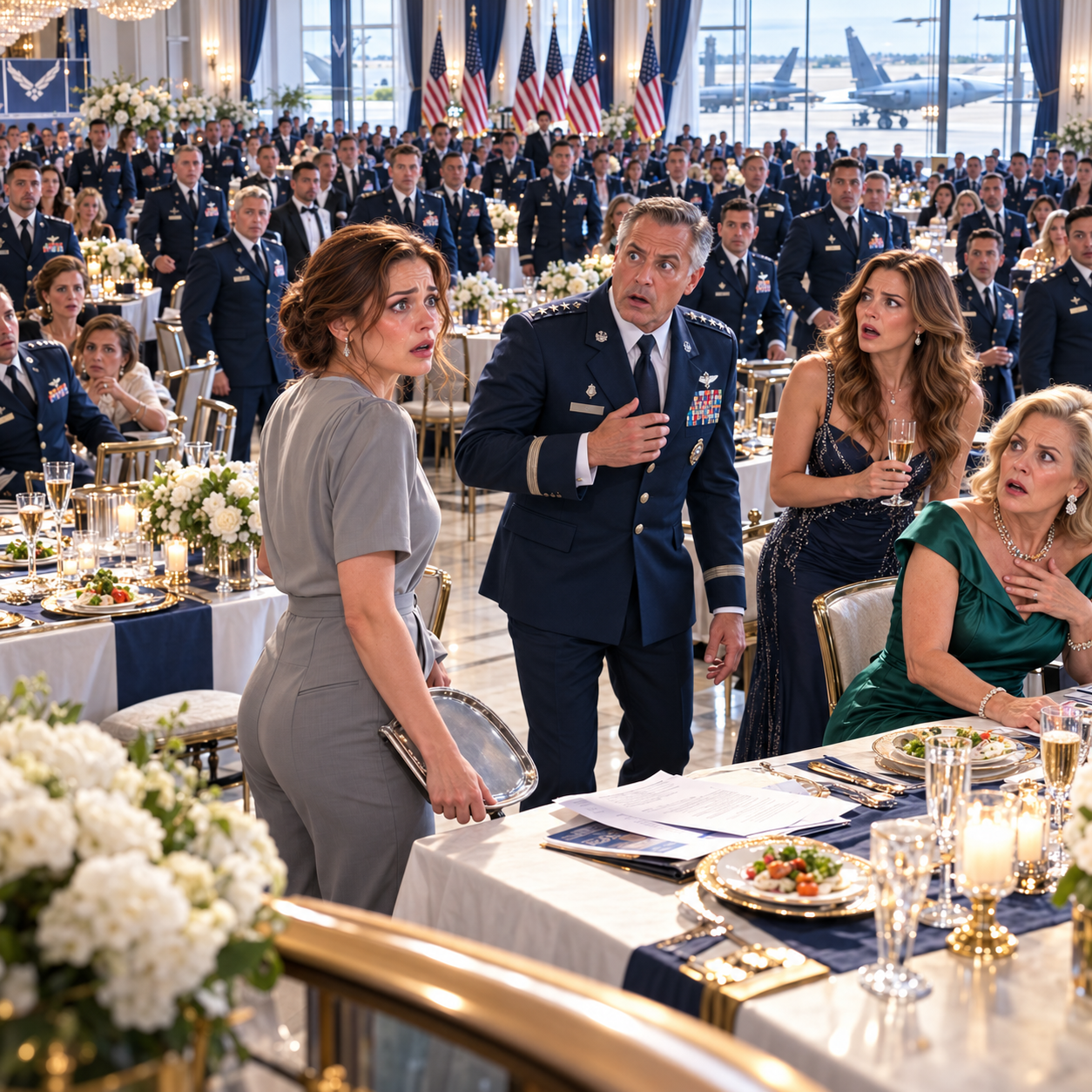
“Oh, don’t worry about Willa,” my mother announced with a bright, dismissive laugh that carried several tables beyond ours. “She doesn’t understand the business side of military operations because she merely cleans airplanes for a living.” One of the junior officers lowered his eyes to his plate, another gave an uncomfortable smile, and Lucian chuckled as though she had delivered an especially clever joke. Piper stared into her champagne glass, making no attempt to correct her. My mother patted my wrist and continued, “There’s absolutely nothing wrong with honest manual labor, dear, but tonight belongs to people who have real responsibility.”
I placed my glass on the table and looked directly at Piper, giving her one final opportunity to say something. She met my eyes for less than a second before turning toward Lucian, who leaned across the table and offered to find me work supervising the cleaning crews at his company’s private hangar. Judith laughed again, delighted by the idea, and Piper finally joined her. I was deciding whether to excuse myself when the ballroom doors opened and Colonel Rhys Talbot, the installation commander, entered with two members of his staff. He spotted me almost immediately, stopped beside our table, and straightened with an expression of unmistakable recognition.
“General Sloane, ma’am,” he said, coming to attention and raising his hand in a sharp salute.
I stood and returned it, noticing that conversations around us had stopped and several officers were rising from their chairs. Colonel Talbot lowered his hand and added, with genuine surprise, “We understood the four-star general wasn’t arriving for the readiness review until Monday.”
My mother’s fingers closed around her champagne glass so tightly that I thought it might break. Piper was staring at the four stars on the commander’s briefing folder, then at me, as though she were desperately searching for an explanation that would make what she’d just heard untrue.
Part 2
For a moment, I could hear the soft mechanical hum of the ventilation system more clearly than the voices around us. Colonel Talbot seemed to realize that his greeting had interrupted something, although he had no reason to understand the full extent of it. I quietly told the officers who had stood nearby to relax and thanked him for his courtesy, then asked whether we might speak somewhere more private. He guided me toward a small reception room adjoining the ballroom while I felt my mother’s horrified stare following me across the carpet. I had imagined many possible reactions if my family ever learned the truth about my career, but I had never imagined feeling so strangely tired.
Talbot closed the reception-room door and apologized for surprising me, explaining that my office had identified Monday as the beginning of my formal visit. He was a capable commander with a reputation for dealing honestly with difficult problems, and I had worked with him briefly several years earlier. I assured him that he had done nothing wrong, then told him about the conversation I’d overheard concerning Bellamy Aeronautics. His expression shifted from polite curiosity to immediate concern when I explained that the company’s owner was engaged to my sister. Instead of asking him to open contracting records for me, I told him that any questions involving Piper needed to be handled independently because my personal connection presented an obvious conflict.
He listened without interruption and said his staff had already been examining several procurement irregularities as part of an unrelated readiness review. A recently established supplier had received an unusually favorable expedited arrangement, and complaints about delayed equipment were beginning to reach the wing’s senior leadership. He couldn’t confirm whether the supplier was Bellamy Aeronautics without consulting the appropriate officials, but he promised the concerns would receive proper attention. I asked him to document our conversation and notify the relevant ethics and investigative offices rather than treating my remarks as an order. Before returning to the ballroom, I told him something that surprised even me: “I hope there’s an innocent explanation.”
When I stepped outside, Piper was waiting near a display case containing a model fighter aircraft and several framed commendations. She glanced toward the reception room, then looked at me with an expression that combined embarrassment, resentment, and fear. “You could have told me,” she whispered, pressing her fingers against the brass edge of the display case. I reminded her that I had sent photographs from my promotions and invited her to two ceremonies, neither of which she’d attended. She looked away and said, “Mom told me those were mostly honorary appointments, and I thought you were exaggerating because you were jealous.”
The accusation hurt more than the laughter at dinner because it exposed how little my sister had ever trusted me. I remembered staying up until two in the morning helping her prepare for her commissioning interview, reassuring her when she feared she had entered military service too late. I had never asked her to compare our careers or to diminish her accomplishments, and until that night I hadn’t realized she believed I resented them. “You could have asked me,” I said, and for a second she looked genuinely ashamed. Then her expression hardened, and she wanted to know whether I’d discussed Lucian’s business with Talbot.
I told her I had raised a concern that any responsible officer would have been obligated to report. Piper immediately insisted that her relationship had been disclosed to the contracting office, that she had merely provided technical information, and that Lucian had won the arrangement because his company could deliver faster than competing suppliers. I wanted to believe her, but she kept describing the decision as though her personal judgment had mattered more than the independent acquisition process. When I suggested she preserve her correspondence and speak honestly with the appropriate officials, she folded her arms. “You finally get your chance to overshadow me, and suddenly you’re worried about rules,” she said.
I left the gala before dessert, declining Talbot’s gracious invitation to sit near the head table. Outside, the parking lot shone beneath tall security lights, and somewhere beyond the dark buildings an aircraft engine rose into a steady roar. My phone began vibrating before I reached my rental car, first with a call from Judith, then with messages demanding that I return and explain myself to the guests. One message from Piper simply read, “Lucian says you misunderstood everything.” I silenced the phone and drove to my hotel, unsettled less by the evening’s humiliation than by the possibility that my sister had allowed someone she loved to compromise her judgment.
At eleven fifteen, someone knocked hard enough on my hotel door to wake a neighboring guest. Judith stood in the hallway with Piper behind her, both still wearing their gala clothes, and my mother pushed past me as soon as I opened the door. She launched into an angry speech about my selfishness, claiming I had deliberately concealed my rank so I could steal Piper’s celebration and embarrass her in front of important people. I asked whether she remembered receiving invitations to my promotion ceremonies, and she answered that she couldn’t possibly keep track of every military event. When I reminded her that she had referred to my first star as a decorative recognition, she looked irritated rather than confused.
Piper seemed less interested in our history than in finding out exactly what Talbot and I had discussed. She told me Lucian was furious because someone from the installation had requested additional contract documents shortly after the gala, although the request had apparently been scheduled before our conversation. “He’s got employees depending on him,” she insisted, her voice shaking, “and you’ve made everyone think he’s done something terrible.” Judith suggested that a person with my rank could surely make an administrative misunderstanding disappear with one telephone call. I told them I would not interfere with an independent review, whether it cleared Lucian or uncovered wrongdoing. My mother stared at me as though I had refused to help a drowning stranger.
“Your sister has spent years building this life,” Judith said, lowering herself into the armchair beside the window. “Do you have any idea what an investigation would do to her reputation?” I looked at the woman who had missed my commissioning, ignored my deployment homecomings, and once described my work as something anyone could learn in an afternoon. “Yes,” I answered, “because I’ve spent years building a life that depends on taking my responsibilities seriously.” Piper began crying, but even then she didn’t ask whether the contract was legitimate or whether anyone had been harmed by the arrangement. She asked only whether I could promise that no one would lose a career.
After they left, I sat at the little hotel desk and wrote a factual account of the evening, including Piper’s remarks and my mother’s request that I intervene. The following morning, I contacted the appropriate ethics officials, disclosed my family relationship, and formally removed myself from any role that could influence the handling of the Bellamy matter. My scheduled readiness review would continue, but another senior officer would oversee the affected procurement area and any related findings. The arrangement felt necessary and deeply unpleasant because I had spent my life trying to avoid exactly this kind of conflict. Being powerful did not give me permission to decide what happened to my sister, and I was grateful that the rules made the boundary unmistakable.
Two days later, an Air Force investigative liaison contacted my office after receiving authorization to notify me that my name had appeared in materials submitted by Bellamy Aeronautics. The investigators weren’t asking me to judge the contract; they wanted to know whether I had provided a personal endorsement or approved the use of my professional credentials. The document was described as a letter of support identifying me as a senior strategic adviser, complete with my title and a signature resembling my own. I requested a formal interview and assured the liaison that I had never agreed to advise Lucian’s business. When I finally saw the disputed letter, my stomach tightened because the signature wasn’t mine—but the particular way my first name had been misspelled was painfully familiar.
Part 3
The misspelling was small enough that another person might never have noticed it. My mother had always written my name as “Willah,” adding a final letter that wasn’t on my birth certificate, because she insisted that was how my grandmother had originally wanted it spelled. I had corrected her on school forms, birthday cards, and family invitations for most of my life, but Judith treated the correction as a petty objection rather than a matter of accuracy. Seeing that spelling on a document submitted to a military contracting office made me feel as though a door had opened onto a room I had deliberately avoided entering. I told the investigator about the spelling, emphasizing that it suggested a possible source but proved nothing by itself.
Special Agent Leona Serrano conducted my interview in a plain conference room where the blinds were half closed against the afternoon sun. She was methodical, patient, and completely uninterested in my rank beyond the specific questions necessary to establish my role. She asked whether I’d ever met Lucian before the gala, discussed government requirements with him, authorized him to use my biography, or shared information about military procurement opportunities. I answered each question carefully, including details that could be independently verified through my calendars and correspondence. When she asked about Judith, I explained our difficult relationship without attempting to turn a family grievance into evidence.
The letter described me as someone who had personally reviewed Bellamy Aeronautics’ capabilities and believed the company could support important readiness objectives. It was written on stationery carrying a version of my professional title, used terminology that sounded impressive without demonstrating any actual technical review, and concluded with a statement that could reasonably be mistaken for an endorsement from a senior military leader. I had never seen the letter, approved its wording, or given anyone permission to represent me as an adviser. Agent Serrano explained that investigators were working to determine who prepared it, who submitted it, and whether anyone responsible for evaluating the contractor had relied upon it. She didn’t promise an outcome, and I appreciated that more than she probably realized.
For nearly a month, I received little information beyond confirmation that the review was continuing. My official responsibilities kept me occupied with equipment modernization problems across several installations, and I carefully avoided asking colleagues for updates about Piper. At night, however, I found myself revisiting old family conversations with an uncomfortable new perspective. Judith had once asked for a copy of my military biography, claiming that a local veterans’ association wanted to recognize me, and I had emailed it without much thought. Later, she had asked whether the government still considered me an active senior commander, a question I had dismissed as another example of her confusion about my career.
Then a package arrived at my home containing photographs from Piper’s childhood, along with a handwritten note from Judith. She described the pictures as reminders of how close we’d once been and suggested that family disagreements were usually best settled privately. Most of the photographs showed Piper receiving trophies, blowing out birthday candles, or opening gifts while I stood somewhere near the edge of the frame. Near the bottom was a picture from my first deployment homecoming, taken by a neighbor after Judith and Piper arrived almost two hours late. My mother had written “Willah, home from the aircraft repair shop” on the back, and I sat staring at those words long after the afternoon light faded.
The investigation eventually reached beyond the disputed endorsement and into the decisions that had placed Bellamy Aeronautics ahead of more established suppliers. According to information later released through official proceedings, the company had been created less than two years earlier and had struggled to obtain enough financing to meet its obligations. Piper had participated in developing urgent supply requirements involving mobile ground-power equipment and specialized aircraft towing assemblies, even though her relationship with Lucian created an obvious conflict. Several competing suppliers had offered credible delivery schedules, but the requirements had been revised in ways that favored Bellamy’s particular inventory and proposed subcontractors. The independent contracting officers had approved an agreement based partly on readiness claims that were later shown to be inaccurate.
The financial trail told an even more disturbing story. Judith had borrowed against her Columbus home to help Lucian finance his company’s expansion, putting a substantial portion of her retirement security at risk without telling me or several relatives who depended on her for occasional assistance. In exchange, she received payments through a consulting arrangement that investigators examined for possible undisclosed financial interests and improper compensation. Her involvement had not been a harmless mother’s attempt to support her younger daughter’s fiancé. She had stood to benefit personally if Bellamy Aeronautics obtained enough government business to repay its lenders and keep the company operating.
I learned about the operational consequences gradually, through public proceedings and information officially cleared for discussion rather than through private access to investigative records. A junior logistics specialist named Technical Sergeant Nessa Hart had repeatedly questioned delivery certifications that listed equipment as ready for use when several items had not passed inspection. Her objections were initially treated as administrative delays, and Piper had pressured her section to move the paperwork forward so the supplier could meet a contract milestone. Eventually, two training units had to rearrange maintenance schedules because promised equipment wasn’t available when needed. Nobody was injured, but pilots, technicians, and support crews had spent valuable hours compensating for promises that should never have been made.
That detail stayed with me because I knew exactly what it meant to be the person waiting for equipment that wasn’t there. During my early maintenance years, a delayed component could mean another twelve-hour shift, another canceled sortie, or another exhausted crew trying to solve a problem created far above its pay grade. People in offices often described readiness as percentages on a briefing slide, but I still remembered the faces behind those numbers. If Piper had ignored a technician’s warning to protect Lucian’s business, she hadn’t simply broken a procurement rule. She had betrayed the people whose work made her own position possible.
Six weeks after the gala, Piper asked to meet me at a small coffee shop off the interstate. She arrived wearing jeans and a gray sweater, looking older than she had beneath the ballroom chandeliers, and immediately told me she’d been temporarily reassigned while officials reviewed her involvement in the contract. Lucian had assured her his company could handle the work, she insisted, and she’d believed him because she wanted to prove she could solve problems faster than the people around her. I asked whether she’d read the inspection objections before supporting the accelerated schedule. Her silence answered the question before she finally admitted she’d seen them and assumed the problems could be resolved afterward.
For one fleeting moment, I thought she might take responsibility. Instead, she began explaining that Judith had already invested money in Lucian’s business and that a failed contract would leave our mother facing serious financial trouble. Piper wanted me to understand the pressure she’d been under, as though responsibility to family excused disregarding everyone outside it. I told her that pressure might explain her decisions but could not erase them, and that she needed to be truthful with investigators and seek independent legal advice. She pushed her coffee away and asked whether I would at least agree to testify that she’d always been an honorable officer.
“I can only tell people what I personally know,” I answered, and she looked at me with open resentment. She said I had spent decades refusing to share the benefits of my career while allowing her and Judith to struggle, a claim so disconnected from our history that I almost laughed. I reminded her of the tuition assistance I’d provided during her graduate studies, the emergency repairs I’d paid for after Judith’s basement flooded, and the money I’d quietly sent when Piper first moved for training. Piper dismissed those things as small compared with what someone of my rank could supposedly have done. I realized then that she wasn’t angry because I had failed to help her; she was angry because there were limits to what I would sacrifice.
The final discovery came several weeks later, when investigators requested clarification about a family email account Judith had previously used to contact me. They showed me a message lawfully obtained during the inquiry, asking whether I recognized the account and the unusual spelling of my name. In the message, Judith had instructed Lucian to include my professional title in his company’s materials while keeping the arrangement away from me. The final line was so calculated that I had to read it twice: “Use Willah’s position where it helps, but don’t tell her we’re involved. She’s always been too polite to correct the family in public.”
Part 4
I had spent most of my adult life telling myself that my mother’s behavior came from ignorance rather than cruelty. She was uncomfortable with the unfamiliar parts of my career, I reasoned, and preferred to celebrate the daughter whose assignments she could explain to neighbors over coffee. But the message to Lucian revealed that Judith had understood my position well enough to exploit it when money was involved. She had kept my accomplishments small in family conversations while allowing a private business to borrow the credibility of those same accomplishments. What hurt most wasn’t that she had lied about me; it was that she had counted on my silence as part of her plan.
I was asked to provide a formal statement confirming that I had neither authored nor approved the disputed endorsement. The investigators had already gathered documents, electronic records, and testimony from people involved in preparing the company’s submissions, so my statement was only one part of a much larger case. The contracting authority subsequently suspended further work under the disputed arrangement while officials determined which deliveries had been completed and whether the government could recover improperly paid funds. Bellamy Aeronautics faced a separate review of its eligibility for future federal contracts, while military investigators continued examining Piper’s actions. I followed the proceedings only through authorized channels and resisted every temptation to request details from people who worked for me.
Four months after the gala, my mother called on a Sunday afternoon while I was repairing a loose hinge on the kitchen cabinet of my Virginia townhouse. She began by saying that I should be grateful investigators hadn’t accused me of participating in Lucian’s business, a remark that almost made me put the telephone down immediately. Then she admitted she’d known I was a four-star general long before the gala, because she’d kept a newspaper clipping announcing my appointment. “I didn’t want Piper feeling that she could never measure up to you,” Judith said, as though concealing an adult daughter’s accomplishments were a reasonable parenting strategy. “You were always strong enough to take care of yourself, and your sister needed someone to believe in her.”
I asked why protecting Piper’s feelings required telling strangers that I cleaned airplanes for a living. Judith sighed and said I was too sensitive about titles, apparently forgetting that she’d spent years introducing Piper by her rank before mentioning her name. When I asked why she’d permitted Lucian to use my position in business documents, her voice hardened. “Because nobody would have lost anything if he’d succeeded,” she said, and the simplicity of that answer explained more about our family than a hundred arguments ever had. She believed dishonesty became acceptable when the promised reward was sufficiently attractive, provided someone else carried most of the risk.
“People did lose something,” I told her. “The crews waiting for equipment lost time, the other suppliers lost a fair opportunity, and Piper may lose the career she worked to build.” Judith replied that those were technicalities and accused me of enjoying her distress, even as she admitted that the money she’d borrowed against her home was now becoming impossible to repay. For the first time, I understood how her favoritism had evolved into something more damaging than an unequal distribution of affection. By constantly protecting Piper from consequences, she had taught my sister that disappointment was an injustice and that rules existed mainly for people without useful connections.
That evening, I opened an old storage box containing letters from my first years of service. Near the bottom was a note my father had written before he died, when I was still debating whether to enlist. He’d told me that he admired people who learned to be useful, particularly when the work was difficult and nobody else wanted to do it. His handwriting was uneven because he was already ill, but I remembered how he’d smiled when I said I wanted to work around aircraft. I placed the letter on my desk and thought about all the years I’d measured my family’s absence more carefully than the loyalty of the people who had actually stood beside me.
The independent proceedings continued through the winter, and the facts became harder for Piper to dispute. Testimony and electronic records established that she had helped shape requirements to benefit Lucian’s company, failed to disclose the full extent of her personal and financial connections, and made inaccurate official statements when the arrangement was questioned. She had also dismissed documented inspection concerns after being warned that certain equipment wasn’t ready for acceptance. Several other personnel had accepted assurances they should have checked, but their mistakes didn’t excuse the decisions she had knowingly made. What began as an attempt to guarantee a favored supplier government business had exposed weaknesses in oversight that the installation could no longer ignore.
Lucian’s relationship with Piper deteriorated as the financial investigation expanded. He accused her of promising more influence than she actually possessed, while she claimed he’d misrepresented his company’s ability to deliver equipment on schedule. Their engagement ended before the first anniversary of the gala, and the photographs Judith had once proudly circulated disappeared from her social media accounts. Bellamy Aeronautics lost the disputed contract after the appropriate proceedings and later faced substantial civil recovery claims and restrictions on seeking federal work. The company’s employees paid a painful price for decisions made by the people who controlled it, a consequence I never found satisfying.
Nearly fourteen months after the gala, Piper appeared before a military court following negotiations with prosecutors and her defense counsel. She admitted responsibility for knowingly false official statements and misconduct connected to the procurement arrangement, and the court considered her record, cooperation, and the documented effects of her actions. I attended only the portion for which my testimony had been requested, sitting quietly while attorneys established that the endorsement carrying my name had been unauthorized. When Piper finally acknowledged that she’d seen the inspection objections and had chosen not to act, she sounded like someone hearing her own decisions described clearly for the first time. Her guilty plea resulted in a dismissal from the service, subject to the military justice system’s required review procedures, and the loss of the career she’d once celebrated so proudly.
My mother sold her Columbus home the following spring, partly to settle the debts she’d incurred financing Lucian’s business and partly because she could no longer maintain the payments on her own. She moved into a modest rented townhouse near Piper, who was beginning the difficult process of finding civilian employment with a damaged professional record. Judith sent me a twelve-page letter describing the sale, the humiliation of explaining her circumstances to friends, and her disappointment that I hadn’t offered financial assistance. She included exactly two sentences acknowledging that she had misrepresented my career, followed by several pages explaining why she felt justified at the time. At the end, she wrote that a loving daughter would understand how frightening it was for an elderly mother to lose the life she’d expected.
I read the letter twice, not because I was considering giving her money, but because I wanted to be certain I wasn’t responding out of anger alone. I could afford to help her, and that fact made the decision more complicated than I cared to admit. But I also knew she was still receiving retirement income, had access to ordinary financial counseling, and was not being left without shelter or basic necessities. What she wanted from me wasn’t emergency assistance; she wanted me to restore the comfort she had risked while assuring her that she bore no responsibility for what had happened. I folded the pages, placed them inside an envelope, and decided that whatever answer I eventually gave would not purchase another round of the same relationship.
Part 5
My reply to Judith was four sentences long, written by hand on plain stationery because I didn’t want the message to sound like something prepared by an attorney. I told her that I was sorry she was facing financial difficulties, but I would not assume responsibility for debts she had chosen to create or for the consequences of decisions she’d made without my knowledge. I explained that I would not participate in further conversations that minimized her conduct or blamed me for refusing to interfere with an investigation. Finally, I asked her not to contact me again unless she was prepared to respect those boundaries. I mailed the letter the following morning and felt an unexpected lightness as I watched it disappear through the slot.
For several weeks, I wondered whether I had been unnecessarily harsh, particularly when I remembered Judith as a younger woman teaching me how to sew a loose button or making soup when I had the flu. Those memories were real, and I refused to rewrite them simply because the rest of our relationship had become painful. But I also remembered the empty seats at my commissioning ceremony, the Christmas dinners when my accomplishments went unmentioned, and the way she had laughed while strangers insulted me at Piper’s celebration. Love could exist alongside selfishness, and occasional kindness did not cancel years of deliberate humiliation. I could accept that my mother had loved me in the limited way she understood without agreeing to spend the rest of my life accommodating that limitation.
Piper wrote to me four months after her military case concluded, using the careful handwriting I remembered from the notebooks she’d filled as a teenager. She had started working for a regional warehouse distributor, managing ordinary shipments and learning a civilian inventory system that offered no shortcuts based on rank or personal relationships. Her letter was different from Judith’s because she didn’t ask for money or demand that I intervene with anyone on her behalf. She admitted that she’d seen the problems with Lucian’s business and had convinced herself she was helping the installation by moving things forward quickly. Then she acknowledged something I had waited most of my life to hear: she had enjoyed watching our mother diminish me because it made her feel more important.
I sat with that sentence for a long time, remembering how Piper had looked away when Judith mocked me at the gala. She wrote that she had always suspected my career was more substantial than our mother admitted, but asking questions would have required her to surrender a story in which she was the successful daughter and I was the family disappointment. Even after discovering my rank, she’d initially cared more about protecting her image than understanding what her choices had done to others. She didn’t ask me to forgive her, although she said she hoped we might someday speak again. I appreciated the admission, but an honest apology did not automatically restore the trust her conduct had destroyed.
I sent Piper a short reply acknowledging that I had received her letter and respected her decision to accept responsibility. I told her that I hoped she would rebuild her professional life through honest work and that I believed she was capable of doing so. I did not suggest meeting for coffee, invite her to visit, or promise that our relationship could return to what it had been. The sister I had spent decades trying to support had repeatedly chosen our mother’s approval over honesty with me, and I no longer wanted to organize my life around the possibility that she might eventually choose differently. For the first time, I allowed myself to love someone from a distance without feeling obligated to remain available to them.
The following summer, I returned to the Dayton installation for a leadership conference involving equipment readiness and improvements to maintenance support systems. The procurement investigation had long since passed out of my hands, and the resulting oversight reforms had been reviewed through the appropriate independent authorities. Several changes addressed problems that extended far beyond Bellamy Aeronautics, including stronger separation between operational requirements and vendor selection, clearer documentation of conflicts of interest, and better protection for personnel who raised legitimate safety or quality concerns. The reforms weren’t glamorous, and they wouldn’t make attractive headlines, but they mattered to the people doing the work. I was especially pleased that the installation had created a process allowing technicians to challenge disputed equipment-acceptance records without first obtaining permission from the officers whose decisions they questioned.
After the conference, I asked to visit the maintenance area rather than attend a planned reception. Colonel Talbot had since moved to another assignment, and the installation’s new commander arranged for a small group of technicians to show me the improvements they’d made to their equipment tracking procedures. Among them was Technical Sergeant Nessa Hart, the woman whose concerns about incomplete deliveries had helped expose problems in the Bellamy contract. She greeted me with professional composure and explained how her section now recorded discrepancies, documented corrective actions, and ensured that unresolved maintenance issues remained visible to supervisors. I thanked her for the work she had done, careful not to turn a difficult experience into a public spectacle. She simply nodded and said, “Ma’am, I just wanted the paperwork to match what we actually had.”
Her answer reminded me of the people who had shaped my own career, especially the supervisors who taught me that competence meant telling the truth even when the truth created inconvenience. Farther down the hangar, a young airman was kneeling beside the landing gear of a transport aircraft, shining a flashlight into a narrow space behind a hydraulic assembly. Her dark hair was secured beneath a maintenance cap, and there was a long smear of grease across one sleeve of her coveralls. When she noticed our group approaching, she stood quickly and wiped her hands on a rag before offering a nervous salute. I returned it and asked what she was inspecting.
She explained that an earlier check had revealed a small discrepancy, and she wanted to confirm its source before clearing the aircraft for its next assignment. She spoke carefully at first, perhaps intimidated by the number of senior officers standing nearby, but her confidence grew when I asked her to walk me through the procedure. I listened as she described the technical manual, the inspection sequence, and the reasons she wasn’t comfortable signing off until she understood what she’d found. One of her supervisors mentioned that she had only been in the Air Force for eight months and was already developing a reputation for asking difficult questions. I smiled and told him that difficult questions were often the ones that prevented difficult mornings.
The airman looked at my uniform, then at the machinery behind her, and asked whether I had ever worked on aircraft myself. I told her about my first assignment, the freezing mornings, the tools I’d misplaced, and the patient technical sergeant who had made me repeat a maintenance procedure until I could explain why every step mattered. She seemed surprised that someone wearing four stars had once struggled with the same problems she encountered every day. I didn’t tell her that my mother had spent decades treating that work as something shameful, because it would have been unfair to burden a young stranger with my family’s failures. Instead, I said, “There’s no small job when other people’s safety depends on how well you do it.”
Afterward, I walked alone toward the edge of the hangar, where enormous doors stood open to a bright afternoon sky. An American flag moved gently above the operations building, and a transport aircraft was taxiing toward the runway while ground crews checked equipment and communicated through their headsets. The smell of aviation fuel drifted across the pavement, mixing with warm concrete and the faint metallic scent of the maintenance area. I watched a technician signal to another worker and remembered being eighteen, exhausted, homesick, and terrified that I had made a mistake by leaving Ohio. I wished I could tell that younger version of myself that the life she was building would become more meaningful than the approval she had left behind.
I had once imagined that reaching the highest levels of military leadership would finally make my mother proud of me. Standing in that hangar, I realized how little her recognition would have changed the things that mattered. My career had never been a secret to the people who depended on me, and the rank on my shoulders had been earned through years of responsibility that no family dinner could diminish. The gala hadn’t transformed me from an invisible worker into an important person; it had merely exposed how willingly my family had ignored the truth. More importantly, the consequences that followed hadn’t come from my authority or my desire for revenge, but from the choices Judith, Piper, and Lucian had made when they believed personal advantage mattered more than honesty.
Before leaving the installation, I received a message from an old friend asking whether I wanted to join her family for dinner the following weekend. There would be no dress uniforms, expensive table settings, or conversations designed to impress strangers, just grilled food on a backyard patio and the familiar laughter of people who had known me through good assignments and difficult ones. I accepted without hesitation and slipped my phone back into my pocket as the afternoon sun warmed the concrete beneath my shoes. My mother had spent years insisting that I was merely someone who cleaned airplanes, and for a long time I had allowed her contempt to make those words hurt. Now, watching the ground crews prepare another aircraft for flight, I understood that the work she’d mocked had never needed defending, and neither did I.
THE END!
Disclaimer: Our stories are inspired by real-life events but are carefully rewritten for entertainment. Any resemblance to actual people or situations is purely coincidental.