
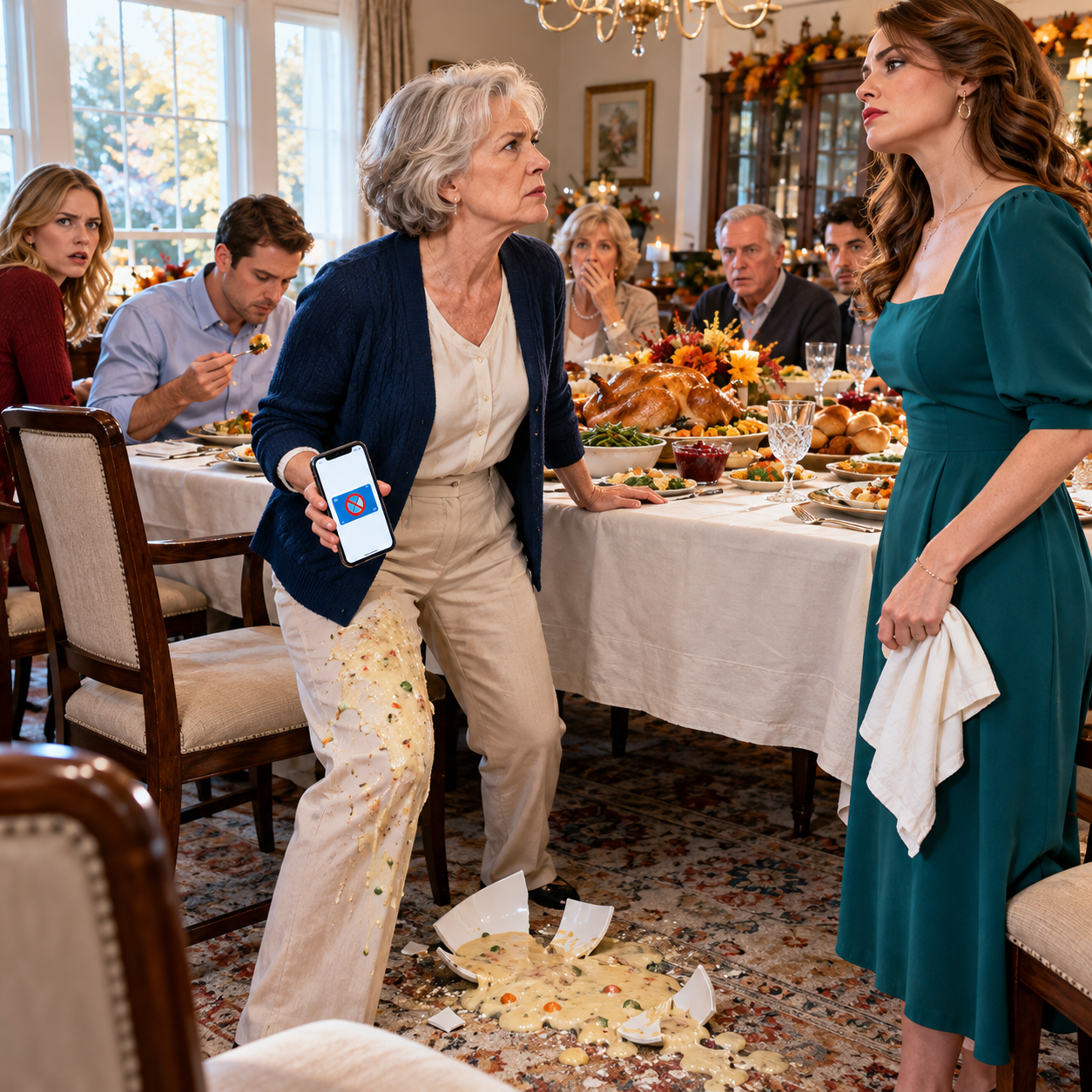
## Part 2: My quiet departure uncovers a secret plan for my home
Penny knocked on my bedroom door three minutes later. I’d pulled off my stained pants and was holding a cold, damp towel against my thighs when she entered. She took one look at me, crossed the room, and wrapped her arms around my shoulders. “Mom, I’m sorry,” she whispered. “I should have said something.”
I told her that watching her brother do nothing had hurt worse than the soup. Then I asked her to help me pack a bag, because I was going to spend a few days at her apartment in Charlotte. Penny answered immediately. “You’re coming with me.”
After changing into dark jeans and a soft sweater, I walked into the kitchen and gathered the broken bowl with a paper towel. I knew it was ridiculous to clean up after someone who’d just humiliated me, but I couldn’t leave sharp ceramic where a guest might step on it. Penny watched silently while I dropped the fragments into the trash.
Warren appeared near the front door as I collected my purse.
“Mom, where are you going? It’s Thanksgiving.”
“To Charlotte.”
“You can’t just leave because Amber made a mistake.”
I turned toward him, searching his face for some sign that he understood what had happened. “Did you see me sitting there, Warren?”
He glanced toward the dining room. “Of course.”
“And you kept eating.”
His jaw tightened. “I didn’t want to make a scene.”
I looked at the son I’d raised, remembering the boy who once cried because another child had been left alone on a playground. “You didn’t have to make a scene,” I told him. “You only had to care.”
For a moment, he looked ashamed. Then his expression changed.
“By the way, what happened to the Wi-Fi? Nobody can connect.”
I stared at him, almost unable to believe those were the next words out of his mouth.
“I changed the password.”
“Well, what’s the new one?”
“I haven’t decided whether I’m sharing it.”
I stepped outside with Penny, leaving my car in the driveway. Warren remained in the doorway, looking less like a concerned son than a man whose comfortable arrangements had suddenly stopped working.
We reached Charlotte after dark. Penny made decaf coffee, and we settled at her kitchen table beneath a small yellow lamp. For nearly two hours, she told me things she’d witnessed during visits to Asheville: Amber correcting me in front of guests, Warren dismissing my concerns, and conversations that stopped whenever I entered a room.
Then Penny placed her cup down with both hands.
“Mom, there’s something I should have told you last Christmas.”
My stomach tightened.
She explained that she’d overheard Amber talking to Warren about the house. Amber had complained that their current rooms were too cramped and said my bedroom would make a wonderful home office. Her solution was simple: persuade me to move permanently into the smaller guest room.
I stared at my daughter.
“What did Warren say?”
Penny hesitated. “He said he’d think about it.”
For several seconds, all I could hear was the refrigerator humming behind me.
I’d spent months wondering whether Amber realized how unwelcome she made me feel. Now I knew she’d been considering how to push me out of the largest room in my own home.
“Why didn’t you tell me?” I asked.
“Because I was afraid you’d defend them again.”
That hurt because it was true.
At nine that evening, Warren texted to say the internet was causing problems for our guests. Forty minutes later, another message arrived.
Amber’s card had been declined when she stopped for ice cream, and he wanted to know what was going on.
I turned my phone facedown.
The following morning, I began making calls.
First, I contacted a locksmith about re-keying the front and back doors while ensuring Warren and Amber retained access during their move. I arranged for the new keys to be available through Mrs. Ostrowski, my trusted neighbor of seventeen years.
Next, I called a property manager whose number I’d saved after meeting her at a library conference. I explained that I owned a four-bedroom house in Asheville and was considering making it available to tenants. She told me she already had interested clients and arranged to inspect the property the following Monday.
Before taking further action, I checked what notice and access arrangements would be required for Warren and Amber to leave properly. I wasn’t going to replace one ugly situation with another.
That afternoon, I sent Warren a carefully written message. I explained the lock arrangements, informed him that I planned to rent the house, and asked that he and Amber prepare to leave by November 30. A professional showing was tentatively scheduled for December 15, subject to the house being available.
His phone calls began almost immediately.
I let eleven calls go unanswered before picking up the twelfth.
“Mom, you’ve completely lost your mind,” he said. “You’re throwing us out because Amber spilled some soup?”
“No, Warren. I’m asking you to move because you’ve forgotten that this is my home.”
“She didn’t mean it.”
“Maybe you believe that. But I have spent two years pretending that your behavior doesn’t hurt me.”
His breathing became louder.
“You’re punishing us.”
I closed my eyes. “I’m not doing something to you. I’m finally doing something for myself.”
He fell silent, and for one brief moment, I hoped he would apologize.
Instead, he asked how we were supposed to afford an apartment.
That was when I realized the most difficult part of reclaiming my home would not be confronting Amber.
It would be refusing to rescue my son.
## Part 3: Two difficult choices finally break our family’s unhealthy dependence
Over the next several weeks, I discovered how much energy I’d spent preventing two grown adults from experiencing ordinary consequences.
Warren contacted his company’s human resources department to ask about emergency housing assistance. There was none. Amber called Patricia in Phoenix, presumably expecting her mother to offer an unlimited stay. Patricia surprised them both by saying they were welcome for four weeks, provided they actively searched for somewhere else to live.
For the first time in years, Warren and Amber had to make decisions without assuming my house would absorb the cost.
Penny and I returned to Asheville the following Monday for the property manager’s inspection. Before the appointment, I walked through my house and noticed how thoroughly Amber had stamped herself onto every room. Decorative pottery occupied my bookshelves. My favorite reading chair had been moved into a corner. Even Harold’s framed photograph had disappeared from the fireplace mantel.
I found it in the hallway closet, tucked behind a stack of unused picture frames.
For a long moment, I held the photograph against my chest.
Harold had worked hard to buy that house. After he died, I’d paid the mortgage, repaired the roof, replaced the furnace, and kept our family together with a librarian’s salary and careful budgeting. Every room contained a piece of our history, yet somehow I’d allowed someone who contributed almost nothing to decide what belonged where.
Penny found me standing in the hallway.
“Mom?”
I showed her the photograph. She looked at it, then gently took it from my hands.
“Let’s put Dad back where he belongs.”
Together, we returned it to the mantel.
That afternoon, Warren called. He sounded exhausted.
They’d found a two-bedroom apartment about twelve minutes away, but the security deposit and first month’s rent totaled slightly more than three thousand dollars. He explained that they were short and wanted to know whether I could lend them the difference.
I sat at my kitchen table, looking at the empty chair across from me.
For years, I would have opened my checkbook before he’d finished speaking. I could almost hear myself reassuring him that everything would work out and that he could repay me whenever he was comfortable.
Instead, I asked how much they’d saved.
He hesitated.
Then he admitted that the account held considerably less than he’d led me to believe.
“Warren, you’ve had more than two years to prepare.”
“I know, Mom. But we didn’t think we’d have to move this quickly.”
“Because you thought I’d never ask you to.”
He said nothing.
I pressed my palm against the table, remembering how easily he’d ignored my pain on Thanksgiving.
“I love you,” I told him. “But I’m not paying for the apartment.”
“You’re really saying no?”
“Yes.”
He ended the call without saying goodbye.
I cried afterward, sitting alone beside the window where Harold used to drink his morning coffee. Not because I regretted my decision, but because I had spent so many years believing that a good mother could always find one more sacrifice to make.
Eventually, Warren and Amber found the money themselves. Warren used part of his savings, and Amber sold several pieces of pottery she’d created during her classes. Apparently, her work was quite good, and she’d already been selling some privately.
That discovery troubled me more than I expected.
For months, I’d paid almost every grocery bill while Amber spent money on pottery classes and talked about buying a kiln. She’d been capable of earning extra income, yet it had never occurred to her to offer a meaningful contribution toward the household.
They moved out on a Tuesday.
When Penny and I returned that weekend, I stood in the front doorway, bracing myself for a disaster.
Instead, the house was clean.
The counters had been wiped down, the bathrooms scrubbed, and the guest rooms emptied. Amber had left the furniture arranged according to her preferences, but there were no broken fixtures or angry messages. Perhaps even she understood that some endings did not require a final argument.
I spent Saturday restoring my home.
I moved my reading chair beside the window, rearranged the towels, and returned my grandmother’s serving dishes to their proper cabinet. I opened every window and played the music Harold used to enjoy while we cleaned together.
Around three, Mrs. Ostrowski appeared carrying her famous lemon pound cake.
She set it on the kitchen counter and looked around.
“Well,” she said, smiling, “this looks like Miriam’s house again.”
I laughed, then unexpectedly began to cry.
She didn’t ask for an explanation. She simply cut two slices, brewed tea, and sat beside me until I was ready to talk.
The property manager returned for our final walk-through a few days later. She complimented the house, discussed rental rates, and began explaining how quickly she could find suitable tenants.
I listened while looking through the kitchen window at the maple tree Harold had planted.
Then I interrupted her.
“I’ve changed my mind.”
She lowered her folder. “About the timing?”
“About renting it at all.”
I looked around the kitchen, at the familiar cabinets and the sunlight falling across my table.
“I think I’d like to live here.”
She smiled and closed her folder.
For twenty-eight months, I had believed the only way to preserve my relationship with my son was to surrender pieces of my life.
Now the house was quiet again.
And for the first time in years, that quiet didn’t feel lonely.
It felt like freedom.
## Part 4: My son’s painful confession brings an unexpected chance for healing
Six weeks passed without a meaningful conversation between Warren and me.
He sent a brief Christmas message. I replied with love, but neither of us mentioned Thanksgiving, the apartment, or the afternoon he had watched me walk away. Penny visited often, and I began rebuilding the ordinary routines I’d almost forgotten: reading beside the window, gardening without interruptions, and cooking dinner without wondering whether Amber would criticize it.
Then, one Sunday evening, my phone rang.
It was Warren.
“Mom, could I come over?”
I gripped the phone. “Is Amber coming?”
“No. Just me.”
His voice sounded different. There was none of the irritation I’d grown accustomed to hearing whenever I refused him something.
“I need to talk to you.”
I told him he could come.
Twenty minutes later, he stood at my front door wearing an old navy sweater I’d given him years earlier. He looked thinner, and there were dark shadows beneath his eyes. For a second, I saw the fourteen-year-old boy who had stood beside Harold’s hospital bed, trying desperately not to cry.
I stepped aside.
He followed me into the kitchen and sat in the chair he’d occupied so many times before. I placed two cups of coffee on the table, then sat opposite him.
For several minutes, neither of us spoke.
Finally, Warren looked at his hands.
“I’m sorry, Mom.”
I waited.
He swallowed. “Not for Amber. I’m not here to apologize on her behalf. I’m sorry for what I did.”
I studied his face.
“What did you do, Warren?”
He lifted his eyes, and what I saw there made my chest tighten.
“I knew you were unhappy,” he admitted. “I knew she was taking over the house. Every time you tried to talk to me about money or boundaries, I made you feel unreasonable because I didn’t want to have an argument with my wife.”
He rubbed his forehead.
“I kept telling myself you were strong enough to handle it.”
I felt tears gathering, but I refused to look away.
“Being strong doesn’t mean I don’t get hurt.”
“I know that now.”
He stared at the coffee between his hands.
Then he said something I hadn’t expected.
“There’s something else about Thanksgiving.”
My fingers tightened around my cup.
“I saw Amber move the bowl before it spilled. I saw how angry she was when you answered her about the turkey.”
My heart began pounding.
“Are you telling me you knew she did it deliberately?”
He hesitated.
“I can’t prove what she intended. But I saw enough that I should have checked on you immediately. Instead, I convinced myself it was an accident because I didn’t want to deal with what it meant if it wasn’t.”
I sat very still.
All those weeks, part of me had wondered whether Warren simply hadn’t understood the humiliation. I’d imagined he was distracted or uncomfortable, perhaps too embarrassed to react in front of the guests.
Now I understood something worse.
He had noticed.
He had made a choice.
“Why?” I whispered.
Warren’s eyes filled.
“Because I was a coward, Mom.”
He looked down, then continued.
“Every time Amber complained about something, I expected you to make it easier. And you always did. I got used to letting you carry the uncomfortable part of my life.”
I thought of the four hundred dollars they’d stopped paying, the bathroom walls, the neighborhood potluck, and the photograph of Harold hidden in a closet.
Then I remembered Penny’s revelation.
“Did you know Amber wanted me to move into the guest room so she could take my bedroom?”
Warren’s face changed.
That was answer enough.
He nodded.
“She mentioned it. I told her I’d think about it.”
I pressed my lips together.
“That room was mine and your father’s.”
“I know.”
“And you considered asking me to leave it?”
He closed his eyes.
“I didn’t think you’d actually agree.”
I looked at him for a long time.
“Warren, that’s not the point.”
His shoulders sagged.
“I know, Mom. I understand that now.”
The kitchen fell silent. Outside, the bare branches of the maple tree moved against the window, and I could hear the faint ticking of Harold’s old wall clock.
I wanted to embrace my son. I wanted to tell him everything was forgiven, that he could forget Thanksgiving and that we would somehow return to the family we had once been.
But I had spent too many years making promises simply because someone else needed to hear them.
So I told him the truth.
“I love you, Warren. I will always love you. But I don’t trust you the way I used to.”
A tear slipped down his cheek.
“I understand.”
“And I can’t repair that for you.”
He nodded.
For the first time that evening, he didn’t offer an excuse.
He told me the apartment was small but manageable. They were paying their bills, planning their expenses, and learning how to live without assuming someone else would rescue them. Amber was selling more pottery, and Warren admitted that he should have insisted they contribute to my household long before Thanksgiving.
I listened without offering money or solutions.
Eventually, he stood to leave.
At the front door, he turned and reached for me.
“Can I hug you, Mom?”
I stepped forward.
He held me tightly, and for a moment, I allowed myself to remember the little boy who had once believed his mother could fix anything. I kissed his cheek, then gently released him.
Some things, I realized, could only be repaired by the people who had broken them.
Warren and I began talking again after that evening. Slowly, cautiously, with boundaries neither of us had understood before. He sometimes visited for coffee, and we gradually found subjects that didn’t reopen old wounds.
Amber never apologized.
I stopped waiting for her to.
She and Warren remained married, and I made peace with the fact that I could love my son without surrendering my dignity to his wife. Whether Amber would ever understand what happened was no longer a problem I needed to solve.
One afternoon, months after Thanksgiving, I stood in my kitchen preparing cornbread dressing for a small family dinner. Sunlight filled the room, my grandmother’s mixing bowl sat on the counter, and Harold’s photograph rested on the mantel where it belonged.
Penny arrived early and found me setting out plates.
She glanced toward the dining table.
“Mom, do you ever wish you’d handled Thanksgiving differently?”
I considered the question.
I remembered the hot soup, the burning skin, the silence of my guests, and Warren’s fork moving steadily toward his mouth.
Then I looked around my kitchen.
“No,” I said. “I wish I’d handled the two years before it differently.”
Penny smiled sadly.
I placed the final plate on the table and rested my fingertips against the polished wood. For so long, I’d confused keeping the peace with protecting my family. I’d believed that if I swallowed enough hurt, made enough sacrifices, and asked for little enough in return, the people I loved would eventually recognize what I’d given them.
But love should never require a person to become invisible.
I hadn’t lost my son by finally saying no. I’d given him the opportunity to see me as someone other than the woman who solved every problem and absorbed every insult.
Whether our relationship would ever be what it once was, I didn’t know.
What I knew was that I could sit at my own table without fear.
I could open my own front door without wondering what had been changed inside.
And I could look at my husband’s photograph without feeling like a guest in the life we’d built together.
That Thanksgiving, my daughter-in-law had spilled hot soup into my lap, and my son had continued eating.
I didn’t beg for an apology. I didn’t scream for respect. I didn’t ask permission to reclaim what was mine.
I simply stood up.
And for the first time in twenty-eight months, I never sat back down in the place they’d made for me.
THE END.
All characters and events in this story are fictional, created for storytelling and entertainment purposes. Thank you sincerely for reading. Your feedback and support are invaluable and motivate me to continue sharing more stories with you.


