
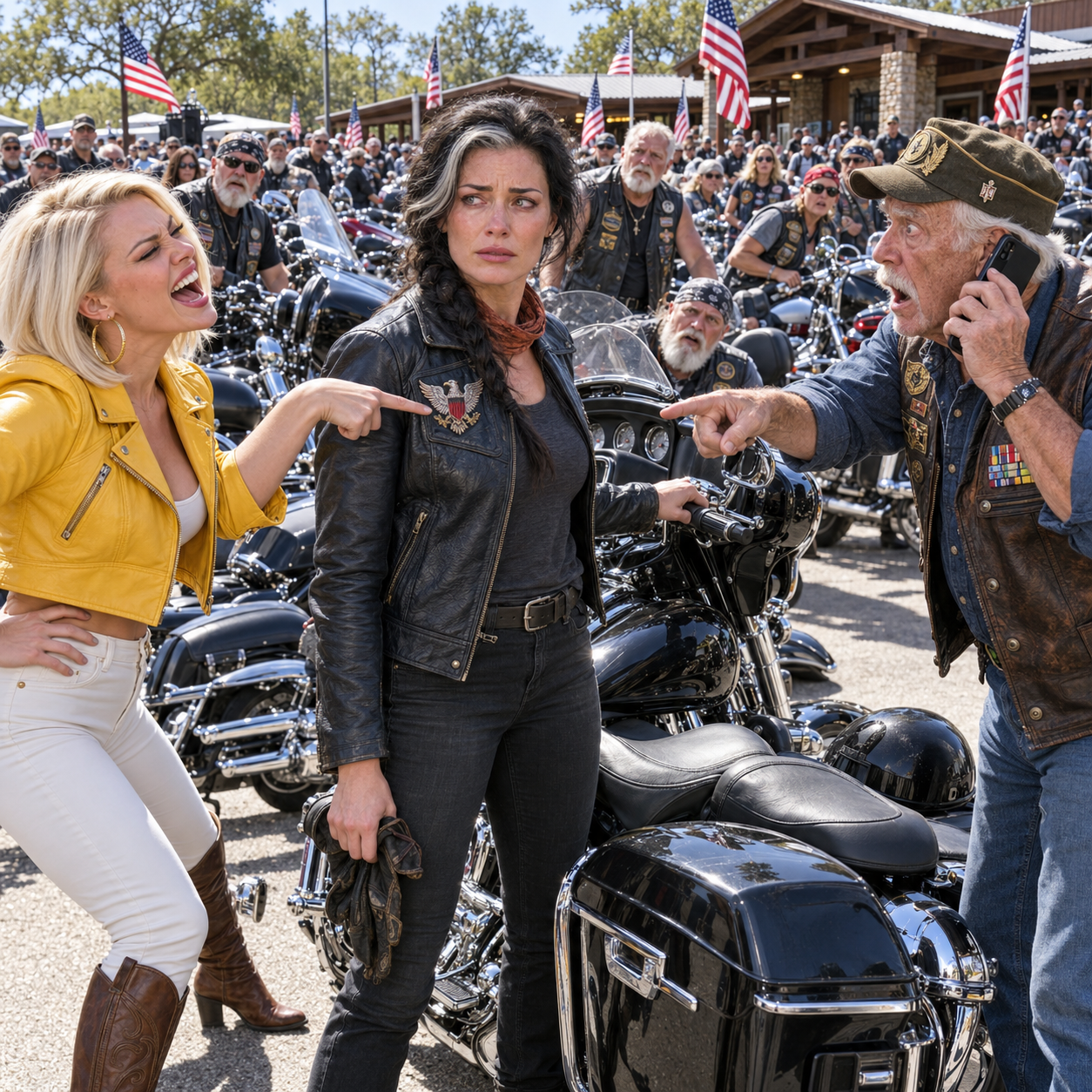
Charity Ride. 40 Harleys. My Sister Pointed At My Jacket: “Ask Her. She’ll Tell You She’s A Hero. She Always Does.” I Said Nothing. An Old Rider In A Vietnam Cap Read The Patch, Set Down His Helmet, And Pulled Out His Phone. My Sister Rolled Her Eyes. “Get Everybody Here. Don’t Ask Why.”
My sister humiliated me in front of forty bikers at a charity ride, pointing at my old leather jacket and telling everyone I wore it because I was desperate to be thanked for my military service. I stayed quiet, just as I had for fourteen years, until an elderly veteran noticed the patch on my shoulder and made a phone call that changed everything. Three nights later, my father found something my mother had hidden before she died, and I finally understood that my sister’s cruelty had started long before that afternoon.
Part 1
The first person who ever taught me to be brave was also the first person who made me ashamed of it. Her name was Brenna Kellan, and when I was ten years old, I thought my older sister could do absolutely anything. She could start our father’s stubborn lawn mower with one pull, climb the enormous oak tree behind our house without touching the lower branches, and persuade our mother to let us stay at the lake until the fireflies appeared. When she taught me to ride a dirt bike behind the electric cooperative outside Mountain Home, Arkansas, she gave me one piece of advice I carried into places neither of us could have imagined.
“Don’t stare at what scares you, Audra,” she told me, steadying the handlebars while the little engine rattled beneath my knees. “Look where you want to end up.”
I was terrified of a drainage ditch at the edge of the gravel lot, so naturally I rode straight into it. Brenna pulled the motorcycle off me, inspected my scraped elbow, and made me climb back on before I could start crying. She pointed toward a fence post fifty yards away, and when I finally reached it without falling, she cheered so loudly that three linemen came outside to see what had happened. For years afterward, whenever someone asked why I trusted my sister, I remembered her standing in that cloud of dust, looking prouder of me than I was of myself.
We grew up in a modest brick house overlooking Norfork Lake, where our father, Miles, worked for the electric cooperative and our mother, Sylvie, kept accounts for a local marina. Dad measured his weekends in miles on a black Harley-Davidson Road King, and Mom measured hers in grocery receipts, clean sheets, and whether everybody had eaten enough. Brenna was outgoing, fearless, and almost impossibly capable, while I preferred books, quiet rooms, and repairing anything people were ready to throw away. Everyone assumed she would eventually leave Arkansas and do something extraordinary, while I would remain close to home.
Instead, the opposite happened.
During my senior year of high school, an Army recruiter visited our cafeteria with a folding table covered in brochures. I wasn’t particularly interested in the smiling soldiers beside helicopters or the advertisements promising exciting careers. What caught my attention was a photograph of a technician wearing a heavy protective suit beside an empty road, accompanied by a description of Explosive Ordnance Disposal. The recruiter explained that the training was demanding, the work dangerous, and the responsibility enormous, and I went home knowing I had found something that frightened me for reasons I couldn’t quite explain.
When I announced my decision to enlist, Mom cried over her untouched meatloaf, Dad disappeared into the garage, and Brenna demanded to know what job I had chosen. I told her I would be working with military ammunition, which was technically accurate but left out almost everything important. She studied me across the kitchen table, searching for the little sister who used to follow her around, then asked whether I was sure. I said yes, and for the first time in my life, she didn’t try to change my mind.
She drove me to the bus station before sunrise that June, using her aging Chevrolet with the unreliable heater and a passenger window that wouldn’t close completely. Somewhere outside Conway, she reached across the console and squeezed my wrist without taking her eyes off the road. “Call Mom every Sunday,” she said, “and don’t pretend you’re fine if you aren’t.” At the station, she hugged me so tightly that my ribs hurt, and I remember thinking there would never be a day when I couldn’t tell Brenna the truth.
Training changed that assumption before I understood what was happening. After basic training came months of instruction at military facilities in Alabama and Florida, followed by examinations, exhausting field exercises, and the constant knowledge that mistakes in my profession could cost other people their lives. I discovered I could remain remarkably calm under pressure, even when my hands were shaking afterward. By the time I earned my EOD qualification, I had learned more about responsibility than I knew how to explain to someone who had never stood beside me on a training range.
Brenna drove to Florida for my graduation because Dad couldn’t get away from work and Mom had begun experiencing unexplained weakness. She sat near the front of the auditorium, wearing a blue dress and the proud expression I remembered from the dirt-bike lesson, and afterward she insisted we celebrate with fried shrimp at a restaurant overlooking the Gulf. When she noticed the distinctive EOD badge on my uniform, she tapped it with one finger and jokingly asked whether the Army had awarded me a metal crab. I nearly explained everything, but then she mentioned that Mom had dropped a coffee mug that morning because her fingers wouldn’t cooperate.
I told her only that the badge meant I had completed a difficult school.
The following year, Mom received a diagnosis of multiple sclerosis, and the landscape of our family changed almost overnight. Brenna abandoned her plans to finish an accounting degree away from home, moved back into her childhood bedroom, and became the person who scheduled appointments, collected prescriptions, handled insurance calls, and drove two hours to Springfield whenever Mom needed specialist care. I was stationed far away, learning the rhythm of military deployments, and I responded in the only practical way I understood: I sent money home every month. Brenna never complained about the deposits, but she rarely thanked me for them either.
In 2010, she married Graham Royce, a motorcycle salesman whose generous laugh and broad shoulders made him seem like someone who could carry an entire household without noticing the weight. I returned for the wedding, wearing my dress uniform because Mom asked, and spent the reception accepting handshakes from relatives who wanted to thank me for my service. Across the room, Brenna repeatedly helped Mom stand, adjusted her chair, fetched water, and made sure her medication was in the overnight bag. I noticed the activity without considering what it cost her, because I had already convinced myself that the money I sent home represented my share of the responsibility.
A year later, in Afghanistan, that comfortable explanation began to fall apart.
I was twenty-four, serving on an EOD team attached to a unit conducting operations through rural Kandahar Province. Our team leader, Staff Sergeant Tamsin Holt, was an exceptionally steady woman who carried sunflower seeds in every available pocket and believed panic was something you could acknowledge without obeying. She frequently reminded us that the smallest decision could matter more than the loudest act of courage. I thought of Brenna whenever Holt told me to concentrate on where I needed to go rather than what might happen on the way.
On August 14, 2011, a vehicle in a military convoy struck an explosive device along a dirt road bordered by mud walls and orchards. The armored vehicle absorbed the initial blast, but the front axle was destroyed, leaving nine soldiers trapped inside while our team assessed the damaged road. A second explosion injured Holt and forced everyone behind cover, and the situation became far more serious when the trapped soldiers reported another suspicious object beneath the vehicle. They couldn’t safely move the truck, and the damaged rear exit made evacuation uncertain.
Our equipment had already taken a beating that day, the light was disappearing, and Holt was lying beside a medic with blood soaking through the bandage on her arm. She looked at me while someone on the radio asked for instructions, and I recognized the expression of someone who knew exactly how few options remained. “Audra,” she said, speaking so quietly that only I could hear, “they need somebody who can keep her head.” I looked at the stranded vehicle, then toward the people waiting behind me, and understood that the next decision was mine.
Nine strangers were sitting above something that could end their lives, and none of them knew my name.
Part 2
I remember the silence beneath that vehicle more clearly than the explosion that brought us there. The metal above me creaked as the trapped soldiers shifted, and I could hear someone praying through a damaged section of the floor. My radio carried Holt’s voice from behind the convoy, steady and familiar despite the pain she was in, while the remaining team members monitored the situation and prepared for an emergency evacuation. I concentrated on the task directly in front of me, refusing to think about what the nine people overhead might have waiting for them back home.
Thirty-eight minutes passed before I was able to report that the immediate danger had been neutralized. I still remember the sound of the rear exit finally opening, followed by the desperate relief of soldiers climbing into the evening air. One young private named Jonah Bell had suffered a severe injury during the original explosion, and as we helped move him toward the approaching medical helicopter, he caught my sleeve. “Who are you?” he asked, his face pale beneath the dust, and I told him my name just before the rotor noise swallowed my answer.
All nine soldiers survived, although Jonah eventually lost his left leg below the knee. Holt recovered and returned to duty, and months afterward I received a Bronze Star Medal with a “V” device for valor during a small ceremony at Fort Campbell. I accepted the award, shook the appropriate hands, and went back to work without mentioning it during my next Sunday call home. By then, Mom’s condition had worsened, and Brenna was spending so much time caring for her that I couldn’t imagine adding the details of that afternoon to everything she already carried.
The following summer, an envelope arrived through military channels containing an embroidered patch and a handwritten letter. The patch showed a brass lantern surrounded by nine white stars, with the date of the incident stitched beneath it, and the letter explained that Jonah’s mother had made a small number of identical patches for the people connected to the rescue. She had included one for the soldier whose light Jonah remembered seeing beneath the damaged vehicle, because he had never forgotten the stranger who stayed with them. At the bottom of the letter were nine signatures, along with a short message from Jonah: “My grandfather says a person who saves somebody becomes part of that family’s story, whether she wants to or not.”
I kept the patch in my desk for almost a year before sewing it onto the shoulder of my old riding jacket. Dad watched from his garage while I struggled with the thick leather and asked what the lantern represented. “Something from my unit,” I told him, and he accepted the answer because we had reached an unspoken agreement about my career. In hindsight, I wonder how many opportunities he gave me to speak and how many I mistook for permission to remain silent.
Back home, Brenna’s life grew smaller as Mom’s needs grew larger. Her accounting degree remained unfinished, vacations became complicated arrangements involving wheelchair access and backup caregivers, and even an evening at the movies required somebody to cover for her. Graham expanded his motorcycle dealership, and Brenna helped with the bookkeeping whenever she could, although most days she arrived exhausted and left early to prepare dinner for our parents. I visited when leave allowed, paid for household repairs, and returned to Kentucky with the familiar guilty relief of someone who could drive away.
The jokes began after a Christmas dinner when a neighbor thanked me for my service. Brenna handed me the gravy boat and announced, “Careful, Audra will want you to say it twice,” making the entire table laugh. At Easter she called me our family’s favorite war hero, and at Thanksgiving she asked whether I needed a standing ovation before carving the turkey. I laughed along because I remembered the sister who had pulled me out of a ditch and assumed she couldn’t possibly mean the insults underneath her smile.
Mom died in November 2019, after a final week during which Brenna barely left her side. I had been committed to a military assignment I couldn’t immediately leave, and by the time I reached Springfield, my mother had been gone for several hours. Brenna met me at the hospital with red eyes and a plastic bag containing Mom’s glasses, her wedding ring, and the blue cardigan she always wore when she was cold. She handed it to me without a hug and said, “I kept telling her you were coming.”
At the funeral, I wore my uniform because Dad asked me to, and strangers formed a line to shake my hand and thank me for serving our country. Across the fellowship hall, Brenna managed food deliveries, collected flowers, answered questions from relatives, and made sure Dad remembered to take his blood pressure medication. When the last visitor left, she stood beside Mom’s photograph and watched me fold my uniform jacket over one arm. “Isn’t it remarkable,” she said, “how everybody remembers to thank the daughter who wasn’t here?”
I had no defense against the part of that sentence that was true. I also knew that I had begged for permission to leave my assignment and would have given almost anything to reach Mom before she died. Instead of explaining, I stared at the carpet and let Brenna walk away, beginning a silence that hardened over the next six years. We still exchanged birthday messages and attended the occasional family holiday, but the woman who had once known every detail of my life gradually became someone I approached with caution.
By the fall of 2025, I was a master sergeant overseeing operations and training for an EOD battalion at Fort Campbell. Dad called that September to say he needed knee replacement surgery in December and wanted to participate in one last long motorcycle ride beforehand. He had chosen the Nine Lanterns Ride, an annual fundraiser for wounded service members that Graham’s dealership sponsored and Brenna helped organize. I knew the event’s name because it had been inspired by the same rescue commemorated on my jacket, although my family had never made that connection.
“Ride beside me just once, Audra,” Dad said. “Before I start getting replacement parts.”
I agreed, knowing that my father had earned more from me than another polite excuse. On October 11, we rode through the Ozark hills beneath trees turning gold and red, with the morning wind pressing against the leather jacket I had worn since high school. At the registration table, Brenna gave me a wristband, inspected the jacket with a dismissive smile, and advised me not to fall behind the older riders. I noticed that she spent several minutes thanking donors and volunteers personally, and I wondered whether she had ever noticed that she had stopped speaking to me that way.
At lunchtime, approximately forty riders gathered beneath the covered patio of a roadside smokehouse, where the smell of barbecue drifted across picnic tables and a raffle table stood beside the entrance. Dad and I sat near an elderly man wearing a faded Vietnam veteran cap, with an old leather vest draped across his narrow shoulders. He introduced himself as Edwin Bell, and when I offered him the extra napkins from our table, he thanked me with the unhurried courtesy of someone who had spent decades listening more than talking. I had no reason to connect his surname with the young soldier I had helped fourteen years earlier.
Brenna began announcing raffle prizes through a cordless microphone, thanking sponsors, congratulating long-distance riders, and charming the crowd with stories about familiar customers. Then her eyes settled on me, and I recognized the particular smile she wore when she wanted to turn somebody into a joke. “Everybody, that’s my little sister Audra,” she announced, pointing toward our table. “She’s been in the Army forever, and she wears that old jacket everywhere because she practically begs people to thank her for her service.”
Several riders laughed, and Brenna encouraged them by adding, “Seriously, don’t get her started, or she’ll spend the afternoon telling you how heroic she is.”
Dad pushed back his chair, but I placed a hand on his arm, unwilling to turn his final ride before surgery into a public argument. I lowered my gaze toward my untouched plate and waited for Brenna to finish, reminding myself that nobody there knew enough about my life to understand how cruel her words were. Then I heard Edwin set down his fork, slowly enough that the faint clink against his plate carried through a pause in the laughter. He was staring at my left shoulder with an expression that made my stomach tighten.
“Young lady,” he said, his voice barely above a whisper, “would you mind letting me see that patch?”
I turned toward him, and he leaned forward to examine the embroidered lantern, the nine white stars, and the date along the lower edge. His hands began trembling, and for a moment I thought he might be ill. Instead, he reached inside his vest, retrieved an old cell phone, and made a call while the other riders gradually stopped talking. “Jonah,” he said when somebody answered, “I need you to bring the others to the smokehouse, and I need you to believe me when I say I’ve finally found her.”
He ended the call, looked directly at me, and removed his cap.
“Fourteen of those patches were made,” he said. “For fourteen years, I’ve known where thirteen of them were.”
Part 3
The first motorcycles arrived twenty minutes after Edwin’s call, followed by another group whose engines filled the gravel parking lot with a low, rolling thunder. Riders wearing matching black vests dismounted beside the smokehouse, many of them carrying the same lantern emblem embroidered on my shoulder. They moved with an unusual sense of purpose, scanning the tables until Edwin raised his hand. I stood without knowing why, suddenly feeling more exposed than I ever had in uniform.
The last vehicle was a dark red motorcycle trike ridden by a broad-shouldered man with a short beard and a prosthetic left leg. He climbed off carefully, paused to adjust his balance, and began walking toward me while the others moved aside. Fourteen years had changed his face, but not the searching expression in his eyes, and I recognized Jonah Bell before he reached the table. The last time I had seen him, he was a frightened twenty-year-old being carried toward a helicopter, still trying to ask the name of the person who had helped him.
“You never answered my question,” he said, looking from my face to the patch and back again.
“I tried,” I replied. “The helicopter was too loud.”
He laughed, but his expression collapsed halfway through, and the next moment he was holding me in an embrace that felt less like a greeting than the release of something he had carried for years. I could feel his shoulders trembling against mine, and I found myself remembering the damaged vehicle, the fading daylight, and the fear I had forced myself to ignore. When he finally stepped back, he told me that every man who had survived that afternoon had spent years searching for the technician whose identity had never made it into the accounts they received.
Edwin, Jonah’s grandfather, turned toward the gathered riders and explained what the lantern represented. He described the convoy, the nine soldiers trapped inside the damaged vehicle, and the specialist who had approached it when her team leader was injured. Several people removed their caps, and the smokehouse became so quiet that I could hear a loose metal sign tapping against the building in the wind. Edwin didn’t call me a hero or ask for applause; he simply told them the charity ride existed because nine families had been given the opportunity to welcome their loved ones home.
Then he indicated the patch on my shoulder.
“That’s the one we were missing,” he said.
Nobody cheered, and I was grateful for that. Jonah introduced me to several men from the original convoy, some of whom had traveled from neighboring states after receiving his call, and they spoke about ordinary things before asking anything about Afghanistan. One had become a high school counselor, another owned a repair shop, and a third showed me pictures of his three daughters, the oldest of whom had just started college. The years represented by those details affected me more deeply than any medal ceremony ever had.
When I finally looked toward the raffle table, Brenna was standing beside Graham with the microphone hanging uselessly from her hand. Her face had lost its color, and she kept glancing between me and the riders who had gathered around our table. Dad looked overwhelmed rather than surprised, as though he had always suspected something important was missing from the explanations I gave him. I excused myself, found him near the motorcycles, and asked whether we could go home.
He didn’t make me explain.
That evening, we sat in his garage while the Road King cooled beside us and my old jacket lay across the workbench. Dad admitted that Mom had questioned my vague descriptions of Army inventory work many times, although she had never pushed me to tell her more. I explained the meaning of the badge, the rescue, and the decoration I had received, and he listened while rubbing a grease stain on his thumb. Finally he asked why I had trusted strangers with my life but couldn’t trust my family with the truth.
“Because you couldn’t do anything about the danger,” I answered. “And I couldn’t bear the thought of giving Mom another thing to be afraid of.”
He considered that for a long moment before saying, “You protected us from knowing, Audra, but that doesn’t mean we were protected from what happened.”
The next afternoon, Brenna and Graham came over for an early dinner because Dad insisted we needed to speak before the entire town decided what our family believed. I explained my work from the beginning, including the reason I had avoided the charity ride for years, without describing anything I wasn’t permitted to discuss. Graham listened with quiet interest, occasionally asking questions, while Brenna watched the yellow pitcher of sweet tea that Mom had used at every holiday meal. When I finished, she pushed her untouched plate away and asked whether I understood how humiliating the previous afternoon had been for her.
“You let me make an idiot of myself in front of everybody,” she said. “My husband’s customers, our volunteers, men we’ve been raising money for all these years.”
“I didn’t make you say those things.”
“You knew what that patch meant.”
“Yes, and you knew you were trying to embarrass me.”
Her expression hardened, and she accused me of treating the entire family as though they were too foolish to understand my career. She reminded me that Brenna had organized registrations, donations, meals, and volunteers for years while I had sent occasional checks and made excuses about being busy. I acknowledged that I had left her carrying responsibilities I couldn’t fully understand, but I refused to accept responsibility for the words she had chosen in front of forty strangers. When she demanded an apology for her humiliation, I told her I was sorry she had been hurt by the revelation, not that she had suffered consequences for humiliating someone else.
Graham finally interrupted, telling Brenna that she had been making those jokes for years and that he had repeatedly suggested she stop. She turned on him, furious that he would contradict her in front of me, and he looked exhausted rather than frightened. “You keep telling everybody she’s asking to be thanked,” he said, “but you’ve been angry about not being thanked yourself since your mother got sick.” Brenna stood so abruptly that her chair scraped across the kitchen floor, grabbed her purse, and left without another word.
Before following her, Graham told me something I hadn’t known. Brenna had proposed adding a caregiver support fund to the Nine Lanterns Ride several years earlier, arguing that families providing long-term assistance to injured veterans needed transportation, respite care, and help with ordinary household emergencies. The committee had declined because its existing donors preferred their contributions to go directly to wounded service members. Brenna had continued handling registration and fundraising despite the rejection, but Graham believed she had gradually come to resent every public expression of gratitude that excluded the people who stayed home.
That explanation troubled me, although it didn’t excuse her behavior. She had recognized an injustice in the community, tried to address it, and then directed her frustration toward the easiest person to hurt. I had done something similar by measuring my contribution to Mom’s care in bank transfers while avoiding conversations about what Brenna’s days actually involved. We had both found ways to misunderstand each other that were convenient enough to preserve for years.
By Tuesday, a video of the smokehouse incident was circulating online. Someone had filmed Brenna pointing at me, the laughter that followed, Edwin recognizing the patch, and the arrival of the other riders, although the recording couldn’t explain the complicated history behind any of it. Customers began asking uncomfortable questions at Graham’s dealership, the charity committee requested that Brenna step away from public announcements, and a reporter contacted me for an interview. I declined, asking instead that she write about the wounded veterans and the families the event supported.
I didn’t enjoy seeing my sister embarrassed, but I wasn’t willing to rescue her from the consequences of her own choices. For years she had treated my silence as permission to insult me, and I had finally stopped participating in that arrangement. I returned to Kentucky believing the situation would gradually quiet down, leaving only the knowledge that some family relationships couldn’t be repaired by a single conversation. Then Dad called on Wednesday night, his voice unusually strained.
He had been searching through Mom’s old sewing supplies for a missing photograph when he discovered a small tin box beneath the fabric and thread. Inside were several folded pages, an unfinished letter, and a calendar from the last years of Mom’s illness. The pages weren’t about my Army career, although my name appeared repeatedly alongside Brenna’s. Dad told me he had read only enough to understand that Mom had been keeping a record of something none of us had ever discussed.
“Audra,” he said, “your mother knew your sister was falling apart, and I think she was trying to tell us.”
Part 4
Dad sent photographs of the pages the following morning, and I sat at my kitchen table studying Mom’s uneven handwriting until the coffee beside me went cold. Some entries were ordinary reminders about medical appointments and grocery expenses, while others described Brenna falling asleep in the laundry room, skipping meals, or crying quietly in the driveway before coming back inside. Mom had written that Brenna insisted she could handle everything, even on days when she could barely keep her own eyes open. Near the bottom of one page, my mother had underlined a sentence twice: “Everybody asks how I’m doing, but nobody asks how my girl is doing.”
The unfinished letter was addressed to Dad and me. Mom wrote that she loved us, understood that we had responsibilities of our own, and never wanted either daughter to believe her illness had ruined the family. But she was frightened that Brenna had built her entire identity around being useful, and that after Mom died, she wouldn’t know what to do with herself. Her final paragraph asked us to help Brenna find a life that belonged to her again, and the last sentence ended halfway across the page, where the pen had apparently slipped from her hand.
I called Dad after reading it and asked how he could have missed what was happening inside his own house. He didn’t defend himself or remind me of how much he had helped during Mom’s illness. Instead, he admitted that he had become so accustomed to Brenna handling emergencies that he had stopped recognizing when she needed help herself. “Every time I offered, she’d say she had it,” he told me, “and after a while, I was grateful enough to believe her.”
I recognized that pattern because I had practiced a different version of it. Whenever Brenna complained that I was never home, I increased my monthly transfer instead of asking what she actually needed. Whenever she made a joke about my service, I told myself that explaining my work would only frighten her or make the distance between us worse. I had mistaken avoidance for consideration, but her exhaustion hadn’t given her permission to humiliate me, any more than my military obligations had erased what she sacrificed.
In November, I supervised a training exercise for a group of young EOD technicians, including a private who reminded me painfully of myself at nineteen. She was talented, meticulous, and so anxious about disappointing her instructors that she barely spoke during the morning briefing. Afterward, I asked how she was managing outside the training environment, and she admitted that she hadn’t called her father in weeks because she didn’t want to tell him how overwhelmed she felt. I suggested that she try giving him one honest answer instead of another reassuring one, and when she walked away, I realized I needed to take my own advice.
That evening I wrote to Holt, who had retired several years earlier and lived in northern Minnesota. I told her about the charity ride, Jonah, the jacket, and my growing suspicion that I had spent my adult life treating difficult conversations as threats to be avoided. She answered a week later with a letter written in the same practical language she had used when we served together. “You were excellent at the work because you learned to understand what was in front of you,” she wrote, “but people aren’t assignments, Audra, and you can’t finish them by following the procedure correctly.”
I kept her letter beside Mom’s photographs.
Dad’s knee replacement was scheduled for December 3, and I arranged leave so I could be at the hospital before sunrise. Brenna was already sitting in the surgical waiting room when I arrived, wearing a gray sweater and holding a folder containing Dad’s insurance information, medication list, and recovery instructions. She looked surprised, then moved her purse off the neighboring chair without speaking. For the first two hours, we discussed the surgeon, the weather, and whether Dad would follow physical therapy instructions, avoiding anything that might turn the waiting room into another battlefield.
Eventually Brenna asked whether I wanted coffee, and we walked downstairs to the cafeteria together. She bought two paper cups and sat near a window overlooking the parking garage, where cars moved slowly around the concrete ramps. After several minutes she told me that during Mom’s final week, she had washed her hair in the kitchen sink because the bathroom had become too difficult to manage. “She used to close her eyes and smile when I did that,” Brenna said, staring into her coffee, “and for ten minutes I could pretend she wasn’t getting worse.”
She explained how the routine had continued through years of hospital visits, lost sleep, paperwork, and emergencies. There were nights when she lay awake listening for Mom to call, mornings when she couldn’t remember the last meal she had eaten sitting down, and weekends when Graham went riding because she insisted he should still have a life. She had loved Mom deeply, but sometimes she resented the responsibility, and afterward she felt so ashamed that she worked even harder. “Then at the funeral,” she said, “everybody walked past me to thank you for your sacrifice, and I couldn’t stop thinking that nobody even knew what mine had been.”
I let her finish without reminding her of the danger I had faced overseas. Her account wasn’t an argument against mine, and I could finally hear it without feeling that one of us had to lose. I told her about Mom’s unfinished letter, and Brenna covered her mouth with her hand as I described the observations Mom had written down. For several minutes she said nothing, then whispered, “She knew I was tired, and I spent all those years trying to make sure she never noticed.”
“She noticed,” I answered. “She loved you, and she was worried about you.”
Brenna wiped her eyes and eventually asked why I hadn’t told her about the rescue. I explained that I had wanted our family to remain somewhere I could be an ordinary daughter rather than a soldier surrounded by questions I couldn’t always answer. I also admitted that secrecy had become a habit long after the original reasons stopped making sense, but I reminded her that she had never needed to know about the medal to treat me respectfully. She looked down and said, “I wanted people to see what I’d done, and every time they thanked you, I heard it as proof that what I did didn’t matter.”
Then she finally said what I had needed to hear since the smokehouse.
“I was cruel to you, Audra, and I knew I was being cruel.”
I didn’t rush to reassure her. I told her that the jokes had made me dread family gatherings, that I had spent years waiting for her to embarrass me in front of other people, and that our relationship couldn’t return to what it had been simply because we now understood each other’s pain. Brenna listened without interrupting, although I could tell it cost her something. When she asked whether I could forgive her, I said I wasn’t ready and didn’t know whether I ever would.
We returned upstairs before the surgeon came to tell us Dad’s operation had gone well. For the next several days, Brenna and I worked together to manage his discharge, medication schedule, and physical therapy appointments, dividing the work instead of allowing her to assume responsibility for everything. I paid for temporary help during his recovery and made sure the arrangements didn’t require Brenna to become the default emergency contact for every problem. She thanked me once, quietly, and I appreciated that she didn’t ask whether our cooperation meant I had changed my mind about forgiveness.
Before returning to Kentucky, I visited Edwin and Jonah to discuss the future of the Nine Lanterns Ride. I explained what I had learned about Brenna’s rejected caregiver proposal and asked whether the organization might reconsider its mission without reducing assistance to wounded veterans. Edwin showed me the original founding papers, which emphasized practical support for service members and the families responsible for helping them recover. He admitted that the committee had gradually interpreted that promise too narrowly, particularly when fundraising became tied to public ceremonies and recognizable stories of military heroism.
At a January meeting, the committee agreed to establish a separate caregiver assistance program with its own donations, transportation volunteers, and short-term respite support. Brenna’s earlier proposal became the starting point, although she wasn’t offered automatic control of the program after what had happened at the smokehouse. I supported that decision because her work deserved recognition, but accountability couldn’t disappear just because her underlying grievance was legitimate. She began attending a local caregiver support group and offered to help organize practical resources without demanding a microphone or a public title.
In April, Edwin invited me to lead the next charity ride. I agreed on one condition: the organization would recognize the families who had carried responsibilities at home before anyone made speeches about medals or military service. He accepted immediately, then asked whether I wanted Brenna involved in the ceremony. I told him the decision was hers, and that I didn’t intend to use a public event to pretend our relationship had been repaired.
Two weeks later, an envelope arrived from Arkansas. Inside was a small embroidered patch showing the same brass lantern as the one on my jacket, but beneath it was a single word: HOME. Brenna had included a note explaining that Jonah’s mother was making patches for family caregivers, and she wanted Dad to receive the first one.
At the bottom, she had written, “You don’t have to ride with me again, Audra, but I finally understand why you didn’t want the applause.”
Part 5
On October 10, 2026, I rode into Graham’s dealership beside Dad beneath a sky so clear that the Ozark hills looked almost close enough to touch. His repaired knee had recovered well enough for him to ride comfortably, although he still complained that the surgeon hadn’t made him any younger. More than sixty motorcycles filled the parking lot, and a new banner beneath the familiar Nine Lanterns emblem announced the organization’s expanded support for military families and caregivers. I had dreaded returning to the place where my sister embarrassed me, but the sight of Dad guiding his old Road King into a parking space reminded me that I had come for reasons larger than that memory.
Brenna stood near the registration tent, helping a younger volunteer arrange folders and donation forms. She wore a plain dark jacket rather than the sponsor shirt she had once treated like a uniform, and the cordless microphone rested on a table several feet away. When she saw us, she smiled cautiously, hugged Dad, and handed him a small wrapped package. Inside was the embroidered HOME patch, accompanied by a note explaining that it represented the family members whose quiet dedication made survival and recovery possible.
Dad turned it over in his hands and asked whether she had made it herself.
“Jonah’s mother did the embroidery,” Brenna explained. “I helped her with the designs.”
He thanked her, and for once she didn’t make a joke to keep anyone from seeing how much the words meant. I watched the exchange without pretending it erased what had happened between us, but I was glad she could accept an ordinary expression of gratitude. When she turned toward me, I complimented the design, and she told me that more than two hundred patches had been prepared for the day’s participants.
We stood together for an awkward moment while motorcycles arrived behind us. Brenna glanced at my shoulder, where the original lantern patch had faded from years of sunlight, and said she hoped I understood that she hadn’t sent the new patch as a request for forgiveness. “I know I don’t get to decide when you stop being hurt,” she said. I thanked her for understanding, then went to help Dad arrange his helmet and gloves.
At seven forty-five, Edwin climbed onto a small platform near the dealership entrance, supported by Jonah on one side and a wooden cane on the other. He welcomed the riders, introduced the volunteers, and explained that the organization had approved its first caregiver assistance requests earlier that year. One family had received transportation assistance for medical appointments, another had been connected with temporary respite care, and a third had been helped through a difficult recovery period following a serious injury. The details were deliberately modest, because these were the ordinary problems that could quietly overwhelm a household long after the public ceremonies ended.
When Edwin invited me forward, I looked over the crowd and saw Jonah standing beside his mother, Lydia, who had sewn the original lantern patch all those years earlier. Behind them were people wearing faded military caps, riding jackets, work boots, and ordinary weekend clothes, with husbands standing beside wives and adult children holding the arms of elderly parents. I recognized several of the soldiers who had survived the explosion in Afghanistan, although I knew almost nothing about the people who had waited for them at home. For fourteen years, I had measured that afternoon by the lives saved, without fully appreciating the thousands of ordinary days those lives had made possible.
I began by telling everyone that I hadn’t planned to become part of the charity ride’s history. I had come the previous October because my father wanted one more long ride before surgery, and the experience had forced me to confront things about my family that I had spent years avoiding. Then I asked the audience to think about the people who were absent from most military stories: the relatives who drove to appointments, handled paperwork, paid household bills, changed bedding, prepared meals, and sat awake wondering whether the person they loved would ever come home. I told them those acts of care weren’t less important because they happened in kitchens instead of places associated with courage.
“My sister cared for our mother through ten years of serious illness,” I said, finding Brenna near the registration table. “She washed her hair when Mom couldn’t manage it herself, stayed awake when she was frightened, and gave up opportunities she had worked hard to earn. I sent money and made phone calls, but Brenna was the one who stayed, and she deserved to have that work recognized long before now.”
For a moment, Brenna looked as though she might leave. Then she lowered her head, pressed her fingers against her eyes, and stood quietly while the crowd applauded her. Dad took off his cap, and Graham crossed the lot to stand beside his wife, resting one hand against her back. I let the applause finish without adding another speech about how much our family had learned, because I didn’t believe every painful experience needed to be transformed into a public lesson with a happy ending.
When Edwin returned to the microphone, he invited the caregivers in attendance to step forward and receive their patches. Lydia began distributing them from a canvas bag, greeting each recipient personally, and I watched an older man become emotional when she thanked him for the years he had spent caring for his wife after her injuries. Several people embraced, while others simply accepted the patches with shy smiles and returned to their families. It was the first ceremony I had attended where nobody seemed interested in comparing whose sacrifice had been greater.
Brenna approached me afterward, carrying a small envelope. Inside was a copy of the caregiver proposal she had written years earlier, now bearing the committee’s approval and the signature of its new program coordinator. She told me she had decided not to lead the initiative herself, partly because she wanted the program to belong to the people receiving help rather than to her reputation. Instead, she had volunteered to coordinate transportation requests twice a month, work she could accomplish without public recognition.
“I spent so much time wanting somebody to notice me,” she said, “that I stopped noticing what I was doing to you.”
I told her I believed she meant the apology, but that I still couldn’t trust her the way I once had. She nodded, and for the first time I could remember, she didn’t argue with my assessment or insist that her intentions should matter more than the effect of her actions. We had both learned things about our family that explained the past, but understanding wasn’t the same as absolution. I could respect what she had done for Mom and appreciate what she was doing now without inviting her back into every private part of my life.
At eight o’clock, the motorcycles rolled out onto Highway 62 behind the sheriff’s escort. Edwin rode in a sidecar Jonah had modified for him, Dad traveled on my left, and the other riders followed through the familiar curves of the Ozark hills. The weather was cool enough to sting my cheeks, and the trees along the lake had begun turning the same deep red and yellow they wore the previous October. For the first time in many years, I wasn’t trying to ride at the back where nobody would notice me, but I wasn’t looking for an audience either.
At the smokehouse, we gathered beneath the same covered patio where everything had changed. I found the picnic table where Edwin had first noticed my patch and sat with Jonah while his grandfather told Dad about the early years of the charity ride. Brenna arrived a few minutes later with Graham and several volunteers, carrying a stack of paper plates and a tray of barbecue sandwiches. She set them down, greeted everyone politely, and sat at another table without trying to insert herself into the conversations around me.
Later that afternoon, Dad joined me beside my motorcycle and handed me Mom’s unfinished letter, carefully protected inside a plastic sleeve. He said he had made copies for Brenna and himself, but he thought I should keep the original because Mom had wanted both of us to understand what was happening before it was too late. I read the final paragraph again, studying the uneven letters and the place where her writing stopped, and imagined how frightened she must have felt watching her daughters become strangers while she was powerless to bring them together. I wished she had been able to finish the letter, although I no longer believed it could have solved everything.
Dad asked whether Brenna and I would ever be close again. I told him I didn’t know, because some relationships could survive years of distance but not the discovery that someone you trusted had deliberately enjoyed hurting you. He looked disappointed, but he didn’t ask me to reconsider, and I appreciated that more than another lecture about family obligations. I promised I would remain respectful at holidays and cooperate whenever he needed help, but I wouldn’t sacrifice my peace simply to make our family look whole.
Before leaving, Jonah asked whether I would attend the following year’s ride. I told him I would, provided my schedule allowed it, and he grinned as he reminded me that several of the men from the convoy still wanted to meet the woman who had helped them get home. We exchanged phone numbers, talked about visiting one another during the summer, and made plans that had nothing to do with ceremonies or military decorations. It felt good to build friendships with people who understood that what happened in Afghanistan mattered, but didn’t have to define every conversation afterward.
That evening, I returned to Dad’s garage and hung my leather jacket on the same nail where it had rested when I was a teenager. The original lantern patch remained on the shoulder, its nine white stars worn by time, and beneath it I had added the smaller HOME patch Lydia had given me. I ran my fingers over the stitching and remembered the little girl who had fallen into a gravel ditch while her sister stood nearby, insisting she could get up and try again. I still loved that memory, even though I had finally accepted that loving who somebody used to be didn’t require trusting who they had become.
Brenna and I didn’t suddenly start calling each other every Sunday. She continued with her caregiver support group and her volunteer work, while I returned to Kentucky and the responsibilities of training soldiers who would eventually face decisions of their own. When we spoke, the conversations were civil, sometimes even warm, but I maintained the boundaries I had explained to her at the hospital. I didn’t need to punish her forever, and I didn’t need to pretend that an apology had restored fourteen years of trust.
One evening, several weeks after the ride, Dad called to say Brenna had received a handwritten thank-you card from a woman whose husband needed long-term assistance. He told me she had kept the card on her kitchen counter for days, not because she wanted to show it off, but because somebody had finally recognized work that usually went unnoticed. I was glad for her, and when Dad asked whether he should tell her that, I said he could. Then we talked about his knee, his motorcycle, and whether he might visit Kentucky for Thanksgiving.
After we hung up, I looked at the jacket hanging beside my door.
For years, I had believed the most important thing about that patch was the afternoon when nine soldiers survived because our team refused to give up on them. Now I understood that the lantern represented something larger: the lives waiting beyond the danger, the people who kept those lives together, and the responsibility each of us carried toward the people we loved. I had earned the right to be proud of my service, just as Brenna deserved recognition for caring for our mother, but neither of those truths canceled the other.
My sister once told forty strangers that I wore my jacket because I begged to be thanked. She was wrong about me, but she had also been telling the world something about herself that nobody knew how to hear. I finally listened, and I acknowledged the sacrifices she had made, without excusing the harm she had chosen to inflict.
I never needed those forty bikers to applaud me.
I needed to learn that someone else’s pain could be real without making their cruelty acceptable, and that gratitude could be given freely without surrendering the boundaries that protected my peace.
And whenever I ride through those Arkansas hills now, I remember Brenna’s advice from the gravel yard: “Look where you want to end up.”
For the first time, I know exactly where that is.
THE END!
Disclaimer: Our stories are inspired by real-life events but are carefully rewritten for entertainment. Any resemblance to actual people or situations is purely coincidental.


