One Hour Before My Wedding, My Daughter Took Off Her Lavender Dress—Then She Told Me What My Fiancé Had Said
One hour before my wedding, I found my eleven-year-old daughter folding the lavender dress she’d spent six months dreaming about wearing. She whispered, “It’s okay, Mom. You deserve a happy family, even if I’m not part of it.” My heart stopped when she explained what my fiancé had told her behind my back. I thought he had merely changed our wedding plans, until I discovered he’d been making decisions about my daughter’s future too. Two hundred guests were waiting, but I suddenly knew I couldn’t marry him.
Part 1: The Lavender Dress
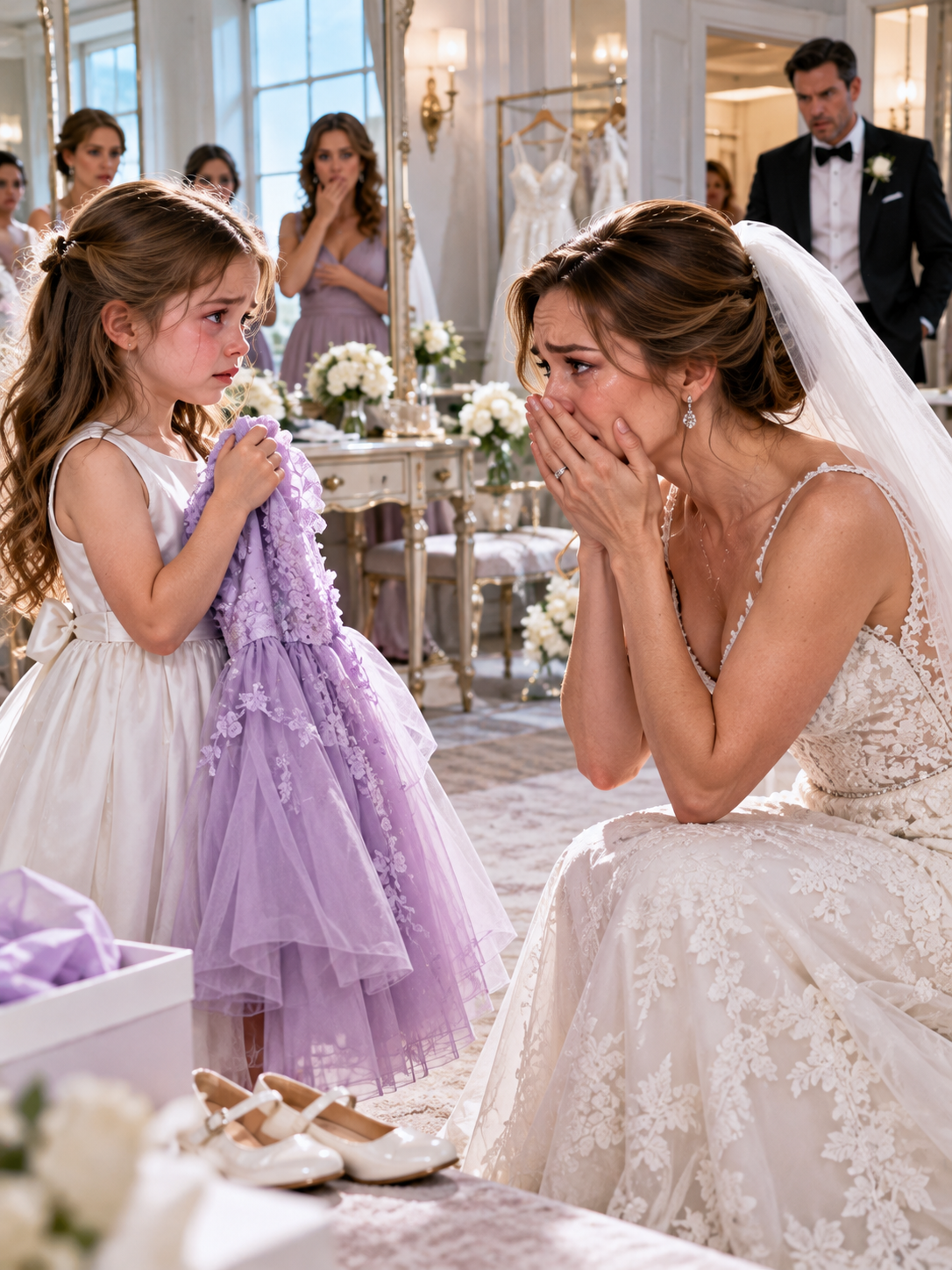
The first thing I noticed was the empty hanger. My daughter’s lavender dress, the one we’d spent three Saturdays searching for, lay folded across the back of a chair in the bridal suite. Eleven-year-old Sophie sat beside it wearing the ordinary blue sundress she’d arrived in that morning, her freshly curled hair falling around her shoulders. When I asked why she’d changed, she looked at the floor and whispered, “I don’t think I should walk with you anymore, Mom.”
I was forty-five minutes away from marrying Nathan Caldwell, the man I’d loved for nearly three years. Outside the suite, florists were arranging white roses along the chapel aisle, and I could hear the distant notes of our processional music drifting through the hallway. My best friend, Allison, was adjusting the ribbons on my bouquet when Sophie spoke. She stopped immediately, sensing something in my daughter’s voice that I hadn’t yet understood.
“Sweetheart, are you nervous about everyone watching us?” I asked, sitting beside her. We’d practiced walking together dozens of times, with Sophie insisting that we link arms exactly the way she imagined we’d do it at the ceremony. She shook her head, twisting a lavender ribbon around her finger. “Nathan said it would be better if I stayed with the other kids.”
I waited for her to explain, believing there must have been some confusion. Nathan had helped Sophie with science projects, taken us miniature golfing, and attended several school concerts during our engagement. When he proposed, he’d told me he wanted to build a future with both of us. I’d trusted those words enough to agree to marry him.
“He said his parents might feel uncomfortable if I stood beside you,” Sophie continued. “Because I came from your first marriage, and weddings are supposed to celebrate a fresh start.” She swallowed and added, “He said I could still sit near Grandma, so I wouldn’t be left out completely.”
My stomach tightened. Sophie had been seven when her father and I divorced, and although the separation was difficult, we’d worked hard to give her a stable childhood. She wasn’t an embarrassing reminder of something I’d done wrong. She was my daughter, the person who had taught me what unconditional love meant long before Nathan entered our lives.
“When did he tell you this?” I asked. Sophie stared at the lavender dress before answering, “Monday, when you went to pick up the flowers.” Five days earlier, she’d been unusually quiet at dinner, pushing peas around her plate while Nathan talked about the wedding. I’d assumed she was exhausted from school and the excitement of the approaching ceremony.
“He told me not to upset you,” she continued. “He said you’d already agreed, but you didn’t know how to tell me because you were afraid I’d cry.” Her voice became smaller. “And he said if I made a big deal about it, you might cancel everything.”
I pulled her against me, feeling her shoulders trembling beneath the cotton fabric. “I never agreed to anything like that,” I told her. “You were always supposed to walk beside me, Sophie.” She leaned back, her eyes suddenly wide with alarm. “Please don’t be mad at Nathan, Mom. He said you’d have to choose between us if I told you.”
Before I could answer, someone knocked on the door. Our wedding coordinator, Melanie, stepped inside carrying a tablet and asked whether we were ready to review the final processional arrangements. I looked toward Sophie’s dress and said, “I’d like to see the schedule Nathan gave you.” Melanie smiled, unaware of the tension in the room.
She opened the document and showed me the revised ceremony order. Sophie was scheduled to enter with Nathan’s nephew and sit in the second row, while I would walk alone toward the altar. The note beside her name read, “Bride’s daughter—guest seating, no ceremonial role.” I stared at the words, hardly recognizing the wedding I’d spent a year planning.
“Who approved these changes?” I asked. Melanie checked the file and explained that Nathan had emailed the revisions Monday afternoon, stating we’d discussed everything together. He’d also requested that no one mention the changes to Sophie until the wedding day because he wanted to avoid disappointing her. That was the exact opposite of what he’d told my daughter.
I asked Melanie to forward me the complete email, including any attachments. She hesitated, clearly uncomfortable, but agreed after confirming that I was the bride and a party to the planning contract. Allison quietly took Sophie into the adjoining dressing area to help her put on the lavender dress again. I remained by the mirror, reading the forwarded message.
Most of Nathan’s changes concerned the procession, but one attachment caught my attention. It was a revised photography schedule eliminating the planned portraits of all three of us together and replacing them with photographs of Nathan and me alongside his parents. At the bottom, he’d written, “Please keep the focus on our new family.”
I remembered Nathan saying those exact words during a conversation about our future home, but I’d never understood why they bothered me. Now, standing in my wedding gown with Sophie’s abandoned shoes beside my feet, I began to wonder how many decisions he’d made without me. I closed the email, handed my bouquet to Allison, and walked toward the groom’s dressing room.
I needed to hear Nathan explain why he’d removed my daughter from our wedding. What I didn’t know was that the seating chart was only the first part of his plan.
Part 2: The Man Behind the Perfect Smile
Nathan was standing in front of a mirror when I entered the groom’s dressing room. His brother, Eric, was fastening his cufflinks, and two groomsmen were laughing about something on a phone. Nathan turned with a delighted smile that disappeared when he saw my expression. “You’re not supposed to see me before the ceremony,” he said, reaching for my hand.
“Why did you tell Sophie she wasn’t allowed to walk with me?” I asked. Eric looked toward the other men and quietly suggested they give us some privacy. Nathan waited until the door closed before answering. “I didn’t say she wasn’t allowed. I suggested something that would make the ceremony more comfortable for everyone.”
I showed him the email Melanie had forwarded. “You changed the procession, removed Sophie from our family photographs, and told the coordinator I’d approved it.” Nathan glanced at the screen, then adjusted his tie as though the problem were my interpretation rather than his actions. “My parents are traditional, Rebecca. They’re paying for most of the reception, and they don’t want things looking complicated.”
“Complicated?” I repeated. “My daughter walking beside me is complicated?” He sighed and explained that his parents had invited several business associates who expected a conventional wedding. According to Nathan, displaying my daughter prominently would encourage questions about my previous marriage. I stared at him, trying to understand how the child he’d promised to love had become a public-relations problem.
“You told Sophie I wanted her out of the ceremony,” I said. Nathan crossed his arms. “I told her what I thought you would eventually agree was sensible.” His answer made me realize he’d deliberately chosen to speak with an eleven-year-old instead of confronting me. He’d expected her to surrender quietly so I wouldn’t discover the change until it was too late.
I asked whether he’d apologized to Sophie for making her feel unwanted. He looked genuinely irritated. “Rebecca, children can’t be at the center of every adult decision,” he replied. “We’re getting married, and our relationship needs to come first sometimes.” I told him that our marriage couldn’t begin by treating my daughter as an inconvenience. He answered, “She’s not an inconvenience, but she isn’t the bride.”
For a moment, I thought about every family outing we’d taken together. Nathan had always seemed patient with Sophie, although I now remembered occasions when he suggested she spend an extra weekend with her father so we could have uninterrupted time. I’d assumed he wanted ordinary couple time, which wasn’t unreasonable. But now his previous comments sounded different.
“Is this how you plan to treat her after we’re married?” I asked. Nathan rubbed his forehead and said we couldn’t continue organizing our lives around Sophie’s preferences. He explained that she was growing older and would eventually need more independence. Then he added, “Her father has a perfectly good house, Rebecca. There’s no reason she can’t spend more time there.”
My chest tightened. Sophie divided her time between my home and her father’s under an arrangement we’d established years earlier. She was happy, doing well at school, and surrounded by people who loved her. Nathan had never suggested changing that arrangement before. When I asked whether he’d already discussed it with anyone, his hesitation answered before his words did.
“Nothing official,” he said. “I mentioned to my parents that we might make some adjustments after the honeymoon.” I asked what adjustments, and he gestured toward the small writing desk beneath the window. A cream-colored folder sat beside his wedding vows. On its cover, in Nathan’s neat handwriting, were the words “Household Transition.”
He moved toward the desk before I could reach it. “That’s just planning material,” he said, blocking my path. I told him to move, and something in my voice finally made him step aside. Inside were notes about furniture, household expenses, and a tentative arrangement for Sophie to spend school weeks primarily with her father. Nobody had discussed those plans with me or with her father.
Nathan insisted he was only considering possibilities. I pointed to a floor plan showing Sophie’s proposed bedroom converted into a home office. He said his parents thought we should establish ourselves as a married couple before allowing children’s needs to dominate the house. The words were so cold that I briefly wondered whether I was hearing him correctly.
“You’ve planned where my daughter will live without asking me,” I said. Nathan finally lost his patience. “I am trying to give us a normal marriage, Rebecca. You keep acting like I’m asking you to abandon her.” I reminded him that he’d already asked Sophie to make herself invisible on our wedding day. He replied that he was tired of being treated like an outsider in his own future family.
I looked at the man I’d intended to marry and saw a stranger. The kindness I remembered hadn’t necessarily been false, but it had clearly come with conditions I’d never understood. I slid the engagement ring from my finger and placed it beside his unfinished vows. “There isn’t going to be a wedding,” I said.
Nathan laughed once, certain I was bluffing. “You’re going to cancel in front of two hundred people because of a seating arrangement?” I walked toward the door and answered, “No, Nathan. I’m canceling because you’ve already decided my daughter doesn’t belong in our marriage.” Behind me, I heard him call my name, but I didn’t turn around.
Part 3: The Wedding That Became Something Else
When I returned to the bridal suite, Sophie was standing before the mirror in her lavender dress. Allison had fastened the matching ribbon into her hair, and my daughter was carefully smoothing the skirt with both hands. She looked up when I entered, searching my face for clues. “Did Nathan get mad?” she asked.
I knelt in front of her, taking her hands. “Sweetheart, Nathan and I aren’t getting married today,” I said. Her expression collapsed, and she immediately whispered, “I’m sorry, Mom. I should’ve just stayed quiet.” I pulled her into my arms and told her the decision belonged entirely to me.
For several minutes, she cried against my shoulder. She asked whether we’d have to return the flowers and whether Grandma would be disappointed. I explained that flowers and decorations could be replaced, but trust couldn’t survive when one person deliberately made another feel unwanted. Sophie looked toward her dress and asked, “Can I still wear this?”
“Absolutely,” I answered. “You chose it because you loved it, and nothing about today changes that.” Allison quietly wiped her eyes before offering to find my mother. Outside, the hallway had grown crowded with relatives and vendors wondering why the ceremony hadn’t begun. I could hear Nathan’s mother speaking angrily near the chapel entrance.
My mother, Caroline, arrived moments later and stopped when she saw Sophie’s tearstained face. I explained what Nathan had done, showing her the revised ceremony schedule and telling her about the household plans I’d discovered. She listened without interrupting, her jaw tightening as the details emerged. When I finished, she hugged Sophie and said, “Nobody gets to make you feel like an unwanted guest in your own family.”
Melanie asked whether I wanted her to announce the cancellation privately. I considered letting everyone leave without an explanation, but two hundred people had traveled to celebrate with us, and several were close friends who deserved to hear the truth from me. I asked her to arrange a brief announcement without allowing Nathan or his parents to interrupt. Then I told the caterer that guests could still enjoy the meal we’d already paid for.
Nathan found us outside the chapel ten minutes later. His mother, Patricia, followed him, her pearl necklace bouncing as she hurried down the corridor. “Rebecca, this is ridiculous,” she announced before I could speak. “Families make accommodations. You cannot humiliate my son because a child was disappointed.”
I looked at her and asked whether she knew Nathan had changed the wedding schedule. Patricia hesitated before admitting she’d suggested simplifying the procession. She claimed Sophie would receive plenty of attention at other family events. When I mentioned the proposed changes to Sophie’s living arrangements, she looked toward Nathan instead of denying her involvement.
“Every household needs boundaries,” Patricia said. “You and Nathan deserve to begin your marriage without constantly being reminded of the past.” I asked her whether she’d described Sophie as a reminder of my past. She looked offended and answered, “I’m simply saying a second marriage is different.” I understood then that Nathan hadn’t invented his ideas in isolation, but he’d willingly embraced them.
My father, Daniel, arrived while Patricia was still speaking. He had been scheduled to sit in the front row while Sophie walked me down the aisle. When he heard what Nathan had done, he stepped beside us and said quietly, “Rebecca has made her decision. Please respect it.” Nathan demanded another private conversation, but I refused.
Melanie opened the chapel doors, and I walked inside with Sophie holding my hand. The guests rose automatically, expecting the ceremony to begin. I felt every pair of eyes turn toward us as we approached the front, and for a moment my courage wavered. Then Sophie squeezed my fingers, and I remembered why we were standing together.
At the microphone, I explained that the wedding would not take place because Nathan and I had discovered fundamental differences about our future family. I didn’t mention Sophie’s private conversation or expose details that might embarrass her. I thanked everyone for coming and invited them to stay for the reception meal if they wished. The room remained silent until my mother began clapping softly.
Soon several friends joined her, followed by relatives who understood that an expensive ceremony was not a reason to enter the wrong marriage. Sophie looked confused by the applause, and I bent close enough to whisper, “They’re supporting us, sweetheart.” She smiled for the first time since morning. I thought the worst part of the day was finally over.
Then Patricia approached me beside the chapel doors with a folded invoice in her hand. She explained that her family had contributed nearly thirty thousand dollars toward the wedding and expected full reimbursement because I’d canceled it. When I refused to discuss finances in front of Sophie, Patricia leaned closer and said, “Then we’ll make sure everyone knows what kind of mother you really are.”
Part 4: The Price of Walking Away
Patricia’s threat followed me into the reception hall, where guests were already sitting beneath strings of white lights. The tables were covered with pale lavender runners, and the three-tiered wedding cake stood beside a silver-framed photograph of Nathan and me. I had imagined sharing our first dance beneath those lights. Instead, I sat beside Sophie while Allison brought us plates of food neither of us felt hungry enough to eat.
My father approached with Patricia’s invoice, which she’d apparently handed him after I refused to discuss it. He sat across from me and asked whether I’d signed anything agreeing to repay her contributions if the wedding was canceled. I said no, although Nathan and I had personally signed several vendor contracts. Dad folded the invoice and said, “Then nobody should be deciding what you owe based on how embarrassed they feel.”
I appreciated his calmness because my hands were still shaking. Melanie helped us collect the contracts, payment confirmations, and messages concerning the wedding arrangements. She explained that certain costs were already incurred, while others might be partially refundable. We would review them properly instead of accepting demands shouted in a hallway.
As guests began eating, Nathan sent me six messages. The first accused me of overreacting, while the second insisted he’d only wanted a marriage where we could prioritize each other. By the fourth message, he was blaming Sophie for revealing a private conversation. The sixth read, “You let an eleven-year-old decide whether we got married.”
I showed Allison the screen. She looked furious but advised me not to respond while emotions were running high. I saved the messages and placed my phone away, unwilling to let Nathan steal another moment from my daughter. Sophie was sitting with her grandmother, carefully cutting a piece of wedding cake into smaller squares.
Later, Melanie forwarded the entire planning email chain. It showed that Nathan had requested the photography changes before speaking with Sophie, then instructed the coordinator to avoid discussing them directly with me. In one message, he’d written, “Rebecca gets sentimental about including Sophie, but she’ll understand once everything is settled.” Seeing that sentence made my stomach turn.
I had wondered whether Nathan had panicked under pressure from his parents. Now I understood that he’d deliberately counted on my reluctance to disappoint people. He knew how much I hated confrontation, and he’d arranged matters so reversing his decisions would require canceling an expensive public event. His mistake was assuming I cared more about appearances than my daughter’s dignity.
During the following week, Patricia contacted relatives claiming Sophie had manipulated me into abandoning Nathan. My cousin forwarded one of her messages, asking whether I knew what was being said. I answered with a short explanation that Nathan had made important decisions affecting my daughter without my consent. I refused to share Sophie’s private words or turn her into evidence for a family argument.
Nathan appeared at my house the next Friday carrying flowers and a photograph from our engagement party. He looked tired, and for an instant I remembered the man who’d helped me paint my kitchen and brought soup when Sophie had the flu. He said he’d been foolish, that his parents had pressured him, and that he wanted another chance. I listened from the front porch without inviting him inside.
“Would you have told me about the arrangements if Sophie hadn’t spoken up?” I asked. Nathan looked down at the photograph and admitted he probably would have waited until after the wedding. He said he’d assumed I would eventually see things his way. That answer confirmed everything I needed to know.
I returned his photograph and told him not to contact Sophie. He asked whether we could attend counseling, but I explained that I wasn’t interested in rebuilding a relationship that required my daughter to disappear. Nathan stood there another minute, waiting for me to soften. When I closed the door, I felt grief, but no regret.
That evening, Sophie found me packing away our unused wedding favors. She helped stack the little boxes into a carton, working silently until she asked whether Nathan would have liked her more if she’d behaved differently. I put the box down and looked at her. Before I could answer, she whispered the question that hurt worse than anything Nathan had said: “Mom, am I still enough family for you?”
Part 5: The Family We Already Had
I pulled Sophie into my arms and held her until she stopped trembling. “You were my family before Nathan arrived, and you’ll always be my family,” I told her. She rested her forehead against my shoulder and asked whether I’d be lonely without a husband. I answered that loneliness could be difficult, but living with someone who made her feel unwanted would be far worse.
The following morning, we packed away the wedding decorations together. I asked Sophie whether she wanted to keep the lavender dress, and she immediately nodded. She said she’d still like to wear it somewhere special, preferably somewhere we could eat fancy desserts. I suggested a weekend trip to Chicago, just the two of us, after everything settled down.
Meanwhile, the practical consequences of canceling the wedding continued. Nathan and I exchanged personal belongings through Allison and Eric, reviewed our shared vendor obligations, and reached a written agreement about the expenses we’d personally undertaken. Patricia continued demanding reimbursement for her voluntary contributions, but after reviewing the contracts, she stopped pursuing the matter. I didn’t thank her for that restraint because she had never been entitled to control my decision.
Some relatives insisted Nathan had merely made a mistake. Others suggested Sophie would eventually leave home anyway, so I shouldn’t have sacrificed my marriage over temporary feelings. I stopped arguing with them. Anyone who couldn’t distinguish an eleven-year-old child’s dignity from an adult’s desire for social appearances wasn’t someone I needed advising me about family.
Sophie struggled for several weeks after the canceled wedding. She sometimes apologized when I seemed tired and asked whether people were still angry about what happened. Her father and I reassured her that our adult decisions were never her responsibility. I also arranged for her to speak with a school counselor so she had another trusted adult to help her process the experience.
Gradually, the questions became less frequent. Sophie returned to her usual interests, filling the refrigerator with drawings and inviting friends over for movie nights. She resumed practicing piano without worrying whether the noise would bother anyone. One afternoon, she announced that she wanted to join the school drama club because she’d discovered she enjoyed performing.
I smiled when she told me. Nathan had once complained that Sophie demanded too much attention, but now I watched her practicing lines in front of the living-room mirror with genuine delight. She wasn’t demanding attention; she was discovering confidence. I promised to attend her first performance, and this time I made certain she knew I meant it.
Three months after the wedding, Allison accompanied us to Chicago for a weekend. We walked along the lakefront, ate deep-dish pizza, and visited a museum where Sophie insisted on photographing every dinosaur skeleton. On Saturday evening, she wore her lavender dress to a restaurant overlooking the city. The fabric caught the light as she twirled beside our table, laughing when Allison pretended to announce her entrance.
Watching her, I remembered how carefully she’d folded that same dress on our wedding morning. Back then, she’d believed making herself smaller was the price of my happiness. Now she was standing beneath sparkling restaurant lights, enjoying every compliment without asking whether she deserved it. I knew healing wasn’t finished, but the change was enough to make my eyes sting.
That winter, I received one final email from Nathan. He wrote that he understood he’d hurt Sophie and regretted allowing his parents to influence him. He said he still loved me and hoped time might soften my decision. I read the message once, then archived it without answering.
I didn’t hate him, but I no longer wanted his love. Whatever sincerity existed in his apology couldn’t undo the fact that he’d planned to begin our marriage by excluding my daughter. Trust wasn’t something I could restore simply because he finally understood what he’d lost. I had already made my choice, and it wasn’t changing.
On the anniversary of the wedding that never happened, Sophie and I went through a small box of photographs. We found one Allison had taken in the chapel, showing me in my wedding gown holding Sophie’s hand while she wore her lavender dress. Neither of us looked particularly happy, but we stood close together. Sophie studied the picture for a long moment before placing it on the mantel.
“I used to think that day was terrible,” she said. I told her parts of it certainly had been, and she nodded thoughtfully. Then she smiled and added, “But that was the day you showed me I never have to disappear to make somebody love me.”
I wrapped an arm around her shoulders and looked at the photograph again. We’d lost a wedding, a carefully imagined future, and someone we’d believed would become part of our family. But we’d kept something far more important: the certainty that neither of us needed to surrender our place in the world to earn love. Sophie leaned against me, laughing when I suggested we order cake to celebrate another year of being ourselves.
The wedding I’d planned never happened, and I no longer wished it had. Nathan wanted a perfect family photograph with my daughter quietly cropped out of the frame. Instead, I chose the imperfect, wonderful family standing right in front of me. And every time Sophie walked confidently into a room, wearing whatever made her happy, I knew that walking away from the altar had been the right decision.
Legal Notice: This story is a work of fiction. Names, characters, businesses, events, and incidents are the product of the author’s imagination or are used fictitiously. Any resemblance to actual persons—living or dead—or to actual events is purely coincidental. Thank you! 💓