My Son Lied About Eight Weekends at His Best Friend’s House—Then One Phone Call Exposed What He Was Hiding
My sixteen-year-old son spent eight weekends supposedly sleeping at his best friend’s house, until his friend’s mother called asking when her boy was coming home from mine. Neither teenager was where we believed, and neither answered his phone. As police searched, I found strange receipts and a clue connected to my husband, who’d died three years earlier. When my son finally returned wearing something I thought was gone forever, I realized the lies concealed a secret that could tear our family apart again.
Part 1
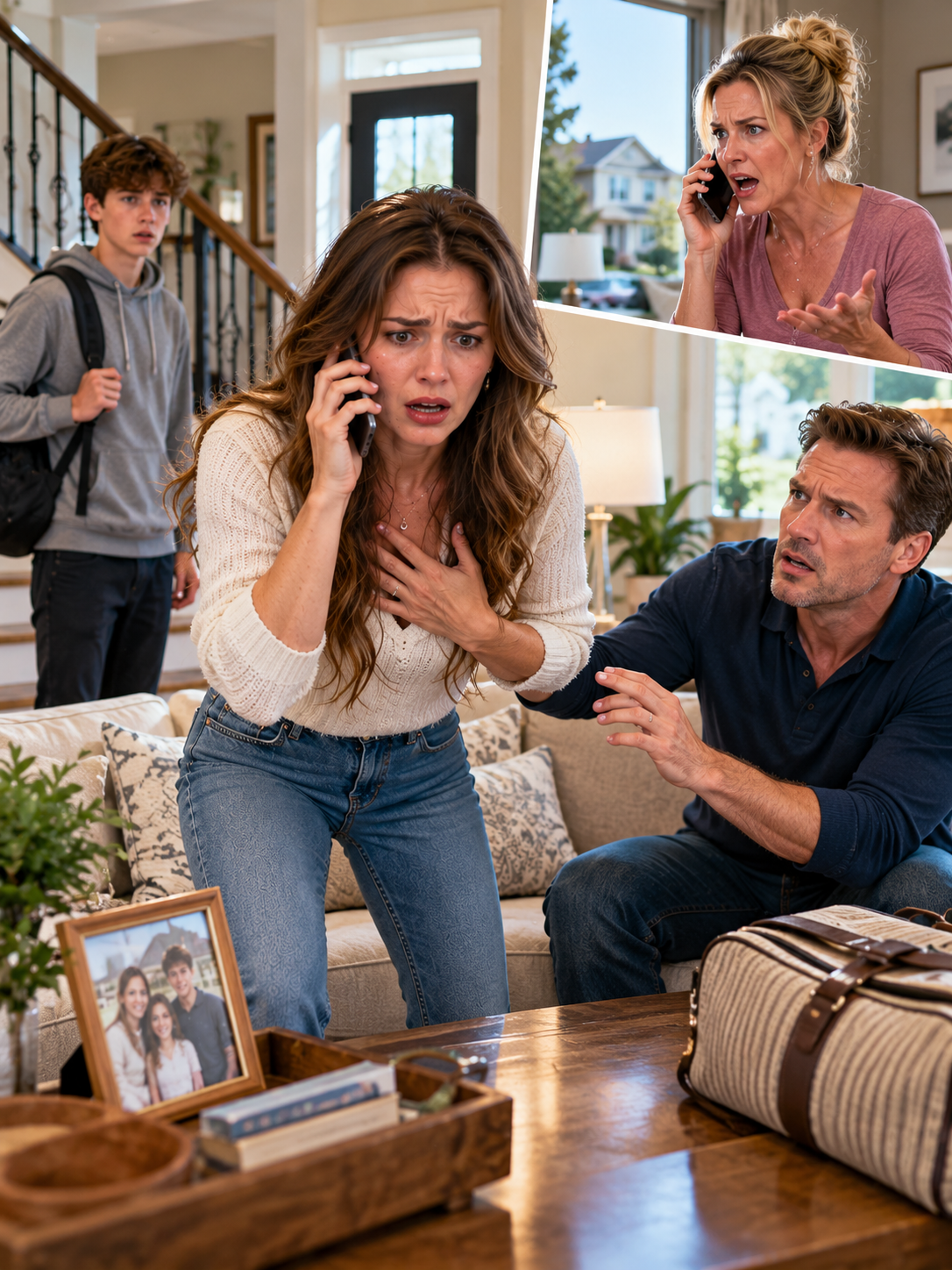
“When is Miles coming home?” Jenna asked, over the hiss of my kitchen faucet. “He has stayed at your place every weekend lately, and I need him here tomorrow morning.” I switched off the tap, water dripping from my fingers onto the faded kitchen rug. “Caleb is at your house,” I said. “He left yesterday afternoon with an overnight bag.”
Jenna didn’t answer immediately, and the silence changed the temperature of the room. Then she said, “Mara, I haven’t seen Caleb since August.” Eight Fridays had passed since my sixteen-year-old son began spending weekends with his best friend. I’d watched him go without suspecting anything.
Caleb and Miles had been inseparable since kindergarten. Jenna and I were comfortable enough that we rarely called to confirm sleepovers, especially now that the boys were sixteen. Now it felt reckless. I asked Jenna when she’d last seen Miles, and she whispered, “The same week you last saw Caleb at my house.”
I called Caleb twice, then three more times; every attempt rolled into voicemail. His last message, sent at seven, read, “Pizza’s here. Watching a movie. Love you.” I typed, “I know you’re not at Jenna’s. Call me now,” and watched the word “Delivered” sit beneath the bubble without changing. Jenna couldn’t reach Miles either, although she’d heard him laughing in the background of a call the previous Sunday.
I wanted to drive somewhere, but we had no destination. I told Jenna to come over, then checked the location-sharing application Caleb normally used with me; it showed his phone as unavailable. I walked through his empty bedroom, taking in a half-built model airplane and a sweatshirt draped over the chair. Its ordinary appearance frightened me, especially the schoolbooks stacked neatly beside the bed as if my son expected to return without questions.
Three years earlier, my husband, Andrew, had died unexpectedly, leaving Caleb and me in a house that still felt built for three. I’d maintained his routine, proud whenever a week passed without tears. We talked about grades, grocery lists, and whether the dishwasher had been emptied. We almost never talked about Andrew, although his photograph stood on the mantel directly across from our dinner table.
Jenna arrived with her coat half-buttoned. Together we called two classmates, a soccer coach, and a parent whose son hosted game nights; nobody had seen the boys. Jenna found a calendar entry showing Miles supposedly stayed here while I’d been working. “They’ve been coordinating these stories,” she said, pressing her knuckles to her mouth.
While checking Caleb’s desk for a friend’s address, I lifted his lamp and found a folded hardware-store receipt. It listed sandpaper, wood glue, clamps, and a package of brass hinges, purchased in a town forty minutes north. Underneath was a photograph I’d never seen: Caleb and Miles standing outside a weather-beaten workshop, smiling into the sun. A wrinkled hand was visible at its edge, gripping a battered paintbrush that looked strangely familiar.
I knew that workshop. It stood behind the house where Andrew had grown up, beside a crooked maple tree he used to describe whenever he missed his childhood. His father, Walter, still lived there, but we hadn’t spoken since Andrew’s funeral. He accused me of erasing his son; I accused him of judging my grief.
I called Walter, but his phone went unanswered. Jenna noticed the receipt’s date and showed it to me: three weeks earlier, on a Saturday when Caleb had come home with red eyes and said he’d been up late playing video games. He’d asked that weekend to unpack his father’s things. I’d told him we would do it another day, then returned to paying bills.
By eleven, we had reported the boys missing and given the responding officer every place we could think to search. Back home, Jenna gripped a cold cup of tea. “What if they’re with someone we don’t know?” she asked. I wanted to reassure her, but my phone lit up with an unfamiliar number and a photograph attached to a message: a close-up of Andrew’s initials carved into wood, followed by four words, “Please don’t come yet.”
Part 2
I showed Jenna the photograph, then called the unfamiliar number with my heart pounding. The mailbox wasn’t set up, and the number couldn’t be traced to anyone I recognized in our contacts. The initials were Andrew’s block letters, including his crooked A. The wood looked new, but I couldn’t identify the object.
Jenna leaned over my shoulder and recognized the background in the photograph. “That green paint looks like an old garage door,” she said. Miles had recently mentioned repairing bicycles for money, so Jenna suspected a secret weekend job. I searched nearby workshops online, but the results showed tourist gift shops and automotive garages instead of anywhere two teenagers might hide.
A patrol officer called to confirm that the boys’ names and descriptions had been circulated to the appropriate local agencies. I told him about Walter’s property and the unexplained photo, and he recorded the information. The officer advised us to report new leads rather than complicate the search. I stared helplessly at my car keys.
At one-thirty, Jenna went home briefly to check whether Miles had returned. I opened Caleb’s bedroom closet and found Andrew’s old toolbox missing from the shelf where it had sat for years. I felt sick, remembering how Caleb had recently started washing his own clothes before I could notice the dust on them. Caleb had barely touched those tools when Andrew was alive.
I remembered a Sunday afternoon a month earlier when Caleb had caught me packing away winter clothes. “What was Dad like when he was my age?” he’d asked. I’d called his father funny and hardworking. Caleb had persisted, asking whether Andrew made things before he became an electrician, and I had changed the subject to his homework.
At three, I tried Walter again. Walter’s familiar gravelly voicemail answered, and hearing that voice brought back the ugly argument we’d had outside the funeral home. “Walter, if you know where Caleb is, please call,” I said, then had to swallow before adding, “I’m frightened. Both mothers are frightened. Our argument doesn’t matter tonight.”
At 4:06 a.m., with cold coffee beside me, Walter called. Walter said, “Mara, the boys are here, and they’re safe.” Relief struck so fiercely that I bent over the kitchen table. Then I heard myself demand, “Put Caleb on the phone. Now.”
Caleb’s voice was thin with exhaustion. He said they’d switched off their phones after seeing our messages, afraid of being caught. Walter insisted he’d been asleep in the main house with his own phone charging in the workshop and hadn’t known we were searching. “You should have known where we thought they were,” I told him. “You’re the adult who let this go on.”
I called Jenna, contacted the officer to report the boys safe, and arranged for Walter to bring Caleb home while Jenna collected Miles. I waited until headlights swept the driveway. Caleb came inside wearing a faded brown canvas work jacket, his hair threaded with pale sawdust. There was a small tear above the left pocket, repaired with uneven blue stitching.
The jacket had belonged to Andrew. I’d searched after the funeral, but Walter claimed it was gone. I touched the torn pocket, and Caleb flinched, expecting anger. “Where did you get this?” I asked, my voice barely audible.
“Grandpa kept it,” he said. “I didn’t take it from you.” He looked younger than sixteen, with shadows under his eyes and an exhaustion I now realized had followed him home every Sunday. I made him sit down, drink water, and tell me whether Miles was all right before addressing the deception. He admitted that they’d spent every weekend sleeping in Walter’s guest room and working in the workshop during the day.
“Why lie about it?” I asked. Caleb rubbed sawdust from his fingers onto his jeans and avoided my eyes. “Because you won’t even drive past Grandpa’s street,” he answered. Then he reached into the jacket pocket and pulled out a folded notice from a real-estate agency. Walter’s house was under contract, with nineteen days until he moved, and Caleb whispered, “If we don’t finish what Dad started before they empty the workshop, it’s going to disappear forever.”
Part 3
I spread the real-estate notice on the kitchen table beneath the bright light over the stove. Caleb said Walter had decided to move into a smaller house near his sister because the old property was becoming too much to maintain. The new owners wanted the workshop cleared. “We only had a few weekends,” he said. “I thought if you found out, you’d make us stop.”
“You let two families believe their children were somewhere else,” I told him. “If either of you had been hurt, we wouldn’t have known where to look.” Caleb nodded, but looked up when I blamed Walter. “Grandpa asked me to tell you,” he said. “I kept saying I would, and then I begged him for one more weekend.”
I wouldn’t excuse Walter. I told Caleb there would be no sleepovers for a month, no unsupervised trips to the workshop, and that he would have to apologize to Jenna and Miles for putting them in that position. He accepted them. I also asked about the photograph; Caleb admitted Miles sent it from Walter’s spare phone, but he’d typed the message begging us to stay away. When I said I would visit Walter that afternoon, his expression filled with something dangerously close to hope.
Jenna called after breakfast, her voice raw from a sleepless night. Miles had wanted to confess weeks earlier, Jenna explained, but my son kept promising their secret would be over soon. “I believe Caleb didn’t mean harm,” she said, “but Miles learned it’s easier to lie to me than disappoint him.” We agreed on adult supervision and clear plans for now.
Walter was waiting on his porch when we pulled into the driveway. The porch smelled of dry leaves and stacked pinewood. Walter looked older and thinner than I remembered. “I’m sorry,” he said before I reached the steps, but I refused to let the apology end the conversation.
“You knew their mothers didn’t know,” I said. “You watched us call, text, and worry, and you didn’t tell us where they were.” Walter admitted he should have contacted us the first Friday and again every weekend afterward. He’d feared I would forbid visits after our old argument. I told him he could be Caleb’s grandfather, but he couldn’t make secret agreements with my child again.
The workshop’s sawdust-and-oil smell nearly weakened my knees. Andrew’s handwriting labeled the drawers; his old radio still hung above the bench. Caleb walked toward something hidden beneath a paint-speckled canvas drop cloth. He glanced at Walter, then pulled it away before he lost his nerve.
It was a wooden rocking chair, honey-colored and almost finished, with curved arms I recognized from a sketch Andrew had once drawn on a grocery receipt. He’d begun it during my pregnancy for our baby. Life had interrupted the project before it disappeared into Walter’s workshop. Now Caleb had built the missing seat with Miles and repaired one uneven rocker.
I touched the smooth armrest and found a tiny dent shaped like a crescent. Andrew had once joked that the dent could hold a toy car. Caleb showed me where he’d fitted new dowels and rubbed away rough edges. “I wanted to give you the chair on Dad’s birthday,” he admitted. “I thought maybe you’d sit in it instead of leaving the room when I say his name.”
The words hurt because I knew they were true. For three years, I’d mistaken keeping the house quiet for helping Caleb heal. I avoided stories because I couldn’t bear their endings, and now my son had learned to hide his questions as carefully as he hid his trips. “You deserved those stories,” I said, but Caleb looked down and answered, “I needed them when I was thirteen, Mom. Not just now.”
Then Walter opened a cabinet and showed me several numbered boxes on the floor. A removal crew was coming Thursday to empty the workshop before Walter’s move, and he feared anything left would be discarded. Caleb wanted to save everything his father had touched. We had only a few days to decide what mattered, and I wasn’t sure I could survive looking through it all.
Part 4
I drove home with a piece of sandpaper in my coat pocket and the smell of the workshop trapped in my hair. At the light near his school, Caleb asked if we could keep the chair. “Yes,” I answered, though I had no idea where we’d put it. Then he asked about the tools and unfinished projects.
That evening, I phoned the real-estate agent and Walter’s moving company, determined to learn exactly what could be removed. The chair and loose tools belonged to Walter, but a workbench bolted into the workshop wall was included with the property unless the buyers agreed otherwise. The agent offered to ask the buyers about the bench. The decisions stopped feeling impossible once someone explained the actual deadlines, even though I still dreaded telling Caleb we couldn’t keep everything.
In our garage, I found the plastic bins I’d sealed after Andrew’s funeral. I had labeled them “tools,” “papers,” and “miscellaneous,” as though grief could be sorted into useful categories. Caleb sat on the concrete floor while I opened the first bin, and a smell of cedar shavings rose from beneath an old sweatshirt. Inside lay Andrew’s notebook and a drawing of the chair.
Under the drawing he’d written, “For our little boy. May he always have somewhere to rest.” Caleb ran a fingertip beneath the words, then asked why I’d kept the notebook hidden. “Because I couldn’t bear opening this box,” I admitted. “But I should have let you have what belonged to your own history. I was trying to protect myself and calling it protecting you.”
Caleb turned to another page and found a drawing of the four-legged kitchen table Andrew had built when we first married. The fourth leg had always been slightly shorter, and Andrew used a folded grocery coupon to stop it wobbling. I told Caleb about the time a birthday cake slid sideways because his dad forgot to move the coupon. He laughed and asked for another story.
On Tuesday, Jenna and Miles joined us at Walter’s house after we’d agreed on a schedule and a firm pickup time. Caleb approached Miles before either boy went inside. “I’m sorry I talked you into lying to your mom,” he said. “You tried to tell me it was wrong, and I kept making it harder.” Miles accepted the apology but told him, “If you ever ask me to do that again, I’m telling her the first day.”
We photographed the workshop’s shelves, labels, and pencil marks. Miles carried small boxes while Walter wrapped tools in towels, and I began creating an inventory on my phone. Caleb wanted to keep every board, every screw, every object his father might once have picked up. When the pile grew beyond what our garage could hold, he stood rigid by the bench, close to tears.
“If we leave it, it’s like losing him again,” he whispered. I put down my phone and told him I understood, although I knew I could never fully know what losing a father at thirteen had felt like. We chose a few favorite tools, the notebook, the chair, and the small drawer bearing Andrew’s carved initials. I promised to ask about the bench rather than give false assurances.
At four, the agent called to say the buyers would allow us to take the workbench if we removed it safely without damaging the wall. Walter offered to hire a carpenter for the job, and Jenna helped locate someone available early Wednesday. Caleb let out a breath that sounded like a sob. He then asked, very quietly, whether I would help him apply the chair’s final coat of finish before dinner.
We worked side by side as daylight slid down the workshop windows. I followed his instructions while the wood turned honey-colored. Walter stayed near the door, giving us space, and I heard Caleb humming the tune Andrew used to whistle when he worked. Then Caleb asked, “Mom, what if I start forgetting him again?” and I realized rescuing the furniture couldn’t be the end of what we needed to do.
Part 5
“Then we’ll remember him together,” I told Caleb, setting down the finishing cloth. I couldn’t promise that grief would stop arriving without warning. I could promise not to close the conversation whenever it did. Caleb leaned against me without hesitation, the first time he had done that since I’d told him his father’s workshop wasn’t a place I could visit.
The following morning, Walter’s carpenter removed the workbench, and we loaded it into a small rented truck. I hired movers for the heavy bench. The chair rode in my car, wrapped in blankets. By sunset, Andrew’s workbench occupied one wall of our garage, beneath a window that let in afternoon light.
We didn’t pretend the missing weekends had been harmless. Caleb lost overnight privileges for the month we’d agreed upon, and for a while he had to confirm his plans directly with both mothers. He apologized to Jenna for frightening her. She thanked him but didn’t excuse his choice, reminding both boys that keeping one another safe mattered more than protecting a surprise.
I set a boundary with Walter, too. He could visit and teach Caleb woodworking, but plans needed to be agreed upon with me beforehand, and he was not to help my son hide anything again. He agreed, though asking permission clearly stung, and he acknowledged that the jacket he’d claimed was gone should have been returned years earlier. Trust, I told him, was something we could rebuild only if the rules held when they were inconvenient.
Andrew’s chair stood in our living room by Thanksgiving, between the bookcase and the window where the afternoon sun reached the rug. One repaired seam was visible near the seat. Caleb wanted to sand the blemish away, but I asked him to leave it. The flaw reminded me who’d built it.
On Thanksgiving morning, Caleb sat on the floor with Andrew’s notebook open across his knees. He pointed to a birdhouse sketch and asked if Andrew had built it. I told him Andrew had tried, but the roof had leaked so badly that a family of sparrows abandoned it after one storm. Caleb laughed and asked where it used to hang.
That evening, Walter brought a small tin of screws and an envelope filled with photographs from Andrew’s childhood. He’d labeled the photographs carefully, including a picture of Andrew at sixteen holding his first crooked wooden shelf in the air like a trophy. I thanked him and invited him to stay for coffee, but I didn’t pretend the old argument between us had been magically settled. We were learning to share Andrew’s memory without treating access to Caleb as something to fight over.
After dinner, Caleb brought me an old phone he’d found in a desk drawer. “There’s a video of Dad teaching me to ride my bike,” he said, “but I haven’t wanted to watch it alone.” Onscreen, Andrew jogged behind Caleb, laughing as he wobbled. His familiar voice sounded: “Keep going, buddy. I’m right here.”
I cried, and for a moment I tried to apologize, but Caleb took my hand. “You don’t have to be okay every time we talk about him,” he said. I told him neither did he, and we watched the video again. This time, I didn’t turn it off when Andrew’s voice became too much; I let my son hear the words all the way to the end.
By spring, Caleb and Miles had rebuilt their friendship with fewer secrets and more honest conversations. Their mothers had become more careful about confirming overnight plans, and both boys knew the rule wasn’t punishment forever but a way to keep everyone safe. Some weekends they worked at our garage bench, where the labeled drawers still carried Andrew’s handwriting. Other weekends they went to the movies, sending their mothers a photograph from the lobby without being asked.
The following September, Caleb sat in the rocking chair and said he could remember Andrew’s laugh without a video. The chair creaked gently as he rocked. For so long I’d believed loving my son meant shielding him from sorrow. Now I understood that love sometimes meant sitting beside him, leaving the door open, and letting us remember together.
Legal Notice: This story is a work of fiction. Names, characters, businesses, events, and incidents are the product of the author’s imagination or are used fictitiously. Any resemblance to actual persons—living or dead—or to actual events is purely coincidental. Thank you! 💓