My Parents Abandoned Me at Five—17 Years Later, They Arrived With a Moving Truck After Grandpa’s Funeral, But He Had Prepared a Surprise
My parents left me on Grandpa’s porch when I was five. Seventeen years later, the morning after I buried him, they returned with a moving truck instead of flowers. My sister announced she wanted the biggest bedroom; my mother handed me garbage bags and ordered me out. I didn’t tell them about the instruction Grandpa had whispered from his hospital bed—or the woman waiting behind his locked study door. But when Mom demanded the house, that door opened, and her certainty vanished.
Part 1
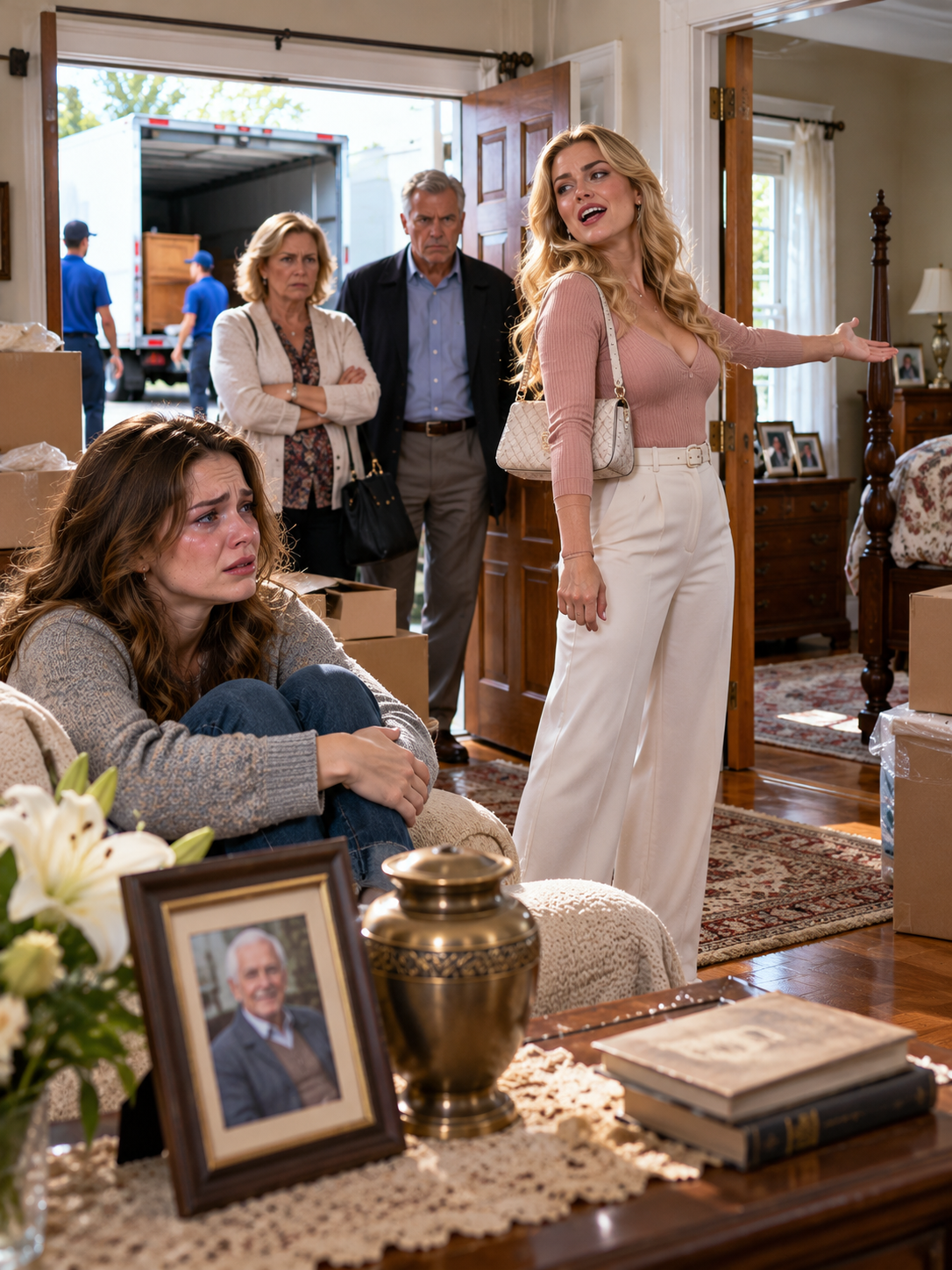
The moving truck arrived at 8:07 on the morning after Grandpa’s funeral. Its reverse alarm echoed through the maple trees while I stood on the porch in his red flannel shirt, holding coffee that had gone cold. The funeral wreath was still tied to the railing, and somebody had left a casserole on the steps. I thought, foolishly, that the truck belonged to a neighbor.
My father climbed out first, followed by my mother and a young woman in expensive sunglasses. I knew their faces from the handful of photographs Grandpa kept in a shoebox, though seventeen years had softened none of my father’s narrow expressions. The young woman, my sister Avery, tipped her head toward the upstairs windows. “I’ll take the master bedroom,” she announced, before anyone said hello.
“You’re blocking the doorway, Mara,” my mother, Celeste, said. Her perfume smelled like sharp white flowers, nothing like the lilies filling our living room. She looked at my swollen eyes and added, “You could have made yourself presentable.” Behind her, Dad waved two movers toward the porch as if the house had already been emptied.
Grandpa Thomas Ward had taken me in when I was five and Avery was barely two. My parents said they needed a weekend to settle something, and I stood at his kitchen window waiting for their blue sedan to return. Weekend became Christmas, then kindergarten graduation, then every birthday after that. Grandpa never told me to stop hoping, but he was the one who showed up at each school play with a thermos of cocoa.
He was also the one who fixed my bicycle with two mismatched bolts and learned to braid my hair from a library book. We grew tomatoes behind the garage and measured my height on the pantry doorframe. After his arthritis got worse, I drove him to appointments, kept the woodstove fed, and learned exactly how he liked his oatmeal. Yesterday I had buried the only parent who had ever stayed.
Mom thrust two black garbage bags into my arms. “Put your clothes in these, along with that awful patchwork quilt,” she said, nodding toward the hall. “Your grandfather was responsible for you, and now he’s gone.” She glanced at Dad for approval before finishing, “This house belongs to us.”
Avery slipped past me and took the stairs two at a time, complaining about the smell of old books. Dad called to the movers to start with the upstairs wardrobes, and one man hesitated at the funeral wreath. I set the bags beside the umbrella stand and said, “Nobody is carrying furniture out today.” Dad laughed and told me not to turn a straightforward inheritance into a tantrum.
A few days before Grandpa died, he had gripped my wrist from his hospital bed. His skin was thin enough that I could see the blue veins, but his voice remained firm. “When they come, don’t fight them on the porch,” he said. “Go to my study. Someone who knows the truth will be waiting.”
I had asked why he believed my parents would come after ignoring him throughout his illness. He looked past me at the hospital window and said, “Because your father has been asking about the house, not about me.” Then he made me promise not to sign anything, however harmless it sounded. I kept that promise as Dad raised his voice and the movers started climbing the staircase.
I crossed the foyer toward the study, its oak door closed beneath Grandpa’s crooked watercolor of the farm. Dad stepped into my path and said he had already spoken to a realtor, so there was no point delaying. I could hear Avery opening drawers overhead, searching through a room she had never slept in. Before I could answer, the study lock clicked from the other side.
A woman with silver-streaked hair opened the door, carrying a leather portfolio and a folder of papers. “Good morning, Peter,” she said to my father. “I’m Evelyn Hart, your father’s attorney and trustee, and those movers need to stop immediately.” My mother’s garbage bags slipped from her hands, and Dad’s confident smile disappeared.
Part 2
The movers froze halfway up the staircase with a dolly. Evelyn didn’t raise her voice; she simply asked for their supervisor and said there was a question about who had authorized access. The older mover looked at Dad, then at the funeral wreath, and instructed his partner to come downstairs. For the first time since the truck arrived, the house grew quiet.
Dad stepped toward Evelyn with the impatient smile he had used on me. “I’m Thomas’s only son. We can sort out the paperwork while the boys work.” Evelyn opened her folder and said the property wasn’t available for him to clear, sell, or occupy. “Your father gave written directions for today,” she added. “And your daughter Mara has every right to remain in her home.”
“She’s my daughter,” Dad snapped, as if the word proved ownership. I remembered Grandpa taking me to a courthouse when I was fifteen, for an adoption. We’d celebrated afterward with pancakes at a roadside diner; I’d cried because the judge called him my father. I hadn’t understood how much work he’d done to make that day possible.
Evelyn laid a certified adoption order on the entryway table. “Thomas legally adopted Mara seven years ago after the court addressed her parents’ abandonment,” she said. “This is not a temporary guardianship.” Dad stared at the raised seal, while Mom said she’d never agreed to give me away. Evelyn answered that the proceedings had included formal notice and that legal questions could be directed to independent counsel.
Avery appeared on the landing holding one of Grandpa’s framed photographs. “Are you saying Grandpa adopted her, like a baby?” she asked. Mom hissed for her to come down and stop touching things, but my sister kept studying the image of me beside Grandpa’s tomato plants. I realized Avery hadn’t known he raised me. She’d apparently been told something entirely different.
Mom recovered first, smoothing her cardigan and reaching for my arm. “Nobody meant to abandon you permanently, honey. Things were complicated,” she said, suddenly sweet. I stepped out of reach and asked why complications had lasted seventeen birthdays. She turned to Evelyn instead of answering and demanded to see the will that supposedly put me ahead of her husband.
“The will doesn’t transfer this house,” Evelyn said. “Thomas arranged his affairs before his death, and the property is already held in a trust.” Dad called that impossible because Grandpa lived on a pension and drove a rusty truck. I thought of him rinsing aluminum foil for reuse and wondered what else I’d mistaken for poverty.
Evelyn refused to discuss financial details with uninvited people in the foyer. She gave the movers a chance to leave peacefully and offered Dad her office number for formal inquiries. But he pulled a folded paper from his jacket and slapped it onto the table. “Explain this, then,” he said. “Dad agreed I could sell the place once he was gone.”
The document was headed “Family Property Agreement,” with Grandpa’s name typed above an uneven signature. Its second paragraph authorized Dad to list the house immediately and retain the proceeds after funeral expenses. Mom watched Evelyn’s eyes moving across the page and began twisting her wedding ring. Evelyn asked whether they had the original; Dad claimed their realtor had it and refused to say where the signing took place.
A message flashed across Dad’s phone, and he angled the screen away, but I caught the words “buyers waiting” and a number followed by three zeros. Evelyn requested a copy to compare against Grandpa’s recorded papers. Dad replied that the closing appointment was already scheduled and that nobody could stop him now. He seemed more frightened of missing the appointment than of being wrong.
While Mom argued, Avery put the photograph down and quietly asked me where she’d be sleeping. I told her she wasn’t moving in, and her face tightened into a look that reminded me painfully of our mother’s. Then Evelyn read the last line of Dad’s document and went still. “Peter,” she said, “why does this say Mara agreed to vacate the property tomorrow?” I had never seen the paper before, much less agreed to sign away my home.
Part 3
I stared at the line where my name appeared beside the words “voluntary surrender.” Dad said it was a standard clause and claimed I’d been told about it months earlier. Evelyn pointed to the date: the previous Thursday, when I had spent the entire afternoon beside Grandpa in hospice. “Mara was with me that day,” she said. “I can also account for Thomas’s whereabouts.”
We moved into the study while the movers waited outside for their supervisor. Grandpa’s magnifying glass still lay on the desk beside a half-finished crossword, and the smell of cedar rose from the old bookshelves. Evelyn spread out the documents she had brought, including the recorded deed. Dad’s paper mentioned a future inheritance, but the house had been transferred into a trust months before the supposed agreement.
“Thomas appointed me to administer the trust, with Mara as its beneficiary,” Evelyn explained. “Your father knew exactly what he was signing when we established it.” Dad demanded proof of Grandpa’s mental capacity, so Evelyn offered the dates of independent legal and medical assessments without handing over confidential records. She said he was free to consult a lawyer, but he could not invent authority over property the estate did not own.
Mom stared at the deed and whispered, “He couldn’t afford something like this.” Evelyn explained that Grandpa had owned forty acres of woodland beyond the creek, an inheritance from his own mother that he’d kept separate from the house. He sold limited timber rights, invested the proceeds, and paid for my education. The rest, including the home, was now protected for my future under the trust’s terms.
I remembered Grandpa counting change for a used winter coat when I was twelve, then insisting we could afford the school trip I’d been afraid to request. He had never made me feel rich, but he had never let me go without medicine, books, or birthday cake. His quiet planning felt like another kind of love, and it made me want to sit down. Yet I couldn’t stop wondering why he’d kept the details secret.
Evelyn handed me a smaller envelope marked “For when they ask what they gave.” Inside were photocopies of returned letters Grandpa had sent my parents, along with unopened birthday cards he’d addressed in my childish handwriting. One letter asked whether they could call me on my tenth birthday; another offered to arrange a visit without any argument about the past. Each had been returned or ignored, with the same forwarding address still written on the envelope.
Mom said the letters must have gone astray. Then Avery spoke from the doorway, her voice unexpectedly sharp: “We lived at that address for eight years.” She said she’d grown up hearing I had chosen to stay with Grandpa because I hated sharing a room and wanted his money. I looked at her, astonished that people who abandoned a five-year-old had somehow made that child the villain.
Dad tore the copied agreement away from the desk and accused Grandpa of turning me against them. Evelyn warned him not to remove any trust property and calmly asked him to leave the study. He insisted that he had taken out a loan against his expected inheritance, counting on a quick sale after the funeral. The first honest explanation of the moving truck came not from grief but from fear of a creditor.
“What loan?” Mom asked, and Dad’s silence told me she didn’t know everything either. His phone rang again with the realtor’s name, and he stepped into the hall to answer. Through the open door I heard him promise that tomorrow’s buyer would still get vacant possession. Evelyn took out her own phone to contact the realtor and title company before anyone transferred money.
Grandpa had predicted the bags, the demands, and even Dad’s appeal to the word “family.” What he hadn’t prepared me for was Avery standing in the hall with tears gathering beneath her sunglasses. She said Mom had already sold their dining set because they were moving into the house today. She showed me a photograph: a real estate listing advertising Grandpa’s home as vacant, with a closing date of Monday.
Part 4
Evelyn called the realtor from Grandpa’s desk while I stood beside the window watching the movers smoke near their truck. She identified herself as trustee and supplied the deed’s recording information, then sent written notice that Dad had no authority to sell. The startled realtor promised to suspend the listing pending title verification. Dad paced the foyer as his phone began ringing again.
The truck supervisor came inside to ask who would pay for the morning’s wasted hours. Dad pointed at me, and I nearly laughed from disbelief. Evelyn explained that he had ordered the service and signed its contract; the crew had no instruction from the lawful owner. The supervisor looked at my funeral clothes hanging beside the door, muttered an apology, and told his men to load the dolly back into the truck.
Dad called Evelyn a thief and swore he would sue the trust. She told him he was entitled to seek independent advice, but that threats wouldn’t change the recorded ownership. Then she asked him to leave the property, and when he refused, she called for a police officer to attend while everyone departed. I didn’t feel triumphant; I felt the same sick tremor I’d felt at five, listening for a car that wasn’t coming back.
Mom cornered me by the pantry door where Grandpa had marked my height every September. She pressed her thumb against the pencil line from my thirteenth birthday and said she’d thought about me constantly. “We were young, Mara,” she whispered. “Your father lost his job. We meant to get you when things improved.” I asked which of those years had been too difficult to make a phone call.
She started crying and blamed Grandpa for making them feel unwelcome, although I’d just seen letters inviting them to visit. “You can’t punish us forever,” she said. I told her that asking strangers to leave my home was not punishment for something seventeen years old. It was a response to what they were doing this morning.
Avery joined us holding her sunglasses in both hands. She said she’d believed I stayed because Grandpa spoiled me and that Mom had promised her a fresh beginning in this house. Their mortgage was months behind, their apartment application had fallen through, and she’d withdrawn from a training program because she thought she’d have a room here. I felt a flicker of sympathy before she asked whether she could stay anyway, just until she figured things out.
“No,” I said, more gently than I’d spoken to our parents. “I’m sorry they lied to you, but you don’t get to walk into my bedroom and claim it.” She studied my face, perhaps expecting the older-sister generosity she’d been promised all her life. When I didn’t change my answer, she shoved her sunglasses into her purse and followed Mom outside.
Dad made one final attempt at the threshold, waving his document and saying I was depriving my own father of his inheritance. Evelyn asked him to preserve the original for any formal review and warned that presenting false property documents could have consequences. He suddenly stopped waving it, folded it into his pocket, and stepped down the porch stairs. The arriving officer spoke with him beside the truck while I watched from behind the screen door.
I wanted to shout at all of them about school concerts, stomachaches, and every birthday when I checked the mailbox anyway. Instead, I picked up the two black garbage bags and carried them onto the porch. Mom turned when I held them out. “You brought these for my life,” I told her. “They’re the only things you brought that you’re taking away.”
After the truck disappeared, Evelyn went back into the study and opened Grandpa’s bottom desk drawer with a small brass key. She gave me a packet containing information about the trust, a handwritten budget for keeping up the house, and a letter addressed to me alone. On its front Grandpa had written, “Read this after they leave. It’s time we talk about your future.” I held it unopened, suddenly more afraid of his gentle handwriting than I’d been of my father’s shouting.
Part 5
I opened Grandpa’s letter at the kitchen table, where he’d taught me long division. “Mara, if you’re reading this, the worst part is over,” he wrote. “I didn’t protect you so you’d spend your life guarding these walls. A home should give you somewhere to leave from, and somewhere to return when you choose.”
He’d kept the trust quiet because he feared my parents would pressure me before the documents were complete. The woodland income could maintain the house and help with school, but he wanted me to earn a living I enjoyed. “You have a good eye and patient hands,” he wrote. “Please build things that are yours, not only repair things that belong to me.”
Beside the letter lay a brochure for a furniture-restoration apprenticeship I’d shown him in spring. I’d talked myself out of applying because his health was failing and the program required weekend travel. Grandpa had circled the deadline in red and written, “They’ll take you. If they don’t, try somewhere else.” I cried until the ink blurred beneath my thumbs.
Over the following weeks, Evelyn arranged a professional inventory and updated the house’s security. Dad sent demands through an attorney, but the recorded trust documents established he had no authority to sell the property. Questions about his supposed agreement were referred for review, and I gave my account without guessing what investigators would decide. Protecting myself turned out to involve passwords, receipts, and careful signatures, not grand speeches.
Mom sent a letter saying they might lose their home, Avery had nowhere to go, and decent daughters didn’t abandon family. She offered no apology for the garbage bags or the years of silence. I replied through Evelyn that they had no permission to enter or use the property and that legal contact must go through counsel. Then I blocked Mom’s number.
Avery contacted me separately in December and admitted she’d believed a lie about why I lived with Grandpa. She apologized for claiming his bedroom while the funeral wreath still hung outside. Then she asked whether I had a room she could rent cheaply until she found work. I said I hoped she found somewhere safe, but I wasn’t offering my home or financing our parents’ decisions.
I struggled afterward because I’d spent my childhood imagining a sister who might someday knock just to meet me. Avery had her own disappointments, yet our first real conversation still ended with a request. I couldn’t make us close by paying an entrance fee. Maybe she would change one day, but I wasn’t gambling my safety to find out.
In January, I applied to the restoration program and earned a spring placement outside Pittsburgh. With Evelyn’s help, I arranged routine upkeep of the house while I traveled. Before leaving, I repainted the upstairs room Grandpa had used for storage and brought in a workbench I’d refinished. I wanted to return to rooms that reflected my choices as well as his.
Our neighbor Mrs. Bell arrived with soup on my last evening and asked whether I worried about leaving the house empty. I admitted I still sometimes heard the moving truck’s alarm when a vehicle reversed nearby. She offered to watch the property and water the seedlings. For the first time, accepting help didn’t make me feel like somebody else’s burden.
I put Grandpa’s flannel shirt over the kitchen chair and stepped onto the porch. The dark windows reflected a young woman with a duffel bag, car keys, and plans she hadn’t yet described to anybody. Seventeen years earlier I had waited at this door for people who never returned. Now I was leaving because I wanted to.
In the shed, I found two unused black garden bags and filled them with fallen leaves before driving away. I tied them shut, stacked them for collection, and smiled at how ordinary they looked. My mother had handed me garbage bags because she thought my life could be packed away in minutes. Grandpa left me something no moving truck could take: the right to decide where I belonged.
Legal Notice: This story is a work of fiction. Names, characters, businesses, events, and incidents are the product of the author’s imagination or are used fictitiously. Any resemblance to actual persons—living or dead—or to actual events is purely coincidental. Thank you! 💓