My Husband’s Mistress Invited Me to Their Wedding While I Was Still His Wife—Then I Saw My Family Crest on the Envelope
My husband’s mistress mailed me an invitation to marry him while I was still legally his wife. She even stamped the envelope with my grandmother’s family crest and booked our ancestral seaside estate for the ceremony. My husband laughed when I demanded an explanation, convinced I would accept the humiliation quietly. But when I opened my grandmother’s safe, I discovered something far worse than an affair. Someone had stolen a priceless family heirloom, replaced it with a fake, and used it to build a secret that could destroy everything my grandmother left me.
Part 1: The Invitation That Should Never Have Existed
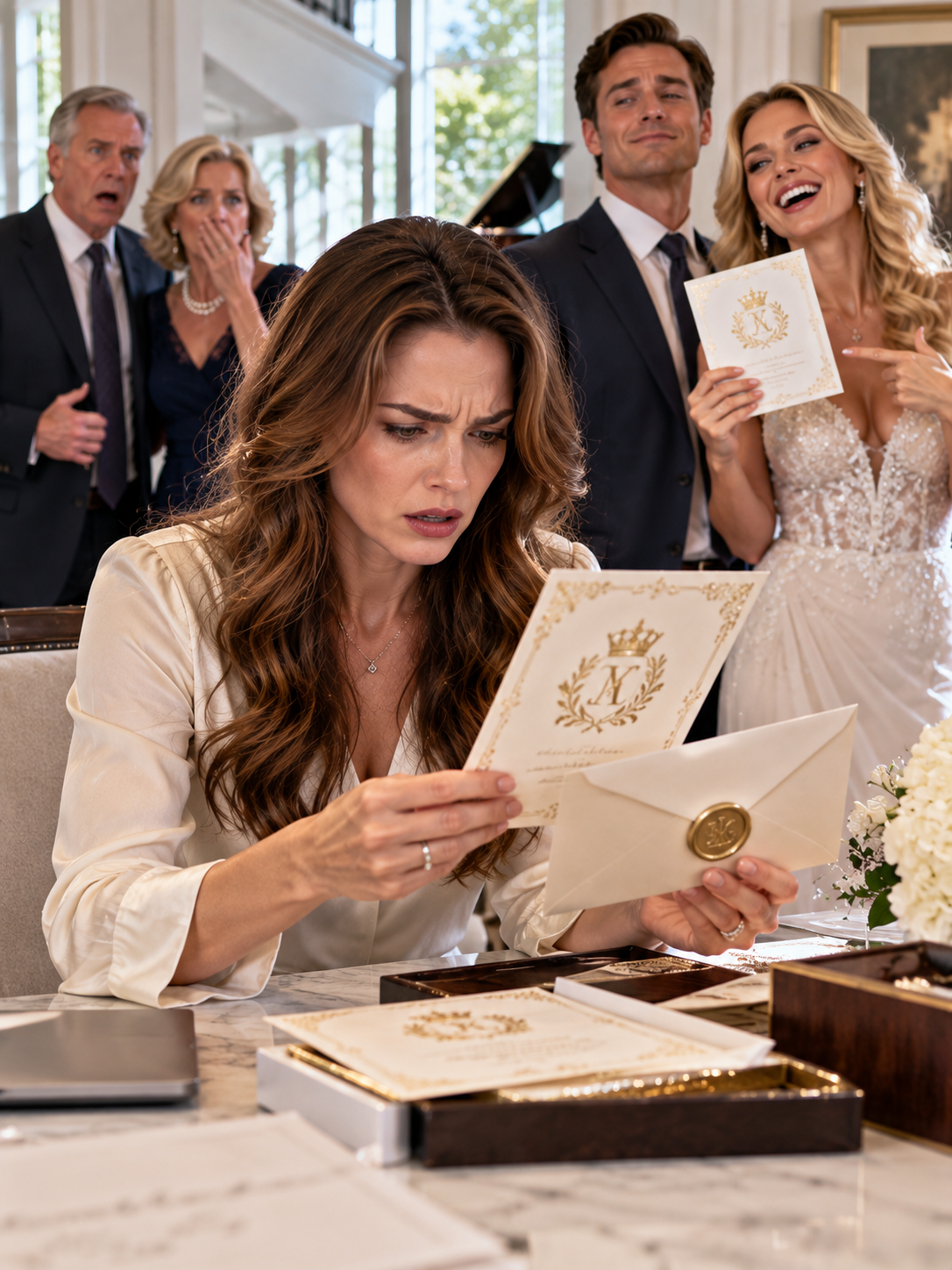
The wedding invitation arrived on a Wednesday morning, tucked between a property tax notice and a letter from my insurance company. Etta Collins, who had helped care for our Boston home for nearly twelve years, placed the thick ivory envelope beside my coffee and studied my expression. “That’s beautiful stationery, Mrs. Vale,” she remarked, pointing toward the gold lettering. I might have agreed if the envelope hadn’t been addressed to Mrs. Graham Vale, a name my husband’s mistress apparently believed I would soon surrender.
I turned it over and felt my stomach tighten. Pressed into a circle of dark green wax was a silver heron standing between two reeds, with a small compass rose above its head. The Bellamy family crest had appeared on our property documents, charitable foundation certificates, and invitations for generations. It belonged to my grandmother’s legacy, and I recognized every tiny detail because she had taught me to draw it when I was eight.
Inside, elegant lettering announced the upcoming marriage of Graham Alexander Vale and Celia Margaret Mercer, scheduled for October twelfth at four o’clock. Beneath their names was the location: Bellamy Point House, Newport, Rhode Island. I read the card twice, then checked the envelope as though another page might explain the mistake. My husband wasn’t merely planning to marry his girlfriend before our divorce; he was arranging the ceremony at an estate my grandmother had placed under my family’s preservation trust.
At 8:17, Graham called, sounding irritatingly cheerful. “Celia says the invitations arrived, so I suppose you’ve seen ours,” he announced, without bothering to ask how I was feeling. I asked whether he understood that we were still married, and he answered, “The divorce is a technicality, Addie, and you know it’s going to happen.” When I reminded him that no divorce petition had even been filed, he laughed and said his attorney would handle the details.
I was forty-two years old, and I’d spent eleven of those years married to a man who could make an insult sound like practical advice. Graham had built a successful investment consulting business partly through introductions made by my grandmother, Margaret Bellamy, while I managed several historic properties and the trust she’d established before her death. For years, I had believed our different careers complemented each other. Only recently had I understood how easily Graham confused access to my family’s resources with ownership of them.
When I asked why Celia had used our crest, Graham called it a decorative flourish. “It’s a bird on some wax, Addie, not the Declaration of Independence,” he said, his voice sharpening when I explained that the mark was registered for the trust’s heritage hospitality services. Then he accused me of trying to make his new relationship difficult because I couldn’t tolerate being replaced. I ended the call before he could hear how badly those words had hurt.
Graham’s affair had become undeniable four months earlier, when I’d found hotel confirmations and photographs on a shared tablet. He’d promised that Celia, a thirty-one-year-old event consultant, was merely helping him develop an exclusive hospitality business. Eventually he admitted their relationship and moved into a rented apartment, insisting we could settle everything privately without damaging his reputation. I had declined the settlement document he proposed because it contained vague language about family-owned assets that Graham had never purchased.
I carried the invitation upstairs to my grandmother’s library, where floor-to-ceiling walnut shelves still held her gardening journals and old maritime maps. Behind a sliding panel was a small safe containing family jewelry, historical property records, and the gold signet ring used for ceremonial impressions. My grandmother had told me repeatedly that the crest represented stewardship rather than status, and that anyone using it commercially required the trust’s permission. As I entered the combination, I remembered she’d once warned me that people usually claimed ownership most loudly when they had none.
The velvet jewelry box rested exactly where I’d left it after her funeral three years earlier. Inside was a ring shaped like a heron and compass rose, its polished surface catching the pale morning light. Relief lasted only until I lifted it, because the metal felt strangely light against my fingers. My grandmother’s original was solid gold, with a tiny crescent engraved beneath the bird’s wing, but this ring had neither the proper weight nor that distinctive mark.
I called my attorney, Miriam Chen, and described what I’d found. She asked whether Graham knew the safe’s combination, and I told her he hadn’t, although an antiques appraiser had visited our house two months earlier while I was away. Etta had let the man examine several rooms after Graham claimed our insurance company needed updated valuations. As Miriam asked me to locate the visitor’s information, I noticed a faint scratch beside the safe’s lock that hadn’t been there before.
Someone hadn’t simply borrowed my grandmother’s ring. They had replaced it with a convincing imitation, returned it to the safe, and expected me never to notice.
Part 2: The Man Who Had Entered My Grandmother’s Safe
Miriam came to my house that afternoon with a document specialist named Daniel Price, who examined the substitute ring without damaging it. He confirmed that the metal was inexpensive brass coated to resemble gold, while the engraved design appeared to have been reproduced from a detailed impression. Whoever made it had copied the visible crest accurately but overlooked the tiny crescent inside the original band. Daniel recommended preserving the ring as evidence and obtaining photographs of the original from our family’s jewelry records.
Etta remembered the appraiser’s visit clearly because Graham had insisted she stay downstairs while the man worked. “He said some valuable things needed private inspection,” she explained, twisting her apron between her fingers. She had written his name in the household appointment book and remembered his carrying a narrow black equipment case upstairs. When she asked whether to accompany him, Graham told her that insurance examinations were confidential and that she shouldn’t interfere.
The visitor had introduced himself as Leo Kessler, representing a company called Harbor Claims Associates. Miriam checked the firm’s public registration and discovered it had been formed only three months earlier, with no obvious history of insurance appraisal work. That didn’t establish theft, but it made Graham’s explanation suspicious. I found an old email from him confirming the appointment and telling me he would personally supervise the inspection, although he’d later claimed he’d been out of town.
The following morning, I drove to Newport to examine Bellamy Point House. The estate stood above a rocky section of coastline, its pale stone walls weathered by generations of Atlantic storms. My grandmother had spent summers there restoring gardens, repairing antique windows, and arguing with preservation contractors about protecting the original architecture. After she died, I continued operating the property through the Bellamy Heritage Trust, hosting small historical events whose proceeds helped finance its maintenance.
Our estate manager, Miles Rowan, greeted me near the old carriage entrance with an expression that made me uneasy. He admitted receiving several inquiries about a lavish wedding, including a request to accommodate nearly two hundred guests and install temporary catering facilities. When he’d refused because the property hadn’t been authorized for such an event, a representative from Graham’s office had produced what appeared to be an approval letter. Miles had forwarded it to our administrative office but received no response because the document used an outdated email address.
He showed me the letter, and I immediately recognized my signature beneath a formal statement authorizing temporary event access. The wording sounded legal, but it identified Graham as the trust’s appointed representative and permitted him to negotiate hospitality arrangements on its behalf. I’d never signed anything resembling that authorization, and Graham had never held any position in the trust. Miles looked genuinely horrified when I explained that the document was fraudulent.
For several hours, Miriam and I worked through the estate’s records with Miles. There were no legitimate trustee resolutions approving Graham’s appointment, no rental agreement, and no payments deposited into the trust’s accounts. Yet several vendors believed they had been booked by someone authorized to use the estate. Miriam instructed Miles to preserve every message and prevent further access without written confirmation from the trust’s actual representatives.
That evening, she discovered that Leo Kessler had previously worked at a specialty jewelry workshop in Providence. His former employer confirmed that he had experience creating decorative molds and reproductions, although she wouldn’t discuss particular customers. Then Miriam found a family connection that made the pieces fit together more clearly. Leo’s mother and Celia Mercer’s father were siblings, making the supposed insurance appraiser Celia’s first cousin.
I stared at his photograph on my laptop, remembering how Graham had dismissed the crest as an ordinary decoration. The theft might have been intended to impress wedding guests, but the forged authorization suggested something more calculated. Miriam cautioned that we couldn’t assume every document was connected without examining the complete transaction history. She requested public property records and sent preservation notices to several businesses associated with Graham’s event arrangements.
The next morning, I received a scanned document from Newport’s municipal land evidence records office. It was a purported power of attorney authorizing Graham to execute a long-term commercial lease involving Bellamy Point House, supported by a notarized acknowledgment and an attached copy of the trust’s crest. The signature looked like mine, right down to the unusual flourish beneath my last name. But the date fell on a Thursday when I’d been attending a preservation conference in Chicago.
Then I noticed the company listed as the proposed tenant: Mercer Vale Heritage Holdings, LLC. Graham had mentioned that business during our marriage, describing it as a minor consulting venture with no significant assets. According to the document, the company intended to lease my grandmother’s estate for thirty years. I hadn’t authorized a single day, and I finally understood why someone had needed more than a beautiful wedding invitation.
Part 3: Their Wedding Was Never Just a Wedding
Miriam obtained a copy of the proposed lease and arranged for an independent attorney specializing in commercial property disputes to examine it. The document claimed Mercer Vale Heritage Holdings could convert Bellamy Point House into an exclusive private club, with membership fees, restaurant services, and luxury accommodations. Graham had promised the company rights to our historic name, distinctive crest, and access to surrounding grounds. The proposed lease would extend far beyond the lifetime of any event planner involved.
I couldn’t understand how Graham intended to finance such an enormous project until Miriam received a confidential investment presentation from a business contact who had been approached by his company. It described an $11.8 million capital raise backed by a thirty-year lease and projected membership commitments. The photographs showed my grandmother’s gardens transformed into cocktail terraces, the library converted into a private dining room, and guest suites installed inside protected historic spaces. My name appeared nowhere in the presentation.
The investors had been told that Graham controlled the estate through a completed family settlement. Several had reportedly deposited funds into a third-party escrow account, pending confirmation of the lease and final corporate approvals. Miriam contacted the escrow administrator with evidence disputing the authorization, asking that no money be released while the documents were investigated. She also notified our title insurer about the recorded power of attorney and the purported lease.
Then we examined the wedding arrangements more closely. The ceremony was scheduled for four o’clock, but a private investor reception would begin at three, with founding membership agreements available for signature. Celia had commissioned embroidered linens, stationery, and jewelry displaying the Bellamy crest, making the entire celebration appear connected to our trust. Their wedding was supposed to introduce her as the new public face of the property’s wealthy heritage.
The most painful discovery was an email Graham had sent to a prospective investor. He described me as his estranged wife, supposedly uninterested in managing inherited assets, and claimed I had accepted a generous settlement in exchange for relinquishing control. Attached was a proposed divorce agreement containing a clause that would have granted his company extensive commercial rights. I’d rejected that proposal months earlier, but Graham had continued presenting those rights as though they were settled.
I remembered how impatient he’d become whenever I asked specific questions about the agreement. “You’re already rich, Addie,” he’d complained during one argument. “Why can’t you let somebody else make something useful out of that old place?” At the time, I thought he resented the independence my inheritance gave me. Now I understood that my refusal to sign had threatened a business venture he’d apparently promised to investors before securing the property.
Miriam’s investigators also located financial records linking Celia’s event company to Leo Kessler’s jewelry workshop. The payments were described as design services, but the dates aligned with the unauthorized appraisal and the appearance of the copied signet. We provided those documents, along with Etta’s account and the substitute ring, to the appropriate police investigators. I wanted Celia held responsible for anything she had knowingly done, but I wasn’t interested in inventing facts simply because I despised her.
With October twelfth approaching, we sought emergency court relief to prevent unauthorized use of the property and further reliance on the disputed documents. Our application included the trust records, disputed signatures, evidence concerning the copied crest, and notice that substantial investment commitments were being solicited. Graham’s attorneys disputed our allegations, insisting their client had acted in good faith under his understanding of a marital settlement. The court scheduled an urgent hearing shortly before the proposed ceremony.
Two days before the wedding, a courier delivered another invitation to my Boston home. This one was for a founding members’ reception following the ceremony, promising investors the opportunity to participate in an extraordinary new coastal hospitality venture. Across the bottom, beneath my stolen family crest, were the words, “A New Legacy Begins.” I finally understood that Graham hadn’t merely invited me to witness my replacement; he’d invited me to watch him sell a legacy that had never belonged to him.
Part 4: Two Hundred Guests Watched His Perfect Plan Collapse
On October twelfth, I woke before sunrise in a small Newport hotel overlooking the harbor. My phone contained messages from Graham telling me not to interfere, including one claiming that embarrassing Celia would only make our divorce more expensive. I forwarded everything to Miriam, dressed in a navy suit my grandmother had once admired, and drove to our attorney’s office. By late morning, the judge had granted temporary relief restricting unauthorized use of Bellamy Point House and the trust’s commercial identity.
The order also barred reliance on the disputed authorization while the court examined the underlying documents. Miriam explained that it didn’t determine anyone’s criminal guilt or settle every ownership dispute, but it gave the trust immediate protection against the planned commercial activities. Our estate manager had been coordinating with law enforcement about the unauthorized event access and maintaining security around the historic buildings. A professional process server would deliver the order directly to Graham at the property.
At three fifteen, our car turned through the stone entrance toward Bellamy Point House. White tents covered the lawn, musicians played beneath a floral arch, and expensive cars lined the driveway. Through the open garden gates, I could see guests drinking champagne while employees directed prospective investors toward a registration table. Every folder displayed the familiar heron and compass rose, reproduced so beautifully that my stomach tightened.
Graham noticed me first. He hurried down the terrace steps in a black tuxedo, his expression shifting from surprise to anger as Miriam stepped out beside me. “Addie, you’ve made your point, but this is neither the time nor the place,” he said, trying to steer me away from the arriving guests. I told him the property belonged to the Bellamy Heritage Trust and that he had no authority to conduct the event. Behind him, Celia appeared in an elaborate white gown, gathering her long train as she approached.
“What are you doing here?” she demanded, her cheeks reddening beneath carefully applied makeup. “This is our private wedding, and you’re not welcome.” I looked at the crest embroidered across her satin gloves and replied, “You’re standing on property I manage, wearing a design you never had permission to use.” Celia laughed sharply and ordered the security manager to escort me out, but Miles stepped forward and identified me as the trust’s lawful managing trustee.
Miriam introduced the process server, who handed Graham the court documents as guests began gathering around us. She explained that the judge had ordered an immediate halt to the unauthorized commercial event and restricted use of the disputed lease and family mark. One investor asked whether the estate was genuinely available for a thirty-year club development. I answered, “No, and it never was,” while Miriam directed him to the documents disputing Graham’s claimed authority.
The investor turned toward Graham, demanding an explanation for the lease he had been shown. Graham insisted everything was a misunderstanding caused by our difficult divorce, but Miriam pointed out that no signed marital settlement had transferred the trust’s property rights. Celia grabbed his sleeve and asked whether the documents were authentic. When he didn’t answer, she whispered, “You promised me she agreed to everything.”
Several guests began leaving before the ceremony could start. The musicians stopped playing, and the catering director asked where his staff should place food already prepared for two hundred people. Miles instructed vendors to secure their belongings while the estate’s employees began an orderly shutdown. I watched Celia standing beside the abandoned floral arch, surrounded by guests who were no longer congratulating her.
Then she approached me, holding a crumpled invitation in one hand. “Graham told me the ring was a family gift,” she said, her voice shaking. “He said your grandmother wanted him to protect the Bellamy name.” I asked whether that explained paying her cousin to reproduce my grandmother’s signet, and Celia’s face went white. She looked toward Graham, who had already turned away to call his attorney.
I refused to argue with either of them. Investigators could determine what Celia knew, and the courts would decide the financial consequences of Graham’s documents. As the guests departed, I walked toward the stone terrace overlooking the Atlantic, breathing in the familiar salt air. For the first time in months, I felt that my grandmother’s home was truly secure again.
But just before we left, Miriam showed me another document obtained during the court proceedings. It was an investment planning memorandum dated nearly eighteen months earlier, while Graham was still telling me he loved our marriage. He had been negotiating control of Bellamy Point House long before I discovered Celia’s affair. The betrayal had begun much earlier than I ever imagined.
Part 5: The Legacy They Couldn’t Steal
The weeks after the wedding were filled with interviews, legal filings, and questions I had never imagined answering about my husband. Investigators obtained records from the jewelry workshop, including communications about reproducing the Bellamy signet and concealing the original’s absence. Leo Kessler eventually acknowledged that he’d entered our home under a false professional pretext and taken the ring for reproduction. The original was recovered from secured storage connected to his workshop and returned after the necessary evidence procedures.
The property case continued separately from the criminal investigation. The court eventually determined that Graham had never possessed valid authority to execute the proposed commercial lease, and the disputed documents were formally invalidated. The escrow administrator returned investor deposits according to the applicable agreements, while several investors pursued claims against Graham’s company for misrepresentation and expenses. Bellamy Point House remained under the trust’s control, free from the proposed thirty-year commercial arrangement.
Celia’s involvement became clearer as investigators reviewed emails and payment instructions. She had commissioned the invitations and unauthorized crest merchandise, and evidence indicated she’d known the ring was being reproduced without my consent. Her event company lost several important clients, and she became a defendant in related civil proceedings. Whatever Graham had promised her, she’d helped create the illusion that my family’s property was available for their private ambitions.
Graham’s investment business collapsed as the dispute became public. After lengthy proceedings, he reached a resolution involving financial penalties, restitution obligations, and responsibility for fraudulent representations connected to the venture. Our divorce was finalized separately, with legitimate marital assets divided under the applicable law. Bellamy Point House wasn’t a marital asset Graham could simply claim, and his fantasies of controlling it through our marriage finally ended.
One evening, almost a year after the ruined wedding, Graham appeared outside my Boston home. Etta told me he was standing near the front gate holding a small paper bag, looking much older than he had the previous autumn. I agreed to speak with him briefly outside, where the security camera could record the conversation. He said he’d come to return several photographs from our marriage that had been left in his apartment.
I accepted the bag, but Graham didn’t leave. Instead, he apologized for the affair, the forged documents, and the embarrassment he’d caused me, claiming he’d become obsessed with proving he could build something important. “I know I destroyed your trust,” he said, staring at the pavement. “But eleven years have to mean something, Addie, and I keep hoping we might eventually find our way back.”
For a moment, I remembered the man who had proposed to me during a rainy weekend in Vermont. I remembered how he’d made me laugh in grocery stores, how we’d once stayed awake planning trips, and how I’d defended him when my friends questioned his ambitions. Those memories were real, but so were the stolen ring, the fraudulent documents, and the wedding invitation he had allowed Celia to send. I no longer confused remembering love with owing someone another chance.
“Our marriage meant something to me,” I told him. “That’s why what you did hurt so much, but I don’t want you back, Graham.” He asked whether I could ever forgive him, and I replied that his apology couldn’t undo the choices he’d made over many months. I handed him back the spare house key he’d included in the bag and asked him not to visit again.
After he left, I returned to the library and opened my grandmother’s jewelry box. The genuine gold signet rested on its original velvet cushion, its tiny engraved crescent visible beneath the heron’s wing. Beside it lay a note in her familiar handwriting reminding me that inherited possessions carried responsibilities as well as privileges. I realized that protecting her legacy had never been about winning an argument with Graham or humiliating Celia.
The following spring, I reopened Bellamy Point House for a series of small public heritage events. Local historians gave presentations in the library, conservation students studied the building’s original architecture, and ticket proceeds supported preservation work along the Rhode Island coast. Etta attended the first opening and stood beside me as visitors admired the restored gardens. Watching families walk through rooms my grandmother had loved, I felt a happiness that had nothing to do with revenge.
That afternoon, I stepped onto the terrace where Celia had once expected to exchange wedding vows. The expensive decorations were gone, replaced by ordinary wooden benches and pots of white hydrangeas. Beyond the stone railing, sunlight scattered across the Atlantic while gulls wheeled above the shoreline. I thought about the invitation that had started everything and how terrified I’d been when I realized someone had entered my grandmother’s safe.
Graham had believed that marrying me entitled him to my history, my family’s name, and everything generations before me had worked to preserve. Celia had believed replacing me meant inheriting what belonged to me. Both discovered that a beautiful seal, an expensive gown, and a confident lie couldn’t create ownership where none existed.
I had lost my marriage, but I hadn’t lost myself. I still had my home, my independence, and the freedom to build a future without people who treated love as an opportunity to take whatever they wanted.
My grandmother had taught me that the strongest people didn’t always need to shout to be heard. Sometimes all they needed was the truth, the courage to defend it, and the strength to close a door that should never have been opened.
I looked toward the estate’s iron gates, where another group of visitors was arriving, and smiled.
This time, everyone entering Bellamy Point House was there because I had invited them.
Legal Notice: This story is a work of fiction. Names, characters, businesses, events, and incidents are the product of the author’s imagination or are used fictitiously. Any resemblance to actual persons—living or dead—or to actual events is purely coincidental. Thank you! 💓