My Boss’s Fiancée Ordered Me to Kneel Before Her Father—Then He Saw My Torn Uniform and Asked One Question
“Get on your knees and apologize to my father, or I’ll make sure you never work in Chicago again!” my boss’s fiancée screamed before pouring red wine over my white uniform. Forty wealthy guests watched while her father smiled, knowing he’d grabbed me moments earlier and torn my sleeve when I refused his disgusting invitation. I was twenty-five, desperate to keep my job, and terrified of losing my mother’s medical coverage. Then the most feared man in the room stood up and noticed something neither of them expected.
Part 1
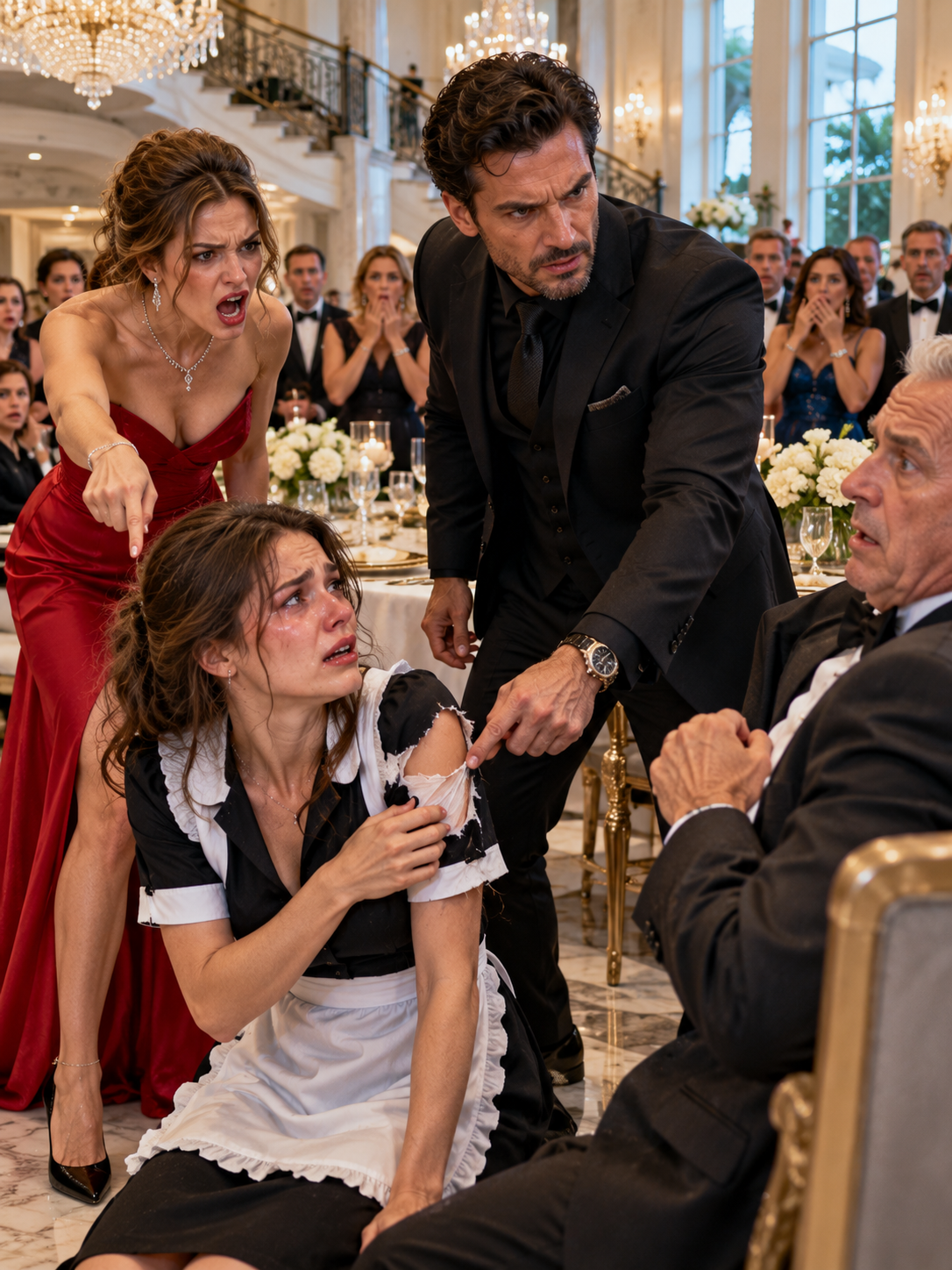
“Get on your knees, Hannah. I’m not going to embarrass myself by asking you again.” Sloane Varela stood in front of me wearing a crimson evening gown that probably cost more than three months of my wages, her diamonds flashing beneath the dining room chandeliers. Behind her, forty guests sat around a polished walnut table covered with crystal glasses and elaborate flower arrangements. I could feel red wine soaking through my apron, cold against my stomach, while her father watched with an amused smile.
My name is Hannah Reed, and I’d worked at Roman DeLuca’s Chicago mansion for eleven months. At twenty-five, I’d already learned that wealthy people could make you feel invisible without ever lowering their voices. Roman owned a sprawling freight and logistics business, although people whispered that his family’s influence extended into places respectable businessmen never discussed. None of that mattered when I applied for the housekeeping position; the salary and health benefits mattered because my mother was recovering from cancer treatment.
I’d spent the previous hour serving dinner without attracting attention, which was exactly how I preferred working in that house. The kitchen smelled of roasted rosemary, garlic butter, and fresh bread, while the dining room glittered with crystal under enormous chandeliers. Everything was going smoothly until Sloane’s father, Grant Varela, caught my wrist as I leaned forward to collect his plate. His heavy gold ring dug into my skin, and he pulled me close enough that I could smell expensive cologne on his jacket.
“Come upstairs after dinner,” he whispered, tightening his grip when I tried to straighten. “I could make your life considerably easier, sweetheart.” I told him quietly to release me, but his fingers closed around my sleeve instead. The fabric tore with a sharp ripping sound, and the serving spoon struck his plate.
Sloane hurried over before I could explain what had happened. She glanced at my damaged uniform, then at her father’s expression, and immediately accused me of deliberately attracting his attention. “You little opportunist,” she hissed, loud enough for the nearest guests to hear. “Do you honestly think my father would be interested in someone like you?”
Grant leaned back in his chair and adjusted his cufflinks as though nothing had happened. “She’s embarrassed because I corrected her attitude,” he said smoothly, and Sloane nodded as if that settled everything. I tried to explain that he’d grabbed my arm, but she interrupted before I finished. She picked up a glass of red wine and slowly poured it across my apron.
Several people gasped, although nobody stood up or asked whether I was all right. Sloane placed the empty glass on the table and pointed at the floor. “Now clean up your mess, and apologize to my father properly.” I bent to retrieve a fallen napkin, not because I intended to obey, but because my hands were shaking uncontrollably.
My mother, Irene, had another appointment scheduled for Monday, and I couldn’t afford to lose the insurance benefits connected to my job. Two years earlier, I’d been working toward a hospitality management degree before her illness forced me to postpone school. Roman’s estate offered a steady paycheck, predictable hours, and enough overtime to cover the bills piling up in our apartment. I kept reminding myself of those things while Sloane waited for me to kneel.
Then a chair moved at the head of the table. Roman DeLuca rose slowly, buttoning his charcoal jacket with one hand, his dark eyes fixed on my damaged sleeve. At thirty-nine, he rarely raised his voice, yet conversations stopped whenever he stood. “Hannah,” he said, “come here.”
I walked toward him with wine dripping from my apron onto the marble floor. Roman looked at my wrist, where angry red marks were forming, then examined the torn seam of my sleeve. “Who did that?” he asked. Before I could answer, Sloane laughed and said I’d created an inappropriate misunderstanding with her father.
Roman ignored her and repeated his question. Grant cleared his throat, smiling with the confidence of someone accustomed to being believed. “I barely touched the girl, Roman. She’s making a ridiculous fuss over a harmless joke.” Roman slowly turned toward him, and something in his expression made Grant’s smile falter.
“That’s interesting,” Roman said quietly. “Because I never asked whether you touched her.” He glanced at the tear in my sleeve, then at Grant’s heavy gold ring. “I asked who damaged her uniform.”
The entire room fell silent, and for the first time that evening, Grant Varela looked uncomfortable. Roman pulled out the empty chair beside him and gestured for me to sit. Sloane started protesting that household employees didn’t belong at the table, but he stopped her with a single look. Then he asked his security chief to bring him the dining room surveillance records.
Part 2
Marcus Bell, Roman’s head of security, entered the dining room carrying a tablet. He was a broad-shouldered man in his late forties who normally moved through the mansion so quietly I barely noticed him. Tonight, he approached the table with an expression I couldn’t read and placed the tablet in front of Roman. Sloane folded her arms and demanded to know why anyone was treating a servant’s complaint like a criminal investigation.
The footage showed me approaching Grant’s chair with the serving tray balanced against my hip. It showed his hand reaching across the table, catching my wrist, and pulling me toward him until the fabric at my shoulder stretched. I watched myself struggle to step backward before the seam tore, then saw Sloane hurry over and begin shouting. The camera had no audio, but the physical sequence was painfully clear.
“She twisted away before I could explain myself,” Grant protested, leaning toward Roman. Roman replayed the recording and pointed out that Grant continued holding my sleeve after I’d pulled away. Then he asked me what Grant had said, and I repeated his invitation in a voice that sounded strangely detached. Grant’s face hardened as he accused me of inventing the entire conversation.
“Enough,” Roman said, turning to Marcus. “Preserve the original recording, document what happened, and have Mr. Varela escorted from the property.” Grant started laughing in disbelief, but Roman wasn’t finished. He instructed Marcus to arrange an incident report and asked whether I wanted to speak with the police. When I nodded, Grant stopped laughing.
Sloane sprang from her chair and demanded that Roman reconsider. “You’re choosing a maid over the family you’re about to marry into?” she shouted, her diamond earrings trembling as she moved. Roman looked at the wine stains spreading across my uniform before answering. “I’m choosing not to excuse what happened simply because your father is wealthy.”
The dinner broke apart in uncomfortable fragments. Guests gathered handbags and coats while drivers were summoned to the front entrance, and Grant tried unsuccessfully to draw several business associates into his argument. Sloane followed Roman into the corridor, demanding a private conversation about their engagement. I slipped into the service kitchen, where the warm smell of bread suddenly made me nauseous.
Mrs. Alvarez, our senior housekeeper, helped me remove the stained apron and brought a clean cardigan to cover my torn sleeve. She’d worked in Roman’s household for almost seventeen years and knew precisely when I was pretending not to cry. “Sit down, Hannah,” she said, setting a glass of water before me. “You can be frightened without being ashamed.”
Marcus arrived with an incident form and asked if I was comfortable describing what had happened. I told him everything, including Grant’s words and the moment Sloane poured wine over me. He photographed the torn fabric and the marks on my wrist with my permission. Before leaving, he mentioned something unexpected: Grant’s visit had already been under scrutiny because of discrepancies in documents connected to his freight company.
I assumed Marcus meant financial disagreements between businessmen, which were hardly unusual in that house. Roman’s shipping interests overlapped with Grant’s warehouse operations, and several recent dinners had involved long conversations about a partnership. I’d overheard nothing specific, but I remembered Roman arguing with someone on the phone about missing inventory reports. Until that night, those details had seemed completely unrelated to my life.
Roman came into the kitchen shortly afterward and apologized for allowing Grant’s behavior to escalate in his home. He offered paid leave while the incident was reviewed and assured me that reporting it wouldn’t cost me my position. I thanked him, but he seemed distracted when Marcus quietly handed him another tablet. After studying its screen, Roman asked whether I’d entered his private study the previous Thursday evening.
The question startled me because Thursday was the night my mother had gone to the emergency room with a fever. I’d left work early after receiving her call, and Mrs. Alvarez had personally arranged my transportation. Roman listened without interrupting, then asked whether anyone else had borrowed my employee identification card. I told him I’d misplaced it briefly that afternoon before finding it beside the laundry shelves.
Marcus explained that someone had used my credentials to enter a restricted hallway near Roman’s study after midnight. The security system had recorded an access attempt involving confidential shipping documents, and my identification number appeared in the log. I stared at him, struggling to understand why someone would use my card when I hadn’t even been inside the mansion that night. Roman assured me he wasn’t accusing me, but I could see the question troubling him.
“Why are you telling me this now?” I asked. Marcus said the security team had been reviewing irregular access records before the dinner, but the incident with Grant made the timing important. Someone had apparently entered an area containing documents related to Grant’s pending contracts. I remembered Grant’s sudden interest in the service corridors and how he’d asked whether staff were allowed near the study.
Marcus opened a second recording taken from a hallway camera just after midnight. A woman wearing the same black-and-white uniform I wore appeared briefly, moving toward the restricted doors with her face turned away. She carried a folded cleaning cloth, but something about her shoes bothered me immediately. My uniform required flat black footwear, while the woman in the recording wore narrow, pointed heels.
Then she turned slightly, revealing a silver bracelet beneath her sleeve. I had seen that bracelet before, glittering beside a crimson evening gown only an hour earlier. It belonged to Sloane Varela.
Part 3
I watched the hallway recording three times before anyone spoke. Sloane had worn that silver bracelet throughout the evening, a narrow band with a distinctive crescent-shaped clasp. Roman noticed it too, but he reminded Marcus that a bracelet wasn’t enough to establish someone’s identity. Marcus enlarged the image and explained that investigators would need additional evidence before drawing conclusions.
The following morning, my mother noticed the bruises on my wrist while I helped her prepare breakfast. Our apartment smelled of toasted bread and the lavender soap she kept beside the kitchen sink. I tried to minimize what happened, but she refused to let me change the subject. “You didn’t survive all these difficult years with me just to let strangers teach you that you deserve humiliation,” she said.
After breakfast, I contacted an employment attorney named Rachel Kim. She reviewed the incident report, my photographs, and the messages confirming my hospital visit on Thursday. Rachel advised me to preserve everything independently, especially because Roman’s investigation concerned his own business interests. “He may be treating you fairly,” she said, “but protecting yourself shouldn’t depend entirely on his goodwill.”
Marcus called that afternoon with another discovery. The electronic lock had registered my identification number, but the security system couldn’t confirm that my original card had physically opened the door. Someone had requested a temporary duplicate through the estate’s administrative office earlier that week. The request carried Sloane’s approval, supposedly for organizing preparations before the engagement dinner.
I remembered finding my identification card beside the laundry shelves Thursday afternoon. Sloane had visited the service area that morning, claiming she wanted to inspect arrangements for the dinner. She’d asked about staff schedules, which entrances employees used, and whether housekeeping keys opened the private study. At the time, I considered her intrusive; now those questions sounded disturbingly calculated.
Three days later, Sloane appeared outside my mother’s medical center. She stood beside a silver Mercedes, wearing oversized sunglasses and holding a leather folder. “We need to stop this nonsense before someone gets seriously hurt,” she said, glancing toward the entrance. I told her to leave, but she opened the folder and showed me a prepared statement bearing my name.
The document claimed I’d entered Roman’s study without permission and mistakenly removed confidential business papers while cleaning. In exchange for signing it, Sloane promised a substantial payment that could cover my mother’s remaining medical expenses. She also offered to arrange another position at one of her father’s hotels. I read the statement twice before asking why she needed me to confess to something I hadn’t done.
“Because Roman’s people need somebody to blame,” she replied, lowering her sunglasses. “You can either accept an arrangement that benefits everyone or fight people who can make your life miserable.” I asked whether her father had authorized the offer, and she smiled without answering. Then she added, “Your mother needs stability, Hannah, not a daughter who thinks she’s some kind of hero.”
I photographed the document before returning it, then walked inside without discussing money. Mom was sitting in the waiting area, reading a magazine with her glasses halfway down her nose. When I told her what Sloane had offered, she quietly took my hand. “I’d rather owe the hospital money than watch you sell your own name,” she said.
That evening, Rachel helped me provide Sloane’s proposed statement to the investigators handling the original incident. Marcus separately confirmed that Roman’s business attorneys had uncovered unexplained changes to several warehouse shipment records. The records involved containers managed by Grant’s freight company, with paperwork suggesting some cargo had been redirected to facilities outside Roman’s approved network. The missing documents from Roman’s study could have exposed those discrepancies before a major contract renewal.
I finally understood why Grant had been so interested in which rooms I could enter. He wasn’t merely an arrogant guest who thought employees existed for his amusement; he apparently believed I could be pressured into supporting a much larger deception. But the investigation still hadn’t established whether Sloane had taken the documents herself. Then Marcus called again with news about the temporary identification card.
An administrative employee had found a signed requisition for the duplicate, along with a note instructing security not to question the person carrying it. The handwriting matched Sloane’s, and the duplicate had been issued under my employee number. Worse, an earlier version of the requisition described me as someone who would “accept responsibility for routine document handling.” Suddenly, her demand that I kneel in front of forty witnesses seemed less like a spontaneous tantrum and more like preparation for a public confession.
Part 4
Roman asked me to meet him in his office the following Monday, with Rachel present. The room overlooked Lake Michigan, its tall windows revealing gray water beneath a low October sky. He looked tired, with several folders spread across his desk and his phone turned facedown beside them. “I owe you more than an apology,” he said, “because people I invited into my home tried to make you responsible for their actions.”
He explained that his company had suspended its proposed partnership with Grant’s freight business pending an independent review. Financial auditors had already identified shipments charged to clients despite being redirected through unauthorized facilities. Grant’s company had submitted supporting documents that didn’t match original warehouse records. The missing papers from Roman’s study contained preliminary findings that could have exposed the discrepancies.
“Did Sloane know?” I asked, remembering her expression when Roman noticed my sleeve. Roman said she had helped organize the contract documents and had access to his study during their engagement. Investigators were examining whether she’d deliberately removed files or simply assisted her father without understanding the full scheme. He didn’t ask me to accept either explanation, and I appreciated that more than another promise of protection.
Then Rachel asked a question that changed the conversation. “Why choose Hannah as the person supposedly responsible for handling those documents?” Roman looked toward Marcus, who opened another folder. Inside was a copy of a staff emergency-assistance application I’d submitted months earlier, when my mother’s medical bills threatened to overwhelm us. Someone had included it among papers circulated during the proposed partnership negotiations.
Sloane had apparently used that application to learn the extent of my family’s financial difficulties. The investigators also found a questionable consulting-payment entry identifying me as the recipient of money linked to a Varela-affiliated business. I’d never received such a payment, but the company records suggested otherwise. Rachel immediately requested the supporting bank documentation and warned everyone not to assume the ledger entry represented a genuine transfer.
For the first time, I understood how carefully Sloane had selected her target. A young housekeeper supporting a sick mother might seem desperate enough to sell confidential papers, especially if someone created records implying she’d been paid. If investigators questioned me, she could describe my financial worries and point toward a fabricated paper trail. The public humiliation at dinner would make me look unreliable before I ever had a chance to defend myself.
Roman leaned back and told me he’d ended his engagement after the dinner. Sloane had demanded that he choose between their families’ partnership and an employee she considered replaceable. “I told her there was no partnership worth protecting if it required ignoring what happened at my table,” he said. He wasn’t asking for admiration, and I wasn’t prepared to give it simply because he had finally enforced a basic standard of decency.
Outside the mansion, the situation grew increasingly unpleasant. Grant’s attorneys disputed the allegations, while his representatives sent letters threatening legal action over damage to his reputation. Rachel handled any correspondence mentioning me and helped me make a formal report about the physical incident. I continued working reduced shifts because I needed the income, but every unfamiliar car near our apartment made me uneasy.
Six weeks later, investigators confirmed that the supposed consulting payment had never reached me. The entry had been created in an internal ledger using unsupported documentation, and the account supposedly receiving the money didn’t belong to me. An independent review of the duplicate access credentials also connected Sloane to the restricted hallway on Thursday night. Her explanation that she’d been retrieving personal belongings didn’t account for the missing shipping documents.
My mother gradually regained her strength during those weeks, although I hadn’t told her how frightened I sometimes felt. One evening she found me sitting at our kitchen table, staring at a photograph of my torn sleeve. She placed a bowl of soup beside me and said, “You keep thinking you have to earn the right to be safe.” I started crying because she was right.
Roman’s attorneys eventually provided the relevant findings to the authorities investigating the financial discrepancies. I understood that complicated commercial misconduct could take months or years to resolve, but at least the available evidence no longer pointed toward me. The estate restored my regular work schedule, and Marcus confirmed the false access entries had been formally disputed. For the first time since dinner, I believed I might escape the situation without losing my career.
Then Rachel called with a final development before the scheduled mediation concerning my workplace complaint. Grant’s representatives were offering a substantial settlement if I agreed not to pursue the matter publicly or discuss the dinner incident. Buried in the proposed agreement was a sentence describing what happened as a “mutual personal misunderstanding.” I read it twice, remembering his hand tightening around my wrist, and realized the Varelas still expected money to buy the truth.
Part 5
I rejected the settlement language the following morning. Rachel warned me that negotiations could become expensive and exhausting, but she agreed the proposed statement contradicted the evidence we’d preserved. I wasn’t demanding that Grant publicly humiliate himself or beg for forgiveness. I wanted an accurate account, appropriate compensation, and assurance that the incident wouldn’t follow me into future employment.
The mediation took place in a downtown office with wide windows overlooking the Chicago River. Grant arrived wearing a navy suit and the same gold ring that had cut into my wrist. Sloane sat beside him, avoiding my eyes until Rachel placed the photographs of my torn uniform on the conference table. Then she whispered, “Are we seriously still talking about this?”
“Yes,” I answered, surprising myself with the steadiness of my voice. “We’re talking about what happened because neither of you has acknowledged it.” Grant’s attorney asked whether I’d consider a private apology, but I told him an apology wasn’t a substitute for a truthful settlement. After several hours of negotiations, their representatives agreed to revise the language and address the employment-related harm without requiring me to deny the incident.
Grant eventually looked across the table and said he regretted his behavior. He claimed the dinner had gotten out of hand and insisted he’d never intended to frighten me. I listened without interrupting, remembering how confidently he’d smiled while Sloane ordered me onto my knees. “You frightened me because you believed nothing would happen to you,” I replied, and he had no answer.
The settlement wasn’t an instant fortune, but it covered my legal expenses and provided compensation for the harm I’d experienced. Separately, Roman’s household adopted clearer procedures for reporting misconduct by guests, safeguarding employee credentials, and preventing private medical information from being circulated. Mrs. Alvarez helped develop the new policies because she understood what employees actually faced. I appreciated that more than any dramatic promise of revenge.
The financial investigation continued well beyond my case. Months later, Grant’s company faced civil recovery claims over disputed shipments, and prosecutors announced charges involving falsified commercial records. Sloane also faced legal scrutiny for her involvement in the unauthorized access and supporting paperwork. Their attorneys contested portions of the allegations, and the courts took their time determining responsibility.
Roman never threatened to have anyone disappear or used his reputation to frighten them into submission. Whatever complicated history surrounded his business empire, he insisted the documented evidence should determine the outcome. I was grateful he’d intervened at dinner, but I also knew I couldn’t build my future around the protection of one powerful man. I needed a life in which my safety and opportunities belonged to me.
Several months after the dinner, Roman offered me a position coordinating household operations and supervising outside contractors. The salary was generous, and he said my handling of the investigation had demonstrated judgment under pressure. I considered the offer carefully before explaining that I wanted to finish my hospitality management degree and eventually work in a larger organization. He accepted my decision without attempting to change it.
I completed my final semesters while working part-time, and the following spring I accepted an operations position at a Chicago arts foundation. The building was smaller than Roman’s mansion, with creaking wooden stairs and an elevator that occasionally complained between floors. I loved the practical challenges, the predictable schedule, and the way my coworkers asked for my opinion without treating my job title as a measure of my worth. My mother attended my graduation, walking slowly but smiling through the entire ceremony.
Almost two years after that terrible dinner, I saw Sloane outside a downtown restaurant. She looked thinner and less polished, and for a moment I thought she might pretend not to recognize me. Instead, she approached and said, “I suppose you got everything you wanted.” I looked at her carefully before answering, “No, Sloane. I wanted to do my job and go home to my mother without being humiliated.”
She began explaining how much her life had changed since Roman ended their engagement. Her father’s legal troubles had damaged the family business, several friends had disappeared, and she was trying to rebuild her career. I didn’t interrupt, but when she finally said she’d never meant for things to become so serious, I shook my head. “You meant to hurt me,” I said. “You just didn’t expect anyone to believe me.”
I walked away without waiting for another apology. That evening, Mom and I had dinner together in our apartment, laughing over an old photograph from my college orientation. For years, I’d feared losing the job that kept our lives from falling apart, but now I had a career I’d chosen for myself and a future that didn’t depend on anyone’s mercy. My mother was doing well, and the bills that once kept me awake were finally manageable.
Sometimes I still remember the dining room, the wine soaking into my apron, and forty people watching while Sloane demanded that I kneel. I remember Roman asking who had torn my sleeve and Grant suddenly realizing that someone was willing to question him. But the most important thing that happened wasn’t a powerful man standing up for me. It was discovering that I could stand up for myself, tell the truth, and walk away without asking anyone’s permission.
Legal Notice: This story is a work of fiction. Names, characters, businesses, events, and incidents are the product of the author’s imagination or are used fictitiously. Any resemblance to actual persons—living or dead—or to actual events is purely coincidental. Thank you! 💓