I Called My Husband 31 Times From the ER—His Mistress Answered, but My Dying Mother-in-Law Had the Last Word
I called my husband thirty-one times while his mother was dying in the emergency room. On the final call, his mistress laughed and said, “We’re in Maui, old wife. Stop bothering us!” My mother-in-law heard everything, squeezed my hand, and pressed a tiny silver key into my palm. “Expose him,” she whispered. Three days later, I opened a secret box containing documents my husband never expected me to find. What began as an affair was hiding something far more devastating.
Part 1
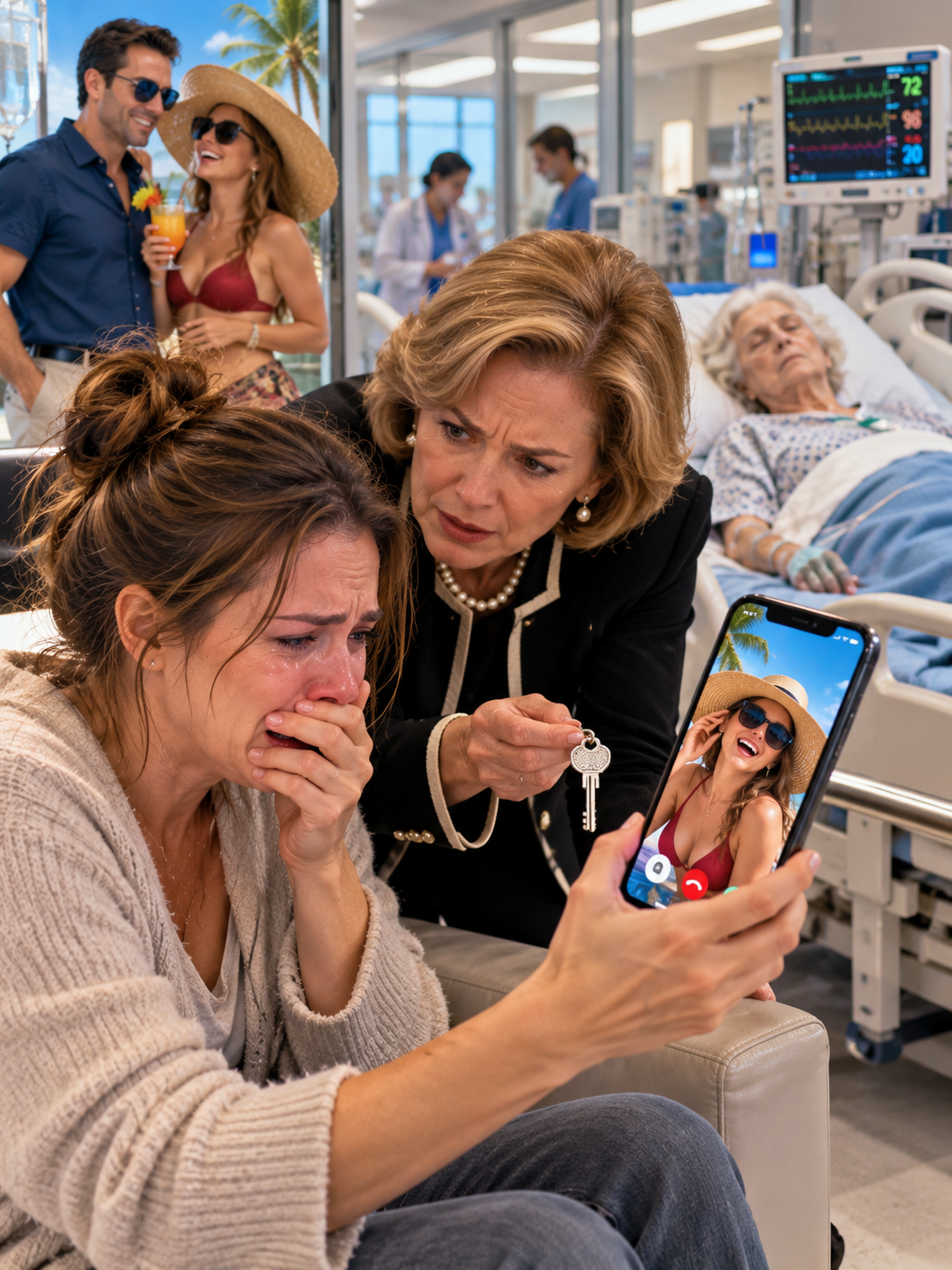
The thirty-first call connected beside my mother-in-law’s emergency room bed. I said, “Colin, please,” but a woman answered over the sound of waves and clinking glasses. “He’s in the shower, old wife,” she laughed. “We’re in Maui. Stop ruining our vacation.” She hung up.
My name is Nora Mercer, and my twenty-one-year marriage had become a series of excuses. Colin managed procurement for a major hospital construction firm, and I ran a small bookkeeping practice from home until his mother, Evelyn, suffered a stroke four years earlier. Our days were measured in therapy appointments and the squeak of her walker. Colin called me an angel at dinner parties, then disappeared whenever the work actually needed doing.
He’d said his trip to Hawaii was a conference, and I’d believed him despite the unfamiliar perfume on his shirts and the sudden password on his phone. That afternoon, Evelyn complained of chest pressure while sorting photographs. Rain blurred the ambulance windows. I called Colin from the ambulance and admissions desk, counting because I couldn’t stop.
When I returned from that last call, Evelyn was awake enough to recognize me. “He isn’t coming,” I whispered, afraid the truth might distress her more than my silence. She closed her eyes, then opened them and squeezed my wrist with the surprising force she sometimes found when she was angry. From beneath her blanket she pushed a small silver key into my palm and rasped, “Tell the truth. All of it.”
She couldn’t tell me what it opened. A nurse stepped in, followed by the physician, and I had to move back as they worked. Evelyn died before midnight, with my hand resting beside hers on the mattress. I sat there afterward staring at the key’s worn teeth, wondering why she’d carried it in her dressing-gown pocket.
Three days later our house smelled of lilies and the lemon disinfectant I’d used to wipe down her equipment. Colin hadn’t returned a single call, though a message from his assistant claimed his phone had been lost during travel. I completed the funeral arrangements, signed the cremation authorization, and set the urn on the dining-room sideboard. I put my wedding ring beside a divorce lawyer’s card.
Evelyn had mentioned a solicitor named Leonard Price several times during her last year, always when Colin was away. His office occupied the second floor of a brick building above a stationery shop, and it smelled of old paper and peppermint tea. When I set the key on his desk, he stopped stirring his cup. “She hoped you’d never need this,” he said, opening a locked cabinet behind him.
Inside a narrow metal case were a letter addressed to me, a signed estate plan, and copies of statements from an account Evelyn had kept separate from her son. Her instructions nominated me to administer her estate and left her remaining assets to me, subject to the ordinary legal process. The account held just over half a million dollars, including deposits I couldn’t explain. Each bore a payment reference linked to Ridgewell Supply, a construction subcontractor owned by Colin’s uncle, Douglas.
“She asked me to preserve these,” Leonard said, sliding a blue ledger across the desk. In Evelyn’s careful handwriting, certain entries had stars beside them, and one page contained the words “children’s wing” underlined three times. I thought it might be a charitable project until Leonard turned on the television behind the reception partition. A reporter was standing outside the newly renovated Briarfield Children’s Hospital, where a ceiling section had collapsed overnight and several people had been injured.
The report named Ridgewell Supply among contractors under examination. I looked down at Evelyn’s stars, then at the silver key still beside my elbow. My husband was supposed to have approved procurement on that project, yet he’d spent three days refusing to come home while his mother died. When Leonard asked whether Colin knew about the case, I remembered the ocean in the background of the mistress’s voice and said, “I don’t think he knows what she left me.”
Part 2
Leonard didn’t let me rush to the bank with Evelyn’s ledger. “An estate isn’t a checking account you can simply take over,” he explained, putting the documents into protective sleeves. We notified the bank of her death, requested preservation of transaction records, and started the probate process under the signed will. He also contacted the insurer listed on a recently issued policy naming Colin as beneficiary, because Evelyn’s letter said she’d never understood why he had purchased it.
I read that letter in the privacy of Leonard’s conference room. Evelyn wrote about the guilt she’d felt for making excuses for her son and the years I’d spent caring for her while he traveled. “I cannot repay you for the time,” she wrote, “but I can make sure he doesn’t get to rewrite it.” Beneath her signature she added a strange request: “Check the invoices against the days I was in rehabilitation.”
Back home, I opened a binder of calendars I’d kept to coordinate Evelyn’s appointments. During weeks when she could barely leave the rehabilitation center, substantial payments had arrived from Ridgewell Supply, followed by transfers to an account associated with a consulting company. Colin used to tell me these were ordinary distributions from his mother’s investments. But Evelyn had never mentioned owning part of a construction supplier, and the consulting company name meant nothing to me.
At first, I wondered whether she had secretly invested in her brother Douglas’s business and forgotten to tell me. Then I found a photocopy of an invoice folded into her medical folder, its margins marked in her shaky handwriting. It charged Briarfield Children’s Hospital for fire-rated panels at a price far above anything I remembered from bookkeeping work. In the corner was a handwritten notation: “C approved. Ask Nora?”
I photographed it, left the original in place, and called Leonard. He told me not to draw conclusions from a single invoice, but agreed to have a forensic accountant compare it against the ledger. By afternoon I’d moved Evelyn’s papers and my own essential documents to his office, then packed a suitcase for a guest room at my friend Paula’s house. I couldn’t bear to wait alone for Colin under the roof where I’d washed his mother’s hair and helped her learn to hold a spoon again.
Our home had security cameras in the common rooms, installed after Evelyn wandered outdoors one winter evening. Colin knew they were there, although he’d never bothered to learn how the recordings were stored. That night, from Paula’s dining table, I watched a familiar silver SUV roll into our driveway. Colin climbed out wearing a linen jacket, with a younger woman carrying a white designer suitcase behind him.
“So this is the house?” she asked as they entered. “I thought you said your mother would leave it to you.” Colin switched on the hallway lights, noticed the empty space where Evelyn’s walker had stood, and started calling my name. He found the funeral program on the sideboard and stopped speaking. For a long moment I thought he was grieving.
Then he picked up the program and said, “Why didn’t anyone tell me?” The woman, whom he called Brielle, reminded him that I’d phoned repeatedly. He snapped that he’d assumed I was exaggerating again, then demanded to know whether I’d found Evelyn’s private papers. Brielle glanced toward the camera and murmured, “We need to leave before your uncle calls again.”
Colin reached for his phone. “Douglas promised that money would be available by Friday,” he said. “If Nora gets the account records, she’ll ask questions nobody needs her asking.” Brielle asked whether I could be persuaded to sign whatever forms were required. Colin’s answer came without hesitation: “She’s signed my paperwork for years. I’ve got copies of everything.”
I saved the full unedited recording and sent Leonard the timestamps. He called back with news from the forensic accountant: several questionable procurement approvals submitted to Colin’s employer bore my name as the supposed outside financial reviewer. I’d never worked for that employer, never reviewed its hospital contracts, and never agreed to certify a single purchase. But the signature attached to the approvals was a near-perfect copy of my own.
Part 3
I spent the next morning staring at signatures I seemed to have written on documents I’d never seen. Some were dated while I was helping Evelyn in a rehabilitation center; one fell on the day of my own outpatient surgery. Others appeared on approval forms beside equipment codes I couldn’t begin to decipher. I had handled Colin’s household bills for years, but my bookkeeping practice never certified construction materials or authorized hospital purchases.
Leonard introduced me to a document examiner and a former corporate auditor named Simone Ellis. Simone didn’t promise to prove a conspiracy by lunchtime; she asked for ordinary things, including original files, invoice numbers, employee permissions, and bank records. She explained that a copied signature might establish misrepresentation, but proving who placed it on a form required more. Her caution was infuriating and comforting at the same time.
While she worked, Colin sent forty-three messages in one afternoon. He began with, “I’m devastated about Mom,” moved quickly to, “We need to discuss her money,” and ended with, “Don’t be stupid about the documents, Nora.” When I declined to meet at the house, his attorney proposed a conference at Leonard’s office. I agreed only after Leonard arranged for a representative from Colin’s employer, Northstar Medical Construction, to review the disputed authorizations separately.
The meeting was set for Thursday. Colin arrived wearing a dark suit and the expression he used at funerals when there were important clients in the room. Douglas sat beside him, his broad hands resting over a leather portfolio, while their attorney, Preston Vale, greeted me with exaggerated concern. Colin said he was there to restore peace between us, although he hadn’t asked where his mother’s ashes had been placed.
Preston slid a settlement proposal toward me. It demanded that I withdraw any claim to Evelyn’s estate, surrender the ledger, and acknowledge that I’d managed certain financial approvals on Colin’s behalf. In exchange, Colin would supposedly decline to pursue allegations that I had misused funds entrusted to his mother. I read the page twice, feeling an impulse to apologize.
“You’re telling me I stole money from a woman whose laundry I washed last Tuesday?” I asked. Douglas leaned forward and said Evelyn had been confused for years, while Colin stared at the wall. Preston pointed to my signatures and warned that investigators might view my refusal to cooperate as evidence of guilt. It was a threat dressed up as a favor, and suddenly I understood why my husband had brought so many supposedly routine forms home.
I turned to Colin and asked whether he’d ever told Evelyn about the hospital materials. He said his mother had been incapable of understanding business matters. I reminded him she’d balanced the accounts for her family’s grocery stores before he was born and could still spot a billing error through thick reading glasses. He smiled thinly and said, “You’ve always confused caregiving with authority.”
Leonard pushed the proposed agreement back across the table. He told Preston we would not sign, relinquish records, or make statements admitting responsibility for acts I hadn’t performed. He also explained that the forensic review had uncovered discrepancies now being referred to the company’s compliance division and appropriate investigators. Colin’s face tightened for the first time, but Douglas merely folded his arms.
After they left, Simone brought us a packet of employee access logs. The contested approvals had been uploaded through Colin’s credentials, and several supporting files originated on a company laptop assigned to Douglas’s project liaison. That didn’t resolve every question, but it demolished their suggestion that I’d secretly submitted them from my home office. I could feel the pressure in my shoulders loosen.
Then Leonard showed me one more item found behind the ledger’s back cover: a sealed letter Evelyn had dated four years earlier, before her first major stroke. Across the front she had written, “For Nora, if Colin says I imagined what happened.” Inside was a description of an argument with her son, along with a reference to an audio file she’d entrusted to Leonard. I looked up, unable to believe there was another secret, and he said, “It’s time you hear why she was afraid of him.”
Part 4
The audio began with a scrape of furniture and Evelyn’s voice, stronger than I remembered. Leonard said she’d recorded the conversation on her phone when Colin came to demand access to an account, then saved the file with him before her health worsened. Our kitchen clock struck eleven. Listening felt like entering a house where she could still stand unaided.
“Those panels aren’t what the specifications require,” Evelyn said in the recording. “Douglas showed me the invoices, and your name is on the approval.” Colin answered sharply that she knew nothing about modern contracting, but she insisted the payments passing through her account had to stop. Then he said, “If you talk to anyone, I’ll say you authorized every transfer.” The next sounds were a chair moving and Evelyn breathing harder.
“Colin, something’s wrong,” she whispered. “Please call for help.” His reply was cold enough to make my fingers go numb: “You always do this when I’m busy. I’m leaving.” A door slammed, and the recording continued through several agonizing seconds of her calling his name. Leonard stopped it before the end and asked whether I wanted a moment.
Four years earlier, Colin had told me he discovered Evelyn after returning from work, alone and unable to speak clearly. He’d said he called emergency services immediately and blamed himself for not coming home sooner. I had comforted him through the night while doctors explained the damage from her stroke. Now I knew at least part of that account was a lie, though the recording alone couldn’t tell us what medical difference an earlier call might have made.
“Why didn’t she report him?” I asked. Leonard told me Evelyn had initially insisted the argument was a family matter, then feared Colin would retaliate against me or deny her care. She’d given Leonard the file and written instructions to preserve it, but refused to let him act while she was able to make that decision. After the recent hospital procurement news, she’d finally authorized disclosure if she died or became unable to speak for herself.
I cried until I couldn’t read the ledger. Then I washed my face, called the physician who had treated Evelyn after her first stroke, and asked how to provide potentially relevant information through proper channels. I didn’t ask him to declare that Colin had caused her illness. I wanted someone independent to examine the timeline without being pressured by either side.
The following week, Northstar Medical Construction’s compliance director, Felicia Grant, met with Leonard, Simone, and me. We provided preserved account records, copies of the questioned approvals, and information about the home security recording, with legal advice concerning its use. Felicia had already begun an internal review after regulators announced the hospital investigation. She showed us a procurement chart where approved safety-rated panels had been substituted with a less expensive product before delivery.
“The final engineering findings aren’t in,” she cautioned, “but the purchase trail matters regardless.” Ridgewell Supply’s invoices charged for premium materials while warehouse records reflected something different. More troubling, reimbursements had moved through companies associated with Douglas and an account Colin could access using authority once granted by Evelyn. The ledger I’d assumed was evidence of her investments was beginning to look like a record of money passed through her name.
Colin’s attempts to contact me became frantic after Northstar suspended his access to company systems. Brielle sent a short message saying she had left him and wanted to give investigators a laptop he’d taken on their trip. I referred her to Leonard rather than offering protection I couldn’t promise. That evening, an investigator called to confirm that a separate inquiry into possible elder financial exploitation had begun.
Then Felicia forwarded a copy of a medical emergency record obtained through authorized channels. It showed that on the day of Evelyn’s first stroke, someone using Colin’s phone had called emergency services, disconnected before providing an address, and called back nearly an hour later. I knew his recorded words were terrible, but seeing the gap documented made the kitchen feel suddenly colder. For four years, he’d let me believe he found her too late to help.
Part 5
The hospital report took three more months. Investigators found that approved fire-resistant ceiling components had been replaced with lower-grade materials while invoices continued to charge for the original specifications. Engineers linked the substitutions to the collapse while examining other contributing factors. Injured families pursued civil claims long after television crews left.
Colin and Douglas were charged after investigators examined purchasing records, account transfers, and the origins of the false approvals. The charges concerned fraud and conspiracy, while state authorities examined Evelyn’s finances. There was no dramatic confession. Colin wore a plain jacket, listened to his attorney, and avoided looking at me across the courtroom.
Brielle eventually provided investigators with travel messages and a laptop Colin had taken to Maui. Her cooperation didn’t excuse what she’d said while Evelyn was dying, and I didn’t mistake it for friendship. When she sent me an apology, I forwarded it to Leonard without answering.
Northstar dismissed Colin; Ridgewell lost contracts and entered insolvency proceedings. Simone’s accounting review traced the suspicious deposits without assuming every dollar in Evelyn’s account belonged to her. Some funds became subject to court restrictions while the estate was administered, and Leonard made sure no disputed payment was casually passed to me. The process was painfully slow.
Colin tried to make the divorce part of his defense. Through his attorney, he argued that our marriage had deteriorated and I’d become resentful after years of caring for his mother. My lawyer documented Hawaii, the unanswered calls, and the fabricated approvals. His cruelty wasn’t proof of forgery, but the record mattered.
Almost a year after Evelyn died, Colin agreed to plead guilty to financial crimes involving the false invoices and transfers. His conduct during Evelyn’s emergency remained under review. I never learned whether an earlier ambulance call would have changed Evelyn’s condition; a specialist told investigators that certainty wasn’t possible from the records. What I did know was that when she asked her son for help, he’d chosen to leave.
His plea agreement didn’t require me to forgive him, and neither did our divorce decree. When he sent a letter claiming he’d been terrified of Douglas and had only wanted to protect our future, I put it in a file for my lawyer. He wrote, “You know the good man I used to be.” I could no longer build a life around who he claimed he once was.
Once the estate’s legitimate assets were settled, I received an inheritance far smaller than the balance that had first appeared on Leonard’s statement. It was enough, combined with my savings, to purchase a narrow storefront near the North Carolina coast. I named the place Evelyn’s Table and hired two local women who loved baking more than spreadsheets. Opening morning smelled of cinnamon rolls instead of hospital disinfectant.
On the anniversary of her death, I carried a small vase of white flowers to the cemetery and told Evelyn about the café. I thanked her for trusting me with the key, though I wished she’d felt safe enough to tell me everything while she was alive. I drove home beneath live oaks. My phone rang as I parked, displaying an unfamiliar number from the correctional facility where Colin was serving his sentence.
I let the call go unanswered. Later, a message through his attorney asked me to help pay for another legal challenge and said he missed his wife. I told the attorney not to contact me again except for matters requiring a legal response. Then I unlocked the café, hung my coat behind the counter, and put the kettle on.
The silver key rests now inside a small wooden frame beside a photograph of Evelyn laughing in our garden. Customers sometimes ask what it opens, and I tell them it belonged to someone who taught me to recognize the truth even when it hurts. I used to think devotion meant staying until there was nothing of me left to give. Now, when morning light fills the café and I hear the front bell ring, I know I can care deeply for someone without surrendering my own life.
Legal Notice: This story is a work of fiction. Names, characters, businesses, events, and incidents are the product of the author’s imagination or are used fictitiously. Any resemblance to actual persons—living or dead—or to actual events is purely coincidental. Thank you! 💓