The Neighbor I Helped Every Sunday Left Me a Battered Suitcase—Then His Estranged Son Came for Everything
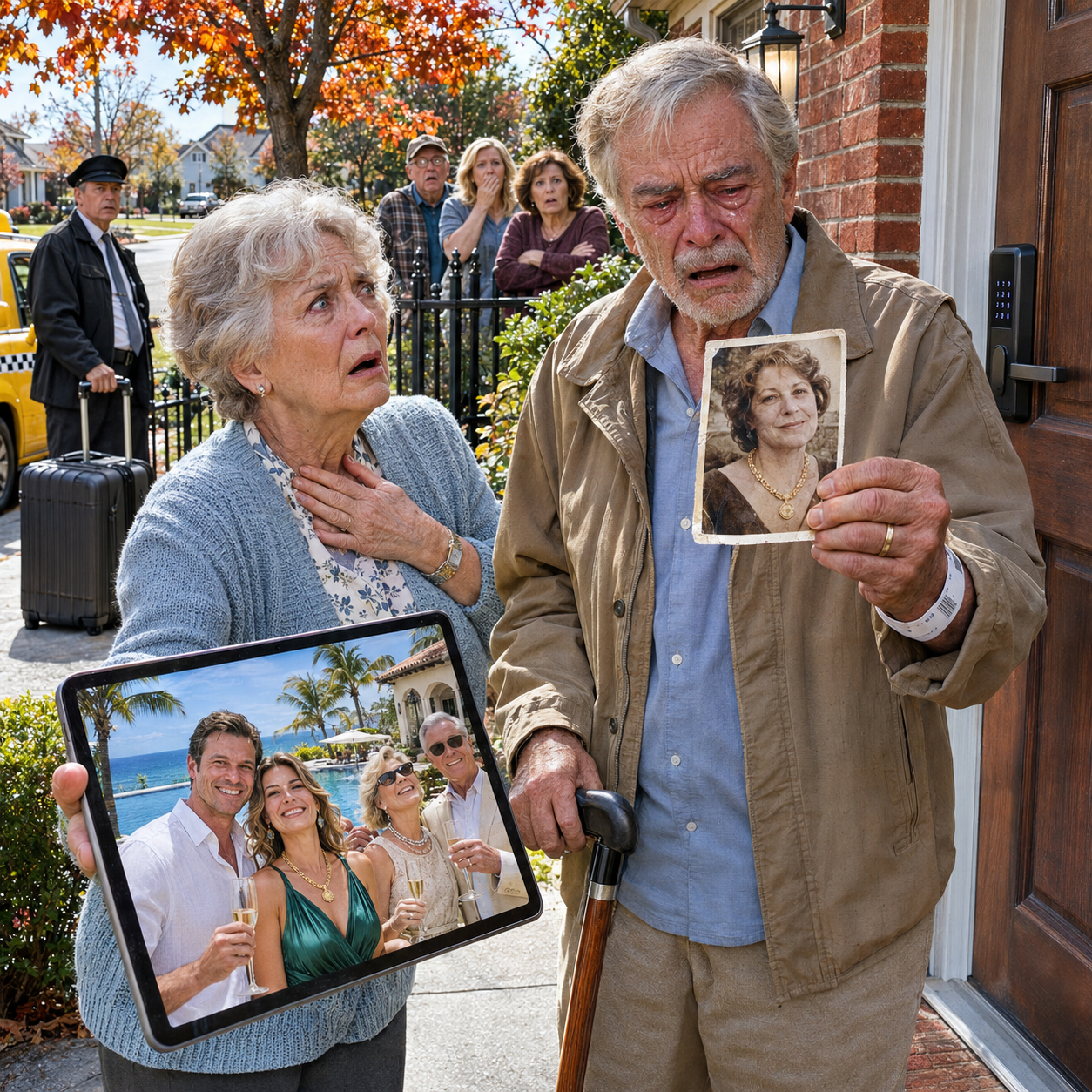
“You stole my father’s house,” a stranger shouted across my porch, two weeks after I buried the man I’d brought groceries to every Sunday for twelve years. His lawyer stood behind him, clutching papers that could turn my life upside down. I hadn’t asked for a penny from my eighty-four-year-old neighbor, yet the battered suitcase he left me held something far more unsettling than money. And when I opened his journal, I learned why his own son had stayed away—and why he’d suddenly returned.
Part 1
The first time I carried groceries into Edwin Kessler’s house, a jar of pickles rolled across his driveway and cracked against my shoe. He stood beside his old Buick, embarrassed, with two plastic bags cutting red grooves into his fingers. I picked up the jar, gathered the rest of his groceries, and asked whether he wanted help getting everything inside. “Only if you have five minutes,” he said, though I could tell he expected me to make an excuse.
I was fifty-two that autumn, a maintenance supervisor outside Columbus, Ohio, living with my wife, Nora, and our four-year-old daughter, Clara. Edwin had lived next door for years, though we had rarely spoken. His wife, Margaret, had died six months earlier, and his curtains remained drawn even on bright days. Inside, the house smelled of furniture polish and cold toast.
I put milk away while Edwin made coffee in an ancient percolator, apologizing for a mess that didn’t exist. A photograph showed him and Margaret beside a yellow rosebush, both laughing. When I asked about it, his expression softened, and I stayed for an hour.
He told me about his old hardware store and Margaret’s yellow roses; I told him about Clara’s rain boots and Nora’s hospital shifts. Before leaving, I offered to help with groceries again. “I might take you up on that,” he said.
He did, the following Sunday, with an apologetic voicemail asking for bread, eggs, and two cans of tomato soup. By winter, I’d started collecting his list every Saturday and taking him shopping or delivering what he needed after my own grocery run. Edwin always tried to hand me cash for the favor, and I always accepted only the cost of the groceries, not a fee. The rest of our time belonged to coffee and conversation, usually at the square oak table beneath his kitchen window.
Over twelve years, Clara grew into a teenager who shoveled his walkway, Nora brought soup after his hospital stay, and Edwin taught me to fix a kitchen faucet. He kept three chairs around his little table as though company might arrive any minute.
There were things he wouldn’t discuss. Once I mentioned seeing a younger man drive away from his house with a raised voice, and Edwin quietly changed the subject. Another time, while looking for a pen, I noticed a sealed envelope marked “Gordon” in a drawer beside a pile of returned Christmas cards. Edwin shut the drawer, then asked whether Clara had received her science-fair results, and I understood the subject was closed.
By his eighty-fourth birthday, Edwin needed a cane and tired easily, though his mind remained sharp enough to defeat me at chess. On our last Sunday together, he asked whether I believed people could choose their family. I told him I thought they could choose whom to show up for, which wasn’t quite the same thing but seemed to satisfy him. He squeezed my shoulder before I left and told me to come earlier next week because he had something to show me.
There wasn’t a next week. On Wednesday morning, his porch light was still burning after sunrise, and a home-care visitor found he’d died peacefully overnight. At the small funeral, I recognized more of the flower arrangements than the mourners, and Nora held my hand while the minister described Edwin as a man of quiet habits. I kept watching the empty pew near the front, wondering whether the man from the driveway would appear.
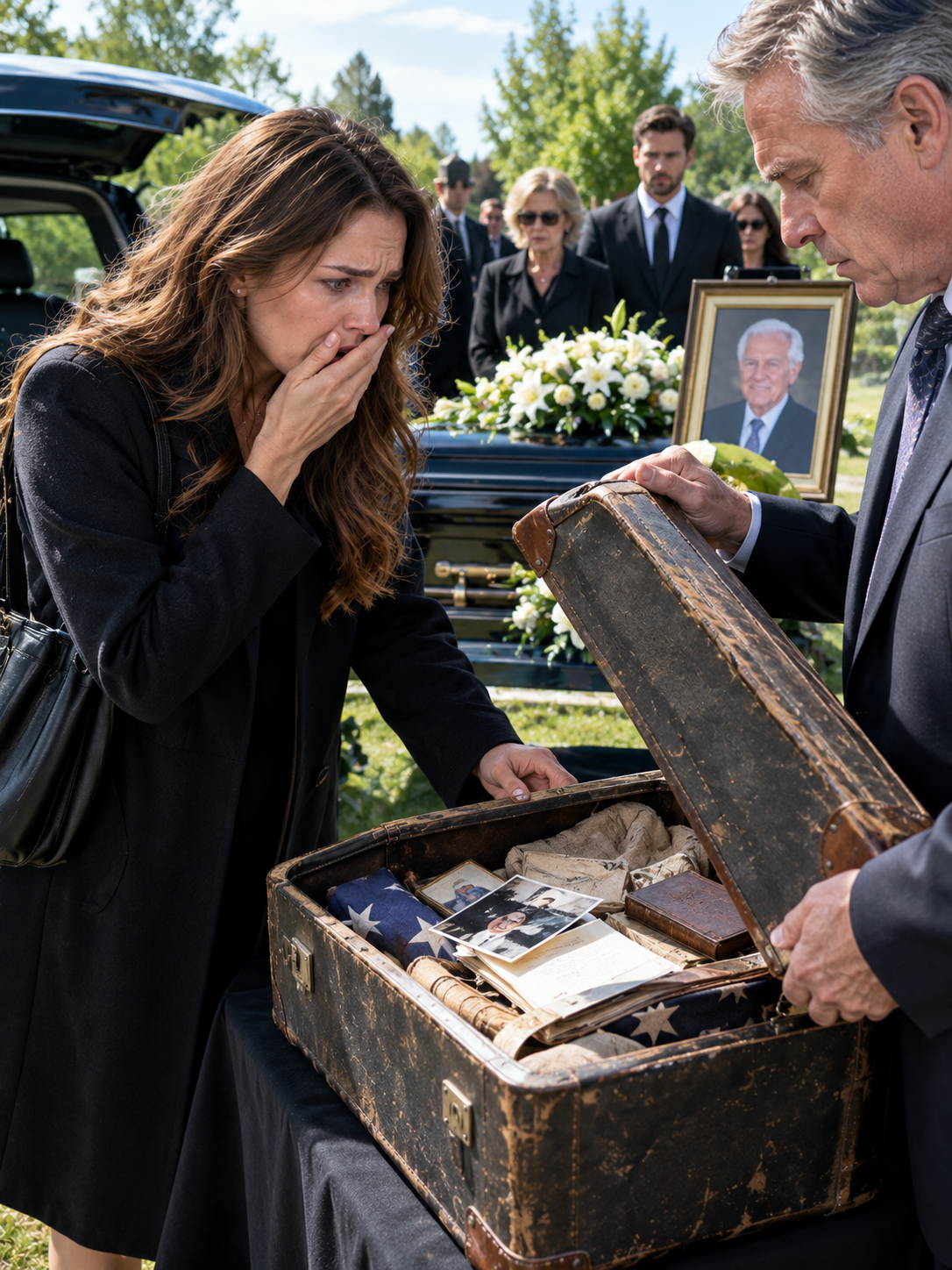
As we were leaving, a silver-haired attorney approached and asked, “Are you Daniel Ross, Edwin’s Sunday neighbor?” She introduced herself as Helen Mercer, showed me her firm’s card, and led me to the trunk of her car. Inside lay Edwin’s old brown suitcase, its corners rubbed pale and one brass clasp held shut by a leather strap. “He left explicit instructions for this to reach you after the funeral,” she said, handing me a sealed receipt to sign. When I lifted the case, I was startled by its weight—and by the small label tied to its handle: “For the man who came back.”
Part 2
After Clara went upstairs, I set the suitcase on our dining table while Nora watched with her tea. Beneath a wool scarf lay bundles of hundred-dollar bills, a green journal, a manila envelope, and a photograph of Edwin beside a younger man. I had expected his chessboard, not enough cash to fill a drawer.
Nora whispered, “Daniel, don’t touch anything else until we call his lawyer.” I agreed, but the folded letter resting on top was addressed to me, and the handwriting was unmistakably Edwin’s. I opened it and read aloud. “You came when I called about bread and stayed when there was nothing left to carry. I don’t think you know what that meant.”
He wrote that the first Sunday I’d helped him, he’d been overwhelmed by grief and had stopped seeing any reason to look forward to another day. Margaret’s death had hollowed out the house, and his only son had been gone for years after a bitter dispute about the family hardware business. Our conversation about yellow roses had made him laugh for the first time in months. “I didn’t need a rescuer,” he wrote. “I needed someone who wasn’t checking the clock.”
I had to stop reading because I couldn’t see the paper clearly. I remembered how I’d almost hurried away that afternoon to watch football, how irritated I’d been when the percolator took forever to finish. I remembered his chess lessons, Clara singing, and Nora delivering soup. What felt like errands to me had meant much more to Edwin.
The letter explained that the money came from a documented sale of rural land Margaret had inherited, and that Helen held the records needed to account for it properly. A separate note listed three hundred thousand dollars in cash, although we hadn’t counted the bundles ourselves. The manila envelope contained copies of trust documents naming me as the intended recipient of Edwin’s house, subject to proper administration after his death. I read everything three times.
“We can’t just keep this,” I said, staring at the money. Nora nodded and insisted we call Helen before morning, but she also pointed toward the journal. A bookmark protruded from a page dated six years earlier, and beside it Edwin had written in heavy pencil, “If Gordon returns, this is where the truth begins.” The suitcase suddenly felt less like a gift than a responsibility.
Helen came the next morning, bringing a second attorney to inventory the contents while Nora and I watched. She confirmed the funds were inventoried and that any distribution and required filings would follow proper estate procedures. I asked why Edwin hadn’t simply donated everything to a charity or left it to relatives. Helen looked toward the kitchen window and said, “He considered both, but he wanted the decision about how to use this gift to belong to someone who knew him.”
I told her the house was too much and that the money made me uncomfortable. She replied that accepting it wasn’t compulsory, but declining wouldn’t undo Edwin’s intentions or repair his relationship with his son. Then she showed me a signed letter from a doctor confirming that Edwin had independently discussed his estate decisions while fully understanding their consequences. He had expected a challenge.
That evening I returned to the journal. The marked entry described an argument inside the hardware store, followed by an unexplained withdrawal from its business account and Edwin’s decision to demand an accounting from Gordon. But the entry ended mid-sentence, and the next several pages had been carefully removed. I turned the book upside down, searching for loose paper, and noticed an old brass key taped beneath the inside cover.
Attached to the key was a tiny card bearing four words in Edwin’s handwriting: “Back cabinet. Bottom drawer.” Before I could show Nora, my phone rang with an unfamiliar number, and a man introduced himself as Gordon Kessler. “I hear you’ve been given something that belongs to my family,” he said. “We need to meet before you make a very expensive mistake.”
Part 3
I told Gordon that all questions about Edwin’s estate belonged with Helen Mercer. “Funny,” he replied, “because Helen won’t return my calls, and you’re the one holding my father’s property.” He announced he would come by the next morning and hung up. Nora called Helen, who warned us not to discuss the inheritance without counsel.
Before Gordon arrived, Helen accompanied me into Edwin’s house to retrieve the papers his key identified. His chipped mug sat beside the sink, and a grocery list still read “peaches, if good.” I stood frozen until Helen reminded me about the cabinet. Its bottom drawer held a metal document box containing the missing journal pages and an envelope addressed to Gordon that had never been mailed.
The pages described the sale of Edwin’s hardware store after he’d undergone major surgery seventeen years earlier. Gordon had been managing its books and had persuaded his father to give him limited authority to negotiate with potential buyers. Edwin later discovered that the store had been sold on terms he never approved, while substantial proceeds had flowed into a company belonging to Gordon. Edwin wrote about his failed attempts to recover the money.
I asked Helen whether Gordon had actually stolen from his father. “There were allegations, and the parties reached a confidential civil settlement,” she answered, sliding the papers into an archival folder. “His records explain why he stopped trusting Gordon with his finances.” At the bottom of the box lay a more recent document, an unsigned proposal for Edwin to transfer his house into a family investment partnership.
The date on that proposal was only fourteen months old. I recognized the younger man’s face in the suitcase photograph and suddenly remembered the visitor who’d shouted in Edwin’s driveway. Gordon had come back, not to reconcile, but to make another proposal about property. Edwin had kept that visit to himself.
Gordon arrived just before noon in a black SUV, accompanied by a man who introduced himself as his probate attorney. He stepped onto my porch without offering his hand and looked past my shoulder into the house. “My father was eighty-four and lonely,” he said. “You brought him groceries until he signed everything over, and I’m supposed to believe that was innocent?” I felt my face burn, partly from anger and partly because I feared the neighbors might believe him.
I told him I’d never asked Edwin about his will and hadn’t known about the money until after the funeral. Gordon laughed and pointed toward the house next door, saying, “That’s where my mother died, where I grew up, and where my children should be welcome.” For a moment I heard genuine grief under the bitterness, but then he demanded that I relinquish the inheritance immediately or face litigation. His attorney handed me an allegation of undue influence.
Helen pulled into our driveway before I could respond. She reviewed the letter with professional calm and told Gordon’s attorney that Edwin had made his decisions privately, with independent legal advice and documented assessments of his capacity. She also explained that I couldn’t personally transfer trust property on Gordon’s demand. Gordon’s face reddened as he accused her of helping me steal an old man’s home.
“You’re entitled to pursue a lawful challenge,” Helen said, “but not to harass Mr. Ross at his residence.” Gordon started back toward his SUV, then stopped and glanced toward Edwin’s upstairs windows. “Dad promised me that house when I was sixteen,” he said, suddenly sounding younger than his tailored suit suggested. He drove away before I could answer.
That evening, Helen called with another development. Gordon’s attorney had filed a petition challenging the trust and requesting that distributions be delayed, meaning the estate could remain tied up for months. The recovered envelope contained a final statement and instructions for a recording Edwin had prepared in anticipation. “Daniel,” she said, “I think you need to hear what Edwin finally decided to tell him.”
Part 4
Helen played Edwin’s recording in her conference room on a gray January morning. He looked thinner on the laptop screen, sunlight crossing his cardigan. Another attorney asked whether he understood the property he was placing in trust. Edwin answered without hesitation, then looked directly into the camera as if Gordon were sitting across the table.
“I loved my son when he was little and I love him now,” he began. “But loving him doesn’t mean pretending the things that happened didn’t happen. We already settled our dispute about the store, and I won’t spend my last years negotiating over this house.” He smiled recalling nine-year-old Gordon helping Margaret plant roses.
Edwin explained that Gordon had stopped visiting after Edwin refused another business proposal, and their most recent conversation had ended with a demand for the house. He confirmed I had never attended his estate-planning meetings. “Daniel never asked for the house,” Edwin said. “Most Sundays he barely let me buy the coffee. I am leaving it to him because I trust what he does when nobody is watching.”
I couldn’t watch the final minute. Nora reached for my hand as Edwin thanked her and Clara by name, then thanked us for making him expected on Sundays. He sounded sad, not vengeful, about Gordon. Helen paused the video and gave me time to compose myself.
The legal challenge didn’t vanish because of the recording. Over the next four months, attorneys exchanged documents, reviewed Edwin’s medical and financial records, and interviewed independent witnesses. Gordon’s lawyer argued that Edwin had been isolated and susceptible to influence, while Helen presented the history of independent estate planning and the long-standing rift between father and son. I answered questions about our Sundays and repeated that Edwin had promised me nothing.
At a settlement conference in May, Gordon looked less certain than he’d appeared on my porch. His lawyer acknowledged that continuing the contest carried serious risks. After reviewing the record, Gordon agreed to withdraw the challenge in exchange for receiving family photographs, Margaret’s jewelry that had been designated for him, and several items of sentimental value. None of Edwin’s gift to me was surrendered, and the trust administration finally moved forward.
Outside the courthouse, Gordon approached while Nora was retrieving our car. Holding a photograph of his parents, he asked whether Edwin ever spoke kindly of him. I told him about the chess set Gordon had received for his tenth birthday and how Edwin remembered teaching him the moves. Gordon stared at the picture, nodded once, and left without asking me for anything else.
That summer, the house passed to me through the completed trust administration, and the documented funds were distributed after the required accounting. I walked through Edwin’s rooms, unsure what to do. Selling the house seemed practical, but the thought of strangers tearing out Margaret’s rosebushes made my chest ache. Nora suggested we ask the people who’d known Edwin what the neighborhood actually needed.
We invited a dozen older residents to our backyard for lemonade and folding-chair conversation. Some needed a ride to grocery stores; others hadn’t shared a meal with anyone in weeks. A retired schoolteacher named Florence admitted that she sometimes visited the pharmacy just to have someone say hello. Clara listened, then pointed across the fence toward Edwin’s empty kitchen window and asked, “Couldn’t they come there instead?”
We began asking practical questions. We met with a nonprofit adviser, reviewed zoning and accessibility requirements, and investigated the costs of making the ground floor a safe neighborhood gathering place. The inheritance could fund renovations; volunteers and donations could sustain operations. By autumn, I was holding a permit application bearing a name Nora and Clara had chosen: The Edwin and Margaret Kessler House.
On the morning work began, I found one final grocery list folded inside Edwin’s percolator manual. Beneath “coffee, pears, oatmeal,” he’d added a line in his small handwriting: “Enough chairs for whoever comes.” I tucked it into my pocket, then opened the front door for the workers, certain we’d finally understood what he meant.
Part 5
The Kessler House opened the following spring with twelve folding chairs, a borrowed coffee urn, and a sign welcoming everyone. Four people arrived that first Sunday, including Florence, carrying oatmeal cookies in a dented tin. She asked whether staying all morning was an inconvenience. “That’s what the chairs are for,” Nora told her, and I remembered Edwin’s handwritten grocery list.
Progress was slower than our hopeful brochures suggested. We needed volunteers, insurance, and trust. Some refused invitations until Clara asked them to contribute something, like sorting books or teaching chess. They came to help and stayed for lunch.
Over the next decade, our registered nonprofit grew through local donations, grants, and a carefully protected reserve from the inheritance. Volunteers delivered groceries to people who couldn’t easily leave home, while the downstairs rooms hosted coffee, games, and shared meals. Donations eventually helped us purchase vans. We kept Edwin’s oak table and Margaret’s yellow roses beside the walkway.
Ten years after the funeral, I was seventy-four, with a slower walk and knees that predicted rain better than the weather report. Clara was twenty-four, home from college with a nonprofit management degree. She directed programs and understood budgets better than I did. Nora still organized Sunday breakfast, insisting she was only helping out.
One October morning, I carried two travel mugs across the leaf-covered path between our houses. Through the open doorway came laughter, clattering dishes, and the smell of cinnamon rolls. Florence was arguing over dominoes with a retired bus driver while teenagers arranged fruit on a table. It was much louder than Edwin’s quiet kitchen, but I thought he would have loved it.
Clara stopped me outside the study with the latest delivery report. Four vans now covered twelve routes and brought weekly groceries to more than eighty homebound residents, and volunteers wanted to expand again. I noticed the estimated costs beside her report and admitted that growth frightened me; eventually Nora and I wouldn’t be around to solve every problem. “Dad, that’s why we built a real organization,” Clara answered, turning her laptop toward me.
She showed me recurring donations, a healthy reserve, and younger volunteers managing the routes I’d once driven. Students unloaded groceries in a photograph. I realized the work could continue without requiring one exhausted person to do everything. The community no longer depended on any one person.
Above Clara’s desk sat the battered suitcase, cleaned but not restored, with its worn corners and crooked clasp. Inside were Edwin’s letter, his brass pocket watch, and their photograph. Clara had framed the tag that read “For the man who came back” beside a picture of our volunteers on the front steps. Clara slipped her arm through mine.
A volunteer interrupted to say someone new was waiting outside. Samuel Ortega was eighty-one, recently widowed, clutching a grocery bag in the doorway. He explained that he didn’t know anyone locally and seemed uncomfortable taking a chair. “I don’t want to be any trouble,” he said, already looking toward the exit.
I took his bag and guided him to Edwin’s oak table. “We keep chairs open for exactly this reason,” I told him, setting down my coffee. Nora brought eggs while Samuel described the garden his late wife had tended, and slowly his shoulders relaxed. When he asked what breakfast cost, I said the only thing we’d appreciate was another visit.
At nine o’clock, Edwin’s old brass clock chimed above the fireplace. I’d inherited his house and three hundred thousand dollars, but the money alone could never have built the conversations happening around us. What he’d really passed on was the habit of noticing when someone’s door had stayed closed too long. I watched Samuel smile at Nora, and I finally understood how far that first Sunday had carried us.
I pulled out a chair beside him and asked what flowers his wife had grown. Outside, Margaret’s yellow roses swayed in the autumn breeze, and the kitchen filled with the ordinary sounds of people who knew they were welcome. My twelve-year Sunday tradition with Edwin hadn’t disappeared when he died. We’d simply made room for more people at his table.
Legal Notice: This story is a work of fiction. Names, characters, businesses, events, and incidents are the product of the author’s imagination or are used fictitiously. Any resemblance to actual persons—living or dead—or to actual events is purely coincidental. Thank you! 💓