I Found My Eight-Month-Pregnant Daughter Bruised on Her Kitchen Floor—Three Hours Later, Her Husband Was Screaming My Name in the ER
I arrived at my eight-month-pregnant daughter’s house carrying flowers and a teddy bear, expecting to discuss baby names. Instead, I found her trembling against the kitchen wall, her wrists covered in bruises, while her husband laughed and called her dramatic. Three hours later, he was screaming my name from a hospital bed, demanding my arrest. When detectives questioned me, I handed them evidence that turned his accusations upside down. But the biggest shock was discovering why his mother had helped keep my daughter trapped.
Part 1
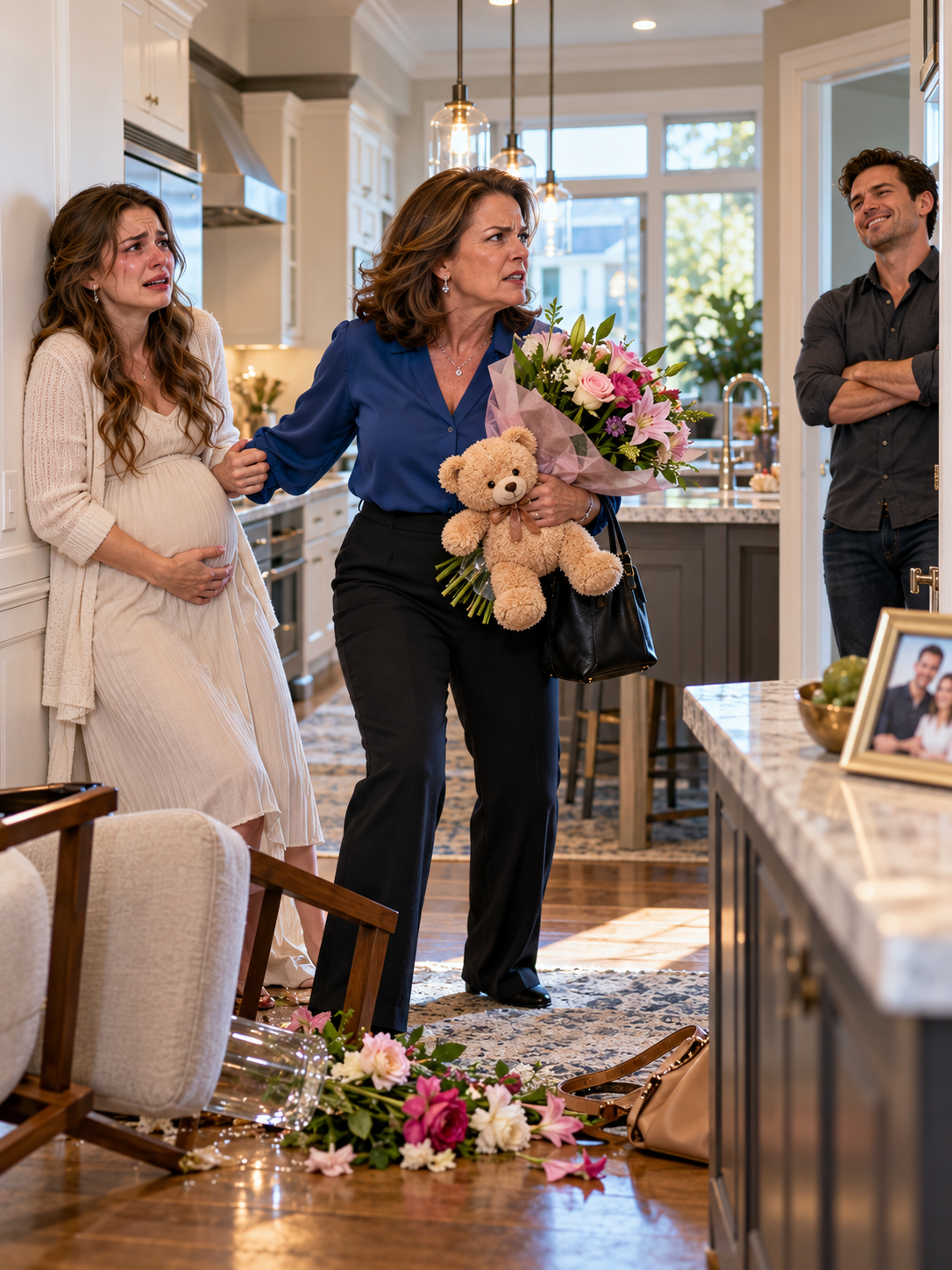
“Please, Dad. Don’t ask me what happened.” Those were the first words my daughter whispered when I found her sitting on the kitchen floor, one hand beneath her swollen belly and the other gripping the edge of a cabinet. The flowers I’d brought slipped against my coat, scattering droplets of water across the tile. Behind her, my son-in-law stood in the doorway, smiling as though I’d interrupted a private joke.
My name is Thomas Bennett, and at sixty-three, I’d imagined becoming a grandfather would be the peaceful reward for thirty-one years working as a criminal investigator for the district attorney’s office. I’d retired two years earlier, trading witness interviews and courthouse hallways for fishing trips and a vegetable garden behind my house. My daughter, Natalie, was thirty-one and expecting her first baby in five weeks. I’d driven forty minutes that afternoon to bring her some sunflowers and a ridiculous little teddy bear with a blue ribbon around its neck.
Her husband, Derek Holloway, leaned against the doorframe in a freshly pressed shirt, holding a half-empty coffee mug. “Don’t look so worried, Thomas,” he said, glancing at Natalie. “She’s been emotional lately, and apparently everything I say is a personal attack.” He chuckled, but my daughter didn’t even raise her head.
I noticed the bruises when Natalie reached toward the counter to steady herself. Four dark marks circled her left wrist, and another discolored patch disappeared beneath the sleeve of her loose maternity shirt. Her hair clung to her damp cheek, and her breathing came in shallow bursts. I set the flowers down and crouched beside her, keeping my voice low.
“Sweetheart, are you hurt anywhere else?” I asked, looking into the eyes I’d known since the morning she was born. Natalie glanced toward Derek before answering, “I’m okay, Dad. I just got dizzy.” But the way she flinched when he shifted his weight told me more than her words did.
Derek snorted and told me I should stop treating a grown woman like a helpless child. Then he reminded me that I rarely visited more than twice a month and suggested I had no right to interfere in his marriage. I didn’t respond immediately, because the room had begun telling its own story. A broken ceramic mug lay in the sink, the refrigerator door carried a fresh dent, and the small security camera near the pantry had been unplugged.
I’d seen enough frightened witnesses to recognize when someone was measuring every word against the reaction it might cause. Still, experience didn’t give me permission to make decisions for Natalie or assume I understood everything that had happened. I asked whether she wanted me to call her doctor. Derek answered for her, saying she needed rest rather than another unnecessary appointment.
Then a woman spoke from the hallway, her voice clipped and impatient. “Derek, why is everyone making such a production out of this?” His mother, Celeste, appeared wearing an expensive cream-colored cardigan, gold earrings, and a look of profound annoyance. She glanced at Natalie’s position on the floor without moving to help.
“She’s upset because Derek asked her to stop spending money,” Celeste explained, smoothing her sleeves. “Pregnant women can become terribly unreasonable, Thomas, and Natalie has been particularly difficult.” My daughter lowered her eyes while Celeste continued describing her as ungrateful. Something inside me tightened when I realized this woman had been present long enough to know Natalie needed help, yet had done nothing.
I placed the teddy bear beside Natalie and offered my hand. “Let’s get you checked by your doctor,” I said, giving her time to decide. Her fingers closed around mine, trembling but deliberate, and she whispered, “Okay.” Derek immediately stepped away from the doorway and blocked the path to the hall.
“She’s not going anywhere,” he announced, his smile disappearing. I told him Natalie had agreed to leave and asked him to move aside. He reached for her arm, and she recoiled so sharply that she bumped against the cabinet. I positioned myself between them, and Derek shoved me backward with both hands.
My shoulder struck the counter, knocking the flower vase onto the floor. Water spread across the tile while Derek lunged toward me again, grabbing my jacket and pulling me sideways. I pushed his arm away and moved out of his path, but he lost his footing on the wet floor and crashed against the low wooden bench beside the kitchen island. His right knee twisted beneath him, and his scream filled the room.
For a second, nobody moved. Then Celeste shrieked that I’d attacked her son, while Derek clutched his leg and cursed at me through clenched teeth. I stepped away, told everyone not to move him, and called 911, reporting an injured man and a pregnant woman who might have been assaulted. Natalie stood beside me, still holding the teddy bear, and asked in a small voice whether I was going to be arrested.
“I don’t know what the officers will need to investigate,” I answered, “but you haven’t done anything wrong by asking for help.” I kept the dispatcher informed until paramedics and police arrived, then explained that Natalie needed a medical assessment as well. Derek continued shouting that I’d deliberately injured him, and Celeste repeated every accusation as if she’d rehearsed it. I stayed close enough for Natalie to reach me without touching her unless she asked.
As paramedics wheeled Derek outside, Natalie gripped my sleeve and whispered that her husband would never let this go. I promised I would stay with her, but I didn’t pretend the situation was over. Then I noticed Derek’s phone lying beneath the bench, its screen glowing with an incoming message from Celeste’s number. The preview contained just six words: “Make sure she doesn’t mention the account.”
Part 2
Three hours later, the emergency department smelled of disinfectant, burnt coffee, and the rain soaking coats in the crowded waiting room. Derek was being treated for a serious knee injury and continued shouting my name whenever someone opened the curtain around his bed. Natalie was upstairs in maternity observation, where nurses had connected her to monitors and confirmed that her baby’s heartbeat was reassuring. I sat beside her empty chair, staring at the crushed blue ribbon still tied around the teddy bear.
A detective named Marissa Cole approached with two uniformed officers and introduced herself. “Mr. Bennett, your son-in-law says you entered his home, threatened him, and deliberately injured his leg,” she explained, opening a notebook. “I’d like your account of the events, including anything that happened before the physical confrontation.” I told her exactly what I’d seen and what I’d done, including the shove, the spilled water, and Derek’s fall.
She listened without interruption, which I appreciated more than she could have known. I’d spent decades watching people damage credible statements by trying to make themselves sound perfect. I didn’t claim I’d handled every moment flawlessly, and I admitted that my first instinct had been anger. But I also explained that Natalie had agreed to leave for medical care and Derek had tried to prevent her from doing so.
Before leaving my house that afternoon, I’d started recording a short video on my phone because Natalie had sounded frightened during an earlier call and I wanted to preserve her words accurately. I’d kept the phone in my coat pocket when I arrived, and the recording continued through the confrontation. The audio captured Derek blocking the doorway, Natalie’s frightened responses, and the sounds of the struggle, although the camera showed little useful footage. I offered the original file and explained its limitations.
Detective Cole asked that it be preserved for proper review rather than simply relying on my interpretation. She also requested the responding officers’ reports, photographs of the kitchen, and any medical findings Natalie consented to share. I appreciated her caution, even though Derek’s accusations made me want immediate answers. Years behind an investigator’s desk had taught me that being angry at a suspect was never a substitute for proving what happened.
A nurse called me upstairs shortly afterward because Natalie wanted to speak with me. She lay against white pillows with a fetal monitor secured around her belly, looking impossibly young beneath the harsh hospital lights. The bruises on her wrists had been photographed with her permission, and a physician had examined the tenderness near her ribs. Natalie reached for my hand and asked, “Is the baby really okay?”
“The doctor says the monitoring looks reassuring,” I told her, sitting close. “They want to keep watching you for a while because of what happened.” Natalie nodded, but her attention kept drifting toward the door. When I asked whom she feared might enter, she whispered Derek’s name.
I told her she could decide how much to tell me, and that I would listen without asking why she’d stayed. For nearly a minute, the only sound was the steady electronic rhythm of the monitor. Then she said Derek had begun controlling her spending shortly after their wedding. At first he’d described it as sensible budgeting, but eventually he demanded access to every account and questioned even small grocery purchases.
She showed me messages on her phone in which Derek criticized her for buying prenatal vitamins, visiting a friend, and spending twenty dollars on maternity clothes. Another thread contained repeated demands that she answer his calls immediately, followed by accusations whenever she didn’t. Natalie admitted he’d grabbed her during arguments before, but insisted the frightening incidents had grown more frequent since she became pregnant. I held her hand and tried not to let my anger make her feel she needed to protect me.
When I asked about Celeste, Natalie’s expression changed. “She always tells me Derek’s only worried about becoming a father,” she said, staring at the blanket. “If I complain, she says I should be grateful he’s providing for us.” Natalie hesitated before adding that Celeste had recently begun attending meetings with their financial adviser. Derek had told her the arrangements were private family business and that she didn’t need to understand them.
That detail brought me back to the message I’d seen on Derek’s phone. I asked Natalie whether there was an account she wasn’t supposed to mention, but she looked genuinely confused. Then she remembered receiving several verification messages from her bank over the previous month. Derek had taken her phone during one argument, insisting he needed to correct a problem with their household finances.
“Did you authorize him to make changes?” I asked gently, careful not to sound like an interrogator. Natalie shook her head and said she couldn’t remember approving anything beyond ordinary bill payments. Her grandmother had left her an inheritance several years earlier, and she’d kept most of it in a separate savings account. Derek had been irritated about that money from the beginning, frequently insisting married couples shouldn’t hide assets from one another.
I suggested she review the account when she felt well enough, but Natalie immediately reached for her phone. We signed in together, and she frowned as the page loaded. Her savings balance was dramatically lower than she expected, with several transactions she didn’t recognize. The largest transfer had occurred two days earlier, while she was attending a prenatal appointment with Derek.
Natalie covered her mouth and whispered, “Dad, that money was supposed to help me take time off after the baby comes.” I asked her not to change or delete anything and suggested she contact the bank’s fraud department. Before she could dial, another notification appeared: someone had requested a change to the account’s contact information. Then Natalie looked at me with tears in her eyes and said, “There’s something else you need to know about the papers Celeste brought me last week.”
Part 3
Natalie explained that Celeste had brought a folder labeled “Family Estate Planning” to their house the previous Thursday. Derek told her the documents would simplify things if she needed emergency medical care during childbirth, and Celeste insisted they were ordinary precautions. Natalie remembered signing several pages while Derek stood behind her chair, criticizing how slowly she read. When she asked for copies, Celeste took the folder home.
I didn’t blame my daughter for signing. She’d been exhausted, frightened, and repeatedly told she was making trouble whenever she questioned anything. Instead, I asked whether she remembered the name of the attorney who supposedly prepared the documents. She couldn’t, but she remembered a red-and-gray logo printed on the folder.
The following morning, Natalie contacted her bank with a hospital social worker beside her. The bank’s fraud specialist confirmed several substantial transfers to an unfamiliar business account and opened an investigation. Access to the savings account was restricted while they reviewed the activity. The missing money totaled $68,400, nearly everything Natalie had inherited from her grandmother.
The recipient was a company called Seabrook Property Holdings. Natalie had never heard of it, but the name sounded strangely familiar to me. I remembered Celeste mentioning an investment property she’d recently purchased with a business partner. When I searched the state’s public business registry, her name appeared in connection with Seabrook’s registered office.
I printed the publicly available record and took it to Detective Cole. She reviewed it without promising the transfers were criminal, explaining that investigators would need banking records and evidence of authorization. Natalie separately reported the suspected financial abuse and provided her messages and available statements. I watched my daughter sign the complaint herself, her hand steady despite everything she’d endured.
That afternoon, Derek called from the hospital using an unfamiliar number. Natalie chose not to answer, but he left a voicemail demanding that she withdraw her statements. He warned that his family had lawyers and that she would regret making accusations while pregnant. Detective Cole asked to preserve the voicemail, particularly because he was attempting to influence her account of events.
Then Celeste appeared at the hospital’s maternity reception desk. She demanded access to Natalie, claiming she was authorized to make decisions for her daughter-in-law. When staff refused without Natalie’s consent, Celeste produced documents from her handbag. The hospital’s patient advocate reviewed her claim and explained that Natalie was capable of making her own decisions and had explicitly declined her visit.
I saw Celeste through the glass doors as security escorted her away. Her expression wasn’t grief over her son’s injury or concern for her unborn grandchild. It was fury at being told no. She spotted me and shouted that I was destroying a respectable family over a misunderstanding.
Natalie heard the commotion from her room, and for a moment her confidence faltered. “What if they take my baby?” she whispered, gripping the blanket. I sat beside her and explained that Derek’s threats were not legal decisions, and that we would get advice from a qualified family-law attorney. She nodded, then asked the nurse for information about documenting her safety concerns.
Detective Cole returned that evening with a question about the estate-planning documents. An initial review suggested they might include a financial power of attorney granting Derek unusually broad authority. Whether the document was valid, and whether any transactions exceeded legitimate authorization, required further investigation. But Celeste’s attempt to use the papers at the hospital had raised additional concerns.
When Cole asked if I had anything else to add, I thought about Derek screaming my name from the emergency room. “That confrontation was only the beginning,” I told her, handing over the business registration. My daughter had been frightened inside her own home, and now the financial trail was leading directly to the woman who’d stood watching her suffer.
Part 4
Natalie was discharged after her doctors were satisfied that she and the baby were stable. She chose to stay at my house rather than return to the place where Derek had frightened her, and I helped arrange for essential belongings to be collected safely. The first night, she slept in the bedroom that had once been hers, surrounded by old photographs and a quilt her mother had sewn years earlier. I sat awake downstairs, listening for footsteps that never came.
The next morning, Natalie met with an attorney specializing in domestic violence and family law. She discussed protective measures, financial safeguards, and her right to make decisions about her baby without Derek controlling the conversation. Her attorney helped her seek a protective order and began reviewing the disputed financial documents. For the first time since entering the hospital, Natalie spoke about the future without asking what Derek would allow.
Meanwhile, Detective Cole’s investigation uncovered more information about Seabrook Property Holdings. Financial records obtained through the proper legal process showed that money from Natalie’s savings had been transferred into the company’s account. Celeste controlled the company, and some funds had already been used toward a property purchase. Investigators also discovered inconsistencies in the documents supposedly authorizing Derek to manage Natalie’s finances.
The most revealing evidence came from Derek’s own messages. Natalie had preserved conversations in which he threatened to leave her without access to money if she questioned his decisions. One message read, “Mom knows how to protect our assets, and you need to stop interfering.” Another warned that if she tried to separate, he would make sure everyone believed she was incapable of caring for a child.
Derek continued denying that he’d hurt Natalie, but the medical documentation and witness accounts complicated his story. His knee injury had resulted from the confrontation, while the evidence showed he’d physically blocked Natalie’s departure and shoved me before falling. My own actions were reviewed, as they should have been, but investigators found insufficient grounds to pursue an assault charge against me. I felt relief, though it was nothing compared with seeing Natalie begin to feel safe.
Several weeks later, authorities pursued criminal charges arising from the alleged assault and financial misconduct. Celeste’s role in the transfers became part of the investigation as well, and her attorneys advised her against contacting Natalie. Derek was furious when he learned that my daughter intended to end their marriage. He sent one final message through his attorney claiming that everything he’d done had been for their family’s future.
Natalie read that statement at my kitchen table and shook her head. “He keeps calling it our future,” she said, setting down the paper. “But he never asked what I wanted.” She signed the divorce petition that afternoon, then asked me to accompany her to an appointment about recovering the missing inheritance.
Not every financial dispute could be resolved immediately. Some transfers remained under investigation, and her attorney explained that recovering the full amount might involve prolonged proceedings. Natalie was disappointed, but she began making practical plans without assuming the money would return. She adjusted her budget, arranged maternity leave, and contacted her employer about returning after the baby was born.
One evening, while we were organizing a small nursery in my guest room, she found the teddy bear I’d brought on that terrible afternoon. Its blue ribbon was wrinkled, and one ear had been flattened inside her hospital bag. Natalie sat down in the rocking chair and held it against her stomach. “I thought you’d be disappointed that I stayed with him so long,” she admitted.
I knelt beside her and told her the truth. I was disappointed that she’d been made to feel so alone, not that she’d needed time to escape. She didn’t owe me an explanation for surviving a situation I hadn’t understood. Natalie reached for my hand, and I realized that helping her meant trusting her to rebuild her life rather than making every decision on her behalf.
Two days later, Natalie woke before dawn with persistent contractions. Her due date was still several weeks away, and the doctor told us to come to the hospital for assessment. I drove carefully through the empty streets while she counted her breaths beside me. When the hospital entrance appeared, she turned toward me and whispered, “Dad, I’m scared he’ll find out and come here.”
Part 5
I parked beneath the bright emergency entrance and helped Natalie inside, where a nurse took one look at her expression and brought a wheelchair. Natalie gripped my hand while I explained the situation to the admitting staff, including the protective order and her request that Derek and Celeste receive no information about her care. The nurse recorded her instructions and reassured her that visitors would need her permission. Only then did my daughter’s shoulders begin to relax.
The doctors determined that her labor had begun early but that the baby was doing well. Natalie asked me to remain with her until her closest friend, Rebecca, arrived, and I spent the next several hours bringing ice chips and reminding her to breathe. Every time a monitor sounded, my stomach tightened, although the nurses remained reassuringly calm. I had investigated serious crimes without trembling, yet watching my daughter endure childbirth made my hands shake.
Just after noon, Natalie gave birth to a healthy little girl with dark hair and a surprisingly determined cry. The nurse placed the baby against her chest, and Natalie began crying as she studied her daughter’s face. She named her Grace, after my late wife, who had died when Natalie was in college. When she asked whether I wanted to hold my granddaughter, I could barely answer.
Grace weighed just over six pounds and curled one tiny hand around my finger. I remembered carrying Natalie home from the hospital thirty-one years earlier, terrified I’d somehow hold her incorrectly. Now I looked at my exhausted daughter and understood that becoming a parent had never been about controlling someone else’s future. It was about helping them grow strong enough to choose their own.
Derek learned about Grace’s birth through legal channels several days later. His attorney requested information concerning his parental rights, and Natalie’s lawyer handled the matter through the appropriate court procedures. Natalie complied with lawful requirements while maintaining the safety arrangements established for herself and the baby. She refused to let Derek use their daughter as another way to frighten or control her.
The criminal and financial cases continued for months. Eventually, Derek accepted a plea agreement involving the assault and financial wrongdoing, with supervised probation, restitution obligations, and restrictions on contacting Natalie. Celeste faced consequences for her role in the unauthorized transfers, and a separate financial settlement required her company to return the money it had received. Recovering the funds took time, but Natalie ultimately regained most of her inheritance and secured an enforceable agreement for the outstanding balance.
I attended the final court hearing but didn’t speak unless asked. Derek sat several rows away, looking considerably smaller than the confident man who’d laughed over my frightened daughter. Celeste avoided looking toward us throughout the proceedings. Neither offered Natalie the kind of apology that acknowledged what they’d actually done.
Outside the courthouse, Derek attempted to speak to me through his attorney. He wanted me to know he’d been attending counseling and believed he deserved a chance to repair his relationship with Natalie. I told the attorney that any legally appropriate communication should continue through Natalie’s counsel. Then I walked away, because my daughter’s future didn’t depend on whether Derek finally understood the damage he’d caused.
Natalie made her own decision equally clear. She didn’t want a reconciliation, didn’t accept Celeste’s excuses, and didn’t intend to rebuild personal relationships with either of them. Her attorney helped establish the arrangements necessary to protect Grace’s welfare while the divorce and parenting matters were resolved. Natalie stopped treating their disappointment as something she was responsible for fixing.
Six months after Grace’s birth, Natalie moved into a small house fifteen minutes from mine. Its garden needed work, the kitchen cabinets were outdated, and the front porch creaked whenever someone stepped on the third board. But the mortgage was manageable, the neighborhood was quiet, and every key belonged to someone Natalie had chosen. She stood in the empty living room holding Grace and smiled in a way I hadn’t seen for years.
I helped her paint the nursery pale green, assembled a bookshelf, and repaired the loose porch board. Sometimes I caught myself wanting to take over when she struggled with a decision, but I learned to ask whether she wanted help before offering it. Natalie found a reliable childcare arrangement, returned gradually to work, and began rebuilding friendships she’d lost during her marriage. Her confidence returned quietly, through ordinary choices nobody questioned.
One Sunday afternoon, I visited with fresh sunflowers and another small stuffed bear. Grace was sleeping in her crib while Natalie prepared coffee in the kitchen, sunlight falling across the counter where she’d left a grocery list and a stack of children’s books. I watched her move comfortably through her own home without glancing toward the doorway. That ordinary ease was worth more to me than any courtroom victory.
“Dad,” she said, noticing my expression, “you know you saved us, right?” I shook my head and reminded her that she was the one who chose to leave, told the truth, filed the reports, and built this life. “I came when you needed someone,” I answered. “But you’re the one who kept going after the worst day was over.”
Later, while Grace slept against my chest, Natalie sat beside us and rested her head briefly on my shoulder. I remembered the afternoon I’d found her trembling on the kitchen floor, afraid even to ask for help. I also remembered Derek screaming my name from the emergency room, convinced that fear and threats would restore his control. He’d been wrong about both of us.
I’d spent thirty-one years investigating the damage people could do to one another, but I had learned something important only after retirement. Justice wasn’t the sound of an abuser screaming in pain, and it wasn’t the satisfaction of watching someone face consequences. It was seeing my daughter safe in her own home, holding her child without fear, free to build a future that belonged to her.
As the afternoon sunlight warmed Grace’s tiny fingers, Natalie laughed at something her daughter did in her sleep. I looked at the flowers on the table and the blue ribbon tied around the first teddy bear, now resting on a high nursery shelf. The memory of that terrible afternoon would never disappear, but it no longer defined our family. Derek and Celeste had lost their place in Natalie’s life, and no belated apology would give it back.
I kissed my granddaughter’s forehead and watched Natalie open the curtains to let more sunlight into the room. For the first time in a long while, I wasn’t thinking about evidence, police reports, or the people who had hurt her. I was thinking about tomorrow, when Grace would wake up safe and loved, and my daughter would make breakfast in a home where nobody had the power to make her afraid.
Legal Notice: This story is a work of fiction. Names, characters, businesses, events, and incidents are the product of the author’s imagination or are used fictitiously. Any resemblance to actual persons—living or dead—or to actual events is purely coincidental. Thank you! 💓