
My Seven-Year-Old Called at 2 A.M. Because His Little Sister Couldn’t Breathe—Then I Learned Where Their Mother Really Was
My seven-year-old son called me after midnight and whispered that his little sister was struggling to breathe. Their mother had supposedly taken them to a mountain cabin, but I found them alone in a silent Nashville house, hungry and terrified. At the hospital, I learned their mother’s disappearance wasn’t the only emergency. Money reserved for our daughter’s medical care had vanished, someone had signed my name to the withdrawal, and the woman who left our children behind was preparing to accuse me of taking them.
Part 1
My phone vibrated at 2:14 a.m., sliding across the nightstand until it struck my water glass. I almost ignored the unfamiliar number. Then I heard my seven-year-old son whisper, “Dad? I don’t know what to do about Poppy.” Behind him, something rattled unevenly.
“Evan, where’s Mom?” I asked, reaching for my jeans. He said she’d left for a week and his four-year-old sister was feverish and unresponsive. “She said not to call you,” he added. I told him he’d done exactly the right thing and called emergency services on my other phone.
My ex-wife, Marissa, had primary residential custody, while I had the kids on alternating weekends and Wednesday dinners. Four days earlier she’d told me she was taking them to her family’s mountain cabin, where reception was terrible. Now Evan said no adult had been at their Nashville house since Monday. I drove through empty streets as the dispatcher sent help.
At our last handoff, Marissa had been unusually cheerful, waving from her porch as I drove away. She said the mountain air would help Poppy sleep. I remembered offering to pack the breathing equipment myself, and her saying, “Already handled.” The memory made my hands tighten around the steering wheel.
The porch was dark except for light beneath the door. I smelled sour milk before I reached the hall; inside, the television displayed a frozen cartoon menu. Evan stood barefoot beside the couch, clutching a flattened cereal box. “I gave Poppy the last cereal,” he said apologetically.
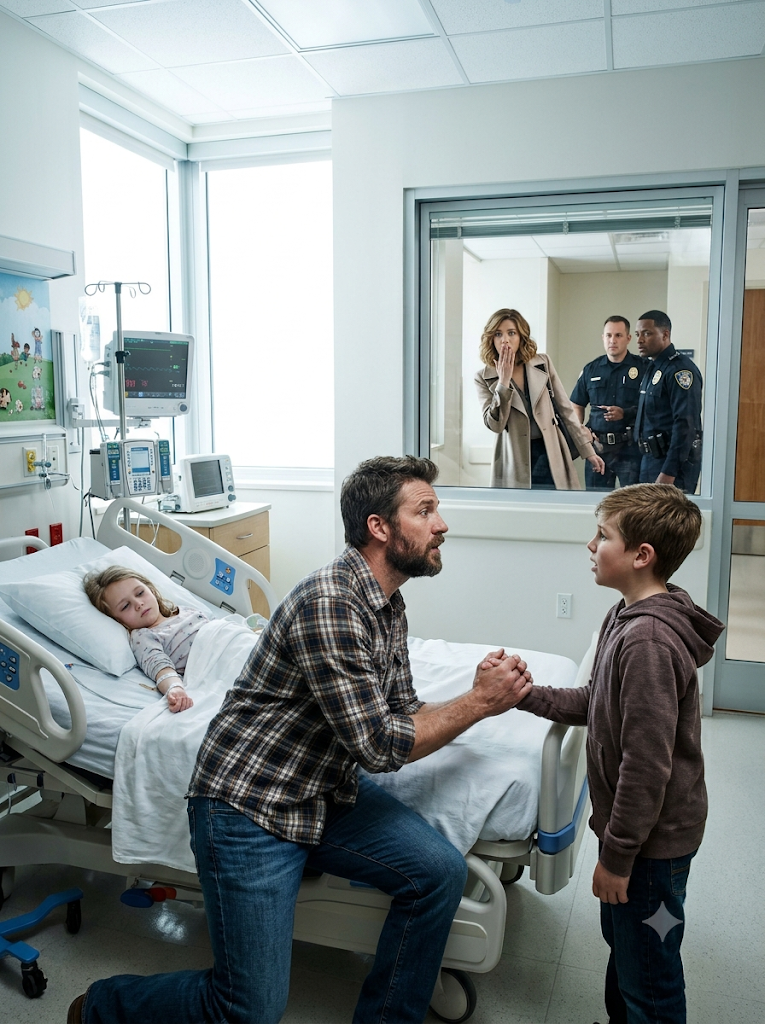
Poppy lay curled beneath a beach towel in her bedroom, one sock on and one missing. Her forehead burned, and she struggled for every breath. I knelt beside her and spoke softly while the paramedics came through the doorway. Evan gripped my shirt as they lifted her.
At Vanderbilt Children’s Hospital, a nurse brought Evan water and crackers while doctors treated Poppy’s fever, dehydration, and breathing difficulties. Dr. Miriam Keene asked about her prescribed breathing equipment, which should have been close at hand. I said Marissa packed the supplies. Evan stared at the crackers and said, “The machine is in the garage, but the bag was empty.”
I sat with him under the waiting-room lights, which made the skin beneath his eyes look almost gray. He saved two crackers for his sister. “I tried to make cereal last,” he said. “I thought if I called you, Mom would be mad.” I promised he would never be punished for asking for help.
Just before dawn, Dr. Keene told me Poppy was responding to treatment but needed observation. The hospital would document everything and notify child protective services. I’d expected to feel relief when I heard my daughter was stable. Instead I kept hearing Evan say that nobody had been home.
With Evan supervised, I returned for clothes and Poppy’s striped socks. The good suitcases were missing from Marissa’s closet; makeup trays lay open and a travel adapter was gone. Her car was parked outside, but the medical equipment case in the garage held only tubing. Her absence felt planned.
On the kitchen counter sat the old family tablet Evan had used to call me. A shared travel inbox showed an unfamiliar booking. Two first-class tickets had taken Marissa and a man named Nolan Price to a Caribbean resort on Monday morning. They had booked a private suite.
Nolan was a property developer I’d met once at a charity auction, a man with bright cuff links and a smile that never reached his eyes. I photographed the screen and called my lawyer, Rachel Dunn. Rachel told me to preserve what I already had and request the official records properly. Then she asked whether anything unusual had happened with Poppy’s medical fund.
I opened the account portal to which I was a named co-trustee. The $45,000 we’d saved for our daughter’s care was gone, transferred weeks earlier to an account I didn’t recognize. My palms went damp against the tablet case. The authorization record showed an electronic signature bearing my name.
Part 2
At nine the next morning, Rachel spread my photographs across a conference table and handed me black coffee. “First we protect the children,” she said. “Then we separate what we know from what we suspect.” She had requested an emergency custody hearing and hospital records. I needed her calm.
The bank confirmed the trust transfer but wouldn’t release the complete signature record without formal process. Its manager logged my fraud dispute. I could see my own name beside a code I’d never used. Rachel said a copied signature could be examined.
Marissa called that afternoon while Poppy slept in the hospital bed beside me. “How’s the mountain trip?” she asked brightly, over clinking glasses. I told her Poppy had been hospitalized after Evan found her struggling to breathe alone. For several seconds she said nothing, then demanded, “Why did you go into my house?” She never asked what Poppy needed.
“You left two children without an adult,” I said. Marissa insisted a sitter had been arranged and that I was twisting a misunderstanding into a custody fight. She promised the sitter’s name later. When I asked where she was, she said, “Somewhere with no reliable signal,” though the call had sounded clearer than most conversations from my office.
Rachel advised me not to argue further. That evening a petition from Marissa’s attorney arrived, claiming I’d removed the children from their home without permission while an agreed caregiver was due to arrive. A typed agreement carried my signature beneath a promise to split sitter fees. Seeing my handwriting imitated turned my stomach.
At the temporary hearing, the judge studied the hospital’s report and the dispatch log from my emergency call. Marissa appeared by video, saying her hired caregiver must have failed to show up. Rachel asked for the caregiver’s contact details and proof of payment; neither was available. The judge placed the children with me temporarily and ordered a fuller hearing.
A social worker inspected my apartment that afternoon, opening the refrigerator and checking the children’s sleeping arrangements. I had stocked the kitchen with fruit, bread, and enough cereal for a small army. When she asked where I planned to sleep during Poppy’s recovery, I showed her the couch beside the kids’ bedrooms. She nodded and wrote something down.
Evan was waiting at my apartment when I returned, arranging toy cars in a straight line against the wall. He didn’t ask about court; he asked whether Poppy could have the blue blanket from his bed. A folded note fell from his pocket. “Mom said to read it every morning,” he explained, unwilling to meet my eyes.
The note said, “Stay inside. Don’t answer the door. Do not call your father.” Evan told me Marissa had left it beside the television before sunrise on Monday. He’d followed it until his sister became too sick to drink. I asked Rachel to arrange a specialist interview so he wouldn’t have to repeat his story.
The next day, Poppy sat up and demanded both striped socks. A hospital social worker helped us plan follow-up care and a dependable supply of breathing equipment. Some routine refills appeared missing; the pharmacy would verify why. Watching Poppy argue about socks was the best sound I’d heard all week.
Rachel’s investigator located the sitter named in Marissa’s filing: a licensed caregiver called Brenda Ellis. She’d never met the children or accepted the booking. Someone had used her business name and copied an old rate sheet. Rachel filed her statement, and I thought we’d finally caught the lie that would settle everything.
Then the bank supplied a preliminary tracing report. Roughly $24,000 of Poppy’s medical fund appeared to have covered Marissa’s resort expenses, while another $20,000 had moved toward a company connected to Nolan Price. The rest involved smaller withdrawals. I was still studying the figures when Rachel called with a warning: Nolan had contacted my employer about a supposed financial scandal involving me.
Part 3
I worked as a commercial property analyst, and Nolan’s company was bidding on a project involving one of our clients. My manager received the custody petition and an accusation I’d emptied the trust. He asked privately, but compliance placed me on paid leave. I carried my desk plant home, furious.
Rachel arranged a meeting with the bank’s fraud team, where I supplied verified examples of my signature. The original authorization had been generated through an old shared scanner profile, not from my personal banking login. The bank restricted the trust. Recovery would take longer, Rachel warned.
The next morning Nolan asked to meet me in the lobby of my attorney’s building. He smelled of cologne and offered $5,000 if I’d “stop making trouble.” I told him the hospital had made its own report and I wouldn’t pretend the children had been supervised. He stiffened when I mentioned Poppy’s money.
“Marissa said it was hers,” he replied, closing his checkbook. He claimed the transfer reimbursed a short-term business advance, then warned that my employer might dislike the publicity. I referred him to Rachel and stood. His expensive watch couldn’t make his story true.
Back at home, Evan kept checking whether the front door was locked. He apologized when I found crackers hidden in his backpack. I put a small snack basket beside his bed and told him food would always be available. Poppy, newly home from the hospital, wanted me to sit on the floor until she fell asleep; sometimes she checked that I was still there without opening her eyes.
The child specialist met Evan in a room with paper, crayons, and a shelf of toy animals. She didn’t pressure him to recount every hour, and I didn’t ask for details afterward. Her report described his fear of calling adults and being blamed. Seeing those feelings in clinical language made me angrier than any insult Marissa had sent.
The pharmacy records arrived that afternoon. Several scheduled refills had been canceled from Marissa’s contact number, though nobody could explain her reasoning. I arranged new supplies with Poppy’s medical team and kept each receipt. I wanted the judge to have facts, not theories; Poppy needed dependable care regardless of what the investigation found.
Two days before the fuller hearing, the bank confirmed the resort payment had been routed through Marissa’s personal account. Nolan’s company had received a separate transfer, but its books listed the money as her investment. Whether Nolan knew its origin was still under review. Someone had spent my daughter’s safety net.
Rachel obtained the original sitter agreement through the court’s disclosure process. Its electronic creation date was four days after the children had been found, despite the earlier date typed across the top. Brenda Ellis supplied her actual booking calendar and a sworn statement denying any arrangement. The document hadn’t simply recorded a plan that failed; someone had written the plan after the emergency.
Marissa landed in Nashville that evening and requested to see the children immediately. Rachel offered a supervised meeting after the court could consider appropriate safeguards. Marissa responded with a long message claiming I was poisoning the children against her. I didn’t reply; I was helping Poppy plant a bean seed in a paper cup, and she wanted to know whether it would grow overnight.
At the hearing, Marissa sat beneath fluorescent lights wearing a cream blazer I remembered buying for her birthday. Her lawyer called the agreement a reconstruction, contradicted by Brenda and the digital record. Dr. Keene’s documented findings were considered alongside the emergency call and the specialist’s interview. The judge asked Marissa one plain question: “Who was physically responsible for your children on Monday night?”
Marissa looked at Nolan in the back row, then down at her hands. “I thought their father would check,” she finally said. My stomach dropped because she’d told me the children were with her in the mountains, beyond phone service. She hadn’t merely failed to arrange supervision; she’d created a story that kept me from knowing I was needed.
Part 4
The judge asked how I could check on supposedly out-of-town children. Her attorney mentioned our divorce, but the court refocused. Marissa admitted she’d told Nolan the children were staying with me. Two adults heard opposite stories; neither came home.
Rachel submitted the actual dispatch records, medical documentation, sitter statement, and bank evidence. The judge kept the children with me, ordered supervised contact and a full review. I didn’t smile when we left. I pictured Evan counting mornings beside an empty cereal box.
On the courthouse steps, Marissa caught up with me while Rachel stood nearby. “You don’t have to destroy me,” she said, mascara collecting beneath her eyes. I told her I was following the process required to protect the children. “They’re my babies,” she whispered, and for one terrible second I heard the woman who used to sing to Poppy in the kitchen. Then I remembered the note instructing Evan not to call.
“They’re people, not proof of love,” I answered. “Work toward being safe for them, but don’t call this a misunderstanding.” Marissa asked whether I could ever forgive her. I said, “I don’t know what kind of future you’ll earn with them. But you and I are finished.” Our relationship was over.
The financial review continued for months. Investigators found an unauthorized trust transfer, and settlement recovered the money, including Nolan’s company’s portion. Nolan provided records after learning the account’s purpose. I remembered how he’d pressured me.
For weeks, Marissa sent apologies followed by angry texts whenever I kept my distance. She offered Evan a new bike if I’d tell the court she’d hired a sitter. I forwarded everything to Rachel. No gift could repair that lie.
My employer completed its review and reinstated me, but I accepted a different position that required less overnight travel. The salary was a little smaller, and the hours were predictable. I wanted to be at school pickup. At first, ordinary Tuesdays frightened me.
Evan and Poppy helped correct that fear. Our calendar showed school, appointments, and supervised visits; Evan checked it daily. On hard evenings, he asked the same question: “You’re here tomorrow too, right?” I promised only what I could deliver. Gradually he stopped hiding snacks.
The first time Evan left a half-eaten sandwich on the table, I almost cried. He had stopped treating food like something that could vanish. Poppy began sleeping through the night without checking the hallway. Their progress was uneven, and we kept the appointments their counselor recommended, but the house was slowly becoming a place where they could relax.
Six months later, the custody review left the children primarily in my care, with Marissa’s contact structured around their safety and the professionals’ recommendations. She began attending required parenting services, though I didn’t treat her participation as a reason to restore our old trust. The children’s safe relationship with her was separate from mine.
By spring, Poppy’s breathing was steadier under regular medical care, and she’d returned to arguing about which socks belonged together. Evan joined a school science club and built a paper bridge that held more pennies than anyone expected. He kept the flattened cereal box on a shelf. One Saturday he finally handed it to me and said, “We don’t need this anymore.”
I didn’t throw it away in front of him. I stored it beside his first drawing of the three of us under a yellow sun. Then I went back to the kitchen, where Poppy was spilling pancake batter and Evan was telling her that too many chocolate chips would ruin the structure. They were beautifully ordinary.
That night I switched off the hallway light and listened to the house settle. I’d once thought saving my family meant protecting arrangements instead of people. Now I knew it meant believing my children when they asked for help, keeping my promises, and refusing to excuse someone who hadn’t kept hers. When Evan called, “Dad, are you still there?” from his room, I answered before he had to ask twice: “Right here, buddy. Always close enough to hear you.”
Legal Notice: This story is a work of fiction. Names, characters, businesses, events, and incidents are the product of the author’s imagination or are used fictitiously. Any resemblance to actual persons—living or dead—or to actual events is purely coincidental. Thank you! 💓


