
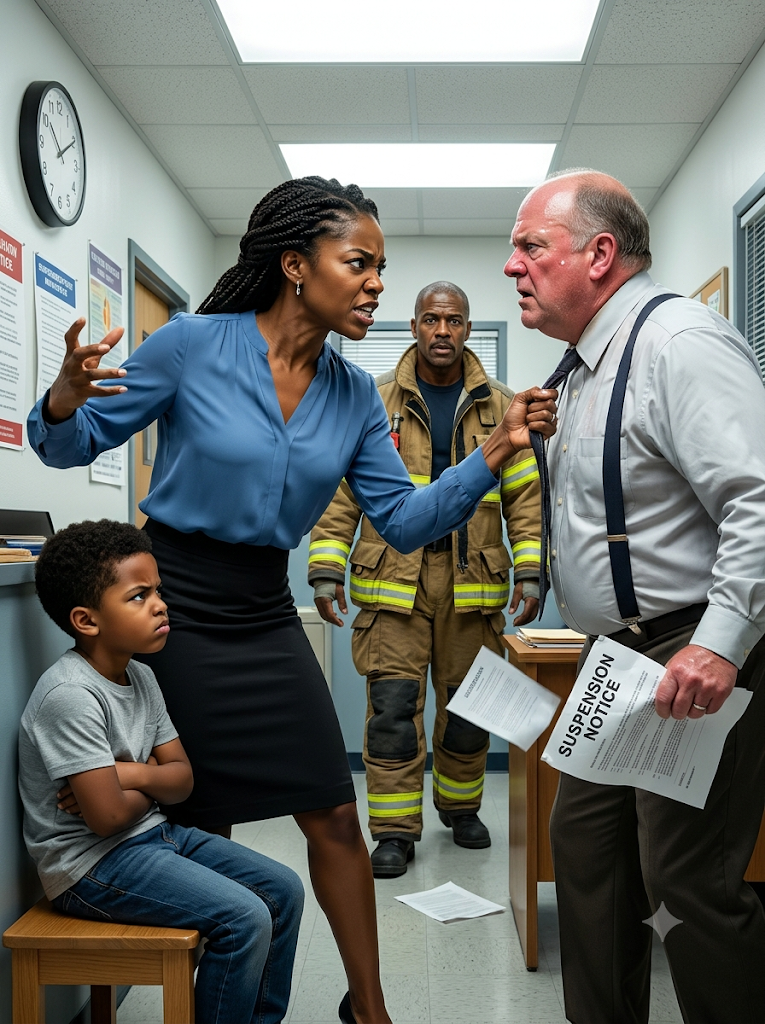
My Son Pulled the School Fire Alarm—and the Principal Tried to Suspend Him Before the Firefighters Finished Looking
When my ten-year-old son pulled a fire alarm during an assembly, the school called me as if he’d committed an unforgivable offense. More than three hundred people had been evacuated, and the principal already had a suspension form waiting. My boy kept saying he’d smelled something nobody else believed. I wanted to trust him, but I also knew how serious a false alarm could be. Then a firefighter stepped into that office with a question that changed everything—and exposed why the adults had been so determined not to listen.
Part 1
The call came at 9:42 on a Friday morning, while I was trying to explain a dental insurance claim to a woman who had already been transferred twice. I saw Cedar Ridge Elementary on my screen and pictured my son, Owen, sitting in the nurse’s office with a stomachache. Instead, a man’s voice said, “Mrs. Fletcher, you need to come immediately. Owen activated a fire alarm during our school assembly.” My hand tightened around the receiver until the plastic creaked.
“Is he hurt?” I asked. Principal Warren said he wasn’t, but more than three hundred students and staff had evacuated, and the fire department had responded. When I asked why Owen had pulled the handle, he gave a weary sigh. “He claims he smelled smoke, but there’s no evidence of a fire. We’re treating this as a serious disciplinary matter.”
I told my supervisor I had an emergency and drove across town without turning on the radio. Outside, the sky was a flat November gray, and damp leaves gathered along the curbs. Owen was ten, thoughtful, and stubborn enough to debate whether a tomato belonged in fruit salad, but he wasn’t someone who enjoyed frightening other kids. Still, I knew the difference between believing my child and assuming he could never be wrong.
Fire trucks were parked beside the school when I arrived, their lights flashing silently against the brick walls. Teachers counted children near the playground while parents from the volunteer committee stood in tight little circles. As I passed, one woman said, “Some kid just wanted attention,” and another replied, “My daughter was terrified.” I kept walking, ashamed of how badly I wanted to tell them it wasn’t my boy.
Owen sat in the principal’s office with his blue sweatshirt bunched around his wrists. One shoelace dragged across the carpet, and he looked smaller than he had that morning when he’d complained about the lunch I’d packed. Principal Warren gestured toward a chair and slid a sheet of paper across his desk. The heading read, “Proposed Three-Day Suspension.”
“Already?” I asked. He explained that intentionally activating an alarm without a genuine emergency violated school policy and endangered others through an unnecessary evacuation. That was fair enough as a general rule, but I looked down and noticed the form was dated and almost completely filled out. “Has the fire department confirmed this was a false alarm?” I asked. He avoided my eyes and said the facilities staff had found nothing.
I turned toward Owen. “Did you pull it?” He nodded, his eyes shining, and I felt my stomach drop. “Then tell me what happened, beginning with the first thing you noticed.” Across the desk, the principal checked his watch, as though my son’s explanation were an inconvenient delay.
Owen said the assembly was in the gym because the auditorium was being repainted. The fourth graders were seated near the old stage while the choir practiced, and somebody had rolled equipment crates beneath the risers. “It smelled like when the toaster burns,” he said. “Only sharper, like plastic.”
He had told his teacher, Mrs. Bell, who asked him to sit down and stop distracting the children beside him. He tried again when the smell got stronger, but a staff member warned that he’d lose recess if he left his row. “I didn’t want to get in trouble,” he whispered, rubbing his sleeve across his nose. “I just couldn’t make it stop smelling bad.”
Principal Warren folded his hands. “Children sometimes invent explanations after acting impulsively.” Owen stared at the floor, and I watched him decide that speaking again might only make things worse. I took his hand, hoping he’d look at me. Instead, he leaned close and said something I hadn’t heard on the phone: “Mom, I didn’t just smell it. I saw a gray line coming out behind the stage curtain.”
Part 2
“Show me where,” I said, pulling a notebook from my purse. Owen traced the gym’s back wall with a shaking finger, marking the exit, the folded bleachers, and a vent grille half-hidden by curtains. He said the gray line appeared and disappeared whenever the ventilation rattled. Principal Warren watched us draw, his pen tapping steadily against the suspension form.
“The custodian checked the gym,” he said. “There was no visible smoke afterward.” I asked whether anyone had inspected the space behind the vent, but he replied that firefighters were handling the building. Then he tried to hand me the pen, suggesting I sign the acknowledgment while we waited. “I can acknowledge receiving a decision,” I said, “once you’ve actually made an informed one.”
The office door opened, and Mrs. Bell stepped inside carrying a paper cup of coffee. Her cheeks were pink from the cold, and she looked genuinely upset when she saw Owen crying. “I thought he was talking about the fog machine,” she explained. Apparently the drama club had tested one the previous afternoon, and a faint theatrical smell had lingered after cleanup. For a moment, I wondered if my son had mistaken leftover stage effects for danger.
But Owen shook his head. “The fog machine smells sweet,” he said. “This burned my nose.” Mrs. Bell admitted she hadn’t gone to look because she’d been managing twenty-six children and preparing them for the assembly. She was trying to make sense of a crowded morning, not deliberately put anybody at risk. That distinction mattered to me, though it didn’t change what had happened.
I asked Owen whether anyone else noticed the smell. He mentioned a girl named Tilly who had pulled her shirt over her nose and a boy who complained the air felt hot. Warren interrupted: “Neither student reported a concern to administration.” I wanted to ask how a ten-year-old was supposed to file an official report while seated in a gym with hundreds of classmates, but I held my tongue.
The secretary knocked and whispered something to the principal. He went into the hallway, shutting the door almost completely, and I could hear pieces of an argument about reopening classrooms. Mrs. Bell looked toward the door, then lowered her voice. “The ventilation system has been making that knocking sound for weeks,” she said. “I assumed maintenance was working on it.”
Owen sat up straighter. “That’s the sound,” he said, drumming an uneven rhythm on the chair arm. He described three loud clicks, followed by a long metallic groan, just before he saw the gray thread. I pictured all the mornings I’d told him to stop noticing every tiny noise because we were late for school. Now the very attention that sometimes exhausted me might be the reason he’d acted.
When Warren returned, he said the main gym had been cleared by the custodian and the evacuation had been orderly. He had already drafted a message for parents describing the alarm as “student misconduct.” I told him that phrase was premature. He replied that families needed reassurance and that keeping discipline consistent was part of his job.
A firefighter appeared at the office doorway before I could answer. She wore a dark jacket over her turnout pants, with soot smudged along one sleeve, and carried a small camera in a protective case. “I’m Captain Ruiz,” she said. “Which child pulled the alarm?” Owen shrank against the chair as if another adult had arrived to scold him.
The captain crouched beside him instead. She asked exactly what he’d smelled, which way the air had moved, and whether the noise had changed before he pulled the handle. Owen answered without once looking at the principal. Ruiz thanked him, then stood and turned toward Warren. “One more question,” she said. “Who told you this was a false alarm before my crew finished inspecting the ventilation chase?”
Part 3
Nobody answered immediately. Principal Warren cleared his throat and said the custodian had inspected the gym floor, the stage, and the nearby hallway. Ruiz opened her camera case and placed a printed inspection image on his desk. “The problem isn’t on the gym floor,” she said. “It’s behind the wall, where your staff couldn’t see it.”
The image showed a bright band of heat along a section of ductwork. Ruiz explained that a ventilation motor behind the stage had malfunctioned, overheating wiring and surrounding materials. Her crew had found scorched insulation and smoke trapped in the enclosed space; they’d shut down the equipment and isolated the affected circuit. “Owen noticed the warning signs before the detectors in the occupied room activated,” she said.
For a second I couldn’t process what she’d told us. I had been bracing myself to explain a foolish mistake to my son, perhaps even accept a reasonable consequence. Instead, the smell of burnt plastic and the tiny gray thread he’d described had been real all along. Owen looked at me, lips trembling, as though he still expected me to be angry.
“Is everyone safe?” I asked. Ruiz said everyone had exited safely, and the fire crew had contained the problem before it spread beyond the equipment enclosure. The affected wing would remain closed until repairs and inspections were completed. She didn’t speculate about exactly what might have happened if the assembly had continued, but her expression told me the situation wasn’t trivial.
Warren glanced at the suspension notice. “We had no indication of a hazard,” he said. Ruiz nodded toward Owen. “You had an indication. He reported a burning smell and saw smoke.” I felt a flush of anger, not because she’d raised her voice—she hadn’t—but because the difference was suddenly impossible to ignore.
Mrs. Bell sat down beside the window and covered her mouth. “He told me,” she admitted. “Twice.” Warren started to say she’d been supervising a large group, but she stopped him. “I should have checked, or called someone who could.” She turned to Owen and said, “I’m sorry I didn’t listen.”
The principal removed the suspension form from his desk and set it in a folder. “There will be no suspension,” he said, switching to a polished voice I recognized from school newsletters. “Owen demonstrated good judgment under difficult circumstances.” My son didn’t smile; he was watching Warren’s hand as if the form might reappear.
I asked what would happen to the parent notification calling the incident misconduct. Warren said he would revise it to reflect the fire department’s findings. Then I asked whether the district would review the previous maintenance complaints and the way staff responded to Owen. His smile tightened, and he said that could be discussed later.
Captain Ruiz gave Owen a small nod. “You did the right thing by telling adults,” she said. “And when you saw smoke and believed there was danger, activating the alarm helped everyone get outside.” Owen finally took a full breath. He asked whether he’d frightened his friend Tilly, and Ruiz told him the alarm was supposed to get people’s attention so they could leave safely.
In the parking lot, he climbed into my car and stared through the windshield at the idle trucks. “I thought you wouldn’t believe me,” he said. I told him I had been worried and confused, but his explanation deserved to be heard. He picked at the edge of his backpack and whispered, “Mrs. Bell said sorry. Did the principal?”
I couldn’t answer yes. While we waited for the traffic line to clear, an email from the school appeared on my phone, still using the words “inappropriate alarm activation.” The building had been made safe, but I realized Owen’s reputation might require another kind of rescue.
Part 4
I forwarded the email to Captain Ruiz’s office and the district superintendent, attaching a factual timeline of what Owen reported and what we’d been told. I asked them to correct the record, explain why his warnings were dismissed, and confirm that the ventilation system would be inspected before children returned. My hands shook a little when I pressed send.
By Monday, the district had acknowledged the fire department’s findings in a new message to families. The gym would stay closed pending repairs, and students would have assemblies in smaller groups elsewhere. The notice said a student had appropriately activated the alarm after detecting warning signs of an equipment failure. It didn’t name Owen, which was exactly how I wanted it.
The superintendent, Dr. Harrell, called that afternoon. She said a review of maintenance records was underway and invited me to meet with the school safety coordinator. She didn’t pretend to know why earlier complaints went unresolved. I asked that Owen be allowed to describe what happened in his own words if he wanted to, without facing another interrogation.
Owen chose to attend the meeting the next week. He brought the drawing he’d made of the stage, carefully labeling the curtain, vent, and alarm handle in green pencil. The coordinator listened as he explained the knocking noise, and this time nobody interrupted. When he finished, she thanked him for giving details that could improve staff training.
The review found that teachers had mentioned unusual noises near the gym in previous work requests, but the equipment problem hadn’t been identified before the assembly. The district arranged additional inspections and updated procedures for responding to reports of burning odors, visible smoke, or other urgent hazards. Students would also receive a reminder about when and how to activate a fire alarm. The point wasn’t that children should pull alarms casually; it was that nobody should ignore a credible warning because it came from a child.
Warren requested a private meeting with me. We sat in the same office, with the suspension form nowhere in sight. He apologized for judging Owen’s actions before the investigation was complete and for issuing a premature description to families. I thanked him for saying it, but told him trust would have to be rebuilt through what he did next.
Owen’s return to school was awkward at first. Classmates asked about detention and the canceled assembly. Then Tilly told everyone she’d smelled something strange too, and the questions slowly changed. We practiced a simple answer: “I thought there was a fire, and the firefighters found a problem.”
Mrs. Bell began inviting students to raise safety concerns without fear of losing recess. She also checked in privately so Owen felt comfortable speaking up. He told me she had started a classroom question box for things children were nervous to say aloud. I hoped it would help the next student who noticed something adults missed.
Six weeks later, Owen and I made grilled cheese while a basketball game played softly in the other room. He watched the bread brown in the skillet and wrinkled his nose. “That’s not the smell from the gym,” he said, and we both laughed for the first time about that morning.
Then he grew serious and asked whether he should still speak up if a teacher said he was wrong. I switched off the stove and looked at him. “Be respectful, explain what you notice, and if you truly think someone is in danger, get help,” I said. “Adults are supposed to protect you, but they’re not right every time.”
At bedtime, he left his shoes by the door, both laces neatly tied, and fell asleep with a library book open on his chest. I stood there remembering the frightened boy in the principal’s office and the paper that nearly defined him before anyone finished asking questions. I couldn’t promise he would always be believed immediately. I could promise that at home, his voice would never have to compete with an adult’s pride to be heard.
Legal Notice: This story is a work of fiction. Names, characters, businesses, events, and incidents are the product of the author’s imagination or are used fictitiously. Any resemblance to actual persons—living or dead—or to actual events is purely coincidental. Thank you! 💓


