
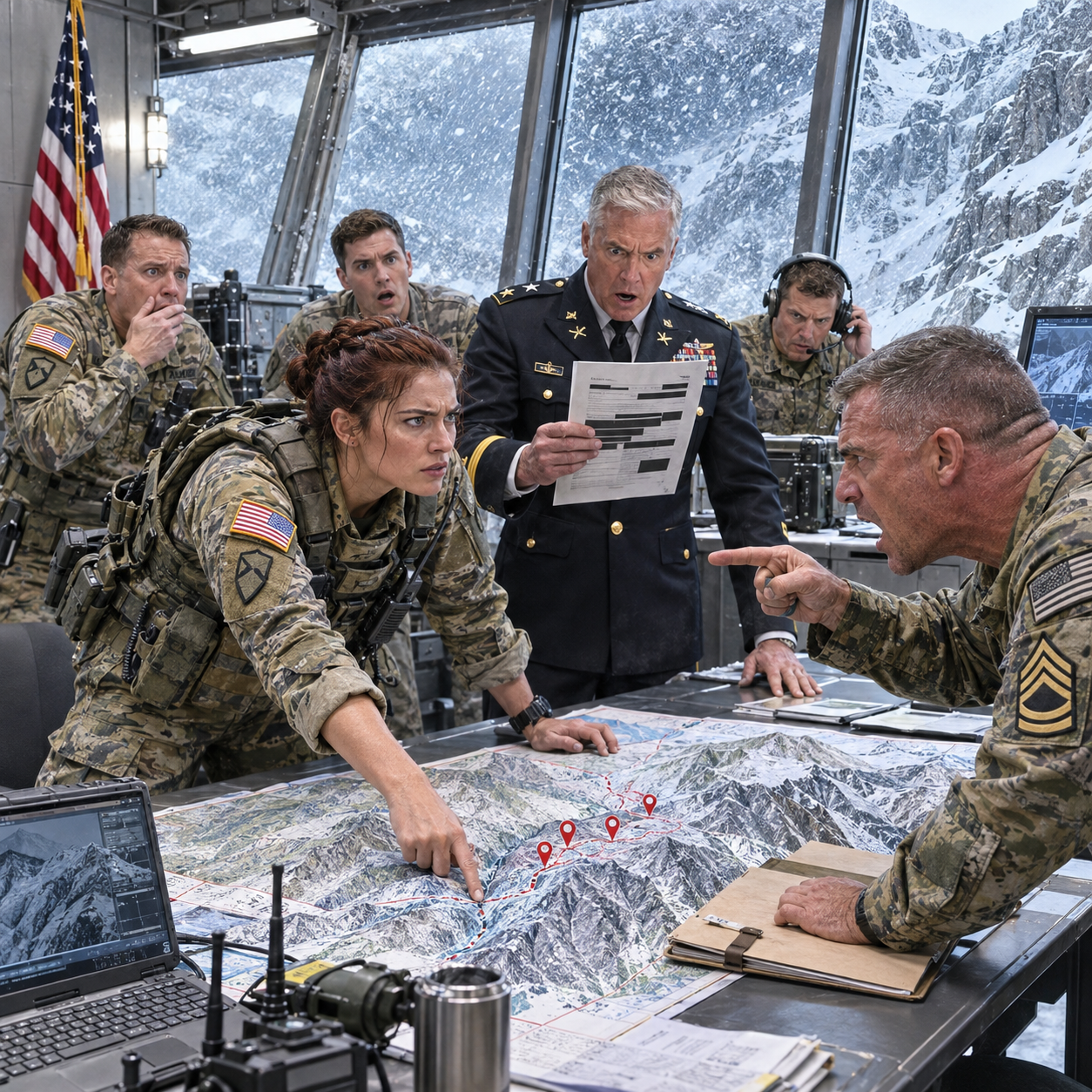
“No girl survives forty-eight hours on that ridge,” Master Sergeant Dean Rourke told the room while my sealed transfer file sat unopened beneath his hand. I had spent years learning exactly what those mountains could do to people, but I let him believe I was an inexperienced twenty-six-year-old chasing a heroic résumé line. Then four scouts vanished inside a blizzard, the rescue route Rourke chose became a death trap, and our division chief finally opened the redacted page everyone else had ignored.
### Part 1
The metal folding chair beneath me was cold enough to soak through my utility pants, but the hostility across the briefing table felt colder. Master Sergeant Dean Rourke dropped my transfer folder onto the scratched surface without opening it, and the folder slid several inches until one corner struck my field radio with a hollow plastic knock. “No girl survives forty-eight hours on the north ridge,” he said, looking at the three younger scouts rather than me, as though I were an object lesson headquarters had mailed him by mistake.
Nobody laughed, which somehow made the comment worse. One specialist stared down at his clipboard, another suddenly became fascinated with the zipper on his jacket, and a young corporal beside the weather console shifted in his chair with the uncomfortable expression of a man who knew something ugly had happened but had not yet decided whether silence made him part of it. I took a drink from my canteen, tasted the faint metallic tang of treated water, and said nothing because I had learned a long time ago that insecure people often revealed more when you refused to interrupt them.
My name was Mara Vance, and thirty minutes earlier a transport truck had dropped me outside Camp Alder with a sixty-pound field pack, one waterproof communications case, and orders assigning me to the Fourth Reconnaissance Division’s long-range surveillance section. Camp Alder sat against a chain of northern mountains where dark spruce forests climbed toward bare stone and permanent snowfields, and that morning the air smelled of wet pine, diesel exhaust, and the thin mineral scent that always came before freezing weather. After thirty-six continuous months working remote reconnaissance corridors, the clean buildings and painted signs of a permanent base almost felt artificial.
Rourke had been waiting near the tactical map when I entered the staging bay. He was broad through the shoulders, gray beginning to show at his temples, with the stiff posture of a man who had spent twenty-two years being obeyed and had started confusing obedience with proof that he was always right. His eyes had traveled from my boots to my clean jacket before he asked, “You the incoming lateral transfer?” and I had answered, “Specialist Vance reporting, Master Sergeant,” while offering him my sealed orders.
He never took them. Instead, he tucked both hands into his vest and gave me a small, humorless smile. “Headquarters didn’t mention sending us office support.”
“I’m assigned to the reconnaissance line.”
“That’s what the paperwork probably says.” He looked toward the younger scouts, letting them hear every word. “Paperwork also says plenty of people are qualified right up until elevation strips off the paint.”
I set the envelope on the table between us. “Then I suppose we’ll find out.”
The answer seemed to bother him more than an argument would have. He walked around me slowly, boots squeaking against damp concrete, then stopped beside my pack and tapped the top buckle with a metal pen. “Standard transfer inspection,” he announced. “Full gear breakdown, right here.”
There was nothing unusual about inspecting equipment, but his performance made his intention obvious. He wanted the room watching while the new woman unpacked something foolish, forgot an item, or struggled to explain equipment she supposedly did not understand. I knelt beside the pack, spread an olive field cloth over the floor, and began laying everything out with the same methodical order I had used in snow shelters, cargo bays, abandoned ranger stations, and valleys where losing one small piece of gear could become the difference between inconvenience and catastrophe.
The standard clutter Rourke expected never appeared. My shelter system had been stripped down to a graphite-frame bivouac barely larger than a rolled jacket, my cold-weather layer carried reinforced knees and elbows, and my food packets had been repacked into compact high-calorie blocks designed for movement rather than comfort. Last came the waterproof communications case, and when I released its latches, the corporal at the weather console leaned forward despite himself.
Inside sat a field-modified long-range transceiver, an infrared optic with a glare shield, a small directional antenna, and a wiring harness built by hand. Rourke picked up the transceiver with two fingers as though it had been pulled from a trash bin. “What kind of garage project is this?”
“Cold-climate relay package.”
“It isn’t division standard.”
“No.”
He turned toward the scouts. “Exactly my point. Unauthorized equipment creates logistics failures, power incompatibility, maintenance issues, and dead weight.” Then he looked back at me. “You don’t bring homemade toys onto my reconnaissance line.”
I rested both hands on my knees. “Field modification waiver Seven-Charlie. Approved under the northern special operations annex.”
For the first time, something shifted behind his eyes. “That annex is restricted.”
“Yes.”
The young corporal looked from Rourke to me.
Rourke set the transceiver down harder than necessary. “And what exactly does this miracle box do?”
“It establishes a line through dense timber and ice interference faster than the current division unit.”
“According to whom?”
“According to testing.”
“Whose testing?”
I almost smiled, because there were answers I was permitted to give and answers sealed under classifications he did not have access to. “The waiver is attached to my orders.”
That was when Rourke finally glanced at the unopened envelope, but pride won. He folded his arms instead. “Equipment doesn’t make an operator, Vance.”
“No, Master Sergeant.”
“Good. At least we agree on something.”
The red beacon above the tactical operations console began flashing before he could continue. A piercing alarm cut through the building, followed by the clatter of boots on the overhead walkway, and every expression in the room changed at once. The corporal spun toward his console, pressed a headset against one ear, and said, “Priority distress transmission from November Two. Scout Team Four just dropped off the network.”
Rourke moved instantly, all mockery disappearing beneath professional reflex. I rose beside him as the main topographical table came alive with contour lines, weather data, and one blinking amber position marker high on the northern sector. Outside, wind struck the metal building hard enough to rattle the wall panels.
“The storm came two hours early,” the corporal said. “Wind speed climbing fast. Temperature dropping. Their automatic locator stopped transmitting less than five minutes ago.”
Rourke planted both hands on the table. “Get the tracked carriers ready. We push them up the eastern logging road, establish at the lower saddle, and send the recovery team on foot.”
I stared at the map.
For the first time since arriving at Camp Alder, my stomach tightened.
Because I knew that road.
More importantly, I knew what was hanging above it.
“Master Sergeant,” I said quietly, “you can’t send them that way.”
His head turned toward me.
The room became silent again.
This time, nobody was embarrassed.
They were waiting to see whether I had just made the worst mistake of my first day—or whether I knew something their own commander did not.
### Part 2
Rourke stared at me for half a second before irritation replaced surprise. “Excuse me?”
“The eastern road sits underneath an avalanche chute.” I stepped closer to the illuminated map and followed the contour lines with one finger without touching the glass. “The wind is loading the overhang above kilometer marker six. With this direction and temperature drop, the road will be buried long before the carriers reach the saddle.”
His jaw tightened. “That access route has been used for twelve years.”
“Not under this wind pattern.”
“You’ve been on this base less than an hour.”
“I’ve been on that mountain considerably longer.”
The words escaped before I could soften them. Rourke straightened slowly, and the atmosphere around the table changed from emergency tension to something more personal. “Specialist, step away from my map.”
I did not move. “Look at the pressure drop on Peak Three. Then look at the southeast gusts. Snow is being pushed over the cornice directly above the road.”
The weather corporal swallowed and enlarged the display. Numbers populated the side of the screen, and I saw his expression change before Rourke did. “Master Sergeant,” he said cautiously, “the shear is stronger than the morning model.”
Rourke did not look at him. “How long have you been assigned to mountain recovery, Vance?”
“Long enough to know the carriers won’t make it.”
“That wasn’t my question.”
“No, Master Sergeant.”
He slapped an open palm against the frame of the table, hard enough to make a coffee cup jump. “Then here’s the answer you need. You are not in operational command, you have no familiarity with my team, and you will not disrupt a recovery response because you spent time staring at charts somewhere else.”
I felt something old and unwelcome settle behind my ribs. Thirty-four months earlier, another commander had dismissed a weather warning as theoretical until nine men were trapped in a whiteout and visibility vanished before the helicopters could reach them. I remembered the smell of frozen fabric inside my mask, the raw cracks across my knuckles, and the sound of men trying not to panic over a weak radio link while the storm erased every landmark around them.
“I’m not trying to disrupt anything,” I said. “I’m trying to keep you from creating a second rescue mission.”
One of the younger scouts drew a sharp breath.
Rourke’s face darkened. “Pull the historical weather files from supply. That is your assignment. Leave the recovery operation to people who’ve earned their place here.”
“The historical files are why I’m telling you the road will fail.”
“You’ve had enough warnings.”
He pointed toward the far door.
Then that door opened.
Cold air rushed through the operations bay, carrying flakes of wet snow that melted instantly on the dark floor. Major General Elias Mercer stepped inside with two aides behind him, removing leather gloves as he walked, his field coat beaded with moisture. The room snapped to attention almost as one body.
Mercer was in his late fifties, lean rather than imposing, with silver hair cropped close and deep lines beside his eyes from years spent squinting into snow and wind. I had seen him only twice before, both times from a distance, and I did not expect him to recognize me. The work that mattered had happened under call signs and coded reporting chains, not handshakes.
Rourke saluted. “General, we have a personnel recovery event on Ridge Four. Scout Team Four lost communications during the squall. I’m deploying two tracked carriers along the eastern access route.”
Mercer’s attention moved over the table and stopped on the highlighted road. “Eastern access?”
“Yes, sir.”
“Current avalanche assessment?”
“Within acceptable tolerance.”
The weather corporal shifted again.
Mercer noticed.
“Corporal?”
The young man hesitated. “The updated shear reading is higher than forecast, sir.”
Rourke answered before he could continue. “Still manageable.”
Mercer looked at me then, perhaps because I was the only person standing beside the table without a permanent section patch on my shoulder. “You’re new.”
“Yes, sir.”
“Name?”
“Mara Vance.”
His gaze narrowed slightly.
Rourke reached for my folder as though suddenly remembering it existed. “Incoming lateral transfer, sir. Headquarters sent her this morning. We were completing intake when the distress call came through.”
Mercer extended a hand.
Rourke gave him the folder.
The general opened it while the alarm continued pulsing red above us. For several seconds, nothing changed in his face. Then he reached the second page, saw the red classification strip across the bottom, and stopped.
I knew exactly what line he had reached.
His eyes moved upward very slowly.
“Vance,” he said.
“Yes, sir.”
“Mara Elise Vance?”
The room seemed to contract around us.
Rourke cleared his throat. “Sir, she’s been instructed to assist with archived weather records while—”
Mercer lifted one hand.
Rourke went silent.
The general stepped toward me, staring first at my face and then at the old serial plate attached to my communications case. Most people saw scratched metal, faded numbers, and a piece of equipment overdue for replacement. Mercer saw the same thing one rescue coordinator had seen three years earlier.
His breath left him softly.
“No,” he murmured.
I said nothing.
He looked down at the file again.
Then back at me.
“Ghostfire.”
Nobody moved.
I heard the ventilation fan above the map table, the faint static leaking from the corporal’s headset, and the wind throwing sleet against the building. Rourke’s expression had gone strangely blank.
Mercer stepped closer. “You were Ghostfire on the North Corridor operation.”
“Yes, sir.”
“The Ridge Four evacuation?”
“Yes.”
“The forty-eight-hour visual relay?”
“Yes, sir.”
His eyes closed for half a second.
When he opened them, he turned to Rourke.
“What exactly did you say her assignment was?”
Rourke seemed to have difficulty finding his voice. “Historical weather archives, sir.”
Mercer stared at him with an expression I could not read.
Then he looked around the room.
“The terrain maps this section has used for the last two years,” he said quietly, “were built from her field notes.”
One of the younger scouts slowly raised his eyes from the table.
Mercer continued. “The western extraction corridors, the thermal pockets, the emergency acoustic channels, the avalanche triggers you teach in qualification briefings—she mapped them while half the division believed those routes were impassable.”
Rourke looked at me as if my face had changed.
It hadn’t.
I was still the woman he had refused to let near his map ten minutes earlier.
Mercer planted both palms on the illuminated table. “Specialist Vance, take the recovery window.”
Rourke stiffened.
The general did not look at him.
“How do we get our people home?”
I reached for my communications case.
“First,” I said, “we stop pretending the eastern road is an option.”
Then I opened the case Rourke had called a box of homemade toys.
### Part 3
The auxiliary cable clicked into the central console, and for one ugly second nothing happened. Rourke stood three steps behind me with his arms rigid at his sides while the younger scouts watched the screen, and I could feel his disbelief hanging in the room like smoke. Then the display flickered, accepted my encryption key, and a second layer of topographic data appeared over the division map.
Blue lines traced narrow drainage channels that did not exist on the standard grid. Small triangles marked rock shelves, tree breaks, false ridgelines, and dead zones I had recorded over dozens of missions, sometimes by hand while lying under a tarp in sleet. Mercer leaned closer.
“What are we looking at?” the weather corporal asked.
“The mountain underneath the map,” I said.
Rourke’s eyes snapped toward me.
I ignored him.
“Scout Team Four is here.” I touched the pulsing amber marker on the northern slope. “If their last automated position is accurate, they’re above the eastern chute and below the main ridge. They cannot climb safely, and they cannot descend east.”
Mercer nodded. “Western route?”
“There’s a drainage pocket under the false peak. Gully Seven.”
The corporal shook his head. “There’s no navigable gully on the current chart.”
“There is when the snowpack closes the upper rocks.”
“How wide?”
“Wide enough.”
Rourke finally spoke. “You’re proposing we send exhausted scouts into an unmarked depression during whiteout conditions.”
“I’m proposing we keep them away from an avalanche path.”
“And if the gully is blocked?”
“Then I’ll know before they reach the constriction.”
He gave a short laugh with no humor in it. “How?”
I pulled on my headset.
“Because I built the route.”
Static swallowed the first transmission. I adjusted the directional array, shifted the frequency three degrees, and listened to nothing but wind. Every person in the room seemed to be holding the same breath.
“November Two, November Two, this is Ghostfire on emergency relay.” I waited. “If you receive, key your transmitter twice.”
Nothing.
I adjusted the signal.
“November Two, this is Ghostfire. Key twice if you receive.”
Two tiny bursts broke through the static.
The younger corporal whispered something I did not catch.
I leaned closer to the microphone. “November Two, confirm personnel count.”
A voice emerged in pieces. “Four… present… one ankle… visibility zero.”
It was the sound that changed the room. Not the technology, not Mercer’s recognition, not the file. A human voice was somewhere inside that storm, weak but alive, and suddenly nobody cared about pride except the man who had built too much of himself around it.
“November Two, listen carefully. Leave nonessential equipment. Keep medical, communications, thermal layers, and water. I need your altimeter reading.”
The scout answered.
I checked it against my notes.
“Descend twenty meters on a bearing of two-eight-zero. You’ll feel the grade flatten. Stop when the wind drops.”
Rourke stepped toward the table. “If they move downhill blind—”
Mercer turned his head. “Master Sergeant.”
Rourke stopped.
The general’s voice remained calm. “You had the window. She has it now.”
Rourke’s mouth tightened, but he stepped back.
For the next eighteen minutes, my world narrowed to a headset, four moving points, and memories I wished were less clear. I told the team where the slope would tilt, where a buried rock shelf created a sudden step, and where to stay left because the right side opened into a drop invisible under fresh powder. Each instruction came from something I had learned the expensive way.
At one point the team leader reported that the terrain did not match the map on his wrist display. “Forget the display,” I said. “Trust your altimeter and my bearing.”
He hesitated.
I heard it in the silence.
“Ghostfire,” he finally answered, “copy.”
That name had power I never asked for. It had started as a call sign assigned during an operation when radio traffic needed anonymized relays, and afterward it became a story passed through units that had never seen my face. Some versions claimed Ghostfire was a retired mountain guide, some said a classified drone program, and one ridiculous version insisted the call sign belonged to three different operators rotating shifts so nobody could explain the endurance.
I had never corrected anyone.
Being a rumor was easier than being underestimated in person.
“Wind dropping,” the team leader said.
“You’re entering the drainage pocket.”
The weather corporal stared at the atmospheric readings. “She’s right. They’re in a shadow zone.”
Mercer exhaled through his nose.
I continued. “Move another one hundred forty meters. There’s a stand of dwarf pine against the western wall. Use it for visual reference.”
The scout team advanced.
Then one amber point stopped.
“November Two, why did you stop?”
Static.
“November Two?”
The reply came strained. “Corporal Ellis went down. Ankle injury worse than reported.”
I closed my eyes for one second. Every plan changes when a person can no longer move at the speed the terrain demands.
Mercer asked, “Can we put a helicopter into the western clearing?”
The aviation controller shook his head. “Wind is too unstable above the ridge.”
“Not above it,” I said. “Below.”
I expanded the map and circled a narrow clearing near the drainage outlet. “Approach from the southwest, stay under the stone shoulder, then climb only after crossing the second tree line.”
The controller stared. “That corridor is not approved.”
“It was approved once.”
“When?”
“Three winters ago.”
“Why was it removed?”
“I don’t know.”
That bothered me.
I looked toward Rourke.
He was staring at the same route with a strange expression.
Mercer noticed too.
“Master Sergeant,” he said, “do you recognize this corridor?”
Rourke waited a fraction too long.
“I’ve seen it in archival material.”
“Why isn’t it on our current recovery chart?”
“I’d have to check.”
Something cold moved through me that had nothing to do with the storm.
The helicopter launched anyway.
I stayed with the scouts, guiding them meter by meter until the sound of rotor blades became audible through their radio. When the first aircraft position appeared over the western clearing, three people in the room quietly cheered.
I did not.
Because I was looking at the route database on the lower edge of the screen.
The corridor had not disappeared by accident.
It had been manually removed eleven months earlier.
And the authorization code beside the deletion belonged to Dean Rourke.
### Part 4
I did not confront him while four people were still trapped outside. Anger has a way of making itself feel urgent, but the mountain had taught me that urgency and importance were not the same thing. I minimized the route history, returned my attention to the headset, and listened as the rescue helicopter settled into the western clearing.
The pilot reported terrible visibility but acceptable wind below the stone shoulder. Scout Team Four had to cover the final eighty meters on foot, carrying Corporal Ellis between them on an improvised support, and their breathing came hard over the radio. I gave them one last bearing and told them what they would hear before they could see the aircraft.
“Rotor wash should hit from your left,” I said. “If it hits from your face, you’re drifting south. Correct immediately.”
“Copy.”
Thirty seconds later the team leader shouted, “Visual!”
The room released a breath.
Forty-six minutes after the distress ping, the helicopter landed back at Camp Alder. All four scouts came down the ramp alive, faces pale from cold and clothing crusted with ice, with Ellis supported between two medics. Mercer walked to the motor pool personally, and I followed because there are times you need to see the people behind the dots on a screen.
The team leader, Staff Sergeant Jonah Reed, recognized my voice before he saw my face. He was tall, bearded, and exhausted enough that his legs shook when he stood still, but the moment I spoke he turned sharply toward me. “Ghostfire?”
I nodded.
For several seconds, he simply stared.
Then he gripped my forearm. “You told us where the ground was when we couldn’t see our own boots.”
“You listened.”
“That’s because I’m not stupid.”
The joke came out weak, but it made one of the medics laugh.
Rourke stood ten feet away.
Reed noticed him and straightened as much as exhaustion allowed. “Master Sergeant, our locator failed before the storm hit full strength. We tried resetting it twice.”
Rourke frowned. “Equipment failure?”
“Maybe.”
“Turn it over to maintenance.”
Reed glanced toward me. “There was something else.”
Mercer stopped walking.
“What?” I asked.
“Our wrist navigation had us moving toward the eastern access.”
My eyes went to Rourke.
Reed continued. “The emergency route populated automatically after the beacon fault. We were following it when the slope started cracking above us.”
The motor pool seemed suddenly too quiet.
Mercer’s voice hardened. “Who loaded that emergency route?”
Reed shook his head. “It came from the division package.”
Rourke answered quickly. “Standard package. Same one every scout carries.”
“Standard according to which revision?” I asked.
His gaze moved to mine.
“Current revision.”
“That road should not be an emergency route during winter.”
“It has been used for years.”
“You keep saying that as if repetition changes terrain.”
His face tightened.
Mercer stepped between us before the exchange could become something else. “Enough. Medical takes priority. All navigation devices and communications equipment from Scout Team Four are sealed for review.”
Rourke looked offended. “General, that’s unnecessary.”
“No,” Mercer said. “What would have been unnecessary was burying eight more people because we were too proud to ask why our maps disagree.”
Nobody spoke after that.
Back inside the staging bay, my unpacked equipment still covered the tarp exactly where I had left it. The sight looked almost absurd now—the same modified transceiver Rourke had mocked had just helped bring four scouts out of a storm his preferred route might have turned fatal. I began packing slowly, more tired than I wanted anyone to see.
Rourke approached alone.
The swagger was gone. His shoulders sat lower, and for the first time since I met him, he looked his age.
“Specialist Vance.”
I latched one side of the communications case. “Master Sergeant.”
He waited.
“I owe you an apology.”
I looked up.
He seemed uncomfortable saying the words, which told me he probably did not say them often.
“I misjudged your experience,” he continued. “And your capability.”
“You judged more than that.”
His jaw moved.
“I judged the information I had.”
“No.” I closed the second latch. “You refused the information you had.”
He went still.
“My orders were sealed on your table. My equipment waiver was attached. Your weather corporal told you the shear model had changed. I explained the eastern route was dangerous.” I stood. “You did not lack information, Master Sergeant. You decided none of it mattered because of what you assumed when I walked through the door.”
A muscle jumped in his cheek.
“I said I was wrong.”
“Yes.”
“What else do you want?”
There it was.
Not remorse exactly.
A desire to finish the uncomfortable part and move on.
“I don’t want anything from you,” I said.
That answer seemed to land harder than anger.
He took a slow breath. “For what it’s worth, I’ve worked with plenty of young transfers who arrived thinking specialized equipment made them special.”
“And I’m sure some disappointed you.”
“They did.”
“That still doesn’t explain why you never opened my file.”
He looked away.
I picked up the case.
Then I remembered the authorization code.
“Why did you remove the western aviation corridor?”
His head turned back sharply.
For the first time all day, Dean Rourke looked genuinely frightened.
“I don’t know what you’re talking about.”
“Yes, you do.”
“No.”
“The route database records every deletion.”
His face hardened, the apology disappearing as fast as it came.
“You’re new here,” he said quietly. “You should be careful about assuming you understand decisions made before you arrived.”
I almost laughed.
He had spent the morning accusing me of being too new to understand the mountain.
Now he was using the same argument to protect himself from a map.
“I’ll keep that in mind.”
I walked past him.
At the far end of the bay, General Mercer was waiting beside the operations office.
He held a printed route log in one hand.
And from the expression on his face, I knew he had found the same deletion.
### Part 5
Mercer closed the office door behind me and placed the route log on a steel desk. The small room smelled of burnt coffee, wet wool, and the dusty heat from an old radiator beneath the window, and for several seconds neither of us spoke. Outside the glass partition, I could see Rourke directing his scouts with stiff, exaggerated concentration.
“Sit down,” Mercer said.
I remained standing. “I’m fine, sir.”
“You’ve been awake since before dawn.”
“I’ve operated on worse.”
“That wasn’t the question.”
I sat.
He lowered himself into the chair opposite me. “The western corridor was removed eleven months ago under Rourke’s credentials.”
“I saw.”
“He says the aviation office requested it.”
“Did they?”
“No.”
I looked through the glass again.
Mercer rubbed one hand across his jaw. “Before you decide what kind of scandal you’ve landed in, there may be a simpler explanation.”
“I’m listening.”
“Rourke is stubborn, territorial, and convinced that every procedure he learned the hard way should remain carved in stone. That makes him difficult. It does not automatically make him corrupt.”
“I didn’t say corrupt.”
“You thought it.”
He was right.
I had spent too many years in places where administrative decisions sometimes hid personal motives, career protection, or failures nobody wanted reopened. The easiest story was that Rourke had deleted a route because it challenged his preferred doctrine. The more dangerous possibility was that there was a reason I had not yet seen.
Mercer slid another report across the desk.
“Three months before the deletion, an aviation crew used your western corridor during a training recovery. They encountered severe rotor turbulence near the stone shoulder.”
“In which wind direction?”
“Northwest.”
“That corridor was designed for southwestern approach under eastern or northeastern loading.”
“I know.”
“Then somebody used it outside parameters.”
“Yes.”
I read the report.
Nobody had been injured. The pilot aborted, returned safely, and filed a recommendation that the approach be restricted pending review. Rourke had converted “restricted pending review” into complete deletion.
“He removed it instead of correcting the conditions under which it could be used,” I said.
“That appears to be what happened.”
“So today the route that could save Scout Team Four existed only because my personal overlay still carried it.”
“Yes.”
I placed the report down.
Mercer’s expression was tired. “The question is whether that was negligence, poor judgment, or something worse.”
“Does the label matter to the four people we just pulled out?”
“It matters if I’m going to take action.”
I understood.
Military organizations run on accountability, but accountability requires more than anger and hindsight. I had seen good people make terrible decisions under pressure, and I had seen dangerous people hide behind good intentions. The difference mattered.
“What do you need from me?” I asked.
“Review the full terrain package. Tell me what else is missing.”
That was how my transfer to Camp Alder became an audit before I had even been assigned a bunk.
For the next six hours, I sat with the weather corporal, whose name turned out to be Evan Pike, and compared current division maps against archived overlays. Coffee went cold beside us as daylight faded from white to gray outside the high windows, though the storm kept the mountains invisible. We found seven changes.
Three were reasonable updates.
Two involved trails closed because of rockfall.
One rerouted a summer observation line away from unstable ground.
The last made me stop.
“Open Revision Twenty-Six,” I said.
Evan pulled up the file.
A narrow saddle route near Ridge Four had been reclassified as “seasonally inaccessible.”
I stared.
“That’s wrong.”
Evan glanced at me. “How wrong?”
“It is most accessible in winter.”
He frowned. “That makes no sense.”
“Exactly.”
I opened the metadata.
Rourke had approved that change too.
For a moment, the pieces seemed obvious. Too obvious.
Then I noticed the date.
The modification had been entered while Rourke was away at a training conference.
“Who had delegated credentials?” I asked.
Evan brought up the administrative log.
A different name appeared.
Captain Nolan Crest, former operations officer.
“Where is Crest now?”
Evan looked at me. “Retired six months ago.”
That was our red herring.
For the next hour, we chased it.
Crest had approved several route packages, signed maintenance delays, and overseen a software migration that generated inconsistent terrain classifications. It would have been easy to blame him, especially because he was no longer there to defend himself.
But the deeper we looked, the less satisfying that explanation became.
The winter-access designation had not been typed manually. It had been imported from an old civilian survey database whose categories did not distinguish between snow-covered accessibility and vehicle accessibility. The system had interpreted “closed to wheeled traffic” as “inaccessible.”
Someone should have caught it.
Nobody had.
That was more troubling than sabotage.
Sabotage requires one bad actor.
Complacency can infect everyone.
At 2100 hours, Mercer returned.
“What did you find?”
I rotated the monitor toward him. “No conspiracy.”
His eyebrows lifted.
“That sounds almost disappointing.”
“It isn’t.” I pointed to the revision history. “It’s worse in a different way. The database is full of corrections nobody revalidated after migration. Rourke removed the western corridor because of one bad aviation approach. Another route was mislabeled by imported data. Several seasonal designations were copied forward without field review.”
Mercer leaned over the screen.
“So Scout Team Four went out using a package everyone assumed had been verified.”
“Yes.”
“Who owns verification?”
I already knew the answer.
“The section master sergeant.”
Mercer looked through the glass.
Rourke was still in the bay.
“He inherited the system,” Mercer said.
“He maintained it.”
“Fair.”
I hesitated.
“There’s another problem.”
“What?”
“His people are afraid to challenge him.”
Mercer looked back at me.
I told him about Evan’s hesitation when the wind data changed, the junior scouts avoiding eye contact, and the way Rourke shut down any disagreement as disrespect. Mercer listened without interrupting.
Then he asked a question I had not expected.
“Why do you think headquarters sent you here?”
I shrugged. “My transfer request cleared.”
“No.”
Something in his voice made my stomach tighten.
Mercer opened a locked drawer and removed a second envelope.
It had my name on it.
“This was sent separately from your orders.”
I stared at the red classification stripe.
“What is it?”
He pushed it toward me.
“Your real assignment.”
### Part 6
The envelope contained four pages.
I read them twice.
Headquarters had not sent me to Camp Alder simply because the Fourth Reconnaissance Division needed another scout. Over the previous year, the unit had recorded a pattern of near misses, route discrepancies, communication failures, and aborted mountain exercises that never became serious enough individually to trigger an external investigation. Together, they suggested something more important than a broken transmitter or a bad map.
The division was losing what the document called “adaptive field culture.”
I almost laughed at the language.
Bureaucracy has a talent for turning human problems into phrases nobody would ever say over dinner.
Mercer watched me. “Thoughts?”
“You knew.”
“I suspected.”
“You knew who I was before today.”
“I knew Ghostfire had been transferred. I didn’t know headquarters had put your civilian name behind the call sign until I opened your file.”
“And they sent me to evaluate the section.”
“They sent you to operate with them and report what you saw.”
I looked through the office glass at Rourke.
His scouts were cleaning equipment around him in absolute silence.
“You could have told him.”
“Then he would have performed for you.”
That, unfortunately, was true.
The next morning the storm passed. Sunlight hit the fresh snow so brightly that the entire compound seemed bleached white, and the mountains beyond the fence looked peaceful in the dishonest way dangerous places sometimes do after they have finished trying to kill somebody.
Rourke met me beside the training board.
His apology from the previous night had hardened into professional distance.
“General says you’re conducting a terrain review.”
“I am.”
“He also says my scouts are assigned to assist.”
“They are.”
His eyes narrowed. “Under whose authority?”
“His.”
That answer left him nowhere useful to go.
For three days, I worked with the section.
I asked the scouts to redraw routes from memory, explain why they trusted specific evacuation corridors, and identify locations where they would ignore the standard package. At first they answered like students taking an exam, repeating phrases from manuals with such perfect consistency that I could almost hear Rourke’s voice inside their heads.
Then I changed the questions.
“What if the bridge is gone?”
“What if your team leader is injured?”
“What if the weather model is wrong?”
“What if headquarters tells you to take a route you believe will kill you?”
The room became quieter every time.
On the third afternoon, Specialist Tessa Moore finally raised her hand.
“You want us to say we’d refuse an order?”
“I want you to tell me what evidence would make you challenge one.”
She glanced at Rourke.
That glance told me more than her answer could.
Rourke saw it.
His mouth tightened.
After the session, he followed me into the equipment corridor.
“You’re undermining the chain of command.”
“I’m teaching them to think.”
“You’re teaching them to question leaders in front of their peers.”
“If a leader’s plan is wrong, where would you prefer the question happen? Before deployment or during the rescue afterward?”
He stepped closer.
“You think one successful recovery gives you the right to rebuild my section.”
“No.”
That stopped him.
“I think years of near misses give the division the responsibility to fix what isn’t working.”
“You’ve been here four days.”
“And in four days I’ve watched one corporal hesitate to give you weather data because he was afraid you’d shut him down. I watched a patrol follow an unsafe automatic route because nobody had been taught to challenge the package. I found mapping errors that survived multiple reviews because everyone assumed somebody else had checked them.”
“You’re blaming me for software failures?”
“I’m blaming you for creating a culture where disagreement feels dangerous.”
His face went pale with anger.
“My people respect me.”
“I’m sure they do.”
“Then what exactly are you saying?”
“Respect and fear can look identical when the room is quiet.”
For several seconds, neither of us moved.
Then he said, “You enjoyed yesterday.”
I blinked.
“You enjoyed Mercer recognizing you. You enjoyed making me look like a fool.”
The accusation was so far from what I had felt that it almost made me tired.
“I spent yesterday wondering whether four people would freeze to death because we lost contact with them.”
“That isn’t what I asked.”
“No, because the answer you want is about you.”
His expression changed.
I continued before he could interrupt. “You think I wanted to walk in here and embarrass you. I wanted to unpack my gear, learn the section, and do my job. You turned my arrival into a public test because you saw a young woman and decided I needed to be put in my place.”
He stared at me.
I lowered my voice.
“Then when the weather changed, you treated every correction as a challenge to your authority.”
For the first time, Rourke had no immediate reply.
He looked down the corridor toward the staging bay.
“My last team leader ignored me once,” he said finally.
The anger in his voice had faded.
I waited.
“Eight years ago. Winter exercise. I told him the western descent was too exposed. He wanted to save time.” Rourke swallowed. “He took it anyway.”
“What happened?”
“Fall through a cornice.”
I understood before he finished.
“He died?”
Rourke nodded.
There it was.
Not an excuse.
But an explanation.
After that, certainty had become his armor. If subordinates challenged him, he heard the echo of a decision that ended with someone dead. Over time, he had stopped distinguishing reckless defiance from informed disagreement.
“That matters,” I said.
His eyes rose.
“But it doesn’t make what you’ve been doing safe.”
He gave a bitter laugh. “Of course not.”
“You can understand why someone built a wall and still admit the wall is blocking the exit.”
He looked at me for a long moment.
“I don’t know if I can change how I run this section.”
“Then you shouldn’t run it.”
The words landed between us without drama.
I did not soften them.
That evening Mercer convened the formal review.
Rourke sat at the far end of the table.
And for the first time since I arrived, he was the one waiting to learn whether he still had a place in elite reconnaissance.
### Part 7
The review board lasted four hours.
There were no raised voices, no theatrical accusations, and no satisfying moment where everyone suddenly understood the world in the same way. Real accountability is usually less dramatic than people imagine; it comes in documents, timestamps, repeated questions, and uncomfortable silences while someone realizes their intentions cannot erase their results.
Rourke admitted removing the western flight corridor.
He admitted approving terrain packages without full field revalidation.
He admitted discouraging junior scouts from challenging plans during briefings because he believed debate undercut discipline.
He did not excuse himself.
That mattered.
But it did not erase anything.
When Mercer asked for my assessment, every person at the table looked toward me.
I chose my words carefully.
“Master Sergeant Rourke is experienced, physically capable, and knowledgeable about this sector. He also created a decision environment where subordinates learned that agreeing quickly was safer than raising uncertainty.”
Rourke kept his eyes on the table.
I continued. “That environment contributed to delayed correction of mapping errors and nearly contributed to an unsafe recovery deployment.”
Mercer folded his hands.
“Recommendation?”
I hated that question.
Not because I did not have an answer, but because I knew Rourke would hear whatever I said as a verdict on his entire career.
“He should not retain unilateral operational control until he completes retraining and the section demonstrates independent challenge procedures.”
One of the board members asked, “Removal?”
“Temporary suspension from operational command.”
“Why temporary?”
“Because the problem is serious, but I haven’t seen evidence that he cannot learn.”
Rourke finally looked at me.
His expression was unreadable.
Mercer approved the recommendation.
For the next six weeks, Rourke remained in the section but no longer commanded field deployments. Captain Elise Garner took temporary operational control, and I was assigned to rebuild the terrain-validation and recovery program with the scouts.
That should have felt like victory.
Instead, it felt like work.
Every map had to be reviewed against field observations. Every emergency route needed weather conditions attached rather than a simple green or red status. We built briefings where the youngest person in the room was required to identify one weakness in the plan before deployment.
The first few times, the scouts treated the exercise like a trick.
Eventually, they started arguing.
That was when I knew it was working.
Tessa Moore challenged a proposed observation post because morning sun could expose optics from the southern valley. Evan Pike rejected a winter transit route because drainage ice would create a hidden hazard beneath fresh snow. Jonah Reed, recovered from the storm with nothing worse than bruised ribs and a deep respect for thermal drainage, started asking his team, “What am I missing?” before every patrol.
Rourke watched all of it.
At first, he said little.
Then one morning, during a route rehearsal, a young scout named Caleb Dunn disagreed with him about crossing a frozen creek. The whole room went tense.
Rourke stared at the map.
Six weeks earlier, I knew exactly what would have happened.
This time, he asked, “Show me.”
Dunn stepped forward.
He pointed to a temperature curve and explained that daytime warming could weaken the edge ice on the return journey.
Rourke studied it.
“You’re right.”
The room relaxed.
It was a small moment.
Small moments are usually where real change lives.
After the briefing, Rourke found me outside the equipment shed. Snowmelt dripped from the roof, and the mountains had begun showing dark stone through their winter cover.
“I’m being reinstated next month,” he said.
“I heard.”
“Probationary command.”
“Yes.”
He shoved his hands into his jacket pockets.
“I wanted to thank you.”
“For recommending suspension?”
“For not recommending removal.”
I looked at him.
“You earned the suspension.”
“I know.”
“And you’re earning the reinstatement.”
He nodded.
Then came the part I had been expecting for weeks.
“I also owe you a better apology.”
I said nothing.
He looked uncomfortable but continued.
“What I said when you arrived wasn’t professional. It wasn’t just skepticism. I saw your age, saw that you were a woman, and decided I already knew what kind of operator you were.”
The honesty surprised me more than the apology.
“I made you prove something I never would have demanded from a man with the same file.”
“Yes.”
He winced slightly.
“I’m sorry.”
I believed him.
That did not mean everything disappeared.
“I accept that you mean it,” I said.
His eyes narrowed. “That’s not the same as accepting the apology.”
“No.”
A long silence passed.
“Fair enough.”
People sometimes think forgiveness is a ceremonial door you open once someone finds the right words. I had never believed that. An apology can be sincere while trust remains damaged, and recognizing someone’s growth does not require pretending they never harmed you.
Rourke looked toward the mountain.
“I suppose I’ll have to live with that.”
“Yes.”
He gave a faint smile.
Then he walked away.
Three days later, Mercer called me into his office.
There was a new set of orders on his desk.
I expected another field assignment.
Instead, he slid the papers toward me.
The heading made me read it twice.
Fourth Reconnaissance Division, Advanced Terrain and Recovery Cell.
Officer in Charge: Mara Vance.
I looked up.
“You’re kidding.”
Mercer smiled.
“Ghostfire shouldn’t be a rumor anymore.”
### Part 8
I did not accept immediately.
That surprised Mercer.
He had expected resistance based on modesty or discomfort with recognition, but that was not my concern. I had spent years doing my best work when nobody knew my name, and there was freedom in being the quiet voice behind a radio instead of the person everyone watched when something went wrong.
“What happens to field rotation?” I asked.
“You keep one.”
“How much?”
“Enough to stop you from becoming one of those people who designs mountain policy from a heated office.”
“That’s reassuring.”
He laughed.
I accepted.
Four months later, the Advanced Terrain and Recovery Cell occupied two rooms at the edge of the operations bay where Rourke had first ordered me to empty my pack. The old light table remained in the center of the larger room, but now every route carried seasonal notes, alternate options, and names of the scouts who had physically verified it.
Nothing was labeled infallible.
That was deliberate.
On a bright September morning, I stood behind a new class of reconnaissance candidates while Tessa Moore gave their first briefing. Rourke had been fully reinstated and was leaning against the far wall with a coffee cup, listening rather than dominating the room.
One candidate pointed to an emergency extraction route.
“Why do we have three alternatives?”
Tessa answered, “Because mountains don’t care what the plan says.”
I smiled.
Rourke noticed.
He raised his coffee cup slightly.
I ignored him.
Not cruelly.
Just honestly.
We worked well together now, but we were not friends, and I did not need us to become friends for the ending to be meaningful. He had changed because his career and the lives around him required it, not because I owed him emotional absolution.
That distinction mattered to me.
At noon, an alert appeared on the weather display.
Nothing critical.
A civilian research group operating near the southern boundary had reported losing a communications relay after an unexpected fog bank rolled through a high basin. Local rescue teams were already moving, but their command post requested terrain assistance.
Evan looked across the room.
“Want me to send the standard package?”
“No.”
He grinned.
“Right. Stupid question.”
“Send the standard package, current weather overlay, two alternates, and the field notes from June.”
“Yes, ma’am.”
I pointed at him.
“Do not call me ma’am.”
“Yes, Ghostfire.”
That was worse.
The nickname had spread after the Ridge Four rescue.
For a few weeks, people whispered it whenever I entered a room, which I hated. Then the mystery wore off, and Ghostfire became less of a legend and more of a running joke about my refusal to replace the ancient communications case I carried everywhere.
The case sat beneath my desk that afternoon, its corners scarred and metal clasps polished by years of use.
Rourke stopped beside it.
“You know supply has offered you a new one six times.”
“The new ones are heavier.”
“By fourteen ounces.”
“Fourteen unnecessary ounces.”
He shook his head.
“Still carrying weird homemade toys.”
I looked at him.
His face froze.
Then he realized I was smiling.
He laughed.
The sound surprised both of us.
“Careful,” I said. “That joke almost cost you your career once.”
“Believe me, I remember.”
So did I.
Some memories should remain sharp.
Not because you want to stay angry forever, but because forgetting how a bad pattern began makes it easier to repeat.
That evening, I walked out of the operations building after the last briefing and stopped near the motor pool.
The mountain range stretched across the horizon beneath clean white clouds. From a distance, Ridge Four looked almost gentle, its slopes softened by late-summer grass and scattered patches of old snow.
I knew better.
Three years earlier, I had spent nearly two days exposed on that mountain maintaining a visual and radio line while an eighteen-person patrol waited for weather to open an evacuation corridor. Frost had split the skin across my hands, my boots had frozen stiff overnight, and twice I had considered abandoning the observation point.
I stayed because voices on the radio needed someone who knew where they were.
Nobody saw that part.
Nobody needed to.
That was what Rourke had failed to understand the morning I arrived.
He believed toughness announced itself.
He believed experience came with a certain face, a certain age, a certain body, a certain tone of authority.
The mountain had taught me the opposite.
The strongest people I knew rarely looked dramatic when things were going wrong.
They checked batteries.
They counted steps.
They admitted uncertainty.
They listened.
They carried exactly what they needed and left pride behind because pride weighs more than any field pack when survival depends on moving intelligently.
A group of new scouts crossed the yard behind me.
One young woman carried a pack nearly as large as she was. Two men walked beside her arguing about the fastest route to the dining hall, and she interrupted them.
“You’re both wrong.”
One of them laughed.
“Then show us.”
She did.
No one told her to be quiet.
No one told her the men were handling it.
No one told her girls did not survive.
That felt better than any apology.
Mercer came outside a few minutes later and stopped beside me.
“Thinking about Ridge Four?”
“Always.”
“You know there’s a rumor you stayed out there seventy-two hours.”
“It was forty-eight.”
“I heard sixty last week.”
“By next year it’ll be a month.”
He smiled.
“Legends are inconvenient that way.”
“I’d rather they remember the procedure.”
“They will.”
I looked toward the operations building.
Inside, the maps we had rebuilt glowed across the screens. Scouts challenged routes before using them. Weather technicians interrupted senior leaders when data changed. Recovery crews practiced alternatives instead of memorizing one perfect plan.
That was the real legacy.
Not a call sign.
Not a story.
Not the moment a general recognized me while a master sergeant stood embarrassed beside an unopened personnel file.
The important part was what happened afterward.
Rourke kept his position because he changed how he led. I kept my distance because growth did not erase the way he had treated me, and neither of us pretended otherwise.
As for me, I stayed at Camp Alder.
I trained scouts.
I still deployed.
I still carried the scratched communications case that had once been dismissed as an unauthorized toy.
And every time a new operator walked into my briefing room, I made sure their file was opened before anyone decided who they were.
Because reputation may open doors.
Rank may command attention.
Legends may make people whisper.
But out where weather erases roads, radios fail, and confidence becomes useless without judgment, none of those things keep people alive.
What keeps people alive is quieter.
Preparation.
Humility.
Competence.
And the willingness to listen when the least expected person in the room says, “That route is wrong.”
Dean Rourke once told an entire reconnaissance section that no girl could survive forty-eight hours on his ridge.
He eventually learned the truth.
It had never been his ridge.
And I had already survived it long before he learned my name.
THE END!
Disclaimer: Our stories are inspired by real-life events but are carefully rewritten for entertainment. Any resemblance to actual people or situations is purely coincidental.


