My Sister Slapped Me at Our Family Barbecue—Then My Husband Revealed the Documents My Mother Had Hidden
“Apologize to your sister,” my mother demanded while I sat on the patio with my cheek burning and my ankle twisted beneath me. My older sister had slapped me in front of twenty relatives, then accused me of attacking her. My husband offered me two choices: leave quietly or let everyone see what had really happened. I chose the truth. I had no idea that the recording would lead us to my grandmother’s stolen ring, a missing education fund, and signatures I had never written.
Part 1
The slap sounded like a firecracker going off beside my ear. One second I was carrying two paper plates toward the buffet, and the next I was sitting on the stone patio, staring at blackberry filling smeared across my white sneakers. My older sister, Taryn, stood over me with her palm still raised. “She pushed me,” she shouted, although all I’d done was brush her elbow while reaching for the ranch dressing.
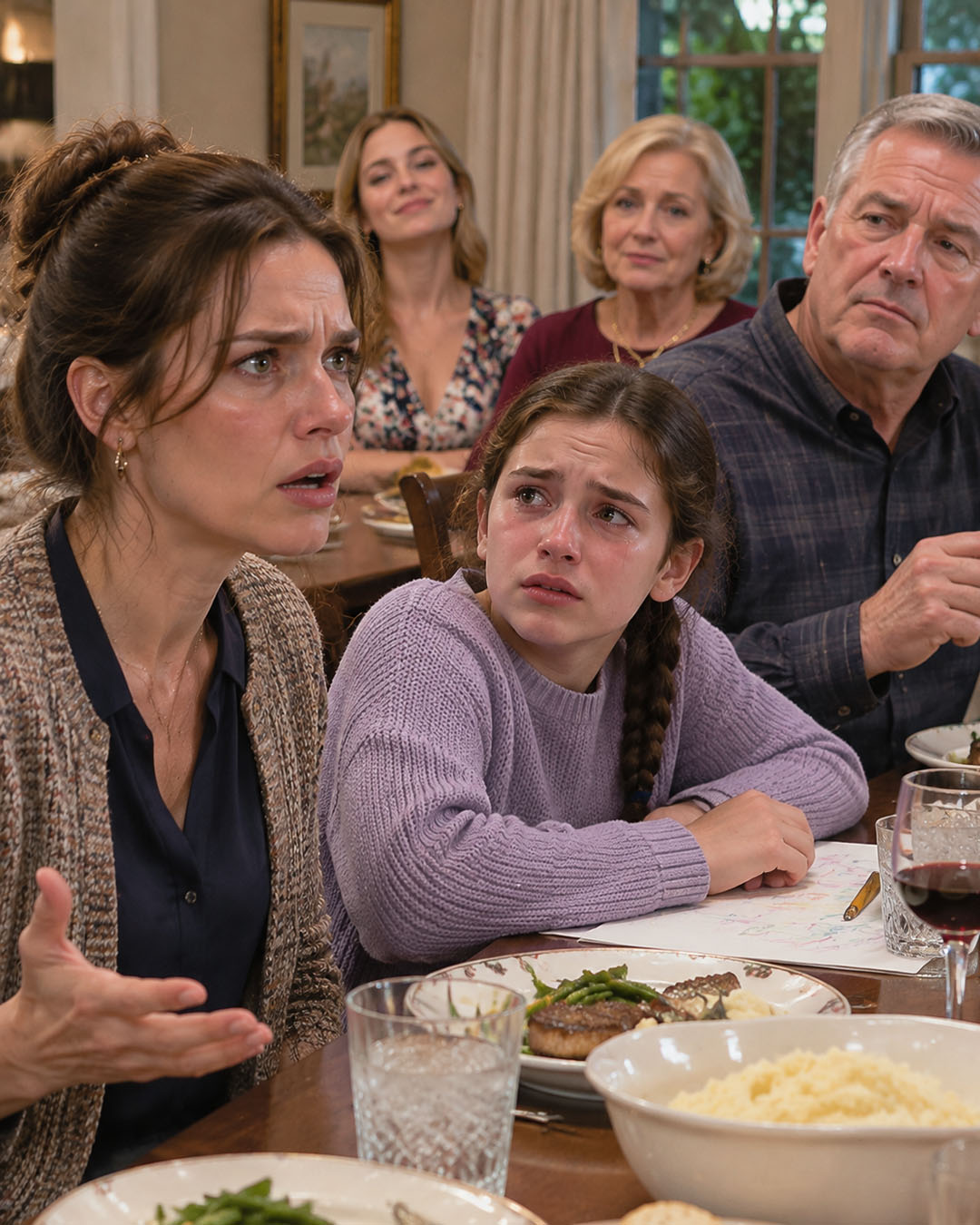
My husband, Evan, dropped to one knee beside me and asked whether I could move my foot. Before I could answer, Mom marched across the patio in her red Fourth of July apron, past the spilled cobbler and my overturned chair. “Nora, apologize to your sister right now,” she ordered. Our father, Dennis, stood beside the grill with a spatula in his hand, watching the entire scene as if somebody else’s children were fighting.
For thirty-six years, I had known how this would usually end. Taryn was two years older, and when she broke my favorite ceramic horse at eight, Mom made me sweep up the pieces because my tears upset her. When she took my allowance, I was told that older sisters had greater expenses. Eventually I learned to surrender things before anyone asked; being agreeable was the only way our house stayed quiet.
I paid for community college with diner shifts, then found steady accounting work. When I graduated, my parents mailed a card and asked if I could help Taryn with rent. When she dropped out of cosmetology school twice, they found twenty thousand dollars to launch her salon. It failed in eighteen months, and nobody ever explained where the startup money came from.
I’d almost skipped the barbecue in Westerville, Ohio, because Taryn and I hadn’t spoken properly since Christmas. At that dinner, she’d arrived wearing Grandma Ruth’s sapphire-ringed engagement band, which Grandma had explicitly left to me in a handwritten note. Mom insisted the note had been misunderstood and asked me not to embarrass Taryn. I swallowed my anger again, partly because Grandma had been gone four years and I couldn’t bear arguing.
The night before the cookout, Mom called with three instructions. I wasn’t to discuss the ring, Taryn’s failed marriage, or the eight thousand dollars she’d borrowed from me and never repaid. “Let her have one lovely day,” Mom said, as usual. I made Grandma’s blackberry cobbler anyway, hoping the familiar smell might remind us of a gentler person.
At four, the patio smelled of charcoal, sunscreen, and sugar. My cousin Paige was pouring lemonade while Uncle Frank argued with the grill, and Taryn deliberately backed into my path near the buffet. I said, “Sorry, let me get by,” as my shoulder grazed her arm. She turned, struck me across the face, and shouted that I’d been trying to hurt her all day.
Evan helped me sit upright, carefully avoiding my swelling ankle, while Mom repeated her demand for an apology. Taryn gave me a tiny, satisfied smile behind Mom’s shoulder, confident that I’d accept the blame. Instead, I looked at my husband and said, “You mentioned two choices this morning. What’s the second one?” His expression tightened, not with excitement but with concern, as he asked whether I was sure.
“I’m sure,” I said, hearing how different my own voice sounded. Evan took out his phone and explained that choice one had been to leave immediately, preserve whatever evidence we had, and deal with my family privately. Choice two was to show the people who’d witnessed the accusation what actually happened and stop pretending we hadn’t uncovered troubling records about Grandma’s property. I told him to choose the second, and the chatter around the grill died away.
He opened a video he’d recorded while filming the backyard decorations for our family album. The screen showed my shoulder brushing Taryn’s arm, her deliberate slap, and Mom ordering me to apologize before asking whether I was hurt. Taryn lunged toward the phone, but Evan pulled it back and told her the original recording was secure. Then he opened a photograph of Grandma’s handwritten note beside an appraisal I’d never seen, and Mom whispered, “You weren’t supposed to find that.”
Part 2
Evan turned the screen so everyone could see the date on Grandma’s note. The words were plain: “My engagement ring goes to Nora, who listened to its stories and promised to care for it.” Taryn’s hand flew to the blue stones on her finger as though the ring had suddenly become hot. Mom said Grandma had changed her mind, but Evan asked why the newer appraisal showed Taryn as owner while citing a different version of the same note.
I struggled to my feet with Evan’s arm around my waist, unwilling to keep discussing my life from the ground. The printed copy accompanying the appraisal had been cropped just above the sentence naming me. In its place was a vague line about giving Taryn a family keepsake, lifted from an entirely different paragraph. Evan had found both copies in my archived family records with my permission, but Mom accused him of prying.
Dad put down his spatula, wiped his hands on a towel, and asked Mom whether she had sent the cropped page to the appraiser. “I was handling everything after Ruth died,” she said sharply. “Somebody had to make decisions.” Dad asked the question again, slower this time, and she replied that Grandma had wanted harmony between the grandchildren. Paige made a quiet sound beside the lemonade pitcher, and Mom glared at her until she stopped.
Evan moved to another file, a statement from an education account Grandma had established when I was thirteen. Mom had always said the money was exhausted by the time I began college, which was why I’d worked evenings and weekends to pay tuition. But a statement from three years earlier showed more than twenty thousand dollars remaining after Grandma died. A withdrawal transferred exactly twenty thousand to an account bearing Taryn’s name.
“That paid for the salon,” I whispered. Dad immediately objected that he’d paid for Taryn’s business from his savings, while Mom said the money had been pooled long ago and wasn’t anybody’s individually. Neither explanation matched the printed account history. I asked where the money had been for all the years I was borrowing textbooks and putting off dental appointments. I had spent so long being called selfish that seeing the transfers made me almost doubt my own eyes.
Mom pointed at me and said, “You had a steady job; your sister needed a chance.” Taryn looked between us, apparently hearing for the first time that the salon money had come from Grandma’s account. “You said Dad gave it to me,” she told Mom, her voice going thin. Mom began talking about family investments and how a mother must treat children according to their needs. It was the same speech I’d heard since kindergarten, now backed by a bank transfer.
Evan told me quietly that a transaction record did not by itself settle ownership or prove a crime. The account’s legal terms and the bank’s authorization would have to be examined before anyone concluded what happened. I appreciated his restraint because my mother was already calling us vindictive, and I didn’t want my anger to outrun the evidence. But when I asked to see the supporting withdrawal form, Evan hesitated, then opened the next page.
The authorization carried my full name in crooked cursive, followed by a declaration that I approved transferring funds for a family business. I’d never completed such a document, and the signature bent backward where mine always leaned forward. There was a second page, labeled “Repayment Agreement,” describing the withdrawal as a loan to Taryn, with a fallback clause assigning financial responsibility to me. I read the clause twice, my throbbing ankle forgotten.
Mom had not merely redirected money Grandma meant for my education. She had tried to make me responsible if Taryn failed to repay it, using a signature I didn’t recognize. Dad demanded to know when he’d authorized the arrangement, and Taryn suddenly said she’d never signed a loan either. When Evan enlarged the last page, three signatures appeared beneath it, and the only person who refused to look was my mother.
Part 3
Dad took the phone and squinted at the signatures, his thumb leaving a grease mark on the case. “I never signed a loan,” he said, and Taryn echoed him before he’d finished. Mom insisted that she had completed everything as a convenience, because banks made families jump through ridiculous hoops. I asked her which part of that convenience required writing my name without permission, and she told me to stop speaking like a stranger.
Paige stepped forward from the cooler, setting down her lemonade with a sharp click. “Aunt Sharon, you told me something different in the kitchen,” she said. Mom ordered her not to interfere, but Paige kept going, her voice trembling with effort. She had heard Mom and Taryn worrying that I’d bring up Grandma’s ring, and Taryn had said she’d make me look unstable before I could embarrass them in front of the relatives.
“I was angry,” Taryn snapped, but she didn’t deny saying it. Paige explained that she’d kept quiet because our family punished anyone who contradicted Mom at a gathering. Uncle Frank turned off the grill, and the sudden quiet made the neighborhood lawn mower audible over the fence. I looked at my cousin and realized she had spent years learning the same lesson I had: keeping peace meant protecting the loudest person.
Evan offered to help me to the car, but I asked for another minute. I needed to know whether Taryn had realized the salon came from my account before today. She said she believed Mom when told Grandma had saved money for both grandchildren, though she admitted finding a bank notice with my name on it after the salon closed. “I was going to ask,” she said, and I answered, “You had over a year to ask.”
The fuller statement showed that the twenty-thousand-dollar transfer wasn’t the beginning. It was the final payment after years of smaller transactions and shifting labels, money Grandma had wanted protected until I chose further education. Mom called the account communal savings, though its title specifically identified me as the intended beneficiary. I could feel the old instinct to soften my accusation, but I pushed it aside and asked her for the original records.
“You’re going to destroy this family over money?” Mom demanded, her apron strings trailing through a puddle of spilled lemonade. I told her this wasn’t only about money, because she’d also watched Taryn strike me and immediately required me to apologize. She replied that I had always been jealous of my sister and that Evan had filled my head with grievances. “No,” I said, “he believed me when you wouldn’t.”
Taryn finally slipped Grandma’s ring from her finger and laid it beside the cold hamburgers. She admitted she’d seen Mom crop the note but claimed she’d thought the original wording was open to interpretation. Then she asked whether I really intended to take her to court and whether I could just accept the ring as compensation. My throat tightened at her assumption that a piece of jewelry could settle years of lies, and I asked her to give it to our attorney instead.
Mom reached for the ring before I could touch it. “You will not turn Ruth’s memory into a lawsuit,” she said, catching my wrist with her other hand. I pulled free and told her our grandmother’s memory had been distorted by the very document she altered. Evan stood close but waited for me to decide whether to leave, and Paige quietly announced she would give a statement about what she’d heard. Mom looked from face to face as though discovering the audience no longer belonged to her.
“You always find a way to make everything about yourself,” Mom hissed, stepping toward me. I said I would report the assault, dispute the unauthorized signatures, and let professionals examine the records rather than fight on the patio. Her hand flashed toward my face before I could step back, striking the same cheek Taryn had slapped. The family gasped, and Mom stared at Evan’s phone as she realized the recording had never stopped.
Part 4
Evan didn’t rush at Mom or make the kind of threat my father would have made. He asked whether I could walk, then helped me through the side gate while Paige offered to accompany us. Behind me, Mom accused me of ruining Independence Day; Taryn cried as guests stared. I kept walking, my ankle aching on every step, until the car door shut out their voices.
At urgent care, a nurse examined my cheek and ankle, documented the bruising, and asked whether I felt safe returning home. I said I lived safely with Evan and wanted the injuries recorded. My ankle was sprained, not broken, but the doctor recommended rest and follow-up if symptoms worsened. Evan brought water and sat beside me without asking me to forgive anyone or turn the afternoon into a lesson.
“What if I’d chosen to leave without showing them?” I asked while he adjusted the ice pack. He said he’d have saved the footage and waited for me to decide what to do with it. He’d found financial inconsistencies while searching the archives with my permission, but hadn’t wanted to decide how much confrontation I could bear. “I wanted you to have a choice,” he said, “because they’ve spent your whole life taking choices away.”
We met with an attorney named Celia Moreno the following morning, bringing the original video, the bank papers, and Grandma’s unaltered note. Celia said the recording and witness accounts could support a police report about the assaults, while the bank and account administrator needed to authenticate the financial records. She warned that signatures on scanned pages could be disputed, and that recovery might be complicated by time limits and account rules. I thanked her for offering a process instead of promising an instant victory.
Paige sent a written account of what she heard in the kitchen before Taryn hit me. Uncle Frank supplied his own statement that he’d seen the slap and the demand for an apology, although he hadn’t heard the planning. Taryn eventually wrote that she would return the ring through Celia’s office, but she described her violence as “an emotional response to provocation.” I refused to negotiate wording with her; her apology mattered less than her willingness to state what actually happened.
The account administrator confirmed that the funds had been designated for my education and provided a certified transaction history. The largest transfer went to a bank account controlled by Mom, then on to Taryn’s salon, following several smaller withdrawals. Celia explained that the money trail was important but still didn’t identify who had signed each authorization. We requested the original forms and communications rather than treating Mom’s silence at the barbecue as a legal confession.
Dad came to our porch one evening with a grocery bag and asked whether we could talk. I stood behind the screen door because my cheek was still tender, and he said he’d never known Mom had changed the ring paperwork. When I asked why he’d believed Taryn without checking whether I’d been hurt, he stared at his shoes. “I wanted the shouting to stop,” he admitted, and I said, “So did I. That’s why I kept agreeing with you.”
He said he wanted to repay the missing money if it proved I was owed it. I told him payments would have to go through the account investigation and my lawyer, not through a private arrangement with conditions attached. Before leaving, he mentioned that Celia’s request for the original authorization forms had reached the bank. He seemed strangely anxious about whether she’d received the page with two witness signatures, and I watched him walk to his car without answering.
The following morning, Celia called with the original withdrawal packet in hand. The version Evan had found contained scanned signatures, but the bank’s copy also included a signed acknowledgment stating that the account proceeds would finance Taryn’s business. One witness signature belonged to Mom, and the other was my father’s. I looked at the page and realized Dad hadn’t merely failed to notice the money disappearing; he had witnessed the transaction he’d just promised to investigate.
Part 5
When Dad called that evening, I didn’t give him room to repeat that he knew nothing. I read the acknowledgment date aloud and asked whether he remembered going to the bank with Mom. He admitted he had signed a page she brought home, claiming she told him it was routine paperwork for Taryn’s salon. “You watched me work double shifts to pay tuition,” I said, “and you never even asked where her twenty thousand came from.”
He began apologizing, then stopped as if he finally understood that another explanation would make things worse. I told him I’d send everything through Celia and didn’t want him coming to the house again. After we hung up, Evan found me sitting on the kitchen floor beside the dishwasher, crying into a dish towel. He sat down beside me and let the silence last until I was ready to get up.
The review that followed was slow, full of forms, interviews, and records that contradicted Mom’s story. Financial specialists established that several withdrawals had been improperly supported by documents bearing my name, and the evidence was forwarded for further investigation. Through attorneys, my parents agreed to a civil settlement that repaid the disputed money over time; the agreement did not require me to claim the signatures were genuine. I made my own decisions about the assault report and kept copies of everything.
Taryn returned Grandma’s ring to Celia without meeting me. Along with it came a letter saying she hadn’t understood the account arrangement at first but had been afraid of losing Mom’s financial help once she suspected the truth. She said she was sorry for striking me, yet added that she hoped I’d remember how hard her divorce had been. I put the letter in a folder, grateful the ring was safe but unwilling to confuse explanations with accountability.
I used the first settlement payment to retire the remaining debt from my community-college years. The rest went into savings that neither parent could see or control. There was no sudden fortune, only the quiet relief of opening a bank statement without wondering who else considered its balance available. Grandma would have understood that feeling; she’d worked as a bookkeeper herself and saved receipts in shoeboxes labeled by year.
Mom never apologized directly. She sent three holiday cards, each insisting that family should put the past behind it, and asked whether we could have Christmas dinner “without lawyers or cameras.” Dad wrote that he was trying to make things right, then asked if I would reassure Taryn that I didn’t hate her. I answered neither of them, because they’d turned even their regret into another job for me to do.
That Thanksgiving, Evan and I invited Paige, Uncle Frank, and a few friends to our house. No one was assigned the task of keeping a difficult guest happy, and when the gravy spilled, we laughed and fetched paper towels. Paige helped me make blackberry cobbler from Grandma’s recipe, and we ate it warm with vanilla ice cream. The sweetness brought back the summer afternoons when Grandma showed me how to pick berries without crushing them.
After dinner, Paige asked if I’d ever wear the ring. I took the little velvet box from my desk and showed her the oval blue stones, newly cleaned but otherwise unchanged. I said I wasn’t sure, because it still reminded me of Taryn smiling while I was told Grandma had chosen her. Paige shrugged and answered, “It doesn’t have to mean what they tried to make it mean.”
I left Grandma’s ring on the windowsill until morning, where the winter light caught in its small blue stones. I didn’t need to wear it to prove she had loved me, and I didn’t need my parents to acknowledge the past before I could build a future. That Fourth of July, my sister had hit me expecting the same apology she’d received all our lives. Instead, I had stood up, chosen the truth, and walked away without asking any of them for permission.
Legal Notice: This story is a work of fiction. Names, characters, businesses, events, and incidents are the product of the author’s imagination or are used fictitiously. Any resemblance to actual persons—living or dead—or to actual events is purely coincidental. Thank you! 💓