Chapter 2
Stanley explained that he’d been bringing Mom’s mail inside every day because the porch steps were difficult for her. During the third year, he had even built a shelf in her bedroom closet when the first shoebox became too full. Now there were six boxes, all arranged in order, and Mom sometimes spent entire afternoons rereading them.
“She asked me to count them last week,” he continued. “Four hundred and sixty-seven letters. Your birthday card makes four hundred and sixty-eight.”
I couldn’t speak for several seconds. Mom almost never wrote back, except for an occasional recipe card in pencil, but I’d never imagined she was keeping every letter.
I landed in Syracuse on Friday afternoon and drove east through the rain. When I turned onto Mom’s street, I recognized the porch and the old black mailbox immediately. Stanley was sitting next door, and he raised one enormous hand when he saw my rental car.
“She’s been watching the window since noon,” he called.
Mom opened the door before I reached the steps, took my face between her hands, and studied me.
“You got thin,” she said.
“I got older, Mama.”
“Same thing.”
The following evening, I helped wash cut-glass bowls in her kitchen while Gretchen organized the index cards for her birthday speech. She was planning to thank the church ladies, Mom’s friends from the bakery, Stanley, Keith, and Sophia.
“I’m going to say something about you, too,” she added without looking up.
“Something nice, I hope.”
She gave a short laugh. “Somebody has to say what everyone is thinking.”
I turned off the faucet and faced her. “Gretch, I know you drove Mom to physical therapy forty-one times. I know you sat in waiting rooms with Sophia and helped with the groceries. I’ve never forgotten what you did.”
“Writing letters doesn’t drive somebody to the hospital, Fran. I was the one who stayed.”
“There are things you don’t know.”
“Then tell me.”
I looked toward the living room, where Mom was watching television. I couldn’t break the promise I’d made nine years earlier, so I simply shook my head. Gretchen gathered her cards and walked outside, muttering that I never could tell her anything.
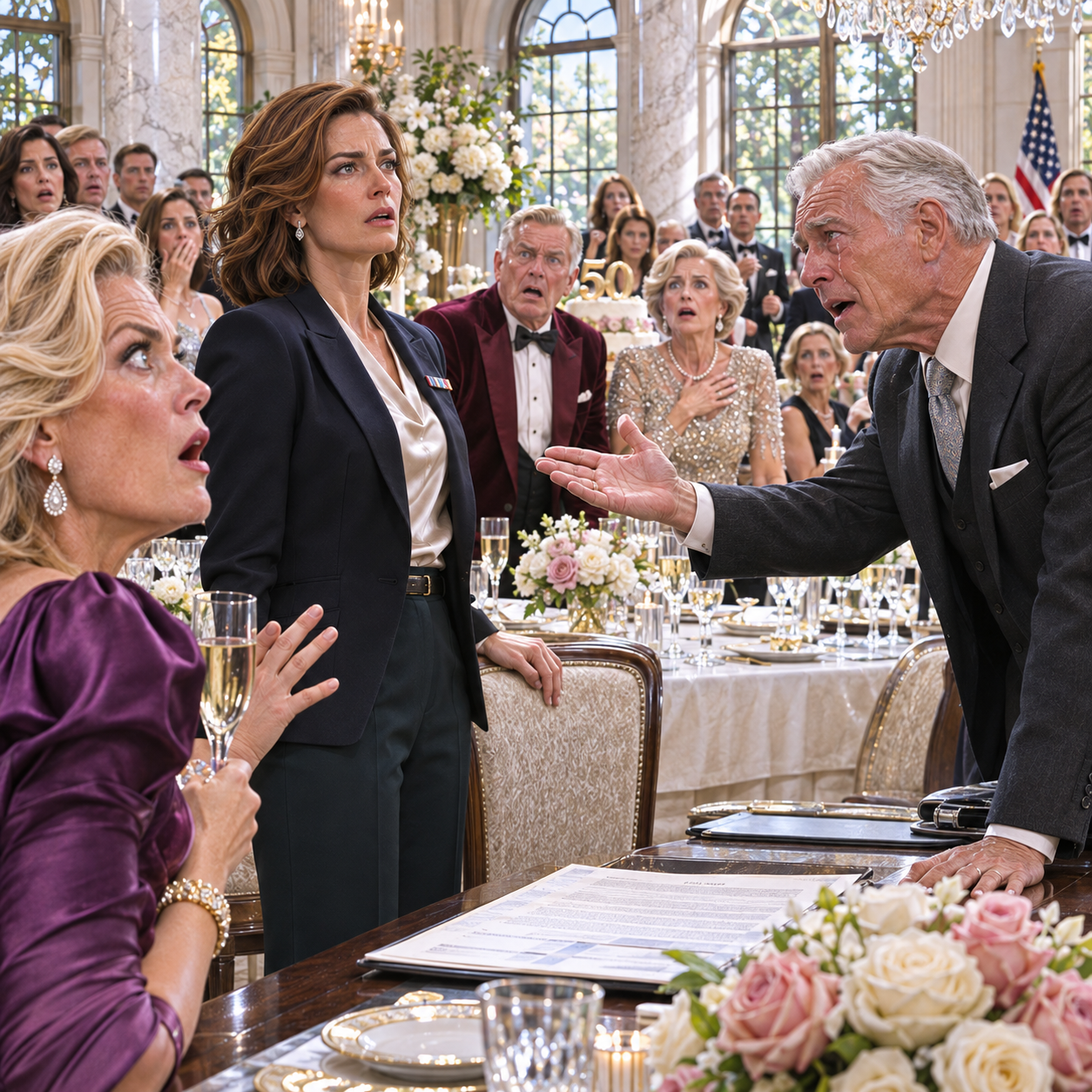
The next evening, her speech was charming until she turned toward my table and raised her glass, announcing that her sister had moved away and forgotten them.
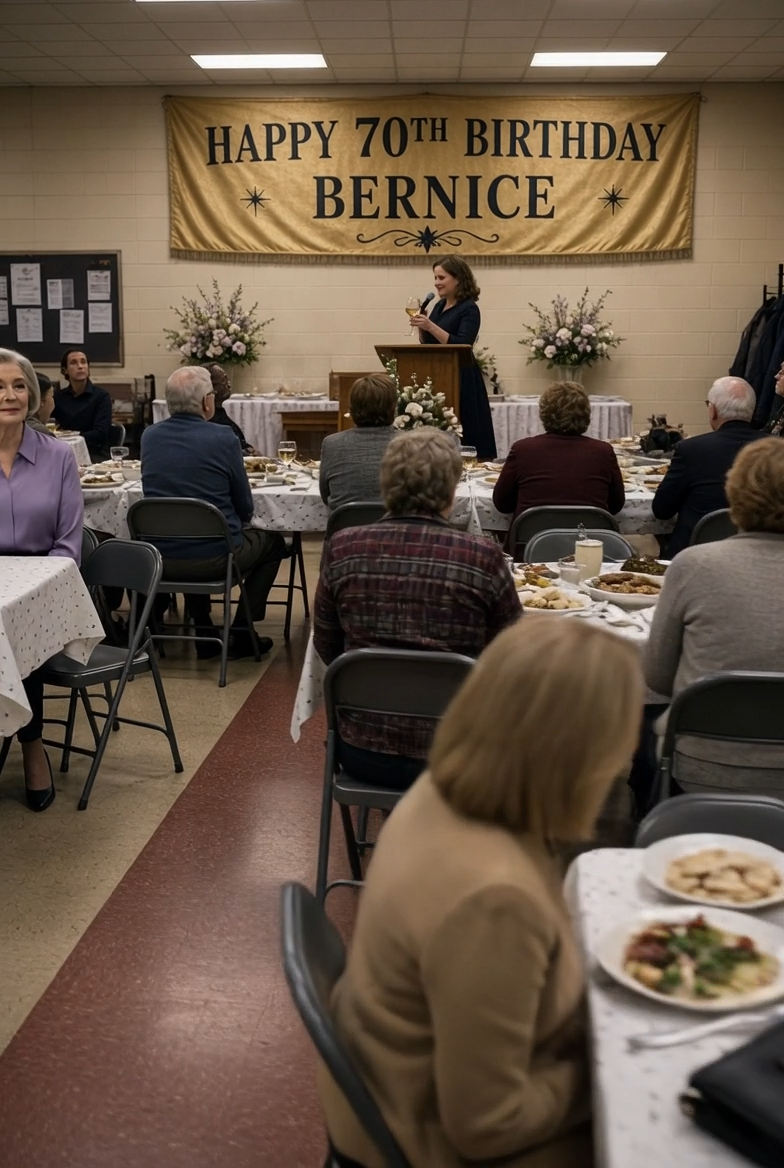
Now, in the parish hall, Mom held the microphone close to her mouth and asked Stanley to bring in the boxes.
He returned carrying a large cardboard container filled with six shoeboxes, each secured with a rubber band. He placed it beside the birthday cake, and sixty guests turned toward the head table as Mom removed the first lid.
She lifted a yellowed letter and held it up.
“Your sister moved away nine years ago, Gretchen, but every Sunday night since then, she’s written me a letter. Four hundred and sixty-eight of them, including the birthday card she brought tonight.”
Gretchen stared at the boxes.
“Mom, what is this?”
“This is me talking,” Mom replied. “And I think everyone should hear what your sister actually did.”
Chapter 3
Mom unfolded the first letter and began reading.
“Dear Mama, I’m not there to hold your hand tomorrow, so I’m sending this instead. Hold it if you want. Dad always said a letter is the only thing you can hold that somebody else held. Your surgery is at seven tomorrow morning, your time. That’s four in the morning here, and I’ll be awake. Gretchen will be with you. Let her fuss. She’s good at it, and she loves you more than she knows how to say. I’m sorry I can’t be there, but I’m doing what I can from here. The bill is paid, Mama. All of it. Don’t worry about one cent. Just get better. Love, Franny.”
When she finished, the hall was so quiet that I could hear the coffee urn ticking beside the buffet.
“Your sister was awake at four in the morning,” Mom continued. “She called the nurses’ station to make sure I’d made it through surgery. She paid the entire $31,000 bill, took a job in California, and borrowed against her retirement savings to make it happen.”
Gretchen looked at me as though she were seeing a stranger.
“You paid for Mom’s knee?”
I nodded.
“Why didn’t you tell me?”
“Because I promised Mom I wouldn’t.”
Mom immediately took responsibility. “That was my idea, Gretchen. Your husband had lost his job, and I didn’t want you feeling ashamed. If you’re angry about the secret, be angry with me.”
Gretchen’s face reddened, and she gripped the edge of her chair.
“I drove her to physical therapy forty-one times. I sat in those waiting rooms. I shoveled that porch. I was the one who stayed!”
“I know,” I answered quietly. “I never said you weren’t. You were here, Gretch. You did things I couldn’t do from California, and I’m grateful. I wasn’t trying to take anything away from you.”
But she had already picked up her purse and walked through the side door.
I followed her into the parking lot, where she sat in the passenger seat of their minivan with the door open. Keith stood beside her, his hands in his pockets.
“You let me stand up there and say those things,” she said without looking at me. “You knew what was in those boxes.”
“I didn’t know Mom was bringing them tonight.”
“But you knew about the surgery. Nine years, Fran. I’ve been the one doing everything.”
“Both things are true, Gretchen. You stayed, and I helped. Neither of us was trying to hurt the other.”
She pulled the door shut and covered her face with both hands. Keith shook his head gently, silently asking me not to push, so I returned to the party.
Mom had put down the microphone and announced that somebody needed to cut her birthday cake. The church ladies quickly resumed their work, and the room slowly came alive again.
My twelve-year-old niece, Sophia, came over with a slice of cake and sat beside me.
“Did you really write 468 letters, Aunt Franny?”
“I did.”
“I can’t even write a thank-you note without crying. Mom makes me sit at the kitchen table until I finish.”
I laughed, and Stanley sat down on my other side, resting his large hand on my shoulder.
“Your father would have liked that,” he said. “He numbered his letters, too. Your mother showed me once.”
I stared at him in surprise. I’d read Dad’s old letters as a child but never noticed the numbers in their corners.
Gretchen didn’t return that evening. Keith came back around nine to collect Sophia, and before leaving, he stopped beside my chair.
“She’s not only mad at you,” he said quietly. “She’s mad at herself, too. And there’s something I should have said years ago about the money.”
I wanted to ask what he meant, but he left before I could.
The following Sunday evening, I sat at Mom’s kitchen table and wrote letter number 469. It was the first time in nine years that I’d written one while she sat directly across from me, watching my pen move.
“What are you writing?” she asked.
“That my sister is mad at me, that the party was lovely, and that the stuffed cabbage was a little dry.”
“It was dry,” Mom agreed. “Don’t tell Helena.”
After I finished, she went into her bedroom and returned with an older shoebox.
“This belonged to your father,” she said.
Inside were his 104 letters from the Pacific, and when she opened one, I noticed a number written in the upper-right corner.
Fifty-two.
“You did the same thing without knowing,” Mom whispered. “That’s how I knew you were his.”
Chapter 4
We sat together for a while, looking through Dad’s letters, until Mom suddenly closed the box and told me she needed me to accompany her to the lawyer’s office the following morning.
Gretchen had arranged an appointment to sign healthcare proxy and power-of-attorney documents, but Mom wanted both daughters named. She explained that Gretchen had suggested making herself the sole decision-maker because I lived three thousand miles away.
“She thinks you can’t do anything from California,” Mom said. “But I know better.”
The lawyer, Theodore Pack, had handled Dad’s will and the paperwork for the family house. Gretchen was already sitting in his office when Mom and I arrived, her eyes red and her coat still buttoned.
Mom explained that she wanted both daughters listed as co-agents. Mr. Pack assured her that distance wasn’t a problem, since either daughter could communicate with doctors and handle financial matters when necessary.
“That’s what we’ve been doing for nine years,” Mom said. “Only nobody said it out loud.”
The lawyer then opened Mom’s bank statements to review her income and expenses. He noted that the mortgage had been paid off three years earlier before stopping at a recurring transfer.
“Bernice, there’s a $400 payment on the third of every month to an account in Gretchen’s name. It’s been happening for nine years. Do you want that to continue?”
Gretchen looked up.
“That’s Dad’s pension money. Mom has been helping us since Keith lost his job.”
I stared at the statement, suddenly remembering the recipe card Mom had sent me years earlier.
“Mama, I send you $400 on the first Sunday of every month.”
“I know,” she answered.
“And on the third of every month, you send Gretchen $400.”
“I know that, too.”
Gretchen slowly turned toward our mother.
“Wait. Is that Franny’s money?”
Mom folded her hands in her lap. “It went where it was needed most. Keith had no job, you had a little girl to raise, and your sister had a good salary and no children. I had my knee repaired and my pension. So I sent the money on. I’d do it again.”
Gretchen stared at her.
“You told me Dad’s pension was helping us.”
“I never told you that. You assumed it, and I didn’t correct you because I didn’t want either daughter feeling ashamed.”
For nine years, Gretchen had believed our mother was helping her with family pension money, never realizing that the money came from the sister she’d accused of abandoning them.
“You let me stand up in front of sixty people and say she forgot us while I was paying for Sophia’s braces with her money,” she whispered.
Mom looked at her sadly. “You never asked where it came from. I told both of you not to ask, and neither of you listened.”
Gretchen turned toward me, tears gathering in her eyes.
“I’ll pay you back, Fran. Every cent. I’ll figure something out.”
I quickly shook my head. The transfers added up to roughly $43,000, but I had never sent the money expecting repayment.
“I don’t want it back. I sent it to Mom so she wouldn’t worry. She sent it where it was needed, and Sophia got the help she deserved. That’s what I wanted.”
Gretchen covered her face, and I finally understood what Keith had meant when he said he should have spoken up years ago.
Mr. Pack waited patiently before sliding the documents across the desk. Mom signed first, followed by Gretchen and me, and he pressed his heavy silver notary stamp onto the final pages.
Outside, Gretchen stopped me beside the car.
“I don’t know how to apologize for nine years.”
“You don’t have to do it all at once,” I told her. “It’s a long list. We can take it one thing at a time.”
She gave me a small, tearful smile.
“You and your lists.”
Chapter 5
The following morning, Keith knocked on Mom’s back door while I was making coffee. He was still wearing his work jacket and carried a plain envelope containing $500.
“My first payment,” he said, holding it toward me.
I refused, but he explained that he’d suspected where the money came from years earlier. He had noticed that Mom’s pension couldn’t possibly cover the additional $400 she was giving them, and when he questioned Gretchen, she’d told him to mind his own business.
“I figured it out a long time ago,” he admitted. “I just didn’t know how to say it. I’ve felt terrible ever since.”
I looked at the envelope and thought about Sophia, who had recently become fascinated with marine biology despite never having seen the ocean.
“Is she still talking about studying the sea?”
Keith smiled. “Every day. She says she’s going to be a marine biologist.”
“Then open a college account for her. Put that $500 in it, and write that it’s from Aunt Franny’s letters. When she’s eighteen, she can come to California, and I’ll take her to see the Pacific.”
Keith stood there for a moment before laughing and wiping his nose with his sleeve.
“Deal. Gretchen’s going to say I caved.”
“You did cave,” I teased. “Very manly.”
That Tuesday evening, Gretchen came to Mom’s house with Sophia and a box of pastries from the bakery where Mom used to work. She sat at the kitchen table, looking nervous, before finally asking whether she could read one of my letters.
Mom went to her closet and returned with the third shoebox. She knew exactly which letter she wanted and found number 251 after carefully searching through the envelopes.
I recognized it immediately. I’d written it four years earlier, the Sunday after the Christmas when Sophia had asked whether Aunt Franny was a real person.
Gretchen unfolded the paper and began reading aloud.
“Dear Mama, Gretchen told me Sophia asked if I was real because I only come home once a year. It’s a fair question. I’m not around much, and I’m sorry for that. But I want you to tell Gretchen something for me. Someday, when the time is right, tell her she’s the strong one. She always was. When we were kids and the furnace stopped working, she built a blanket fort and told me stories until Dad got it running again. She’s still doing that for you now. I can send money and letters, but she’s the one who sits in the waiting room. Don’t tell her I said this yet. She’ll get a big head. Love, Franny.”
Gretchen stopped reading and carefully placed the letter on the table.
“Do you remember the blanket fort?” she asked.
“Every winter.”
“You told me the story about the lady who lived inside the radiator.”
“Radiator Ruthie.”
Gretchen laughed through her tears. “Radiator Ruthie!”
Sophia looked between us, confused, so her mother told her the ridiculous story about an imaginary little woman who lived inside our old radiator and banged on the pipes whenever children refused to go to bed. Mom laughed until she had to remove her hearing aid, and I laughed so hard that powdered sugar went up my nose.
For the first time in years, our kitchen sounded like the home we remembered from childhood.
When the laughter settled, Gretchen looked at me.
“Have you ever seen the ocean in winter?”
“I live beside it.”
“I’ve never been to California.”
“Then come visit. I have a couch. It folds out, although it’s terrible.”
She smiled.
“I’ll bring Radiator Ruthie.”
Chapter 6
Stanley drove me to Syracuse Airport the following Wednesday because Mom insisted, and he was never particularly good at refusing her requests. He drove exactly the speed limit, both hands on the steering wheel, before finally telling me that his own wife had written him letters during his eighteen months in the Army in Germany.
“I was twenty years old, and I didn’t realize how lucky I was,” he said. “She died five years ago, but I still have every letter.”
At the airport, he carried my suitcase to the entrance and gave me a quick, firm hug.
“Your father would be proud,” he said.
I returned to San Diego with a lighter heart, although I knew rebuilding my relationship with Gretchen would take time.
In February, she finally came to visit, traveling alone for five days while Keith stayed home with Sophia. When she stepped out of the terminal into the California sunshine, she looked around at the palm trees and laughed.
“This is obscene. It’s February, and nobody’s wearing a winter coat!”
I took her to the naval base, showed her the ships in the harbor, and brought her to the little taco restaurant I’d written about so many times. That evening, we drove to the beach, where the sunset turned the Pacific gold and pink.
Gretchen kicked off her shoes and walked straight into the water wearing her jeans. She screamed when the cold reached her knees but kept walking anyway, laughing like the girl who used to build blanket forts with me.
We sat on the sand afterward, our jeans wet and a bag of churros between us.
“I’m going to write you,” she said.
“Write me what?”
“Letters. Every week, maybe. I’m terrible at writing, but I want to try.”
“You don’t have to.”
“I know,” she replied. “That’s why it counts.”
Her first letter arrived the following week, two pages written in purple ink, with three spelling mistakes and a drawing of Radiator Ruthie in the margin. In the upper-right corner, she’d written a number.
One.
A week later, another envelope arrived from Utica, this time addressed to Aunt Franny and written in pencil on paper torn from Sophia’s school notebook.
“Dear Aunt Franny, you are real. I checked. This is my first letter. I did not cry while writing it. Love, Sophia. P.S. Number one.”
I put it on my refrigerator, where it remains.
The following March, Mom celebrated her seventy-first birthday in San Diego. Gretchen, Keith, and Sophia flew out, and Stanley came, too, despite not having been on an airplane since 1979. We rented a picnic shelter at Coronado Beach, invited a few friends from the naval base, and ordered a birthday cake from the grocery store.
There were paper plates, plenty of food, and the Pacific Ocean stretching behind us in a shade of blue that almost looked unreal.
In the afternoon, Stanley pushed Mom’s wheelchair down the wooden walkway toward the wet sand. He carefully removed her shoes and knee-high stockings before helping her stand, holding her arm as she slowly placed both feet in the ocean.
She was seventy-one years old, and it was the first time she’d ever touched the Pacific.
For a long while, she said nothing. Then she looked toward the horizon.
“Casimir sailed on this ocean,” she whispered. “He wrote me about the flying fish.”
Stanley smiled.
“He was probably trying to make you jealous.”
“He did,” Mom answered. “It worked.”
Later that afternoon, Gretchen stood on a picnic bench with a plastic cup of lemonade and gave another toast. She thanked Keith for making the trip, Sophia for writing her thank-you notes, and Stanley for getting on an airplane after all those years.
Then she turned toward me and raised her cup.
“And to my sister, who moved away and never forgot us. Not once. Not one single Sunday.”
Mom clapped so enthusiastically that she nearly dropped her cake.
I still write to my mother every Sunday evening. I’m somewhere past letter number five hundred now, and Stanley still brings the mail inside whenever he’s at her house. He recently told me he’s building another shelf.
These days, though, I write two letters every Sunday, one to Mom and one to Gretchen. And every week, an envelope arrives from Utica in purple ink, usually with a story about Sophia, a complaint about the snow, or another drawing of Radiator Ruthie.
Sometimes I think about that evening in the parish hall when my sister raised her glass and announced that I’d moved away and forgotten us. I understand why she believed it. From where Gretchen stood, carrying groceries up Mom’s porch steps and driving her to physical therapy, I was simply the sister who lived in California and appeared once a year with Christmas presents.
What she couldn’t see was that we were both taking care of the same woman. Gretchen did it with her hands, her time, and her presence, while I did it with letters, money, and the sacrifices I rarely talked about. Neither of us was the hero. We were sisters who loved our mother but had somehow stopped telling each other the truth.
And perhaps that was the greatest lesson those six shoeboxes taught us: love doesn’t always look the way we expect. Sometimes it arrives in a hospital waiting room, sometimes in a monthly bank transfer, and sometimes in a handwritten envelope with a small number in the corner.
The person who seems farthest away may still be finding a way to be there.
THE END.
⚠️ All characters and events are fictional. Do not imitate or apply them in real life. 😌😌😌