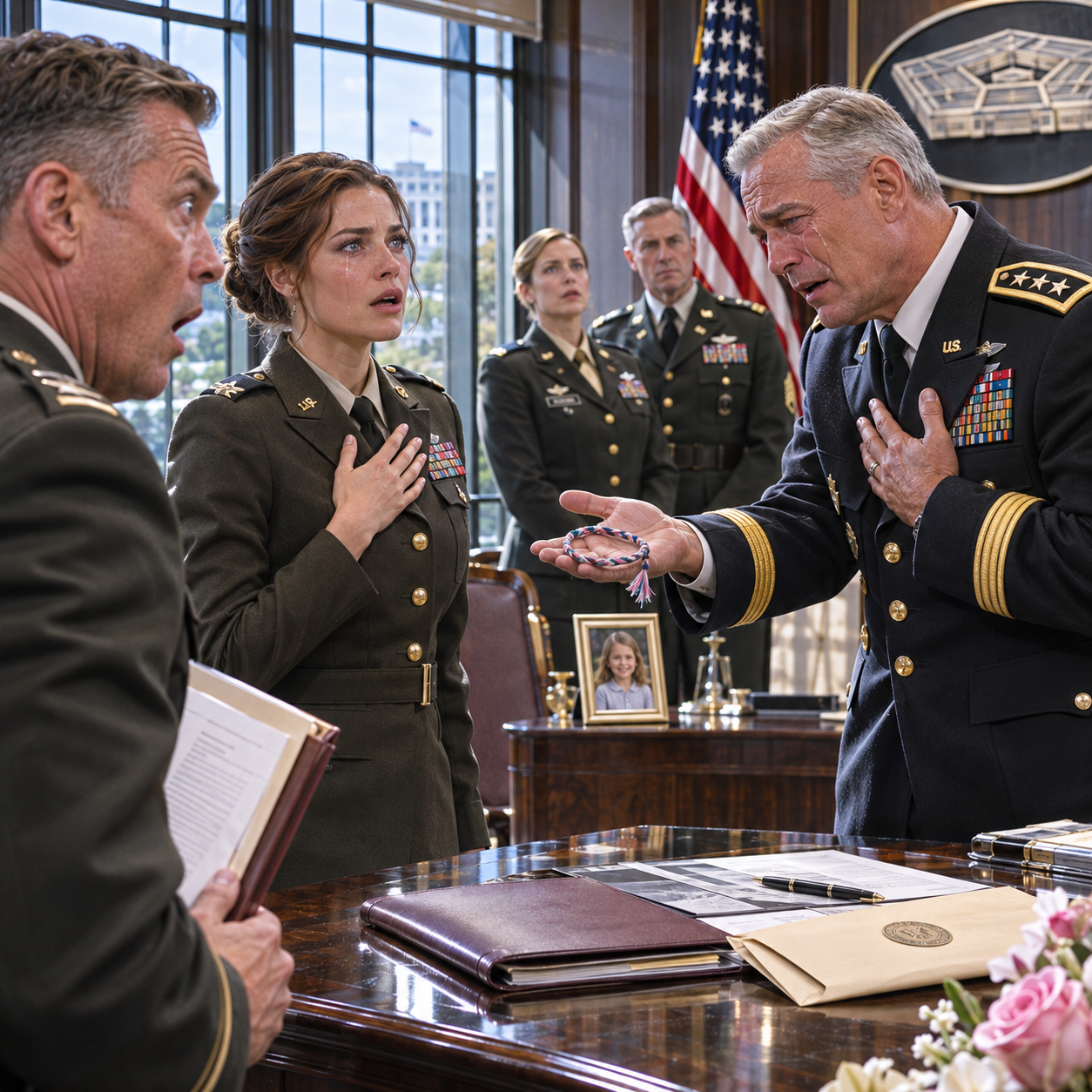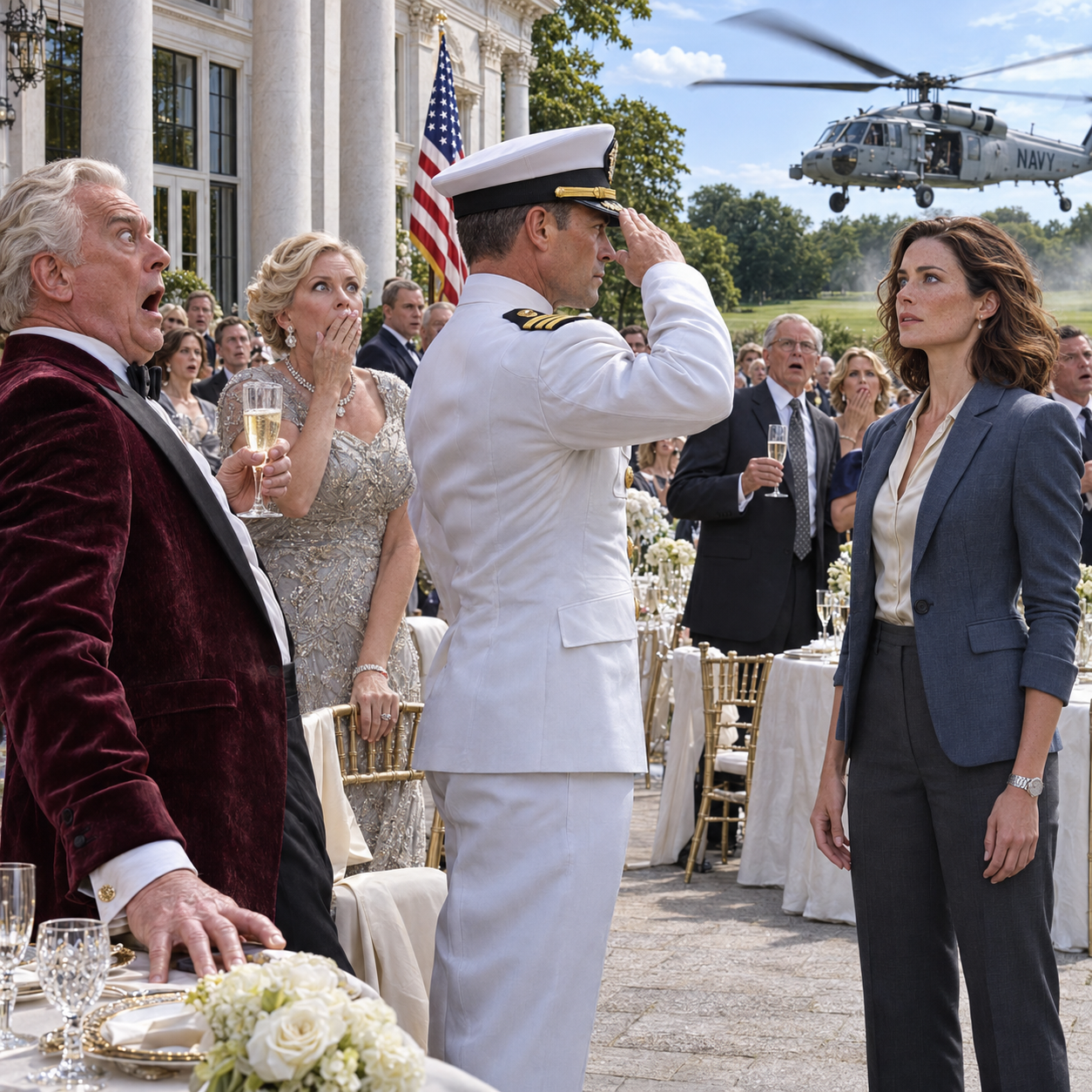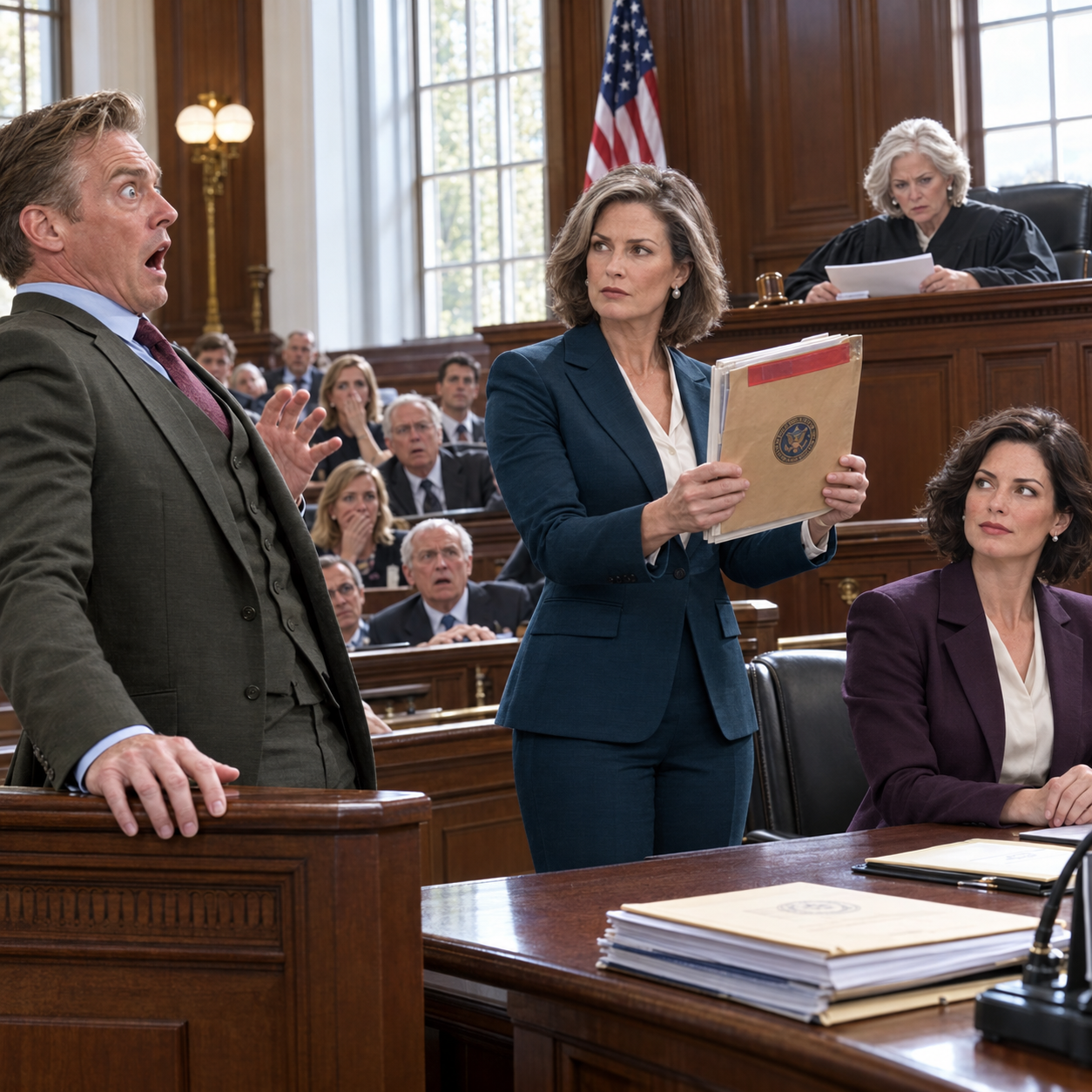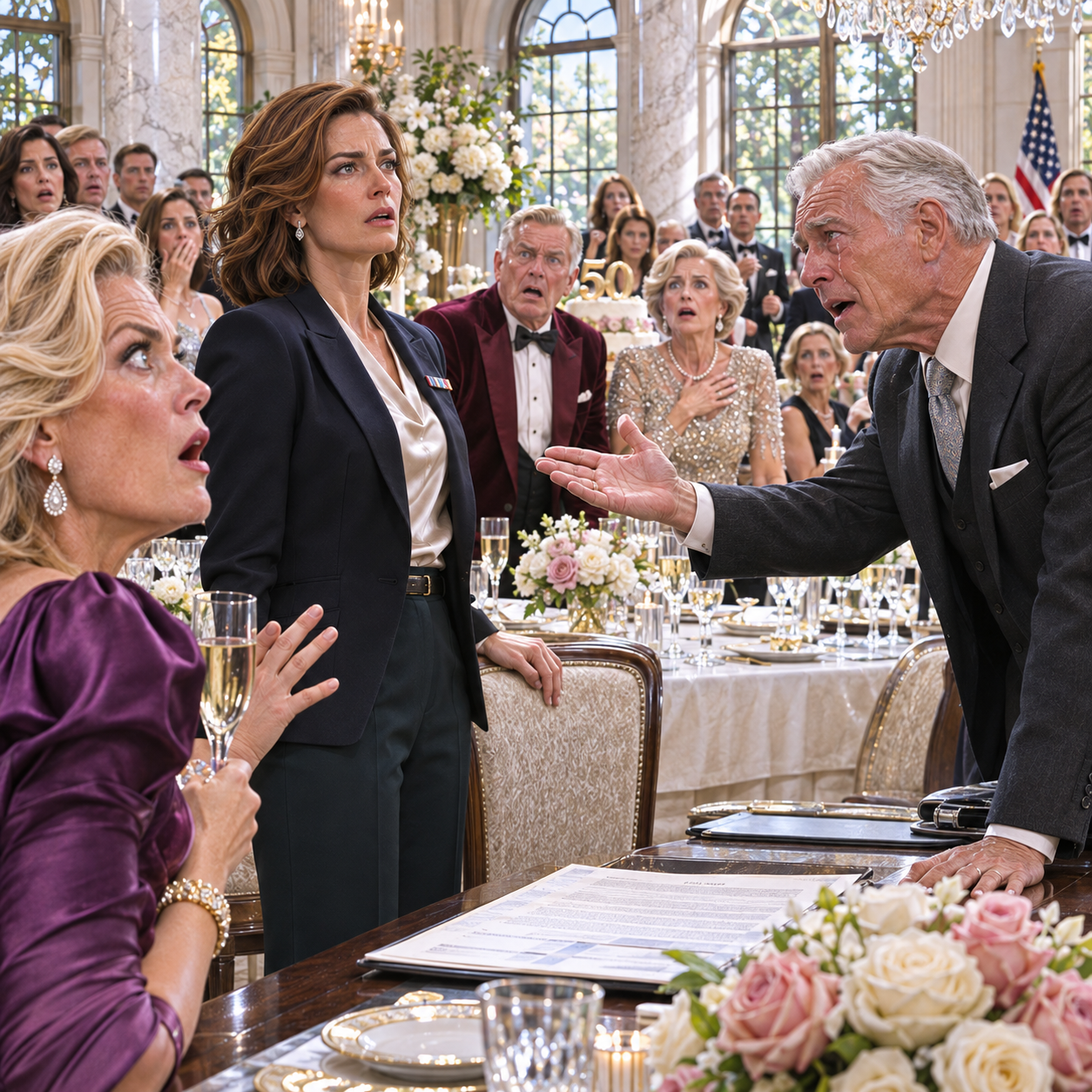
For 20 years, my family introduced me as the quiet daughter with the safe government desk job, and I helped them believe it because correcting them always seemed harder than staying silent. Then, at my parents’ fiftieth anniversary dinner, my aunt mocked my service in front of forty relatives. Before I could answer, an elderly stranger across the table noticed the tiny ribbon on my blazer, slowly stood up, addressed me by my military rank, and said nine words that shattered my family’s version of me forever.
### Part 1
My name is Mara Ellison. I was forty-three years old when my family finally discovered that the life they had been describing for twenty years had almost nothing to do with the life I had actually lived. The strange part is that nobody had deliberately lied about me. They had simply decided who I was when I was young, repeated the decision often enough to make it sound like fact, and I had spent most of my adulthood quietly refusing to correct them.
I grew up in a brick house outside a small Pennsylvania town where people knew which family owned which pickup truck and where somebody’s aunt could remember what you wore to kindergarten. I was the younger of two daughters, and my parents divided our personalities before either of us was old enough to object. My sister Rachel was warm, outgoing, pretty, and destined—according to every family prediction—to marry someone dependable and live nearby. I was “the smart one,” which in our family meant good grades, books, practical decisions, and eventually some respectable occupation that could be explained between bites of Sunday dinner.
My parents were loving people, which made resisting their version of me harder rather than easier. Nobody screamed that I could not do something. Nobody locked a door or tore up an application. They simply spoke about my future with such gentle confidence that disagreement felt like disturbing furniture in a room everyone else had carefully arranged.
When I was seventeen, I sat at our kitchen table while my mother talked on the phone to a cousin and said, “Mara will probably teach. Maybe work at the college. She has always been the bookish one, and she’ll want to stay close.” In the next room, inside my backpack, were forms I had signed two days earlier committing me to ROTC at a state university and, if I successfully completed it, a commission in the United States Army. I could have walked ten feet, pulled the papers out, and changed the conversation permanently.
Instead, I finished my math homework.
That decision sounds ridiculous to me now. At seventeen, though, correcting someone in my family felt strangely aggressive, especially when they were saying something affectionate. I had been trained from childhood to preserve the peace of the room, and peace, I believed, meant allowing small misunderstandings to survive if correcting them might make anyone uncomfortable.
My aunt Denise encouraged that habit without ever understanding she was doing it. She was my father’s younger sister, lived fifteen minutes away, and appeared at our house often enough that she might as well have owned a key. Denise was funny, generous, loud, opinionated, and completely convinced that her greatest virtue was saying what everyone else was supposedly afraid to say.
Every family has a person like that. Denise would lean across a table and announce something about another relative’s marriage, career, clothes, children, or finances, then smile as nervous laughter circled the room. Because nobody challenged her, she interpreted their silence as proof that she had been right.
I loved her anyway.
She was the one who taught me to drive after my father frightened me by gripping the passenger door every time I touched the brakes. She covered for Rachel and me when we came home late once as teenagers. She brought groceries when my mother had surgery and sat beside my father during one of the worst weeks of his life. Denise was not cruel. She simply needed very badly to believe she understood people.
That became a problem when it came to me.
The Army understood something about my mind that my family had always reduced to “Mara is good at puzzles.” I noticed patterns quickly. Give me fragments, inconsistencies, partial reports, odd movements, conflicting timelines, and I could usually feel the shape forming before I could fully explain why. My instructors noticed it, my commanders noticed it, and after commissioning I entered military intelligence.
My family attended the ceremony. They took pictures, hugged me, complained about the drive, and spent lunch debating which highway would have less traffic on the way home. Denise heard the words military intelligence and brightened with relief.
“So basically analysis?” she asked. “Reports, computers, paperwork?”
“Some of it.”
“A desk job.” She smiled as if she had solved a riddle. “Good. Safe.”
I remember the sunlight coming through the restaurant window and flashing against my new insignia. I also remember the answer sitting behind my teeth. I could have explained that military intelligence did not mean spending an entire career inside an office. I could have told her that units moved, intelligence moved with them, and sometimes the safest place available was still nowhere near safe.
Instead, I smiled.
“Something like that.”
Those three words followed me for twenty years.
Soon, I became the daughter with the steady government job. At Christmas, relatives asked whether I was still “doing analysis.” At cookouts, Denise joked about me fighting wars with spreadsheets. If I came home exhausted from travel, somebody would say the paperwork must be brutal. The jokes were never vicious enough to justify confrontation, which somehow made them harder to stop.
My first major deployment changed me in ways my family noticed without understanding. I returned thinner. I slept badly. Sudden noises occasionally turned my head before I could stop myself. I had developed a habit of looking at entrances whenever I entered a restaurant, and I sometimes went silent in the middle of a conversation because something ordinary had reminded me of somewhere that was not ordinary at all.
My mother watched me pushing food around my plate one evening and frowned.
“You’re working too hard at that desk.”
I looked at her across the kitchen where I had done homework as a teenager. She was worried. That was all I could see.
So I said, “Probably.”
It was easier than bringing the truth into that warm room.
I told myself that silence protected them. There was truth in that. Parts of my work could not be discussed, and other parts I simply did not want placed inside my parents’ imaginations. But underneath all my respectable reasons was still the frightened seventeen-year-old who believed the peace of the room mattered more than being accurately known inside it.
By my thirties, I had become remarkably good at living as two versions of the same woman. In uniform, I became Captain Ellison, then Major Ellison, an officer trusted to assess threats, brief commanders, and remain calm when other people needed calm more than I did. At home, I was Mara, unmarried, overworked, always traveling for some vague government reason, and apparently still sitting behind the same imaginary desk Denise had assigned me at twenty-two.
There was one name from those years I never expected to hear again.
Thomas Keene.
When I first knew him, he was a lieutenant colonel attached to an element that reached us after a night neither of us would ever forget. He had found me at dawn sitting against a damaged wall, filthy, exhausted, and still trying to give instructions after the need for instructions had finally passed. He looked at me for several long seconds without speaking.
I remembered that look for sixteen years.
People sometimes imagine recognition feels warm. Sometimes it does. Other times, it feels like somebody has suddenly opened a locked door inside you and seen a room you had forgotten was there.
Keene left that morning and continued through a distinguished career. I heard occasionally that he had advanced. Eventually, someone mentioned that he had made general.
I never contacted him.
I assumed our lives had crossed once because history required them to and would never cross again.
Then, in the spring of 2026, my parents celebrated fifty years of marriage.
Forty relatives and family friends gathered in a private dining room at a country club outside town. I wore a dark blazer that night, and on my left lapel I pinned one small ribbon I had almost never worn around my family.
I stood in front of my mirror for nearly five minutes before leaving home.
My hand reached toward the ribbon twice.
Both times, I almost removed it.
Both times, I stopped.
I had no idea that one person at that dinner would recognize it immediately.
And when he did, the version of me my family had carried for twenty years would not survive the next sixty seconds.
### Part 2
The anniversary dinner began beautifully enough that I nearly forgot about the ribbon. My father wore a navy tie he hated and touched the knot every few minutes like it was trying to strangle him. My mother wore pearl earrings he had given her on their fortieth anniversary, Rachel circulated between chairs making sure everyone had drinks, and the long table slowly filled with the familiar noise of people who had known one another too long to bother speaking one conversation at a time.
I sat near the middle with Denise several seats away. Across from me was an older man in a gray suit whom I did not recognize, seated beside one of my niece’s new relatives. He was lean, white-haired, quiet, and perfectly comfortable letting louder people dominate the evening. We exchanged a polite nod once, then I thought nothing more about him.
The ribbon on my blazer was small enough that almost nobody would recognize it. That had been part of the reason I finally allowed myself to wear it. It represented the Distinguished Service Cross, awarded to me years earlier for actions I almost never discussed, but to forty civilians at a family anniversary it looked like nothing more than a narrow bar of colored fabric.
For years, that had been my preferred kind of truth.
Visible enough that I could tell myself I was not hiding.
Obscure enough that nobody would ask.
Dinner moved through speeches, old photographs, embarrassing stories, laughter, and a dessert my mother insisted she could not possibly finish before eating every bite. My father gave a short toast to my mother that made Rachel cry. Then my mother responded with one twice as long that made my father stare at the ceiling and blink rapidly until he regained control of himself.
Everything was warm.
Everything was ordinary.
Then Denise had her third glass of wine.
I noticed the change because I had been noticing it since childhood. Her voice grew louder. Her stories became longer. She began scanning the room for something she could turn into material.
Several relatives from my niece’s husband’s family were seated near her, which gave Denise a new audience. She told them about Rachel’s terrible first haircut, my father’s ancient fishing accident, and the time my mother accidentally served a frozen pie because she had mistaken it for one that had already thawed.
Then her eyes landed on me.
“Now Mara,” she said, pointing her fork in my direction, “Mara was always the sensible one.”
I felt my shoulders tighten.
Rachel noticed. Her eyes flicked toward mine.
Denise continued. “Twenty years in the Army and she somehow managed never to leave a desk.”
A few people laughed.
Not because they meant anything by it. They laughed because Denise expected them to and because family habits can be stronger than thought.
“Some of us actually had exciting lives,” Denise said, glancing toward the new relatives. “Mara fought the legendary Battle of the Filing Cabinet.”
More laughter.
I had heard variations of that joke for two decades. Usually I smiled, added something self-deprecating, and moved on.
That evening, I did not.
Maybe it was the ribbon. Maybe I was tired. Maybe a person can carry a weight for so long that the final ounce becomes impossible.
I placed my fork beside my plate.
“That’s enough, Denise.”
My voice was quiet.
The room changed anyway.
Denise blinked as though she had misheard me. Then she gave a little laugh designed to tell everyone the moment was still harmless.
“Oh, come on.”
“I said that’s enough.”
Something old moved through my body as I spoke—the temptation to repair the discomfort I had just created. I nearly smiled. I nearly turned my own boundary into a joke before anyone else could resent me for having one.
Then I noticed the man in the gray suit.
He had been raising his fork toward his mouth.
He stopped halfway.
His eyes were fixed on my lapel.
Slowly, he lowered the fork until it touched the plate. His face lost color so quickly that for a second I wondered if he was ill. One hand rested against the tablecloth, and I could see the smallest tremor passing through his fingers.
Denise did not notice him.
“Well,” she said, spreading her hands toward me, “enlighten us. What did you actually do all those years?”
The old answer appeared automatically.
Reports.
Analysis.
Paperwork.
Long flights.
Nothing interesting.
I had spent twenty years learning how to disappear in exactly those words.
Before I could choose whether to use them again, the man across from me placed both hands on the table and stood.
He did it slowly.
Carefully.
The scrape of his chair against the floor seemed impossibly loud.
Conversation died.
He was not looking at Denise.
He was looking at me.
I recognized him then.
Not from his face at first. Sixteen years had altered the face too much. It was the eyes.
Those eyes had once looked at me through gray dawn and drifting dust as men shouted behind him and somebody called urgently for a medic.
Thomas Keene.
The name moved through me like an electric current.
He had aged. Of course he had. So had I. But suddenly I could see the younger lieutenant colonel underneath the gray suit, pushing through a damaged gate while the sky brightened behind him.
He looked at my ribbon again.
Then at me.
“Colonel.”
One word.
Nobody at that table had ever called me that.
I saw my mother’s head turn sharply.
My father stopped touching his tie.
Rachel’s mouth opened slightly.
Denise simply stared.
Keene drew a careful breath. “Forgive me for interrupting your family’s celebration. I don’t mean to take anything away from your parents tonight.”
Then he faced me fully.
“I never expected to see that ribbon again.”
My heart began pounding hard enough that I could feel it beneath the blazer.
Keene’s voice became less steady.
“I was there where you earned it.”
Nobody moved.
“I was one of the men who came for you at dawn.”
A sound escaped my mother. Not quite a gasp. More like she had forgotten to breathe and suddenly remembered.
Keene continued.
“I’ve thought about that morning for sixteen years.”
His eyes shone now.
“I never imagined I’d be sitting across a dinner table from you.”
Then came the sentence that destroyed twenty years in less time than it takes to pour a glass of water.
“What you did kept people alive.”
Nine words.
What you did kept people alive.
He stopped there.
That restraint meant more to me than anything else he could have said.
He did not tell them where. He did not tell them how. He did not describe the night. He did not turn my history into entertainment simply because my family was finally ready to listen.
He only nodded.
“It is an honor to see you again, Colonel Ellison.”
Then he sat down.
The room remained silent.
Forty people looked at me.
The new relatives understood first because they had no old version of me to defend. Their faces held only surprise. My cousins followed, then Rachel, then my parents.
Denise was last.
She looked from Keene to me and back again as if she were trying to force what she had just heard into the shape she already knew.
I watched the attempt fail.
Her face changed.
For one shameful instant, I expected satisfaction.
I thought after twenty years I would enjoy seeing her embarrassed.
I did not.
What I felt instead was grief.
My mother’s eyes were wet. My father’s hands had closed around his glass. Rachel looked almost angry, though I could not tell whether she was angry at Denise, at herself, or at me.
And suddenly I understood the terrible contradiction of finally being seen.
I had wanted it.
I had imagined it.
I had secretly resented them for not doing it.
Yet now that the truth had arrived, all I could think about was how much easier it would have been if someone I loved had simply asked me one honest question twenty years earlier.
Denise swallowed.
“Mara…”
I stood before she could continue.
Every eye followed me.
For a moment, I could have done anything with that room.
I could have punished her.
I could have told them everything.
Instead, I lifted my glass toward my parents.
“Fifty years,” I said, “is a long time to choose the same person every morning.”
My mother covered her mouth.
“This evening belongs to Mom and Dad.”
I turned toward them.
“So here’s to fifty winters, fifty springs, every difficult year nobody photographed, and every beautiful one we did.”
Glasses rose.
The room began breathing again.
But as people drank, I looked across the table at Thomas Keene.
He gave me the smallest nod.
And I knew before the evening ended, he and I were going to have a conversation sixteen years overdue.
### Part 3
After the toast, dinner slowly rebuilt itself. People talked too loudly at first, forcing normality back into the room with exaggerated effort, but eventually forks moved again and small conversations formed. I could feel questions circulating around me like static, yet nobody was brave enough to ask one while we were still seated.
I was grateful for that. I did not want my parents’ anniversary turned into my interrogation.
When dessert plates were cleared, people broke into smaller groups near the windows and bar. I waited until Thomas Keene stood alone beside the tall glass overlooking the darkened golf course, then I walked toward him.
“General Keene?”
He turned.
A faint smile appeared.
“So you remember.”
“I remember.”
His shoulders lowered slightly, as though a tension he had been carrying since standing at the table had released.
“I wasn’t sure I should say anything.”
“You said exactly enough.”
He looked toward the family behind me. Denise stood near Rachel pretending to study old photographs while very obviously avoiding my eyes.
“I hope I didn’t cause trouble.”
“You didn’t create anything tonight,” I said. “You only uncovered something that was already here.”
Keene studied my face, and for one strange second we were back in another place entirely.
“You look better than the last time I saw you.”
I laughed once.
“So do you.”
That brought a real smile from him.
The last time we had stood together, neither of us had looked particularly presentable.
We spoke quietly. He told me he had retired as a major general. I told him where my career had taken me in broad terms, carefully avoiding anything unsuitable for a country club window. He asked about officers we had both known, and together we discovered which names belonged to retirement, which to promotion, and which required the respectful silence reserved for people who would never grow older.
Then Keene glanced at my ribbon.
“I wondered whether you ever wore it.”
“Not often.”
“You should.”
I looked away.
“That has always felt complicated.”
His expression softened.
“Recognition isn’t the same thing as vanity.”
That sentence stayed with me.
Before I could respond, someone approached behind me.
Denise.
Keene noticed the tension immediately.
“I should find my sister,” he said.
He shook my hand.
This time, instead of using my rank, he said, “Take care, Mara.”
“You too.”
Then he walked away.
Denise stood with her arms folded close to her body. Without her usual performance, she seemed smaller than I remembered.
“Well,” she said.
There it was.
The joke was coming.
I could see her building it because I knew her too well.
“You certainly could’ve mentioned you’d won some kind of medal.”
Her laugh sounded brittle.
“Hard for anyone to know if you never tell us anything.”
That was the moment.
Not Keene standing.
Not the silence at the table.
Not my mother’s tears.
That sentence was where twenty years finally ended.
“Denise.”
She stopped.
“You can be proud of me or not proud of me. That’s your choice.”
Her arms loosened.
“But you don’t get to keep making me smaller so you can feel larger.”
Color moved up her neck.
“I never—”
“You did.”
She looked around, checking whether anyone was listening.
“I let you,” I continued. “That’s the part I own. I laughed. I deflected. I helped you build the story because correcting it felt harder.”
Her mouth tightened.
“But it’s finished.”
For once, my voice did not shake.
“You don’t have to understand my career. You don’t have to admire it. You don’t have to ask me about it. But you don’t get to turn it into a joke anymore.”
Denise stared at me.
Then something happened I had never seen in my life.
My aunt had nothing to say.
She picked up her coat.
I watched her leave.
The satisfaction I thought I wanted never came.
Rachel found me ten minutes later.
“What the hell, Mara?”
“That’s a broad question.”
She looked furious and devastated.
“Colonel?”
I almost smiled.
“Lieutenant colonel.”
“That isn’t helping.”
We moved into an empty side hallway.
“Why didn’t you tell me?”
“I did tell you I was promoted.”
“You said, ‘Work promotion went through.'”
“That was accurate.”
Rachel stared at me as if she had discovered I spoke another language.
“Who are you?”
The question hurt more than Denise’s jokes.
“I’ve always been the same person.”
“No, you haven’t. Not to us.”
There was no accusation in the second sentence.
Only grief.
I leaned against the wall.
“My work couldn’t always be discussed.”
“I’m not asking why you didn’t tell me operational details. I’m asking why I had no idea my sister had earned something that made a retired general stand up with tears in his eyes.”
I had no good answer.
“I got used to silence.”
Rachel looked toward the dining room.
“We got used to not asking.”
That surprised me.
She rubbed both hands over her face.
“I’ve been sitting there thinking about every Thanksgiving where Denise made the desk joke and every time I laughed.”
“You didn’t know.”
“I could’ve asked.”
“So could everyone.”
Her eyes met mine.
“So could I.”
That was the first crack in my anger I had not known existed.
My mother waited until almost everyone had gone before approaching me. She did not ask about the ribbon. She simply touched my cheek as if verifying that I was still there.
“I don’t know what to say.”
“You don’t need to say anything tonight.”
“Did I fail you?”
The question came out so quietly that for a second I wished she had never asked it.
“No.”
It was too easy.
My mother’s face told me she knew it.
I corrected myself.
“Not exactly.”
She nodded once.
That answer hurt her, but she accepted it.
My father stood behind her with both hands in his pockets. He had always been uncomfortable with emotional conversations, so he looked toward the floor.
“I thought the desk thing was true.”
“I know.”
“You let us.”
“I did.”
He looked up.
“Why?”
That question followed me home.
I drove forty minutes through empty roads with the radio off. My ribbon remained pinned to the blazer on the passenger seat after I changed out of it at home.
I placed the blazer over a chair.
Then I sat across from it.
Why?
I had spent years believing the answer was professional discipline.
Some of it was.
I had believed I was protecting my parents.
Some of it was that too.
But sitting alone after midnight, I finally admitted the ugliest part.
I had also been afraid.
Afraid that speaking plainly would sound like boasting. Afraid that people would accuse me of exaggerating. Afraid that Denise would turn even the truth into another joke. Afraid that if I showed them who I was and they still chose not to see me, I would lose the comfort of believing they simply did not know.
Silence had protected me from that risk.
It had also guaranteed the outcome.
Three days later, Rachel called.
“I need to tell you something about Denise.”
Her tone made me straighten.
“What?”
“Something I should have told you years ago.”
I glanced toward the blazer still hanging across the chair.
“What kind of something?”
Rachel hesitated.
“The kind that might explain why she spent twenty years trying to convince everyone you never really did anything.”
### Part 4
Rachel came to my house the following evening carrying takeout and the expression she wore whenever she believed she was about to complicate my life. We sat at the kitchen counter, and for ten minutes she talked about completely irrelevant things. I let her because I had spent enough time around nervous people to know that sometimes the shortest route to a hard subject is allowing them to circle it first.
Finally, she put down her fork.
“Denise once wanted to leave.”
I waited.
“Not just town. Everything.”
Rachel explained that before either of us was born, Denise had been accepted into a training program several states away. The exact career mattered less than what it represented: independence, travel, responsibility, and a version of herself nobody in our family had expected.
“She was good,” Rachel said. “Grandma used to keep a certificate.”
“What happened?”
“A combination of bad timing, money, and Grandpa getting sick. Denise came home temporarily.”
I already knew how family stories worked well enough to predict the rest.
“Temporary became permanent.”
Rachel nodded.
“When the opportunity passed, everyone started joking about it.”
“What kind of jokes?”
“‘Denise had big ideas once.’ ‘Denise was going to conquer the world.’ That kind.”
I felt something cold settle under my ribs.
The phrases were different.
The structure was identical.
Rachel continued. “Mom told me Denise used to get furious. Then after a while she started laughing too.”
I stared at the paper container between us.
“Of course she did.”
“What?”
“Nothing.”
But it was not nothing.
I could suddenly see Denise at twenty-two, twenty-five, thirty, sitting at family tables while people she loved turned the most painful lost possibility of her life into a harmless story everyone could carry.
She had learned the same lesson I had.
Just in the opposite direction.
I survived being overlooked by becoming quieter.
Denise survived it by becoming impossible to overlook.
She filled every room because somewhere inside her lived a young woman who had once been told that wanting more was funny.
Understanding that did not erase what she had done to me.
I want to be very clear about that.
Pain can explain cruelty without excusing it. A wound is not a permission slip.
But explanations matter.
They change what kind of thing you are looking at.
For years I had imagined Denise enjoyed reducing me because she believed herself superior. Now I wondered whether the opposite was closer to the truth. Maybe every time my career quietly advanced, she heard an echo of the life she had lost. Maybe calling my work a desk job allowed her to keep believing I had not actually escaped anything she had failed to escape herself.
Two women.
Same family.
Same injury.
Different armor.
That night, I finally told Rachel a little more about my career.
Not the classified pieces.
Not the things belonging to other people.
Just enough.
“When Keene said he came for me at dawn,” Rachel asked, “what did he mean?”
I stared toward the window.
“It means there was a night in 2010 that went very badly.”
Rachel waited.
She had always been bad at silence.
That evening, she surprised me.
I continued.
“I was at a forward district compound because we needed an assessment from the ground. I shouldn’t have been the senior person making decisions.”
“But you were.”
“Eventually.”
The assault began before dawn.
It was coordinated and fast.
The senior officer present was incapacitated early, communications became unreliable, and within minutes the situation stopped resembling anyone’s plan. Training teaches you procedures. Reality eventually removes enough pieces that all that remains is judgment.
I remembered fragments more than sequence.
The sharp smell of smoke.
Concrete dust coating my tongue.
A radio pressed hard against my ear.
Someone shouting that the eastern position could not hold.
A young soldier beside me whose hands were trembling so badly he could barely reload.
I put my hand on his shoulder.
“Look at me.”
His eyes found mine.
“What do I do, ma’am?”
“Stay where you are. Breathe. Listen to my voice.”
I sounded calm.
That was the important part.
Inside, I was terrified.
But fear becomes strange when other people are waiting to borrow your composure. You stop asking whether you feel brave. You become occupied with the next problem.
Move those people.
Give up that doorway.
Reposition to the inner wall.
Get the wounded farther back.
Call again.
Repeat the grid.
Speak slowly.
Do not let the fear enter the radio.
Hour after hour, the world narrowed into tasks small enough to solve.
At one point, the same young soldier asked me whether daylight would make things better.
I looked toward a sky that remained completely black.
“It always gets light.”
I had no idea whether light would help us.
He needed the sentence.
So did I.
We held.
Not elegantly.
Not heroically in the way movies make heroism look.
We simply continued solving the next problem until the dark began thinning.
Black became charcoal.
Charcoal became gray.
Then, through what remained of the entrance, came the first elements of the relief force.
Thomas Keene came through with them.
I had spoken to him briefly before, but we did not know each other well. He reached me after the immediate crisis passed and asked who had been coordinating the defense.
Someone pointed at me.
Keene looked at my intelligence insignia.
Then at me.
“You?”
“Yes, sir.”
He stared toward the compound.
Then back at me.
That was the look I remembered.
A complete revision of one person by another.
Only after things stabilized did my body apparently decide I no longer needed to stand. I sat against a wall, still clutching a radio I did not need anymore.
Keene crouched near me.
“You did well.”
I answered with something absurd.
“I need coffee.”
He laughed.
Sixteen years later, seated across my parents’ anniversary dinner, he recognized the decoration that eventually came from that morning.
Rachel listened without interrupting.
When I stopped, her face had gone pale.
“And you came home after that?”
“Eventually.”
“Mom said you were thin because you were skipping lunch at your desk.”
“Yes.”
“And you agreed with her?”
“Basically.”
Rachel pushed back from the counter.
“Why would you do that?”
“Because telling her what happened would have put that night inside her head forever.”
“You’re her daughter.”
“Exactly.”
Rachel stood and paced toward the sink.
“Do you realize we would’ve wanted to know you?”
The sentence hit harder than anything else.
Not know what happened.
Know you.
I looked down.
“No,” I said.
And that was the truth.
Somewhere during those twenty years, I had stopped believing my family was capable of knowing me.
I had made the decision on their behalf.
Two weeks after the anniversary dinner, my father called.
“Can you come by?”
“Everything okay?”
“Yes. I just…”
He hesitated.
“I want to ask you something.”
That alone was enough to make me drive over.
I found him on the back porch with two mugs of coffee.
He handed me one.
Then, after forty-three years of believing he knew exactly what his younger daughter did with her life, my father asked his first real question.
“What do you actually do?”
And for reasons I could not explain, that nearly broke me.
### Part 5
My father did not suddenly become a different man after asking that question. He did not transform into someone fluent in military structure, intelligence work, or the complicated boundaries around what I could discuss. He remained my father: practical, awkward, suspicious of emotional vocabulary, and much more comfortable fixing a loose porch board than talking about regret.
That made the question more valuable.
“What do you actually do?”
I stared into the yard before answering.
“Some of it really is desk work.”
He smiled faintly.
“I figured Denise couldn’t be wrong about absolutely everything.”
I laughed despite myself.
Then I explained what I could.
I told him about analyzing information for commanders, developing assessments, leading teams, moving between assignments, traveling, briefing senior officers, and sometimes working far closer to danger than my family had ever understood. I explained ranks. I explained responsibility. I explained that promotions were not automatic milestones and that the ones he had congratulated me for over the years represented evaluations, competition, and years of accumulated performance.
He listened.
Actually listened.
Once, he interrupted to ask a question, then apologized.
“Don’t apologize.”
“I’m learning.”
Those two words were probably the most generous thing he could have said.
When I finished, he rubbed his thumb against the side of his coffee mug.
“I told people you had a good government job.”
“You weren’t wrong.”
“I was missing most of it.”
“Yes.”
He nodded.
Then, without looking at me, he said, “I’m sorry I didn’t ask.”
I swallowed.
“I made it easy not to.”
“You’re my kid. Shouldn’t have mattered.”
We sat in silence.
I had imagined receiving an apology from my family more times than I would ever admit. In those imaginary versions, I always delivered some perfect speech afterward.
The real thing required no speech.
I touched his shoulder.
That was enough.
My mother changed more slowly. She asked small questions while pretending they were casual.
“Do people call you Colonel every day?”
“At work, yes.”
“Even older people?”
“If I outrank them.”
That information delighted her for reasons I never completely understood.
One afternoon she asked, “Were you afraid?”
She did not specify when.
I knew.
“Yes.”
Her eyes filled.
I wanted to rescue her.
That instinct was still immediate.
Instead, I let the answer remain.
“Being afraid doesn’t mean you failed,” I added. “Sometimes it just means you understood the situation.”
She nodded.
Then she changed the subject to dinner.
That was progress.
Denise remained absent.
For almost six weeks, I saw her only once from across a grocery store. She turned down another aisle before we could speak.
I did not chase her.
Compassion is not the same thing as abandoning a boundary.
I understood more about why she had treated me the way she had.
I was still unwilling to pretend it had not happened.
General Keene, meanwhile, mailed me a letter.
Actual paper.
No email.
His handwriting slanted sharply across cream stationery.
He wrote that seeing me had stirred memories he thought age had settled. He wrote that he had always wondered what became of the intelligence officer who sounded calmer on the radio than anyone had any right to sound that morning. He said that when he saw my ribbon, he did not immediately recognize me, but he recognized what it meant, and then he recognized my eyes.
At the bottom he wrote:
You should never confuse modesty with erasure.
I read that sentence three times.
Then I placed the letter in a drawer.
I had spent most of my life believing humility required other people to underestimate me.
Keene understood the difference immediately.
Months earlier, I might have answered him with a polite thank-you and allowed the correspondence to end.
Instead, I wrote back.
I told him about my career.
I told him that my family was finally learning the difference between secrecy and absence.
I thanked him for what he had done at the dinner—not for exposing my history, but for refusing to expose too much of it.
He replied two weeks later.
That became a pattern.
Then Denise appeared at my parents’ house one rainy Saturday.
I was helping my mother reorganize a cabinet when I heard the back door.
Denise entered carrying her purse with both hands.
No bright entrance.
No joke.
No announcement.
My mother looked from her to me and apparently understood enough to disappear into the laundry room with remarkable speed.
Denise stood in the same kitchen where, at seventeen, I had listened to my mother describe the future she thought I would have.
“I owe you an apology.”
I waited.
“I’m terrible at these.”
“I know.”
Her mouth twitched.
Normally, that would have become a joke.
This time it vanished.
“I made you small for a lot of years.”
Her fingers worked against the leather strap of her purse.
“I’ve been thinking about why.”
I leaned against the counter.
She inhaled.
“I think I needed you to be small because I felt small.”
There it was.
No excuse.
No defense.
Just the sentence.
“When I came back home all those years ago, everybody laughed about my big plans. You remember the jokes.”
“I do.”
“I started laughing too.”
Her eyes filled.
“Then eventually I became the one making them.”
I said nothing.
“I think if your career had really been what it was…” She struggled. “Then you did something I didn’t.”
“Denise—”
“No, let me finish.”
I did.
“You left. You kept going. You became something difficult. Something I would’ve respected if I hadn’t been so busy resenting it.”
She wiped one cheek angrily.
“So I decided it wasn’t difficult. I decided it was paperwork. I told the story until everybody believed me.”
I spoke carefully.
“I helped.”
“You shouldn’t have had to fight your own aunt for the right to be accurately described.”
That sentence surprised me.
Denise looked directly at me.
“I’m sorry, Mara.”
I had spent years imagining her apology.
Like everything else, the real version was messier.
Better.
“I don’t forgive twenty years in one afternoon,” I said.
Her face tightened, but she nodded.
“I’m not asking you to.”
“But I believe you’re sorry.”
Relief flickered through her.
I opened one cabinet, took out two mugs, and started coffee.
We stood quietly while the machine filled the kitchen with its familiar hiss.
Then I made a decision.
“I’m going to tell you one thing about 2010.”
Denise stopped moving.
“Not everything.”
“Okay.”
“One thing.”
I told her about the young soldier whose hands shook.
I told her how he asked whether daylight would help.
I told her what I had answered.
“It always gets light.”
Denise covered her mouth.
When I finished, she did not joke.
She did not interrupt.
She simply cried.
Then, after a long silence, she whispered, “I spent my whole life calling myself the one who tells the truth, and I don’t think I ever told one true thing about you.”
I reached across the counter.
My hand settled over hers.
“No,” I said gently. “You didn’t.”
And for the first time in our lives, neither of us tried to soften an accurate sentence.
### Part 6
Repair did not happen in a straight line.
That is the part people leave out when they tell stories about apologies. Someone admits what they did, tears happen in the kitchen, hands meet across a counter, and the audience expects the next scene to show everyone laughing together beneath warm sunlight.
Real people carry habits longer than intentions.
Two weeks after Denise apologized, we attended my cousin’s birthday dinner. Someone asked whether I could stay late.
Before I could answer, Denise said, “Don’t keep Mara. She’s probably got some classified spreadsheet waiting.”
The joke left her mouth automatically.
The entire table froze.
So did she.
Old Denise would have laughed harder.
New Denise closed her eyes.
“Damn it.”
I looked at her.
She lifted both hands.
“That was exactly what I said I wouldn’t do.”
Nobody knew whether to speak.
I rescued no one.
After a few seconds, Denise turned to the cousin who had asked me the question.
“What I should’ve said is Mara’s work is important, and I actually don’t know what she has tomorrow because I spent twenty years not asking.”
The tension broke.
Not with laughter.
With relief.
That moment mattered more to me than the apology.
An apology proves a person can regret the past.
Correction proves they are working on the future.
I had corrections of my own to make.
At another family gathering, my mother introduced me to a neighbor and said, “This is our daughter Mara. She’s in the Army.”
The woman smiled.
“What do you do?”
I felt the automatic response forming.
“Mostly paperwork.”
I stopped.
My mother heard it.
So did I.
I started again.
“I’m a lieutenant colonel in military intelligence.”
The woman looked impressed.
“That sounds demanding.”
“It can be.”
That was all.
No trumpet.
No spotlight.
No accusation of arrogance.
The room did not collapse.
I drove home thinking about how many times I had treated the simple statement of truth as something dangerous.
Keene’s letters continued.
Sometimes they were only a page. Sometimes four.
He never treated me like a fragile survivor of a difficult night. That was another gift. He treated me as a professional whose career had continued for sixteen years after an extraordinary event.
He asked about leadership challenges.
He pushed me to consider positions I would once have dismissed as too visible.
When I wrote that I was uncertain whether I wanted to pursue another promotion track, he responded with one sentence underlined twice:
Do not let discomfort with recognition make decisions that belong to your ability.
I carried that letter to work in my briefcase.
My family changed too, though not always gracefully.
Rachel became aggressively curious.
“Explain the rank thing again.”
“I’ve explained it three times.”
“I’m a civilian. It falls out of my head.”
My father started watching military ceremonies online and then calling me with questions based on whatever he had misunderstood.
“Why does that colonel have birds?”
“Dad.”
“What?”
“We are not doing insignia over the phone while I’m driving.”
My mother worried that learning more meant discovering more reasons to be afraid. Sometimes she retreated.
One evening she said, “I liked thinking you were safe.”
I looked at her.
“I know.”
“It was easier.”
“I know that too.”
She took my hand.
“I’m trying not to ask you to become smaller just so I can feel better.”
That sentence showed me how much she had understood.
I squeezed her fingers.
“I’m trying not to become smaller just because you look worried.”
We smiled.
That became our quiet agreement.
Denise and I developed one too.
No more jokes that erased real pain.
No more declaring who the other person was.
If one of us did it, the other was allowed to say, “You’re filing me again.”
The phrase came from a conversation about how our family categorized people.
At first it sounded ridiculous.
Then it became useful.
One afternoon Denise said, “You’ve never cared about fashion.”
I raised an eyebrow.
“You’re filing me.”
She groaned.
“Fine. Have you ever cared about fashion?”
“Not even once.”
“See? I was right.”
“Different process.”
She laughed.
That difference mattered.
Assumption versus question.
It sounds small.
Whole lives are built out of small differences.
By summer, my parents hosted a backyard dinner.
Nothing formal.
Burgers, salad, folding chairs, citronella candles, and my father arguing with the grill as though it had personally betrayed him.
At one point Denise and I were seated across from each other when she told a story about teaching me to drive.
“You nearly killed us at that stop sign.”
“The car stalled.”
“After you drove onto the shoulder.”
“The road curved.”
“The road barely bent.”
I laughed.
Someone took a picture.
In it, Denise is leaning toward me with one hand lifted, I am laughing back, and the afternoon light catches the edge of my face.
That photograph now sits on my mother’s mantle.
A stranger looking at it would assume Denise and I had always been easy with each other.
We had not.
The photograph does not prove the past disappeared.
It proves the future changed.
I never gave Denise complete forgiveness in the sentimental sense people sometimes expect.
I did not erase the years.
I did not tell myself her wound canceled mine.
What I gave her was more deliberate.
I allowed her to become someone new in relation to me.
That was enough.
Around the same time, my next career decision approached.
There was an opportunity I would previously have avoided.
More responsibility.
More visibility.
A board process.
A role that would put me in rooms where pretending to be smaller was not merely unhealthy but professionally irresponsible.
I stared at the application materials for almost a week.
Then I called Keene.
He answered on the third ring.
“Ellison.”
“Sir.”
“I’ve been retired too long for you to call me that.”
“Thomas feels weird.”
“Then suffer.”
I smiled.
“I need advice.”
His voice changed instantly.
“Go ahead.”
I explained the opportunity.
When I finished, he remained silent for several seconds.
“What are you actually asking me?”
I looked at the papers.
“Whether I’m ready.”
“No.”
I frowned.
“No?”
“That’s not what you’re asking.”
He waited.
“What you’re asking is whether you’re allowed to want it.”
I said nothing.
“Mara, you spent half your life apologizing for existing at full size. Don’t take that habit into the next half.”
My throat tightened.
“I hate when you’re right.”
“That’s why generals are expensive.”
I laughed.
Then he said something more serious.
“I saw you once on the worst morning of your career. Your family saw you for decades on ordinary ones. Both views are incomplete.”
I stared through my office window.
“So decide based on the whole woman.”
That evening, I submitted the package.
Weeks later, my father asked what I had done at work.
For the first time in my life, I did not say, “Nothing interesting.”
I told him.
Not everything.
Enough.
And when he smiled with actual understanding, I realized the miracle had never been that my family finally learned who I was.
The miracle was that I had finally stopped preventing them from trying.
### Part 7
The board process brought me face-to-face with a truth I had avoided even after the anniversary dinner: being seen is not a single decision. It is a habit, and I had spent twenty years practicing the opposite habit with extraordinary discipline.
The first time a senior officer asked me during preparation to describe my most significant leadership achievement, I minimized it automatically.
“My teams have done strong work.”
He frowned.
“That’s not the question.”
I tried again.
“I’ve been fortunate to serve with excellent people.”
“Mara.”
He leaned back.
“Can you state something you’ve done well without hiding behind your team?”
The question irritated me because I knew exactly what he was pointing at.
Leadership should credit teams.
That belief was real.
It was also the most respectable place I had found to hide.
So I answered differently.
“I remain calm under pressure. I see patterns early. I can make decisions with incomplete information, and I communicate those decisions clearly enough that people trust them.”
Saying it felt almost physically uncomfortable.
The officer nodded.
“Good.”
Nothing exploded.
That became my new practice.
Not exaggeration.
Not performance.
Accuracy.
Meanwhile, my family began learning the same discipline in reverse.
My father stopped introducing me as “our daughter with the government job.”
Now he said, “This is Mara. She’s an Army officer.”
Sometimes that opened questions he could not answer.
He learned to say, “Ask her.”
My mother stopped filling silence with assumptions.
Rachel apologized one day for something I had not even remembered.
“When you were deployed and didn’t call for almost three weeks, I told Mom you were probably busy with meetings.”
“You had no way to know.”
“I also didn’t ask afterward.”
I shrugged.
“We’re asking now.”
She smiled.
“Yes.”
Denise changed in subtler ways.
The loudness remained.
I am glad it did.
I had never wanted to erase her.
I wanted her to stop erasing other people.
At Thanksgiving, one cousin mentioned wanting to change careers. Several relatives immediately began explaining why the idea was impractical.
Denise raised her hand.
“Everyone stop.”
The table went quiet out of habit.
Then she looked at my cousin.
“What do you want to do?”
I nearly laughed.
Denise caught my eye.
She knew exactly why.
Later, while we washed dishes, she bumped her shoulder against mine.
“Look at me asking questions.”
“Historic.”
“Don’t get smug, Colonel.”
“I outrank you.”
“Not in this kitchen.”
That relationship had become something I never expected.
Not innocence.
Not forgetting.
Honesty with scars.
Keene agreed to serve as a professional reference for my board.
I had not asked him.
He offered.
In another life, I would have refused out of reflex.
“I don’t want to impose.”
The sentence almost left my mouth.
Instead, I said, “Thank you.”
Several weeks later, another letter arrived.
He wrote that he had waited sixteen years for an appropriate place to record what he witnessed during that operation, within the limits of what could be formally discussed. He told me he was grateful to finally have one.
I placed that letter beside the others.
The drawer had become unexpectedly important to me.
For years, I had thought of drawers as places where people put things they did not want visible.
My family had put me in one.
Smart one.
Desk job.
Quiet daughter.
Unmarried career woman.
Safe.
Understandable.
Now the drawer held Keene’s letters.
The same object could conceal or preserve.
It depended entirely on what you believed you were doing when you closed it.
My board result eventually came.
I was selected.
The first person I called was Rachel.
She screamed loudly enough that I held the phone away from my ear.
The second call went to my parents.
My father answered.
“Dad.”
“You sound serious.”
“I got it.”
Silence.
Then he shouted for my mother.
I heard footsteps, confusion, and my mother demanding to know whether someone had died.
“Mara got it!”
“Got what?”
“The thing!”
I closed my eyes and laughed.
Progress has limits.
When my mother finally understood, she cried.
My father did too, though he would later deny it.
Denise called me before I could call her.
“Your father told me.”
“That was fast.”
“He’s calling everybody like you won the lottery.”
“I did not win the lottery.”
“I know. You actually earned this.”
There was a pause.
Then Denise added, “I’m proud of you.”
Simple words.
Once, I would have wanted them desperately.
Now I could receive them without needing them to repair anything.
“Thank you.”
“I mean it.”
“I know.”
That difference mattered too.
Late approval is strange.
If you have spent years starving for it, you expect finally receiving it to feel like being fed.
Sometimes you discover you learned to feed yourself long ago.
Then the approval becomes something else.
Dessert instead of dinner.
Pleasant.
Not necessary for survival.
The ceremony came months later.
My parents attended.
Rachel attended.
Denise attended.
Keene came too.
Before it began, my mother adjusted the front of my uniform despite having no idea what she was checking.
“Mom.”
“What?”
“You’re going to wrinkle something.”
“I gave birth to you. I can straighten your clothes.”
“I am a senior Army officer.”
“You’re still crooked.”
Rachel covered her mouth to hide laughter.
Denise whispered, “Some things outrank rank.”
I looked around at them.
For decades, I had kept my military life and family life separated as though bringing them together would cause some catastrophic reaction.
Instead, they looked absurdly natural standing in the same room.
My father saw Keene and immediately straightened.
Keene shook his hand.
“You raised an exceptional officer.”
My father glanced at me.
Then something unexpected happened.
He said, “She did a lot of that herself.”
I had to look away.
That sentence was everything I had needed my father to understand.
Not that he had built me.
Not that my family could now claim the accomplishments they had ignored.
That I belonged to myself.
The ceremony passed in a blur.
Afterward, Denise found me near the edge of the room.
She looked at the ribbon on my uniform.
“You know what I thought that was at the anniversary dinner?”
“What?”
“Some little Army decoration everybody got.”
I smiled.
“I know.”
Her face tightened.
“I was so certain.”
“Yes.”
She shook her head.
“Being certain is dangerous.”
“Occasionally.”
She looked at me.
“I’m trying.”
“I know.”
Then she hugged me.
I hugged her back.
Across the room, Keene was talking with my father.
My mother was showing Rachel pictures she had taken badly.
And I realized something that would have been impossible for the seventeen-year-old version of me to understand.
The peace of a room is not the absence of uncomfortable truth.
Sometimes the truth is the thing finally strong enough to hold the room together.
### Part 8
A year after my parents’ anniversary dinner, the old desk joke had almost disappeared from our family vocabulary. Not because anyone had formally banned it, but because it no longer made sense. Once people truly understood that I had spent decades serving in demanding assignments, commanding teams, deploying, making decisions in dangerous places, and carrying responsibilities they had never imagined, the old joke simply sounded embarrassing.
That did not mean my family suddenly understood everything.
They never will.
There are pieces of my life they cannot fully know, partly because I cannot tell them and partly because experience cannot always be transferred through language.
That no longer bothers me.
Being seen is not the same thing as being completely understood.
Sometimes it is simply having the people you love acknowledge that there may be entire rooms inside you they have never entered.
My father still asks awkward questions.
My mother still worries.
Rachel still occasionally confuses ranks.
Denise is still loud enough to dominate a restaurant without trying.
And I am still quiet.
The difference is that none of us mistakes those traits for the whole person anymore.
The photograph from the backyard dinner remains on my mother’s mantle.
Denise and I are laughing across a folding table, and sunlight cuts through the trees behind us. My father is visible in the background losing another argument with his grill.
Every time I see the picture, I remember how the story began.
Not at the anniversary dinner.
Not in 2010.
Not even when I joined the Army.
It began when I was young enough to believe that keeping other people comfortable was the same thing as loving them.
That confusion shaped almost every relationship I had.
I did not lie exactly.
I edited.
I softened.
I removed any part of myself that might complicate the room.
There is a cost to doing that long enough.
People cannot know a version of you that you continuously hide from them.
That is the part I had refused to admit because blaming my family entirely would have been easier.
They should have asked.
Absolutely.
My parents should have been more curious about a daughter whose career repeatedly took her across the world.
Rachel could have asked better questions.
Denise had no right to turn ignorance into certainty and certainty into jokes.
Those truths remain.
But another truth sits beside them.
Every time I smiled and said, “Just paperwork,” I helped preserve the fiction.
Every time I came home carrying something difficult and turned the conversation toward the weather, I reinforced their belief that there was nothing else to see.
Every time someone underestimated me and I chose a joke instead of a correction, I signed the same invisible document:
You may decide who I am.
I do not sign it anymore.
A stranger once asked me about the ribbon.
I was waiting for coffee near a conference center when a man beside me glanced at my jacket.
“What’s that one for?”
A year earlier, I would have answered vaguely.
Instead, I said, “It’s a Distinguished Service Cross.”
His eyebrows rose.
“For valor?”
“Yes.”
“What did you do?”
There it was.
The question I had feared for decades.
I smiled.
“Something difficult with good people beside me.”
He seemed to understand the boundary.
“Thank you.”
Then I asked what conference he was attending.
That was all.
The exchange lasted perhaps thirty seconds.
I walked away almost laughing.
I had spent twenty years afraid that telling the truth would require turning myself into some boastful version of Denise.
It did not.
Truth did not require performance.
It only required accuracy.
General Thomas Keene remains part of my life.
We do not speak constantly.
We do not need to.
Every few months a letter arrives, or I call when I need advice from someone who has no patience for my habit of minimizing myself.
Once, I thanked him again for standing at the anniversary dinner.
“You know,” he said, “I didn’t do much.”
“You stood up.”
“I recognized a ribbon.”
“You stood up.”
He was quiet.
Then he said, “Maybe that’s the lesson.”
“What is?”
“Recognition matters when somebody else has been sitting down too long.”
I wrote that sentence in a notebook afterward.
Not because I wanted to be recognized forever.
Because I wanted to remember to recognize other people.
That became one of the biggest changes in me.
I began watching for the quiet person in meetings whose idea was ignored until someone louder repeated it. I began asking younger officers questions instead of assuming I understood their ambitions. I stopped praising only the visible achievement and started asking what it cost.
Maybe this is how family patterns finally end.
Not through one dramatic confrontation.
Through hundreds of small moments where someone chooses curiosity instead of narration.
Denise does it now too.
At gatherings, when someone says, “You know how so-and-so is,” Denise occasionally interrupts.
“Do we?”
The first time she did it, Rachel and I nearly fell out of our chairs.
Denise glared at us.
“I’m capable of growth.”
“Documenting this historic moment,” Rachel said.
Denise threw a napkin at her.
We laughed.
That laughter felt different from the old kind.
Nobody was being sacrificed to create it.
My parents are older now.
Their fiftieth anniversary photograph hangs beside the backyard picture.
When I visit, my mother sometimes tells guests about the dinner.
She never describes the military details.
She tells the part that matters to her.
“A retired general stood up,” she says, “and that’s when we realized there was so much about our own daughter we’d never asked.”
Then she usually looks at me.
The first time she told the story that way, I almost stopped her.
Now I let her.
That is her truth.
My father’s version is shorter.
“We underestimated her.”
He says it without drama.
That plain sentence means more to me than a speech.
Denise has her own version.
“I was an idiot.”
I always respond, “That’s slightly oversimplified.”
She says, “Don’t ruin my character development.”
We are not perfect.
I never wanted perfection.
Perfect families are another story people tell because reality is harder to carry.
We are simply more accurate now.
Sometimes that is the closest thing to healing available.
And accuracy, I have learned, is a form of love.
I still attend the dinners.
I still sit at the same tables.
My mother still calls me good at puzzles.
My father still asks whether the Army has finally designed a comfortable boot.
Rachel still steals food from my plate without asking.
Denise still talks too loudly.
I still scan entrances.
I still choose the chair facing the room.
But I no longer disappear.
That is the ending.
Not revenge.
Not humiliation.
Not cutting everyone out and walking into a better family waiting conveniently somewhere else.
I kept the family I had.
What I stopped keeping was the version of myself they found easiest to understand.
There is a difference.
If someone decides who you are before they bother to look, you may not be able to force them to see differently.
You cannot control what story another person prefers.
But you do control whether you keep supplying them with evidence for a lie because truth feels socially inconvenient.
You are allowed to say, “That’s not accurate.”
You are allowed to answer the question.
You are allowed to stop laughing at the joke.
You are allowed to wear the ribbon where it shows.
The people who love you might catch up.
Some will.
Some will not.
Their timing cannot be the measure of your life.
I spent twenty years believing the safest way to preserve peace was to make myself smaller than the truth.
Then one elderly man across a dinner table looked at a strip of colored ribbon, stood on shaking legs, and spoke nine words.
“What you did kept people alive.”
He did not give me my worth.
I already had it.
He did not create my history.
I had lived it.
He simply interrupted a story that had gone unchallenged for too long.
The rest was my responsibility.
So now, when my family sits together and somebody asks what I do, I do not say I push paper.
I do not laugh.
I do not apologize.
I tell them plainly.
And if Denise is nearby, she usually smiles before I even finish.
Because she knows better now.
So do I.
For most of my life, I thought courage meant what I had done on one terrible morning before sunrise.
I was wrong.
Sometimes courage is far quieter.
Sometimes it is sitting at your own family table, setting down your fork, looking directly at someone who has described you incorrectly for half your life, and finally saying three simple words.
“That’s enough, Denise.”
And meaning them.
THE END!
Disclaimer: Our stories are inspired by real-life events but are carefully rewritten for entertainment. Any resemblance to actual people or situations is purely coincidental.