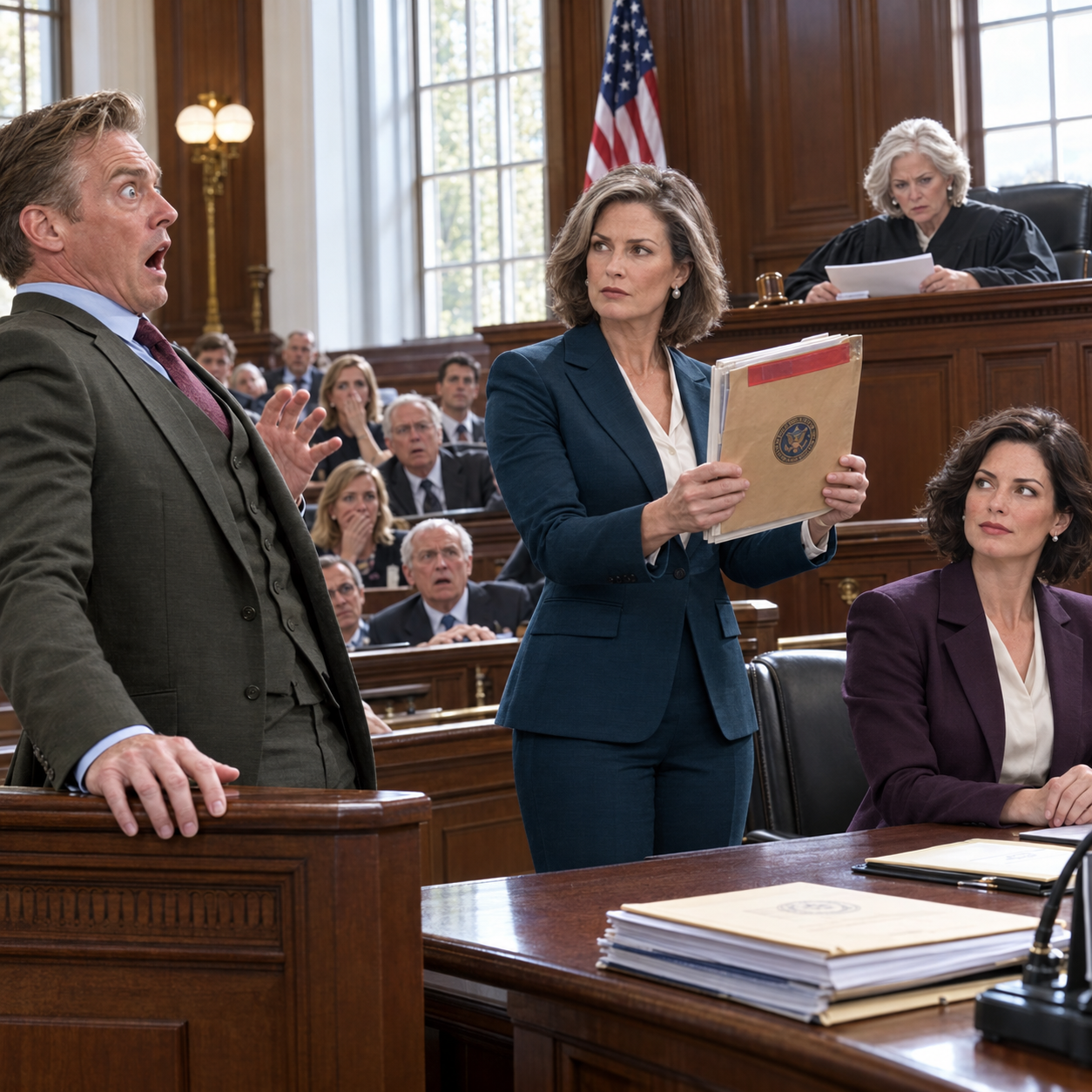
My brother stood in court and swore I had sat across from him at our family table, signed away control of my bank accounts, and handed him authority over properties our grandfather spent forty years building. He even had a notarized document proving it. I didn’t interrupt him. I knew exactly where I had been that morning, and when my attorney placed a sealed military flight record in front of the judge, my brother’s confidence disappeared so fast I almost heard it break.
### Part 1
For six years, my life had been measured in numbers most people never thought about. Fuel weight, altitude, weather windows, runway length, radio frequencies, oxygen pressure, coordinates, and seconds between decisions all mattered more than whether somebody liked my tone at Thanksgiving dinner. As a tactical pilot in the United States Air Force, I learned early that assumptions were expensive, records mattered, and every important action left a trail somewhere. My older brother, Grant Hale, had apparently spent years assuming none of those lessons followed me home.
Grant told our relatives I had a “government desk job with occasional flying.” I never corrected him because explaining my work usually created more questions than I was allowed to answer, and because I had stopped caring whether my family understood the difference between quiet and insignificant. At Christmas, Grant talked loudly about development deals while I washed dishes with my aunt, and at summer cookouts he introduced me as “the one who ran away to the military.” I would smile, take another drink of iced tea, and let him enjoy being the loudest person in the yard.
Our grandfather, Walter Hale, never made that mistake. Grandpa had spent forty-one years building Hale Industrial Supply from one rented warehouse outside Chicago into four commercial properties serving construction and manufacturing clients across Illinois. He still carried a battered pocket notebook even after accountants started sending him spreadsheets, and he could tell you which loading dock door needed new hinges without looking at a maintenance report. “Anybody can look rich,” he once told me. “The trick is knowing what you actually own when everybody stops clapping.”
Grant hated sayings like that because Grant loved applause. By thirty-eight, he had leased two luxury cars, bought watches he quietly resold whenever cash got tight, and developed commercial properties using so much borrowed money that every interest-rate increase made him look physically ill. At family dinners, though, he spoke like he controlled half the skyline. If one of his projects stalled, it was never because he had overextended himself; it was always a contractor, a lender, city permits, an incompetent partner, or “temporary market friction.”
Fourteen months after Grandpa died, Grant’s polished confidence had started cracking around the edges. Grandpa’s will placed his major commercial holdings and reserve capital into a family trust, with Grant and me listed as beneficiaries but neither of us permitted to make major withdrawals, sell core properties, or transfer controlling authority without dual approval and review by an independent fiduciary. Grant called the restrictions insulting. I called them proof that Grandpa had understood us both perfectly.
The calls started six months before everything exploded. Grant would ring while I was walking from briefing rooms or eating dinner from a paper container, always beginning with some version of, “Valerie, I need five minutes and I need you to think like an adult.” Then came explanations about bridge financing, contractors waiting for payment, opportunities that would disappear by Friday, and why keeping several million dollars protected inside a trust was “financially illiterate.” Each conversation ended the same way: he wanted my signature.
“I am thinking like an adult,” I told him during our last real conversation. I had been sitting outside a temporary operations building in Europe, listening to generators hum while cold wind pushed dry leaves across the pavement. “Grandpa required the review for a reason. The fiduciary completes it in December, and then we discuss everything with full numbers in front of us.”
Grant gave a short laugh that had no humor in it. “You fly airplanes, Val. I build companies. Stop pretending we have equal expertise here.”
“We have equal authority under the trust.”
For several seconds, I heard nothing except his breathing. Then he said, “That’s the problem,” and disconnected.
He didn’t call again.
At first, I thought he had finally accepted reality. That should have bothered me more than it did.
Three weeks later, I was finishing a temporary administrative rotation at an allied transit airfield when a staff sergeant stepped into the planning room carrying a thick certified envelope. My name was printed across the front beneath an Illinois court return address, and the words EXPEDITED HEARING DATE appeared near the top in block letters. The paper smelled faintly of toner when I opened it, and by the second page the noise of the room seemed to fade behind me.
Grant had petitioned the Cook County Chancery Division for emergency control over the trust, several linked commercial accounts, and two properties in which I held administrative rights. He claimed our grandfather’s assets were facing “immediate financial harm” because I was unavailable due to military commitments. That alone made my jaw tighten, but it wasn’t the sentence that made me read the packet twice.
Attached as Exhibit A was a notarized durable power of attorney bearing my full legal name.
According to the document, I had voluntarily granted Grant control over my financial interests on October 12.
According to the notary, I had signed it in person.
And according to Grant’s sworn affidavit, he had watched me do it from across our family kitchen table.
I stared at the date until something cold and precise settled in my chest.
On October 12, I had been more than five thousand miles from that kitchen.
Even stranger, Grant had chosen one of the worst possible days in my entire career to invent my presence in Illinois.
Because nearly every minute of that morning had been recorded.
### Part 2
I took the petition directly to the installation legal office the next morning. Major Ethan Mercer, the attorney assigned to review it, had the unnerving habit of becoming quieter whenever something made him angry, and by page four he had stopped making small sounds of acknowledgment entirely. He laid the document beneath a white desk lamp, adjusted his glasses, and studied every signature, seal, timestamp, and certification while I sat across from him listening to the ventilation system click overhead.
“Your brother isn’t merely claiming you agreed verbally,” he said at last. “He’s claiming a formal in-person execution.”
“That’s what I noticed.”
Mercer turned the final page toward me. A blue notary stamp identified Raymond Pike, a commissioned Illinois notary based in Cook County, and beneath it sat a signed acknowledgment stating that I had appeared before him at 10:15 a.m. on October 12, presented identification, confirmed my identity, and signed willingly. Grant’s affidavit repeated the same time and described the location as our mother’s kitchen in Oak Park. The specificity was almost impressive.
Mercer tapped the page with his pen. “Were you in Oak Park at 10:15 that morning?”
I leaned back. “Which time zone would you like?”
For the first time, he smiled.
I explained that October 12 had been part of a multinational readiness exercise conducted from Aviano. My squadron had launched that morning for a coordinated training sortie over the Mediterranean, with aircraft movements synchronized against naval and allied assets. We had signed crew sheets, entered a controlled flight line through badge checkpoints, logged departure and recovery times, communicated through recorded air-control systems, and filed post-flight maintenance data. The military didn’t merely know where I was; multiple systems knew where I was independently.
Mercer listened without interrupting, then asked, “How much of that can be certified for civilian court without exposing anything classified?”
“Enough.”
That afternoon became an exercise in paperwork rather than drama, which suited me perfectly. I requested certified duty-status records, security access logs, and declassified portions of the flight manifest showing my assigned aircraft and sortie times. My squadron’s administrative staff confirmed what I remembered: I had entered the secured flight area before sunrise local time, attended briefing, completed preflight, and been airborne during the exact interval Grant claimed I was presenting identification to a notary in Illinois.
When Mercer saw the initial confirmations, he gave a low whistle. “He could have picked almost any date.”
“He picked the one he needed.”
“No,” Mercer said. “I mean he could have picked almost any date that would have been harder to disprove. Instead, he picked a morning when governments were tracking you.”
That thought stayed with me.
Grant was reckless, but he wasn’t stupid. He knew I served overseas frequently, yet he could not have known my exact schedule. The document might have been prepared first and the date selected for some other reason, perhaps because a financial deadline required authority by that day. If so, the forgery wasn’t just an attempt to take control of Grandpa’s trust. It might have been designed to solve a much more immediate problem.
I began looking more carefully through the petition.
Buried in the exhibits was a declaration concerning one of Grant’s development companies, Lakefront Meridian Partners. The company had a financing deadline four days after October 12, and its lender required evidence of additional collateral before extending a commercial loan. Grant had attached projections suggesting he intended to use distributions from our family trust as evidence of liquidity. Suddenly his urgency made sense.
He didn’t want future access.
He had already promised somebody he could obtain the money.
I called our independent trust administrator, a woman named Nora Bennett who spoke with the patient precision of someone accustomed to wealthy people confusing urgency with entitlement. She confirmed that Grant had contacted her repeatedly in early October, asking whether one beneficiary could assume sole authority if the other became “unavailable.” Nora had refused to discuss hypothetical workarounds and documented every call.
“Did he tell you I had given him power of attorney?” I asked.
There was a pause.
“Not at first,” she said. “But on October 14, he emailed a copy.”
My stomach tightened. “Did you accept it?”
“Absolutely not. We requested direct verification from you and original documentation. He became extremely hostile.”
That explained another mystery. I had received a strange automated notice weeks earlier saying somebody had attempted to update contact information associated with one of the trust accounts. I had assumed it was a routine administrative error because the change had been rejected. Now I asked Nora to send Mercer every communication.
Her next sentence changed the entire shape of the case.
“Valerie, there is something else. Two days before he sent the power of attorney, your brother requested an emergency transfer of seven hundred fifty thousand dollars.”
I stood from my chair without realizing it. “On what authority?”
“He claimed you had already approved it.”
I looked through the window toward the gray runway beyond the building. A transport aircraft was taxiing in the distance, slow and steady, while ground crews moved beneath the wings in reflective vests.
Grant hadn’t forged one document after becoming desperate.
He had begun behaving as though my money belonged to him before the document even existed.
Mercer filed our response within forty-eight hours. We contested every claim, requested preservation of the original instrument, and notified the court that we intended to introduce certified government records disproving personal execution. He advised me not to contact Grant, and I didn’t.
Grant contacted me anyway.
His first message arrived at 2:11 in the morning.
“Val, whatever your lawyer told you, this is getting blown completely out of proportion. Call me before you destroy the family over paperwork.”
At 2:19 came another.
“You know Grandpa wanted us to work together.”
At 2:43:
“If you embarrass me in court, there are things about the trust you’re not going to like.”
I read the messages once, took screenshots, and forwarded them to Mercer.
Then I put my phone facedown.
For the first time, I stopped wondering whether Grant believed he could win.
I started wondering what else he thought I hadn’t discovered yet.
### Part 3
I returned to Illinois four days before the hearing. October cold had already sharpened the air, and when I stepped outside O’Hare the smell of rain, exhaust, and wet pavement felt strangely familiar after months overseas. My mother, Diane, had offered to pick me up until she learned why I was coming home, then suddenly said she “didn’t want to be dragged into legal hostility.” I rented a car instead.
I had not been inside Grandpa’s warehouse office since the funeral. The building sat near an industrial corridor west of the city, surrounded by loading docks, chain-link fencing, and rows of box trucks whose backup alarms echoed through the morning haze. Nora Bennett met me upstairs in Grandpa’s old conference room, where the same scratched oak table still carried a pale ring from the coffee mug he used for twenty years. Seeing it made me angrier than I expected.
Nora placed three folders in front of me. “These are the requests your brother submitted during the last six months.”
Grant had asked for advances, distributions, emergency collateral letters, authority to refinance trust properties, and permission to pledge one warehouse as security for his private development company. Every request had been denied or deferred pending review. His financial position wasn’t merely uncomfortable; it was collapsing.
Lakefront Meridian owed contractors more than $1.2 million. A lender had issued a notice requiring additional collateral. Another development had missed interest payments. Grant had personally guaranteed portions of the debt, meaning failure would not simply cost him a company.
It could bankrupt him.
“He never told the family this,” I said.
“People rarely announce leverage ratios over Thanksgiving dinner.”
I almost smiled.
Nora slid another sheet toward me. “This is what concerns me more.”
It was a printout of an email sent from an address nearly identical to mine. The message authorized Grant to discuss account restructuring on my behalf and asked Nora’s office to direct future verification through “my private representative.” The language was stiff and formal, nothing like the way I wrote, but somebody had clearly tried to impersonate me.
“Did this work?”
“No. Your grandfather required voice verification for unusual account changes.”
A memory surfaced immediately. Two months earlier, Grant had called me unexpectedly and asked casual questions about my first car, where I opened my original bank account, and whether I still used my mother’s address for financial mail. I had laughed and asked whether he was filling out some family trivia game. He changed the subject.
My skin prickled.
I looked at Nora. “He was gathering verification information.”
“That would be my assumption.”
By the time I left the warehouse, rain had begun tapping softly against the windshield. I drove to my mother’s house because avoiding the conversation would have meant letting Grant control yet another version of events. Mom opened the door before I knocked twice and immediately looked past me, as though she expected attorneys to be standing on the sidewalk.
“You wore your uniform?” she asked.
“I came directly from a military appointment.”
“It feels aggressive.”
I stepped inside. “It’s clothing, Mom.”
The kitchen looked almost exactly as Grant described it in his affidavit. White cabinets, long marble island, framed family photographs near the pantry, and a round wooden table beside the windows. He claimed I had sat in the chair nearest the patio door while a notary watched me sign away financial authority.
I walked to that chair and pulled it out.
Mom folded her arms. “Don’t do this.”
“Do what?”
“Turn everything into a crime.”
I stared at her. “Grant submitted a document saying I was sitting right here when I was flying over another continent.”
She flinched, but only slightly. “He told me the dates got mixed up.”
“The notary certified the date.”
“Maybe the notary made a mistake.”
“The time is written three different places.”
Mom pressed her fingers to her forehead. “Your brother is under enormous pressure.”
That sentence finally told me where she stood.
Not with the truth.
With the person creating the most chaos.
I asked one simple question. “Did you ever see me sign a power of attorney?”
“No.”
“Did you ever see Grant bring a notary here?”
She hesitated.
It lasted less than two seconds, but pilots learn to notice small delays.
“Mom.”
She looked away toward the sink. “Someone came by one afternoon. I didn’t ask who he was.”
“When?”
“I don’t remember.”
“Before or after October 12?”
“I said I don’t remember.”
Her voice had risen, and suddenly I knew she remembered perfectly.
I lowered mine. “Did Grant sign something at this table?”
“Valerie, stop interrogating me.”
I stood very still. “I’m not interrogating you. I’m giving you a chance to tell me the truth before somebody else does.”
She began wiping a perfectly clean spot on the counter with a dish towel. “Grant said he was handling paperwork for Grandpa’s accounts. That’s all I know.”
I watched her for several seconds, then picked up my coat.
“Where are you going?”
“To court in four days.”
She followed me into the hallway. “If your brother loses everything because of this, I hope you can live with yourself.”
My hand stopped on the doorknob.
I turned around. “Grant didn’t lose anything because I told the truth. Whatever happens next started when he signed my name.”
Outside, the rain had become heavier.
I sat in the rental car for nearly ten minutes before driving away, not because I doubted myself, but because I was finally accepting something harder.
Grant might have forged my signature.
My mother had helped him hide the circumstances around it.
And I had no idea how far that help had gone.
### Part 4
The morning before the hearing, Mercer called me while I was running on a hotel treadmill. “Don’t speak to anyone from your brother’s side,” he said without greeting. “Especially Raymond Pike.”
“The notary?”
“His lawyer contacted the court.”
I slowed the treadmill. “About what?”
“He wants to amend his statement.”
That got my attention faster than caffeine.
Pike now claimed he could no longer be certain that I personally appeared before him. According to his attorney, Grant had introduced a woman as his sister during a rushed appointment, presented copies of identification, and assured Pike that everything had been prearranged. It was not a confession, but it was close enough to explain why Grant’s attorney had begun sending increasingly frantic procedural emails.
“Did Pike describe the woman?” I asked.
“Not yet.”
My mind immediately went to my mother, then rejected the thought. She and I looked nothing alike beyond family resemblance, and she was more than twenty years older. Anyone checking identification would notice instantly.
Unless nobody checked carefully at all.
Mercer continued, “There’s another problem for Grant. The court clerk requested Pike’s official journal.”
“And?”
“The signature doesn’t resemble yours.”
I stepped off the treadmill and grabbed a towel. “How bad?”
“Bad enough that a handwriting expert won’t be our most interesting witness.”
When we met later that afternoon, Mercer showed me a scanned copy. The signature attempted my full name in looping cursive, but I signed military and banking documents with a compact, angular version I had used since college. Whoever wrote this had copied the decorative signature from an old family Christmas card rather than the one on my driver’s license.
I recognized it immediately.
Five years earlier, Grandpa had framed one of our Christmas cards in his office. Grant had access to it after Grandpa died.
“So he copied the wrong signature,” I said.
“Possibly.”
“That’s almost insulting.”
Mercer closed the folder. “Do not underestimate desperate people simply because they’re sloppy. Sloppy fraud can still do enormous damage.”
That evening, Grant appeared in the lobby of my hotel.
I saw him before he saw me. He was sitting in a leather chair near the fireplace, wearing a navy overcoat over a suit, both hands wrapped around a paper coffee cup he clearly wasn’t drinking. He looked thinner than he had at Grandpa’s funeral, and when he stood, there were dark circles beneath his eyes.
“We need five minutes,” he said.
“My attorney told me not to speak with you.”
“I’m your brother.”
“That’s not a legal exemption.”
His jaw tightened. “Always the pilot. Always the little checklist.”
I began walking toward the elevator.
He followed. “Val, I didn’t steal anything.”
I stopped.
“Then why is my signature on a document I never signed?”
His eyes flicked toward two people crossing the lobby. “Not here.”
“You came here.”
Grant lowered his voice. “I was trying to stabilize things. Grandpa’s money was sitting useless while I had real assets at risk.”
“Your assets.”
“Our family’s future.”
“Your development company is not our family’s future.”
He stepped closer. “Do you know what happens if Lakefront Meridian collapses? People lose jobs. Contractors go unpaid. Investors sue. Mom loses the income I give her every month.”
There it was.
Mom.
I looked at him carefully. “How much are you giving her?”
His expression changed.
Not much, but enough.
I continued, “And what did she do in exchange?”
“Don’t drag her into this.”
“You already did.”
Grant exhaled sharply and rubbed both hands over his face. For one second, he didn’t look like the arrogant older brother who had spent years correcting me at dinner. He looked frightened.
Then he ruined it.
“You could end all of this tomorrow,” he said. “Tell the court we had a misunderstanding, authorize the transfer, and I’ll make you whole within a year.”
I actually laughed.
Not loudly. Just once.
“Make me whole?”
“You know what I mean.”
“You forged control over assets I already own, and your solution is for me to give them to you voluntarily.”
“I was under pressure.”
“So you committed fraud.”
“Keep your voice down.”
“No.”
The word came out calm enough that he stopped.
I looked at him and finally understood something I should have understood years earlier. Grant didn’t see boundaries as rules; he saw them as temporary resistance from people who had not yet been persuaded, exhausted, shamed, or frightened into compliance.
His voice softened. “Valerie, if this gets referred for prosecution, my life is over.”
I held his gaze.
“You should have thought about that before using my name.”
The elevator doors opened behind me.
As I stepped inside, Grant said, “You think the flight records are going to save you?”
I pressed the button for my floor.
“They’ll prove where you were,” he continued. “They won’t prove who authorized everything else.”
The doors began closing.
His final words slipped through the narrowing gap.
“Ask Mom what Grandpa promised me before he died.”
Upstairs, I stood motionless in the hallway.
It was almost certainly a distraction.
But for the first time, I wondered whether Grant’s scheme had begun before Grandpa’s death.
### Part 5
Courtroom 3B smelled like polished wood, floor wax, and old paper. Morning light entered through high windows in narrow pale rectangles, cutting across counsel tables while attorneys whispered over folders and the clerk arranged files beside the bench. I arrived in service dress because I had another official obligation later that day, not because I wanted to make a statement, though the way Grant stared at my uniform suggested he assumed everything I did was aimed at him.
He sat beside his attorney, Leonard Price, wearing a tailored charcoal suit and the expression of a man attending a meeting whose outcome had already been negotiated. Mom was behind him in the gallery, twisting a tissue around her fingers. When I looked at her, she glanced down.
Judge Miriam Carver entered precisely at nine.
She was in her sixties, silver-haired, composed, and so economical with expression that even Grant seemed to sit straighter when she opened the file. “This matter concerns the Walter Hale Family Trust, petition for emergency fiduciary authority and related financial relief. Counsel for petitioner, you may proceed.”
Price stood. “Your Honor, the trust’s commercial assets face immediate impairment because the respondent is frequently unavailable due to military obligations. My client and his sister reached an agreement allowing him to assume sole administrative authority, and we have submitted the duly notarized instrument reflecting that agreement.”
Judge Carver looked toward our table. “The respondent contests execution?”
Mercer rose. “Completely.”
Before he could continue, Grant touched Price’s arm and asked permission to speak. The judge allowed it.
Grant stood with exactly the expression he used at funerals and investor dinners: solemn, sincere, almost injured by the burden of responsibility.
“Your Honor, my sister came to our mother’s home on October 12. She told me her military schedule had become overwhelming and she didn’t want to manage family finances from overseas. We sat at the kitchen table, discussed Grandpa’s wishes, and she signed the authority voluntarily.”
My mother closed her eyes.
I noticed.
Judge Carver asked, “You personally witnessed her sign?”
“Yes, Your Honor.”
“At approximately 10:15 a.m.?”
“Yes.”
“And the notary was physically present?”
“Yes.”
Price’s face had tightened slightly, as though he wished Grant had stopped one answer earlier.
Judge Carver turned to Mercer. “Your response.”
Mercer lifted a thin red-edged folder from our table. “Your Honor, we request admission of certified government records establishing the respondent’s physical location at the time of the alleged execution. The materials have been reviewed for release and contain no classified operational information.”
Price stood immediately. “We object to unnecessary federal materials being introduced into a private estate dispute.”
Judge Carver raised one eyebrow. “If the materials establish whether a party could physically have signed the disputed instrument, I would hardly call them unnecessary.”
The clerk carried the folder to the bench.
For the next minute, nobody spoke.
Judge Carver read the first page, then the second. She removed her glasses, cleaned them with a cloth, put them back on, and read a third page. The longer she remained silent, the more Grant shifted in his chair.
Finally she looked at me.
“Captain Hale, these records reflect your assignment on October 12?”
“Yes, Your Honor.”
“And the flight manifest identifies you as pilot?”
“Yes.”
Judge Carver turned toward Grant.
“Mr. Hale, you have sworn under oath that your sister was sitting in an Oak Park kitchen at 10:15 a.m. Central Time on October 12.”
Grant swallowed. “Yes.”
The judge tapped one page with her finger.
“These certified records establish that Captain Hale entered a secure military flight line in Italy hours earlier. Additional records show her aircraft departed during a multinational exercise, and the authenticated manifest places her airborne over the Mediterranean during the period in which you claim she was signing paperwork in Illinois.”
Nobody moved.
A pen rolled off somebody’s table and struck the floor.
Judge Carver continued, “Unless Captain Hale has developed a method of occupying two continents simultaneously, we have a serious problem.”
Grant’s face lost color.
Price leaned toward him and whispered something urgent.
Grant stood halfway. “Your Honor, the date must be wrong.”
Mercer did not react.
“The date on what?” Judge Carver asked.
“The document. We may have signed earlier.”
“Your sworn affidavit repeats October 12.”
“We could have remembered incorrectly.”
“The notarial acknowledgment states October 12.”
“The notary could have entered it wrong.”
“The petition your counsel filed identifies October 12.”
Grant’s breathing had become visible in his shoulders.
Judge Carver folded her hands. “Do you wish to continue revising your testimony, Mr. Hale?”
Price stood quickly. “Your Honor, counsel requests a brief recess to confer with our client.”
“Denied.”
The word landed harder than a gavel.
Judge Carver reached for another document.
“This court received supplemental information this morning from counsel representing the notary, Mr. Raymond Pike.”
Grant stopped moving.
I looked toward Mercer. He gave me the smallest nod.
The judge continued.
“Mr. Pike now disputes significant portions of your account.”
Grant’s mouth opened, but no sound came out.
And for the first time that morning, I realized the flight manifest was not going to be the worst thing waiting for him.
### Part 6
Judge Carver read Pike’s supplemental statement without changing her tone. He admitted that Grant had arranged the appointment, supplied copies of my identification, and presented a woman who was introduced as Valerie Hale. Pike claimed the meeting was hurried, that he failed to compare the identification carefully, and that he relied on Grant’s repeated assurances that the woman was his sister and that the paperwork reflected a prior family agreement.
Price looked physically ill.
Judge Carver lifted the copy of the notary journal. “Mr. Pike also acknowledges that the woman signed the journal in his presence.”
Grant stared at the table.
The judge continued, “Captain Hale’s counsel has provided multiple authenticated examples of her signature. The signature in the journal does not appear consistent even to an untrained observer.”
Price stood. “Your Honor, my client was not responsible for the notary’s verification procedures.”
Judge Carver’s eyes moved to him. “I suggest you avoid making representations until you have spoken privately with your client about what he intends to admit.”
The courtroom became utterly still.
Mercer then introduced Nora Bennett’s records. She had documented Grant’s earlier requests for emergency access, his attempt to secure a $750,000 transfer, the false email purporting to come from me, and his submission of the disputed power of attorney only after the trust administrator refused to act without direct verification. Each document added another layer to the timeline.
Grant finally whispered, “This is insane.”
Judge Carver heard him.
“What is insane, Mr. Hale?”
He lifted his head. “Everyone is making this sound like I created some elaborate criminal conspiracy. Valerie knew I needed financial authority. We discussed it for months.”
“Did she authorize you to sign her name?”
“No.”
“Did she authorize another person to appear before a notary claiming to be her?”
Grant said nothing.
Mom began crying quietly behind him.
Judge Carver looked toward the gallery. “Mrs. Hale?”
My mother froze.
“Please stand.”
She rose slowly.
The judge asked whether she had accompanied Grant to any notarial appointment. Mom immediately shook her head.
“No.”
Grant turned around so fast his chair scraped the floor.
“Mom.”
Price grabbed his sleeve. “Do not speak.”
Judge Carver’s voice sharpened. “Mrs. Hale, did you assist in locating a woman to appear as your daughter?”
My mother’s face crumpled.
“No.”
I watched her carefully.
For days I had believed she might be hiding direct involvement, but her fear looked different from Grant’s. His eyes kept darting toward lawyers and documents. Hers stayed fixed on him.
Judge Carver asked one more question. “Did you know your son intended to submit a power of attorney bearing your daughter’s name?”
Mom’s lips trembled.
“Not until afterward.”
Grant whispered something under his breath.
The judge ordered him silent.
Mom gripped the railing. “He told me Valerie had agreed. He said they were fixing paperwork because she couldn’t get home. I knew somebody came to the house, but I didn’t know she was pretending to be Valerie.”
I felt no relief.
Mom might not have participated in the forgery, but she had still defended it after learning the truth.
Judge Carver turned back to Grant. “Who was the woman?”
Grant stared straight ahead.
“Mr. Hale?”
“I don’t know.”
A strange sound escaped Price, halfway between a cough and disbelief.
Judge Carver leaned back. “You arranged the appointment.”
“My assistant may have.”
“Name the assistant.”
Grant hesitated.
That hesitation was enough.
Mercer passed another document to the clerk.
“Our investigation identified a payment from Lakefront Meridian Partners to a temporary administrative consultant named Erica Sloan two days after the notarization,” he said. “The payment memo reads ‘document services.'”
Grant closed his eyes.
I recognized the name. Erica had worked at one of his developments years earlier. She had similar coloring to mine, was roughly my age, and had once attended a family charity event where photographs of us appeared together online.
My stomach turned.
Mercer continued. “We have not made accusations regarding Ms. Sloan. We are asking only that the court preserve all relevant records and refer the matter for investigation.”
Judge Carver nodded.
Price rose slowly. “Your Honor, after conferring with my client, we would request permission to withdraw the emergency petition.”
“You may withdraw as counsel if professional obligations require it,” she said. “The petition itself is not disappearing.”
Grant finally looked at me.
The expression on his face wasn’t remorse.
It was betrayal.
As if I had somehow broken an agreement by proving I had never made one.
“Valerie,” he said.
Judge Carver struck the gavel once.
“Mr. Hale, you will address the court.”
Then she issued her ruling.
The purported power of attorney was declared invalid. Grant was immediately barred from accessing trust accounts or acting on behalf of the estate. All disputed financial requests were frozen, original exhibits were ordered preserved, and the matter was referred to the state’s attorney and appropriate regulatory authorities for investigation.
Grant gripped the edge of the table.
“This will destroy my company.”
Judge Carver looked directly at him.
“Your company is not before me today. Your conduct is.”
A court officer approached.
Grant turned toward me again. “Tell them this is family.”
I held his gaze.
“It stopped being family when you hired someone to become me.”
His face changed then.
Not because he was sorry.
Because he finally understood I was not going to rescue him.
### Part 7
The investigation lasted seven months. Grant was not dragged away dramatically in handcuffs from the courtroom, which probably disappointed everyone who expected justice to arrive like television. Instead, justice came through subpoenas, bank records, interviews, preserved emails, metadata, deposition transcripts, handwriting analysis, and the slow disappearance of every explanation Grant attempted to use.
Erica Sloan cooperated.
Through her attorney, she admitted Grant had told her the documents were part of a family restructuring agreement and that I had authorized her to sign as my representative because I was overseas. She said she knew pretending to be me before a notary was improper but claimed she believed I had consented. Investigators found messages in which Grant coached her on details about my appearance, supplied an old copy of my driver’s license, and sent her photographs of my signature.
He had paid her five thousand dollars.
The same week those messages surfaced, his lenders stopped negotiating extensions.
Lakefront Meridian entered insolvency proceedings soon afterward.
Mom called me repeatedly.
At first, I ignored the calls. Eventually, I answered one because avoiding her forever felt too much like allowing unfinished business to control me.
She spoke before I could say hello.
“Your brother is losing everything.”
I stood in my apartment near the base, watching rain trail down the window. “He’s losing things he risked.”
“He might go to prison.”
“He knew forging financial documents was illegal.”
“He was desperate.”
“Desperation doesn’t create my signature.”
Mom began crying. “Why do you have to be so cold?”
That sentence hurt more than I expected.
Not because I believed it.
Because I had heard versions of it my entire life.
When Grant shouted, people called him passionate. When he demanded, they called him ambitious. When he insulted me, they said he was stressed. But when I set a boundary in a calm voice, I was cold.
I sat down on the edge of the couch.
“Mom, do you know what you asked me the day I confronted you in your kitchen?”
She was silent.
“You asked whether I could live with myself if Grant lost everything. You never asked whether I could live with knowing my brother used my identity to seize control of what Grandpa left us.”
“I was scared.”
“So was I.”
“He needed me.”
“I needed you to tell the truth.”
She started to say my name.
I stopped her.
“I believe you didn’t arrange the impersonation. I believe you didn’t know exactly what he had done until afterward. But once you did know, you still asked me to protect him from consequences instead of protecting me from what he did.”
For a long time, neither of us spoke.
Finally she whispered, “What do you want from me?”
“Nothing.”
That answer seemed to hurt her more than anger would have.
I meant it.
I didn’t want an apology produced because court documents had made denial impossible. I didn’t want family therapy organized because Grant’s criminal defense lawyer suggested repairing relationships could make him look remorseful. I didn’t want holiday dinners where everybody pretended betrayal could be folded neatly under a napkin because enough months had passed.
I wanted distance.
The trust underwent a complete independent audit. Grandpa’s core properties remained intact because Nora’s office had blocked Grant’s transfer attempts before money actually left protected accounts. The court appointed an institutional fiduciary to administer major decisions, removing the possibility that either beneficiary could pressure the other into reckless distributions.
I welcomed it.
Grant accused me through his lawyer of “surrendering family control to strangers.”
For once, I didn’t care.
The audit also revealed something unexpected.
Grandpa had not secretly promised Grant sole control, as Grant implied in the hotel lobby. There was no hidden letter, secret codicil, or deathbed arrangement. Instead, Grandpa’s files contained a handwritten memo drafted six months before he died after Grant pressured him to guarantee a development loan.
One line stayed with me.
Grant confuses access with ownership.
I read it three times.
Beneath it, Grandpa had written another.
Valerie understands stewardship because she can walk away from money when using it would be easier.
I sat alone in Nora’s office with the paper in my hands and finally cried.
Not because Grandpa had chosen me.
He hadn’t.
He had protected the assets from both of us.
I cried because someone in my family had seen the difference all along.
Grant eventually accepted a negotiated plea on charges related to fraudulent financial instruments, false statements, and attempted misappropriation. The final sentence included a period of incarceration, restitution for investigative and administrative costs, supervised release, and restrictions involving fiduciary roles. Raymond Pike lost his commission and faced separate professional consequences for failing to perform basic identity verification.
None of it felt satisfying.
Consequences rarely look the way revenge fantasies do.
Mostly they looked like empty chairs, legal invoices, and people learning that life continues without them.
Several weeks before Grant reported to begin his sentence, he mailed me a letter.
I almost threw it away unopened.
Instead, I read it once.
The first three pages explained his pressure, his debts, Grandpa’s restrictions, his employees, Mom, the economy, and every reason he believed he had been forced toward the decision. Only near the end did he write, “I know I crossed a line.”
A line.
As though he had stepped slightly over a painted boundary instead of hiring another woman to become me.
His final sentence said, “When this is over, I hope you’ll remember I’m still your brother.”
I folded the letter and put it back inside the envelope.
Then I placed it in a drawer with the court order.
Blood explained how we were related.
It no longer determined whether he had a place in my life.
### Part 8
Two years later, I was flying less often and serving in a training and operations role that gave me something I had never had during the height of my deployment cycle: predictable weekends. I bought a small house outside Colorado Springs with a mountain view, a narrow kitchen, and a back porch where the evening wind smelled like pine instead of jet fuel. For the first time in years, my life felt quiet without feeling temporary.
Grandpa’s warehouses continued operating under professional management. One property was modernized, another received new long-term tenants, and a portion of the trust’s annual income funded scholarships for employees’ children pursuing technical training. That had been one of Grandpa’s ideas, found in an old notebook after the audit.
I helped implement it.
Not because Grant thought the money needed to “do something.”
Because Grandpa had already decided what doing something responsibly looked like.
Mom and I spoke occasionally.
Our relationship never returned to what it had been, largely because I stopped pretending it had once been healthier than it was. She apologized several times, but her apologies often began with “I was caught between my children,” and I would remind her that she had not been asked to choose which child she loved. She had been asked whether fraud was fraud.
Eventually she learned to stop defending Grant in our conversations.
That was enough for civility.
It wasn’t enough for closeness.
Grant wrote after his release.
His first letter was shorter than the one he sent before sentencing.
“I spent a long time blaming you because blaming you meant I didn’t have to admit I did this to myself.”
I read that sentence twice.
The rest of the letter contained no request for money, no explanation about pressure, and no demand that we rebuild our relationship. He said he had started working for a small facilities company, lived in an apartment, and was paying debts slowly.
At the end he wrote, “I’m sorry I tried to take something from you because I thought I deserved it more.”
That was the first apology I believed.
Believing it did not mean accepting him back.
I wrote one reply.
“I hope you build a decent life. I also hope you understand that forgiveness is not the same thing as access. I don’t hate you, Grant, but I do not want a relationship with you.”
I mailed it the next morning.
Then I went to work.
There was no dramatic reconciliation years later. We didn’t hug beneath Christmas lights while Mom cried in the background. Grant didn’t show up unexpectedly at my promotion ceremony and deliver a speech that repaired everything.
Sometimes the healthiest ending is quieter than that.
A person hurts you badly enough that you finally stop making room for them.
My life expanded after I stopped carrying responsibility for Grant’s choices. I became an instructor, then moved into operational planning, where younger pilots occasionally arrived with the same need to prove themselves that I remembered from my twenties. I learned I loved teaching almost as much as flying.
One of those instructors was Daniel Reyes, a former transport pilot who had transferred into training command after years overseas.
We became friends first.
He never asked me to explain why I kept my finances separate, why I hated surprise paperwork, or why I checked every signature page twice. When I eventually told him the story, we were sitting on my back porch while a storm moved across the mountains.
He listened until I finished.
Then he said, “Your brother forged your signature and thought arguing harder would change your location?”
I laughed harder than I had in months.
“Basically.”
“Pilots really are the worst people to lie to about timestamps.”
That was the entire conversation.
No pity.
No attempt to rescue me.
No speech about trusting again.
Just understanding.
We started dating months later, slowly enough that neither of us needed to pretend certainty before it existed.
Three years after courtroom 3B, I returned to Chicago for the dedication of a technical scholarship program funded through Grandpa’s trust. Nora attended. Several longtime warehouse employees brought their families. Mom sat near the front and cried when the first scholarship recipient, the daughter of a forklift mechanic who had worked for Grandpa twenty-three years, stepped onto the stage.
For a moment, I thought about Grant.
I wondered whether he would have understood why Grandpa preferred this over another development tower with his name hidden inside an investment company.
Maybe he would now.
Maybe he wouldn’t.
It no longer mattered.
After the ceremony, Mom walked beside me through the warehouse. The place smelled like cardboard, metal shelving, machine oil, and the same dark coffee Grandpa used to drink from dawn until lunchtime.
She stopped beside his old office.
“He would be proud of you,” she said.
I looked through the glass at the empty desk.
“He’d probably tell me we spent too much on the new loading system.”
Mom laughed softly.
Then her face became serious.
“I was wrong about something.”
I waited.
“I kept thinking protecting Grant meant protecting the family.”
She looked down at her hands.
“I understand now that I was protecting him from the family seeing what he had become.”
That was the closest we ever came to repairing the old wound.
I nodded.
“Thank you for saying it.”
She touched my arm, but she didn’t ask for more.
That mattered.
Later that night, I stood alone outside the warehouse while planes crossed high above Chicago, tiny blinking lights moving through cold clear air. Somewhere years earlier, Grant had believed he could replace reality with a document because he assumed nobody would check closely enough.
He had mistaken distance for absence.
Silence for weakness.
Family for permission.
The judge never needed to decide whether I sounded believable or whether Grant looked sincere.
She only had to compare his story to the record.
At 10:15 on the morning he swore I was sitting in our mother’s kitchen signing away my authority, I had been thousands of miles away, strapped into an aircraft above the Mediterranean with my name attached to a flight manifest that could not be bullied, guilted, rewritten, or manipulated.
That detail destroyed his lie.
But the court case taught me something even more important.
People who benefit from your silence may call you cruel when you finally produce evidence. People who crossed your boundaries may accuse you of destroying the relationship when you refuse to erase the consequences. And family members who love peace more than truth may pressure the injured person because confronting the person who caused the damage feels harder.
I don’t live that way anymore.
I don’t confuse forgiveness with reconciliation.
I don’t confuse understanding someone’s desperation with excusing what they chose to do because of it.
And I never again assume that sharing blood means sharing access to my life.
Grant tried to take my name, my authority, and part of the future our grandfather had protected.
He lost all three.
I kept the one thing he never understood how to value.
My integrity.
And unlike a forged signature, that was something no judge had to give back to me.
THE END
THE END!
Disclaimer: Our stories are inspired by real-life events but are carefully rewritten for entertainment. Any resemblance to actual people or situations is purely coincidental.