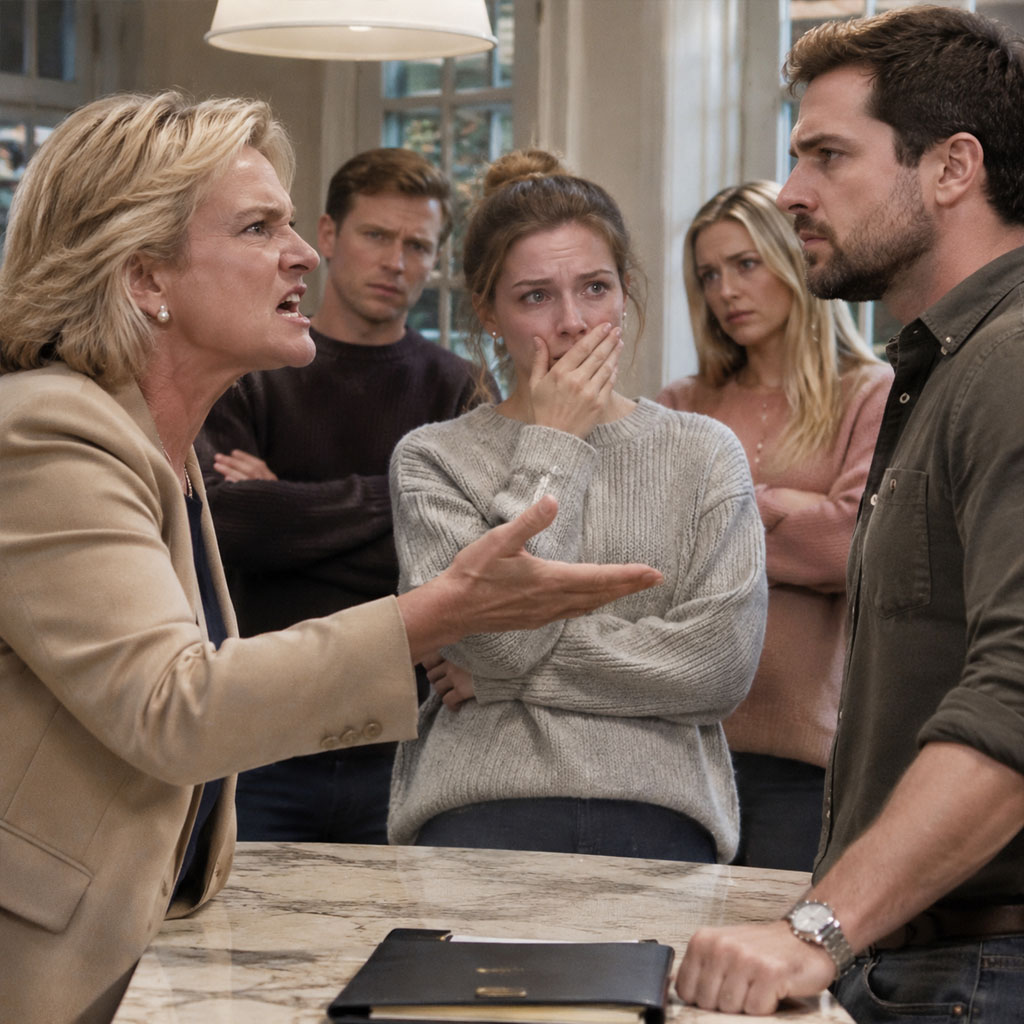
Chapter 2
Marcus and I had been together for nine years and married for six.
I knew his mother was difficult. I knew Trent was irresponsible. I knew family gatherings often ended with Marcus apologizing for something his mother had said.
What I didn’t know was that the trouble went much deeper.
His father, Owen Bell, had died when Marcus was 22. It had been sudden, leaving Dileia to manage the household and handle the estate while her two sons were still trying to understand how to live without their father.
There had been a life insurance payout of approximately $211,000.
According to Owen’s wishes and the estate arrangements, Marcus and Trent were each supposed to receive a third of the money once they turned 25.
Dileia had been appointed executor.
At first, she’d told them there were complications. Then she mentioned legal fees, outstanding debts, and expenses associated with settling the estate.
By the time Marcus turned 25, she told him there was only $12,000 left.
She gave him a tearful explanation about how expensive everything had become.
He accepted it.
Trent accepted it, too.
“Why didn’t you question her?” I asked.
Marcus rubbed his forehead.
“Because I didn’t want to believe she’d taken it. Dad had just died. She was the only parent we had left. I couldn’t look at her and ask whether she’d stolen from her own children.”
He looked down at his hands.
“And after a while, it became easier to pretend there hadn’t been enough money.”
I reached across the table.
“What does that have to do with our house?”
“Everything.”
Eighteen months earlier, when we had first started discussing construction, Marcus had visited an estate attorney named Renata Ibarra.
He’d explained the family history, the missing inheritance, and his concerns about his mother’s habit of treating his money as though it belonged to everyone.
Renata had recommended an irrevocable trust designed to protect the property.
The house would be held for my benefit, with me as its sole beneficiary and Marcus serving as trustee until I turned 35.
It was a legal structure Renata believed would best protect the property from competing ownership claims and financial disputes.
“She suggested putting it entirely in your name rather than dividing ownership between us,” Marcus explained. “She wanted everything clear. No ambiguity about who benefited from the property.”
“Why didn’t you tell me?”
He looked genuinely ashamed.
“I thought I was protecting you. I didn’t want you carrying the burden of what my mother had done. I kept telling myself I’d explain everything once the house was finished.”
“You don’t get to decide what I can handle.”
“I know.”
He reached for my hand.
“I should have trusted you.”
I believed him. I knew Marcus well enough to recognize genuine regret.
But I also knew that he had spent years avoiding a confrontation with his mother, and I was beginning to understand how expensive that avoidance could become.
Wednesday morning, I found the first strange email.
We shared a household email account for utility bills, homeowners’ association notices, and all the other dull business that comes with owning a house.
The message came from something called Coastal Title and Escrow Services.
Its subject line read: QUITCLAIM DEED PROPERTY TRANSFER REQUEST.
I assumed it was spam.
Our new address was now public record, and it wasn’t unusual to receive questionable messages after a property purchase.
I deleted it and made coffee.
That evening, I mentioned it to Marcus almost casually.
He stopped eating.
“Did you say Coastal Title?”
“Yes. Why?”
“Did you keep the email?”
“I deleted it.”
He put down his fork.
“If it comes again, forward it to me.”
His expression had changed.
“What are you thinking?”
He was quiet for several seconds.
“I think my mother may have tried something like this before.”
He told me about his grandmother’s house.
In 2009, before Marcus and I met, a quitclaim deed had appeared transferring half of his grandmother’s property to Dileia.
The document carried his grandmother’s signature.
But his grandmother insisted she’d never signed it.
By then, she was experiencing early dementia. Nobody could establish what had happened, and no formal case was pursued.
When she died two years later, Dileia ended up with the property.
Marcus had always wondered about it.
He’d simply never allowed himself to investigate.
“Why didn’t you tell me this before we built the house?”
“Because I thought the trust made it impossible for her to do anything.”
The following afternoon, another email arrived.
This time it came directly to my personal account.
The message politely requested that I review and sign attached transfer documentation to avoid delays in the title correction process.
I opened the PDF.
The document appeared official at first glance. It contained our property address, legal descriptions, and a section requesting my signature.
At the bottom was a signature that looked remarkably like mine.
For several seconds, I couldn’t move.
I enlarged the image.
The signature was close, but the details were wrong. My middle initial had a particular shape. I printed my R rather than curling it in cursive, a habit my mother had taught me when I was young.
The signature on the document had a looping R.
I had never written it that way.
Someone had forged my name.
I called Marcus at work.
He didn’t ask me to explain twice.
Within twenty minutes, he had left his office, and we were driving downtown to Renata Ibarra’s law firm.
For the first time in nine years, I watched my husband abandon everything else because his family had crossed a line he could no longer ignore.
Chapter 3
Renata was a woman in her early fifties with dark hair threaded with gray and reading glasses that seemed permanently balanced on top of her head.
She had practiced trust and estate law for 22 years.
After examining the document, she leaned back in her chair.
“I want you both to understand something. This is not a legitimate title correction.”
She turned her laptop toward us.
“Coastal Title and Escrow Services isn’t licensed in this state. I checked the registration records when Marcus called. It’s a mail drop and a website created four days ago.”
I stared at the screen.
The website featured a generic photograph of two people shaking hands, a brief description of services, and a telephone number that went directly to voicemail.
“Can somebody actually transfer our house using this?” I asked.
“Not through legitimate procedures,” Renata said. “But that’s not necessarily the point. They may be trying to frighten you into signing something without understanding it. Or they may be hoping to file a fraudulent deed directly with the county recorder and get away with it before anyone notices.”
Marcus leaned forward.
“Can they do that?”
“They can attempt it. County recording offices generally don’t verify every signature against a live notary database before accepting a document. Fraudulent deeds are sometimes discovered months or even years after they’re recorded.”
I felt sick.
Renata immediately began making calls.
She filed a fraud alert with the county recorder’s office and instructed us to preserve every email, attachment, and message.
She also told us to report the attempted fraud to the police.
“This is no longer a disagreement between relatives,” she said. “Forging a property transfer document is a serious criminal matter.”
Before we left, I made a mistake.
I thought I could still fix things the old way.
I had spent most of my adult life believing that difficult family situations could be improved by choosing the right words and keeping my voice calm.
So while Marcus was still inside completing paperwork, I called Dileia from the parking lot.
“I received the email,” I said.
There was a brief silence.
“What email?”
“The one from Coastal Title and Escrow.”
“I don’t know what you’re talking about.”
“I have the document, Dileia. Someone forged my signature.”
Her voice immediately became wounded.
“After everything I’ve done for this family, you think I would stoop to something criminal?”
“I’m not accusing you without evidence. I’m telling you what I found.”
“Then you have a document,” she replied.
Her tone had suddenly become cold.
“Documents can say anything. Think very carefully about who a judge is going to believe. A scared young wife with an overactive imagination, or a grandmother who raised two boys alone.”
She paused.
“Don’t make this worse than it needs to be, sweetheart.”
Then she hung up.
I sat in the parked car for several minutes.
I was angry with her, but I was also angry with myself for hoping she’d offer some explanation that would make the entire thing disappear.
Marcus found me shortly afterward.
“You tried to talk to her,” he said.
I nodded.
“I know. It was stupid.”
“It wasn’t stupid. It was decent. She’s just not meeting you with the same decency.”
He started the engine.
“From now on, everything goes through Renata and the police. No more private conversations.”
Two days later, we met Detective Marisol Vance at the financial crimes division.
She was in her late fifties, with short gray hair and the steady expression of someone who had spent years listening to people explain why they hadn’t noticed something important sooner.
“Fourteen years in financial crimes,” she told us. “Before that, six years investigating general fraud. I want you to understand that cases involving family members can be difficult. People hesitate to cooperate when the accused is a parent, grandparent, or sibling.”
She examined the forged deed and the emails.
Then she opened the PDF’s technical information.
“Here,” she said, pointing at the screen. “The file was created using an Adobe account registered under the display name DBell.”
Marcus leaned closer.
“My mother’s name is Dileia Bell.”
“Does she own a computer?”
“An older Dell laptop. She’s had it since around 2019.”
Vance wrote something down.
“That gives me a direction. It doesn’t give me enough to obtain a warrant yet.”
She asked about the earlier incident involving Marcus’s grandmother.
Marcus explained what he remembered.
Vance listened carefully.
“We can’t treat an old suspicion as proof. But it may help establish a pattern if we can document it.”
Then she asked about Owen’s insurance payout.
Marcus told her the amount and explained that he’d never filed a complaint.
“Do you have any records?”
“Not personally.”
“Probate court will. I want the estate accounting, bank records, and any supporting documents. If money was misappropriated, we’ll need to know where it went.”
Renata recommended a forensic accountant named Priya Anand.
Priya had spent 17 years reconstructing financial records for litigation involving divorce, elder financial exploitation, and disputed estates.
Her office looked nothing like Renata’s.
Banker’s boxes filled one wall. Three monitors covered her desk. A half-empty cup of coffee sat beside a stack of documents.
She listened to Marcus’s account and asked for permission to obtain the available probate records.
“Give me two weeks,” she said. “I’ll tell you where that money went.”
It took her nine days.
She called us into her office on a Thursday evening and placed three printed pages on the desk.
“Your father’s estate was filed for probate in March of the year he died,” she explained. “The total estate value was approximately $236,000, including the insurance proceeds.”
She tapped the first page.
“Your mother filed the required accounting eleven months later. Technically, she complied with the filing requirement. That’s actually useful to us because she signed the document under oath.”
She slid the second page toward Marcus.
“Here’s the accounting.”
The listed expenses included approximately $12,000 for funeral costs and $4,000 in probate attorney fees.
Then came a line item labeled miscellaneous estate management and family support disbursements.
The amount was $191,000.
Marcus stared at it.
“That’s not a real expense category.”
“No,” Priya said. “It’s a vague description. It tells us almost nothing about where the money went.”
She placed the final page on the desk.
“I traced four large transfers before the estate account was closed. One went to a Chevrolet dealership. Another paid off a mortgage on a property titled in your mother’s name. The remaining two went into accounts we haven’t fully identified yet.”
Marcus slowly lowered himself into his chair.
I watched him read the numbers again.
He wasn’t thinking about the house anymore.
He was thinking about a 22-year-old man who had buried his father and trusted the only parent he had left.
“Can this go to the district attorney?” he asked.
“Every bit of it,” Priya answered.
Then she looked at me.
“Paperwork is boring. That’s why people underestimate it. But money leaves a trail.”
For the first time, I understood that the house in our driveway was only one part of something much larger.
And Dileia had apparently been counting on everyone being too uncomfortable to look closely.
Chapter 4
We should have felt safer after Priya’s findings.
Instead, that Saturday night, I woke at 2:47 a.m. to the sound of our side gate rattling.
Marcus was already sitting upright.
“Call the police,” he whispered.
I reached for my phone while he picked up the flashlight from his nightstand.
He didn’t go outside. He simply stood near the bedroom window and listened.
By the time two patrol cars arrived, whoever had been in the yard was gone.
But the side gate lock had been cut.
A manila envelope had been wedged into our physical mailbox.
The officer opened it carefully.
Inside was a printed copy of the forged quitclaim deed.
Beneath it was a handwritten note.
Marcus recognized the handwriting immediately.
It was Dileia’s familiar slanted cursive, the same writing she’d used on birthday cards and holiday envelopes for decades.
The message contained only a few sentences.
Sign it or I file it anyway.
Nobody checks these things until it’s too late.
You know that better than anyone.
I felt my knees weaken.
A patrol officer photographed the note and placed it in an evidence sleeve.
Detective Vance called us that morning.
When she examined the note, she looked almost grimly satisfied.
“This is what we call evidence of consciousness of guilt,” she explained. “She’s demonstrating that she knows the document is questionable and is trying to pressure you into cooperating.”
“The gate was cut,” Marcus said.
“That makes this more serious. We’re looking at an attempted unlawful entry, along with the property fraud. I’m requesting an emergency protective order today.”
She looked directly at both of us.
“I want you to understand something. You did the right things. You didn’t sign anything. You preserved the documents. You contacted your attorney and reported the incident. That matters.”
The protective order was granted that afternoon by Judge Coleman Reyes.
The judge reviewed Priya’s financial summary, the forged deed, and the handwritten note before signing.
At six that evening, a county sheriff’s deputy served Dileia at her home.
Trent was there.
He called Marcus less than an hour later.
I sat on our bed while Marcus answered on speakerphone.
“I didn’t know about the forgery,” Trent said immediately. “I swear to you, Marcus. I didn’t know she cut the gate lock, either. I didn’t know any of that until the deputy showed up.”
Marcus remained silent.
“But the money from Dad’s estate,” Trent continued. “I knew some of it wasn’t right. Not all of it, but some. Mom told me not to bring it up because you’d make everything into a bigger problem.”
“Did you know about Grandma’s house?”
There was a long pause.
“I suspected something. I never asked.”
Marcus closed his eyes.
“You need to tell Detective Vance what you just told me.”
“She’s my mother.”
“She forged my wife’s signature and tried to take a house that doesn’t belong to her. I don’t care whose mother she is anymore. I care whether my brother is going to tell the truth.”
Trent began crying.
He apologized, but Marcus didn’t respond to the apology.
He simply gave him Detective Vance’s number and ended the call.
Two days later, Trent provided a statement.
Kayla gave one separately.
Her involvement turned out to be more complicated than we’d expected.
Dileia had asked her to help build the Coastal Title website using an online template service. Kayla was 29, reasonably comfortable with computers, and had been struggling to find steady employment.
She claimed she hadn’t known about the forged signature.
She said Dileia had described the website as a legitimate service she was setting up to help with property paperwork.
Detective Vance wasn’t entirely convinced, but she believed there was insufficient evidence to pursue charges against Kayla at that point.
She made one thing clear.
“Not knowing every detail doesn’t automatically make your involvement harmless. You built the tool being used in an attempted fraud. Think carefully before agreeing to help anyone with something like that again.”
The laptop warrant came through on Wednesday.
Vance called us personally.
“We recovered the original PDF on the device,” she said. “The creation timestamp matches the document you received.”
I felt my stomach tighten.
“Was it definitely your mother’s computer?”
“We’re still completing the forensic identification, but the account and device evidence are consistent.”
She paused.
“There are also several draft versions of the document. They go back nine days before the first email was ever sent to you.”
Marcus looked at me.
“Nine days?”
“That’s right. This wasn’t something she threw together after the argument in your driveway. She had been preparing it beforehand.”
I sat down.
Then Vance said something that made the room feel smaller.
“We found another draft deed on the laptop.”
“For what property?” Marcus asked.
“Your brother’s condo.”
Neither of us spoke.
“It uses the same forgery pattern and the same fake escrow company. It’s dated eleven months ago. We don’t know whether it was intended as a trial run or whether she abandoned the plan, but it’s important evidence.”
Marcus slowly put his hand over his mouth.
His mother hadn’t simply reacted badly to losing control of our house.
She had been preparing documents to take property from her own family long before we knew what was happening.
“Does Trent know?” I asked.
“Not yet. We’ll handle that through the investigation.”
Vance told us that the district attorney was reviewing the evidence and expected to move forward soon.
For the first time in weeks, I felt that someone outside our family understood what was happening.
But the hardest part was still ahead.
Chapter 5
Dileia was arrested on a Thursday morning at the house where she’d been living.
The charges included second-degree forgery, attempted grand theft through fraudulent property transfer, burglary related to the cut gate lock, and probate fraud.
The district attorney also reviewed possible federal wire fraud exposure because the forged documents had been sent electronically.
Detective Vance called afterward.
“Your mother-in-law’s attorney has seen the forensic evidence and the financial reconstruction,” she told Marcus. “The case is strong.”
We didn’t celebrate.
I had imagined feeling relieved when the arrest happened.
Instead, I felt exhausted.
The person accused of doing these things was still Marcus’s mother. No amount of evidence could erase the years he’d spent loving her, trusting her, and trying to protect the version of her he wanted to believe existed.
Eight weeks later, Dileia accepted a plea agreement.
She received an 18-month sentence, with the fraud and forgery counts running concurrently.
The court also ordered restitution for the $191,000 that had been improperly disbursed from Owen’s estate.
The money was to be divided between Marcus and Trent as the original heirs, payable over time from whatever assets remained available.
After legal fees and other expenses, the amount Dileia could actually repay was considerably smaller than the original figure.
I didn’t attend the sentencing.
Marcus asked me not to come.
“I know that sounds strange,” he said one evening. “But I need to do this by myself.”
I understood.
He returned home that afternoon and sat on the porch steps for nearly an hour.
When he finally came inside, he didn’t tell me what had happened in the courtroom.
He simply wrapped his arms around me and held on.
I understood that kind of silence.
Sometimes a person needs to mourn someone who is still alive.
Trent wasn’t charged.
The investigation concluded that there wasn’t sufficient evidence to prove he’d known about the forged documents or the attempted entry. His knowledge of the older estate problems was troubling, but the financial transactions were outside the applicable statute of limitations by the time the investigation was formally pursued.
He and Kayla moved out of Dileia’s old house within a month.
They rented a smaller place across town.
I couldn’t say whether that was punishment or simply the natural consequence of losing the person who had quietly supported much of their lifestyle.
About four months after the sentencing, Trent appeared at our house without calling first.
Marcus almost didn’t answer the door.
I watched from the kitchen window as the two brothers stood on the porch.
The trim still had a faint scratch from where the movers had scraped it on the day we’d received the keys.
They talked for about twenty minutes.
I couldn’t hear what they were saying.
Trent eventually lowered his head, nodded, and walked back to his car.
Marcus came inside looking tired.
“What did he want?” I asked.
“He apologized.”
“For what?”
“Something from when we were kids.”
He sat down at the kitchen island.
Apparently, when they were young, Trent had damaged Marcus’s bicycle and blamed someone else. Dileia had helped him maintain the lie, and Marcus had been punished for something he hadn’t done.
It was a small memory compared with everything that had happened since.
But Trent had apparently remembered it all these years.
“He said he knew it wasn’t fair, and he let Mom keep telling the story because it was easier for him.”
Marcus looked toward the window.
“He said he was sorry he spent so much of his life letting me pay for his comfort.”
I sat beside him.
“Do you forgive him?”
“I don’t know.”
He thought for a moment.
“But I believe he means it.”
That was enough for now.
The following spring, we replaced the old kitchen backsplash.
Kayla had been right about one thing: the original choice wasn’t particularly attractive.
We selected something simple, warm, and timeless.
Renata handled the final trust paperwork. Every signature was verified, every document reviewed, and every property record checked.
Priya sent us a Christmas card that year.
It seemed unusual at first, until I realized that she probably understood something about the families she helped. Sometimes the most important thing an accountant could recover wasn’t money.
It was the truth.
Dileia was released on parole and moved into a one-bedroom apartment about 40 minutes away.
Marcus didn’t visit her.
I didn’t ask whether he ever would.
One evening, we were sitting on the back steps when he finally spoke about her.
“The version of my mother I’ve spent 30 years protecting,” he said, “I don’t think she ever existed.”
I turned toward him.
“What do you mean?”
“I kept telling myself she was a good person who’d made a few bad decisions. That she was grieving Dad. That she’d sacrificed everything for us. That if I gave her enough time, she’d eventually treat us the way a mother should.”
He took a slow breath.
“But the real person was standing right in front of me all along. I just didn’t want to look.”
I rested my head against his shoulder.
There was nothing I could say that would make those years disappear.
After a while, I asked him something I’d been thinking about for months.
“Do you regret putting the house in my name?”
He looked at me.
“No.”
“Even after everything?”
“I regret not telling you about the trust sooner. I regret making decisions for you because I thought I was protecting you.”
He reached for my hand.
“But I don’t regret making sure nobody could take this house away from us.”
I smiled faintly.
“Even though it’s technically mine?”
He laughed for the first time that evening.
“Especially because it’s technically yours.”
We sat there until the light faded.
The house was quiet now.
There were no unexpected trucks in the driveway, no strangers carrying boxes through our front door, and no family members making plans for rooms they had never been invited to use.
The side gate had a new lock, heavier than the previous one. Marcus had installed a motion light the week after the incident. It still worked perfectly, although we’d never needed it again.
The following summer, Renata confirmed that the trust arrangements were in order and that all relevant property records had been properly updated.
Everything was finally settled.
Dileia remained absent from our lives.
Perhaps that would change someday. Perhaps it wouldn’t.
Marcus no longer felt obligated to make that decision on anyone else’s timetable.
Sometimes, when I’m alone in the kitchen, I run my hand along the counter and remember that first afternoon.
The truck.
The movers.
Kayla inspecting the backsplash.
Dileia standing in our driveway as though she’d arrived to collect something that had always belonged to her.
For months, I had thought the worst part of the experience was the attempt to take our house.
I eventually understood that the house itself had never been the most important thing.
It was the years of silence that had allowed the behavior to continue.
It was the money Marcus had been too ashamed to question, the memories he’d been afraid to revisit, and the family loyalty that had been demanded from him even when it came at his own expense.
Justice didn’t erase any of that.
It didn’t return his father or give him back the years he’d spent believing his mother had done nothing wrong.
It didn’t automatically make Trent a better brother or make Kayla understand what she’d helped create.
But it gave us something we hadn’t had before.
A foundation built on facts instead of excuses.
A home where nobody had to pretend.
And a marriage where we finally understood that protecting each other meant telling each other the truth, even when the truth was uncomfortable.
The house had survived the people who tried to take it.
More importantly, our lives had survived the family secrets that nearly tore us apart.
Every now and then, I still think about that first day when Marcus handed me the keys.
I remember how excited I’d been, how carefully I’d carried them, and how certain I’d felt that the hardest part of building our home was finally behind us.
I know better now.
A house isn’t finished when the construction crew leaves or when the furniture is delivered.
It’s finished when the people inside it know what they stand for, what they’re willing to protect, and who they can trust to stand beside them.
And sometimes, the strongest thing you can build is a boundary.
THE END.
⚠️ All characters and events are fictional. Do not imitate or apply them in real life. 😌😌😌