Chapter 2
Dad grew friendlier as September 18 approached. He called me at work, joked about my “little gates,” and told me how proud he was that I’d finally become reasonable. Meanwhile, he promised McKenna’s bank that the lake house would be sold by the end of the month and used the expected sale proceeds to secure more time on her overdue business loan.
He even accepted a $15,000 deposit directly from the buyer. Instead of holding it safely until closing, he immediately used it to cover McKenna’s back rent and payroll. When I saw the check at the lake during a Labor Day cookout, he tapped it proudly and said, “That’s what fathers do. They take care of their children.”
The cookout was the first family event I’d attended since Dad labeled me unstable. Addie ran across the lawn and hugged me as soon as I arrived. Then she looked up with a serious little frown and asked, “Grandpa Sterling says you’re sick. Are you better now?”
Across the lawn, my mother heard her.
She looked away.
During dinner, Dad announced to twenty relatives and friends that the lake house had a buyer and that everyone was finally on board. He looked directly at me when he said it. Then, after several drinks, something strange slipped out.
“He let me drown once right here,” Dad said, pointing toward the dock. “I asked him for help, and he said no.”
My aunt tried to change the subject. Dad laughed too loudly and raised his beer.
I filed the sentence away.
I had heard part of that story when I was fourteen.
Dad’s hardware store was failing, and one summer evening I overheard him asking Grandpa for help on the dock. He mentioned $61,000, a personal guarantee, and our house. Grandpa answered with one word.
“No.”
Dad left looking humiliated.
That fall, however, the supplier suddenly forgave what Dad owed. At Thanksgiving, Dad raised a glass and announced that “some people still keep their word,” but he never looked at Grandpa when he said it.
At fourteen, I never connected those events.
At thirty-one, I was beginning to.
A week before the signing, Thurman called me into his office at the lock. His green logbook lay open on the desk. Dad had called again that morning.
This time, he claimed I had stopped taking medication, cried for days, and was mentally unfit to operate the gates because I was about to sign important legal papers.
Thurman had asked what medication.
Dad couldn’t name one.
Then Dad warned him, “You’ll be sorry when she drives into your river.”
Thurman documented every word and handed me a copy.
“Anything else you need?” he asked.
“Keep the book.”
“It doesn’t leave my desk.”
That afternoon, I understood the pattern. Dad wasn’t merely insulting me when he called me unstable. He was building a record.
The next day, I got an accidental FaceTime call from Addie. She was hiding under a blanket while my mother packed Grandpa’s carved wooden loons into boxes for donation. Grandpa had carved one every winter after Grandma died, thirty-one of them lined across the cabin windows.
Addie whispered that she’d hidden a small loon with a chipped bill inside her boot.
“Keep it safe,” I told her.
She nodded, then asked again, “Are you still sick?”
Before I could answer, someone called her name and the screen went dark.
The following week, Dad posted a photo of Grandpa’s old fishing boat being sold for $4,800. His canvas fishing hat was still on the back seat. I sent the image to Donna Ritter with one sentence: Property belonging to the trust may be disappearing.
She replied four minutes later.
Noted.
On September 17, Donna called.
“The bank has accepted,” she said. “Letters go out tomorrow.”
I looked at the blue folder spread across my kitchen table.
“One question,” she added. “Whatever happens at that meeting, do not sign anything.”
“I won’t.”
That night I organized the folder in order: Grandpa’s documents, the certified county record, tax receipts, Mr. Tilman’s emails, Thurman’s records, and letters connected to the trust. The sealed envelope addressed to Dad remained unopened.
It wasn’t mine.
The next morning, I drove to Tamarack Lake.
Dad had placed Grandpa’s urn on the shelf above the kitchen sink.
Lauren Tilman arrived with a notary.
Then Dad rolled the pen across the table.
And I handed his lawyer Grandpa’s folder.
Chapter 3
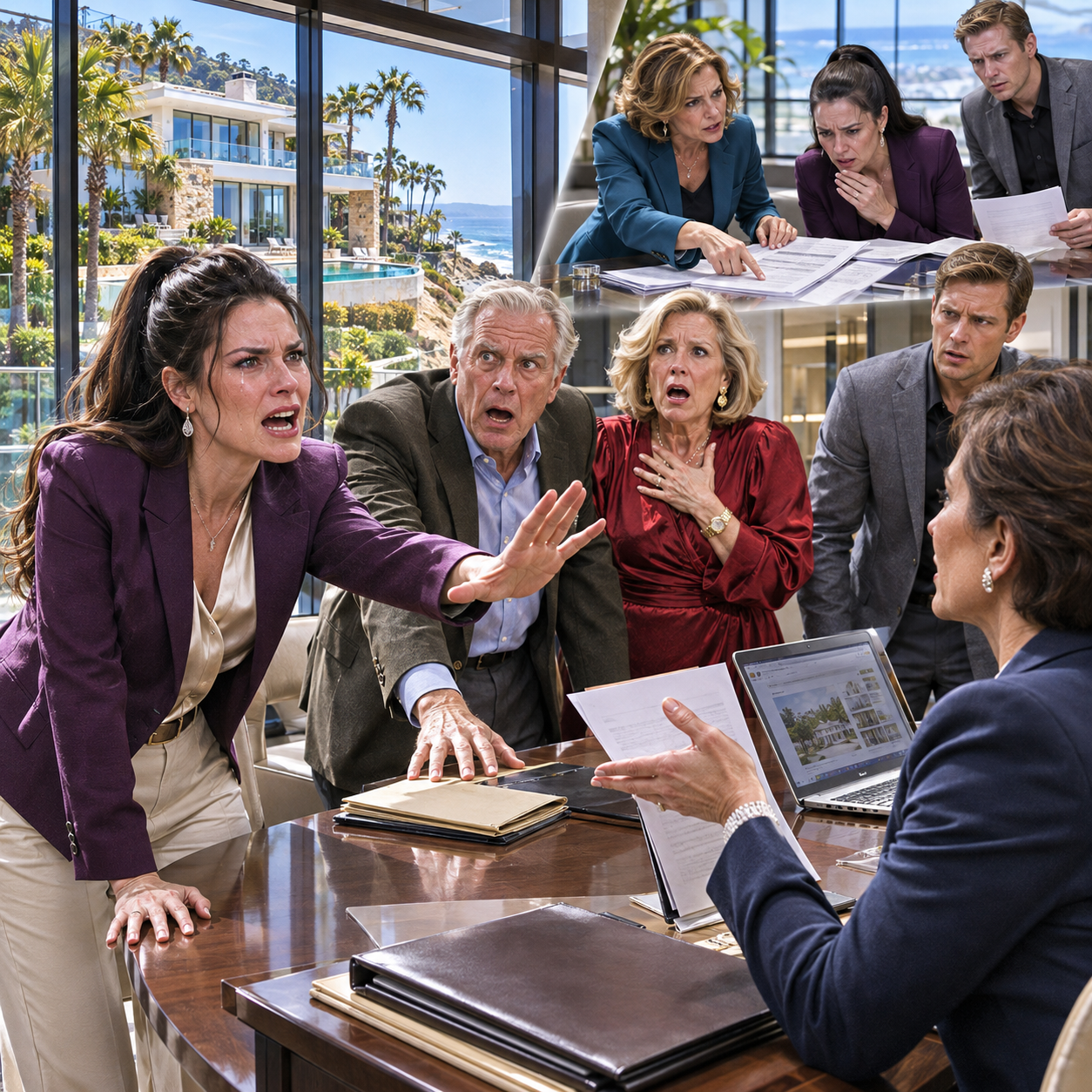
Lauren reopened the blue folder and turned the first document toward my father. “The Elwood J. Simmons Tamarack Lake Trust,” she read. “Dated May 14, 2018. Irrevocable.” Then she showed him a certified deed recorded several weeks later transferring the lake property from Grandpa personally into the trust.
McKenna finally put down her phone. “What does that mean?”
Dad answered before the lawyer could. “Nothing. Your grandfather was eighty. Riley got to him.”
Lauren’s expression hardened. “It means Elwood Simmons did not personally own this property when he died. The trust does.”
She moved her finger to the beneficiary clause.
Upon Grandpa’s death, the lake house passed to me.
If I died first or formally disclaimed my interest, then it would pass to Dad.
The entire room seemed to stop breathing.
My mother covered her mouth. McKenna stared at me. Dad shook his head and insisted he’d never seen the document.
Then Lauren read the property-tax receipts.
The bills had been mailed in the trust’s name for two years.
Dad and Mom had paid them from their own account.
“You’ve been paying taxes billed to the trust,” Lauren said.
“I paid Dad’s bills. Nobody reads the name line on a tax bill.”
“You read it,” I said.
That was all.
Lauren picked up the waiver she’d drafted and read one clause aloud: I would relinquish any interest I held by will, trust, gift, promise, or otherwise.
She looked at Dad.
“You asked me to draft a complete release from a trust interest after telling me, in writing, that no trust existed.”
Dad didn’t answer.
Lauren packed her briefcase.
“This meeting is over.”
She advised me to hire independent counsel and told me not to sign anything she had drafted. Then she left with the notary.
Dad followed me down the driveway.
“That house is mine,” he said. “That’s my father’s house.”
“If you own it,” I said, “you’ll have paperwork saying so.”
By the next afternoon, Heartland State Bank’s certified letter was waiting for him.
The bank had formally accepted its role as successor trustee. My parents had no lease, so they were instructed either to sign one at fair-market rent or vacate by October 31. The bank also demanded an accounting for the boat Dad had sold and warned that nothing else could be removed from the property.
Lauren sent me a separate letter ending her representation of Dad in all matters involving the lake.
At the bottom, she added one handwritten line.
I’m sorry for the letter I sent you.
Dad didn’t scatter Grandpa’s ashes that Saturday.
Instead, he left me a voicemail promising I would never see them if I didn’t give up the house.
The buyer backed out when Dad couldn’t deliver clear title and demanded the $15,000 deposit back. The problem was that Dad had already spent it rescuing McKenna’s business. Her bank had also granted a temporary forbearance based on Dad’s written promise that the property sale would close.
Now there was no sale.
McKenna drove four hours to see me at Lock and Dam 8.
She stood at the visitor overlook watching water drain from the chamber. “The bank’s calling Dad’s guarantee,” she said. “I’m going to lose both stores.”
“I’m sorry.”
“You could fix this.”
I knew what was coming.
“Borrow against the lake. It’s worth around six hundred thousand. You’d barely notice.”
“No.”
The same word I’d used two years earlier.
Her face collapsed.
“You planned this.”
I didn’t answer.
Then she said something I had never expected.
“My whole life, I’m the one somebody has to catch.” She wiped her face. “Pregnant at eighteen. Addie’s father gone. Dad paying for everything. You were the one nobody ever had to catch, and I hated you for it.”
For the first time, I heard my sister instead of my father’s argument coming out of her mouth.
“The store was the first thing I ever did that felt like mine,” she said.
“I know.”
“Then help me.”
“I’m not giving you the lake.”
She started to turn away.
“But Addie’s school year is a different conversation. Call me when you’re ready to have that one.”
She looked back at me for a moment.
Then she left.
A week later, Dad sued the trust.
His new lawyer claimed Grandpa had lacked mental capacity in 2018 and that I had manipulated an elderly man into cutting out his son. Attached as evidence was the 2023 document placing me on leave from work pending a psychological evaluation.
They conveniently omitted the later report clearing me completely.
Then I reached paragraph six.
Dad had signed an affidavit under oath stating that he first learned of the trust on September 18, 2025.
He swore Grandpa had never informed him about it.
I read that sentence five times.
Then I looked at the sealed envelope from Grandpa.
Across the front, in the same square handwriting as my folder, were the words:
For Sterling — if he ever says he didn’t know.
Chapter 4
The bank scheduled a settlement conference for October 21. Until then, Dad told relatives I’d manipulated Grandpa while he was elderly and confused. Some believed him because he’d spent two years preparing them to believe almost anything about me.
The family group chat filled with prayers for Dad. I remained silent.
Meanwhile, McKenna put EVERYTHING MUST GO signs in both boutiques. The bank inventoried the lake property. Dad initially changed the locks and refused entry, but once the trust attorney got involved, he backed down.
My parents began looking for somewhere else to live.
Then, nine days before the conference, Dad drove four hours to my apartment.
Grandpa’s urn was buckled into the passenger seat of his truck.
“Call the bank,” Dad said. “Give the house back.”
“No.”
“You can fix everything. McKenna’s stores. Your mother. Me.”
Then he nodded toward the urn.
“You can have him. Put him in the lake yourself.”
I stared at him.
“He’s not a bargaining chip.”
Dad’s face twisted. “Everything is a bargaining chip. He taught me that.”
Then his voice broke.
“You know what my own father told me when I was losing everything?”
“No,” I said.
Dad stared.
“I was in the boathouse. I was fourteen.”
Something changed in his face.
For a second, I thought he might finally tell me the truth.
Instead, he hardened again.
“Then you know what it’s like to be cut out by that man.”
He drove away.
Before the settlement conference, Thurman signed a notarized statement documenting both of Dad’s calls to my workplace. The original call that got me suspended had come weeks after I refused McKenna’s loan. The second came eight days before Dad expected me to sign away the lake.
At the conference, Dad’s new attorney began by describing Grandpa as confused and vulnerable. Then he pointed to my leave from the Army Corps as evidence that I had a documented mental-health history.
The bank’s lawyer, Mr. Brewer, quietly slid Thurman’s statement across the table.
He read Dad’s calls aloud.
Dad shifted in his chair.
“I was worried about my daughter.”
“Of course,” Mr. Brewer said mildly.
Then Dad’s lawyer emphasized paragraph six of the affidavit.
“My client never knew this trust existed.”
That was when I reached into my bag.
I put Grandpa’s sealed envelope in the center of the table.
Mr. Brewer read the handwriting aloud.
“For Sterling — if he ever says he didn’t know.”
Nobody moved.
“I’ve never opened it,” I said. “It isn’t addressed to me.”
Mr. Brewer looked at Dad’s attorney, who looked at Dad.
Then he used a letter opener.
Inside was a postal return receipt.
It showed a certified letter delivered to Dad’s old address in June 2018.
The signature belonged to Sterling Simmons.
My father’s attorney stopped taking notes.
There was also a copy of Grandpa’s letter.
Mr. Brewer read it aloud.
Grandpa told Dad he’d placed the lake property in trust for me and enclosed a copy of the recorded documents so there could be no confusion. He wrote that he understood Dad would be angry, but he would rather have his son angry than watch the lake disappear into another bank loan.
Then came the part that changed everything I thought I knew about my father and grandfather.
Grandpa wrote about 2009.
The $61,000 Dad believed his supplier had forgiven had not been forgiven.
Grandpa had paid it.
He’d secretly sent the supplier a cashier’s check covering Dad’s entire debt and instructed the company to tell Dad only that the balance had been written off.
Grandpa explained why.
I said no to your face because if I’d said yes, you’d have spent the rest of your life owing me. I wanted you to owe nobody.
A copy of the cashier’s check was inside the envelope.
Dad stared at it.
“He let me think he said no.”
His voice was barely audible.
Nobody answered.
Then Mr. Brewer continued reading.
Grandpa had included a provision allowing Dad to remain at the lake if I ever became legally unable to manage my own affairs. It was meant to protect me while ensuring Dad would still have a roof over his head.
I felt cold.
Dad had known about that clause for seven years.
Then, in 2023, after I refused McKenna’s loan, he began telling people there was something wrong with me.
He called my employer.
He told relatives.
He convinced hospice staff that I shouldn’t be allowed near Grandpa.
He repeated the story until the label became familiar enough to sound true.
It had never been about concern.
Calling me unstable created a path to controlling the trust if I could be made to look incapable.
My refusal to fund McKenna’s store had simply given him the first opportunity to start building that story.
Dad’s attorney closed his legal pad.
“I need a few minutes alone with my client.”
The lawsuit was withdrawn that afternoon.
Later, a judge ordered Dad to pay thousands of dollars toward the trust’s legal expenses because of his false affidavit.
Paragraph six became the most expensive sentence he’d ever written.
As I waited for the elevator, Mom stepped into the hallway.
“I wrote that message,” she said.
I looked at her.
“The family chat. About your mental health. Your father asked me to, and I did.”
She swallowed.
“I’m not asking you to forgive me.”
“Okay.”
“My father drank. When I was little, I learned that if you never challenged the man in the house, the house stayed standing. I thought that’s what keeping a family together meant.”
I looked at her.
“I was in that house too, Mom.”
The elevator doors opened.
I stepped inside.
She stayed behind.
Chapter 5
Two days later, I met Donna at Tamarack Lake to walk through the property as the beneficiary. While we were checking the boathouse, I heard bicycle tires crunching down the gravel drive. Addie appeared in a purple raincoat, dropped her bike in the grass, and walked carefully toward me carrying a mason jar full of coins and folded bills.
“It’s $31.85,” she said. “I counted twice.”
I knelt so we were eye level.
“What is it for?”
“Can I buy Grandma and Grandpa’s room back?”
My chest tightened.
She explained that Grandpa Sterling said my parents had to leave because I was sick and didn’t know what I was doing. If I was better now, she reasoned, maybe thirty-one dollars and eighty-five cents would let them stay.
Then she pulled the little chipped wooden loon from her pocket.
“I can give you this too.”
I pushed the jar gently back toward her.
“I’m not taking your money.”
Her chin began to tremble.
“Then I have to tell you the other thing.”
She spoke quickly, as if she’d been carrying the words too long.
Before Great-Grandpa died, he’d made her practice a message for me. Dad had later told her not to deliver it because seeing me would supposedly make my illness worse.
“What did Grandpa want you to say?”
Addie closed her eyes like a child reciting something for school.
“Tell Riley I waited. Tell her I wasn’t mad. And tell her the loons are hers to keep.”
For months, I’d stayed composed through lawyers, lies, bank letters, accusations, and my father’s threats.
I couldn’t stay composed then.
I sat down on the cold dock and cried.
When I could speak, I took the carved loon from Addie’s hand.
“I’m not sick, honey.”
She studied me.
“I never was.”
“Then where were you?”
“At work.”
Addie nodded slowly, accepting the answer with the seriousness children sometimes have when adults have made simple truths unnecessarily complicated.
Donna stood at the end of the dock, politely pretending to examine her clipboard.
I asked whether the trust could allow McKenna and Addie to live in Grandpa’s little bunkhouse through the end of Addie’s school year.
“What rent?” Donna asked.
“One dollar a month.”
“And your parents?”
“They move out on schedule.”
Donna wrote it down.
“That can be arranged.”
When I called McKenna, she was silent long enough that I thought the line had disconnected.
“Why?” she finally asked.
“It’s Addie’s third-grade year.”
“This isn’t forgiveness.”
“I know.”
She moved into the bunkhouse with Addie after both stores closed. On the first day of every month, she put one dollar in an envelope and handed it to me. She never missed a payment.
Mom called a few days later.
“Your father wants to scatter Grandpa tomorrow,” she said. “At the dock.”
There was a pause.
“He asked me to ask you.”
Another pause.
“He asked me to say please.”
The next morning was cold enough for winter coats. My aunt came. McKenna stood with Addie near the shoreline, and Mom stayed on the lawn with both hands in her pockets.
Dad walked down the dock carrying Grandpa’s urn in both arms.
At the end, he tried to speak.
“Dad was…”
Nothing came after that.
He tried again.
Addie watched him for a moment, then spoke in the plain voice children use when they aren’t trying to wound anyone.
“You told Great-Grandpa she didn’t want to come. I heard you in his room.”
Dad looked at her.
“She came,” Addie said.
Then she let go of McKenna’s hand and walked over to me.
Dad stared at Grandpa’s urn for a long time.
Finally, he held it out.
I took it.
Addie and I knelt together at the end of the dock. We opened the box and slowly let Grandpa return to Tamarack Lake until the container was empty and the water became smooth again.
After everyone walked back toward the cabin, I stayed on the dock.
From my wallet, I removed the one document from Grandpa’s tackle box I’d never shown anyone.
It was a single sheet written on the back of an old feed-store receipt.
Riley, if you’re reading this, somebody has asked you to sign something about the lake. Don’t. And don’t let anybody tell you that you need watching. You never did. You are the steadiest person I have ever known. I’m sorry I won’t be there to say it to their faces. Love, Grandpa.
I read it aloud to the lake.
A week later, my parents handed the bank the house keys and moved into a rented duplex in Rhinelander. Dad sold his truck, emptied much of his retirement account, returned the buyer’s deposit, paid the trust back for Grandpa’s boat, and settled the bank guarantee tied to McKenna’s failed business.
Mom went back to work.
Then she posted something in the same family group chat where she’d once announced I was mentally unwell.
Riley was never unwell. I said she was because I was asked to, and I let it stand because it was easier. I’m sorry to her and to all of you.
Nobody reacted with hearts.
Nobody argued either.
I eventually bought Grandpa’s fishing boat back from the man Dad had sold it to. He gave me the canvas hat too.
At work, Thurman handed me a posting for lead operator.
Across the top he’d written in pencil, About time.
By spring, Tamarack Lake belonged to me outright.
The ice came off in late April. Addie called me at six one morning to announce it as if she had personally arranged the thaw.
The first weekend in May, we sat together at the end of the rebuilt dock.
Then we heard them.
Loons.
Two came around the point, then a third, black against the morning water with white markings bright along their necks.
“There,” Addie whispered. “They came back.”
“They always do.”
Grandpa’s green boat was tied beside us. The old outboard started on the second pull, and Addie climbed into the back seat wearing Grandpa’s fishing hat pulled down over her ears.
The red tackle box sat near my feet.
There were no papers under the false bottom anymore. Addie kept her fishing jigs there now, mostly pink and glittery and terrible for catching anything. The chipped wooden loon was wrapped in a sock beside them.
Once we were away from shore, I let her take the tiller.
She steered in a crooked circle while I reminded her to give the birds plenty of room.
“When I grow up,” she said over the motor, “I want your job.”
I smiled. “Do you even know what my job is?”
She thought seriously about it.
“You make a whole river hold still until it’s safe.”
I looked across the lake.
“That’s pretty close.”
Dad came to Tamarack once that spring.
He didn’t call ahead.
He parked across the road beneath the white pines and stood beside his car for nearly ten minutes looking down toward the dock. I didn’t wave him away, but I didn’t invite him down either.
Eventually, he got back into the car and left.
Addie asked who it was.
“Your grandpa.”
“Oh.”
Then she returned to sorting her fishing jigs.
I think that’s where the story ends.
Not with everyone forgiven.
Not with the family restored to what it was before.
Some things shouldn’t be restored exactly as they were.
For two years, I rarely fought the word unstable. Every time I defended myself too forcefully, Dad could point to the reaction and say, See? That’s what I’m talking about.
That’s the trap with labels like difficult, dramatic, unstable, selfish, or unwell.
The defense becomes evidence.
Grandpa understood something I didn’t.
Being steady isn’t the same as being silent.
At Lock and Dam 8, thousands of tons of water press against steel gates every day. My job isn’t to fight the river or pretend the pressure isn’t there.
I hold it.
I watch it.
I wait until the conditions are right.
Then I open the gates.
The water goes exactly when it’s safe to let it go.
Not when someone threatens me.
Not when someone calls me selfish.
Not when someone tells the world I’m unstable because they need me to doubt myself.
Exactly when I choose.
THE END.
⚠️ All characters and events are fictional. Do not imitate or apply them in real life. 😌😌😌