### Part 2: I Left for Christmas and an Unexpected Phone Call Exposed Everything
On December 20, I rolled my suitcase down the stairs just after breakfast. Hugh had already left for work, and Carla sat at the kitchen table surrounded by disposable serving trays, shopping lists, and delivery confirmations. I reminded her that the plumber’s number was on the corkboard and that the garbage needed to go out Thursday morning. She barely looked up until she realized I was wearing my traveling coat.
“You’re actually leaving?” she asked, staring at my suitcase. “I told you I was going,” I replied, reaching for my keys. Suddenly, her expression changed. “But who’s going to help me with the turkey?”
I told her the instructions were on the packaging and that she could find plenty of cooking advice online. She opened her mouth, but I wished her a Merry Christmas before she could turn another responsibility into mine. Outside, the taxi driver lifted my suitcase into the trunk, and I climbed into the warm back seat. As we merged onto Highway 417 toward the airport, I watched the familiar streets disappear behind us.
My friend Blanche had been inviting me to Cape Breton for years. Three years earlier, she’d retired to a little house near the Bras d’Or Lakes, where she promised the silence could make a person remember who she was. I had always found an excuse not to visit because someone at home needed something. This Christmas, for the first time, nobody else’s needs were going to determine where I spent my holiday.
Blanche opened her front door wearing a flannel shirt and thick wool socks. She handed me a steaming mug before I’d even removed my boots. The house smelled of baking bread and woodsmoke, and beyond the kitchen window, the lake stretched gray and peaceful beneath the winter sky. “You look exhausted,” she said, taking my coat, and I laughed because she hadn’t even heard the story yet.
For two days, I barely touched my phone. We walked along the shoreline, read beside the wood stove, and drank Nova Scotia white wine while talking about everything except the house I’d left behind. At night, I slept so deeply that I sometimes woke confused by the unfamiliar quiet. I hadn’t realized how long I’d been living with my shoulders tightened against the next demand.
On the third day, my phone began vibrating across the table. Hugh had texted at 9:47 that morning, asking where the big roasting pan was. At 10:12, he asked again, and by noon, Carla had joined the search. One message from Hugh read, “Mom, we have a twenty-two-pound turkey sitting on the counter. Please tell us where the pan is.”
I continued scrolling. Carla wanted to know whether I’d taken the roasting pan with me, which would have required carrying it halfway across Canada. Later, she reported that an upstairs toilet was running and complained that she couldn’t get into my locked bedroom to reach a shutoff valve she assumed was inside. At eight that evening, Hugh sent the shortest message of all: “This is a lot harder than we thought.”
I sat beside Blanche’s window with my coffee, remembering eleven months of meals that seemed to prepare themselves, bathrooms that somehow stayed clean, and groceries that appeared without anyone asking who paid for them. Then I typed a single reply. “The roasting pan is in storage with some other kitchen things. Home Hardware sells roasting pans, and the grocery store has disposable ones. Merry Christmas.”
Blanche read the message over my shoulder and quietly poured another glass of wine. She didn’t congratulate me or suggest anything else I should do. She simply said she was glad I’d finally come east. I was beginning to understand that friendship sometimes looked like a warm room where nobody expected you to earn your place.
That evening, December 22, my phone rang again. The number was from Alberta, and when I answered, a measured woman’s voice said, “Jacqueline? This is Suzette, Carla’s mother.” I welcomed her and asked whether she’d had a comfortable flight from Edmonton. She thanked me, but something about the long pause that followed made me sit upright.
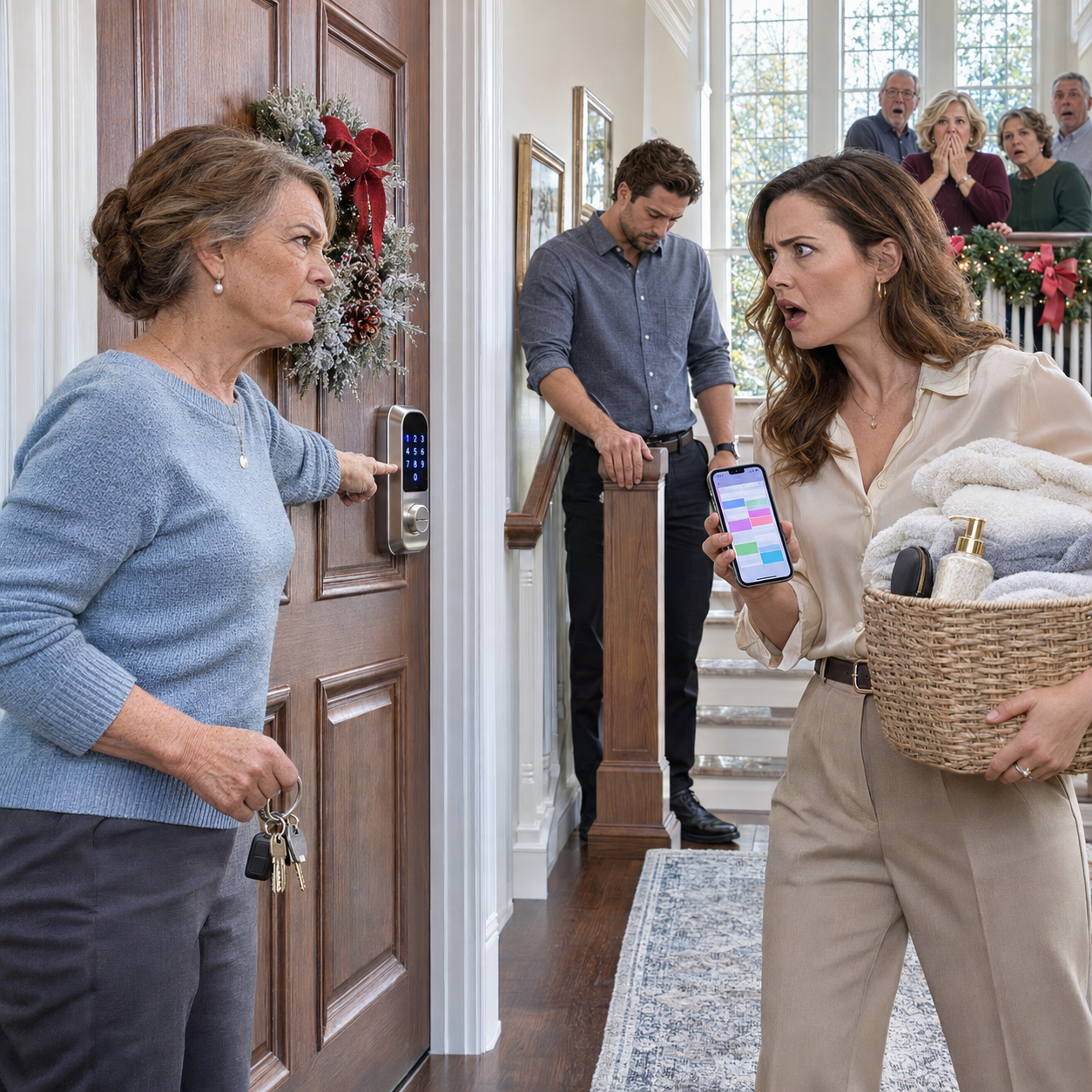
“I’m standing in the upstairs hallway,” she said. “There’s a keypad on what Carla tells me is her master bedroom, and I need to ask you something.” I explained that I had installed the lock before leaving, but Suzette interrupted gently. “Carla says the previous owners put it there during an old renovation. I don’t believe her.”
I heard footsteps behind her, then a door closing. When Suzette spoke again, her voice had become very quiet. “Jacqueline, whose house is this?”
I moved to the staircase so Blanche wouldn’t overhear and told her everything. I had owned the property for seventeen years, and Hugh and Carla were staying temporarily because of their financial difficulties. I explained the original six-month arrangement, the bedroom dispute, and my decision to spend Christmas away. Suzette listened without interrupting.
For several seconds, I heard nothing but her breathing.
Then she said, “She told me they bought this house.”
My fingers tightened around the phone. Suzette explained that she and her husband, Gary, had flown from Edmonton believing they were celebrating their daughter’s first home. She had even brought a housewarming gift. As she spoke, I realized Carla hadn’t simply taken credit for decorating my house.
She had invented an entirely different life and invited her family to celebrate it.
### Part 3: The Truth Shattered Christmas and Forced My Son to Choose
I stayed on the staircase while Suzette waited for me to respond. Through Blanche’s window, I could see snow beginning to gather along the branches of a spruce tree. I told Suzette that I was sorry she’d been misled and that I didn’t blame her for believing her daughter. She exhaled sharply and said, “Thank you for telling me the truth, Jacqueline. I’ll handle the rest from here.”
When the call ended, I remained seated for a long moment. I had expected Carla to complain about me, perhaps even describe me as difficult or selfish. I had never imagined she would tell her own mother that she and Hugh owned a home they hadn’t purchased. The woman who wanted to put me on a basement couch had apparently erased me from the story of my own house.
Blanche found me sitting on the stairs and handed me my wine without asking questions. When I finally told her what had happened, she listened with a troubled expression. “Being ashamed of needing help is one thing,” she said. “Pretending the person helping you doesn’t exist is something else.” I carried those words with me throughout the holiday.
Christmas Eve at Blanche’s was simple and wonderful. We roasted a small chicken with root vegetables, opened sparkling wine, and played two rounds of cribbage beside the wood stove. Snow drifted past the windows as the clock crept toward midnight, and I thought about how much money and effort people spent trying to manufacture the kind of peace we already had. For once, I wasn’t responsible for keeping everyone else happy.
I called Hugh that evening, but he didn’t answer. I left a warm voicemail wishing him a Merry Christmas and telling him I loved him. At 11:52 p.m., a message appeared on my phone: “Mom, it’s been a rough night. Call when you can.” I didn’t call immediately because I suspected he needed a little time to face what had happened without asking me to fix it.
On Christmas morning, I sat beside the window with my coffee and dialed his number. Hugh answered on the second ring, sounding as though he hadn’t slept. “Mom,” he whispered, “Suzette knows everything.” I waited while he gathered himself, and then he told me about the confrontation that had followed her phone call.
Suzette had asked Carla directly whether she and Hugh owned the house. Carla tried to explain that they’d been living there long enough for it to feel like theirs, but her mother refused to accept that answer. According to Hugh, Suzette placed the housewarming gift on the kitchen table and asked why she had been invited across the country to celebrate a purchase that had never happened. Hugh said the silence afterward had been unbearable.
The argument lasted for hours. Suzette had been calm, almost painfully so, asking questions Carla could not answer without admitting another lie. Three relatives eventually moved into a nearby hotel because the atmosphere had become impossible. Hugh admitted that he’d sat through most of it feeling ashamed, not only of Carla’s behavior but of his own refusal to intervene months earlier.
Then came the Christmas dinner disaster. The turkey had cooked unevenly, overdone on the outside and underdone in the middle, and nobody knew how to rescue it. With the kitchen in chaos and the refrigerator nearly empty, they’d ordered delivery from Swiss Chalet on Christmas Eve. Hugh described the meal without laughing, though I could almost picture the abandoned roasting trays on the counter.
“I’m sorry, Mom,” he finally said. “Not just about Christmas. About everything.” I watched the snow slide from Blanche’s porch railing while he continued. “I knew Carla was starting to treat your house like ours, and I kept thinking it would be easier to let things go than have another argument.”
I asked him why he hadn’t defended me when Carla announced she was taking my bedroom. He was quiet for a moment before answering, “Because I didn’t want to fight with my wife.” I closed my eyes, remembering the boy who once ran to me with every scraped knee and broken toy. “Hugh,” I said, “you avoided a fight with her by letting her fight with me.”
He didn’t argue. Instead, he began crying quietly, something I hadn’t heard him do in years. He admitted that his business troubles had left him embarrassed and afraid, and that Carla’s need to appear successful had become something he stopped questioning. “We really made a mess of this, didn’t we?” he asked.
“Yes, sweetheart,” I answered. “You did.”
I wasn’t trying to punish him. I wanted him to understand that I loved him enough to tell him the truth, even when it hurt us both. I told him we would sit down properly when I returned in January, and he promised we would. After the call, I put on my coat and joined Blanche for a walk beside the frozen shoreline.
For the rest of my visit, I stopped checking my phone every few minutes. I didn’t need to hear every new argument or learn whether the turkey leftovers had been salvaged. Those problems belonged to the adults who had created them. Mine was the harder task of deciding what love would look like when I finally went home.
### Part 4: I Came Home to an Apology but Chose Freedom Instead
I returned on January 3 and found the house cleaner than I’d expected. Hugh and Carla had clearly worked hard to restore order after their guests left, though a faint scorch mark remained on the oven door. The upstairs hallway smelled stale, like a hotel room after too many people had occupied it. I carried my suitcase through the front door and felt a strange mixture of relief and apprehension.
Carla was sitting at the kitchen table when I walked in. She looked exhausted, with dark circles beneath her eyes and none of the confidence she’d displayed while planning Christmas. “Hi, Jacqueline,” she said quietly. I placed my keys on the counter and replied, “Hello, Carla.”
She stood, then sat again, twisting her hands together. “I owe you an apology,” she began, and the words came quickly, as though she feared losing her courage. She admitted she’d been deeply embarrassed that she and Hugh needed financial help, especially when friends and relatives seemed to be buying houses and moving forward with their lives. The longer she pretended they were doing well, the harder it became to tell the truth.
“I wanted Mom to be proud of us,” she whispered. “I told her we’d bought the house, and then I had to keep pretending. I know it was wrong.” Her eyes filled with tears, but for the first time, she didn’t look away from me. “And asking you to give up your bedroom was cruel. I’m sorry.”
I didn’t rush to comfort her or pretend the apology erased what had happened. I appreciated her honesty, and I told her so. But the problem was bigger than Christmas, bigger than her mother, and bigger than an ill-advised lie. For eleven months, I had allowed my home and my generosity to become things other people felt entitled to control.
“Carla, I accept that you’re sorry,” I said. “But this living arrangement isn’t working anymore. You and Hugh need to find your own place, and I need you moved out by the end of January.”
Her face crumpled. She explained that they didn’t have enough saved for the first and last month’s rent and that finding an affordable apartment in Ontario was almost impossible. I knew the rental market was brutal, and part of me wanted to rescue them from another difficult decision. But I remembered the basement couch, Hugh’s silence, and a woman in Edmonton believing her daughter owned the house where I had buried my husband.
“I understand it’s hard,” I told her. “The deadline is still the end of January.”
Hugh came home that evening, and we sat together at the kitchen table for nearly two hours. We discussed his struggling business, their finances, and how a temporary arrangement had quietly become permanent in everyone’s mind except mine. He admitted that he’d recognized the growing disrespect but had avoided confronting it because he was afraid of another argument. This time, he didn’t offer excuses or ask me to make things easier.
“I thought keeping the peace meant staying out of it,” he said. I looked at him across the table and shook my head. “Peace that depends on someone else swallowing every insult isn’t peace, Hugh.” He rubbed his eyes and nodded, and I knew he understood. I told him I loved him, but love wasn’t a promise that I would always be the person who sacrificed.
The weeks that followed were difficult, but surprisingly quiet. Hugh and Carla searched rental listings, cut unnecessary expenses, and began making plans they should have made months earlier. Suzette, I later learned, had refused to lend them money, insisting that she and Gary would not finance another attempt to appear more successful than they were. Eventually, Hugh and Carla found a small one-bedroom apartment in Kanata and signed the lease without asking me to co-sign.
They moved out on January 29.
That morning, I helped carry boxes to the moving van. Hugh worked silently, lifting furniture and checking that nothing had been left behind, while Carla made one final trip through the kitchen. When the last box was loaded, my son wrapped his arms around me and held on longer than he had in years. Neither of us spoke, but I could feel the apology in the way he hugged me.
Carla stood beside the van with her purse over her shoulder. “Goodbye, Jacqueline,” she said, meeting my eyes instead of looking past me. I wished them both well, and I meant it. I wanted their marriage to survive, their finances to recover, and their new apartment to become a home they could genuinely call their own.
I watched the van disappear around the corner before walking inside and locking the front door.
For several minutes, I stood in the silent kitchen. There were no shopping lists spread across the counter, no unfamiliar voices upstairs, and no expectation that I would prepare dinner for three. I could hear the furnace running and the faint ticking of the clock above the stove. The quiet felt almost unfamiliar.
Then I walked upstairs to my bedroom.
The steel keypad was exactly where I’d left it. I entered my code, heard the familiar click, and stepped into a room that smelled faintly of cedar and my own belongings. My husband’s keepsakes rested where they belonged, and the blankets on the bed were folded exactly as I’d left them before Christmas. I sat on the mattress and ran my hand across the quilt.
For a moment, I considered calling the locksmith to remove the keypad. Hugh and Carla were gone, after all, and the lock had served its purpose. But as I looked around the room, I realized something I hadn’t understood when I first installed it.
The lock had never really been about keeping my family out. It was about the moment I finally stopped allowing other people to decide how much of myself I was required to give away.
I left it there.
Downstairs, I made myself a proper breakfast: two eggs, buttered toast, and the good coffee I’d brought home from Cape Breton. I sat at my kitchen table while pale winter sunlight reached across the floorboards. Outside, the cedar hedge needed trimming, the spare bedrooms needed airing, and the mortgage still had two years left before it was paid off.
Those responsibilities hadn’t disappeared. But they no longer felt like burdens imposed on me by someone else’s expectations.
I thought about Hugh as a little boy, how I’d taught him to tie his shoes and ride a bicycle, always knowing that my job was to help him stand on his own two feet. Somewhere along the way, I’d confused helping him with protecting him from every consequence. It had taken one uncomfortable Christmas, a locked bedroom, and a woman brave enough to ask whose house she was standing in to make me see the difference.
I still loved my son. I hoped Carla would become the woman her apology suggested she could be. And I knew that forgiving them didn’t require handing back the keys to every corner of my life.
For seventeen years, I had worked to keep that house standing.
That morning, sitting alone with my coffee, I finally understood that I deserved to live in it, too.
THE END.
All characters and events in this story are fictional, created for storytelling and entertainment purposes. Thank you sincerely for reading. Your feedback and support are invaluable and motivate me to continue sharing more stories with you.