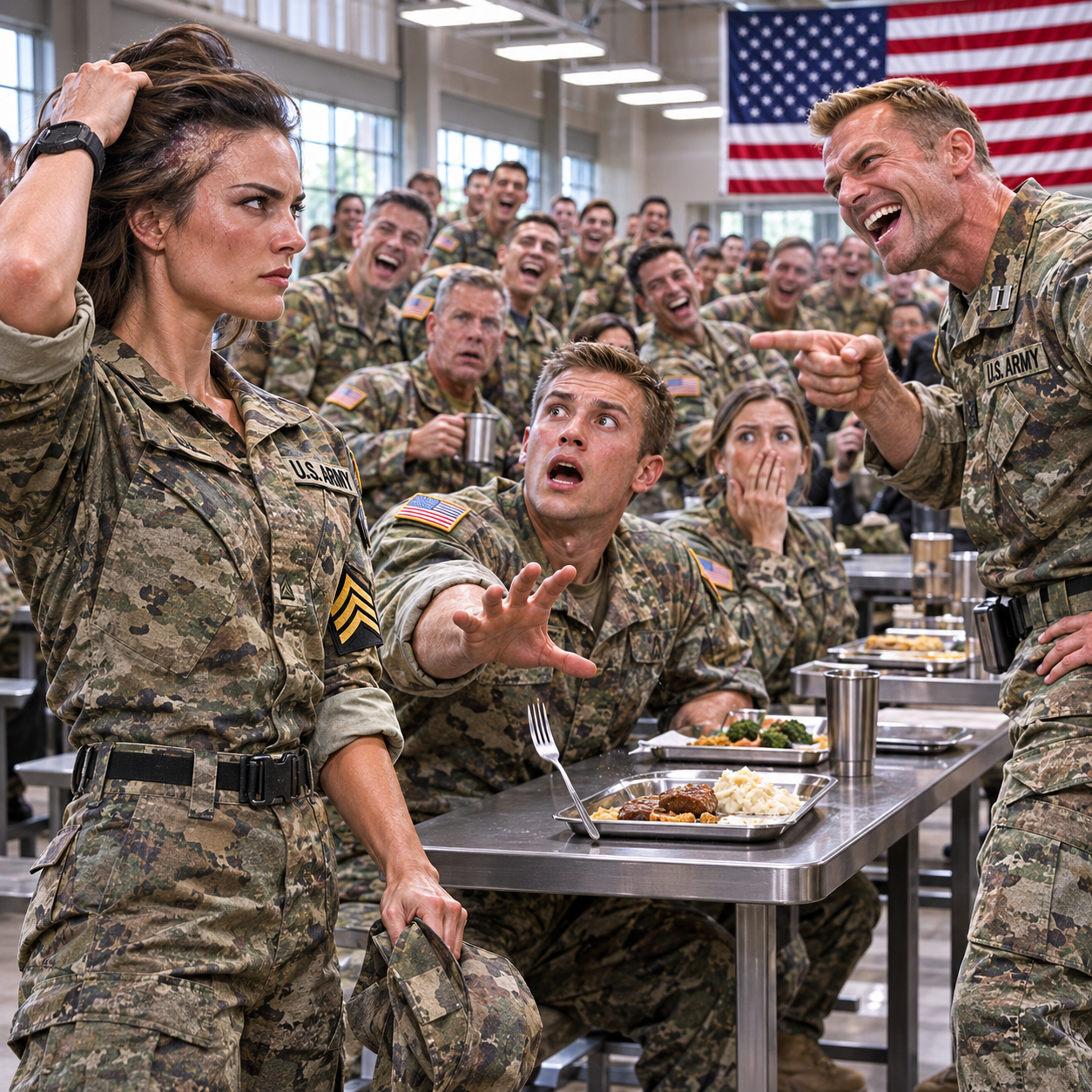
“Cover Off Indoors, Sergeant. Or Is That Hat Holding Up A Bad Haircut?” The Major Joked. Forty Soldiers Laughed. I Took My Cap Off. I Pushed My Hair Back, The Way He Wanted. The Private At The Table Dropped His Fork. The Major Kept Smiling. “Better.” “Sir, Don’t Make Her Say It.”
The major ordered me to remove my cap in a crowded Army dining hall, then laughed when he saw what my hair had been hiding for eight years. I followed his order, accepted the humiliation, and refused to explain myself to the room. Five weeks later, I climbed into a live-fire control tower and found that same officer unable to speak. His left hand was making a movement I recognized immediately. What happened next exposed something far more dangerous than my scar.
## Part 1
The first thing I noticed about Major Everett Calder was that he never entered a room without looking for something wrong. A crooked name tape, an untucked shirt, a soldier leaning against a wall—nothing escaped him. He had been our battalion executive officer at Fort Stewart, Georgia, for less than three weeks when he decided my patrol cap was the problem worth addressing in front of forty hungry soldiers.
It happened on a Thursday in late September, just before noon. I was standing in the dining facility line with a tray of grilled chicken, green beans, and mashed potatoes that had already developed a skin under the heat lamps. My name is Mara Kessler, and at thirty-eight, I was a sergeant first class with seventeen years in the Army. I had spent three of those years training recruits at Fort Jackson, where I taught young soldiers to follow regulations before they understood why those regulations existed.
One of those regulations was simple: remove your headgear indoors unless an exception applies.
I knew the rule better than most.
I was also breaking it.
For almost a year, I had developed the habit of keeping my cap on until I reached a seat or somewhere nobody was paying attention. My previous supervisors had overlooked it, perhaps assuming I had an explanation. Some probably thought a senior noncommissioned officer deserved a little latitude.
Major Calder didn’t believe in latitude.
“Sergeant First Class,” he called from behind me.
I turned carefully, balancing my tray against my hip. Calder stood near the beverage station with two lieutenants and our operations officer. His uniform looked freshly pressed, and he carried the same black binder he brought to every meeting.
“Sir?”
“Is there a reason you’re wearing your cover inside my dining facility?”
Several soldiers looked up.
“No, sir.”
He smiled.
“Well, take it off before somebody mistakes you for the building’s new roof inspector.”
The lieutenants laughed, followed by a few soldiers near the cashier. Calder seemed pleased with himself, and I could almost hear the lesson he believed he was delivering: standards apply to everyone.
I set my tray down and removed the cap.
My hair was pinned into a regulation bun, with a narrow section deliberately brushed forward along my left temple. I had learned to arrange it that way without looking in a mirror.
Calder noticed.
“And while you’re correcting things, Sergeant, let’s get that hair away from your ear.”
I looked directly at him.
“Yes, sir.”
I could have asked to speak privately. I could have explained that the hair covered an injury. Instead, I reached up and moved it back.
The scar began just above my left ear and curved across my temple before disappearing into my hairline. It was pale and uneven, with a narrow patch where the hair had never grown back. Underneath was a titanium plate covering an area of missing skull bone.
The dining hall became quiet.
I noticed the silence before I noticed anyone’s expression.
The civilian cashier stopped entering a price. A specialist near the salad bar lowered his fork. At a nearby table, a young private first class stood so suddenly that his chair scraped against the floor.
I recognized him immediately.
Private First Class Jonah Bell.
Fifteen months earlier, he had been one of my trainees at Fort Jackson.
“Sir,” he said, his voice tight, “please don’t make her explain that.”
Calder turned toward him.
“Explain what, Private?”
Bell swallowed and looked at me.
I shook my head slightly.
“Sit down, Bell.”
He remained standing for another second before obeying.
Calder looked back at my temple, and his smile disappeared.
“What happened to your head, Sergeant?”
The question wasn’t cruelly delivered, but forty people were listening. That made the difference between curiosity and humiliation.
“Combat injury, sir. Titanium cranial plate.”
His eyes moved along the scar.
“How long ago?”
“Eight years.”
He took one small step backward, reaching for the edge of a nearby bench. I thought he might ask another question, but instead he lowered himself onto the seat and stared at his hands.
Something about the movement bothered me.
Not his decision to sit down.
The way his left fingers pressed against his thigh, one after another, as though he were checking whether they still obeyed him.
“Carry on,” he said quietly.
I picked up my lunch, paid the cashier, and walked to an empty table beside the windows.
The chicken was cold when I finally took a bite.
I had survived worse things than being embarrassed in a dining hall. But I had never felt so exposed while surrounded by people wearing the same uniform I did.
Eight years earlier, I had nearly died on a road outside an American outpost in eastern Afghanistan.
I was a staff sergeant then, leading a small logistics convoy delivering fuel, bottled water, and replacement parts. Our vehicles had traveled that route so often that I knew which stretches flooded after heavy rain and where local children sometimes appeared beside the road.
The explosion came just before sunrise.
I didn’t hear it clearly. I felt the force through the floor of the truck, followed by a violent sideways motion that threw me against the cab.
When I regained awareness, I was lying in the dirt with my helmet missing.
My driver, Specialist Leah Vance, was trapped inside the vehicle. Smoke was pouring through the damaged passenger compartment, and she was shouting for someone to release her harness.
I crawled back toward the truck.
I remember cutting the strap, pulling Leah across my shoulder, and stumbling away from the spreading fire. I remember setting her down behind a low concrete barrier.
Then something struck the left side of my head.
I woke up several days later in a military hospital in Germany.
Leah survived without permanent injuries. Every member of our convoy came home, though two required lengthy rehabilitation.
I wasn’t as fortunate.
The doctors had removed damaged bone to relieve swelling. Later, surgeons reconstructed part of my skull. I recovered my speech, learned to walk without losing my balance, and spent months convincing doctors that I could still do useful work.
Then came the episodes.
Sometimes I smelled something burning when nothing was there. Sometimes an ordinary conversation suddenly disappeared, leaving me confused about what had happened during the missing seconds.
A neurologist explained that the injury had caused a seizure disorder.
My military future became uncertain almost overnight.
With treatment, monitoring, and a carefully reviewed medical waiver, I eventually returned to limited duties. My restrictions were specific, and I followed them because I understood what could happen if I didn’t.
But I learned another lesson during those years.
People could respect a combat injury and still become uncomfortable around the person carrying it.
They praised my service until they heard about the neurological consequences. Then their eyes drifted toward the nearest chair, the closest exit, or the paperwork that might transfer responsibility somewhere else.
So I covered the scar.
At first, it was simply easier.
Eventually, it became automatic.
That afternoon, after the dining hall incident, I returned to the ammunition section and found a young specialist waiting with a stack of inventory forms.
“Sergeant Kessler,” he asked cautiously, “are you okay?”
I accepted the paperwork.
“Do the ammunition counts match?”
“Yes, Sergeant.”
“Then we’re having a good day.”
He nodded, relieved to have something ordinary to discuss.
I thought the incident was finished.
At 4:35 that afternoon, however, a message arrived directing me to report to Major Calder’s office the following morning.
Attached was a revised duty roster.
My name had been removed from the live-fire safety assignment I had held for months.
And beside my replacement assignment, someone had typed two words:
Medical review.
## Part 2
Major Calder’s office overlooked the motor pool, where rows of military trucks stood beneath the morning sun. His black standards binder occupied the center of his desk, perfectly aligned with the edges. Beside it sat a white coffee mug, a small stack of counseling forms, and a photograph of two children standing in front of a Christmas tree.
“Close the door, Sergeant Kessler.”
I did.
He gestured toward the chair, but I remained standing.
“Yesterday’s incident wasn’t handled appropriately,” he began.
I waited.
“I shouldn’t have made a joke in front of the dining facility. That was unnecessary.”
“Understood, sir.”
He pushed a counseling form across the desk.
“However, your uniform violations were legitimate. I corrected two junior soldiers for similar issues last week, and I won’t enforce one standard for them and another for you.”
I read the form.
It documented improper indoor headgear and hair that failed to meet the prescribed appearance standard. The language was factual, and nothing in it mentioned my injury.
“I agree, sir.”
That surprised him.
“You do?”
“Yes. I knew the regulation. I should have addressed the situation through the appropriate medical and command channels instead of expecting people to overlook it.”
He watched me sign.
For the first time since meeting him, I saw something resembling uncertainty on his face.
Then he opened another folder.
“There’s a separate issue concerning your upcoming range assignment.”
I already knew.
“Your medical profile prohibits working at certain heights without additional safeguards. The control tower catwalk is nine feet above ground level.”
“Yes, sir.”
“I’ve reassigned you to ammunition accountability behind the tower. Staff Sergeant Talia Chen will take over your line safety duties.”
“May I speak freely?”
“Go ahead.”
“I’ve worked firing ranges under this profile for years. When an elevated position is required, I coordinate the necessary support. My medical team has reviewed my duties repeatedly.”
He closed the folder.
“I’m not questioning your work ethic. I’m responsible for following your documented restrictions, and the current roster doesn’t provide the required safeguards.”
His reasoning wasn’t unreasonable.
That made it harder.
The situation could have been resolved through a conversation with the medical office and a revised safety arrangement. Instead, he had looked at my scar, looked at my file, and quietly decided the safest place for me was somewhere out of sight.
“Roger, sir.”
As I turned toward the door, his coffee cup slipped from his hand.
It barely moved, just enough to strike the desk.
He caught it with his right hand while his left remained pressed against his thigh.
“Something wrong, Sergeant?”
“No, sir.”
I left before he could ask anything else.
Outside, I sat in my truck for several minutes without starting the engine.
I wasn’t angry that Calder expected me to follow regulations. I was angry that his concern had begun only after the dining hall incident, despite my medical profile having been available to the unit from the beginning.
For the rest of the morning, I buried myself in ammunition records.
There were discrepancies in the previous month’s brass returns, a broken seal on a storage container, and several forms that needed correcting before the next inspection. It was tedious work, which suited me.
Just after lunch, Jonah Bell appeared beside a parked fuel truck.
“Sergeant Kessler?”
“Bell.”
He stood at parade rest.
“I wanted to apologize for yesterday.”
“Why?”
“Because you told us not to talk about your injury.”
I remembered the day he learned about it.
During training at Fort Jackson, Bell had slipped while carrying equipment through a muddy obstacle course. He collided with me hard enough to knock off my campaign hat and loosen the pins securing my hair.
He saw the scar.
Later, after asking permission to speak privately, he told me his older sister had suffered a serious head injury in a car accident. He recognized the shape of the surgical scar because he had helped care for her during recovery.
That evening, I spoke to my platoon about why people sometimes carried injuries that weren’t immediately visible.
I told them only what I wanted them to know.
And I asked them to respect that boundary.
“Yesterday,” Bell said, “I heard everyone laughing, and then I saw your face. I knew what was going to happen.”
“You didn’t tell anyone anything.”
“But I stood up.”
“That’s allowed.”
He stared at the gravel.
“I thought maybe I made it worse.”
I leaned against the truck.
“Jonah, sometimes you can’t stop someone from making a bad decision. You can only decide whether you’re going to participate.”
He nodded slowly.
Then he asked a question that stayed with me.
“Did the major know what happened to you?”
“Not until yesterday.”
“Then why did he look so scared?”
I had no answer.
That evening, Command Sergeant Major Gideon Price called me.
Price had served more than thirty years and possessed the remarkable ability to make a lieutenant colonel reconsider a decision simply by becoming quiet.
“Heard about the dining hall,” he said.
“Yes, Sergeant Major.”
“Heard about your reassignment.”
“Yes.”
“Want me involved?”
I looked at the medical paperwork spread across my kitchen table.
“Not yet.”
“Don’t confuse handling something yourself with handling it alone, Kessler.”
“I won’t.”
He ended the call.
On Saturday, I drove to a small grocery store outside the installation. I had just reached the produce section when I noticed a woman looking at the left side of my head.
I had forgotten to brush my hair forward.
My first instinct was to reach up and fix it.
Instead, I picked out three apples.
The woman looked away.
Nothing happened.
That small moment bothered me more than I expected.
I had spent years treating my scar like an emergency that required constant management. Yet most people were too occupied with their own lives to care.
On Sunday evening, I called Leah Vance.
She had left the Army several years earlier and now lived in Washington State with her husband and two daughters.
She answered while preparing dinner.
“Please tell me you’re calling because you’ve finally agreed to visit.”
“Not exactly.”
I told her about Calder, the dining hall, and the revised range assignment.
She listened without interrupting.
When I finished, she sighed.
“Mara, do you remember what you said when they first told you about the plate?”
“No.”
“You asked whether the surgeon could make the scar smaller so nobody would stare.”
I leaned against my kitchen counter.
“I was thirty years old and had half my head covered in bandages.”
“You had also dragged me out of a burning truck.”
“That didn’t make me immune to vanity.”
“It wasn’t vanity. You were scared people would see you differently.”
I didn’t answer.
Leah lowered her voice.
“You know what my youngest daughter calls you?”
“What?”
“The lady who brought Mommy home.”
For several seconds, I watched headlights passing across the kitchen blinds.
“She doesn’t know what your scar looks like,” Leah continued. “She just knows there’s a reason I’m alive.”
After we hung up, I went into the bathroom and removed the pins holding the left side of my hair.
I brushed everything back.
The scar looked exactly as it had for years.
Nothing about it had changed.
The following Monday, I walked into battalion headquarters with my cap properly removed and my hair fully secured.
A few soldiers noticed.
Nobody said anything.
Over the next four weeks, I prepared the ammunition records for Range Nine while Staff Sergeant Chen organized the firing line.
Major Calder remained unusually attentive to the operation.
He checked radio procedures twice, demanded updated contractor access lists, and personally inspected the range control tower.
I assumed he was preparing for a routine command evaluation.
Then, three days before the exercise, Chen showed me something unusual on the revised duty schedule.
Calder had assigned himself as tower officer in charge.
“Since when does the battalion XO volunteer for a whole day in the tower?” she asked.
I studied the roster.
He had also removed the second qualified operator from the tower staffing plan, assigning that soldier to another task.
I pointed to the empty position.
“Who’s his backup?”
Chen frowned.
“I asked. He said the range safeties could cover any problem.”
I looked toward the headquarters building.
Through the second-floor window, I could see Calder standing at his desk, one hand gripping the edge while the fingers of his left hand moved against his leg.
It was the same movement I had seen in his office.
And for the first time, I began to wonder whether the major’s obsession with controlling everyone else’s behavior had something to do with what he couldn’t control himself.
## Part 3
Range Nine smelled of wet pine needles, burned powder, and coffee that had been sitting too long in a steel thermos. By six thirty on the last Tuesday of October, the first soldiers were already unloading equipment beneath portable floodlights.
I arrived before sunrise to inspect the ammunition distribution area behind the control tower.
My assignment was straightforward: verify ammunition quantities, supervise distribution, document returns, and reconcile every cartridge before the range closed.
It was work I understood.
Still, I found myself looking toward the tower more often than necessary.
Major Calder arrived at seven fifteen carrying his black binder. He was wearing a fleece jacket beneath his uniform blouse, although the morning wasn’t particularly cold.
He stopped beside my table.
“Everything accounted for, Sergeant?”
“Yes, sir. Initial inventory matches the issue documentation.”
“Good.”
He looked toward the firing lanes.
“I expect a clean operation today.”
“So do I, sir.”
His gaze briefly settled on my exposed scar.
Then he looked away.
I considered mentioning the missing backup tower operator, but Staff Sergeant Chen had already raised the issue during the final safety review. Calder had declined to change the plan, and I was no longer assigned to tower operations.
Instead, I asked a different question.
“Sir, did range control confirm the contractor access restrictions?”
He nodded.
“All contractor activity is suspended during live fire.”
“Understood.”
He turned toward the stairs.
Before climbing, he reached inside his jacket and checked something in his pocket. Then he paused with one hand on the railing, staring at the first step.
For a moment, he looked older than forty-one.
“Sir?”
He blinked.
“Just thinking through the sequence, Sergeant.”
Then he climbed.
At eight hundred, the first relay began.
Sixteen rifles cracked almost simultaneously, sending sharp reports across the sandy clearing. Brass struck the ground in scattered metallic bursts, and range safeties moved behind the firing positions, watching weapons, shooters, and targets.
I checked ammunition quantities, signed the distribution sheet, and listened to radio traffic through the spare receiver on my table.
Everything ran smoothly until shortly after lunch.
At 2:12 p.m., a civilian maintenance truck passed along the service road beyond the range perimeter.
I noticed it because its green paint was almost the same color as the vegetation behind it.
A few seconds later, a tractor with an attached brush cutter followed.
The contractor was supposed to be maintaining vegetation along the outer service road.
Instead, he turned through an access gate.
My stomach tightened.
Beyond that gate was an area directly connected to the live-fire range. The driver continued forward, apparently unaware that the firing operation was active.
I reached for my radio.
“Tower, ammunition point. Contractor vehicle entering the left-side access road. Confirm.”
Static answered.
I repeated the call.
Through the tower window, I saw Calder rise from his chair.
He had spotted the tractor.
The vehicle rolled beyond a warning sign, moving toward the area beside the third firing lane.
The major grabbed the loudspeaker microphone.
“Cease fire! Cease fire!”
His voice rang over the range.
Then it stopped.
Not gradually.
It disappeared between one command and the next.
I looked up.
Calder was standing beside the radio desk, holding the microphone several inches from his mouth.
His lips were moving.
His eyes stared straight ahead.
His left hand had begun pulling repeatedly at the front of his uniform, searching for something that wasn’t there.
The microphone slipped from his fingers.
It swung against the desk.
Gunfire continued.
Some shooters had responded to the interrupted command, but others farther down the line were still firing.
Staff Sergeant Chen was outside on the tower catwalk, speaking to a safety officer near the stairs. From where she stood, she couldn’t see what had happened inside.
The tractor kept moving.
I don’t remember deciding to leave the ammunition table.
I remember the radio falling against my chest and my boots striking the gravel as I ran toward the firing line.
“CEASE FIRE!”
My voice hurt my throat.
“CEASE FIRE! VEHICLE ON THE LEFT!”
I crossed my arms above my head, signaling an immediate halt.
The nearest range safety repeated the command.
Then another.
I moved behind the shooters, staying clear of their weapons, while the safety personnel took control of their assigned lanes.
“WEAPONS SAFE! HOLD YOUR POSITIONS!”
The command traveled across the range in uneven bursts.
Lane three stopped.
Lane four.
Lane seven.
Then the remaining lanes fell silent.
The final shot sounded impossibly loud.
Beyond the targets, the tractor rolled another few feet before stopping. Its driver looked around in confusion, apparently noticing the soldiers waving toward him for the first time.
I called range control and reported the vehicle intrusion.
Then I turned toward the tower.
Calder was still standing in the same position.
His head had tilted slightly, and he was swaying.
I recognized what I was seeing.
I had experienced similar episodes years earlier, although proper treatment had kept mine under control. The strange mouth movements, the blank awareness, the repetitive motion of one hand—none of it looked like ordinary confusion.
Something was happening inside his brain that he couldn’t interrupt.
“Chen!” I shouted.
She turned from the catwalk.
“Get medical support! The major’s having an episode!”
I ran for the tower stairs.
Fourteen metal steps.
I counted them afterward because my medical profile required specific safeguards for elevated work, and I knew exactly what I was doing.
I climbed anyway.
At the top, Chen was already moving toward the radio desk while I entered the tower.
Calder stood dangerously close to the open doorway leading to the catwalk.
His face was pale.
The repetitive movement of his left hand continued.
“Major Calder.”
No response.
“It’s Sergeant Kessler. I’m beside you.”
I positioned myself between him and the doorway, keeping my movements slow and controlled.
“I’m going to help you sit down.”
His legs moved stiffly when I guided him toward the chair.
He resisted for a moment without seeming to understand why. Then his knees bent, and he settled into the seat.
“That’s good, sir. Stay there.”
Chen entered behind me.
“What happened?”
“Possible focal seizure. Notify the medic and range control. The firing line is cold, and there’s a contractor inside the restricted area.”
She stared at the major.
Then she picked up the radio.
I checked my watch.
2:17 p.m.
Calder’s eyes remained open, but he didn’t appear aware of the room. I moved anything hazardous out of his immediate reach, stayed beside him, and watched his breathing.
I knew better than to hold his arms or demand that he respond.
Instead, I spoke quietly.
“You’re at Range Nine, sir. It’s Tuesday afternoon. The firing has stopped. Medical personnel are coming.”
For nearly another minute, he remained distant.
Then his fingers stopped moving.
His eyes shifted toward the window.
“Where…”
“You’re in the tower, sir.”
He looked down at his hands.
“The range?”
“Cold. Everyone stopped firing.”
He turned toward the microphone hanging from its cord.
“Did I…”
His voice failed.
“You started the cease-fire call,” I told him. “The line safeties completed it.”
He closed his eyes.
A tear slipped down his cheek.
I didn’t comment on it.
The medic arrived with an emergency response team moments later. Chen gave them the timeline while I described the movements I had observed.
Calder answered questions slowly.
He knew his name and rank but struggled with the date.
When the medic asked whether he had experienced anything similar before, Calder glanced at me.
“No,” he said.
The answer came too quickly.
I noticed his left hand tighten around the chair.
The medic continued the assessment and arranged further evaluation.
As they prepared to move him from the tower, Calder caught my sleeve.
“Sergeant.”
“Sir?”
“How did you know?”
I looked at his hand.
“Because I’ve experienced something similar.”
His face changed.
“Your injury?”
“Yes, sir.”
He swallowed.
“Before it happens… do you ever smell something burning?”
The question struck me harder than the shouting in the dining hall.
“Sometimes,” I said. “Burned bread, usually.”
His eyes filled.
“That’s what I smell.”
The medic stepped closer, but Calder wouldn’t release my sleeve.
He looked at me with the frightened expression of a man who had finally reached the end of a story he’d been telling himself.
Then he whispered something I hadn’t expected.
“I’ve been hiding it for nine years.”
## Part 4
For the first twenty-four hours after the incident, the battalion operated on rumors.
Someone claimed Major Calder had suffered a heart attack. Someone else said he’d collapsed from dehydration. By Wednesday afternoon, a story was circulating that I had physically dragged him out of the tower while bullets were still flying.
That one irritated me.
There was no enemy fire, no dramatic rescue under combat conditions, and no reason to embellish what had happened.
A contractor had entered a live range.
An officer had experienced a medical emergency.
And the system designed to keep both situations from becoming fatal had nearly failed.
That was serious enough.
Lieutenant Colonel Adrian Morrow, our battalion commander, called me into his office Thursday morning.
He was a broad-shouldered man with thinning brown hair and reading glasses that usually hung from his shirt pocket. He preferred precise answers and had little patience for stories that improved with each retelling.
“Start from the moment you saw the vehicle,” he said.
I described everything.
The contractor truck, the tractor turning through the gate, the unanswered radio transmission, the interrupted cease-fire call, and the line safeties stopping the firing.
Morrow wrote notes without interrupting.
“How did you identify the major’s condition?”
“His behavior was consistent with episodes I’ve experienced following my own brain injury.”
“You recognized it through the window?”
“Yes, sir.”
“How far away?”
“Approximately forty yards.”
He looked at my medical file.
“You were assigned to the ammunition point because of your profile.”
“Correct.”
“Then you went up into the tower.”
“Yes, sir.”
“Without the planned safeguards.”
“Yes, sir.”
He set down his pen.
“Why?”
“Because he was disoriented beside an elevated exit, and I believed he was in immediate danger. Staff Sergeant Chen reached the tower area as I did, and medical personnel were already being called.”
“Would you make the same decision again?”
I considered the question.
“I would initiate the same emergency response, sir. But I’d want the command structure to ensure nobody had to make that choice under those circumstances.”
Morrow leaned back.
“That’s a better answer than simply telling me you’d do it again.”
He spent another hour reviewing the duty roster, my medical restrictions, and the emergency response timeline.
Before dismissing me, he turned to a document in my personnel file.
“Your retention authorization says that continued service depends on command assessment of your medical readiness and assigned duties.”
“Yes, sir.”
“Do you know how many soldiers would read a sentence like that and stop volunteering for anything difficult?”
I didn’t answer.
He tapped the page.
“Your restrictions still matter. We’ll review what happened on those stairs. But I also want to know why an experienced safety NCO was moved without a workable replacement plan.”
I left his office feeling something I hadn’t felt since the dining hall incident.
Not vindicated.
Heard.
The investigation continued over the following week.
The contractor had been instructed to maintain vegetation near an access road, but his work authorization contained an outdated operating schedule. The gate guard, who had recently relieved another soldier, believed the maintenance crew had clearance to enter.
Nobody had reconciled the contractor schedule with the actual range activity.
The tower had no dedicated backup operator.
And the person responsible for stopping the exercise had become medically incapacitated at precisely the wrong moment.
Major Calder’s condition was only one part of the problem.
The rest had existed for months.
Then the medical findings reached the command.
Calder had suffered a traumatic brain injury during an earlier deployment near Mosul in 2017. He experienced occasional episodes afterward, initially brief enough that he convinced himself they were simply lapses in concentration.
He had sought civilian medical attention years earlier.
But he had never properly disclosed the condition through military medical channels.
As his symptoms continued, he became increasingly determined to protect his career from scrutiny. He avoided appointments that might trigger an official readiness review and concealed episodes from his supervisors.
I learned those details from Calder himself, not from the investigation.
He called me nine days after the range incident.
“Sergeant Kessler, this is Major Calder.”
“Yes, sir.”
“Would you be willing to speak with me?”
“About what, sir?”
He paused.
“About why I spent nine years convincing myself I wasn’t sick.”
We met the next afternoon in a small conference room near battalion headquarters.
Calder looked exhausted.
He had dark circles beneath his eyes, and a medical identification bracelet was visible beneath his sleeve. For once, there was no black binder in his hands.
He sat across from me.
“I was injured during a deployment,” he began. “Nothing as visible as yours. A blast, a concussion, a few days of confusion.”
I waited.
“The symptoms started afterward. Strange smells. Missing pieces of conversations. Sometimes my hand would move without me deciding to move it.”
“Did you tell your commanders?”
“No.”
“Why?”
He stared at the table.
“Because I knew what they might do with the information.”
I understood that fear better than I wanted to.
“But you were responsible for a live-fire range,” I said.
“I know.”
“You had soldiers relying on you.”
“I know.”
“And you removed me from the firing line because you considered my properly documented medical condition a risk.”
His face tightened.
“Yes.”
I leaned forward.
“That’s the part you need to understand, sir. I followed the medical process, accepted restrictions, completed evaluations, and continued serving. You avoided the process, then decided you were qualified to judge whether I was safe.”
He didn’t look away.
“You’re right.”
“I’m not interested in being right. I’m interested in sixteen firing lanes where the person responsible for stopping the exercise can actually complete the command.”
He took that without responding.
For several seconds, the only sound was the ventilation system.
Then he said, “I thought if anyone discovered what was happening to me, I’d lose everything.”
“You could have lost much more by concealing it.”
He nodded.
“I know that now.”
I believed he understood the consequences.
That didn’t erase them.
Before leaving, he asked whether I had ever resented the Army for allowing me to remain only under medical conditions and command review.
“Sometimes,” I admitted. “But I resent the assumption that a diagnosis tells people everything they need to know about my abilities even more.”
He studied his hands.
“I built my whole reputation around standards.”
“Then start applying them to yourself.”
He nodded again.
There was no handshake.
No sudden friendship.
I returned to work.
The official investigation concluded the following week.
The battalion implemented new procedures requiring a designated backup in every live-fire control tower. Contractor access records had to be verified directly with range control before entry, and any uncertainty required a stop to the activity.
Calder was removed from range authority and government vehicle operation pending medical evaluation. His failure to report his condition was referred for an administrative review, separate from his treatment.
He retained his rank and continued with restricted staff duties while the review proceeded.
The findings also addressed my decision to climb the tower.
Investigators concluded that I had acted during an immediate emergency, but recommended changes to emergency response assignments so medical limitations would not be overlooked during future rescues.
I agreed with that recommendation.
Two days later, Command Sergeant Major Price found me outside the ammunition office.
“Major wants to address the battalion,” he said.
“About the range?”
“About that. And something else.”
I looked up.
Price handed me a folded sheet of paper.
It was a copy of Calder’s proposed statement.
I read the first paragraph and realized he intended to return to the exact place where everything had started.
Not the tower.
The dining hall.
And this time, he planned to tell the soldiers what he had been hiding.
## Part 5
Seven weeks after Major Calder embarrassed me in the dining facility, I found myself standing in almost exactly the same place.
Same lunch line.
Same smell of overcooked chicken.
Same cashier, who recognized half the battalion by the way they ordered their food.
This time, my patrol cap was folded inside my cargo pocket, and my hair was secured tightly enough to leave the entire scar visible.
I had stopped checking whether people were looking.
Mostly.
Calder entered through the side door shortly before noon.
He removed his cap at the threshold, folded it carefully, and walked to the back of the line.
For several minutes, he behaved like any other soldier waiting for lunch.
Then he turned toward me.
“Sergeant Kessler.”
“Sir?”
“I owe you an apology.”
The nearby conversations faded.
I looked at him.
He wasn’t smiling.
“Several weeks ago, in this room, I corrected your uniform in a way that unnecessarily embarrassed you. The correction itself was appropriate. The way I handled it was not.”
Nobody spoke.
Calder continued.
“I used your appearance to entertain an audience. Then I made assumptions about your medical readiness without properly addressing the available information or discussing the necessary safeguards.”
He paused.
“I expect professional judgment from everyone under my authority. I failed to demonstrate it myself.”
I could feel people watching us.
Calder’s voice remained steady.
“What happened at Range Nine reminded me that standards are not a performance. They exist to protect people. That includes recognizing when we need qualified help and when our procedures aren’t sufficient.”
He looked around the room.
“I’m undergoing my own medical evaluation. I won’t discuss the private details, but I want you to understand that failing to address a medical problem can put other people at risk. I made that mistake.”
He returned his attention to me.
“I’m sorry, Sergeant.”
I studied his face.
There was no expectation that I would comfort him.
No request for forgiveness.
No attempt to turn his apology into a story about how brave he had become.
“Thank you for acknowledging it, sir.”
He nodded once.
Then he returned to the lunch line.
The dining hall slowly resumed its normal noise.
I picked up my tray.
At a table near the windows, Jonah Bell was watching with an expression of complete disbelief.
When I sat across from him, he pushed his spaghetti aside.
“Sergeant, I’ve never seen a major apologize like that.”
“Neither have I.”
“Are you going to forgive him?”
I opened my carton of milk.
“That’s not something I need to decide over lunch.”
Bell considered that.
“Fair enough.”
I looked at his untouched food.
“Your spaghetti is getting cold.”
He picked up his fork immediately.
Some habits survived long after basic training.
The public apology changed something in the battalion, but not in the simple way people might expect.
There were still awkward conversations.
A lieutenant asked whether I experienced headaches when the weather changed. A civilian employee wanted to know whether airport security scanners could detect the plate. One soldier whispered a question about whether I was legally allowed to handle a rifle.
I answered what I wanted to answer.
The rest I directed toward appropriate medical guidance or politely declined to discuss.
For years, I had hidden the injury partly because I feared those conversations.
Now I knew the alternative wasn’t entirely comfortable.
Being visible didn’t mean becoming understood.
It meant accepting that some people would misunderstand me and refusing to spend the rest of my life rearranging myself to prevent it.
One Saturday evening, I sat on my apartment floor surrounded by paperwork I had been avoiding.
There were old medical evaluations, appointment summaries, and notebooks documenting my recovery after Afghanistan.
I opened one from the first year.
The pages were filled with careful handwriting.
Times.
Symptoms.
Sleep.
Questions for my neurologist.
On one page, I had written, “Will I ever be trusted to do my job again?”
I stared at the sentence for a long time.
I remembered writing it.
I had been sitting in a hospital waiting room with a paper cup of coffee, waiting for another evaluation that might determine whether my Army career continued.
Back then, I believed the answer depended entirely on whether someone else considered me capable.
Eighteen months later, I had passed the necessary evaluations and returned to duty.
Years after that, I had trained hundreds of soldiers.
I had managed supply operations, inspected firing ranges, and supervised personnel who relied on my judgment.
Yet some part of me had remained in that waiting room.
Still expecting the next person through the door to tell me I didn’t belong.
I closed the notebook.
Then I called Leah.
She answered on the third ring.
“Please tell me you’re finally coming for Christmas.”
“I think I can manage a few days.”
There was a brief silence.
“Really?”
“Really.”
Her daughters began shouting in the background when she told them.
I laughed harder than I had in weeks.
Five weeks after the range incident, I returned to Range Nine as part of the line safety team.
The morning was cold, and a thin mist hung between the pine trees.
The contractor gates were secured and verified. Updated access procedures were posted inside the tower, and two qualified personnel were assigned to manage the firing operation.
Major Calder was there as an observer under his temporary duty restrictions.
He wore his medical identification bracelet openly.
His administrative review was still ongoing, and he hadn’t been cleared to resume his former range responsibilities.
That morning, he did something small that mattered more to me than his speech.
He noticed a discrepancy between the contractor access sheet and the range schedule.
Instead of assuming someone else had checked it, he reported the discrepancy and held the operation until range control confirmed the area was secure.
No lecture.
No joke.
Just the procedure working as intended.
At the end of the day, while I was supervising the ammunition reconciliation, he approached my table.
“Sergeant Kessler.”
“Sir.”
“I wanted you to know I’ve recommended that the battalion review how medical restrictions are communicated and accommodated during duty assignments.”
“That’s overdue, sir.”
“I agree.”
He hesitated.
“I also submitted a recommendation for recognition of your emergency response. Not because you climbed the tower, but because you identified the hazard and coordinated the cease-fire when the primary system failed.”
I looked at him.
“That’s part of my job.”
“Yes,” he said. “And it deserves to be documented accurately.”
He didn’t ask for anything in return.
Before leaving, he glanced toward the control tower.
“I used to think admitting a limitation meant I was no longer useful.”
I checked the last ammunition return form.
“Maybe we’re both learning that’s not true.”
He gave a small, tired smile and walked toward the parking area, where another officer was waiting to drive him home.
I watched him leave.
I didn’t suddenly regard him as a friend.
I also didn’t wish him harm.
His decisions had created consequences he would have to face, and a public apology couldn’t erase the danger created by concealing his medical condition.
But he had started accepting responsibility.
For a man who had spent nine years avoiding it, that was significant.
Command Sergeant Major Price found me locking the ammunition container.
“Good day?” he asked.
“Clean ammunition count. No safety incidents.”
He nodded.
“That’s what I like to hear.”
We walked toward the main road together.
After a while, he looked at my uncovered temple.
“You seem different, Kessler.”
“I finally started following the indoor headgear regulation.”
He chuckled.
“That’s not what I meant.”
“I know.”
We reached the sidewalk outside battalion headquarters.
Price stopped beside the American flag flying above the entrance.
“You planning to stay in?”
“As long as I’m medically qualified and can contribute, Sergeant Major.”
“Good.”
He adjusted his cap.
“We need people who understand the difference between looking ready and being ready.”
Then he went inside.
I stood there for a moment, watching the flag move in the afternoon breeze.
Eight years earlier, I had come home from Afghanistan with a scar, a titanium plate, and a future nobody could promise me.
I had spent much of that time trying to make the evidence disappear.
I thought hiding it protected my career.
Sometimes it probably did make individual encounters easier.
But the hiding also convinced me that my place in the Army depended on never letting anyone see how much I had survived.
I don’t believe that anymore.
I still have medical appointments.
I still follow my restrictions.
I still have days when exhaustion catches up with me and I need to pay closer attention to my limits.
None of those things makes me less responsible for the soldiers under my care.
And none of them means I owe strangers an explanation of my medical history.
The next morning, I walked into headquarters with my cap in my hand.
A young private coming through the opposite doorway nearly collided with me.
“Sorry, Sergeant!”
“You’re fine.”
He hurried past, then stopped.
“Sergeant?”
I turned.
“Yes?”
He hesitated, looking briefly at my scar.
“Nothing, Sergeant. Have a good morning.”
“You too, Private.”
I continued down the hallway.
For the first time in eight years, I hadn’t reached for my hair.
I hadn’t turned my injured side toward the wall.
And I hadn’t wondered whether the person looking at me would decide I was less capable.
There was work waiting in my office, ammunition to account for, and soldiers who needed answers.
I had survived the explosion, the surgeries, the uncertain recovery, and the long years of proving I could still serve.
I no longer needed to hide the evidence.
The scar was simply part of my face.
And I had a job to do.
THE END!
Disclaimer: Our stories are inspired by real-life events but are carefully rewritten for entertainment. Any resemblance to actual people or situations is purely coincidental.