
Chapter 2
Richard Wilson stepped forward with a whiskey glass in his hand.
“Let’s not be ridiculous.”
He had spent thirty years building one of the most successful real-estate development companies in the state, and he spoke with the confidence of a man accustomed to making uncomfortable situations disappear by declaring them unimportant.
“Amber is upset,” he continued. “Everyone should calm down.”
“I am calm.”
My voice surprised even me.
“Your wife deliberately left my parents outside in freezing weather. You’re both leaving.”
Richard’s smile faded.
“Be careful how you speak to us.”
Ryan moved beside me.
“Dad.”
Richard looked at his son.
“Surely you’re not encouraging this.”
Ryan’s face was pale, but something in him finally seemed to settle.
“Mom knew they were outside.”
“According to a confused teenager.”
“I heard her,” Melissa said.
Richard ignored her.
Barbara folded her arms.
“This entire spectacle is proving my point.”
“What point?” Dad asked.
Barbara turned toward him.
“That our families are fundamentally different.”
Dad nodded slowly.
“They are.”
Barbara seemed pleased until he continued.
“We raised our daughter to treat a janitor and a governor with the same respect. Apparently Ryan wasn’t raised with that advantage.”
Several guests looked away.
Richard reddened.
“That’s enough.”
“No,” Ryan said. “It isn’t.”
Everyone turned toward him.
For most of our marriage, Ryan had survived his parents by avoiding conflict. He deflected. He negotiated. He apologized for them afterward.
This time he faced them.
“You knew they were outside,” he said to his mother. “You embarrassed Amber in her own home all day. You treated her parents like hired help. And now you’re acting like they’re beneath you because they don’t have your money.”
Barbara’s eyes widened.
“After everything we’ve done for you?”
“This has nothing to do with what you’ve done for me.”
“It has everything to do with it,” Richard snapped. “We gave you opportunities most people would kill for.”
“I didn’t ask you to humiliate my wife’s family in exchange.”
Barbara looked around at the watching guests, perhaps finally recognizing that she had lost control of the audience.
Her voice dropped.
“Ryan, you are choosing strangers over your own parents.”
Mom spoke then.
“We’re not strangers.”
Barbara laughed bitterly.
“Please. Your daughter married into our family. That doesn’t magically erase differences.”
“What differences?” I asked.
She looked at me.
“Money. Education. Connections. Social expectations. Must I really spell it out?”
“Apparently.”
“Fine.” She lifted her chin. “You married up, Amber.”
The silence that followed was almost physical.
Richard closed his eyes briefly.
Even he seemed to know she’d gone too far.
I walked to the front door and opened it.
Cold air rushed across the foyer.
“Leave.”
Barbara stood rigid.
“You will regret speaking to us this way.”
“Maybe.”
I looked at my parents.
“But I’ll never regret speaking for them.”
Ryan came beside me.
“Go, Mom.”
Richard stared at him.
“If you choose this, there will be consequences.”
“What kind?”
“Financial. Professional. Family.”
Ryan gave a humorless laugh.
“There it is.”
Richard’s expression hardened.
“You think you’re independent because you have a mortgage and a middle-management salary?”
“No. I think I’m independent because I’d rather lose money than lose my self-respect.”
Barbara grabbed her coat.
At the doorway she turned.
“When you come to your senses, we’ll discuss what needs to change.”
Ryan shook his head.
“The only thing changing is what we’re willing to tolerate.”
They left.
The door slammed.
For several seconds, nobody spoke.
Then Ryan’s sister Jessica crossed the room and hugged my mother.
“I’m sorry,” she whispered.
One by one, others followed.
Some apologized for not noticing what Barbara was doing. Others admitted they’d noticed for years and had never challenged her.
The Christmas party ended early.
After everyone left, Ryan and I sat in our darkened living room beneath the glow of the tree.
He looked exhausted.
“I failed you.”
I turned toward him.
“Ryan—”
“I kept telling you she didn’t mean it. Every time she insulted you, every time she belittled your parents, I told you to ignore it because that was easier for me.”
His eyes filled.
“I’m sorry.”
I took his hand.
“What matters is what happens next.”
He looked at me.
And almost on cue, his phone began ringing.
MOM.
He declined the call.
It rang again.
Then again.
By the next morning, Barbara had already begun rewriting Christmas.
According to her version, my parents had gone outside voluntarily, become impatient at the door for “a few minutes,” and then staged a humiliating confrontation because I had always resented the Wilson family’s success.
Two days later, Richard began calling people connected to Ryan’s company.
Three days later, someone from my television network quietly asked whether there was “a family matter” that might affect my professional judgment.
That was when I stopped thinking of Christmas as an argument.
It had become a campaign.
And if the Wilsons wanted to fight with reputation and influence, they had forgotten one important fact about their daughter-in-law.
I was an investigative reporter.
Chapter 3
We didn’t retaliate with rumors.
We documented.
Ryan wrote down every call connected to his father, including names, dates, and implied threats. He met privately with human resources before Richard could poison the well.
I contacted guests who had witnessed Christmas.
Melissa gave a simple written account.
Jessica did too.
So did three family friends who had heard Barbara admit she’d seen my parents outside.
The more facts we collected, the less powerful Barbara’s version became.
Then I learned something unexpected.
Eleanor Patterson called me.
Eleanor chaired several charitable foundations and belonged to the social circle Barbara had spent years trying to impress.
“I heard what happened,” she said.
“I imagine you’ve heard several versions.”
“I have. That’s why I’m calling.”
We spoke for nearly an hour.
Near the end, Eleanor sighed.
“Barbara’s obsession with class has always been unfortunate.”
“Always?”
“Amber, Barbara did not grow up wealthy.”
I paused.
Eleanor continued.
“Her father worked in a steel mill. Her mother cleaned offices at night. There is absolutely no shame in either of those things, but Barbara has spent forty years pretending they never happened.”
Suddenly, so much made sense.
My parents didn’t offend Barbara because they lacked refinement.
They frightened her because they were comfortable with the kind of honest, middle-class life she’d spent decades erasing.
When I told Ryan, he wasn’t surprised.
“Grandpa Frank,” he said quietly. “She almost never mentioned him.”
We sent his parents one email.
No insults.
No threats.
Only four requirements.
They had to stop contacting our employers and friends. Stop spreading false accounts of Christmas. Acknowledge what happened. And sincerely apologize to my parents if they wanted any relationship with us.
Richard called within ten minutes.
“Are you threatening us?”
Ryan put the phone on speaker.
“No, Dad. I’m explaining what happens if you continue.”
“You wouldn’t expose private family matters.”
“The truth isn’t blackmail.”
A long silence followed.
Richard finally said, “I’ll speak with your mother.”
For two weeks, nothing happened.
The calls stopped.
The rumors quieted.
Then Jessica called.
“Mom’s telling people you apologized.”
Ryan closed his eyes.
“What?”
“She’s saying the Christmas problem was resolved and that Amber admitted she overreacted.”
I almost laughed.
Almost.
Jessica continued.
“They’re telling everyone everything will be normal at the Children’s Hospital gala.”
That gala was Barbara’s favorite event of the year.
Hospital trustees. Business leaders. Major donors. Local media.
The very people whose opinions mattered most to her.
Ryan looked at me.
“No scenes.”
“Agreed.”
“No humiliation.”
“Agreed.”
“Just the truth.”
I smiled.
“Exactly.”
Chapter 4
The ballroom glittered with chandeliers and winter-white flowers when Ryan and I entered.
Across the room, Barbara saw us.
Her champagne glass stopped halfway to her mouth.
Richard leaned toward her immediately.
We didn’t approach them.
We didn’t need to.
Instead, we circulated normally.
When acquaintances asked about the family tension they’d heard so much about, we answered plainly.
“Unfortunately, my parents were locked outside our home on Christmas,” I told one couple. “Barbara knew they were there and chose not to let them in. We’re still waiting for an honest apology.”
No embellishment.
No dramatic language.
Truth was enough.
By dinner, whispers had traveled farther than we had.
Barbara remained at her table, smiling too brightly.
Then Eleanor Patterson came over.
“I’ve heard some disturbing things tonight,” she said.
Her voice wasn’t loud, but nearby tables could hear.
“Barbara has always been very concerned with proper conduct. Leaving guests outside in dangerous cold seems difficult to reconcile with that.”
Ryan answered before I could.
“My mother has complicated feelings about social status.”
Eleanor tilted her head.
Ryan continued.
“She grew up very modestly. Her father worked at the steel mill. There’s nothing shameful about that. I wish she believed it.”
Eleanor’s brows rose.
“Really?”
“Yes.”
Across the room, Barbara had gone still.
Ryan wasn’t mocking her.
That made the truth more devastating.
“My wife’s parents worked hard their entire lives,” he continued. “Her father taught public school. Her mother ran a bookstore. I’m proud to call them family.”
Eleanor smiled.
“As you should be.”
Barbara left the gala early.
Richard followed.
We stayed.
By the end of the evening, two of Richard’s business associates had privately assured Ryan they wanted no part in interfering with his career.
A hospital board member asked whether my station might consider a feature on their pediatric outreach program.
The pressure campaign had collapsed.
Not because we’d destroyed anyone.
Because Barbara and Richard had built their power on the assumption that nobody would contradict them.
We did.
Three days later, an email arrived.
Barbara and Richard wanted to apologize.
Chapter 5
They came to our house on a Sunday afternoon.
No entourage.
No expensive gifts.
No grand gestures.
My parents sat across from them in the living room.
Barbara looked smaller without an audience.
For several minutes, nobody seemed willing to begin.
Then she turned toward my mother.
“What I did on Christmas was wrong.”
Mom waited.
Barbara swallowed.
“I knew you were outside. I should have opened the door immediately. Leaving you there was cruel.”
Dad nodded once.
“And afterward?”
Barbara looked down.
“The things I said were worse.”
Her voice trembled.
“I have spent too much of my life measuring people by things that don’t matter.”
Richard shifted beside her but didn’t interrupt.
Barbara continued.
“My parents were poor. My father worked at a mill. My mother cleaned office buildings after dinner.”
She looked at Mom.
“I used to be ashamed when classmates saw my father’s work clothes. Then I married Richard, entered another world, and convinced myself that becoming someone else meant I had succeeded.”
Mom’s expression softened.
Barbara gave a sad little laugh.
“You and Michael never seem embarrassed by who you are.”
“Why would we be?” Dad asked.
“Exactly.”
For the first time since I’d known her, Barbara had no answer prepared.
She looked at my parents.
“I think that bothered me more than I understood.”
Mom reached across the coffee table.
“We can accept an apology without pretending nothing happened.”
Barbara nodded.
“I understand.”
“And forgiveness isn’t permission to repeat it,” Dad added.
“I understand that too.”
Richard finally spoke.
“I owe all of you an apology as well. I defended something indefensible because admitting Barbara was wrong felt like admitting our family had failed.”
Ryan looked at him.
“We all fail.”
Richard met his son’s eyes.
“It’s what happens afterward that matters.”
Nothing magically healed that afternoon.
I didn’t suddenly trust them.
My parents didn’t forget Christmas.
Ryan didn’t erase thirty years of learning to fear his parents’ disapproval.
But something shifted.
For the first time, the Wilson family had boundaries nobody could buy, intimidate, or charm their way around.
Chapter 6
By spring, Jessica’s wedding became our first major test.
Both families attended.
Barbara didn’t take over.
Richard didn’t make a single remark about money.
During the reception, I saw Barbara sitting beside Dad, asking about his years teaching algebra.
Later, Mom showed her photographs from the bookstore she’d owned for twenty-four years.
Neither conversation looked forced.
On the drive home, Ryan was quiet for several miles.
Then he said, “I thought keeping peace meant preventing arguments.”
I looked at him.
“What do you think now?”
“Sometimes it means having the argument you’ve been avoiding for twenty years.”
I smiled.
“That’s expensive wisdom.”
“No kidding.”
His parents’ attempts to damage our careers had backfired too.
Ryan’s company respected the way he’d handled outside pressure.
My network knew I’d refused to turn a private dispute into sensational television, and that restraint led to more responsibility, not less.
My parents changed as well.
At Sunday dinner one evening, Dad admitted something.
“Your mother and I spent years trying not to be a burden.”
Mom nodded.
“We thought being easygoing was the same as being gracious.”
“It isn’t,” Dad said. “Sometimes gracious people need to say enough.”
The following Christmas, Ryan and I hosted again.
Barbara and Richard were invited.
Not because we’d forgotten.
Because they’d spent a year showing us they remembered.
The gathering was smaller.
No hired servers.
No imported centerpieces.
No competition over wine.
Mom arrived carrying three apple pies.
Barbara stared at them.
“I’ve been meaning to ask you something.”
Mom looked suspicious.
“What?”
“Will you finally teach me how to make that crust?”
Dad nearly dropped the presents he was carrying.
Mom laughed.
“You’ll need shortening.”
Barbara grimaced.
“I was afraid you’d say that.”
An hour later, they stood together at my kitchen counter dusted with flour, arguing good-naturedly over whether the dough was too dry.
I watched them from the doorway.
Ryan came beside me.
“You okay?”
I looked through the window at the patio beyond the glass.
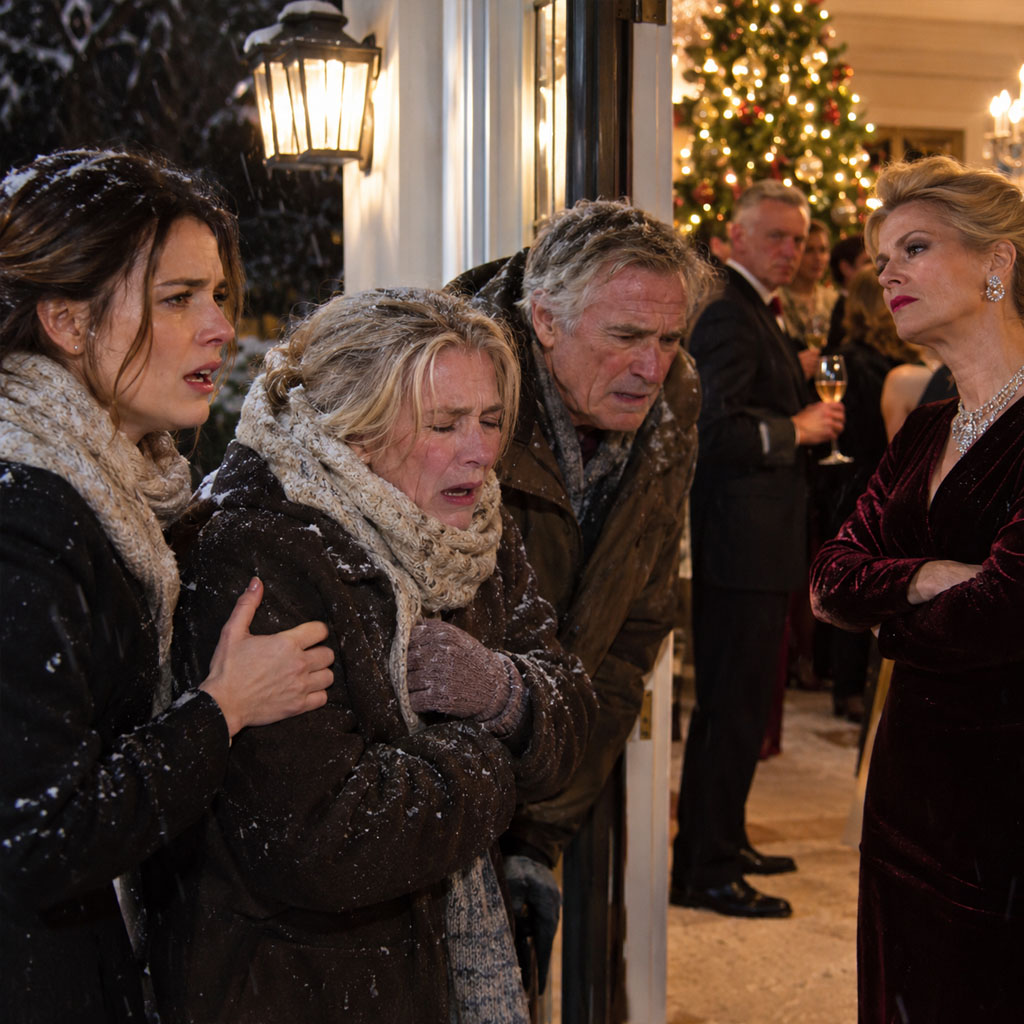
A year earlier, snow had covered my parents’ shoulders while they begged to be let into this house.
I could still see it if I allowed myself.
Some memories don’t disappear when forgiveness arrives.
They become boundaries.
Warnings.
Proof of what silence costs.
But what happened afterward mattered too.
We hadn’t made Barbara and Richard pay by destroying them.
We made them pay the price people fear most when they’ve spent their lives controlling others: consequences.
They lost the right to dictate the story.
They lost the certainty that Ryan would always surrender.
They lost access to our home until they learned how to respect the people inside it.
And because the consequences were real, the change had a chance to become real too.
Mom looked up from the pie dough.
“Amber, tell your mother-in-law she’s using too much flour.”
Barbara stared at me.
“Do not get involved.”
I laughed.
Dad raised his coffee cup.
“Smartest thing she’s said all year.”
Everyone started talking at once.
The house was noisy.
Warm.
Imperfect.
Family.
I had once believed standing up for the people I loved would tear everything apart.
Instead, it showed me which relationships were strong enough to survive the truth.
And which ones could become stronger because of it.
THE END.
⚠️ All characters and events are fictional. Do not imitate or apply them in real life. 😌😌😌