Chapter 2
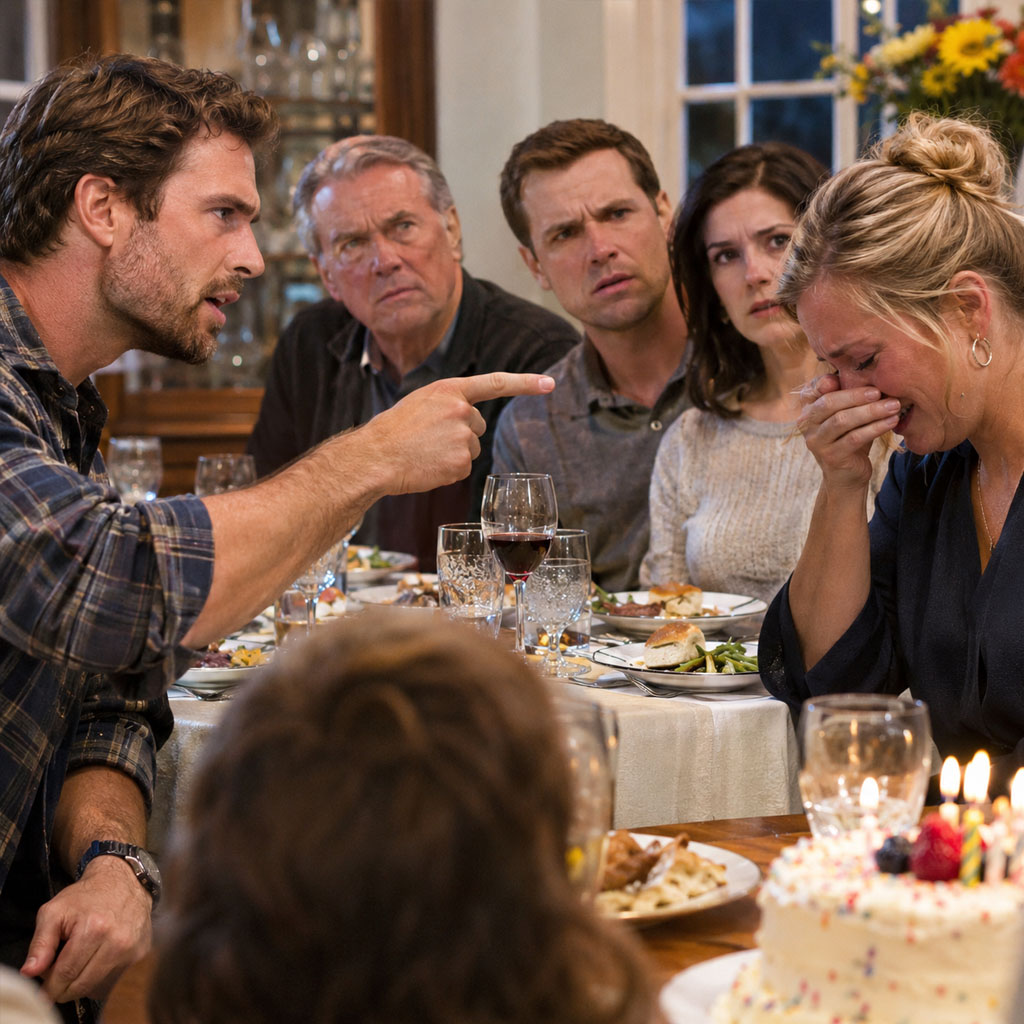
“I told him the truth.”
“At your birthday dinner?” Dad snapped. “You couldn’t handle this privately?”
Craig was sitting frozen beside Meredith’s empty chair.
I stared at my father.
There it was again.
Not concern that one son’s marriage might be collapsing.
Not shock that Meredith had rented an apartment without her husband’s knowledge.
His problem was me.
The son who had disrupted dinner.
“I’ve handled things privately my whole life,” I said. “I’m tired of it.”
Dad’s mouth tightened.
“Don’t turn this into something about you.”
Leah rose beside me and rested her hand against my back.
That small gesture steadied me more than Dad ever had.
Craig finally spoke.
“How long?”
I looked at him.
“Six weeks.”
His eyes lifted.
“You knew for six weeks?”
“I found out by accident. I wanted to be certain before I said anything.”
“And you waited until tonight?”
“Yes.”
His expression changed from shock to hurt.
I understood why.
I also knew that if I had gone to Craig privately, Meredith would have denied it and Dad would have found some reason to accuse me of jealousy.
For once, I wanted the truth where nobody could quietly bury it.
Craig left ten minutes later without speaking to me.
The next morning, Dad called at 7:15.
“You humiliated your brother.”
I was pouring coffee in my kitchen while our dog, Biscuit, slept across my feet.
“His wife was lying to him.”
“You’ve always been jealous of Craig.”
I went still.
“So that’s what you think this was?”
“What else am I supposed to think? You sat on that information until you had an audience.”
That hurt because part of it was true.
I wanted witnesses.
But there was another truth I wouldn’t admit until much later.
For once in my life, I wanted everyone at that table to look at me.
Dad kept talking.
I stopped listening.
Then I did something I had never done before.
I hung up on him.
For three weeks, Craig ignored my calls. Dad stopped contacting me entirely. Even Brenda disappeared.
According to a cousin, the family version quickly became simple: Tom ruined the birthday dinner.
Not Meredith rented a secret apartment.
Not Craig had been deceived.
Tom made a scene.
I worked.
Electrical problems were easier than family problems because circuits followed rules. If a breaker tripped, something caused it. Trace the line, find the fault, repair it.
People could stare at the fault and spend years arguing about whether it existed.
During that period, a developer named Garrett Shaw asked me to bid on the electrical work for a six-building mixed-use project west of Richmond.
It was ten times larger than anything I had ever done.
“I can’t take this,” I told Leah.
She looked over the plans spread across our kitchen table.
“Why?”
“Because I’m one guy with a van.”
“You won’t be if you win the contract.”
“I’d need employees. A project manager. Insurance upgrades. Equipment.”
“Yes.”
I stared at her.
She smiled.
“Tom, you’ve spent your whole life making yourself smaller because your family trained you not to take up space. Maybe stop.”
So I submitted the bid.
I got the project.
Eight months later, Bennett Electrical had gone from a man and a van to six employees, a project manager, an office, and an accountant who kept asking when I planned to establish retirement benefits.
Somewhere in the middle of that chaos, Leah and I got married.
Twenty people came to a vineyard outside Charlottesville.
Dad and Craig were not among them.
I didn’t exclude them to punish anyone. I simply refused to spend my wedding wondering whether Dad would use his toast to announce Craig’s latest bonus.
Leah’s father stood during dinner and talked about us.
Only us.
I cried.
A few months earlier, I had also started therapy.
Dr. Ellis was the one who finally asked the question I had avoided.
“Why did you reveal the affair publicly?”
“I needed witnesses.”
“That’s one reason.”
He waited.
I hated how good therapists were at silence.
Finally, I said, “Because I wanted them to see me.”
He nodded.
Not triumphantly. Not judgmentally.
“Then perhaps the next part of your life is about learning to see yourself.”
That stayed with me.
By spring, the commercial project was nearly complete. I had a growing company, a wife I loved, employees who trusted me, and a life that no longer required Gerald Bennett’s approval.
Then my phone rang.
Craig.
We had not spoken in nine months.
His voice sounded exhausted.
“Tom,” he said, “I need to tell you what happened after that dinner.”
Chapter 3
Meredith and Craig had been separated for four months.
Their divorce would be final soon.
“The apartment wasn’t the worst of it,” he said.
After my birthday dinner, Craig began checking finances he had mostly allowed Meredith to manage.
He found nearly $40,000 in hidden credit card debt.
Two accounts had been opened without his knowledge. Some of the charges covered shopping trips Meredith had described as work conferences. Others paid for furniture in the apartment.
I sat down on my back steps.
“Craig…”
“There’s more.”
He had confronted Meredith and moved out.
Then he went to Dad.
Gerald’s advice?
Work it out.
Think of the children.
Every marriage hits rough patches.
“I couldn’t understand it,” Craig said. “He kept defending her.”
Then Craig discovered why.
Six months before the affair came out, Dad had quietly loaned Meredith $12,000.
She claimed she needed it for a kitchen renovation and told him Craig didn’t need to know.
There had been no renovation.
Some of the money had gone into the apartment.
When Craig learned that, Dad’s behavior suddenly made sense. If the marriage collapsed, Gerald had to admit he had secretly financed his daughter-in-law without telling his son.
“He was protecting himself,” Craig said.
“Yes.”
There was a long pause.
Then my brother said something I had never expected to hear.
“I should have listened to you.”
I closed my eyes.
“You were the only one who told me the truth,” he continued. “And I punished you for it. I’m sorry.”
For thirty-four years, Craig and I had existed in neighboring versions of the same family. He was praised too much. I was praised too little.
Neither of us had ever really talked about it.
“I forgive you,” I said.
We met for coffee two days later.
Craig looked thinner. Quieter.
“I knew Dad treated us differently,” he admitted. “I just never said anything because it benefited me.”
“That’s hard to hear.”
“I know.”
“But I’m glad you said it.”
For the first time, we talked like brothers instead of competitors assigned roles before we were old enough to understand them.
I helped him organize the financial documents for his attorney. Hidden accounts. Statements. The apartment lease. Messages between Meredith and Dad about the $12,000.
One message stood out.
Thanks again, Gerald. Craig doesn’t need to know about this.
Dad had answered:
Agreed. Let’s keep it simple.
Craig read that exchange three times.
“My own father helped my wife hide money from me.”
“He probably thought he was helping.”
“That doesn’t make it better.”
“No.”
A family-law attorney Leah knew helped Craig’s lawyer understand the paper trail. The financial deception would matter during the divorce.
But by then, another issue mattered more to us.
Dad.
“What do we do about him?” Craig asked.
Months earlier, I might have wanted revenge.
I didn’t anymore.
Dr. Ellis asked me what outcome I truly wanted.
Not what would make me feel victorious.
What would make me feel whole.
The answer embarrassed me with its simplicity.
“I want him to admit it.”
“Admit what?”
“That he favored Craig. That I wasn’t imagining it.”
Craig agreed to help.
He invited Dad to dinner at his new apartment, saying he needed advice about the divorce.
Gerald never ignored a summons from Craig.
He arrived at 6:30 sharp.
Then he entered the dining room and saw me.
His expression hardened.
“What’s Tom doing here?”
Not hello.
Not good to see you.
Craig shut the door.
“Sit down, Dad.”
Gerald looked from him to me.
He understood immediately that this wasn’t a social dinner.
On the table sat three plates, a bottle of wine, and one thick folder.
Craig waited until Dad sat.
Then he said, “I know about the twelve thousand dollars.”
Dad’s face barely changed.
“That was a loan.”
“For a kitchen that was never renovated.”
“She told me—”
“She lied to you.”
Gerald reached for his wine.
Craig slid the folder across the table.
“She also told you not to tell me.”
Dad stared at it.
Craig’s hands were trembling.
“When I came to you because my marriage was falling apart, you told me to forgive her. You told me to think about the kids. You knew you had been secretly giving her money.”
“I was trying to keep your family together.”
I finally spoke.
“No, Dad. You were trying to keep yourself from looking foolish.”
His eyes snapped toward me.
“Excuse me?”
“You loaned Meredith money behind Craig’s back. Then her lies came out. If the marriage ended, you had to admit she played you too.”
“That is not what happened.”
Craig pushed the folder closer.
“You blamed Tom for everything.”
Dad said nothing.
“You let the whole family call him jealous and cruel when he was the only person who told me the truth.”
“Tom had no business doing what he did at that dinner.”
“The only person,” Craig repeated.
Dad looked at his favorite son.
And for once, Craig did not look back with admiration.
Chapter 4
“I was trying to protect this family,” Dad said.
“From what?” I asked. “The truth?”
He looked older sitting at Craig’s little dining table. Maybe he had always looked that age and I had only recently stopped seeing him as the man who knew everything.
“I made mistakes.”
I leaned forward.
“No.”
His eyebrows drew together.
“No what?”
“Don’t say ‘mistakes’ like we’re discussing a wrong turn on the highway. Say what you did.”
“Tom—”
“Please.”
Craig was silent beside me.
I could hear the kitchen clock.
I had waited most of my life for this conversation without knowing it.
“You stood at my birthday dinner,” I said, “and talked about Craig for six minutes. His job. His house. His family. His vacation. His boat. Then you remembered whose birthday it was and said, ‘Happy birthday, buddy.’”
Dad looked down.
“That wasn’t intentional.”
“That’s the problem. None of it was intentional. You didn’t have to decide to ignore me. It came naturally.”
His face tightened.
“You were always fine on your own.”
“I wasn’t fine. I was invisible.”
That sentence changed the room.
Craig looked away.
Dad stared at the table.
Finally, he said, “You were never invisible to me.”
“Then tell me what my biggest contract was before the Richmond project.”
He opened his mouth.
Nothing came out.
“Tell me the year I got my electrical license.”
Silence.
“Tell me where Leah and I got engaged.”
His eyes closed briefly.
I wasn’t enjoying this.
That surprised me.
I had imagined vindication would feel warm.
It felt sad.
Dad rubbed his forehead.
“I understood Craig better.”
There it was.
He took a breath.
“Craig was like me. Sports. Business. Sales. People. I understood what he wanted.”
“And me?”
His eyes lifted.
“You were like your mother.”
The answer hit harder than anger would have.
Mom.
Quiet, patient Patricia.
The woman who sat on a garage floor listening to a ten-year-old explain electricity.
Dad continued.
“After she died, everything about you reminded me of her. The way you listened before speaking. The way you worked with your hands. Even the way you looked at me when you thought I was talking too much.”
His voice weakened.
“I didn’t know what to do with that grief. Craig was easier.”
I swallowed.
“That explains it.”
“I know.”
“It doesn’t excuse it.”
“I know that too.”
For a long time, Gerald Bennett said nothing.
Then he looked directly at me.
“I favored Craig.”
My chest tightened.
“I gave him more attention. More encouragement. More money. More praise. I told myself you were independent and didn’t need me as much.”
His eyes were wet now.
“But maybe I told myself that because it made neglecting you easier.”
Craig lowered his head.
Dad continued.
“You deserved better than what I gave you, Tom.”
My own name.
Not buddy.
Tom.
“I’m sorry I made you feel invisible.”
I had imagined that apology in a hundred forms.
In none of them did cold spaghetti sit ten feet away.
In none of them was my brother beside me with tears in his eyes.
Reality was less dramatic.
And more meaningful.
“Thank you,” I said.
Craig put a hand on my shoulder.
We stayed at the table for another two hours.
Eventually, we ate.
The spaghetti was cold, but nobody complained.
Dad apologized to Craig for hiding the loan. He admitted protecting his pride after realizing Meredith had deceived him. Craig told him trust would not return simply because he apologized.
Dad accepted that.
Nobody hugged at the door.
Nobody declared the family healed.
Some things take longer.
Chapter 5
Craig’s divorce was finalized months later.
The hidden debt and financial deception affected the settlement. The children spent most of their school nights with Craig, while Meredith remained part of their lives under an arrangement they worked out through attorneys and counselors.
I stayed out of the details.
By then, I had learned that truth and punishment were not the same thing.
Dad never recovered the full $12,000.
He stopped complaining about it.
Instead, he adjusted his estate plan to make certain the loss didn’t somehow become another advantage for Craig over me.
My brother objected at first.
Then he caught himself.
“No,” he said. “Actually, that’s fair.”
We both laughed.
It felt strange.
Good strange.
Bennett Electrical now has twelve employees and two commercial projects running at the same time. Sometimes I walk through the office and remember the old van I started with.
Leah is finishing her doctorate in nursing practice. She still reads rooms better than anyone I know, although she has stopped keeping statistics on how often Dad talks about Craig.
Biscuit continues stealing socks and denying responsibility despite overwhelming evidence.
Craig calls me every week.
Not because something is wrong.
Just because.
Sometimes we talk about the kids. Sometimes business. Last Sunday, we spent twenty minutes arguing about whether a hot dog counts as a sandwich.
Our relationship isn’t perfect.
It’s real.
That’s better.
Dad and I are slower.
He comes to dinner about once a month. He asks questions now, sometimes so deliberately that I can tell he prepared them beforehand.
At first, that bothered me.
Then I realized effort often looks awkward when somebody is learning something they should have learned years earlier.
So I let him try.
On my thirty-fifth birthday, my phone rang at 7:02 in the morning.
I saw Dad’s name and answered.
“Morning.”
“Happy birthday, Tom.”
I waited.
He laughed softly.
“I’m not going to talk about Craig.”
“Good start.”
“I was wondering if you and Leah wanted dinner Friday. Your choice.”
“My choice?”
“Don’t get carried away.”
I smiled.
“Friday works.”
After we hung up, Leah looked at me from across the kitchen.
“How was that?”
I thought about it.
Not perfect.
Not erased.
Not magically healed.
But different.
“Good,” I said.
For most of my life, I believed being overlooked meant there was something about me not worth seeing. It took a ruined birthday, a family secret, a broken marriage, and a great deal of painful honesty to understand how wrong that was.
My brother’s success never made me smaller.
My father’s favoritism never determined my worth.
And exposing Meredith’s secret didn’t make me a hero either. I had told the truth in a way fueled partly by years of hurt, and I had to own that along with everything else.
What changed us wasn’t the dramatic question I asked across that birthday table.
It was what happened after the silence.
Craig learned that being favored had protected him from truths he needed to see.
Dad learned that loving two sons did not mean he had treated them equally.
And I learned that being seen begins with refusing to disappear for other people’s comfort.
A few weeks ago, Dad came by my office.
He stood in the doorway watching my crew move through the shop.
“You built all this?”
I almost gave him a sarcastic answer.
Instead, I said, “Yeah.”
He nodded slowly.
Then he smiled.
“I’m proud of you, Tom.”
For once, he didn’t add anything about Craig.
And for once, I didn’t need him to.
THE END.
⚠️ All characters and events are fictional. Do not imitate or apply them in real life. 😌😌😌