“Shall I Go On?” He Smiled. He Read My File To Eight Officers. “Counseled For Disloyalty?” “Yes, Sir.” I Folded My Hands. He Turned The Page. The Judge Leaned Forward. “Keep Reading. Out Loud.”
The civilian lawyer stood before eight military officers and read my record aloud, describing me as disloyal, difficult, and unfit to be trusted. My former commander watched without defending me, just as he had stayed silent when a young soldier died because of his orders. I answered every accusation calmly, even when my hands began shaking. Three years earlier, they had taken my career apart to protect a secret. But when the lawyer turned to the second page, I discovered someone had been keeping records of his own.
Part 1
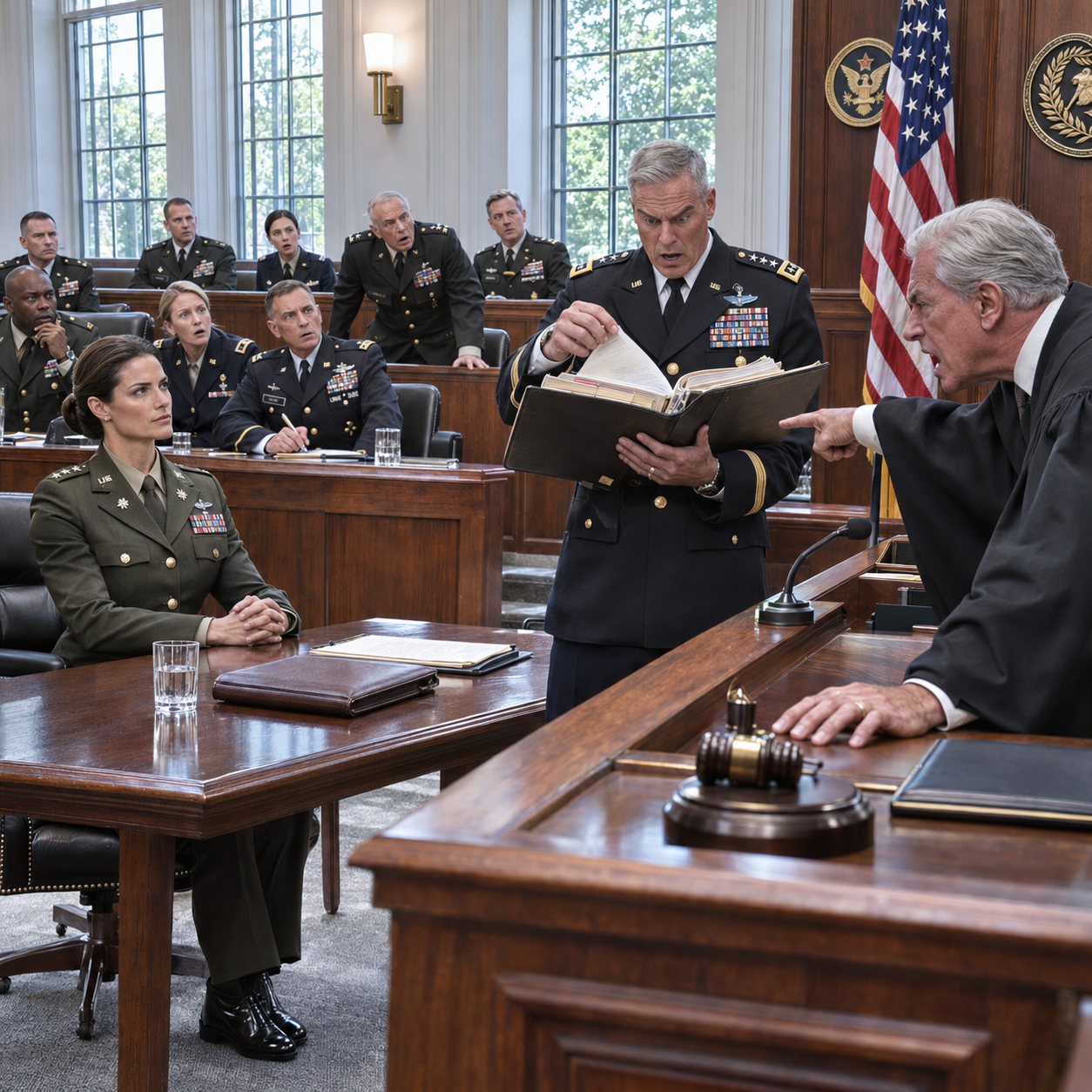
The first pen stopped moving at 9:17 on a Wednesday morning. I remember the time because the clock above the courtroom door had been running four minutes slow since Monday, and I had spent two days watching its second hand hesitate before every twelve. The civilian lawyer standing at the lectern had spent most of the previous afternoon convincing eight Army officers that I was a bitter, unreliable soldier with a history of challenging authority. Now he was reading the document he believed would finish my credibility for good. He had reached the second page when his voice changed. It was barely noticeable, just a slight tightening in his throat, but I heard it.
My name is Sergeant First Class Maren Sloane. I was thirty-seven years old, sixteen years into my Army career, and sitting in a witness chair at Fort Riley, Kansas, in October 2026. My uniform was pressed, my boots were polished, and my hands were folded tightly beneath the wooden rail where nobody could see my fingers trembling. Across the courtroom sat Lieutenant Colonel Bryce Harrow, the man whose decisions had ended one soldier’s life and nearly destroyed mine. His civilian attorney, Malcolm Greer, had silver hair, expensive glasses, and the comfortable confidence of someone accustomed to making uncomfortable people answer questions.
Eight commissioned officers occupied the panel box to my left. Their notebooks had been filling steadily since the trial began. They were there to decide whether Harrow had abused his authority, falsified official records, and knowingly endangered the soldiers under his command. I was the prosecution’s principal witness. I was also the person Harrow’s defense desperately needed them to distrust.
Greer had understood that from the beginning.
“Sergeant Sloane,” he had said the previous afternoon, holding a manila folder where everyone could see it, “would you agree that your military career has included a rather unusual number of disagreements with your superior officers?”
“I wouldn’t characterize it that way, sir.”
He smiled. “Fortunately, we don’t have to rely on your characterization.”
He opened the folder.
What followed was the most humiliating forty minutes of my professional life. He read counseling statements, administrative transfers, and evaluations with carefully selected phrases underlined in yellow. One commander had described me as excessively persistent. Another had written that I questioned established procedures. A third had suggested I needed to demonstrate greater respect for leadership decisions. Each sentence sounded worse when separated from the circumstances that produced it.
“September 2023,” Greer announced. “Formally counseled for insubordination and disloyalty to the chain of command.”
“Yes, sir.”
“October 2023. Removed from your position as battalion motor sergeant.”
“Yes, sir.”
“November 2023. Transferred to an administrative holding detachment.”
“Yes, sir.”
“And shortly afterward, transferred again. Correct?”
“Correct.”
He turned toward the panel.
“Ladies and gentlemen, the government wants you to believe this witness was punished for telling the truth. But perhaps the simpler explanation is that Sergeant Sloane has spent years refusing to accept the decisions of officers appointed to lead her.”
One of the colonels stopped writing long enough to study my face.
I wanted to explain that my counseling statement had been issued seventy-two hours after I reported my commander to the Inspector General. I wanted to tell them why I had been removed from the motor pool, why I had eaten lunch alone in my car for four months, and why a young mechanic named Owen Keene had never returned home to Washington.
Instead, I answered the question I had been asked.
“No, sir. That isn’t what happened.”
Greer tilted his head sympathetically.
“Of course you would say that.”
At the defense table, Harrow adjusted his cuffs. It was the first movement he had made in nearly an hour. I had once watched that same man stand over a maintenance report marked with a red X and tell me that his orders mattered more than my assessment. Back then, he had been my battalion commander, and I had believed there were limits to what an officer could demand of a soldier.
I had learned otherwise.
Owen Keene was twenty-three years old when he died. He came from Spokane, Washington, and spent his weekends sketching the diesel repair shop he planned to open after leaving the Army. He had saved photographs of old engines on his phone and kept a handwritten list of tools he intended to buy. He was never the fastest mechanic in my shop. I trusted him precisely because he wouldn’t hurry through something that could get another soldier hurt.
His mother, Judith, sat in the second row of the courtroom, wearing a dark blue cardigan despite the October heat. She carried a small brown purse and held it in both hands whenever someone mentioned her son. During the trial, I had watched her look at Harrow exactly three times. Each time, her expression was so controlled that it made my stomach tighten.
Greer turned another page.
“Sergeant, isn’t it true that you personally released the vehicle Specialist Keene was operating on the day of his accident?”
The courtroom seemed to contract around me.
“Yes, sir.”
“And you handed the dispatcher the keys?”
“Yes.”
“Even though you now claim the vehicle was unsafe?”
“I documented that it was unsafe before it was released.”
“But you released it.”
I looked at the prosecutor’s table. Captain Simon Vale sat with his hands resting on a closed binder. He didn’t rescue me from the question.
“Yes, sir,” I said.
Greer allowed the silence to settle.
“Nothing further at this time.”
He was almost back to his chair when Captain Vale stood.
“Your Honor, the government requests that Defense Exhibit F be considered in its entirety under Military Rule of Evidence 106.”
Greer stopped.
The military judge, Colonel Naomi Kessler, glanced down at the document in front of her.
“Mr. Greer, you’ve read selected portions of the exhibit into the record. The government is entitled to request the additional material necessary to place those statements in context.”
“The remainder contains administrative findings, Your Honor. They’re not relevant to the witness’s conduct.”
Judge Kessler looked over her glasses.
“I have reviewed the document. They are relevant.”
Greer returned to the lectern and opened the folder.
“Would the court permit a brief recess?”
“Tomorrow morning. Nine hundred hours. You will resume with page two.”
She struck the gavel once.
Everyone rose.
Harrow remained perfectly still until the panel members had filed out. Then he turned toward Greer and spoke urgently enough that I saw his jaw moving, although I couldn’t hear the words.
Captain Vale approached the witness stand.
“You’re finished for today, Sergeant.”
“Sir, what’s on page two?”
He studied me.
“You still haven’t read it?”
“No, sir.”
“Then tomorrow will be the first time.”
I should have insisted on seeing it. Instead, I gathered my belongings and walked past Judith Keene without finding the courage to meet her eyes.
That evening, I went home and opened the closet where I kept the last thing that belonged to my old job.
A faded motor sergeant’s shop coat lay inside a cardboard box. Its sleeves still carried faint grease stains from a vehicle inspection three years earlier. I lifted it and found a folded piece of paper tucked into the inside pocket, exactly where I had left it.
A photocopied maintenance worksheet.
Vehicle 7. Brake system failure.
One red X.
My initials beneath it.
I had kept that document because it proved what I had known before Owen drove down the training road. But as I unfolded it under the kitchen light, I noticed something I had overlooked for years.
Someone else’s initials appeared in the lower corner, beside a maintenance authorization entered after my inspection.
And whoever had written them had used a date six months before Owen died.
Part 2
I barely slept that night. The two initials were difficult to read, and the date looked like a clerical mistake until I compared it with my old notebook. I had recorded the vehicle’s maintenance history during the week of the accident, including a previous repair request that had mysteriously disappeared from our electronic system. At the time, I assumed it was another routine administrative failure. Three years later, sitting at my kitchen table with a photocopy that had survived two transfers and countless inspections, I began to understand why someone might have wanted that earlier entry forgotten.
To understand what happened, you need to know the kind of motor pool I ran at Fort Riley in September 2023. Our battalion maintained trucks, recovery vehicles, generators, and equipment that supported training exercises across thousands of acres of rolling Kansas terrain. Everything smelled of diesel, hot rubber, wet limestone, and coffee burned onto the bottom of a communal pot. I had served in two overseas deployments before taking that assignment. I knew that a reliable vehicle could mean the difference between a soldier coming home and someone receiving a folded flag.
I had been the battalion motor sergeant for fourteen months, and I loved the work. My mechanics complained that I checked their paperwork twice and their torque settings three times. They also knew I would defend them when a commander demanded impossible deadlines. I had a reputation for being stubborn, which didn’t bother me until stubborn became the word people used instead of competent.
Owen joined our section that spring. He was tall, narrow-shouldered, and permanently amused by things I didn’t consider funny. The first time I caught him reorganizing our common tool cabinet, he explained that the arrangement made more sense if the sockets were grouped by size rather than by whoever had most recently misplaced them. I gave him the cabinet as an additional duty. Within a month, even the older mechanics had stopped losing things.
His closest friend was Specialist Caleb Marsh, a twenty-one-year-old driver who could talk his way into almost anything. Caleb was quick, eager, and sometimes careless. Owen balanced him out. When a repair required patience, I assigned them together. I didn’t realize how much I relied on Owen’s judgment until I noticed the other mechanics asking him questions before they asked me.
On September 11, Lieutenant Colonel Harrow gathered his senior noncommissioned officers for a briefing. A visiting general would observe a battalion mobility demonstration the following morning. Harrow wanted every assigned vehicle operational, every driver properly equipped, and the movement completed without delays. He pointed at a readiness chart projected onto the wall. Nearly every box was green.
“That,” he said, “is what professional leadership looks like.”
I noticed Vehicle 7 listed as mission capable. It was an aging cargo truck with repeated maintenance issues, including pressure loss in its rear braking system. I raised my hand.
“Sir, Seven still has an unresolved brake discrepancy.”
Harrow stared at me.
“My readiness report says otherwise.”
“The earlier repairs haven’t been verified.”
“Then verify them before tomorrow.”
The meeting ended.
The next morning, I reached the motor pool before sunrise. The sky was pale gray, and the concrete still held moisture from overnight rain. Owen was drinking coffee beside Vehicle 7 when I heard an irregular hiss beneath the chassis. I asked him to bring the inspection light. We traced the sound to a damaged air line near the rear brake chamber, where repeated friction against the frame had worn through its protective covering.
I checked the pressure loss, then checked again.
The result was the same.
I marked the vehicle not mission capable on the maintenance worksheet. A red X meant it was unsafe to operate until properly repaired and cleared through the required process.
Owen watched me write.
“Looks like I’m riding with Caleb today.”
“Looks that way.”
He grinned. “Then somebody else gets to listen to him talk.”
We both laughed.
That was the last ordinary conversation I ever had with him.
Twenty minutes later, Sergeant First Class Trevor Briggs, my shop foreman, came looking for me. He had just left battalion headquarters, and his expression told me something had gone wrong.
“Seven needs to be on the line,” he said.
“Seven is deadlined.”
“Colonel Harrow says we’re short a truck.”
“Then we’re short a truck.”
Briggs lowered his voice.
“Maren, he’s already angry.”
I took the worksheet and walked to the command building.
Harrow was standing beside his desk, fastening his watch. He didn’t invite me to sit. When I explained the brake problem, he waved one hand toward the window.
“The demonstration starts in ninety minutes.”
“Sir, the rear pressure is dropping. That truck shouldn’t be driven downhill.”
“Your mechanics worked on those brakes last month.”
“And the problem is back.”
He took the worksheet, examined the red X, and set it down.
“You can make an old truck sound dangerous if you describe every imperfection.”
“This isn’t an imperfection, sir. It’s a brake failure waiting to happen.”
His expression hardened.
“Sergeant Sloane, I have a general arriving to evaluate this battalion. I am not canceling a portion of the demonstration because you dislike the condition of one vehicle.”
“Sir, regulations require us to keep it off the road.”
He stepped closer.
“I am giving you a direct order.”
I had spent years imagining what I would do if a superior officer ordered something I believed was unsafe. I thought I would refuse without hesitation, demand written authorization, or take the keys myself. Instead, I stood there calculating how quickly I could arrange another inspection, how much authority I actually possessed, and whether Harrow would replace me before I could stop the movement.
That hesitation changed everything.
I returned to the motor pool and told Briggs the commander had ordered the truck released. He avoided my eyes. I informed Owen about the brake problem and instructed him to use the engine brake, maintain extra distance, and report any loss of pressure immediately.
He listened carefully.
“Understood, Sergeant.”
I handed the keys to the dispatcher.
At 10:26, the convoy entered the long downhill section of the training route. I was riding in the lead vehicle when someone shouted over the radio that Seven was losing braking pressure.
I turned around.
The truck was gaining speed.
Its front wheels drifted toward the outside shoulder. Owen tried to correct the movement, but the rear end swung sideways. The truck crossed the gravel, struck an embankment, and rolled onto its side.
I was running before our vehicle stopped completely.
Dust filled the air. Someone was shouting for medical assistance. The engine was still running when I reached the damaged cab and climbed through the shattered passenger window.
Owen was conscious.
“I’m okay, Sergeant,” he whispered.
He wasn’t.
I held his head steady and told him the medics were coming. He asked whether Caleb was all right, even though Caleb had been driving a different truck. Then he asked me not to tell his mother until someone knew exactly what had happened.
I promised him I would make sure she knew the truth.
Owen died two days later at the hospital.
By then, the first official account had already described the crash as an unexpected mechanical event following a successful pre-movement inspection.
And when I returned to the motor pool to collect my documents, the original maintenance worksheet was missing.
Part 3
I had made the photocopy shortly after leaving Harrow’s office that morning. Something about the way he had handled the worksheet bothered me, particularly his refusal to return it until I asked twice. At 8:42, before the convoy departed, I went to the maintenance office and copied the inspection report, including the old service entries printed along the bottom. I folded the copy and slipped it inside my notebook. Back then, I wasn’t collecting evidence against anyone. I simply wanted proof that I had identified the defect before the truck moved.
After Owen’s accident, the maintenance system showed Vehicle 7 as operational at the beginning of the exercise. My red X was gone. A newly printed worksheet described the brakes as functional and recorded no restriction against movement. I searched the office for my handwritten original, but the tray where we kept pending inspection paperwork had been cleared. Briggs told me headquarters had collected the documents for the investigation. When I asked for a receipt, he shook his head.
Two days later, I learned Owen had died. I was standing beside his workbench when the news arrived. His tools were still arranged in their familiar order, and a half-finished repair estimate lay beneath his notebook. I remember picking up a wrench and putting it down again because I couldn’t decide whether anyone was allowed to touch his belongings. Briggs stood in the doorway. Neither of us spoke for several minutes.
The following Monday, Harrow summoned me to his office. His command sergeant major, Walter Price, stood beside the window with his arms folded. A clean maintenance worksheet lay on Harrow’s desk. Next to it was a pen.
“We need to correct an administrative inconsistency,” Harrow said.
I examined the form.
The red X was missing. My original inspection findings had been replaced with a statement that the braking system had passed its pre-movement checks.
“Sir, this isn’t what I recorded.”
“The initial inspection was performed under poor conditions. Your assessment was incomplete.”
“The air line was damaged.”
“The investigation will determine the cause of the accident.”
“Then why are you asking me to sign a report saying the truck passed inspection?”
Price shifted beside the window. Harrow’s expression changed, not into anger but something colder.
“Because inaccurate paperwork can damage the reputation of this entire battalion, Sergeant.”
I looked at the blank signature line.
“With respect, sir, the paperwork isn’t what killed Owen.”
Harrow’s face flushed.
“You are dangerously close to making accusations you cannot support.”
“I have my original inspection.”
“Then submit it through your chain of command.”
“That’s what I’m trying to do.”
He pushed the pen toward me.
I didn’t touch it.
For a moment, I thought he might call the military police. Instead, he collected the document, placed it in a drawer, and told me to leave. Price opened the door without looking at me.
The next morning, I walked into the Inspector General’s office carrying my notebook and the photocopy. I explained the mechanical defect, the commander’s order, the accident, and the replacement worksheet. Major Camila Pruitt, the investigating officer, listened without interrupting. When I finished, she asked whether anyone else knew about the original report.
“Briggs knew. Owen knew. The dispatcher saw it.”
“Do you believe the records were deliberately changed?”
“I know what I wrote, ma’am.”
She studied the photocopy, particularly the maintenance history at the bottom.
“Where did you get this?”
“I made it before the accident.”
She looked up.
“Keep the original copy somewhere secure. Don’t discuss this complaint with anyone who doesn’t need to know.”
She explained that my report was a protected communication and that retaliation would violate military regulations. I left believing the system would protect me while the investigation proceeded.
Seventy-two hours later, Harrow issued me a formal counseling statement for insubordination and disloyalty. He accused me of undermining command authority and creating unnecessary disruption during a sensitive investigation. I signed only to acknowledge receipt and wrote that I disputed the allegations.
In October, he removed me from my position.
In November, I was assigned to an administrative holding detachment where I spent weeks checking inventory and distributing cleaning supplies. Soldiers who had once called me for advice suddenly stopped answering their phones. One senior mechanic told me privately that Harrow had warned people not to associate themselves with my allegations.
By December, a rumor had spread that I had falsified the original inspection to protect myself after Owen’s death.
Nobody asked me whether it was true.
That was the most effective part of Harrow’s retaliation. He didn’t need to convince everyone I was lying. He only needed to make supporting me feel risky.
I lived alone in a small apartment outside the installation. Every morning, I ran before sunrise because exhaustion was the only thing that helped me sleep. Every evening, I checked my phone for updates from Major Pruitt’s office. Most weeks, someone called to say the investigation remained active. They couldn’t tell me what investigators had found.
One afternoon, Briggs approached me outside the post exchange. He looked thinner than I remembered.
“I heard you’re getting reassigned again,” he said.
“Apparently.”
“Maybe that’s for the best.”
I stared at him.
“Owen trusted you, Trevor.”
His eyes dropped.
“I know.”
“You saw that inspection.”
“I know.”
“Then why haven’t you told anyone?”
He glanced toward the parking lot before answering.
“Because I have a wife, two kids, and fifteen years in the Army. I can’t afford to lose everything.”
I wanted to hate him. Instead, I recognized the fear that had made me hand over Owen’s keys.
“Neither could Owen,” I said.
I walked away before he could respond.
In February 2024, someone from the commanding general’s office contacted me. A review had concluded, certain personnel actions would be corrected, and I would receive new orders. The officer spoke in reassuring administrative language that made the entire ordeal sound like a scheduling problem. When he offered to send me the official findings, I told him I didn’t want to read another document about myself.
He confirmed my mailing address anyway.
An envelope arrived the following week. I put it in a drawer with my military paperwork and never opened it.
That summer, I transferred to a training brigade and eventually earned promotion to sergeant first class. My new supervisors treated me fairly, but I worked as though one mistake would confirm every accusation Harrow had made. I arrived early, documented every decision, and kept copies of everything. I stopped believing that doing the right thing guaranteed anyone would recognize it.
In spring 2025, I testified at Harrow’s Article 32 preliminary hearing. By then, the Inspector General’s investigation had become part of a larger criminal inquiry into altered maintenance records and reprisals against military personnel. The hearing lasted most of the morning. When I stepped into the hallway, Judith Keene was waiting beside a vending machine.
“You’re Sergeant Sloane,” she said.
“Yes, ma’am.”
“You were with Owen after the crash.”
“Yes.”
She studied my face.
“Did he suffer?”
There was no answer that could make what happened easier.
“I stayed with him until the medics took over,” I said. “He wasn’t alone.”
Her lips trembled.
After a long silence, she asked the question I had been asking myself for nearly two years.
“Why did you let him drive that truck?”
I could have told her about Harrow’s order, the commander’s anger, and the regulations I had tried to enforce. Instead, I gave her the one answer I could never escape.
“I was afraid of what would happen if I refused.”
She looked down at her purse.
“So was everybody else, I suppose.”
Then she walked away.
I carried those words into the court-martial eighteen months later.
The Sunday before I testified, Captain Vale showed me Defense Exhibit F. It contained the counseling statement, my removal from the motor pool, and the two transfers. He explained that Greer intended to use those records to challenge my reliability.
“I can object,” Vale said. “There’s a reasonable argument for keeping some of this out.”
“Will the panel hear why the counseling happened?”
“Not necessarily. The defense could argue the later findings are irrelevant.”
I thought about the soldiers who had believed the rumors, the officers who had read only my disciplinary record, and Judith asking why I had let her son drive.
“Let him use it.”
Vale regarded me carefully.
“Sergeant, he’s going to make you look terrible.”
“He already did that three years ago.”
I told him about the unopened envelope and admitted I still hadn’t read the commanding general’s findings. He was quiet for a while, then suggested I might finally be ready to hear them.
On Wednesday morning, I returned to the courtroom.
Greer stood at the lectern with Defense Exhibit F. Harrow sat beside him, staring at the document without blinking.
Judge Kessler directed Greer to continue reading.
He cleared his throat and began.
“Department of the Army. Memorandum for Record. Subject: Findings of Investigation Concerning Staff Sergeant Maren Sloane.”
Then he read the first numbered paragraph.
And for the first time in three years, I heard what the Army had actually discovered about the officer who destroyed my career.
Part 4
Greer’s voice was steady when he began reading the memorandum. The document was dated February 16, 2024, and signed by Major General Alina Velez, the commanding general who had overseen the administrative review of my complaint. I remembered hearing her name during the investigation, but I had never met her. Until that morning, I assumed the memorandum contained a cautious acknowledgment that my situation had been handled imperfectly. I didn’t expect it to describe a deliberate campaign against me.
“Paragraph one,” Greer read. “On September 19, 2023, Staff Sergeant Maren Sloane submitted a protected communication concerning the unauthorized release of Vehicle 7 following documented brake-system deficiencies.”
He paused briefly before continuing.
“The investigation substantiated that Staff Sergeant Sloane’s maintenance assessment was technically accurate and consistent with applicable safety requirements.”
I felt my hands loosen beneath the witness rail.
For three years, I had carried the fear that some hidden technical finding might prove I had misunderstood the truck’s condition. Hearing those words did not erase what happened to Owen, but it removed a doubt I had never admitted to anyone.
Greer continued.
“Paragraph two. Lieutenant Colonel Bryce Harrow knowingly directed the release of Vehicle 7 despite receiving a verbal warning regarding its mechanical condition. Evidence further establishes that the subsequent replacement of the vehicle’s maintenance worksheet was not authorized by the reporting maintenance personnel.”
Colonel Evelyn Ward, the panel president, stopped writing.
Her pen remained suspended above the page.
At the defense table, Harrow shifted in his chair.
Greer swallowed.
“Paragraph three. On September 22, Lieutenant Colonel Harrow issued a negative counseling statement alleging insubordination and disloyalty. This action occurred three days after Staff Sergeant Sloane submitted her protected communication.”
He looked toward the judge.
“Your Honor, perhaps the remainder could be provided to the members in writing.”
Judge Kessler didn’t hesitate.
“Continue, counsel.”
Greer lowered his eyes.
“Subsequent removal from duty and reassignment were likewise determined to constitute prohibited reprisals intended to discourage further disclosures regarding maintenance practices within the battalion.”
Another officer laid down his pen.
Then another.
Greer had spent the previous afternoon using those same administrative actions to suggest I couldn’t be trusted. Now, every punishment he had described was being identified as evidence of my commander’s misconduct.
He reached the next paragraph.
“All adverse administrative actions identified in this memorandum are rescinded. Corresponding records will be corrected or removed from the affected soldier’s official personnel files.”
I hadn’t known that.
I had worked for nearly three years believing the words disloyal and insubordinate remained somewhere in my permanent record. I had accepted assignments cautiously and hesitated before applying for opportunities because I assumed someone would eventually find those documents.
A quiet pressure settled behind my eyes.
Greer turned the page slightly.
“Paragraph four. Investigators identified discrepancies involving maintenance certification procedures predating the September 12 incident. These discrepancies included entries showing completed repairs without corresponding inspection documentation.”
He stopped again.
I looked up.
That wasn’t something anyone had told me.
“Evidence indicates that maintenance readiness figures were repeatedly presented to senior leadership without appropriate disclosure of unresolved safety deficiencies.”
The courtroom was silent.
I remembered Harrow’s readiness chart, every square green beneath the projected image. I remembered how pleased he had been with those numbers.
Greer read the next sentence slowly.
“The command has referred related findings for further investigation to determine the extent of supervisory involvement and whether additional personnel were subjected to improper administrative action.”
He reached the final paragraph.
“Staff Sergeant Sloane’s refusal to certify inaccurate maintenance information and her subsequent protected disclosure reflect the integrity, professional judgment, and accountability expected of noncommissioned officers of the United States Army.”
His voice had become almost inaudible.
“Signed, Alina Velez, Major General, United States Army.”
Nobody moved.
All eight pens were resting on the panel members’ notebooks.
Colonel Ward looked across the courtroom toward Harrow. Another officer removed his glasses. A major near the back of the panel box folded his arms and continued staring at the defense table.
Harrow was looking down.
For a moment, I found myself waiting for an explanation from him. He had always been good at explaining things, particularly why someone else had misunderstood his intentions. But there was no podium for him to hide behind, no formation of soldiers required to remain silent while he spoke.
There was only the record.
Judge Kessler looked toward Greer.
“Do you have any additional questions for this witness?”
He closed the folder.
“No, Your Honor.”
Captain Vale rose.
“Sergeant Sloane, had you previously read the memorandum contained on page two of Defense Exhibit F?”
“No, sir.”
“Why not?”
I looked toward the panel.
“Because every official document I had received after Owen died seemed to say that I was the problem. Eventually, I stopped expecting anyone to write down the truth.”
Vale allowed a moment of silence.
“Did Lieutenant Colonel Harrow ever apologize for the actions described in that memorandum?”
“No, sir.”
“Did anyone inform you that the adverse records had been removed?”
“Not directly, sir. I was told the situation had been resolved.”
“Was it resolved for you?”
I thought about the holding detachment, the empty lunch breaks, the phone calls nobody returned, and the photograph of Owen’s unfinished repair-shop drawing that I kept on my desk.
“No, sir.”
Vale nodded.
“Nothing further.”
Judge Kessler excused me.
As I stepped down, Judith Keene lifted her head. Our eyes met. This time, she didn’t look away.
The panel requested complete copies of the exhibit and reviewed them before the presentation of closing arguments. The defense attempted to distinguish Harrow’s administrative misconduct from the decisions that caused the crash. Greer argued that pressure to meet operational requirements did not necessarily establish criminal negligence and that the maintenance problems might have been misunderstood in real time.
Captain Vale’s closing argument was much shorter.
He placed my original inspection worksheet on the courtroom screen beside the replacement form.
“One document describes the condition of the vehicle before Specialist Keene drove it. The other describes the condition his commander wanted investigators to believe existed afterward.”
He pointed to the red X.
“Sergeant Sloane recorded a safety defect, warned her commander, preserved the original report, and refused to sign a replacement. The accused’s conduct after the accident tells you what he understood before it.”
The panel withdrew for deliberations shortly after noon.
I sat outside the courtroom with a bottle of water that had grown warm in my hands. Judith passed me on her way to the restroom and stopped.
“I heard everything,” she said.
I stood.
“Ma’am, I’m sorry.”
She shook her head.
“Don’t say that again just because you think I need to hear it.”
I looked at her.
“I’ve been angry with you,” she continued. “I needed somebody to blame who was still willing to speak to me.”
I didn’t know how to answer.
“You should have stopped the truck,” she said.
“Yes, ma’am.”
“But he should never have given you that order.”
“No, ma’am.”
Her eyes filled.
“Both things can be true.”
She touched my wrist for a moment and walked away.
At 4:08, the court reconvened.
The members had reached their findings.
Harrow stood beside Greer as Colonel Ward read the verdicts. He was found guilty of reprisal, making a false official statement, and dereliction of duty related to the unsafe vehicle’s release. He remained expressionless until the final finding was announced. Then his shoulders dropped slightly, as though something holding him upright had finally disappeared.
Judith sat with both hands pressed against her purse.
I felt no satisfaction.
I had imagined that moment so often that I knew exactly how it was supposed to feel. There should have been relief, pride, or some great release of anger. Instead, I kept thinking about Owen’s last words and how he had still been worrying about his friend while we waited for the medics.
In the hallway afterward, Greer approached me.
“Sergeant Sloane, I owe you an apology.”
I stopped beside the window.
“My client provided that exhibit. He told me the second page contained routine administrative material. I should have reviewed every page before using it.”
“Yes, sir,” I said.
He accepted the answer.
“I treated your record as a convenient argument instead of understanding what it represented. I’m sorry.”
I thanked him, but I didn’t offer to make him feel better.
As he walked away, I saw Trevor Briggs standing near the far entrance. He had testified earlier in the trial and was still in uniform.
He approached slowly.
“Maren, there’s something else you need to know.”
I looked at the envelope in his hand.
“It’s about that earlier maintenance entry,” he said. “The one dated six months before Owen’s accident.”
He swallowed.
“That wasn’t the first time Harrow ordered us to make an unsafe vehicle look ready.”
Part 5
Trevor and I stood beside the courthouse windows while people moved around us carrying briefcases and folders. He looked older than he had in the motor pool, with deep lines beside his eyes and gray beginning to show in his hair. The envelope in his hand had been opened and resealed several times. When he finally gave it to me, I found copies of maintenance logs, repair authorizations, and inspection summaries dating back to March 2023.
“That signature beside the old repair entry is mine,” he said.
I already suspected it.
“Did you inspect the vehicle?”
“No.”
“Then why did you certify it?”
He looked toward the empty courtroom.
“Harrow ordered us to clear outstanding maintenance discrepancies before every major readiness briefing. Sometimes the repairs were finished afterward. Sometimes the paperwork said they were completed when they weren’t.”
“How many vehicles?”
“I know of eleven.”
I stared at him.
“Eleven?”
He nodded.
“Seven was one of them. That old repair entry was backdated to make it look like the brake issue had been resolved months earlier. When you found the leak again, it threatened to reopen the entire maintenance history.”
I looked down at the documents.
Harrow hadn’t simply wanted one damaged truck included in a demonstration. He had spent months building a record of readiness that didn’t reflect the actual condition of the equipment. An honest inspection could expose the difference between what he reported and what his soldiers maintained.
“And you helped him,” I said.
Trevor closed his eyes.
“Yes.”
“After Owen died, you kept helping him.”
His voice broke.
“Yes.”
I held the envelope against my side.
“Why are you telling me now?”
“Because after I testified, I went through everything I’d kept. I realized the investigation didn’t have all these copies.”
I studied him for several seconds.
“You need to give these to Captain Vale.”
“I already arranged to.”
“Then understand something, Trevor. I’m not going to protect you from what they show.”
He nodded.
“I’m not asking you to.”
I believed him. I also knew that believing his remorse didn’t require forgiving what he had done.
The documents were submitted for further investigation. Over the following weeks, investigators began reviewing older maintenance records and interviewing soldiers who had served under Harrow. Trevor’s own certifications became part of that review. I didn’t know whether everyone responsible would face charges, and I refused to pretend an investigation was the same as accountability. But the evidence was finally outside the control of the people who had created the false records.
The following Wednesday, I returned for Harrow’s sentencing.
He stood beside Greer in his dress uniform. His wife occupied the third row, looking exhausted. Judith Keene sat near the aisle with her purse on her lap.
When Judge Kessler offered Harrow the opportunity to make an unsworn statement, he stood and turned toward Judith.
“Mrs. Keene, I’ve spent three years trying to find a way to explain what happened to your son without admitting what I did.”
Nobody moved.
“I believed that maintaining our readiness numbers was essential to the battalion. I convinced myself that the risks were manageable and that the people questioning my decisions didn’t understand the larger mission.”
He looked down.
“Sergeant Sloane understood exactly what was wrong with that truck. I ignored her. After Owen died, I tried to protect my career by changing the record and punishing the person who refused to cooperate.”
His voice shook.
“I know an apology cannot repair any of that.”
He turned toward me.
“Sergeant, you were right. I should have listened.”
I looked directly at him.
For three years, I had imagined hearing those words. I thought they would finally release me from everything I carried. Instead, they sounded painfully small.
He had been wrong when Owen was alive.
Admitting it after Owen died didn’t change that.
I didn’t nod. I didn’t smile. I didn’t tell him I understood.
Judith remained seated when he finished. She watched him return to his chair without offering a response.
The panel later sentenced Harrow to dismissal from the Army, four years of confinement, and forfeiture of all pay and allowances. The sentence remained subject to the required military review process, but his authority over the soldiers he had once commanded was finished.
Military police escorted him from the courtroom.
I watched the door close.
The man who had threatened my career was finally facing consequences for his own decisions. Yet Owen’s mother still had to return to a house where her son’s bedroom remained empty.
Outside, Judith approached me.
“Do you still have the original inspection?” she asked.
“Yes, ma’am.”
“Good. Don’t ever throw it away.”
She looked toward the parking lot.
“I used to think that if I heard him admit what he did, I’d finally be able to stop being angry.”
“Did it help?”
“A little.”
She adjusted the strap of her purse.
“But my son is still gone.”
I nodded.
“So is the person you were before this happened,” she said.
I hadn’t expected that.
Judith continued, “You don’t have to spend the rest of your life proving you cared about him.”
Then she reached out and embraced me.
I stood stiffly for a moment before returning the embrace. I had spent years believing she blamed me for everything. In that hallway, I understood that she had been trying to live with a loss neither of us could undo.
We did not call it forgiveness. We never needed to.
Two weeks later, I received an invitation from the installation’s Noncommissioned Officer Academy. The commandant wanted me to teach a block on maintenance accountability, professional responsibility, and the authority of safety documentation.
I almost declined.
The last thing I wanted was to become a cautionary story people discussed over coffee. But then I remembered Owen explaining why he never rushed a repair. He had understood that the job wasn’t finished when someone wanted the truck back. It was finished when the vehicle was safe.
I accepted.
On my first morning, forty soldiers sat in a classroom smelling of dry-erase markers and freshly waxed floors. They expected a lecture about regulations. Instead, I placed two enlarged maintenance worksheets on the board.
One showed my original red X.
The other showed the replacement report declaring Vehicle 7 operational.
“These documents describe the same truck on the same morning,” I said. “One records what the mechanic found. The other records what the commander wanted to be true.”
A young staff sergeant raised his hand.
“Which one did the investigation accept?”
“The first.”
“Then why was the second one created?”
I looked around the room.
“Because people were afraid of disappointing someone with more rank than they had.”
Nobody spoke.
I pointed to the red X.
“What does this mean?”
A woman in the front row answered.
“The vehicle is not mission capable.”
“Correct. What happens next?”
“It stays off the road until it’s repaired and properly cleared.”
“And if your commander tells you to release it anyway?”
Several soldiers exchanged glances.
I waited.
Finally, the same woman answered.
“You refuse and elevate the safety concern through the proper channels.”
I nodded.
“That’s what I should have done.”
The room grew very quiet.
“I documented the defect. I warned my commander. But I still allowed that truck to leave the motor pool. A soldier died, and no verdict can change that. I’m telling you because I want the next person facing that decision to understand what hesitation can cost.”
For the next hour, we discussed documentation, unsafe orders, protected reporting, and the difference between respecting authority and surrendering judgment. Nobody asked about Harrow’s sentence. They asked what to do when a supervisor threatened an evaluation, when a replacement vehicle wasn’t available, or when the paperwork disappeared.
Those were the questions that mattered.
After class, the commandant offered me a permanent instructor position beginning the following summer.
I told him I would consider it.
Three days later, a package arrived from Spokane.
Inside was a handwritten letter from Judith Keene and a heavy cloth bundle.
Maren,
Owen saved almost a year to buy this socket set. He talked about opening his own shop so often that I sometimes felt I already knew what the place looked like.
I’ve kept these tools because they were his. But I think they should be used by someone who understands why he cared about doing a job correctly.
You can keep them, or give them to a young mechanic who needs them.
I trust your judgment.
Judith.
I unfolded the cloth.
The steel sockets were arranged in perfect order. The ratchet had scratches along its handle, and Owen’s initials were engraved on the case.
I sat at my kitchen table for a long time.
Then I opened the closet and took down the cardboard box containing my old shop coat. I laid the coat beside the socket set and carefully unfolded the photocopied maintenance report.
For years, I had kept those objects hidden because they reminded me of what I had lost.
That evening, I understood they also represented what I could still protect.
The following morning, I called the academy commandant and accepted the instructor position.
I spent the next several months helping revise the maintenance-accountability training. We added practical exercises in which soldiers had to respond to unsafe orders, preserve inspection records, and report pressure to change documentation. The training wasn’t designed to turn young mechanics against their leaders. It was meant to help them recognize the moment when obedience could become negligence.
The investigation into the older maintenance records continued independently. I provided every document I possessed and answered every question investigators asked. Trevor faced his own review, and I didn’t intervene on his behalf. When Harrow sent a letter through his attorney expressing regret and asking whether I would consider speaking with him, I declined.
I didn’t owe him reconciliation.
The next summer, during my second month as a permanent instructor, a young sergeant named Lena Whitcomb stayed behind after class. She was quiet, meticulous, and embarrassed because she had failed a timed maintenance exercise.
“I know the procedures,” she told me. “I’m just slower than everybody else.”
I asked to see her inspection sheet.
Every discrepancy was documented correctly. She had caught two faults that faster students had missed.
“You’re not failing because you’re careless,” I said. “You’re taking time to verify your work. We’ll improve your speed without sacrificing that.”
I opened a storage cabinet and removed Owen’s socket set.
I told Lena about the young mechanic who had owned it, the shop he wanted to open, and the importance he placed on getting things right. Then I placed the case on the desk.
“These were his. His mother wanted them to go to someone who would use them properly.”
Lena opened the case and stared.
“Are you sure?”
“Yes.”
She touched the engraved initials.
“I’ll take good care of them.”
“I know you will.”
After she left, I returned to the empty classroom. The afternoon sun fell across the desks, and a faint smell of machine oil lingered from the practical training area.
I thought about the courtroom, the eight officers, and the sound of their pens going silent as Greer read the document he believed would destroy me.
For a long time, I had wanted that silence to mean I had finally won.
Now I understood that winning had never been the most important part.
Harrow had lost his command because he chose appearances over safety, then used his authority to conceal the consequences. Trevor had been forced to confront his own involvement. The records they had tried to bury had exposed failures extending far beyond one accident.
And I had learned that being vindicated didn’t erase responsibility for the choices I wished I had made differently.
Before leaving the classroom, I picked up a red marker and wrote one sentence across the whiteboard for the next morning’s students.
“A red X means the vehicle does not move.”
I put the marker down.
Outside, forty young soldiers were crossing the training grounds toward their next class. Somewhere among them was a future motor sergeant who would face an angry commander, a demanding schedule, and an unsafe truck.
I couldn’t change what happened to Owen.
But I could make sure that soldier knew exactly what to do.
And this time, when someone said the truck had to move, there might be a person willing to keep the keys.
THE END!
Disclaimer: Our stories are inspired by real-life events but are carefully rewritten for entertainment. Any resemblance to actual people or situations is purely coincidental.