Chapter 2
The store was called Rosewood Estate Jewelry. It occupied a narrow storefront between a tailor shop and a small café in Columbus.
I called Monday morning and explained that I believed a piece of jewelry belonging to my mother had been listed on its website.
The woman who answered was polite but cautious.
“Ma’am, we can’t discuss another customer’s transaction over the telephone. However, you’re welcome to bring your documentation.”
I took an extended lunch break and drove there.
Inside, the jewelry cases were spotless. A brass bell rang when I opened the door, and a woman in her sixties came out from behind the counter.
I introduced myself and showed her the photographs and appraisal.
“I believe this ring belonged to my mother. My sister-in-law borrowed it, and now she’s claiming she lost it.”
The woman studied the paperwork carefully.
She looked at the photograph on her computer, then back at my mother’s old picture.
“I can understand why you’re concerned,” she said.
“Is it still here?”
“I can’t confirm another customer’s transaction or release property based on a photograph. If you believe it was sold without your permission, you should make a police report.”
I appreciated her honesty.
I saved the public listing to my phone and drove directly to the police station.
An officer listened while I explained that I had voluntarily lent Melissa the ring for one evening but had never given permission for anyone to sell it.
I provided the appraisal, photographs, text messages, and information about the jewelry store.
I also mentioned the unexplained transfers from our joint savings account.
The officer took my statement and explained that an investigator might contact me.
Walking out of the station, I felt physically sick.
For 28 years, I had been part of Richard’s family. Now I had filed a report that could involve his sister and possibly my own husband.
When Richard found out, he was furious.
“You went to the police?”
“Yes.”
“Without discussing it with me?”
“We’ve discussed this for two weeks.”
“Melissa could lose her business over this!”
I stared at him.
“Richard, if she didn’t sell my ring, she has nothing to explain about selling it.”
He stepped closer, his voice rising.
“You have no idea what you’re starting.”
I had never thought of my husband as a frightening man. He had never physically threatened me. But that evening, I became aware of how quickly he could turn an ordinary question into an argument about my supposed shortcomings.
I spent the night at Denise’s house.
She gave me clean sheets, made coffee the next morning, and placed a plate of toast in front of me.
“Eat,” she said. “You can’t solve a family disaster on an empty stomach.”
I managed half a slice.
Later that week, I met with a family law attorney. I wasn’t ready to end my marriage, but I wanted to understand my rights concerning our joint savings, our house, and the financial decisions Richard had been making without telling me.
She advised me to preserve any records I could lawfully access and avoid confronting anyone in a way that might interfere with the investigation.
A few days later, Detective James Porter called.
He told me investigators had identified the ring through the engraving and the supporting documentation.
Melissa had sold it.
Richard had accompanied her.
I sat completely still.
“You’re certain?”
“We’ve confirmed the transaction, Mrs. Bennett. We’re reviewing the circumstances and will need to speak with the people involved.”
I asked whether the ring could be returned.
“That will depend on the legal process and the ownership dispute. We’ll keep you informed.”
When Richard came home that evening, I was waiting in the kitchen.
“Did you go to Rosewood Estate Jewelry with Melissa?”
He stopped near the counter.
“Who told you that?”
“Did you?”
“I went with her to get something appraised.”
“My ring?”
“Melissa said you were okay with it.”
I stared at him.
“If you thought I agreed to sell my ring, why did you tell me she lost it?”
He opened his mouth, then closed it.
“You don’t understand the whole situation.”
For once, I believed him.
There was clearly more to the story.
The following days were filled with explanations that never quite answered my questions.
First, Richard claimed Melissa had misunderstood our conversation. Then he said he’d only gone along because she was nervous.
When I asked how much the store had paid, he rubbed his forehead.
“That’s not the point.”
“It’s becoming an important point to me.”
“Melissa needed help.”
“So you sold my ring?”
“I didn’t sell anything. She handled the transaction.”
“You were there.”
“Because she asked me to be there!”
I thought about the $3,200 transfer and the cash deposit.
I was beginning to understand why Richard had been so determined to keep me away from the bank records.
Then Dorothy called.
She wanted everybody at her house for Sunday dinner.
“We’re going to settle this,” she announced.
“Is Melissa bringing my ring?”
“Laura, don’t start.”
I almost refused, but Hannah was coming, and I wanted to hear what Melissa would say when she had to answer questions in front of the family.
I spoke with my attorney beforehand. She reminded me to remain calm, bring copies of my records, and let the police handle their investigation.
Sunday arrived cold and windy.
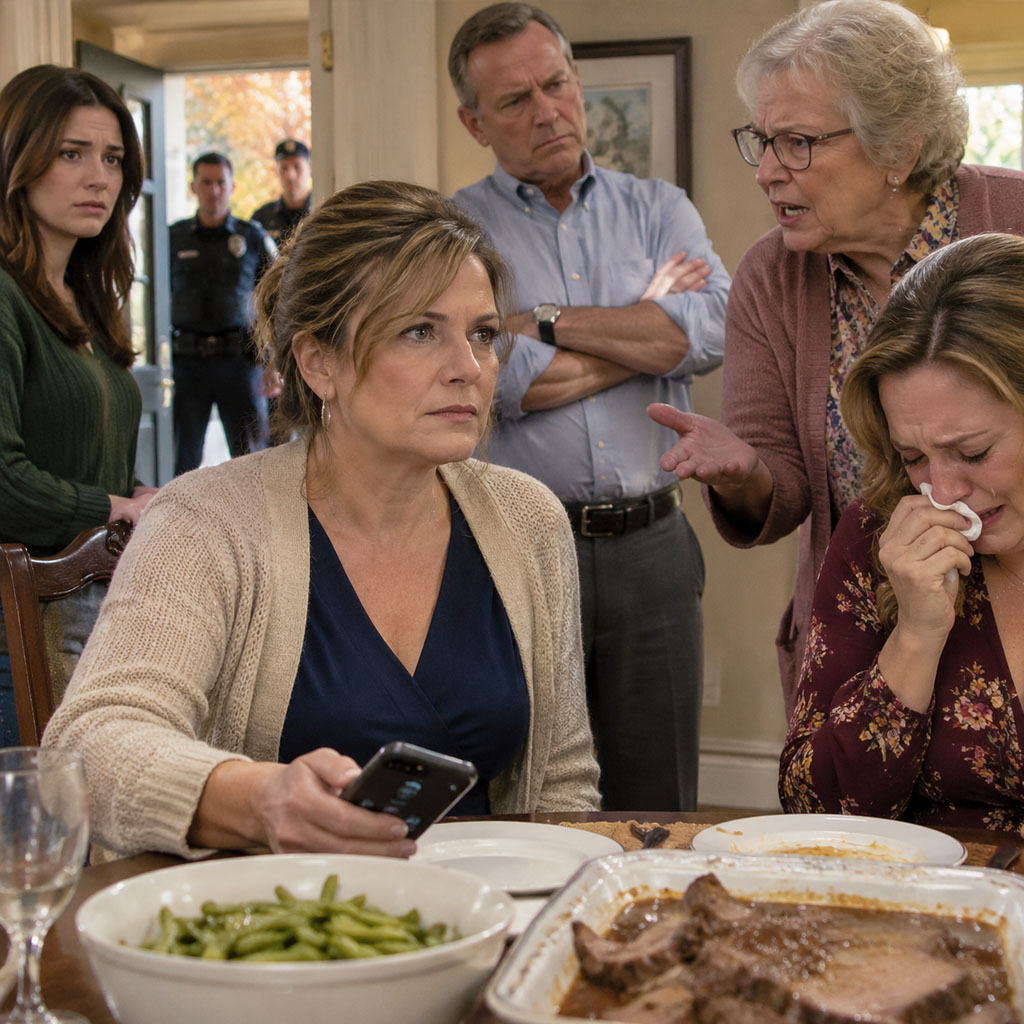
Dorothy had prepared pot roast, mashed potatoes, and green beans. Melissa brought a box of cookies from the grocery store and received so much praise that anyone would have thought she’d baked them herself.
I sat beside Hannah.
She reached beneath the table and squeezed my hand.
“You okay?” she whispered.
“Ask me after dessert.”
For the first fifteen minutes, everyone behaved as though nothing had happened.
Dorothy discussed a neighbor’s new fence. Melissa complained about customers canceling appointments. Richard described a difficult sales meeting.
Then Dorothy put down her fork.
“I think it’s time we put this unpleasant business behind us.”
Melissa immediately reached for a napkin.
Dorothy continued.
“Melissa has suffered enough. She made a mistake, and Laura has taken it far too personally.”
I looked at her.
“Taking somebody’s property personally is generally how ownership works.”
Hannah pressed her lips together, trying not to laugh.
Richard wasn’t amused.
“Laura, don’t start.”
Melissa spoke in a trembling voice.
“I never meant for any of this to happen.”
I turned toward her.
“Did you lose my ring?”
She stared at her plate.
“I already told you what happened.”
“Did you sell it?”
She looked at Richard.
That was answer enough.
Richard pushed back his chair.
“Enough! Apologize to my sister.”
The entire table went quiet.
He stood over me.
“She’s been crying for weeks because of you. It’s just something you wear on your finger. I’ll buy you a fake one.”
Dorothy nodded sharply.
“She’s family. Let it go.”
I looked from one face to another.
Melissa was crying. Dorothy was angry. Richard was demanding that I apologize.
For years, this had been the arrangement. Melissa made a mess, Richard defended her, Dorothy demanded understanding, and I was expected to make everything comfortable again.
But this time, I reached for my phone.
I opened the photograph from Rosewood Estate Jewelry and turned the screen toward Melissa.
“Does this look familiar?”
She stopped crying.
I pointed to the six-prong setting.
“The police identified the engraving, too. Melissa didn’t lose my ring. She sold it. And Richard went with her.”
Dorothy stared at her daughter.
“Is that true?”
Melissa said nothing.
Richard leaned toward me.
“You’re making this sound worse than it was.”
“I haven’t told them anything you didn’t already do.”
He lowered his voice.
“You had no right to drag the police into this.”
I put my phone down.
“I already called the police.”
At that exact moment, the doorbell rang.
Chapter 3
Dorothy looked toward the hallway.
“Who comes calling at supper time?”
She got up and walked to the front door.
I heard it open.
Then a man’s voice.
“Good evening, ma’am. I’m Detective Porter. We’re looking to speak with Richard Bennett and Melissa Carter.”
Dorothy appeared in the doorway.
“Richard, it’s the police.”
My husband went pale.
Not slightly uncomfortable. Completely pale.
Richard stood and walked toward the front entrance.
Detective Porter was accompanied by another officer. He identified himself and explained that investigators were trying to arrange interviews concerning a jewelry transaction.
Richard glanced over his shoulder at me.
“Tell them this is a misunderstanding.”
I remained seated.
“Then tell them what happened.”
Richard turned back toward the detective.
“This is a family matter.”
Porter’s expression didn’t change.
“That doesn’t prevent us from asking questions, sir.”
Richard asked whether he was under arrest.
“No,” Porter replied. “But you’re welcome to arrange any interview through your attorney.”
Melissa came into the hallway crying.
Dorothy asked whether the officers were going to take her daughter away.
The detective didn’t make promises. He simply explained that the investigation was ongoing.
After the officers left, nobody spoke for several seconds.
Then Dorothy turned toward me.
“You’ve brought shame on this family.”
Hannah stood up.
“Grandma, Mom didn’t sell the ring.”
Richard snapped at her.
“Stay out of this, Hannah.”
“No. You’ve been blaming Mom for weeks.”
Melissa began crying harder.
Richard reached for her shoulder, but she pulled away.
“You promised you’d handle this,” she said.
“Melissa, not now.”
“I’m not taking all the blame for your idea.”
The room went silent.
Richard turned toward her.
“Be quiet.”
I looked at my husband.
“Your idea?”
Melissa stared at him, then at me.
She looked as though she wished she could take back the words.
For the first time, I understood that Richard might not have simply helped his sister after she made a terrible decision.
He might have suggested the decision himself.
The drive home was silent.
Richard gripped the steering wheel and stared straight ahead. When we arrived, he went into the living room and turned on the television.
I stood in the doorway.
“Melissa said selling my ring was your idea.”
He didn’t look at me.
“She’s upset.”
“What idea, Richard?”
“Laura, I’m not doing this tonight.”
I switched off the television.
He looked up, irritated.
“Seriously?”
“Yes. I want an answer.”
He stood.
“Fine. You want the truth? Melissa was drowning in bills. Her beauty studio was struggling. I tried to help her, and things got out of hand.”
“Did you tell her to borrow my ring?”
He looked away.
“She needed something she could sell.”
I felt as though the room had shifted beneath me.
“You knew she was going to sell it?”
“I was trying to protect my family.”
“Which part of your family?”
He walked past me without answering.
The following morning, he contacted an attorney.
By Wednesday, he was telling relatives that I had overreacted, that Melissa had intended to buy the ring back, and that my decision to involve the police had made everything worse.
Nobody could explain where the money for buying it back was supposed to come from.
My attorney helped me organize our financial records. We began documenting the transfers, the cash deposits, and Richard’s explanations.
The investigation continued.
I also learned that recovering the ring would take time. The jewelry store had purchased it, and the ownership dispute had to be resolved properly.
I couldn’t simply walk in and demand that the manager hand it over.
That was harder to accept than I expected.
I’d collected evidence, made a report, and hired an attorney. Yet I still didn’t have the one thing I wanted.
Meanwhile, Richard continued living in our house.
He ate dinner at our table, watched television in the living room, and behaved as though I had created the entire problem.
One Thursday, I came home from work and found a little white jewelry box on the kitchen counter.
Richard stood beside it.
“Open it.”
Inside was an imitation diamond ring.
The stone was too large, the setting too bright, and the band felt almost weightless.
He smiled.
“Looks pretty close, doesn’t it?”
I closed the box.
“Where’s Mom’s ring?”
His smile disappeared.
“Nothing is ever enough for you.”
I looked down at the little box.
For a moment, I wondered whether I was really prepared to walk away from 28 years of marriage.
There were holidays, vacations, family photographs, evenings on the porch, and all the ordinary moments that made up our life together.
I put the box back on the counter.
“I don’t want a fake ring, Richard.”
He threw up his hands.
“Then I don’t know what you want!”
That was the saddest part.
After 28 years, he still didn’t understand.
Chapter 4
The truth came out gradually through the investigation and the legal process.
Melissa had begun realizing that Richard was willing to let her take responsibility for the entire transaction. She eventually agreed to provide investigators with messages she and Richard had exchanged before the wedding reception.
I didn’t receive those messages directly. Detective Porter couldn’t simply hand me private investigative material. But as the case progressed, the substance of those communications became clear through the proper legal disclosures.
The first message was from Melissa.
She was behind on expenses at her beauty studio. Rent, equipment payments, and business bills had accumulated, and she was afraid she would lose the place.
She had asked Richard for more money.
He had already transferred $3,200 from our joint savings account without telling me.
When Melissa needed additional help, she suggested selling some jewelry temporarily.
At first, she mentioned pieces belonging to Dorothy.
Richard refused.
He didn’t want their mother upset.
Then he suggested my mother’s ring.
He knew it was valuable. He knew I rarely wore it. Most importantly, he knew I trusted him to respect the things that mattered to me.
Melissa asked what would happen if I noticed the ring was missing.
Richard’s reply was simple.
“She’ll forgive me. She always does.”
I read that sentence three times when it was finally discussed with me.
Another message showed Melissa asking what they should tell me.
Richard answered:
“Say you lost it. I’ll handle her.”
The same words he’d used when Melissa called me crying.
He hadn’t been trying to calm his sister.
He had been reassuring her that he could control my reaction.
The financial details were equally revealing.
Rosewood Estate Jewelry had paid Melissa $4,600 for the ring.
Of that amount, $3,200 had gone back into our savings account, concealing the earlier transfers Richard had made.
The remaining $1,400 had gone toward Melissa’s overdue business expenses.
There had never been enough money set aside to buy my ring back.
Their entire plan depended on me accepting the loss.
I sat in my attorney’s office while she explained the financial records.
“Do you understand now why he was so opposed to the police report?” she asked.
I nodded.
Richard hadn’t been protecting Melissa from embarrassment.
He had been protecting himself.
A few weeks later, Richard and I met with our attorneys to discuss the marriage and our finances.
He was defensive from the moment we sat down.
“I was trying to keep Melissa’s business from closing,” he said.
I looked at him.
“Why did you choose something that belonged to me?”
“You didn’t wear it very often.”
“I wore it when I wanted to remember my mother.”
“You still have your memories.”
I stared at him.
He seemed uncomfortable.
“I didn’t mean it the way it sounded.”
I took a breath.
“Why didn’t you sell something of your mother’s instead?”
He leaned back.
“Mom would have been devastated.”
I waited.
He seemed to realize what he’d said, but he continued anyway.
“She would never have forgiven me.”
There it was.
Twenty-eight years explained in one sentence.
He had protected his mother from the very pain he expected me to swallow.
I looked directly at him.
“And you knew I would forgive you.”
Richard opened his mouth, then closed it.
For once, there was nothing left for him to say.
After that meeting, I began preparing to leave.
Hannah came over one Saturday to help me pack.
She had spoken with her father privately, and he had apparently admitted that he expected me to forgive him eventually.
“He’s acting like you’re ruining everything,” she said while folding my sweaters.
I placed another stack in a suitcase.
“Your father doesn’t know what to do when somebody says no.”
Hannah sat on the edge of the bed.
“Mom, I still love Dad.”
I stopped folding.
“I hope you always can. Whatever happens between us, he’s still your father.”
She nodded.
Then she asked the question I had been avoiding.
“Do you still love him?”
I considered lying.
“Parts of him,” I answered.
She reached for my hand.
A few days later, I moved into a small rental apartment near my workplace.
It wasn’t fancy. The bedroom window faced a parking lot, and the kitchen floor sloped slightly toward the refrigerator.
When I opened the silverware drawer, I found one fork.
Just one.
I stood in the kitchen laughing until tears came to my eyes.
Twenty-eight years of marriage, and apparently my independence came with one fork.
That first night, I cried, too.
I missed my house. I missed the familiar sounds. I even missed Richard asking whether I’d seen his keys when they were usually in his coat pocket.
But I didn’t miss being told that my feelings were the problem.
Just before bed, a message arrived from him.
I bought you the ring you wanted. It should arrive tomorrow.
I stared at the screen.
Then I typed:
Richard, you still don’t understand which ring I want.
I turned off my phone.
For once, I let somebody else’s confusion remain their own problem.
By January, I had bought five more forks.
That probably sounds like a small thing, but I remember standing in the kitchen aisle at the grocery store, choosing silverware without wondering whether Richard would think it was too expensive.
I bought a small set with blue handles.
Hannah said they looked like something from a beach cottage.
I told her that was fine. I’d always wanted to live somewhere that looked as though people were allowed to relax.
Life after leaving wasn’t suddenly wonderful.
Some evenings, I came home from work and stood in the apartment without knowing what to do with myself.
For almost three decades, I’d planned my evenings around another person. What time was Richard coming home? Did he want dinner? Was Dorothy expecting us Sunday? Did Melissa need another favor?
Now I could make a sandwich at 6:30 and watch an old movie without explaining why I wasn’t doing something more useful.
I liked that freedom.
I also found it lonely.
Both feelings could be true.
Meanwhile, the investigation continued through the winter.
Melissa eventually acknowledged through the legal process that she had sold a ring she had no authority to sell. Her cooperation was considered as the case moved forward.
The matter was resolved through an agreed court disposition that required her to accept responsibility and make restitution under conditions established by the court.
I didn’t attend every hearing. My attorney kept me informed, and I attended the proceeding where Melissa formally accepted responsibility.
She stood before the judge looking smaller than I had ever seen her.
The woman who had arrived at my house in expensive shoes, slipped my mother’s ring onto her finger, and kissed my cheek while promising to return it now had to acknowledge what she’d actually done.
There was no shouting and no dramatic speech.
Just questions, answers, and a court record.
That was enough.
Melissa later reduced the size of her beauty studio. Her financial problems hadn’t disappeared simply because she had sold my jewelry.
One afternoon, she called me.
I almost let the call go to voicemail.
“Laura,” she said quietly, “I never thought any of this would go so far.”
I sat at my kitchen table.
“Neither did I.”
“I wish I’d never borrowed that ring.”
I looked out the window.
“I wish you’d brought it home.”
She was silent.
Then she said, “I’m sorry.”
I believed she regretted what had happened. I wasn’t certain she regretted it for the right reasons, but I no longer needed to decide.
“Goodbye, Melissa.”
I ended the call.
Richard and I continued working through the separation.
The financial disclosures showed the money he’d transferred to Melissa and the cash used to replace it. Our attorneys negotiated how those transactions would be addressed in the division of our marital finances.
Richard couldn’t simply announce that helping his sister was a private family matter.
The money had come from an account we owned together.
We eventually reached a written financial arrangement, and I proceeded with filing for divorce.
Chapter 5
Richard was shocked when the divorce papers arrived.
He called me that evening.
“You’re really doing this?”
“Yes.”
“After everything we’ve been through?”
I looked around my apartment.
There was a small dining table, a photograph of my mother beside the lamp, and a set of blue-handled silverware in the kitchen drawer.
“That’s part of why I’m doing it.”
In March, Richard asked whether we could meet for coffee.
We chose a quiet place near downtown Westerville.
He was already sitting at a table when I arrived. He looked tired, older somehow.
For a moment, I felt the old instinct to ask whether he was eating properly.
Then I reminded myself that he was a grown man who knew where grocery stores were.
We ordered coffee.
Richard told me he’d started counseling.
He said he was beginning to understand how often he’d treated Melissa’s problems as emergencies and mine as inconveniences.
“I thought I was being a good brother,” he said.
“You were helping her with somebody else’s property.”
He nodded.
“I know.”
That surprised me.
There was no argument, no lecture about family loyalty, and no attempt to make me feel unreasonable.
He looked down at his coffee.
“I kept thinking I could fix everything before you found out.”
“Did you ever plan to tell me?”
He took a long time answering.
“No.”
I appreciated the honesty, although I wished he’d discovered it before everything fell apart.
Richard asked whether we could try again.
He said he still loved me.
I believed him.
That’s something people don’t always understand about a marriage ending. Sometimes love doesn’t disappear when trust does. Sometimes you can still recognize the good in someone and know you cannot continue living with the harm they keep causing.
“I can’t come back, Richard.”
He looked at me for a long moment.
“I never thought you’d really leave.”
“I know.”
We finished our coffee.
He asked whether he could hug me.
I said yes.
It was familiar and sad.
When I stepped away, I knew I’d made the right decision.
In April, Dorothy sent me a letter.
It was four handwritten pages.
She admitted she had known about the sale before the family dinner. Melissa had confessed to her, and Dorothy had decided the best solution was to convince me to forgive everyone.
She wrote that she had been afraid of her daughter facing consequences.
Then came a sentence I hadn’t expected.
“I thought protecting my children meant protecting them from their mistakes. I see now that I helped them keep making the same ones.”
I read it twice.
Dorothy asked whether we might visit sometime.
I wrote back:
Thank you for apologizing. I need some distance. I hope you understand.
I didn’t promise anything more.
Hannah continued seeing her grandmother occasionally. She also stopped accepting Dorothy’s complaints about me.
One Sunday, Dorothy apparently asked why Hannah wasn’t bringing me over for dinner.
Hannah told her that I no longer lived with Richard.
Dorothy complained that the family hadn’t been the same since everything happened.
Hannah asked whether she’d ever apologized for demanding that I forgive something she already knew was a lie.
Dorothy changed the subject to the weather.
Hannah told me about it later.
“Grandma has decided spring is very unpredictable this year.”
I laughed.
“That sounds about right.”
By early summer, the remaining ownership and evidence issues surrounding the ring had been resolved.
Arrangements were made for it to be returned to me.
I drove to the jewelry store for an inspection before taking it home.
The jeweler examined the setting carefully. The diamond was secure, and the band was in good condition.
Then she noticed the old scratch beside the setting.
“I could polish that out if you’d like.”
I looked at the small mark.
Suddenly, I remembered my mother standing at the kitchen sink, her sleeves rolled up, telling my father about catching the ring on the garden gate.
He’d offered to have it repaired.
She’d laughed and said they were both old enough to have a few scratches.
“No, thank you,” I told the jeweler. “I’d like to keep it.”
She smiled and handed it back.
I slipped it onto my finger.
It fit exactly as I remembered.
I sat in my car for a while afterward.
I didn’t cry.
I simply looked at my hand.
My mother had given me that ring because she loved me. Richard and Melissa had sold it because they believed I would forgive them.
Both things were true.
But only one of them would decide how I lived from then on.
A few days later, a package arrived at my apartment.
Richard’s return address was on the label.
Inside was another imitation diamond ring, much nicer than the first. The stone was larger than my mother’s, and the gold-colored band was shiny enough to catch the light from across the room.
There was also a card.
I know I can’t replace what you lost. I hope someday you’ll forgive me.
I sat with the card for a long time.
Part of me was touched that Richard was finally trying to apologize without blaming his sister.
Another part wondered how a man could spend 28 years with someone and still misunderstand what mattered to her.
I put the imitation ring back into its box.
Then I wrote a note.
You were right, Richard. A fake ring is easy to replace. A real marriage isn’t.
I mailed it back.
I didn’t include my wedding band.
That ring, and what to do with it, was my decision.
By July, Hannah and I had settled into a new Sunday routine.
She came over every other weekend, and we cooked together.
One afternoon, we made roast chicken, mashed potatoes, and green beans. Hannah stood at the counter peeling carrots while I checked the oven.
“Mom, your apartment is starting to look like an actual home.”
“That’s the idea.”
She pointed toward the dining table.
“Although you now own enough forks for a small restaurant.”
“I’ve become reckless in my old age.”
She laughed.
We sat down to dinner.
Halfway through the meal, Hannah noticed the ring on my hand.
“Grandma’s ring looks beautiful.”
I touched the band.
“It always did.”
She was quiet for a moment.
“Do you miss Dad?”
“Sometimes.”
“Do you miss being married?”
I considered the question.
“Not the way I was married.”
Hannah nodded and reached across the table to squeeze my hand.
We finished dinner.
She told me about the children at her school, the summer program she was helping organize, and a little boy who insisted the classroom hamster needed a birthday party.
I told her the hamster probably deserved one.
After dinner, we washed the dishes together.
Nothing dramatic happened.
Nobody demanded an apology. Nobody cried over a problem they had created. Nobody explained why I needed to be the bigger person.
It was just Sunday dinner with my daughter.
And I loved every minute of it.
Richard used to say it was just a ring.
Maybe that was all he saw.
A diamond, a gold band, something that could be replaced with a cheaper copy.
But my mother wore that ring through 40 years of marriage. It had been there for birthdays, funerals, ordinary Tuesdays, and all the little moments that make up a life.
When she gave it to me, she wasn’t giving me money.
She was trusting me with something she loved.
I couldn’t get back all the years I’d spent pretending certain things didn’t hurt. I couldn’t make Richard understand something he had refused to understand while we were married.
But I could stop pretending.
I didn’t call the police to destroy my husband’s family.
I called because something had been taken from me, and the people who took it were counting on my silence.
They were wrong.
I got my mother’s ring back.
I lost the marriage I thought I had.
And somewhere between those two things, I found a kind of peace I hadn’t known I was missing.
It wasn’t the peace of keeping everyone happy.
It wasn’t the peace of swallowing my words or pretending that betrayal was a family misunderstanding.
It was the peace of finally knowing that I didn’t have to apologize for protecting what mattered to me.
My mother had worn that ring through a lifetime of ordinary joys and difficult days. The little scratch beside the diamond was still there, exactly where it had always been.
I intended to keep it that way.
THE END.\
⚠️ All characters and events are fictional. Do not imitate or apply them in real life. 😌😌😌