I came to my new Navy command two days early because I wanted one anonymous morning before everyone learned my rank. Instead, a young SEAL decided my tan, haircut, and quiet confidence were proof I was pretending to belong. He grabbed my sleeve and yanked it above my elbow for twenty men to see. He expected smooth skin. What he exposed made an old Master Chief cross the gym in silence—and forced a secret I had carried for fourteen years back into the light.
### Part 1
The man decided who I was before I finished my first set.
It was 6:07 on a Tuesday morning, according to the red digital clock above the mirrors. The base fitness center smelled like disinfectant, rubber mats, and old coffee. Only half the ceiling lights were on, leaving the far row of squat racks in gray shadow while cold white dawn pressed against the windows.
Exactly the way I liked it.
I had arrived at Naval Station Calder Point two days before I was required to report. My uniforms were still hanging inside plastic garment bags in the small rental house I had found near the water. My boxes were unopened. My new office probably still belonged emotionally to the commander whose name had been removed from the door.
For forty-eight more hours, almost nobody here knew me.
That was the point.
I wore worn black trainers, plain gray workout pants, and a long-sleeved shirt pulled to my wrists. Nothing announced anything. No command ball cap. No unit shirt. No rank. No badge.
Just me.
I was halfway through the shoulder portion of a rehabilitation routine I had been doing for years when somebody laughed behind me.
Not a spontaneous laugh.
A projected one.
The kind designed to gather witnesses.
“You buy the whole look online?”
I set the light bar back onto the rack before turning around.
That habit had kept me alive in places considerably worse than a gym. Never hold weight, tools, or anything else when an unnecessary confrontation begins.
Three men stood behind me.
The one in front was maybe twenty-nine. Broad shoulders, expensive watch, sleeveless training shirt, special warfare insignia printed across his chest. His name, I would later learn, was Trevor Boone.
Two other men hovered behind him, amused because he was amused.
I had met his type before.
That did not mean I disliked him automatically. Confidence is useful in dangerous work.
But there is confidence built from experience, and there is confidence built because nobody has embarrassed you recently.
Trevor looked overdue.
“I’m almost finished,” I said. “Rack’s yours in ten minutes.”
His smile changed.
He had expected embarrassment or attitude.
Calm annoyed him.
He stepped closer.
“You didn’t answer me.”
“I didn’t realize you’d asked a serious question.”
One of his friends coughed into his fist, hiding a laugh.
Trevor noticed.
That made things worse.
“This isn’t some hotel gym,” he said. “People actually train here.”
I glanced at the bar.
“Yes. I noticed.”
His jaw tightened.
Around us, the room had begun listening.
A thin chief doing pull-ups stopped halfway through his next repetition. A sailor on a treadmill slowed to a walk. Someone near the dumbbells pulled out an earbud.
Trevor pointed toward the entrance.
“This is an operator facility.”
“No,” I said. “It’s the installation fitness facility.”
His friends stopped smiling.
He stared at me.
I could almost see the machinery turning behind his eyes. He had chosen an easy target—a woman in her early forties wearing anonymous workout clothes—and now the target refused to behave properly.
“You military?” he asked.
I wiped my hands on my towel.
“That’s none of your concern.”
That answer was technically unnecessary.
It was also true.
His voice became louder.
“You walk into our space looking like you just came back from a resort, take up a rack, and expect everyone to move around you?”
I looked at the nearly empty gym.
There were eleven unused racks.
“Yes,” I said. “This crowd is brutal.”
A few people looked down.
Trevor flushed.
He came close enough that I smelled mint gum and stale coffee.
“You bought that tan and that haircut,” he said. “Prove you belong or leave.”
The sentence hit an old nerve.
Not because it was original.
Because it wasn’t.
I had spent nineteen years hearing different versions of it.
Prove you belong.
Prove you know.
Prove you did.
Show the badge.
Show the paperwork.
Show the wound.
Show me enough of yourself that I can decide whether you’ve earned the space you’re already standing in.
I had joined the Navy at twenty-two. I had entered a field where women were still unusual enough to be remembered individually. I had learned early that some people treated competence like a temporary permit that expired every time you entered a new room.
Normally, I handled those people well.
But that morning I was tired.
I had driven eight hours the day before. My left forearm had been aching since midnight. I had barely slept because the gulls outside my rental screamed like drunk teenagers.
And I wanted one anonymous hour.
So I picked up my towel.
“I’m done here.”
Trevor smiled.
He thought he had won.
That was my mistake.
I turned toward my bag.
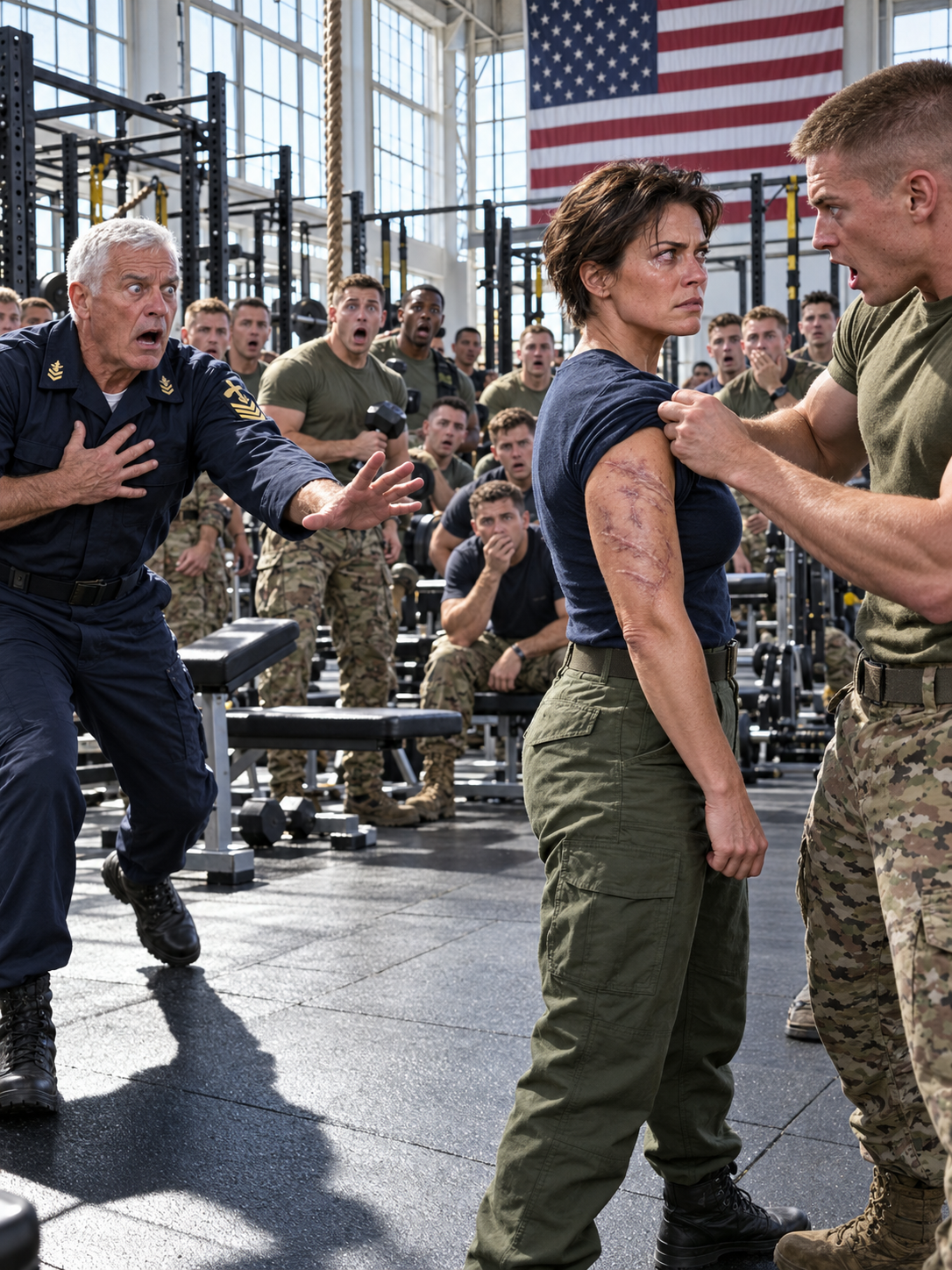
His hand caught my left sleeve.
For one second, I simply stared at his fingers.
“Let go.”
“Oh, come on,” he said loudly. “Let’s see what we’re dealing with.”
Then he yanked the fabric upward.
The sleeve scraped over my wrist.
Past the lower forearm.
Past the place where normal skin ended.
Trevor turned slightly toward the men watching, clearly expecting laughter.
“See? You can always tell when—”
He stopped.
His fingers were still gripping my shirt near my elbow.
His eyes had dropped to my arm.
The graft ran from below the elbow almost to the wrist, pale and uneven beneath the white lights. Reconstructed tissue crossed the inside of my forearm. The skin around it carried old marks from surgeries that had rebuilt tendons and repaired what fire had taken.
The entire room changed.
Nobody laughed.
Trevor’s mouth remained slightly open.
He knew enough to understand that he was looking at something serious.
He did not know enough to understand what.
I felt the old numbness along the graft where his knuckles had dragged across it.
Then, from the opposite side of the gym, I heard metal touch metal.
A cable-machine handle being lowered carefully into place.
A man in his early fifties stood beside it.
Gray at the temples. Thick through the chest. Quiet face.
Master Chief Samuel Keene.
I did not know his name yet.
But I knew immediately what he was.
Senior enlisted authority has a presence that rank insignia barely improves.
Keene stared at my arm.
Not curiously.
Not sympathetically.
He stared at it the way a person stares at a road he has driven before in a nightmare.
Then he looked at my face.
Something drained out of his expression.
He began walking toward us.
Slowly.
No anger.
No hurry.
Men moved out of his way without being asked.
Trevor finally released my sleeve.
“Master Chief, I was just—”
Keene stopped three feet away.
His eyes moved once more over the graft.
Then he looked directly at Trevor.
“Boone.”
Trevor straightened automatically.
“Yes, Master Chief?”
Keene’s voice was quiet enough that everyone had to stop breathing to hear it.
“Stand up straight.”
Trevor blinked.
“I am.”
“No.”
Keene looked at my arm again.
Then back at him.
“You’re not.”
Something in the Master Chief’s face unsettled me more than Trevor ever had.
Recognition.
Not of me.
Of the scar.
And suddenly I was no longer standing in a bright California gym.
I was twenty-seven again.
There was sand in my mouth.
My sleeve was burning.
And Caleb Mercer was still alive.
For another thirty seconds.
### Part 2
Fourteen years earlier, Chief Caleb Mercer had told me that fear was useful as long as you gave it a job.
“If it’s going to ride with us,” he said, tightening a strap on his kit, “make the damn thing carry something.”
That was Caleb.
He could turn terror into a logistics problem.
We were attached to a joint task force in Afghanistan in the fall of 2012. I was Lieutenant Claire Donovan then, twenty-seven years old and convinced exhaustion was something that happened to less disciplined people.
Caleb was thirty-four.
He had shoulders like a refrigerator, permanent stubble, and the driest humor of any person I had ever known.
We were EOD.
Explosive ordnance disposal.
When other people discovered the thing nobody wanted to touch, we walked toward it.
Caleb had a wife named Rachel and a daughter named Sophie who drew enormous yellow suns on every picture she mailed him.
He kept those drawings inside his equipment case.
Before difficult jobs, he would lift the lid, look at them for two seconds, close it, and get to work.
He never discussed the ritual.
Neither did I.
That kind of partnership develops its own language.
We had completed more than forty missions together before the night that changed everything.
The target was a compound near a dry riverbed. A ground team had secured the immediate area and identified what looked like an improvised device embedded near a courtyard wall.
The first report sounded almost routine.
Routine is a dangerous word.
Caleb disliked it.
“Routine means somebody stopped thinking,” he once told me.
That night, somebody had thought.
Unfortunately, it was the enemy.
The first device was bait.
We understood that too late.
Its purpose was not primarily to detonate.
Its purpose was to gather us.
Bring the specialists forward.
Make everyone focus on the obvious problem.
Then trigger the real one.
I remember Caleb humming during the approach.
Four notes.
Maybe five.
He always hummed the same thing and I never asked what song it was.
That omission has bothered me more than things that should probably bother me more.
We were perhaps twenty yards from the wall when Caleb stopped.
Not his normal working pause.
Different.
His whole body became still.
Then he turned sharply.
“Donovan—”
That was all.
He moved toward me.
The heat arrived before the sound.
People assume explosions are primarily noise.
They are wrong.
At close range, they are pressure.
Heat.
Movement.
The sensation that the world has become solid and struck you.
White swallowed everything.
Then dirt.
Then a ringing so complete it almost felt silent.
I opened my eyes on the ground.
My left sleeve was burning.
Training took over where panic would have been useless. I rolled, crushed the flame into the dirt, checked myself, tried the hand.
Pain came later.
Caleb came first.
He had placed himself between me and the second charge.
Deliberately.
There is no kinder version of that fact.
Nearby, one of the operators was badly wounded.
Gunfire started from beyond the compound.
The ambush had been waiting for the blast.
Somewhere north of us, a ground element opened fire in response.
I remember dragging Caleb.
I remember using my damaged arm because I had two arms and therefore, according to the arithmetic of that moment, I was going to use two arms.
I remember someone shouting.
I remember the smell of burned fabric.
I remember an operator grabbing at the dirt as I pulled him.
And I remember Caleb’s weight.
That most of all.
People become unbelievably heavy when they cannot help you carry them.
We reached partial cover.
The wounded operator survived.
Two other men who might not have survived got out.
Caleb did not.
The doctors eventually told me there were things I should not have physically been capable of doing with the damage to my arm.
I never found that observation useful.
Capability depends heavily on what your alternatives are.
Over the next year, surgeons rebuilt what they could.
Skin grafts.
Tendon repair.
Months when closing my hand around a coffee mug qualified as a successful morning.
A therapist named Dr. Nina Patel took responsibility for teaching my hand how to become a hand again.
She never praised me for pain tolerance.
She praised measurements.
“Three more degrees.”
“Better grip.”
“Again.”
That was exactly what I needed.
I received a Bronze Star with Valor and a Purple Heart.
Both eventually went into a drawer.
Caleb’s daughter’s drawing went into a frame.
That difference mattered to me.
The medals described an event.
Her drawing described a person.
When I returned to duty, people expected me to transfer.
I didn’t.
Maybe stubbornness was part of it.
Maybe grief.
Mostly, I refused to let one terrible night make every decision afterward.
I stayed in EOD.
I learned to work with the arm.
I learned its weather.
Cold mornings made the tissue tight. Heavy use created a deep ache that began near the elbow and traveled toward the wrist.
That was why, fourteen years later, I was in the Calder Point gym before sunrise working through shoulder, forearm, grip.
And that was why I kept the sleeve down.
Not shame.
Ownership.
The scar belonged to me.
Caleb belonged to me.
The story belonged to Rachel and Sophie far more than it belonged to any curious stranger.
Then Trevor Boone pulled my sleeve up and turned private history into public evidence.
Back in the gym, Master Chief Keene stared at Trevor.
Trevor swallowed.
“Master Chief, this doesn’t prove anything.”
Several people visibly winced.
Keene’s eyes narrowed.
Trevor kept digging.
“Anybody can have a scar. I’ve never seen her around here. She wouldn’t show identification. I was just trying to establish whether—”
“Stop.”
One word.
Quiet.
Trevor stopped.
Keene looked at him for several seconds.
“I need you to think very carefully about the last sixty seconds of your life.”
Trevor’s face reddened.
“Master Chief—”
“You will be replaying them for a long time. You should at least remember them accurately.”
A man behind Trevor suddenly whispered, “Oh, hell.”
He was staring at my arm.
Maybe he had heard a version of the story.
Military communities collect stories the way ships collect salt.
Details change.
Names disappear.
But certain moments survive.
A young sailor near the treadmills looked from Keene to me.
“Ma’am?”
I turned toward him.
“Were you…?”
He could not finish.
I could have.
I could have told them everything.
My rank.
My record.
The Bronze Star.
The nineteen years.
The command I was about to assume.
For one ugly second, I wanted to.
Then I imagined Caleb watching me spend his death to win an argument in a gym.
The desire vanished.
“I was there,” I said.
Nothing more.
Keene’s face tightened.
“Who was your chief?”
I hesitated.
Then answered.
“Caleb Mercer.”
The Master Chief closed his eyes for one second.
When they opened again, fourteen years were sitting behind them.
“I was north of that wall,” he said.
The gym disappeared around us.
“I was with the element covering your extraction.”
I stared at him.
Keene’s voice lowered.
“I never knew the EOD lieutenant’s name.”
“I never knew yours either.”
He nodded once.
“I saw you dragging Mercer.”
My throat tightened.
“He was still alive then.”
“Yes, ma’am.”
Nobody else moved.
Keene had been there.
Not nearby in the broad historical sense.
There.
Same dust.
Same wall.
Same darkness.
For fourteen years, we had been carrying different pieces of the same night without knowing the other person existed.
Keene turned toward Trevor.
Trevor’s face had gone gray.
Then the Master Chief looked past him at the twenty or so men who had gathered.
“Some of you were laughing.”
Nobody answered.
“I think,” Keene said, “you should understand what you were laughing at.”
And as he began telling them about the wall, I realized something else.
Trevor still had no idea who I was coming to Calder Point to become.
Neither did almost anyone else.
They were going to find out soon enough.
### Part 3
Master Chief Keene did not dramatize the story.
That made it worse.
He described the compound in the flat voice of someone giving coordinates.
The first device.
The second charge.
The ambush.
The wounded operator.
Caleb.
Me.
“I watched that lieutenant pull two men toward cover while her own sleeve was burning,” he said. “Our element was putting fire north because getting those people out depended on somebody keeping the darkness occupied.”
Nobody looked at me now.
They looked at the floor.
Keene continued.
“Several men came home from that compound who had a real chance of not coming home.”
He paused.
“I have spent fourteen years wondering who she was.”
Then he faced Trevor.
“You wanted to know whether she had earned the right to train here.”
Trevor’s eyes closed briefly.
Keene’s voice remained level.
“She earned the floor.”
The young sailor near the treadmill came to attention.
He did it awkwardly.
Nobody had ordered him.
Then another man stood straight.
Then another.
Water bottles went down.
Weights stopped moving.
Across the gym, people rose one by one until the room had quietly reorganized itself around a woman who ten minutes earlier had been treated like an intruder.
I hated almost every second of it.
Not because they meant anything wrong.
Because being honored for surviving a night when Caleb had not survived still felt like receiving somebody else’s mail.
Trevor was last.
He stood there with his hands at his sides, humiliation moving across his face.
I looked down at my exposed arm.
Then I reached across with my right hand and pulled the sleeve slowly back to my wrist.
That mattered.
More than I can explain.
Trevor had uncovered it.
I covered it again.
My decision.
My arm.
My boundary.
Then I looked directly at him.
“You’re going to remember this.”
“Yes, ma’am.”
“I don’t need your career.”
He blinked.
“I don’t need paperwork to make you remember being completely certain and completely wrong in front of twenty people.”
Keene glanced at me.
Trevor said nothing.
“I’ve seen better men make worse mistakes,” I continued. “You made yours publicly. Carry it publicly. Learn something from it.”
His throat moved.
“Yes, ma’am.”
“That’s all.”
I picked up my towel.
Nobody moved as I walked out.
I made it through the doors before my left hand began shaking.
Not fear.
Memory.
There is a difference.
I stood alone in the passageway outside the gym, breathing through the old tightening beneath the graft.
Then I heard the door open behind me.
Trevor.
He stopped six feet away.
His posture had changed.
So had his face.
“Ma’am.”
I waited.
“I was wrong.”
No excuse followed.
That surprised me.
He looked directly at me.
“I was completely wrong.”
“Yes.”
“I’m sorry.”
I studied him.
An apology does not rewind a hand from your sleeve.
It does not return privacy once removed.
But a real apology matters because most people would rather explain themselves than surrender themselves.
Trevor didn’t explain.
That earned him the next thirty seconds.
He hesitated.
“Master Chief Keene said Chief Mercer…”
His voice weakened.
“Did he make it?”
“No.”
The answer hit him harder than my rank could have.
Until then, I think he had seen the morning as social humiliation.
He had challenged the wrong person.
Grabbed the wrong officer.
Made a fool of himself.
Now he understood the scar represented a dead man.
His eyes lowered to my covered arm.
“Oh.”
That was all.
Sometimes “oh” is the most honest word available.
Two hours later, I was drinking coffee from my chipped mug when my phone rang.
The caller identified himself as Captain Adrian Holloway, commanding officer of Calder Point.
“I understand you’ve had an unusually efficient unofficial check-in, Commander Donovan.”
I closed my eyes.
So much for anonymity.
“Yes, sir.”
“I’d like to see you.”
“When?”
A beat.
“Now would be good.”
Captain Holloway’s office overlooked the harbor. Morning sunlight turned the water outside into hammered silver.
He was fifty-one, lean, gray-haired, and calm in a way that suggested other people did the panicking around him.
He had already reviewed my file.
That was obvious from the open folder on his desk.
“Commander.”
“Captain.”
He pointed to the chair.
“Walk me through the gym.”
I did.
No decoration.
No minimizing.
No revenge.
When I finished, Holloway tapped a pen against the desk.
“Boone physically grabbed a senior officer.”
“He didn’t know I was a senior officer.”
“That is not the defense you think it is.”
“I didn’t say it was a defense.”
He almost smiled.
“Good.”
He leaned back.
“I can initiate disciplinary proceedings. Given the circumstances, nobody would question it.”
“I would.”
That got his attention.
“Explain.”
“He behaved like an idiot.”
“Yes.”
“He publicly humiliated himself.”
“Yes.”
“And now twenty witnesses will remind him about it until retirement.”
Holloway’s mouth twitched.
“That is not formal Navy discipline.”
“No, sir. It may be more effective.”
He studied me.
“You could damage his career considerably.”
“I know.”
“And you don’t want to.”
“No.”
“Why?”
I looked toward the window.
A tugboat moved slowly across the harbor.
“Because the Navy spent years making him useful. Because one stupid morning at twenty-nine does not have to become the most important thing he ever does.”
Holloway’s pen stopped.
“And because,” I added, “I know the difference between justice and satisfaction.”
He waited.
“Satisfaction is expensive when you pay for it with somebody else’s future.”
The office became quiet.
Finally Holloway asked, “Are you always this forgiving?”
“No.”
That made him laugh.
“Good. I was worried.”
“I’m not forgiving the behavior. I’m deciding what outcome I want.”
“And what outcome is that?”
“For him to become the kind of man who never does it again—and stops the next guy before he does.”
Holloway nodded slowly.
“That,” he said, “sounds suspiciously like command philosophy.”
“Inconvenient timing.”
“You start in forty-eight hours.”
“That was my understanding.”
He pushed the file closed.
“It appears your command started this morning.”
I sighed.
“Sir, I specifically came early so that would not happen.”
“Yes.”
He looked genuinely amused now.
“How’s that working out?”
I glanced at my phone.
Seventeen unread messages.
“Poorly.”
Before I left, Holloway became serious again.
“There’s something you should know.”
I stopped.
“Master Chief Keene contacted me before you arrived.”
“About Boone?”
“Partly.”
Holloway folded his hands.
“He also asked permission to pull an archived incident packet from 2012.”
My stomach tightened.
“Why?”
“He wants to contact Caleb Mercer’s family.”
For fourteen years, I had kept Rachel and Sophie inside a part of my life I rarely opened.
Now another survivor of that night wanted to knock on the same door.
And for the first time, I wasn’t sure whether keeping it closed was still protecting anyone.
### Part 4
I did not answer Master Chief Keene immediately.
For two days, I told myself I was busy.
Technically, that was true.
I had a command to assume.
Briefings.
Personnel files.
Safety reports.
Maintenance problems.
A workshop inspection.
More acronyms than any language should legally contain.
But every time I passed Keene in a corridor, I knew the real reason I had not answered.
Rachel Mercer.
Sophie Mercer.
I had visited them after Caleb died.
Sophie had been seven.
She wore purple sneakers and asked me whether her father had been afraid.
I had told her the truth.
“Yes.”
Her mother looked startled.
Sophie did too.
Then I added, “Brave people are afraid. They just decide something else matters more.”
She considered that.
“What mattered more?”
I looked at Rachel.
“His people.”
Fourteen years later, I still remembered Sophie nodding like she had been handed something heavy enough to require both hands.
On Thursday morning, I put on my khakis.
The uniform had been pressed the night before. My warfare badge sat above the ribbons. Commander insignia caught the light.
When I walked into headquarters officially for the first time, the corridor became quieter.
Not silent.
Just aware.
Word had spread.
Of course it had.
Navy gossip can beat radio transmission when properly motivated.
Near the operations section, Trevor Boone stepped aside.
He came to attention.
“Good morning, Commander.”
“Good morning.”
No awkward smile.
No resentment.
Clean.
I walked three steps before he spoke again.
“Ma’am?”
I turned.
“I wanted to ask something.”
“Ask.”
“Would your department ever allow people from our side to sit in on familiarization training?”
That surprised me.
“What kind?”
“EOD capabilities. Threat recognition. Maybe just understanding what your teams actually do.”
“Why?”
He held my gaze.
“Because I realized I know less than I thought.”
There are sentences a leader should remember.
That was one.
“Talk to my training chief.”
“Yes, ma’am.”
“And Boone?”
“Yes?”
“You won’t touch anything unless somebody tells you to.”
For one terrible second he thought I was serious.
Then he saw my expression.
A reluctant smile appeared.
“Yes, ma’am.”
That afternoon, I met my department properly.
They were good people.
I could tell within an hour.
Not perfect.
Good.
There is a difference.
Good teams ask difficult questions early.
They challenge assumptions without making theater of it.
They check each other.
They care more about getting home than looking impressive while leaving.
My senior chief, Hannah Reeves, handed me three maintenance problems and one personnel problem before lunch.
I liked her immediately.
By Friday, I had almost convinced myself life had moved forward.
Then Keene appeared outside my office.
He held a folder.
“I found them.”
I knew who he meant.
Rachel and Sophie.
My hand stopped over the report I was signing.
“How are they?”
“Rachel still lives in Colorado. Sophie’s twenty-one.”
Twenty-one.
The seven-year-old with purple sneakers was twenty-one.
Keene continued.
“She’s studying engineering.”
I laughed once.
Of course she was.
Caleb could repair almost anything with six inches of wire, unnecessary profanity, and complete disrespect for manufacturer instructions.
Keene placed the folder on my desk.
“I won’t contact them without you.”
I appreciated that more than I could say.
“Why do you want to?”
He thought about it.
“Because I spent fourteen years remembering that wall as a failure.”
I looked at him.
“We got people out.”
“I know.”
“But Mercer died.”
“Yes.”
Keene sat opposite me.
“I was team lead north of that compound. My job was to protect the extraction lane. Afterward, I kept thinking maybe we were thirty seconds late. Maybe our fire shifted wrong. Maybe if I’d seen the second position earlier…”
“You know that isn’t rational.”
“So do you.”
That shut me up.
He nodded toward my arm.
“You think you’re the only one who’s been doing arithmetic with ghosts?”
That sentence stayed in the room.
Finally I said, “No.”
“No.”
I looked at the folder.
“What would we say?”
“The truth.”
“That’s a dangerous category.”
“Usually.”
I laughed despite myself.
Keene leaned forward.
“Tell them their husband and father is still remembered. Tell them two people who were there found each other by accident. Tell them he saved lives.”
“They already know.”
“They know officially.”
That distinction mattered.
Citation language.
Notification language.
Military language.
They knew the sanitized facts.
Keene had seen Caleb’s last battlefield from another angle.
I had seen it from inches away.
Between us existed a version Rachel and Sophie had never heard.
I picked up the folder.
“Okay.”
We called Rachel on Saturday.
I almost disconnected twice before she answered.
“Hello?”
Her voice had changed.
Of course it had.
Mine had too.
“Rachel?”
A pause.
“Yes?”
“This is Claire Donovan.”
Silence.
Then a sound like somebody inhaling too quickly.
“Claire?”
“Yes.”
“Oh my God.”
I closed my eyes.
Keene sat across the table in my rental kitchen.
Between us were two untouched cups of coffee.
Rachel asked whether I was all right.
Fourteen years and that was her first question.
“I’m good.”
“You still in?”
“I am.”
“Caleb would have laughed himself sick.”
That hit exactly where she intended and exactly where she did not.
“I know.”
I introduced Keene.
He explained who he was.
Where he had been.
Why he remembered the wall.
Rachel became quiet.
Then she said, “Sophie needs to hear this.”
An hour later, Sophie joined the call.
Her voice was adult.
That hurt.
She remembered me.
That hurt more.
“I still have your drawing,” I told her.
She groaned.
“Oh, no.”
“The giant sun?”
“I was seven.”
“It’s framed.”
“Commander Donovan, please destroy that immediately.”
I laughed so hard I had to wipe my eyes.
Then Sophie asked the question I had always known might come someday.
“Did Dad know he was saving you?”
The kitchen went completely still.
“Yes.”
My voice almost failed.
“Yes. He saw something before I did. He moved in front of me.”
Sophie did not speak.
Neither did Rachel.
“He knew,” I said.
A quiet sob came through the phone.
Keene stared down at his hands.
For fourteen years, I had thought keeping that memory private was a form of loyalty.
But listening to Sophie cry, I understood privacy and isolation were not always the same thing.
Sometimes protecting pain too carefully keeps the people who love the dead from touching the parts that might comfort them.
Before we ended the call, Sophie asked me to send her a picture of the old drawing.
I promised I would.
Then she said, “Commander?”
“Yes?”
“Dad would be proud you kept going.”
I stared at the graft beneath my sleeve.
“I hope so.”
“No,” she said. “I know so.”
After the call ended, Keene and I sat in silence.
Then he raised his coffee.
“To Chief Mercer.”
I lifted mine.
“To Caleb.”
For the first time in fourteen years, saying his name did not feel like reopening a wound.
It felt like opening a door.
And on Monday morning, someone unexpected was waiting outside that door.
Trevor Boone.
Holding an EOD training request.
### Part 5
Trevor’s first day with my department began with Senior Chief Hannah Reeves handing him a clipboard.
He looked offended.
“You requested familiarization,” she said.
“Yes, Senior Chief.”
“Congratulations. You are familiarizing yourself with inventory.”
His teammates laughed.
I heard about it from the next room and decided not to interfere.
Humility is most effective when naturally occurring.
Over the next three months, Trevor came back.
Not constantly.
He still had his own command, his own responsibilities, his own training.
But whenever schedules allowed, he attended briefs.
He listened.
That was the difference.
The man I met in the gym wanted an audience.
The man who began appearing in our training spaces wanted information.
One afternoon, I found him speaking with two junior sailors beside a training aid.
One of them made a joke about a maintenance technician who had walked through earlier.
Trevor stopped him.
“You know anything about that guy?”
The sailor shrugged.
“No.”
“Then don’t write his résumé for him.”
I kept walking before Trevor saw me.
That was the outcome I had wanted.
Not fear.
Not obedience.
Transfer.
A lesson leaving the original person and becoming something that could protect somebody else.
Captain Holloway eventually closed the administrative matter with counseling and documentation appropriate to the boundary Trevor had crossed. I supported that.
Mercy does not mean pretending nothing happened.
It means choosing consequences based on what they can build instead of how satisfying they feel.
The gym story faded.
Stories always do.
Another scandal appeared.
Another deployment.
Another promotion.
Another stupid thing somebody did at a barbecue.
Military communities move fast because they have to.
But some changes stayed.
My department became busier than I expected.
Within six months, we had corrected long-standing readiness problems and changed portions of our joint training program with the special warfare tenant command.
Trevor’s familiarization request turned into a larger cross-training pipeline.
People who had once operated beside each other without understanding each other’s capabilities began learning together.
Keene helped build it.
Hannah ran half of it.
I mostly tried not to interfere with competent people doing competent work.
That is a larger percentage of leadership than most leadership books admit.
One year after I arrived at Calder Point, Sophie Mercer visited.
She came during spring break.
Twenty-two by then.
Tall.
Dark hair.
Caleb’s expression around the eyes.
I recognized her immediately even though the last time I had seen her she could barely reach my shoulder.
She recognized me too.
She looked at my left sleeve.
Then at my face.
“Can I?”
Nobody had ever asked that question exactly right before.
I knew what she meant.
I pushed the sleeve upward myself.
She saw the graft.
Her expression changed.
Not horror.
Grief, yes.
But something else too.
Understanding.
“That’s where Dad…”
“Yes.”
Her fingers hovered without touching.
“Does it hurt?”
“Sometimes.”
She nodded.
Then she looked away toward the harbor.
“He really moved in front of you?”
“Yes.”
“Did he say anything?”
I wished I had a better answer.
“He said my name.”
“Just your name?”
“Just my name.”
She smiled sadly.
“That sounds like him.”
“Yes.”
We stood there with gulls yelling overhead and salt in the air.
Then Sophie told me she was working toward a degree in mechanical engineering and wanted eventually to design protective systems.
“Dad liked solving dangerous problems,” she said. “I figured I could inherit the problem-solving part and skip the getting-shot-at part.”
“That would be my professional recommendation.”
She laughed.
Before leaving, she handed me an envelope.
Inside was a photocopy of one of the drawings Caleb had carried.
A huge yellow sun.
Three stick figures.
On the back Sophie had written one sentence.
You brought part of him home too.
I had received medals.
Promotions.
Citations.
Letters from admirals.
Nothing ever hit me like those six words.
I put the note in the same frame as her childhood drawing.
The medals stayed in the drawer.
Two years after the morning in the gym, my orders came through.
New assignment.
New command.
Another move.
Calder Point held a small farewell gathering.
I disliked farewell gatherings, which meant Hannah made sure mine was unavoidable.
Captain Holloway spoke.
Keene spoke.
My sailors gave me a ridiculous engraved training plate because they knew I would hate anything sentimental.
Then Trevor Boone approached afterward.
He had made chief.
That mattered.
Not because stripes magically improve a person.
Because the people around him had decided he was ready to carry some of their weight.
“Commander.”
“Chief.”
He glanced toward the gym across the installation.
“Do you remember the first thing you said to me?”
“I believe it was something deeply inspiring.”
“You said the rack was mine in ten minutes.”
“That sounds right.”
“I thought you were arrogant.”
“I thought you were annoying.”
He laughed.
“Fair.”
Then his face became serious.
“I never thanked you.”
“For what?”
“For not ending me.”
I shook my head.
“You did the work after that. Don’t thank me for work you did.”
“I still think about that morning.”
“You were supposed to.”
“Yes, ma’am.”
He hesitated.
“I teach my guys about it.”
My eyebrows went up.
“Hopefully with names removed.”
“Absolutely.”
“What do you tell them?”
He thought for a second.
“That the most dangerous assumption in a room is the one that feels obvious.”
That was good.
Better than anything I could have assigned him.
“And,” he continued, “that you never demand somebody’s scars as identification.”
I looked at him.
“Keep teaching that.”
“I will.”
We shook hands.
Properly this time.
No performance.
No audience.
On my final morning at Calder Point, I went back to the gym.
6:05.
Half the lights on.
Cold white dawn behind the windows.
The same rubber smell.
The same hum from the ventilation system.
I wore a plain gray shirt.
Long sleeves.
I started with shoulder.
Then forearm.
Then grip.
Exactly the routine Dr. Patel had given me all those years ago.
A young sailor nearby nodded.
“Morning, ma’am.”
“Morning.”
He went back to his workout.
No question about who I was.
No demand for proof.
That ordinary moment meant more than the room standing ever had.
I finished my last set and sat on the bench, flexing my left hand.
Fourteen years earlier, doctors had told me what the hand might never do again.
Close completely.
Carry significant weight.
Return safely to fieldwork.
They were reasonable predictions.
Bodies do not always respect reasonable predictions.
Neither do lives.
For years, I believed strength meant proving I could keep carrying everything alone.
Caleb.
The wall.
The fire.
The surgeries.
The guilt of coming home.
Every room where somebody looked at me and silently asked whether I deserved to be there.
But strength turned out to be stranger than that.
Sometimes it meant covering the scar because the story was mine.
Sometimes it meant uncovering it for a dead man’s daughter because the story was partly hers.
Sometimes it meant allowing a Master Chief to carry his part.
And sometimes it meant refusing to destroy a foolish young man when destroying him would have been easy.
I had not forgiven Trevor because the morning “didn’t matter.”
It mattered.
He had crossed a line.
I simply refused to let his worst sixty seconds define every year that came afterward.
There is a difference.
I pulled my sleeve down.
Not because I was hiding.
Because I could.
That was what I finally understood.
The scar did not prove my worth.
The medals did not prove it.
My rank did not prove it.
Twenty men standing in a gym certainly did not prove it.
My worth had never depended on strangers reading me correctly.
Neither had Caleb’s.
He had been brave before anybody wrote the citation.
He had been a father before anybody called him a hero.
He had been my chief before the wall turned him into a story.
I walked outside.
The sun had finally cleared the harbor buildings, bright and white across the pavement.
My car was packed.
My orders sat in a folder on the passenger seat.
Another base waited.
Another group of people who would size me up.
Another room where somebody might be too confident about what they saw.
That no longer bothered me.
People are allowed to be wrong about me.
I am not required to correct every one of them.
Some things do not need proving.
Some scars do not need explaining.
And some of the strongest things we ever do happen after we have already demonstrated that we could have chosen something harsher.
I started the engine.
Before pulling away, I looked once at the fitness center.
Two years earlier, I had entered that building hoping to be nobody for one hour.
Instead, a stranger rolled up my sleeve and exposed the part of my life I had guarded most carefully.
I thought at first that he had taken something from me.
He hadn’t.
He accidentally gave something back.
Caleb’s name moved through the world again.
Keene stopped wondering who had been behind that wall.
Rachel and Sophie learned one more truth about the man they loved.
Trevor became a better leader.
And I learned privacy does not require loneliness.
I drove toward the gate with both hands steady on the wheel.
The scar stayed beneath my sleeve.
Caleb stayed with me.
But for the first time in fourteen years, neither felt like something I had to carry entirely alone.
THE END!
Disclaimer: Our stories are inspired by real-life events but are carefully rewritten for entertainment. Any resemblance to actual people or situations is purely coincidental.