
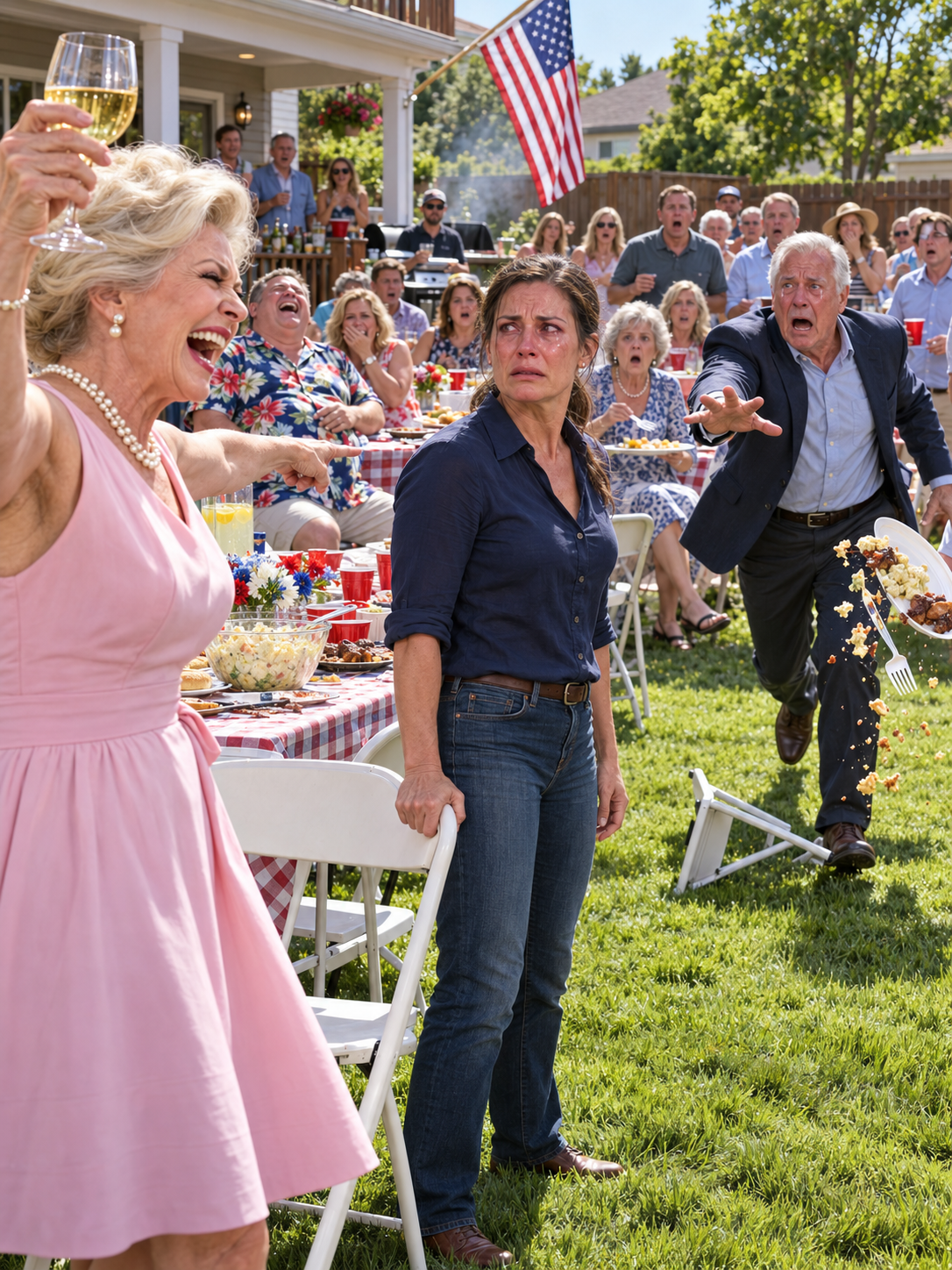
After 22 years in the Navy, I came home expecting nothing more than potato salad, folding chairs, and another evening of my mother explaining my life incorrectly. Then she lifted her wine and joked to the entire backyard that I had spent my career “cooking and cleaning for the real crew.” I was prepared to swallow it like always. But a stranger near the fence heard my old call sign, dropped his plate, and crossed the yard staring at me like he had just seen a ghost.
### Part 1
My mother had my future planned before I was old enough to understand that a person could refuse one.
At eighteen, I sat across from Lorraine Mercer at our kitchen table while she explained the life she believed was waiting for me. There was a boy named Ryan from two streets over whose father owned a plumbing business. There was an apartment above a pharmacy becoming available in October. There was a church she thought would be “perfect someday.”
She spoke as if my life were a room she had already furnished.
I waited until she finished.
Then I unfolded the enlistment paperwork resting in my lap and placed it between the salt shaker and the bowl of artificial fruit she had owned since I was six.
“I joined the Navy.”
My mother stared at the papers.
“The Navy?”
“I leave in September.”
Her eyes moved from my signature to my face.
“You’ll hate it.”
“Maybe.”
“You’ll be back before Christmas.”
I remember that sentence because she said it with complete confidence.
My father, Walter, was in the garage when it happened. He was usually in the garage when anything important happened in our house.
When Mom called him inside, he wiped his hands on an old shop rag, read the paperwork, then looked at me.
“That’s serious,” he said.
I nodded.
“So are you serious?”
“Yes.”
He handed the papers back.
“All right, then.”
From my father, that was practically a standing ovation.
My mother was never cruel in the obvious way. She did not scream every morning or insult me for entertainment. Her talent was quieter.
She assigned identities.
My older brother, Nolan, was exceptional.
I was dependable.
Nolan brought home a B-plus, and Mom talked about his potential.
I brought home an A, and she asked if I had remembered to unload the dishwasher.
Nolan joined student government. Mom bought a new camera.
I became captain of a swim team. She said, “That’s nice, honey,” while sorting coupons.
I loved my brother, and none of that was his fault. Nolan never demanded the spotlight. He simply grew up in a house where the spotlight was already pointed at him.
I learned to function in the dark.
I left in September.
I did not return by Christmas.
By the following summer, I had learned more about myself than Lorraine Mercer had learned about me in eighteen years.
I also discovered I was good on the water.
Really good.
Not pleasure-boat good.
Not fishing-weekend good.
I learned navigation, engines, tides, extraction procedures, communications, night operations, and how quickly an ordinary stretch of water could become deadly when visibility disappeared and somebody on shore was running out of time.
Eventually I qualified into small-boat operations.
Explaining that to my mother lasted approximately thirty seconds.
“So you drive boats?”
“Sometimes.”
“That sounds fun.”
“It’s not exactly—”
She was already calling into the living room.
“Walter, Elena gets to drive boats!”
That was when I began learning the easiest answer.
“Work is fine.”
For twenty years, whenever my mother asked about the Navy, I said fine.
The strange part was that she rarely asked a second question.
There is a particular loneliness in becoming extremely competent at something while the people who raised you remain committed to misunderstanding it.
I would return from months away, sit at the old kitchen table, and listen to Mom describe Nolan’s promotion at the insurance company.
“Nolan has thirty-two people under him now.”
“That’s great.”
“He might become district director.”
“Good for him.”
“And the twins are playing competitive soccer.”
“I saw the pictures.”
Then there would be a gap.
A perfect little opening where someone might have said, “And what about you?”
Nobody did.
Eventually I got so good at redirecting the conversation that my family probably thought I preferred it.
I met my husband, Daniel Brooks, after I had already been in for several years.
Daniel was a machinist’s mate, broad-shouldered, patient, and almost unnervingly calm. He noticed things other people missed.
Including me.
On our third date, he asked what I wanted after the Navy.
I laughed.
Nobody had ever asked me that.
“What?” he said.
“Nothing.”
“That laugh wasn’t nothing.”
I looked down at my drink.
“I’m not used to follow-up questions.”
Daniel didn’t laugh.
He reached across the table and squeezed my hand.
That was probably the moment I started falling in love with him.
Years later, whenever my mother introduced me as “Elena, she works on boats,” Daniel never corrected her unless I wanted him to.
He would simply place one hand against my back, a silent reminder that someone in the room knew exactly who I was.
By forty-two, I had served twenty-two years.
My retirement paperwork was waiting.
And in late August, Daniel and I drove back to my hometown in Ohio for what my mother kept calling my “homecoming party.”
It was not really my homecoming party.
Nolan had recently received a company sales award, and Mom wanted an excuse to fill the backyard.
My return happened to fit nicely into the program.
Daniel drove while cornfields rolled past the windows.
About thirty minutes outside town, he glanced at me.
“You’re doing it.”
“Doing what?”
“That thing where you decide beforehand that you don’t matter.”
I turned toward the passenger window.
“I matter.”
“You know what I mean.”
“I’m not going there to prove anything.”
“I didn’t say you were.”
“It’s Nolan’s celebration.”
“And yours.”
“Mostly his.”
“Elena.”
I sighed.
“Fine. I’m doing the thing.”
He smiled without looking away from the road.
“I know.”
“I just want an easy weekend.”
“I know that too.”
“I’ll let Mom tell everybody I spent twenty-two years paddling tourists around a lake if it keeps her happy.”
“That might test me.”
“Behave.”
“No promises.”
I laughed and rested my hand on his arm.
I truly meant what I said.
I was not going home hoping for recognition.
I had stopped expecting my mother to understand my life years earlier.
I had built something solid without her understanding.
I had commanded crews.
I had brought people home.
I had stood in places where fear tasted metallic in my mouth and still kept my voice steady because everyone around me needed steady more than they needed honesty.
Recognition from Lorraine Mercer no longer felt necessary.
At least that was what I believed.
When we arrived, Mom was in the kitchen mixing potato salad while her oldest friend, Janet Caldwell, sat drinking iced tea.
“Elena!” Mom kissed my cheek. “Look at you.”
Janet smiled.
“Still doing Navy things?”
“For another few weeks.”
Mom waved her spoon.
“Twenty-two years. Can you believe it?”
Janet widened her eyes.
“You’ve been at sea that whole time?”
“Not exactly.”
Mom laughed.
“She was mostly on boats.”
Mostly on boats.
Three words.
Twenty-two years compressed until they could fit on a refrigerator magnet.
Janet nodded knowingly.
“My nephew served on a ship. He said some of those support jobs are pretty comfortable.”
Daniel looked at me.
I gave him the smallest shake of my head.
Not today.
I carried my bag upstairs.
Later, Dad found me in the garage.
He had built new shelves along the west wall and spent ten minutes explaining how he had reinforced them.
Then he stopped.
“There was a letter once,” he said.
“What letter?”
“From the Navy. Years ago. Long envelope.”
I knew immediately.
Dad rubbed his thumb along the shop rag.
“Your mother put it in the front-room drawer.”
I waited.
“I read it.”
I looked at him.
“A lot.”
He swallowed.
“Sounded important.”
“It was a long time ago, Dad.”
“I know.”
He wanted to say something else.
I could see him trying.
But before he managed it, Mom shouted through the open garage door that she needed help with tables.
Dad flinched almost imperceptibly.
The moment closed.
As we carried folding chairs toward the backyard, Mom mentioned that Nolan had invited a new neighbor from Fenwick Street.
“Former military,” she said. “Navy, I think. Quiet fellow. I thought that would be nice for you. Someone who understands your little world.”
My little world.
I almost smiled.
“Very thoughtful.”
I never asked his name.
If I had, maybe something inside me would have shifted.
Maybe not.
Eighteen years is a long time.
Long enough for faces to change.
Long enough for grief to turn into routine.
Long enough for a man to move onto Fenwick Street carrying the memory of a woman he believed had died on a riverbank.
By sunset, I had made one private decision.
Whatever happened at that party, my old life would remain exactly where I had left it.
Especially the name people once used for me on the water.
A call sign I had not heard spoken aloud in nearly eighteen years.
A name almost nobody in Ohio knew.
I planned to keep it buried.
I had no idea there was already someone standing three houses away who had spent nearly two decades mourning it.
### Part 2
My mother loved a crowded backyard.
She loved folding tables covered in mismatched dishes, citronella candles, neighbors yelling through screen doors, children running through sprinklers, and most of all, being the person at the center of everything.
By six-thirty, our yard was full.
Nolan stood near the grill wearing a blue polo and trying not to look embarrassed while people congratulated him on the sales award Mom had placed on a table like a championship trophy.
“Please stop telling everyone,” he muttered when I hugged him.
“You know she won’t.”
“I told her it was an internal company thing.”
“She heard ‘parade.’”
He laughed.
“How long are you staying?”
“A week.”
“Good.”
He looked at me more carefully.
“You okay?”
“Why wouldn’t I be?”
“Because Mom’s been introducing you all afternoon.”
I closed my eyes.
“Oh no.”
“She told the Hendersons you spent two decades helping sailors with housekeeping.”
I opened them.
Nolan winced.
“I corrected that one.”
“Thank you.”
“I still don’t actually know what you did.”
“At least you know that.”
He smiled.
“Fair.”
Before I could answer, Mom tapped a fork against her glass.
The yard quieted.
Here came the performance.
She thanked everybody for coming, congratulated Nolan, mentioned the grandchildren, praised my father’s grilling skills even though Nolan was holding the tongs, then finally turned toward me.
“And of course, my daughter Elena is home.”
People smiled.
My mother raised her wineglass.
“Twenty-two years in the Navy, if you can believe that.”
A few people clapped.
I wished they wouldn’t.
Then Mom leaned toward the crowd conspiratorially.
“But don’t let her make it sound too dramatic. She was just on a boat.”
Several people chuckled.
Mom was enjoying herself now.
“Cooking, cleaning, helping the real crew.”
More laughter.
Warm laughter.
Friendly laughter.
That almost made it worse.
Nobody thought they were humiliating me.
They thought my mother was telling an affectionate family joke.
I felt Daniel become completely still beside me.
I touched his wrist.
No.
My mother was already smiling toward Janet, pleased with the laugh she had gotten.
I could have stayed silent.
I had stayed silent before.
Instead I heard myself say, calmly, “It wasn’t that kind of boat, Mom.”
Not loudly.
Not angrily.
Just enough.
She barely reacted.
“Oh, you know what I mean.”
Then she moved on.
Twenty-two years dismissed in ten seconds.
And strangely, I felt almost nothing.
Maybe I had finally outgrown the wound.
Maybe scar tissue had done its job.
Then a little girl appeared in front of me.
She was seven or eight, barefoot in the grass, clutching a purple juice pouch.
“What did you really do?”
I looked down.
“What?”
“On your boat.”
Behind her, her grandfather called, “Mia, don’t bother people.”
“She’s fine.”
Mia stared at me.
“Did you catch bad guys?”
Daniel laughed.
“It was more complicated than that.”
“Did she have a pirate name?”
“A pirate name?”
“You know. Like Captain Shark.”
Daniel crouched to her height.
“She did have another name.”
Every muscle in my body tightened.
I looked at him.
He saw my face a fraction too late.
Mia brightened.
“What was it?”
Daniel hesitated.
Then, quietly, he said, “They called her Harbor.”
The sound disappeared from the yard.
Not literally.
Kids still shouted.
Ice still rattled in plastic cups.
Someone near the grill laughed.
But inside me, everything stopped.
Harbor.
One word.
Eighteen years gone in an instant.
I had not heard another person say it in nearly two decades.
And apparently I was not the only one affected.
Near the back fence, a man in a gray polo went rigid.
He had been holding a paper plate.
He slowly placed it on the fence rail.
Then he stared at me.
Not casually.
Not curiously.
He stared like a man trying to decide whether reality had made a mistake.
I knew immediately he had heard it.
I did not know him.
At least I thought I didn’t.
He started walking.
People moved around him.
He never looked away from me.
He was maybe fifty, with silver beginning at his temples and the remains of an old military posture beneath twenty extra suburban pounds.
When he reached me, he stopped.
His mouth opened.
Nothing came out.
Then he looked at Daniel.
“Who called her that?”
Daniel stood.
“I did.”
The man turned back to me.
“Harbor?”
My throat closed.
“That was a long time ago.”
He grabbed my hand with both of his.
His fingers were shaking.
“You’re alive.”
A few people nearby stopped talking.
My mother noticed immediately.
She hated unscripted moments.
“I’m sorry,” she said brightly. “Do you two know each other?”
The man didn’t hear her.
“You’re alive.”
His eyes filled.
My chest tightened.
Something about his face moved underneath the years.
A younger face.
Mud.
Black water.
Orange light.
A man stumbling toward the bow while somebody screamed behind him.
I pulled in one breath.
“Grant?”
He made a sound somewhere between a laugh and a sob.
“Oh, God.”
Grant Holloway.
Eighteen years earlier, he had been twenty-eight and bleeding from the side when my crew pulled him and several others off a riverbank nobody was supposed to reach after dark.
Now he was standing in my mother’s backyard.
“You’re not supposed to be here,” he whispered.
My mother’s smile vanished.
“What does that mean?”
Grant looked at her for the first time.
Then at the lawn chairs.
The wineglass.
The string lights.
The table holding Nolan’s acrylic award.
His expression changed from shock to disbelief.
“They told us her boat was lost.”
The yard became quiet in sections.
Daniel placed a hand on Grant’s shoulder.
“Come over here.”
We moved toward the side yard beside Mom’s hydrangeas.
Grant covered his face.
“I need a second.”
“Take one.”
He dropped his hands.
“We were told you were missing.”
“I was.”
“For how long?”
“Two days.”
He shook his head.
“No. No, we got word afterward. We thought—”
“I know.”
“You know?”
“I heard later what went out.”
His breathing became uneven.
“I carried that for eighteen years.”
My mother had followed us.
Of course she had.
She stood several feet away clutching her glass.
“What exactly happened?”
Grant stared at her.
“You really don’t know?”
Mom stiffened.
“Elena never talks about work.”
That sentence landed harder than the joke.
Grant looked back at me.
I gave him a small nod.
He understood immediately.
He wiped his eyes with the heel of his palm.
Then he told the story.
Not my version.
His.
“We were pinned on a bank,” he said. “Six of us. Bad position. No clean route out. Aircraft couldn’t safely reach us.”
Daniel listened silently.
Grant pointed toward me.
“Someone said boats were coming.”
He laughed once without humor.
“We thought they were insane. Nobody ran that channel at night.”
My mother frowned.
“Why?”
“Too narrow. Too shallow. No visibility. One wrong move and you grounded.”
He looked at me.
“Then we heard her.”
I felt the old night rise around me.
The vibration of engines through my boots.
The smell of fuel.
Water black enough to erase distance.
A voice over the radio telling me men were trapped ahead.
My own decision arriving before fear had time to argue with it.
Grant continued.
“The first boat came directly into the worst position and held there so we could load.”
His voice broke.
“She kept telling us to walk.”
Mom looked confused.
“Walk?”
“If six terrified men rush onto a small craft, they can destabilize it. She kept saying, ‘You have time. One at a time. Walk.’”
Grant swallowed.
“We did not have time.”
I closed my eyes briefly.
“We had enough.”
He stared at me.
“You always said that.”
Because panic spreads faster than fire.
Because sometimes leadership means lending people your calm until they can find their own.
Grant looked toward my mother.
“Something hit the boat during the withdrawal. Communications dropped. Later we heard their craft had been recovered downstream and the coxswain was missing.”
My mother looked at me.
“Coxswain?”
“The person running the boat,” Daniel said.
Grant nodded.
“Her.”
The blood drained from Mom’s face.
“We thought Harbor was dead.”
The words fell between us.
My mother whispered, “But Elena came home.”
“Eventually,” I said.
Grant laughed bitterly.
“Lady, your daughter put a boat where nobody thought a boat could go and held it there while people climbed aboard.”
Mom flinched.
Grant lowered his voice.
“I named my daughter after that night.”
I stared at him.
“What?”
“She’s sixteen.”
His eyes filled again.
“Her middle name is Haven. My wife thought I meant the idea of a safe harbor.”
He looked straight at me.
“I meant you.”
That was when my mother finally seemed to understand that this was not a misunderstanding she could laugh away.
But fear made her reach for the same weapon she had always used.
Control.
She forced a smile.
“Well, obviously this is emotional. But we have a yard full of people, and tonight was supposed to be about Nolan.”
I felt Daniel tense.
Then Mom looked at me.
“Elena, sweetheart, please don’t make a scene.”
Something inside me went completely calm.
I had heard those words at birthdays, graduations, weddings, funerals.
Don’t make a scene.
Meaning: make yourself smaller so nobody else has to become uncomfortable.
This time I looked at her and said, “Mom, this man spent eighteen years thinking I died getting him home.”
Her mouth opened.
I continued.
“The least I can do is let him finish realizing I didn’t.”
For once, Lorraine Mercer had no answer.
And behind her, near the lawn chairs, an older man I vaguely recognized as Mia’s grandfather slowly stood up.
He had heard enough.
And from the way he was looking at me, I knew Grant was no longer the only person in that backyard who understood what “Harbor” meant.
### Part 3
Mia’s grandfather was named Harold Bennett.
I remembered him only vaguely from childhood neighborhood cookouts, but Daniel knew immediately what was happening.
Harold had served in the Navy decades earlier.
He did not salute.
He did not say anything dramatic.
He simply stood.
Sometimes the smallest gesture carries the most weight because it comes from someone who understands the language.
Grant continued speaking quietly beside me while Harold remained near his chair.
Other people noticed.
Then they noticed Grant’s tears.
Then they noticed my mother’s face.
The party changed.
Not suddenly.
Gradually.
Conversations lowered.
People turned.
A young man near the patio took out his phone.
Another neighbor whispered something.
I saw Nolan walking toward us carrying his acrylic award like he had forgotten it was still in his hand.
“Everything okay?”
“No,” Mom said immediately.
Grant looked at him.
“You Elena’s brother?”
“Yes.”
Grant nodded once.
“She saved my life.”
Nolan’s eyes moved to me.
“What?”
“I didn’t save anybody alone.”
Grant ignored me.
“She and her crew came for us when nobody thought extraction was possible.”
Nolan looked confused.
Then hurt.
Not angry.
Hurt.
“You never told me.”
I almost laughed because there it was again.
The family refrain.
You never told me.
“I stopped trying a long time ago.”
Before Nolan could answer, Mom snapped, “This is ridiculous. Everyone is acting like Elena deliberately hid some enormous secret.”
I looked at her.
“I didn’t hide my career.”
“You certainly didn’t explain it.”
“Did you ever ask me to?”
Her face tightened.
“This is not the place.”
“No,” I said. “It probably isn’t.”
I started to turn away.
That should have ended it.
But then Mom said, “So this is what you wanted?”
I stopped.
The yard was quiet enough that several people heard.
“What?”
“You come home after all these years, and suddenly everyone’s staring at you. Nolan’s celebration disappears. My party becomes some military reunion.”
“Mom,” Nolan warned.
“No. I want to understand.”
She looked at me.
“You could have corrected me years ago.”
Daniel stepped forward.
I touched his arm.
This one was mine.
“I tried.”
“When?”
“When I was nineteen. Twenty. Twenty-one. When I qualified. When I advanced. When I came home after my first serious deployment. When I made chief.”
Her eyes flickered.
“I remember that.”
“No. You remember telling Aunt Susan I had ‘gotten some kind of promotion.’”
A few people looked away.
Mom lowered her voice.
“Must we do this here?”
“You started it here.”
That hit.
I regretted how sharp it sounded, but I did not take it back.
Nolan moved between us slightly.
“Elena didn’t do anything.”
Mom stared at him.
“You’re taking her side?”
“There aren’t sides.”
“There are always sides when somebody waits twenty years to embarrass you.”
Grant stepped away as if suddenly realizing he had walked into a family wound.
I felt sorry for him.
“Grant, this isn’t your fault.”
He shook his head.
“I shouldn’t have—”
“You absolutely should have.”
Then Harold Bennett crossed the grass.
He stopped near us.
“Ma’am.”
My mother turned.
Harold glanced at me, then back at her.
“I don’t know exactly what your daughter did.”
Mom folded her arms.
“Apparently nobody does.”
“I know enough.”
His voice was quiet.
“When someone who was there reacts the way that man reacted, you listen.”
He nodded toward Grant.
“And when somebody says your daughter held a small boat under fire long enough to extract people, you don’t make it about a sales trophy.”
Nolan looked down at the acrylic award in his hand.
Then, unexpectedly, he walked to the table and placed it facedown.
“Mom,” he said. “Please stop.”
My mother stared at both of us.
And for the first time in my life, I watched her lose control of a room.
Nobody attacked her.
That was important.
Nobody booed.
Nobody shouted.
People simply stopped accepting the version of events she was offering.
That was worse for her.
My father emerged from near the grill.
He had been holding a platter.
He placed it down.
Then he walked toward me.
Walter Mercer did not cross emotional distances.
He waited for them to disappear.
But that evening, he crossed the entire yard.
When he reached me, his eyes were red.
“The letter.”
My throat tightened.
“What about it?”
“I understood it.”
Mom turned sharply.
“Walter?”
He did not look at her.
“I told you I didn’t understand because that was easier.”
His hands trembled.
“I read that citation probably a hundred times.”
I could not speak.
Dad swallowed.
“It said enough.”
He looked at the ground.
“I knew you had done something extraordinary.”
My mother’s face changed.
“Why didn’t you ever say anything?”
Dad finally looked at her.
“Because every time Elena’s career came up, you turned it into a joke or changed the subject.”
Mom recoiled.
“That’s not fair.”
“No.”
Dad’s voice remained soft.
“It isn’t.”
For a second I thought he meant the accusation was unfair.
Then he looked at me.
“It wasn’t fair to her.”
Something broke in my chest.
My father reached toward my face, hesitated, then rested his rough palm against my cheek.
“I was proud of you.”
My eyes burned.
He whispered, “I was so proud I didn’t know what to do with it.”
“Dad…”
“I should have told you.”
“You did sometimes.”
“No.”
He shook his head.
“I nodded. I fixed things. I hid in the garage. That isn’t the same.”
I covered his hand with mine.
Around us, nobody spoke.
Then Grant’s phone rang.
He looked at the screen.
His expression changed.
“I need to take this.”
He walked several yards away.
A moment later he returned, holding the phone toward me.
“There’s someone you should talk to.”
“Who?”
“Just take it.”
I raised the phone.
“Hello?”
Silence.
Then an older male voice said, “Harbor?”
My knees nearly weakened.
I knew the voice.
“Commander Whitaker?”
Adrian Whitaker had been in charge of the operation eighteen years earlier.
He had retired as an admiral.
For years after that night, he had been one of the handful of people who knew the full story.
His voice became rough.
“Elena Mercer.”
“Yes, sir.”
“They told me Grant had lost his mind.”
I laughed.
“He may have.”
Whitaker laughed too.
Then he went quiet.
“I heard you were retiring.”
“In three weeks.”
“Twenty-two years.”
“Yes, sir.”
A pause.
Then he said, “You gave a lot of people twenty-two years they would not have had otherwise.”
I looked across the yard at my mother.
Her hand covered her mouth.
Maybe she could hear his voice.
Maybe she only understood from my face.
Whitaker continued.
“I never got to say this properly after everything settled. You held that channel when better judgment said leave.”
“We had people waiting.”
“That was always your answer.”
“It’s still my answer.”
He breathed slowly.
“Then let an old man say something before you retire.”
I waited.
“I was proud to serve with you, Commander Mercer.”
Commander.
My mother’s eyebrows lifted.
She had never known my final rank.
Why would she?
She had never asked.
When the call ended, I handed the phone back to Grant.
No parade followed.
No cinematic applause.
Instead, something much stranger happened.
People became respectful.
Quiet.
Harold shook my hand.
Two younger veterans I did not know introduced themselves without making a production of it.
A woman from across the street hugged me because her son was deployed and she suddenly seemed to need to hug somebody.
I accepted all of it awkwardly.
I had never been comfortable with attention.
Especially not this kind.
And through it all, I watched my mother.
She stood beside her hydrangeas holding the same glass of wine.
For once, nobody needed her to narrate what was happening.
The truth was functioning perfectly well without her.
I could have humiliated her.
I could have given the speech I had earned twenty times over.
I could have listed every dismissal, every joke, every dinner where nobody asked a question.
Instead, I said nothing.
Not because I forgave it.
Because I refused to let the biggest moment of recognition I had ever received become another story about Lorraine Mercer.
The truth had finally made room for me.
I was not giving that room back.
By nine, guests began leaving.
Grant hugged me at the gate.
“Coffee tomorrow?”
“Absolutely.”
He stepped back.
“I still can’t believe you’re alive.”
I smiled.
“I’ve been doing it every day.”
He laughed, wiping his eyes.
Inside, I found Mom washing dishes.
Of course.
I picked up a towel.
For several minutes, we worked silently.
Finally she said, “I didn’t know.”
“I know.”
“You never told me.”
There it was.
I set the towel down.
Slowly.
Carefully.
“No, Mom.”
I looked straight at her.
“I stopped telling you.”
She turned from the sink.
And for the first time that night, there was nobody else in the room for her to perform for.
### Part 4
My mother stared at me with her hands submerged in soapy water.
“What is that supposed to mean?”
“It means I tried.”
“When?”
“Years ago.”
She looked genuinely confused.
That hurt more than anger would have.
“I told you when I qualified.”
“You said something about boats.”
“I explained what qualification meant. You told Aunt Susan I had found something fun to do near the ocean.”
Mom lowered her eyes.
“I told you when I made chief.”
“I remember being proud.”
“You told Janet I was ‘moving up a little.’”
“I didn’t understand the ranks.”
“You could have asked.”
Silence.
I continued.
“When I came home after that river operation, I barely slept for months.”
Her face shifted.
“You said you were tired.”
“I was twenty-four, Mom. I lost weight. I jumped every time a car backfired. Daniel wasn’t even in my life yet. Dad asked twice if I was okay.”
Dad stood in the kitchen doorway.
Neither of us had heard him enter.
Mom glanced at him.
He did not rescue her.
I looked back at her.
“You asked whether I could help you repaint the guest room.”
She closed her eyes.
“I didn’t know.”
“That’s the point.”
My voice did not rise.
“You didn’t know because knowing required curiosity.”
Her eyes filled.
“I loved you.”
“I know.”
“Don’t say it like that.”
“Like what?”
“Like love didn’t count.”
“It counted.”
I swallowed.
“It just wasn’t the same thing as seeing me.”
That sentence stayed in the kitchen.
Dad leaned against the doorway.
Mom pulled her hands from the sink and dried them.
Her hostess posture disappeared.
She suddenly looked sixty-eight.
Not formidable.
Not controlling.
Old.
Tired.
“I was afraid.”
I frowned.
“Of what?”
“You.”
That surprised me enough that I said nothing.
She shook her head.
“Not afraid of you. Afraid of what your life meant.”
She sat at the table.
“When you left at eighteen, I told myself you would come back because that was easier than admitting you might become someone whose life I could not understand.”
I remained standing.
“Every time you came home, you seemed more distant.”
“I was waiting for someone to ask me something real.”
“I didn’t know how.”
“You knew how with Nolan.”
She winced.
“Yes.”
For once she did not defend herself.
“That’s true.”
She looked toward the dark window.
“Nolan’s life made sense to me. Sales meetings. Promotions. Children. Soccer. A mortgage. I could picture all of it.”
“And mine?”
“You would mention places I didn’t know. Training I didn’t understand. People you couldn’t talk about. Then you would leave again.”
She pressed both hands together.
“And somewhere in my head, I decided if I treated it like nothing dangerous, maybe it wouldn’t be dangerous.”
I understood then.
Not excused.
Understood.
Mom had spent twenty years shrinking my life because a small daughter felt safer than a real one.
“You made me into someone you could tolerate worrying about.”
“Yes.”
Her voice cracked.
“I made you safe by making you small.”
Dad looked away.
A tear slipped down her cheek.
“And tonight that man cried because you were alive.”
She took a shaky breath.
“For one second I realized there was a version of our lives where you never came home, and I would have stood at your funeral knowing almost nothing about the woman I was burying.”
I sat across from her.
She whispered, “That is going to haunt me.”
I believed her.
But I did not reach across the table.
Not yet.
She looked at me.
“Can you forgive me?”
There are moments when people expect a story to become clean.
This was not one.
“No.”
She flinched.
I continued before she could respond.
“Not tonight.”
Her eyes dropped.
“I’m not going to tell you twenty years disappear because you finally understood them in one evening.”
“I know.”
“And I’m not interested in pretending this never happened so we can all feel better by breakfast.”
She nodded.
“But,” I said, “I’m staying until Friday.”
She looked up.
“If you really want to know me, start asking.”
She gave a small, broken laugh.
“I don’t even know where to start.”
“Anywhere.”
She thought for almost a minute.
Then she asked, “Why Harbor?”
Of all possible questions, that was the right one.
I leaned back.
“Because I had a reputation.”
“For?”
“Going after people who were stuck.”
Her mouth trembled.
“That’s all?”
“Pretty much.”
Dad smiled faintly.
“Sounds accurate.”
The next morning, I drove to Grant’s house on Fenwick Street.
His wife, Melissa, answered the door already knowing who I was.
She hugged me without saying anything.
Then Grant brought me into the kitchen.
A photograph was attached to the refrigerator with a magnet.
A teenage girl wearing a swim medal smiled at the camera.
“Haven?” I asked.
Grant smiled.
“Grace Haven Holloway.”
“She’s beautiful.”
“She wants to meet you someday.”
“I’d like that.”
We drank coffee.
For a while neither of us talked about the river.
Then Grant said two names.
I froze.
Thomas Reid.
Jeremy Cole.
Two men who had not made it home from that operation.
I had carried those names for eighteen years.
Daniel knew them.
Commander Whitaker knew them.
But nobody from home did.
Hearing Grant say them in an ordinary kitchen on an ordinary Tuesday morning did something unexpected.
The weight changed.
It did not disappear.
It became shareable.
“I still think about them,” Grant said.
“Me too.”
“I always wondered if your crew blamed themselves.”
“We did.”
“You got four of us out.”
“We didn’t get six.”
“That isn’t the same as failing.”
“I know that intellectually.”
He nodded.
“Different language.”
“Exactly.”
We sat quietly.
Then Grant said, “I’m glad you came home.”
I looked through the window at a neighbor pushing a lawn mower.
“So am I.”
Back at my parents’ house, something almost comical began happening.
My mother asked questions.
Badly.
Constantly.
“What was the smallest boat you operated?”
“Mom, I can’t give you every detail.”
“Oh. Right. Sorry.”
Five minutes later:
“Were you scared?”
She immediately looked horrified.
“That was probably inappropriate.”
“No.”
“It wasn’t?”
“That’s actually a good question.”
She sat beside me on the porch.
“Were you?”
“Yes.”
She blinked.
“I thought people like you weren’t supposed to be scared.”
“People like me are always scared sometimes.”
“Then how did you do it?”
“You decide what matters more than being scared.”
She thought about that for a long time.
Another afternoon she asked, “Did you ever want to quit?”
“Yes.”
“When?”
“My first year.”
“Why didn’t you?”
“Because I knew if I came home, you’d think you were right.”
Her eyes filled immediately.
I did not soften the answer.
She had asked a real question.
She deserved a real one.
Nolan came over several evenings that week.
One night he brought his sales award and placed it on the table.
“I hate this thing now.”
I laughed.
“Why?”
“Because Mom nearly started a family civil war over it.”
“That isn’t the trophy’s fault.”
He rotated it between his fingers.
“I should have asked about you.”
“You were living your own life.”
“That’s an excuse.”
“Nolan.”
“No.”
He met my eyes.
“I liked being the interesting one.”
That surprised me.
He continued.
“I didn’t create the system, but I benefited from it. And I never inspected it because why would I? Everybody asked about me.”
I reached across and tapped the trophy.
“You earned that.”
“So did you.”
“We’re not comparing.”
“I am.”
“Then stop.”
He smiled.
“Yes, Commander.”
“Don’t start.”
We laughed.
For the first time in years, my brother and I talked until after midnight.
Not about Mom.
Not about childhood.
About us.
Before I left town, Dad brought me into the hallway.
The old citation was there.
Framed.
I stared at it.
“Dad…”
“Your mother did that.”
Mom stood behind us.
“I took it out of the drawer.”
She looked embarrassed.
“I figured if I was going to spend twenty years hiding from it, maybe I should spend the next twenty looking at it.”
I ran my finger along the edge of the frame.
“That doesn’t fix things.”
“I know.”
“I mean it.”
“I know.”
She looked me straight in the eye.
“I’m not asking it to.”
That mattered.
Three weeks later, I signed my retirement paperwork.
Twenty-two years ended with several signatures under fluorescent lights in an office that smelled like printer toner and stale coffee.
Daniel took me to dinner afterward.
Halfway through the meal, my phone rang.
Mom.
I nearly let it go to voicemail.
Then I answered.
“Hi.”
“I wanted to ask how today went.”
I smiled faintly.
“It went.”
“Did signing feel strange?”
“Yes.”
“Are you sad?”
“A little.”
“Relieved?”
“A little.”
“What do you want to do next?”
I stared across the restaurant at Daniel.
Three real questions.
Then four.
No mention of Nolan.
No story about the neighbors.
No advice.
Just questions.
The door, apparently, had remained open.
But I still did not know whether my mother had changed or whether guilt was temporarily teaching her manners.
Thanksgiving would tell me.
Because for the first time since I was eighteen, I was going back home without agreeing to become small before I arrived.
### Part 5
Thanksgiving smelled exactly like every Thanksgiving of my childhood.
Turkey.
Coffee.
Cinnamon.
Something burning slightly because Dad always forgot one tray of rolls.
But the house felt different.
Not magically healed.
Different.
There is a difference.
The framed citation remained in the hallway.
Mom did not point it out to guests.
That impressed me more than if she had.
Nolan arrived with his wife and kids.
Dad spent twenty minutes describing a cabinet he was building.
And for once Mom did not interrupt him halfway through to tell the story faster.
Small changes.
Almost invisible.
The kind that matter because nobody applauds them.
A new neighbor named Rachel joined us for dessert.
She had recently moved into the Henderson house and knew almost nobody at the table.
At some point, she asked my mother, “So what does your daughter do?”
My fork stopped.
Daniel noticed.
Nolan noticed.
Dad definitely noticed.
Mom inhaled.
For one terrifying second, I saw the old sentence arriving.
She was on boats.
Easy.
Familiar.
Small.
Then my mother looked across the table at me.
“My daughter served twenty-two years in the United States Navy.”
Rachel smiled.
“That’s incredible.”
Mom continued.
“She commanded small boats that went into places other people couldn’t always reach and brought people out.”
My throat tightened.
Mom did not embellish.
She did not mention the backyard.
She did not turn it into a story about herself discovering my greatness.
Instead she said, “There was a lot about her work I never bothered to learn while she was serving.”
Rachel glanced at me.
Mom’s eyes stayed on mine.
“I’m trying to correct that now.”
Nobody spoke for a moment.
Then Rachel said, “You must be proud.”
Mom nodded.
“I am.”
She swallowed.
“Very.”
That was it.
No dramatic reconciliation.
No speech.
No hug across the turkey.
Just an accurate introduction.
At sixty-eight years old, Lorraine Mercer finally introduced her daughter correctly.
I wish I could tell you that meant everything was repaired.
It didn’t.
Some damages are not cracks you glue together.
They change the shape of the object.
My relationship with my mother would never become the relationship we might have had if she had been curious when I was eighteen.
Those years were gone.
There were deployments she never asked about.
Promotions she never celebrated properly.
Fear she never helped carry.
Entire versions of me she met too late.
I could acknowledge her effort without pretending effort could travel backward in time.
That became important after Thanksgiving when she asked again whether I forgave her.
We were standing on the porch.
Cold air smelled like wood smoke.
She said, “I know you told me not yet.”
“I remember.”
“Has that changed?”
I thought carefully.
“A little.”
She nodded.
“But forgiveness isn’t the same as going back.”
“I know.”
“And I’m never going back to being the daughter who keeps herself small so everybody else can stay comfortable.”
“I don’t want you to.”
“I need you to mean that when it’s inconvenient.”
She looked at me.
“I’m trying.”
“I know.”
That was enough for that night.
Not forgiveness.
Not rejection.
Truth.
I discovered something else after retirement.
Without the Navy schedule controlling my life, I had to learn who Elena Mercer was when nobody needed Harbor.
At first, it was uncomfortable.
I woke before dawn even when I had nowhere to be.
I checked weather reports automatically.
I watched bodies of water differently than everyone around me.
Daniel joked that I could turn a peaceful lakeside breakfast into a navigation assessment.
He was right.
Eventually I began volunteering with a regional maritime rescue training program.
Nothing glamorous.
Mostly teaching.
Young crews.
Safety procedures.
Judgment.
How to remain useful when adrenaline makes people stupid.
On my first morning, one of the trainees asked, “What’s the most important thing you learned?”
I almost gave him a technical answer.
Instead I said, “Don’t confuse calm with the absence of fear.”
He frowned.
“What does that mean?”
“It means sometimes the calmest person in the boat is terrified. They’ve just decided everyone else needs their steadiness more than they need to express their fear.”
He wrote it down.
I nearly laughed.
At home, my mother kept calling.
Not constantly.
Just consistently.
“What did you teach today?”
“Do you miss the crew?”
“Have you talked to Grant?”
“Does Daniel like having you home all the time?”
That last one made me laugh.
“No.”
Daniel shouted from the kitchen, “Absolutely not!”
Mom laughed too.
Grant and I stayed in touch.
Several months after the party, he invited Daniel and me to dinner.
His daughter Grace Haven Holloway was there.
She was sixteen, tall, sharp-eyed, and completely unimpressed by adults.
Perfect.
Grant introduced us.
“This is Elena.”
Grace studied me.
“My dad said I’m partly named after you.”
I looked at Grant.
“He told you?”
“Eventually.”
She smiled.
“He cries every time.”
Grant protested from the kitchen.
“I do not.”
“You cried Tuesday.”
“That was allergies.”
“In February?”
Daniel started laughing.
Grace turned back to me.
“Was he really that scared?”
I thought about the river.
About the younger Grant.
About men waiting in darkness for engines they had no reason to believe would come.
“Yes.”
She nodded.
“And you?”
“Yes.”
That seemed to surprise her.
“You were scared?”
“Terrified.”
“Then why did you go?”
I looked toward Grant.
He had stopped pretending not to listen.
“Because your dad was waiting.”
Grace went very still.
Then she hugged me.
Fast.
Hard.
Before immediately stepping back and looking embarrassed, because she was sixteen and sixteen-year-olds are legally required to regret affection.
“Thanks,” she muttered.
“You’re welcome.”
Grant turned toward the counter.
I pretended not to notice him wiping his eyes.
That evening, driving home, Daniel reached across the console and took my hand.
“You okay?”
“Yes.”
“Really?”
I watched dark fields pass outside.
“Better than okay.”
For eighteen years, I had kept that river night locked inside a room with very few visitors.
Not because I was ashamed.
Because some memories feel too heavy to place in ordinary rooms.
Then Grant had walked into my mother’s backyard.
He had brought the past with him.
And instead of destroying the life I had built afterward, the past had done something unexpected.
It had connected the rooms.
The daughter my family knew.
The commander they didn’t.
The frightened twenty-four-year-old on black water.
The forty-two-year-old woman ready to retire.
All of them belonged to me.
I no longer had to decide which version was easiest for someone else to understand.
Months later, Dad called me without Mom in the background.
That alone was unusual.
“I wanted to tell you something.”
“Okay.”
“I’ve started telling people about you.”
I laughed.
“Oh, no.”
“Not like your mother used to.”
“That is exactly what somebody about to embarrass me would say.”
He chuckled.
“No. Just when they ask about my kids.”
I waited.
“I tell them Nolan sells insurance.”
“Accurate.”
“And I tell them my daughter commanded Navy boats.”
My eyes burned.
“Dad.”
“I don’t tell the river story.”
“Thank you.”
“That one isn’t mine.”
That sentence meant more to me than he probably understood.
The river story wasn’t his.
It wasn’t my mother’s either.
It wasn’t a trophy.
It wasn’t proof.
It belonged to those who had been there.
The people who waited.
The people who came.
The people who returned.
And the ones who did not.
Dad cleared his throat.
“Anyway. I just wanted you to know.”
“I’m glad you told me.”
A pause.
Then he said, “I should’ve said it sooner.”
“I know.”
“I’m proud of you.”
I closed my eyes.
“I know that now.”
That was enough.
My mother and I never returned to what we had before.
That was probably the healthiest thing that happened.
The old relationship required me to disappear in pieces.
The new one required her to tolerate not knowing everything and to ask instead of assuming.
Sometimes she failed.
Sometimes I corrected her.
Sometimes she became defensive.
And unlike the old Elena, I did not rush to rescue her from that discomfort.
If she said, “I only meant—”
I would answer, “I know what you meant. I’m telling you how it landed.”
Then I let the silence sit.
That was new for both of us.
Eventually I did forgive her, but not in the way people usually mean.
I did not decide the past was acceptable.
I decided I no longer needed anger to protect me from repeating it.
There is a difference.
I still kept boundaries.
I still expected curiosity.
I still refused to become small.
Forgiveness did not return my mother’s authority over the story of my life.
If anything, it permanently ended it.
That was the lesson I carried out of the whole strange weekend.
Not that recognition eventually arrives.
Sometimes it never does.
Not that families always change.
Some don’t.
And definitely not that you should spend your life waiting for the person who underestimated you to suddenly understand.
I spent too many years doing that.
The real lesson was simpler.
I had been whole before Grant crossed the backyard.
I had been whole while my mother was laughing.
I had been whole when neighbors thought I spent twenty-two years washing dishes on ships.
Their understanding did not create my worth.
Their misunderstanding could not erase it.
Grant’s recognition was meaningful because it reminded me of who I had been.
My father’s words mattered because I loved him.
My mother’s eventual effort mattered because she finally chose truth over comfort.
But none of them completed me.
I had already completed myself.
Years earlier.
On dark water.
Inside hard decisions.
Beside good crews.
At kitchen tables with Daniel.
In all the ordinary Tuesdays I had once wondered whether I would live long enough to see.
And if you have spent years being reduced to the easiest version of yourself by people who should have known better, I hope you understand this before I did:
Stop performing smallness for people who refuse to make room for the truth.
You do not need to scream your worth at them.
You do not need revenge.
You do not need the perfect speech.
Carry your own name.
Live the full-sized life anyway.
And if one day somebody finally looks at you correctly, receive that recognition for what it is.
Not permission.
Not rescue.
A gift arriving late.
Sometimes very late.
Maybe eighteen years late, carried across a backyard by a shaking man who thought you were dead.
THE END!
Disclaimer: Our stories are inspired by real-life events but are carefully rewritten for entertainment. Any resemblance to actual people or situations is purely coincidental.


