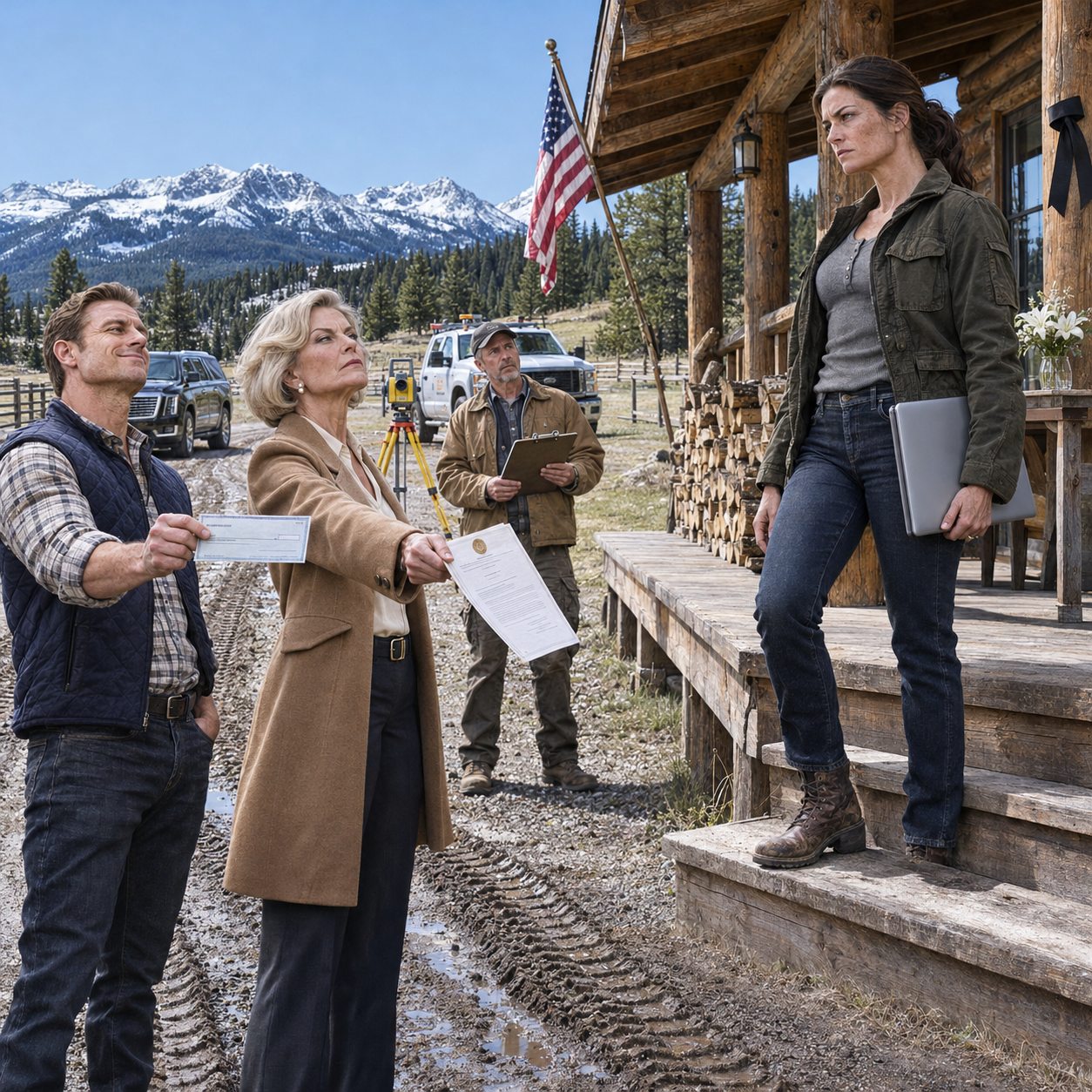
Three weeks after I buried my husband, his family arrived at my Montana cabin with a surveyor, an eviction notice, and a $10,000 check they expected me to accept without argument. They thought grief had made me helpless, that a woman who worked quietly behind a laptop would surrender seventy acres, a home, and everything my husband and I had built. They had no idea why I noticed every tire track on my road—or what six years in the Marines had taught me about people who mistake silence for weakness.
### Part 1
The first thing my brother-in-law put on my kitchen table after my husband died was not a casserole, a sympathy card, or even a photograph.
It was a manila folder labeled PROPERTY TRANSFER.
I remember staring at those two words while the coffee beside my elbow went cold. Outside the kitchen windows, dawn was barely touching the mountains, turning the frost on the ponderosa branches silver, and somewhere beyond the barn a raven kept making the same harsh clicking sound Garrett used to imitate badly just to make me laugh.
Garrett had been dead twenty-three days.
Twenty-three mornings of waking up before remembering.
Twenty-three nights of reaching across our bed and touching sheets that stayed cold.
And now his older brother, Wade Mercer, was standing on the pine floor Garrett had installed himself, grinding Montana mud into the grain with his boots.
“My mother and I are trying to make this easy, Nora,” Wade said.
He leaned both fists on the table and pushed the folder toward me.
Behind him, my mother-in-law, Lorraine, stood with her leather purse clutched under one arm. She wore black even though the funeral had been nearly three weeks earlier, but there was nothing mournful about the way she looked around my kitchen.
She was inventorying it.
Her eyes paused on Garrett’s cast-iron skillet hanging over the stove.
Then the handmade cabinet doors.
Then the window looking toward the eastern timber line.
“There’s a relocation check inside,” Wade continued. “Ten thousand dollars. That’s more than fair considering the circumstances.”
I looked up.
“What circumstances?”
His mouth tightened.
“You can’t maintain this place.”
That was when I understood this wasn’t an awkward attempt to help a grieving widow.
It was an acquisition.
Wade pulled out the chair opposite me and sat without being invited. “Seventy acres is a lot for one person, especially somebody who wasn’t raised out here. You’ve got timber roads, drainage culverts, equipment, taxes, snow removal. You work on a computer, Nora.”
Lorraine nodded sympathetically.
That expression hurt worse than open hostility would have.
“Garrett should’ve dealt with this before the accident,” she said. “But he always was sentimental.”
My fingertips went numb around my mug.
I had heard almost every possible sentence about Garrett since the highway patrol officer appeared at my door on a Tuesday evening.
He had been kind.
He had been strong.
God had a plan.
Everything happened for a reason.
Nobody had called him sentimental as an accusation.
“What exactly are you asking me to sign?” I said.
Wade opened the folder and rotated several documents toward me.
“A quitclaim deed. The original acreage came through Dad’s side of the family, so we’re moving it back into the Mercer family trust where it always belonged. You’ll receive the check, you’ve got thirty days to relocate, and nobody needs to drag attorneys into this.”
I looked at the signature line.
My name had already been typed beneath it.
Nora Mercer.
They had prepared the paperwork before coming to see me.
Maybe before Garrett’s funeral.
Possibly before his body was even buried.
Something inside me changed temperature.
Not hotter.
Colder.
“When did you have these drafted?”
Wade’s eyes flicked toward his mother.
Just once.
Most people would have missed it.
I didn’t.
“That’s not important.”
“It is to me.”
Lorraine released an impatient sigh. “Nora, please. We all lost Garrett.”
“No,” I said quietly. “You lost a son and a brother. I lost my husband. Those are different losses.”
Her lips parted.
Wade pulled the papers toward himself. “This emotional stuff is exactly why we’re trying to handle the practical side.”
I almost smiled.
He mistook my silence for emotion overwhelming me.
Garrett would have recognized it.
For eight years, he had known the difference between me being quiet because I was hurt and being quiet because I was observing.
I turned to the window.
A dark blue pickup was parked beside Wade’s truck.
A man wearing a reflective vest stood near the gate with a tripod over one shoulder.
“Who’s that?”
Wade followed my gaze.
“Surveyor.”
I looked back at him.
“You brought a surveyor?”
“We’re trying to determine the old trust boundaries.”
“This is private property.”
“Nora—”
“Did I give him permission to enter?”
Wade laughed once.
It was short and ugly.
“You’ve been part of this family eight years and still don’t understand how things work around here.”
I closed the folder.
Actually, I understood perfectly.
For most of my marriage, Wade had talked around me rather than to me. At Sunday dinners, he would ask Garrett whether “the wife” was still doing computer work, as if I were an appliance Garrett kept in a spare room.
I had never corrected him.
I worked remotely in geographic logistics, mostly mapping access routes, land-use records, and infrastructure data for private contractors. It paid well, allowed me to live almost anywhere, and suited someone who preferred useful information to loud conversation.
Wade thought I made spreadsheets.
Lorraine thought I answered emails.
Neither had ever asked what I did before I met Garrett.
That had been fine with me.
There were pieces of life I did not display for approval.
Six years in the United States Marine Corps was one of them.
The faded green duffel containing my old uniforms, service photographs, commendations, and training notebooks had been inside a cedar chest in the upstairs storage room since we moved into the cabin.
Garrett knew everything.
He knew why I automatically noticed high ground when we entered unfamiliar country. He knew why I checked weather three times before long drives, why I could sit absolutely still for an hour when deer appeared at the far tree line, and why being underestimated had never made me uncomfortable.
Sometimes it made things easier.
I stood.
Wade smiled as though he thought I had surrendered.
Instead, I picked up his folder and handed it back.
“The answer is no.”
His smile vanished.
“What?”
“The property isn’t for sale. I’m not relocating. Your surveyor needs to stay outside my gate.”
Wade slowly rose from the chair.
He was six-foot-three, broad across the chest, and had spent thirty years treating physical size like an argument.
“Nora, don’t turn this into something ugly.”
I looked directly at him.
“You brought an eviction notice to a widow’s house before sunrise.”
Lorraine’s face hardened.
“You don’t belong on this land more than Garrett’s own blood does.”
There it was.
The real sentence.
Not taxes.
Not snow.
Not concern.
Blood.
Garrett had once warned me that some members of his family remembered property boundaries differently whenever money became involved. At the time I thought he meant petty arguments over fence lines.
Now I wondered what else he had known.
“Leave,” I said.
Wade stepped closer.
Not enough to threaten me directly.
Enough to test whether I would retreat.
I didn’t.
For several seconds we stood across the table from each other while the refrigerator hummed and gravel popped beneath the surveyor’s boots outside.
Then Wade scooped up the folder.
“Thirty days,” he said. “After that, this won’t be polite.”
He and Lorraine walked out.
I watched from the window until both trucks disappeared behind the western rise.
Then I locked the door, carried my untouched coffee into Garrett’s study, and opened the fireproof document cabinet beneath his desk.
Deeds.
Tax records.
Insurance policies.
Equipment titles.
Business filings.
Garrett had always been meticulous.
I spread everything across the floor.
The recorded deed showed exactly what I remembered: joint ownership with survivorship rights, acquired through a legitimate purchase eight years earlier. We had not inherited the land from Lorraine, Wade, or any Mercer trust.
We had bought it.
Together.
But underneath the deed was an envelope I had never seen.
Garrett’s handwriting was on the front.
NORA — IF MY FAMILY EVER STARTS ASKING ABOUT THE SOUTH RIDGE, READ THIS FIRST.
My breath stopped.
Then I opened it.
### Part 2
Inside the envelope were three pages, a hand-drawn map, and an old photograph of Garrett standing beside his father near a weathered fence post.
The first line made the hair rise along my arms.
Nora, if you’re reading this because Wade is making a claim against the property, don’t assume he’s only after the land.
I sat back against Garrett’s desk.
Outside, wind pushed dry snow across the porch in whispering sheets.
Garrett had written the letter eleven months earlier.
He explained that his father, Raymond, had once owned a larger tract in the valley, but debt forced him to sell most of it long before Garrett and I met. Wade had spent years telling people the sale was temporary, that the family would eventually “recover” the acreage, even after the legal title had passed through two unrelated owners.
Garrett and I had purchased seventy acres from the second owner.
Nothing had been gifted to us.
Nothing remained in a Mercer trust.
But Wade apparently hated that distinction.
The south ridge matters because of the access road, Garrett had written. Wade thinks he can use the old logging easement to create leverage. He can’t. It expired before our purchase. Copies are with Martha Bell at the title company.
I read that paragraph twice.
Then the final one.
If anything happens to me, don’t let grief make you generous with people who were never generous with us. You earned this place beside me. Every post, every payment, every frozen pipe, every argument with the tractor. This is your home.
I pressed the heel of my hand against my mouth.
For the first time since the funeral, I cried hard enough that breathing became work.
Not because Garrett had predicted his death.
He hadn’t.
The letter contained jokes, practical instructions, even a reminder that the upstairs bathroom shutoff valve stuck in cold weather.
What destroyed me was the certainty in his words.
He had known I might someday be standing alone against his family.
And he had prepared for it.
By noon I was driving into town with the deed, Garrett’s letter, and the old easement records sealed in a document case.
The nearest town was thirty-four miles away, a place with one grocery store, two gas stations, a courthouse built before anybody thought public buildings needed enough electrical outlets, and a coffee shop where everyone knew who had divorced before the paperwork reached the clerk’s desk.
I went first to Martha Bell.
She was in her sixties, wore red glasses on a silver chain, and had handled our closing eight years earlier.
When I placed Wade’s paperwork on her desk, her expression changed.
“Where did you get this?”
“He brought it to my house this morning.”
She turned three pages.
Then she removed her glasses.
“Nora, this reference number doesn’t belong to a current trust.”
“So there was one?”
“There was a Mercer family trust years ago. It dissolved after Raymond’s debt restructuring.”
“Can Wade revive it?”
“No.”
She leaned closer to the page.
“And this description isn’t your full parcel. Look.”
She traced the legal coordinates.
Only the southern twenty-two acres were listed.
My stomach tightened.
“Why?”
Martha looked at me for several seconds.
“Because that’s where the commercial access runs.”
The old logging road.
Garrett’s warning.
“What would happen if I signed this?”
“You’d create a nightmare.”
“Would Wade own the south ridge?”
“Potentially enough interest to sue over access while everything was being untangled.”
That was the emotional turn Wade had been counting on.
The $10,000 wasn’t payment for seventy acres.
It was bait for a signature.
Martha made certified copies of every relevant record and gave me the name of an attorney named Claire Donnelly who handled property disputes.
Claire’s office occupied the second floor above a pharmacy.
She was about my age, wore her hair in a loose knot, and listened without interrupting while I described the porch visit.
When I finished, she tapped Wade’s quitclaim paperwork.
“This is aggressive.”
“Illegal?”
“Presenting paperwork isn’t illegal by itself. Misrepresenting what it means can become another issue, but proving intent matters. Don’t communicate with them casually anymore.”
She drafted a formal notice denying Wade and Lorraine permission to enter the property.
Then she asked, “Do you have cameras?”
“Trail cameras.”
“How many?”
“Enough.”
She smiled faintly.
“Good.”
I didn’t tell her that “enough” meant fourteen motion-activated units covering the primary drive, both fence crossings, equipment clearing, fuel storage, barn, creek trail, and southern access road.
Garrett had teased me about the system.
“You know we’re watching elk, not enemy movement, right?” he once asked.
“Elk don’t steal diesel.”
“Fair point.”
Thinking about him hurt so sharply I had to look away from Claire’s window.
By the time I returned home, the sun was low behind the ridge.
Something felt wrong before I reached the cabin.
I slowed my SUV.
The chain across our southern service road was hanging open.
Not unlocked.
Cut.
I parked twenty yards away and walked the rest.
Fresh tire tracks crossed the mud beside the cattle guard.
Dual rear wheels.
Heavy truck.
The tread entered from the south, traveled toward our equipment shed, then turned around.
I crouched.
Beside the tracks was a fresh boot print with a triangular missing section along the heel.
I had seen the same damaged sole that morning.
Wade.
Most civilians imagine military observation is about seeing dramatic things.
Usually it isn’t.
It’s noticing what should be ordinary and isn’t.
A moved branch.
A different shadow.
Fresh compression in wet soil.
An object facing the wrong direction.
I followed the tracks only far enough to confirm where they went, photographing everything without disturbing the prints.
Near the equipment shed, the padlock had scratches around the keyway.
Someone had tested it.
Not forced it.
Tested it.
I stood there as the temperature dropped, listening to trees creak above me.
The skidding machine Garrett used for clearing timber was parked inside.
So was the excavator we had purchased through our small land-management LLC.
Combined value: enough to explain Wade’s sudden concern about “family assets.”
My phone rang.
Lorraine.
I let it go to voicemail.
Thirty seconds later, she called again.
Then Wade.
Then Lorraine.
On the fourth attempt, I answered.
“Nora,” Lorraine said immediately, “you embarrassed Wade in front of that surveyor.”
I looked at the cut chain.
“Did Wade enter my property after I told him to leave?”
Silence.
Then, “Don’t be ridiculous.”
“That wasn’t an answer.”
Her voice sharpened.
“This paranoia is exactly why you shouldn’t be alone out there.”
I almost admired the strategy.
Create the problem.
Then use my reaction as proof I couldn’t cope with it.
“I have an attorney now,” I said. “All property communication goes through her.”
Lorraine inhaled sharply.
“You hired a lawyer against Garrett’s mother?”
“No. I hired a lawyer for myself.”
“Garrett would hate what you’re doing.”
That sentence landed where she intended it to.
For half a second, grief opened beneath me like thin ice.
Then I remembered the letter in my coat pocket.
Don’t let grief make you generous with people who were never generous with us.
“I know what Garrett wanted,” I said.
I disconnected.
That night I rebuilt the camera coverage along the southern road.
I moved two units higher into the timber where headlights wouldn’t expose them, added another overlooking the equipment yard, and configured every feed to back up automatically off-site.
No traps.
No confrontation.
No fantasies about teaching anyone a lesson.
Documentation.
Patterns.
Patience.
At 11:42 p.m., I was sitting at the dining table when the first alert arrived.
Movement: South Ridge Camera Four.
I opened the feed.
A truck crept through the trees with its headlights off.
A flatbed trailer was attached behind it.
Then two men stepped into view.
Wade.
And Garrett’s younger brother, Travis.
Travis was carrying industrial cutters.
Wade was holding a towing chain.
They weren’t coming to talk.
They were coming for our machinery.
### Part 3
For several seconds, I watched the screen without moving.
That old part of my mind returned before I consciously reached for it.
Distance.
Routes.
Visibility.
Time.
I had spent years learning how quickly panic destroys judgment.
The Marines hadn’t turned me fearless. Anybody who says military service removes fear is selling something.
Training had taught me what to do while fear existed.
I called the county dispatch line and spoke quietly.
“My name is Nora Mercer. I have two trespassers on my property attempting to access commercial equipment. They’ve crossed a posted boundary through a cut chain. I’m inside my residence and I’m not approaching them.”
The dispatcher asked whether I was armed.
“Firearms are secured in the house. I’m not taking one outside.”
There was a pause.
“Good. Deputies are responding.”
I kept the live feed open.
Wade and Travis backed their truck toward the equipment shed.
Travis set down the cutters, braced one boot against the metal gate, and worked on the padlock.
Wade kept scanning the tree line.
His posture told me he knew he was doing something wrong.
People engaged in legitimate family business generally use headlights.
I switched on the exterior yard lights remotely.
Three white LED arrays ignited at once.
The camera exposure adjusted.
Travis stumbled backward so quickly he nearly fell over the cutters.
Wade jerked his arm across his eyes.
Then my outdoor speaker activated.
“You are being recorded. Law enforcement has been notified. Leave the equipment where it is and remain in the open.”
Wade stared toward the cabin.
Even from the camera angle, I could see rage transform his face.
“Nora!”
His voice echoed through the clearing.
“This belongs to Garrett!”
I didn’t answer.
He walked toward the cabin.
The dispatcher was still on speaker beside me.
“Ma’am, stay inside.”
“I am.”
Wade stopped fifty yards from the porch.
“Nora, come out here!”
My hands rested flat on the table.
Garrett’s coffee mug was still beside the sink because I hadn’t been able to put it away.
I focused on that.
Blue ceramic.
Chipped rim.
White lettering from a hunting lodge we had visited in Idaho.
Something ordinary.
Something real.
Wade shouted again.
“You call the cops on your own family, you better be ready for what comes after!”
The dispatcher heard every word.
That would matter later.
Travis was pacing beside the truck now.
“Wade, let’s just go.”
“No!”
“Wade—”
“We didn’t do anything!”
“You cut her gate!”
“You cut it!”
“You told me to!”
Their argument came through the exterior microphone with remarkable clarity.
I closed my eyes briefly.
Sometimes evidence collects itself.
Blue lights appeared through the pines eight minutes later.
Two sheriff’s vehicles entered from the main road while a third deputy approached along the southern access.
Wade finally understood why the road mattered.
He couldn’t simply drive away.
Deputy Aaron Mills ordered both brothers to remain beside the truck.
I stayed inside until another deputy knocked and told me the scene was secure.
The cold outside had sharpened enough to sting my lungs.
Wade was standing beside a cruiser, furious.
Travis looked sick.
“Nora!” Wade shouted when he saw me. “Tell them this is family property!”
Deputy Mills turned.
“Wade, stop talking.”
“It’s a civil dispute!”
I handed Mills a waterproof folder containing certified deed copies, equipment registrations, the no-trespass notice Claire had sent that afternoon, and photographs from the earlier cut chain.
Then I showed him the camera footage.
He watched silently.
Once.
Twice.
He stopped on the frame showing the cutters against the gate.
“These machines belong to you?”
“To the LLC Garrett and I owned jointly. I inherited his membership interest under the operating agreement.”
“You have documents for that?”
“In the binder.”
Wade laughed from beside the cruiser.
“She planned all this!”
I looked at him.
That accusation told me more about him than he realized.
To Wade, preparation itself was suspicious because he had expected confusion.
He had wanted me grieving, overwhelmed, legally uncertain, and eager for an older man to tell me what happened next.
Deputy Mills walked toward the truck.
The towing chains were positioned beside the trailer ramps.
A pry bar lay behind the passenger seat.
The cut gate chain was still in the truck bed.
Nobody needed me to interpret the scene.
By 1:00 a.m., both men were gone in separate sheriff’s vehicles.
Their truck and trailer remained behind pending investigation.
I stood alone beneath the yard lights after the deputies left.
The clearing smelled like cold diesel and fresh-cut metal.
I should have felt victorious.
Instead, grief hit me so hard I sat down on the porch steps.
Garrett should have been beside me.
He should have been furious about the gate.
He should have complained that Wade’s trailer tires were ruining the gravel.
He should have made coffee afterward and told me I had rearranged the cameras too many times.
Winning anything without him felt strangely empty.
At 7:15 the next morning, Claire called.
“They were both released pending charging review.”
“I expected that.”
“Wade has already retained counsel.”
“I expected that too.”
“What you probably didn’t expect is Lorraine filing something at the county clerk’s office.”
I stood.
“What?”
“A petition claiming Garrett lacked capacity when he converted the parcel into joint survivorship ownership.”
For the first time, I actually laughed.
Not because it was funny.
Because the allegation was absurd.
“We bought the property together.”
“I know.”
“I was at the closing.”
“I know.”
“We both paid for it.”
“I know.”
Claire paused.
“She’s also alleging undue influence.”
That erased my smile.
The words were legal, but I understood the accusation beneath them.
Lorraine was saying I had manipulated her son.
That Garrett’s marriage had somehow turned his own decisions into mine.
“Can she do that?”
“She can file almost anything. Whether she can prove it is another question.”
My anger arrived slowly.
Cleanly.
“What’s her evidence?”
“According to the petition, Garrett became ‘increasingly isolated from his family’ after marrying you.”
I stared toward the window.
Garrett had not been isolated.
He had simply learned boundaries.
There was a difference.
Claire continued.
“And there’s something else.”
“What?”
“They’re claiming an older agreement gives Wade permanent commercial access through your south ridge.”
The same road Garrett had warned me about.
The same twenty-two acres on Wade’s quitclaim deed.
This wasn’t improvisation anymore.
They had a coordinated plan.
I opened Garrett’s envelope again.
At the bottom of the second page was a line I had skimmed the first time.
If Wade ever produces Dad’s 2009 access contract, look at the signature page.
I pulled out the old map.
There was a red circle around a parcel number.
And beside it Garrett had written two words.
Wrong owner.
### Part 4
The document arrived through Wade’s attorney two days later.
It looked convincing.
That was the problem.
The paper was yellowed, the signature faded, the property description written in dense survey language. It granted “Mercer Timber & Excavation” access across the south ridge for commercial hauling, equipment transport, and timber operations.
Wade’s lawyer claimed the agreement remained binding.
Claire read it at her conference table while I studied the signature.
Raymond Mercer.
Garrett’s father.
Dated April 18, 2009.
“What are you seeing?” Claire asked.
“The parcel number.”
I slid Garrett’s map beside the contract.
The easement referred to Parcel 7B-41.
Our acreage was Parcel 7B-44.
Claire sat back.
“That’s not a typo.”
“No.”
The old road crossed multiple properties before reaching ours.
Raymond had apparently negotiated access with the owner of a neighboring parcel fourteen years earlier.
Wade was trying to attach that agreement to ours.
Claire requested the original recording records.
They confirmed it.
The easement had never burdened our land.
It also expired after five years.
“How did Garrett know Wade would use this?” I asked.
Claire folded her hands.
“Maybe Wade tried before.”
That possibility stayed with me all afternoon.
I searched Garrett’s archived emails that evening.
Not his private messages.
Just the shared property account we had both used for taxes, contractors, and equipment.
Six years earlier, I found a thread with the subject SOUTH ACCESS — DO NOT AUTHORIZE.
The first email was from Wade.
Garrett, I need temporary access through your lower ridge for hauling. Dad always used that road. Don’t make this weird.
Garrett’s response was four sentences.
That easement was never on our parcel. You know that. Nora and I aren’t opening our road to commercial hauling. Use the county access.
Wade replied:
You always choose her.
Garrett:
I’m choosing my property.
I sat there reading those words again and again.
For years, Lorraine had implied that I had pulled Garrett away from his family.
The truth was simpler.
Garrett had said no.
They needed someone to blame for the fact that he meant it.
The next confrontation came at the courthouse.
Lorraine attended the preliminary property hearing in a navy coat, accompanied by Wade, Travis, and two cousins I had not seen since the funeral.
It was theater.
A wall of Mercers on one side.
Me and Claire on the other.
Wade looked confident again.
Apparently one night in county holding had not permanently damaged his belief that volume could substitute for evidence.
Before the hearing began, Lorraine approached me in the hallway.
“You can end this.”
I looked at her.
“So can you.”
Her eyes narrowed.
“I buried my son.”
“So did I.”
“You got his house. His land. His business. His insurance.”
There it was.
A ledger.
She had turned Garrett’s death into columns.
“I didn’t get anything,” I said. “I lost Garrett.”
“You know what I mean.”
“Yes. I do.”
She stepped closer.
“He changed after he married you.”
“No. He stopped allowing you to make decisions for him.”
Her expression hardened instantly.
“That Marine arrogance never left you, did it?”
I went still.
Lorraine smiled.
For eight years she had never mentioned my service.
I had assumed she barely remembered.
“Garrett told me enough,” she said. “You always thought you were tougher than everyone.”
“No.”
I met her eyes.
“I learned a long time ago that toughness and intimidation aren’t the same thing.”
Wade walked over.
“What’s that supposed to mean?”
“Nothing you need explained.”
His face reddened.
“You think because you wore a uniform you’re some kind of expert on land?”
“No. The county records make me an expert on who owns my land.”
Claire touched my elbow lightly.
Time to go inside.
The judge did not resolve the entire dispute that morning, but the hearing damaged the Mercers badly.
The supposed 2009 easement was tied to another property.
The survivorship deed was properly recorded.
The purchase records showed that both Garrett and I contributed funds.
Wade’s attorney requested additional time to investigate.
The judge granted limited discovery but denied any temporary access across my land.
Outside, Wade paced near the courthouse stairs.
Travis stood several yards away, hands deep in his coat pockets.
He looked exhausted.
When I walked toward the parking lot, he followed me.
“Nora.”
I stopped.
Wade shouted from the steps.
“Travis!”
Travis ignored him.
“I need to talk to you.”
“Through Claire.”
“No.”
He glanced over his shoulder.
“I mean… not about the lawsuit.”
Something in his face changed my decision.
We walked twenty yards toward the public sidewalk, remaining in full view of everyone.
Travis rubbed his jaw.
“Wade didn’t tell me about the quitclaim.”
I said nothing.
“He told me the machines belonged to Mom’s trust.”
“You brought cutters.”
“I know.”
“You crossed a cut boundary after midnight.”
“I know.”
“You tried to open my equipment shed.”
His eyes dropped.
“I know.”
He seemed to shrink each time he said it.
Finally he whispered, “Wade owes money.”
“How much?”
“I don’t know exactly.”
“To whom?”
“Suppliers. Equipment lenders. Maybe taxes.”
Now the picture sharpened.
Wade’s excavation business had been struggling for nearly two years.
The skidding machine and excavator sitting on my property weren’t sentimental objects from his dead brother.
They were liquidity.
“What does that have to do with the land claim?”
Travis swallowed.
“He has a buyer.”
“For what?”
“The south ridge.”
I stared at him.
“It’s not his.”
“I know that now.”
“What buyer?”
“I never met them. Wade said a private timber group wants guaranteed access through the valley. He said if he could establish the old easement, they’d pay him.”
“For access he doesn’t own.”
Travis nodded.
“How much?”
He hesitated.
“Two hundred fifty thousand.”
The number explained everything.
The eviction pressure.
The altered description.
The old easement.
The midnight attempt to take equipment.
This had never been about family heritage.
It was a cash grab built on Garrett’s death.
I looked toward Wade.
He was staring at us from the courthouse steps.
For the first time since this began, he didn’t look arrogant.
He looked afraid.
And I realized Travis had just given me the first clue that could turn their civil claim into something far more serious.
### Part 5
Claire told me not to celebrate.
“Information isn’t evidence,” she said.
We were sitting in her office while sleet tapped the window.
“Travis telling you Wade has a buyer is useful. Travis telling investigators the same thing, with documents behind it, is useful in court.”
“Will he?”
“I don’t know.”
Neither did I.
Travis had spent most of his life orbiting Wade.
Garrett once described the brothers as a planet and moon.
Wade decided.
Travis followed.
But fear has a way of changing orbits.
Three days later, the county investigator called me.
They had obtained surveillance footage from a gas station near my property showing Wade and Travis purchasing heavy chain, fuel, and replacement lock hardware shortly before the attempted equipment removal.
More importantly, Travis had requested a second interview.
He brought emails.
One was between Wade and a regional timber broker.
The broker had not done anything wrong from what investigators could determine.
Wade had simply represented that he controlled an access corridor he did not own.
The email included a sentence that made my stomach turn.
Widow should be off parcel by end of month. Family title correction in progress.
I read it in Claire’s office.
“The date,” I said.
She nodded.
The email had been sent nine days before Garrett died.
I felt the room tilt.
“Before the accident.”
“Yes.”
“What does that mean?”
“Maybe nothing connected to Garrett’s death,” Claire said immediately. “Don’t let timing create a conclusion the evidence doesn’t support.”
She was right.
Garrett’s accident had been investigated thoroughly.
Black ice.
No mechanical tampering.
No second vehicle.
Nothing suspicious.
But the email proved Wade had been planning to pressure us before Garrett died.
His death simply removed the person he expected to fight back.
I looked again at the phrase.
Widow should be off parcel.
He had written widow before I was one?
“No,” Claire said, reading my face. “Look carefully.”
The email thread had later messages.
The original sentence said Brother and wife should be off parcel.
A forwarded version after Garrett’s death had been updated to widow.
Relief and disgust hit me simultaneously.
No conspiracy.
Just opportunism.
Somehow that felt almost worse.
Wade had taken a plan he was already developing and adapted it within days of burying his brother.
The prosecutor increased pressure after Travis began cooperating.
The attempted equipment removal was no longer easy to dismiss as confused relatives securing shared property.
Emails showed Wade knew the land was disputed.
The recorded notice proved he had been denied access.
The camera audio captured Travis saying Wade instructed him to cut the gate.
Meanwhile, the civil case weakened further.
A forensic review of the quitclaim packet found that the legal description had been copied from an unrelated preliminary survey Wade commissioned months earlier.
His attorney withdrew from representing him in the property matter shortly afterward.
That afternoon, Lorraine came to my cabin alone.
I saw her vehicle on the camera and met her on the porch without opening the door fully.
She looked smaller.
Not kinder.
Just smaller.
“Nora.”
“Why are you here?”
“I want to talk without lawyers.”
“No.”
Her eyes filled.
“Please.”
For years, I would have opened that door.
Not because I trusted her.
Because Garrett loved her.
That distinction had allowed Lorraine more access to my life than she had ever earned herself.
Now Garrett was gone.
I had to decide what remained when borrowed loyalty ended.
“I’ll listen from here.”
Her mouth trembled.
“Wade could lose everything.”
I almost laughed.
Instead, I said, “He tried to take everything from me.”
“He made mistakes.”
“He planned this before Garrett died.”
Lorraine flinched.
“So you know.”
That answer stunned me.
“You knew?”
She looked past me into the cabin.
“I knew he was talking to timber people.”
“You came here with him.”
“I thought if you sold, everyone could move on.”
“I had buried my husband three weeks earlier.”
“I lost my son!”
“And that gave you the right to try to evict me?”
“No.”
The word came quietly.
I waited.
She wiped beneath one eye.
“I thought you would go back east.”
“I haven’t lived east in eleven years.”
“You never seemed attached here.”
For a second I genuinely couldn’t speak.
I remembered repairing the barn roof in sleet.
Digging post holes beside Garrett until both our palms blistered.
Planting twenty spruce trees only to lose nine to deer.
Sleeping on the unfinished cabin floor while snow came through plastic over the windows.
“Because I didn’t perform my attachment for you?”
Lorraine shook her head.
“You were always so self-contained.”
There it was again.
The reason they had mistaken me for weak was not because I appeared weak.
It was because I never demanded to be seen.
“I served six years before I ever met your son,” I said. “I learned very young that being calm doesn’t mean being available for somebody else to control.”
“I know about the Marines.”
“Then you should also know I don’t abandon ground just because somebody raises their voice.”
Her gaze dropped.
“I’m asking you to help Travis.”
“He chose to cooperate. I’ll tell the truth about that.”
“And Wade?”
“No.”
She looked up sharply.
“He’s Garrett’s brother.”
“He knew that when he came here with a surveyor.”
“Nora—”
“He knew that when he cut my boundary.”
Her face changed.
“He didn’t cut it himself.”
I stared at her.
Too specific.
“How would you know?”
Lorraine froze.
Then she reached for the porch railing.
“I just assumed Travis—”
“You weren’t there.”
“No.”
I watched her breathing.
Faster now.
Not grief.
Alarm.
“What else do you know?”
“Nothing.”
She turned.
“Lorraine.”
She hurried toward her vehicle.
I didn’t follow.
Instead, I called Claire.
Because for the first time, I understood Lorraine had not merely supported Wade after the fact.
She knew details that had never been made public.
### Part 6
Investigators interviewed Lorraine the following week.
I wasn’t present, but the consequences reached me quickly.
Claire called just after lunch.
“She admitted she gave Wade copies of several documents from Garrett’s old family files.”
“Which documents?”
“Survey maps. Raymond’s expired access agreement. An old trust schedule.”
“So she helped build the claim.”
“Yes.”
“Did she know it was false?”
“That’s where things get complicated.”
According to Claire, Lorraine insisted Wade told her the family trust still had an interest in the land.
She wanted to believe him.
So she did.
But the investigator had found a text message from Wade asking Lorraine to locate “anything old with Dad’s signature that could support access.”
She had complied.
Another message from Lorraine read:
Nora won’t fight you. She’s never fought anybody.
That sentence stayed with me all day.
It should have made me angry.
Instead, it made me strangely peaceful.
For eight years, I had confused politeness with relationship.
I had attended birthdays.
Hosted Thanksgiving twice.
Sent Lorraine flowers on Mother’s Day.
Helped Travis’s daughter apply for college scholarships.
Cooked meals when Wade’s first marriage collapsed.
They interpreted every choice not to create conflict as proof I lacked the ability to survive one.
That wasn’t my failure.
It was theirs.
The criminal case against Travis was resolved first.
Because he cooperated early, returned information, accepted responsibility, and had no significant prior record, prosecutors offered him a reduced agreement requiring restitution, community supervision, and testimony regarding Wade’s plan.
He accepted.
He called me afterward.
I almost didn’t answer.
Finally, I did.
“I signed,” he said.
“I heard.”
“I’m paying my half of the fence repairs.”
“Good.”
Silence.
Then, “I’m sorry.”
I looked out my window at the southern ridge.
Three months earlier, I might have said I forgave him.
Not because I did.
Because ending discomfort had once felt easier than living inside it.
Now I understood forgiveness should never be demanded as evidence of healing.
“I believe you’re sorry,” I said.
He breathed out.
“Does that mean—”
“No.”
Another silence.
“I’m not asking you into my life again, Travis.”
“I understand.”
“I don’t think you do yet. But eventually you might.”
He didn’t argue.
That mattered.
Two days later, Wade requested a meeting through counsel.
Not a family meeting.
Not a porch conversation.
A formal settlement conference.
I agreed.
Claire and I arrived at the county attorney’s annex at nine in the morning.
I wore dark slacks, boots, and a fitted charcoal jacket.
Pinned inside the jacket, where only a small portion showed when I moved, was an old Marine Corps service pin Garrett had once mounted in a shadow box.
I didn’t wear it for intimidation.
I wore it because Garrett used to tell me I hid too much of myself to keep other people comfortable.
Not anymore.
Wade sat across the conference table with a new attorney.
Lorraine was beside him.
Travis was absent.
Good.
Wade looked older than he had on my porch.
The purple arrogance had drained from his face, leaving gray fatigue around the eyes.
His lawyer did most of the talking.
They proposed withdrawal of every civil claim, reimbursement for damaged fencing, legal fees, survey expenses, and property restoration.
In return, I would provide an accurate victim-impact statement reflecting that no equipment had ultimately been removed.
That was reasonable.
Then Wade spoke.
“I want one thing.”
Claire glanced at me.
“What?”
“Family access to Garrett’s grave site.”
I stared at him.
Garrett was buried in the town cemetery.
Not on my land.
“You already have access.”
“No. I mean the memorial.”
Garrett and I had built a small stone bench overlooking the western ridge years before his death.
After the funeral, I placed a brass plaque there with his name.
The bench sat on my property.
Wade wanted permanent entry.
“No.”
Lorraine started crying.
Wade’s jaw tightened.
“That’s my brother.”
“Yes.”
“So you’re going to keep us from where you scattered his ashes?”
I froze.
Claire looked at me.
Garrett’s ashes had not been scattered there.
Only a small private portion had been placed beneath a pine farther up the ridge.
Nobody knew that except me.
At least, nobody was supposed to.
“Who told you I scattered anything there?”
Wade blinked.
Lorraine stopped crying.
And once again, the wrong detail revealed more than their prepared statements did.
“You’ve been up there,” I said.
“No.”
“You’ve been beyond the house.”
His attorney turned toward him.
“Wade?”
He stared at the table.
The investigator later discovered the answer through old camera archives I had never thought to review.
Six weeks before Garrett’s death, Wade had entered the property while Garrett and I were visiting friends in Wyoming.
He spent nearly forty minutes around the ridge bench photographing access paths, the road, and the timber boundary.
He wasn’t visiting his brother.
He was scouting the parcel for the proposed timber deal.
That evidence finished the civil case.
Every claim was withdrawn.
Wade accepted responsibility for the property damage and attempted equipment theft under a negotiated criminal resolution that included substantial restitution, probation conditions, and restrictions against entering my property.
No dramatic courtroom speech followed.
No judge declared me victorious.
Real life rarely provides music when consequences arrive.
People sign documents.
Clerks stamp paper.
Attorneys close folders.
Then everyone drives home separately.
But as I left the annex, Wade followed me to the entrance.
“Nora.”
I stopped.
He looked past me toward the courthouse lawn.
“Garrett would hate this.”
That old weapon.
One final time.
I turned.
“No, Wade. Garrett knew exactly who you were.”
His face changed.
And I took Garrett’s letter from my bag.
Not to give it to him.
Just to let him see the handwriting.
“He prepared me for you before he died.”
For the first time since this began, Wade had nothing to say.
### Part 7
Spring arrived slowly that year.
Snow remained beneath the north-facing trees long after the valley floor turned green, and every warm afternoon filled the creek until I could hear it from the porch.
The new southern fence went up in April.
Wade and Travis paid for licensed contractors as part of the restitution agreement.
I didn’t watch them work.
I had spent enough time observing damage.
I wanted to observe repair.
The new posts were cedar, straight and clean.
The gate was heavier than the old one.
Claire joked that I had built a border crossing.
I told her Garrett would have complained about the price.
Then I went into the pantry and cried for ten minutes because I could hear exactly how he would have said it.
Grief didn’t disappear after the legal fight ended.
If anything, the conflict had delayed parts of it.
For months, I had documents to gather, calls to make, cameras to review, lawyers to meet, questions to answer.
Purpose had occupied the space where sorrow wanted to live.
When the last settlement form was signed, the silence came back.
That was harder.
I finally packed Garrett’s clothes in May.
Not all at once.
One drawer at a time.
His work shirts smelled faintly of cedar even after months.
Inside the pocket of an old canvas jacket, I found two screws, a receipt for fencing staples, and a peppermint wrapper.
I sat on the bedroom floor holding them like artifacts from an extinct civilization.
No training helps with that.
You cannot out-discipline grief.
You cannot read terrain well enough to find a route around it.
You go through.
A counselor at the veterans’ clinic in town told me something I resisted at first.
“You’ve spent months defending the life you built with Garrett. At some point, you’ll have to decide whether you’re also willing to build a life that exists after him.”
I hated the sentence.
Then I wrote it down.
I returned to work full-time.
I expanded my mapping contracts and began consulting with small ranchers on terrain planning, wildfire access, and equipment routes.
It was familiar enough to feel steady without turning the property into a museum of my marriage.
I also reopened an old part of myself.
The green duffel came out of the cedar chest.
I washed two old training shirts.
Framed one photograph of my Marine unit.
Put my service shadow box in the study where people could actually see it.
Not because military service defined everything about me.
Because hiding it had become symbolic of something larger.
I had spent years making myself smaller around the Mercers because Garrett already fought with them enough.
I thought restraint was kindness.
Sometimes it was.
Sometimes it was erasure.
Lorraine sent letters.
Six in the first two months.
I read the first.
She apologized for helping Wade.
She wrote that grief had “clouded her judgment” and that she hoped losing Garrett would eventually bring us closer instead of pushing us apart.
That sentence angered me more than anything else.
Garrett’s death was not a bridge she was entitled to cross.
I returned the next five letters unopened.
Then she came to the public farmers market where she knew I would be buying seedlings.
I saw her before she saw me.
For a moment, instinct told me to turn away.
Instead, I continued selecting tomato plants.
“Nora.”
I looked up.
She had aged.
Really aged.
The hardness remained, but it sat differently now.
Like something heavy she had finally realized she was carrying.
“I won’t keep you.”
“Okay.”
“I wanted to tell you I’m sorry in person.”
“You already wrote it.”
“I don’t think you believed me.”
“I believe you’re sorry.”
Hope appeared in her face.
I hated that it did.
“Nora, I was thinking maybe we could have coffee sometime.”
“No.”
Her mouth fell slightly open.
I chose my next words carefully.
“I don’t hate you, Lorraine. I don’t spend my mornings wishing something bad happens to you. But forgiveness isn’t the same thing as access.”
Tears filled her eyes.
“I was your family.”
“You were Garrett’s family.”
The distinction hurt both of us.
It was still true.
“He would’ve wanted us to—”
“Don’t.”
My voice remained quiet.
“Please don’t use him to tell me what I owe you. Not anymore.”
She nodded slowly.
Then she walked away.
I stood between rows of basil and tomato seedlings while people moved around us carrying canvas bags and coffee cups.
No explosion.
No applause.
No dramatic satisfaction.
Only relief.
Boundaries are often described as walls.
Mine felt more like doors.
I could choose which ones opened.
That summer, Travis mailed me a check covering the final portion of his restitution.
Inside the envelope was a note.
I don’t expect anything from you. I should’ve asked questions before following Wade. Garrett deserved better from me. So did you.
I kept the note.
Not because I planned to reconcile.
Because accountability deserved to be recognized even when it didn’t purchase reunion.
Wade never contacted me again.
His business survived, though in a smaller form.
I heard he sold two trucks and took subcontracting jobs instead of running his own large projects.
People around town occasionally tried to tell me more.
I always stopped them.
“I don’t need updates.”
And I meant it.
His consequences were no longer my story.
Mine was moving forward.
By August, I had hired a local forestry specialist named Rachel Kim to help me develop a sustainable thinning plan for forty acres.
Rachel was sharp, funny, and incapable of walking past unhealthy trees without commenting on them.
One afternoon she stood beside Garrett’s old skidder and asked, “Do you actually know how to run that thing?”
I looked at her.
“Better than my brother-in-law did.”
She laughed so hard she had to lean against the tire.
It was the first time I had made a joke about the incident.
I expected guilt.
Instead, I felt Garrett.
Not literally.
Not mystically.
Just the memory of the way he loved when I delivered dry jokes with a straight face.
That evening I walked alone to the ridge bench.
The sunset turned the far mountains violet.
I sat beside the brass plaque and told Garrett about the forestry plan.
About Lorraine.
About Travis.
About the fact that I had finally framed the unit photograph he always wanted me to display.
Then I said something I had never said aloud.
“I kept it.”
The land.
The house.
Myself.
I placed my hand on the cold stone.
And for the first time, keeping what we built didn’t feel like refusing to let Garrett go.
It felt like keeping the promise he had left me.
### Part 8
One year after Garrett died, I woke before sunrise.
The cabin was quiet except for the heater clicking once before shutting off.
I made coffee in Garrett’s old steel percolator, carried it onto the porch, and watched morning spread slowly across seventy acres that almost became somebody else’s bargaining chip.
The property looked different now.
Not drastically.
That mattered.
The south fence was new.
Several overgrown access trails had been cleared.
Rachel’s forestry crews had thinned deadfall along the western slope to reduce fire risk.
I converted part of the equipment shed into a mapping workspace with large monitors, terrain prints, and a long table where clients could spread out plans.
But the cabin remained ours.
Then, gradually, mine.
That distinction no longer frightened me.
At nine, Claire arrived carrying bagels.
“You know,” she said, looking at the equipment yard, “when I met you, I thought you were the calmest grieving person I’d ever represented.”
“I wasn’t calm.”
“I know that now.”
“I was busy.”
“Also that.”
We ate at the kitchen table where Wade had once placed his quitclaim folder.
I had almost replaced the table after the case ended.
Then I realized I didn’t want to surrender furniture to a memory.
So I sanded the top, repaired a crack near one leg, and kept it.
Claire noticed a framed Marine photograph on the shelf.
“You never told me exactly what you did.”
“Training. Field observation. Marksmanship instruction. Reconnaissance support for a while.”
She stared at me.
“And Wade thought you were going to panic because he brought a surveyor?”
“To be fair, he never asked.”
Claire laughed.
That had become one of my favorite facts about the entire disaster.
The secret wasn’t that I had been hiding some superhero identity.
I wasn’t.
I had no special power.
I had training, experience, and a habit of paying attention.
Wade’s mistake wasn’t failing to discover that I had once been a Marine.
His mistake was believing he needed a reason to respect me.
After Claire left, I drove into town for the memorial service Garrett’s friends organized each year for several local residents who had died in roadway accidents.
I nearly skipped it.
Then I saw Travis standing near the cemetery entrance.
He didn’t approach immediately.
He waited until I looked at him.
That small act of restraint told me he had changed more than any apology could.
“Hi, Nora.”
“Hi.”
He had lost weight.
He was wearing work clothes with grease along one sleeve.
“I won’t keep you.”
I nodded.
He looked toward Garrett’s grave.
“I think about that night a lot.”
“So do I.”
“I keep wondering what would’ve happened if you hadn’t had those cameras.”
“You would’ve taken the machines.”
He winced.
“Yeah.”
“And Wade would’ve claimed you were protecting family property.”
“Yeah.”
“And I would’ve spent months trying to prove what happened.”
He looked at the ground.
“Yeah.”
There was nothing else to soften.
Sometimes healing means letting facts remain sharp.
Travis inhaled.
“I started seeing a counselor.”
“Good.”
“Wade says that’s ridiculous.”
“Then you’re probably doing something useful.”
A small smile appeared.
He hesitated.
“Would Garrett have forgiven me?”
There it was.
The question everyone eventually tried to route through the dead.
I shook my head.
“I don’t know.”
He looked surprised.
“You knew him better than anyone.”
“Exactly. Which is why I won’t turn him into a voice I can use whenever I need an answer.”
Travis nodded slowly.
Then he held out his hand.
I looked at it.
For a moment, I saw the man from the camera feed carrying cutters through the dark.
Then I saw the man standing in front of me now.
Both were true.
I shook his hand once.
That was all.
Not reunion.
Not restoration.
Recognition.
Later that afternoon, I drove home alone.
Near the turnoff to the property, I passed Lorraine’s vehicle heading toward town.
She raised one hand from the wheel.
I raised mine.
Neither of us stopped.
That was our relationship now.
And it was enough.
Wade received the last legal restriction connected to the case that fall.
His no-trespass condition remained in place.
He paid the final restitution installment through the county clerk.
A stamped notice arrived in my mailbox confirming the account was satisfied.
I read it once.
Then filed it in the same cabinet where Garrett’s warning letter lived.
Not as a trophy.
As a record.
That evening, I walked the southern perimeter.
The air smelled of pine bark and cold soil.
My boots pressed softly into old needles as I followed the fence line toward the ridge.
A year earlier, I had walked the same ground searching for cut wire, tire tracks, and signs that somebody was testing how much they could take.
Now I checked new growth.
Drainage.
Fence tension.
Normal things.
At the far corner of the acreage, I stopped beside one of the old trail cameras.
I removed it.
Then another.
And another.
I left cameras around the equipment yard and primary access points because that was common sense.
But I no longer needed fourteen electronic eyes watching every tree.
A perimeter isn’t supposed to become a prison.
That was the last lesson.
I carried the unused cameras back to the cabin in a canvas bag.
Inside, sunlight stretched across the floor Garrett had laid board by board.
His blue coffee mug remained on the shelf above the sink.
His work jacket remained folded in a cedar box upstairs.
His name remained on the memorial bench.
But his absence no longer occupied every room.
I had once believed surviving him meant preserving everything exactly as we left it.
Now I knew better.
Love wasn’t a crime scene.
I didn’t need to freeze it.
I could change things without betraying him.
I could build something new on ground we once shared.
A few months later, Rachel and I expanded the forestry program into a small consulting partnership helping neighboring landowners map wildfire routes and protect remote access roads.
It grew slowly.
Legitimately.
Nothing dramatic.
That suited me.
People occasionally heard the story about Wade and asked whether being a Marine was the reason I won.
I always corrected them.
“No.”
The Corps taught me discipline.
It taught me to observe before reacting.
It taught me that fear becomes manageable when you reduce a problem into facts.
But the law protected the property.
Garrett’s preparation protected the records.
Claire protected my legal interests.
Travis eventually told the truth.
And I protected myself by refusing to let grief convince me I owed surrender to people who called entitlement love.
One evening the following spring, I carried dinner to the ridge bench and watched cloud shadows move across the valley.
The new cedar fence caught the late sunlight below.
Beyond it, the mountains stretched farther than anything Wade had ever tried to claim.
I thought about the morning he stood in my kitchen and told me a woman alone had no business managing seventy acres.
In one sense, he had been right.
I wasn’t managing it alone.
Garrett had taught me parts of this land.
The Marines had taught me parts of myself.
Good friends had stood beside me.
Professionals had done their jobs.
And eventually, I had learned that independence does not mean isolation.
It means nobody gets to hold belonging over your head as a price for obedience.
I raised my coffee toward the fading ridge.
“Still here,” I whispered.
Wind moved through the pines.
Nothing answered.
Nothing needed to.
The land was legally mine.
The future was mine.
And the family that tried to take both had finally learned the lesson Garrett understood long before they did:
I had never been quiet because I was weak.
I was quiet because I didn’t need to announce where my boundaries were.
I only needed to hold them.
THE END!
Disclaimer: Our stories are inspired by real-life events but are carefully rewritten for entertainment. Any resemblance to actual people or situations is purely coincidental.