The Major Snapped His Fingers At My Seat. “That’s Mine. Officers Don’t Sit Behind Enlisted.” The Flight Attendant Hesitated. I Stood. Forty People Watched Me Walk The Aisle With My Bag. Then The Cockpit Door Opened. The Captain Came Out Himself, Walked Straight Past The Major’s Outstretched Hand, And Stopped At Row 31. Every Phone In The Cabin Went Down. Nobody Expected What He Said Next.
The Army major snapped his fingers at me in front of a full airplane and demanded my window seat. My uniform carried twenty-six years of service, but he saw only enlisted stripes. I stood, picked up my bag, and walked to the back while the passengers stared. Ten minutes later, the captain came looking for me instead of him. I thought that would be the end of it—until a frightened young soldier slipped me a photograph of a wrecked truck and whispered, “He buried the report.”
## Part 1
The gate agent looked at my boarding pass, then at the stripes on my sleeves, and frowned at something on her computer. She typed for several seconds while the line behind me grew restless, tore up the pass I had printed at home, and handed me a new one. “Chief Calder, you’ve been moved to seat 2A,” she said, giving me a professional smile that looked oddly personal. “Thank you for your service, and congratulations on your retirement.”
I glanced down at the new boarding pass. My original assignment had been 31C, a middle seat near the rear lavatory, and I hadn’t complained about it. “You really don’t have to do that,” I told her, but she was already waving the next passenger forward.
It was 6:43 on a Friday morning in late September, and I was standing in a crowded Texas airport wearing my Air Force service dress uniform for what I expected would be the last time. Twenty-six years earlier, I had walked into basic training as Naomi Calder, an eighteen-year-old from Great Falls, Montana, who knew how to change an alternator but had never traveled farther than Idaho. I was leaving the military as a chief master sergeant, with eight stripes on each sleeve, a retirement ceremony behind me, and absolutely no idea what I was supposed to do on Monday morning.
My official retirement date was October first, but my farewell ceremony had been held the afternoon before in a maintenance hangar filled with folding chairs, flowers, and hundreds of people I loved. A brigadier general had presented my retirement certificate, my sister Lauren had flown in from Montana, and four young airmen had carried an enormous wooden display case through the crowd because somebody thought I needed a gift too heavy to fit in a normal car. I had managed to thank everyone without crying, which felt like my final successful inspection.
The only thing I carried onto the airplane was a small black roller bag. Inside, wrapped in an old gray sweater, was the triangular case containing the American flag that had flown over our base on my last official duty day. I had packed it myself because there are some things you don’t hand to baggage handlers, no matter how much you respect their work.
The airplane was full enough that passengers were already arguing over overhead bins before I reached row two. I slipped my bag into the compartment above my seat, carefully positioned the flag case beneath my sweater, and sat down beside the window. Outside, the ground crew moved around the aircraft under bright floodlights, their reflective vests flashing whenever a baggage cart turned.
For the first time in years, nobody needed me to sign anything, find a missing airman, settle a dispute, or explain to a commander why his brilliant idea was going to make twenty mechanics miserable. I should have felt relieved. Instead, I kept reaching for the work phone I had surrendered the previous afternoon.
I had been seated for perhaps five minutes when an Army major stopped beside me. He was tall, broad through the shoulders, and probably in his early forties, with an immaculate green service uniform and a leather briefcase that looked more expensive than my monthly truck payment. He glanced at the number above our row, checked his boarding pass, and stared at the insignia on my sleeve.
“You’re in my seat,” he said.
I pulled my boarding pass from my breast pocket. “I believe I’m in 2A, sir.”
His eyes moved from the pass to my face, then back to my stripes. “I’m assigned 2B, but I prefer the window.”
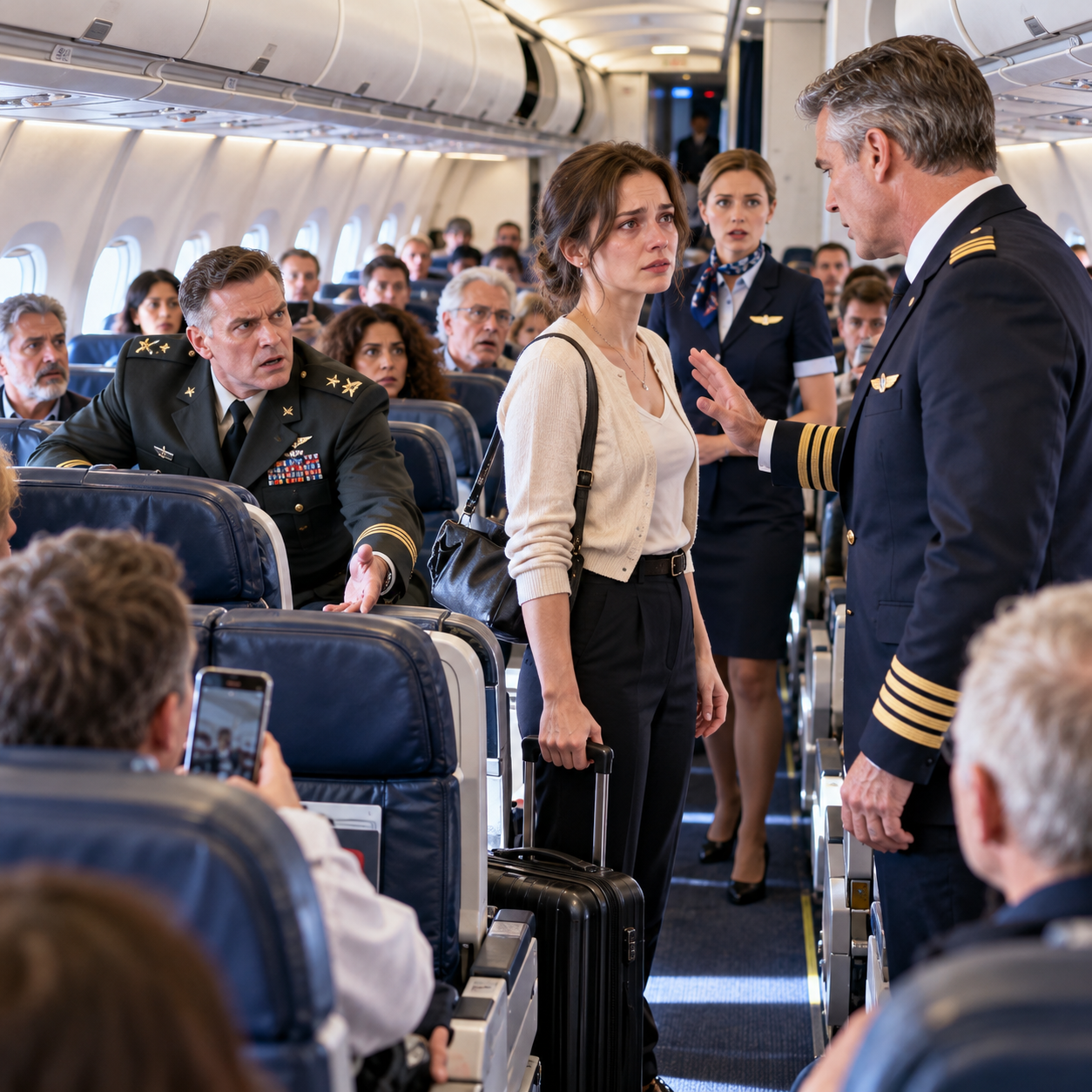
I waited because I assumed he was about to ask politely whether I minded switching. Instead, he snapped his fingers twice, pointed toward the aisle, and said, “Come on, Sergeant. Officers don’t sit behind enlisted personnel.”
The flight attendant across the aisle stopped closing an overhead compartment. Her name tag read Pilar, and she looked between us with the expression of someone who had just realized a routine boarding was about to become an incident report.
“Sir,” she said carefully, “your assigned seat is 2B. Both seats are in first class.”
The major gave her a thin smile. “I understand the seating arrangements, ma’am. I’m sure the sergeant and I can work this out.”
He was looking directly at me when he said it. He didn’t need the window for a medical reason, and there was nothing about my seat that made it different from the one beside it except the view. What he wanted was for the enlisted woman to move because he had told her to move.
I could have remained seated. I knew the airline’s boarding rules, and the major’s Army commission gave him no authority over an Air Force chief on a commercial flight. But the aisle was filling, Pilar was beginning to look trapped between two possible complaints, and I had spent most of my career preventing unnecessary confrontations from swallowing an entire workday.
So I stood.
“Enjoy the window, Major,” I said.
I retrieved my bag, checked that the wooden flag case was secure, and stepped into the aisle. He dropped into 2A without thanking me, already reaching for his phone, while Pilar watched me with a troubled expression.
“Chief, you don’t have to—”
“It’s all right,” I told her quietly. “Please don’t delay boarding on my account.”
I walked thirty rows toward the back.
There are moments when an entire room can pretend not to notice something, but an airplane isn’t designed for that kind of discretion. People looked up, recognized that I was carrying my belongings away from first class, and followed me with their eyes. A man in row seven lowered his newspaper, a woman in row twelve pursed her lips, and somewhere behind me I heard someone mutter, “Unbelievable.”
My original seat was still available. Beside the window sat an elderly gentleman wearing a faded Vietnam veteran cap, with a cane tucked between his knees and a paperback open on his lap. He moved his elbow off the armrest as I sat down.
“That wasn’t right,” he said.
“I’ve had worse assignments.”
“I’m not talking about the assignment.”
He tapped two fingers against his own sleeve, mimicking the major’s gesture.
I looked at him properly then. His name was Amos Bell, a retired Army staff sergeant traveling to Montana for his granddaughter’s nursing school graduation. He had the kind of weathered face that suggested a lifetime outdoors and a voice that carried without needing volume.
“I appreciate that, Mr. Bell,” I said.
“Amos. And I spent enough years in the Army to know a major doesn’t own a window just because he’s got a gold leaf on his shoulder.”
I smiled despite myself. “No, sir. He does not.”
We talked about Montana while the last passengers settled into their seats. Amos told me about his granddaughter’s grades, the scholarship she had earned, and the enormous bouquet his wife insisted he carry through the airport. Then, as Pilar began checking the overhead compartments, I heard a sharp change in the noise coming from the front of the airplane.
The cabin had gone quiet.
A few passengers leaned into the aisle. Others turned in their seats, and a ripple of whispers moved toward us.
I looked past the rows of heads and saw the captain coming out of the cockpit. He was a dark-haired man in his late thirties, wearing a white shirt with four gold stripes on each shoulder and carrying his cap beneath one arm. His expression was serious, and he was studying the seat numbers as he walked.
At row two, the major stood halfway up and extended his hand.
“Captain, good morning. Major Owen Voss, United States Army.”
The captain walked straight past him.
He continued down the aisle, past business travelers and families, past a little boy clutching a stuffed dinosaur, and past a flight attendant who stepped aside to let him through.
At row thirty-one, he stopped.
He looked at me for several seconds, and something in his expression changed. Then he crouched beside my seat, putting himself at eye level with the woman the major had ordered to the back.
“Chief Calder?”
I recognized his eyes before I recognized his face.
“Well, I’ll be damned,” I whispered.
He gave me a nervous smile.
“Do you remember Airman Eli Reyes?”
I hadn’t heard that name spoken aloud in almost fifteen years. The last time I’d seen him, he was twenty-one years old, shaking so badly he couldn’t hold a pen, and waiting for me to tell him whether his Air Force career was over.
Now he was flying the airplane that was supposed to take me home.
## Part 2
The first time I met Eli Reyes, he was standing outside my office with a split lip, swollen knuckles, and two security forces officers who looked relieved to be handing him over to someone else. It was August 2011 at an Air Force base in New Mexico, and I had been a first sergeant for exactly four months. By lunchtime, nine witnesses had already described Eli punching a technical sergeant in the maintenance hangar, and his flight commander wanted him removed from the service.
At twenty, Eli was a quiet aircraft mechanic from El Paso who spent his weekends studying engineering textbooks and sending money home to his mother. His performance records were good, his attendance was reliable, and he had never been formally disciplined. None of that changed the fact that he had struck a superior in front of half a maintenance crew.
I remember closing my office door and watching him stare at his hands. There was dried blood at the edge of one fingernail, and he kept rubbing it with his thumb as though he could erase what had happened.
“Tell me why you did it,” I said.
“He deserved it, Shirt.”
“That isn’t an answer.”
He looked toward the window. Outside, a maintenance truck rolled past, and its backup alarm sounded three times before fading.
“Tech Sergeant Pritchard was cornering Dana Solis in the tool room,” Eli finally said. “She kept telling him to leave her alone. He grabbed her wrist, and I told him to let go.”
“What happened next?”
“He laughed at me.”
I waited.
“He told me to mind my business and said she was learning how things worked around here. Then he put his hand on her again.”
Eli swallowed hard.
“I hit him before I thought about what would happen afterward.”
Dana Solis was nineteen, newly assigned to the squadron, and terrified of being labeled a troublemaker. Wade Pritchard was a decorated technical sergeant with nearly fourteen years of service and friends throughout the maintenance group. Two other young women had previously made complaints about his behavior, but both cases had stalled when witnesses changed their statements and the women requested transfers.
I had seen enough of those situations to know that an accusation could become dangerous for the person making it, particularly when the accused had an excellent reputation with the people deciding what counted as evidence.
“Did Dana ask you to hit him?” I asked.
“No, ma’am.”
“Did she tell you she wanted you to intervene physically?”
“No.”
“Then you understand you’ve made her situation harder.”
His face changed. Until that moment, I think he had considered himself the only person who would pay for what happened.
“Yes, Shirt.”
I told him that protecting someone didn’t give him permission to lose control, and that he would be accountable for putting his hands on another airman. Then I asked him to write down everything he remembered about the incident, including the names of anyone who had been near the tool room. He looked up, genuinely confused.
“You’re still going to investigate Pritchard?”
“Of course I am.”
“Captain Kessler said that was a separate matter.”
“It is a separate matter. That doesn’t mean it disappears.”
Captain Brendan Kessler was Eli’s flight commander, a capable officer whose ambition was visible in everything from the polish on his shoes to the speed with which he answered emails from headquarters. When I walked into his office the next morning, he already had a proposed administrative discharge memorandum on his desk. He listened to my explanation, leaned back, and told me that discipline required consistency.
“Reyes assaulted a supervisor,” he said. “Nine witnesses saw it. We can’t establish the precedent that good intentions excuse violence.”
“I agree.”
He raised an eyebrow.
“Then why are you arguing with me?”
“Because you’re proposing a permanent consequence before we finish establishing what happened.”
I placed Eli’s statement and my preliminary notes on the desk. Kessler glanced at them without touching them.
“Chief, you know what the problem with that approach is?”
“I wasn’t a chief yet, sir. I’m listening.”
He gave a brief, humorless laugh.
“You’re a new first sergeant. People will judge your decisions for the next several years. Don’t stake your reputation on an airman who’s already demonstrated he can’t control himself.”
I told him I understood the risk.
He sighed. “You’re wasting your career on somebody who won’t finish his first enlistment.”
I heard versions of that sentence many times during my career. Sometimes it was directed at me because I’d chosen to remain enlisted despite opportunities to commission, and sometimes it was directed at the young people I believed deserved another chance. What bothered me wasn’t the assumption that someone might fail; it was the certainty with which people treated the failure as inevitable.
I went to our squadron commander, Lieutenant Colonel Franklin Moss, that afternoon. I recommended that Eli receive appropriate nonjudicial punishment rather than immediate discharge and offered to supervise a structured rehabilitation plan while the investigation into Pritchard proceeded independently. Colonel Moss asked whether I was willing to put that recommendation in writing and accept responsibility for overseeing the plan.
I signed before he finished explaining what it might mean for my reputation.
Eli lost rank and pay. His promotion prospects were damaged, his coworkers treated him differently, and for several months he worked under a cloud of suspicion. But he stayed in the Air Force, and he showed up every Tuesday evening in my office with a book report because I’d decided that a young man who thought violence was leadership needed to study the difference.
Meanwhile, Dana Solis gave a formal statement with the help of an investigator outside her immediate maintenance chain. Additional witnesses came forward, and the evidence eventually led to administrative and disciplinary action against Pritchard. Dana remained in the service, although rebuilding her trust in supervisors took much longer than resolving the paperwork.
I thought the matter was finished until my next performance evaluation arrived.
Buried among several positive comments was a sentence questioning my judgment in a significant disciplinary case. Kessler had submitted the remark, and my commander had allowed it to remain. It wasn’t catastrophic on its own, but in a promotion system where small differences could separate hundreds of exceptional noncommissioned officers, that sentence mattered.
I missed selection for senior master sergeant during the next promotion cycle.
At first, I was furious. I spent an entire evening staring at the evaluation, looking for a way to prove that the people who wrote it had been wrong. Eventually I put it in a folder, made myself dinner, and reported for duty the following morning because there were still four hundred people whose problems didn’t stop just because I had acquired one of my own.
I never told Eli.
He was recovering his professional standing, taking college courses at night, and writing book reports that became steadily more thoughtful. In his first report, he summarized the chapters and copied the author’s conclusions. By his tenth, he was arguing with the author and asking whether a leader who enforced every rule without considering the people affected was truly leading at all.
In his final year under my supervision, he applied for an officer commissioning program. I wrote his recommendation, describing both the mistake he had made and the work he had done to earn renewed trust. I wanted the selection board to understand that growth mattered more than a spotless story.
He was accepted.
When he received his commission in 2015, I was deployed overseas and couldn’t attend the ceremony. He emailed me a photograph of himself with his mother, who was fastening his new rank insignia to his uniform, and beneath it he wrote, “Still owe you my first salute and a silver dollar, Shirt.”
I saved the photograph.
Over the years, I heard that Eli had become a military transport pilot, then that he had left active duty, and finally that he was flying civilian airliners. I never contacted him because I didn’t want our relationship to become another obligation he felt required to fulfill.
And because, if I was being less generous with myself, I was afraid to find out whether all those years of worrying about him had mattered.
Now I was sitting in row thirty-one, and the skinny mechanic who once couldn’t look me in the eye was wearing a captain’s uniform.
Eli glanced over his shoulder toward the front of the aircraft.
“I saw your name on the manifest this morning,” he said. “I called the gate and arranged that upgrade myself.”
I looked at him.
“Then I owe you an apology for not keeping it.”
His smile faded.
“Pilar told me what happened, Chief.”
He stood, and for one uncomfortable moment I recognized the anger gathering in his face.
“I’m going to fix this.”
I caught his wrist before he could turn.
“Eli, you and I need to talk about what fixing something actually means.”
## Part 3
Eli looked at my hand on his wrist, then down the aisle where Major Voss had apparently turned in his seat to watch us. I released him and lowered my voice so the nearby passengers wouldn’t hear. “Before you do anything, tell me what you think needs fixing.”
“He took a seat I assigned to you, snapped his fingers at a retired chief, and made you walk past half my passengers like you’d done something wrong.”
“All true.”
“He has no right to treat you that way.”
“Also true. But moving him to the back won’t change what he believes about enlisted people.”
Eli exhaled sharply and rested one hand against the empty aisle seat. He was still the young man who wanted to solve every injustice immediately, although fifteen years had taught him how to hide his temper better. I could see him weighing whether to follow my advice or insist on making a public example of Voss.
“You spent twenty-six years putting other people first,” he said. “Can’t you let somebody look after you for once?”
I wasn’t prepared for that question. I had spent so long explaining what other people needed that I’d nearly forgotten how to identify what I wanted myself. I looked toward the window, where the pale Texas sunrise had begun to spread across the runway.
“I want to go home,” I finally said. “I want this airplane to leave on time. And I’d like to have a conversation with the captain I haven’t seen in fifteen years that doesn’t end with somebody getting escorted off his flight.”
That earned me a reluctant smile.
“Still giving orders, Chief?”
“Occupational hazard.”
I asked him to return to the cockpit, leave the major where he was, and allow the crew to handle any further disruption according to airline procedures. He agreed, although he looked unhappy about it. Before standing, he reached into his breast pocket and showed me a folded index card covered with handwriting.
“I made a promise to myself years ago,” he said. “If I ever got a chance to thank you properly, I wouldn’t waste it.”
“You can thank me when we’re on the ground.”
“I might do it sooner.”
I gave him the same look I used to give him when his book reports arrived suspiciously late. He laughed, straightened his tie, and walked toward the cockpit.
As he passed row two, Major Voss stood again. He extended his hand and said something I couldn’t hear, apparently expecting an explanation for the captain’s trip to the rear. Eli stopped just long enough to speak quietly, then continued into the cockpit without shaking it.
A minute later, Pilar approached me carrying a bottle of water.
“I’d like to apologize,” she said. “I should have corrected him before you moved.”
“You tried.”
“I could have done more.”
“Then you’ll know what to do next time.”
She nodded thoughtfully. Before leaving, she leaned closer and added, “The captain really did arrange that seat specifically for you. He told the gate agent he knew you’d refuse if you knew who requested it.”
I laughed softly. “That sounds like Eli.”
The seat belt sign illuminated, and the aircraft began preparing for departure. I settled back against the narrow seat, thinking I had successfully ended the confrontation, when the speakers crackled overhead.
“Good morning, everyone. This is Captain Eli Reyes speaking.”
He announced our flight time, described the weather in Montana, and apologized for the slight delay at the gate. Then his tone changed.
“Before we depart, I’d like to acknowledge someone traveling with us today. She’s given me permission to tell a little of our history, although she’ll probably regret that permission before I’m finished.”
I closed my eyes.
“Chief Master Sergeant Naomi Calder retired yesterday after twenty-six years in the United States Air Force. Fifteen years ago, I was an airman who made a serious mistake. I faced losing my career, and I wasn’t sure I deserved another chance.”
The cabin grew quiet enough that I could hear a woman in the row ahead stop rustling a plastic shopping bag. Amos lowered his paperback, folded his hands over it, and looked at me with growing interest.
“Chief Calder didn’t excuse what I’d done,” Eli continued. “She made sure I accepted responsibility, but she also insisted that I wasn’t defined entirely by my worst decision. She gave me difficult work, demanded improvement, and trusted me to earn my future.”
He paused.
“Because of her, I eventually became an Air Force pilot. Today I’m flying the woman who taught me that real leadership means seeing people as more than the rank on their shoulders. Chief, thank you for believing I could become better than I was.”
The speakers clicked off.
For one suspended second, nobody moved. Then Amos began clapping, followed by the passengers across the aisle, and within moments applause rolled through the airplane. I felt heat rising into my face as people turned around to locate row thirty-one.
I had managed to survive my retirement ceremony without crying. Apparently, Eli Reyes had decided that was an unfinished assignment.
Amos touched my elbow.
“Now that’s a good officer,” he said.
“He always was a good kid.”
“Sounds like he had a decent teacher.”
I reached into my breast pocket, pretending to rearrange my boarding passes until I was sure I could speak normally again.
The applause eventually subsided, and Pilar reminded everyone to remain seated. Near the front, I could see Major Voss staring down the aisle. He wasn’t smiling anymore.
A few minutes later, before we pushed back, he approached my row carrying his boarding pass. Pilar followed at a respectful distance, clearly aware that she might need to intervene.
“Chief Calder,” he began, “I’d like to offer you the window seat.”
I looked up.
“It’s yours, Major.”
He swallowed. “I shouldn’t have spoken to you the way I did. I misunderstood your position.”
That final sentence told me more than he probably intended. He was apologizing because he’d learned that someone important respected me, not because he had suddenly decided that snapping his fingers at strangers was wrong.
“My position hasn’t changed,” I said. “You knew my rank when you asked me to move.”
His ears reddened.
“I understand.”
“I hope you do. But you can keep the seat. I won’t make another passenger move so we can rearrange ourselves.”
He looked as though he wanted to continue the conversation, but Pilar gently reminded him that departure preparations were underway. He nodded, returned to the front, and sat down without another word.
The airplane pushed back eleven minutes late.
About forty minutes into the flight, the cabin lights brightened and the crew began beverage service. Amos fell asleep with his paperback resting against his stomach, leaving me alone with thoughts I’d spent months avoiding. Without four thousand airmen depending on me, I wasn’t sure what remained of the woman underneath the uniform.
I was staring at the mountain landscape passing far below when someone stopped beside my seat.
A young woman stood in the aisle wearing jeans, a faded gray Army sweatshirt, and a canvas backpack over one shoulder. She was perhaps twenty-six, with her dark hair pulled into a tight braid and an expression I recognized immediately. She looked like someone who had rehearsed asking for help dozens of times but had never gotten past the first sentence.
“Ma’am,” she whispered, “are you really a retired chief master sergeant?”
“Almost retired. Technically, I have a few days left.”
She glanced toward the front of the airplane.
“I’m Staff Sergeant Claire Bennett. Army. I’m sitting three rows ahead.”
I nodded toward the empty aisle seat.
“Would you like to sit down for a minute?”
She hesitated, then carefully perched on its edge. Her fingers tightened around her phone until I thought she might crack the screen.
“I heard what that major said to you,” she whispered.
“Unfortunately, so did everybody else.”
“I know him.”
Something in her voice made me sit straighter.
“How?”
“He’s the operations officer for my battalion.”
I looked toward the front of the aircraft.
Claire drew a slow breath, unlocked her phone, and showed me a photograph of an overturned military truck lying beside a dirt road. Its front end was crumpled, one wheel had separated from the axle, and emergency personnel were standing nearby.
“A soldier got hurt in that truck,” she said. “I warned them it wasn’t safe.”
“Who did you warn?”
Her eyes filled with tears.
“Major Voss. Twice.”
She swiped to another photograph showing a maintenance report with handwritten notes near the bottom.
“He told us the problem had been fixed. After the accident, the reports disappeared.”
I studied the screen without touching it.
“Claire, what exactly are you saying?”
Her voice broke.
“He knew that truck wasn’t safe, Chief. And he signed the report that blamed the driver.”
## Part 4
I had spent too many years dealing with frightened service members to confuse urgency with permission. Claire had just disclosed something serious, but we were still on a commercial airplane, surrounded by strangers, and the officer she was accusing sat thirty rows away. Whatever she needed to tell me deserved more privacy than a conversation conducted over the steady hum of jet engines.
“First,” I said, “put your phone away. Second, take a breath. Third, don’t tell me anything you aren’t comfortable sharing here.”
She nodded, wiped her eyes with the heel of her hand, and locked the screen. Amos remained asleep beside the window, although the slight movement of his eyebrows suggested he might have been listening more carefully than he let on.
“Are you in danger right now?” I asked.
“No, ma’am.”
“Has anyone threatened you physically?”
“No. It’s not like that.”
“All right. Then we have time to think carefully.”
Claire told me she had worked in the motor pool of an Army support battalion in Texas for three years. Eight months earlier, she and another mechanic had repeatedly documented problems with the braking system of a tactical transport truck used during training movements. The vehicle had been scheduled to participate in an exercise involving several units, and the maintenance section was already struggling to keep enough equipment operational.
According to Claire, she had recommended taking the truck out of service until the necessary repairs could be completed. Her section supervisor supported the recommendation, but the operations staff wanted every available vehicle for the exercise. Two days later, the truck returned to the active schedule.
“Major Voss came down himself,” she said. “He said we were creating a readiness problem.”
“Did he order you to change a maintenance record?”
“Not directly. He told my lieutenant that the truck needed to be ready, and my lieutenant told us to stop holding up the movement.”
“That’s an important distinction.”
“I know. That’s what everybody keeps telling me.”
Three weeks later, during a training convoy on a remote road, the truck failed to stop properly while descending a grade. The driver, Private First Class Leo Medina, swerved to avoid striking another vehicle, and the truck overturned into a drainage ditch. Leo survived, but a severe leg injury required several surgeries, and another soldier suffered a fractured collarbone.
Claire had been called to help recover the vehicle. She took photographs of the damage, wrote down what the driver told her, and requested copies of the earlier maintenance entries because she expected investigators would need them. When she later reviewed the official summary, the findings focused on driver error and didn’t mention the earlier braking complaints.
“I asked why,” she said. “They told me the older reports had been superseded by a repair entry.”
“Were the repairs actually completed?”
“Not the ones I’d recommended.”
“How do you know?”
“Because I was the mechanic assigned to inspect that part of the vehicle. Nobody gave me the parts I requested.”
She pulled a folded tissue from her pocket and twisted it between her fingers.
“I tried bringing it up through my chain of command. After that, I started getting counseled for everything. Being late by two minutes, asking questions during briefings, talking to people outside my section.”
I remembered the expression on Eli’s face the day he told me about Dana Solis. Claire wore the same look, a mixture of anger and exhaustion that came from being forced to explain the same facts repeatedly to people who appeared determined not to hear them.
“Have you spoken to an inspector general?” I asked.
“Once. I didn’t give them the whole story.”
“Why not?”
“Because my lieutenant found out I was asking questions. He told me the battalion had already answered everything and that going outside the unit would make me look disloyal.”
I wasn’t surprised. That didn’t make it less troubling.
“Where are you going today?”
“Home to Great Falls. I’m taking leave because my mother is having surgery.”
“And Major Voss?”
“There’s a joint training conference near Great Falls next week. He’s going to brief senior leadership about our battalion’s readiness program.”
The coincidence felt unpleasantly precise. The officer who had bullied me out of a seat was traveling to present himself as an authority on operational readiness, while one of his mechanics was carrying photographs she was frightened to show anyone.
I considered what I could responsibly tell her. I was an Air Force chief, not an Army investigator, and retirement wasn’t a license to conduct my own inquiry into another service’s records. I couldn’t order anyone to cooperate, access military systems on her behalf, or promise an outcome I didn’t control.
“Claire, I can’t determine what happened from two photographs and your account,” I said. “But if you’ve reported safety concerns and believe documents were changed afterward, that’s something the proper investigative authorities need to hear. You have the right to seek advice and make a report without permission from the people you’re concerned about.”
She stared at the carpet.
“What if they say I’m lying?”
“Then the evidence needs to speak for itself. Your job isn’t to win an argument with your commander. It’s to provide the facts you actually know, distinguish them from what you suspect, and let independent people examine the records.”
Her phone vibrated.
She glanced down, and her expression tightened.
“Is something wrong?”
“It’s my lieutenant.”
She turned the screen toward me, showing a message.
“Reminder that all pending vehicle-readiness questions have been resolved. Do not discuss internal battalion matters during your leave. We’ll address your conduct when you return.”
I read it twice.
“Has he sent anything like that before?”
“Yes.”
“Keep the message. Preserve the originals of the photographs, too. Don’t alter them, circulate them online, or go looking for records you aren’t authorized to access.”
She nodded.
“And before you make another statement, consider consulting a military legal assistance office about what support is available, particularly because you’re concerned about retaliation.”
Claire looked at me for a long moment.
“Why are you helping me?”
It was a fair question. She didn’t know me, and the uniform I was wearing represented an institution that had taught her to trust authority while repeatedly disappointing her. I could have given her a speech about military values, but she’d probably heard enough speeches to last a lifetime.
“Because you asked,” I said.
For the first time since she sat down, the muscles around her eyes relaxed.
She returned to her seat, promising to think about the available reporting channels before taking another step. I watched her go, then rested my head against the seat and closed my eyes. An ordinary passenger might have found the story shocking; I found it horribly familiar.
A few minutes later, Major Voss appeared in the aisle again.
This time he didn’t carry his boarding pass. He glanced toward Claire’s seat before crouching beside me, and something in his expression suggested that he already knew she’d spoken to me.
“Chief Calder,” he said quietly, “I wanted to make sure there were no hard feelings.”
“I think we’ve covered that, Major.”
He smiled without much warmth.
“I noticed you were speaking with one of my soldiers.”
I looked directly at him.
“Passengers talk to each other on airplanes.”
“Of course. Staff Sergeant Bennett has had some difficulties in her unit. I hope she hasn’t brought you into an internal personnel matter.”
The wording was careful, rehearsed, and familiar. I’d heard versions of it whenever someone wanted to transform a legitimate concern into a character flaw belonging to the person raising it.
“I’m not conducting an investigation, Major.”
“Good. I’d hate for an incomplete account to create misunderstandings.”
Before I could respond, Pilar approached and asked him to return to his seat so she could finish the service. He rose, adjusted his jacket, and gave me a look that was almost pleading.
“She’s a good mechanic,” he said. “But she’s gotten herself confused about things that were already settled.”
I watched him walk away.
I hadn’t told him what Claire had shared. Yet he had immediately assumed our conversation concerned the vehicle incident, and he had made a point of discouraging me from taking her seriously.
For the remainder of the flight, I tried to focus on ordinary things. Amos told me about repairing old tractors with his granddaughter, Pilar brought me a fresh cup of tea, and the mountains outside the window gradually grew sharper beneath the September sun. But every time I looked toward Claire’s row, I saw her sitting perfectly still, clutching her backpack as if somebody might try to take it.
When we landed in Great Falls, Eli asked the passengers to remain seated for a moment. Pilar escorted me forward after the seat belt sign went off, and I walked past rows of people who smiled, nodded, or quietly thanked me for my service. Major Voss stood when I reached row two, but I didn’t stop.
Eli was waiting by the cockpit door.
“You didn’t let me give you the good seat,” he said.
“You did give it to me. I just didn’t keep it.”
He laughed and reached into his pocket.
“I’ve carried something through more airports than I can count because I promised I’d give it to you someday.”
He opened his palm, revealing an old silver dollar.
The coin was worn along its edge and dated to the year I was born. Eli explained that he’d bought it before his commissioning ceremony, intending to present it after his first salute, and had kept it ever since.
My throat tightened.
“You kept this all those years?”
“I wasn’t going to break my word to the person who taught me what keeping one meant.”
We embraced briefly, awkwardly navigating his pilot’s cap and my bag. I promised to send him my new phone number, and he reminded me that I was still owed his thirty-fifth book report.
When I stepped into the terminal, I saw Claire waiting beside a row of windows. She looked relieved that I hadn’t disappeared through the crowd.
I walked over.
“Have you considered what you want to do?” I asked.
She nodded.
“Yes, Chief. I’m going to tell the truth. All of it.”
Then she showed me a message she’d received while we were taxiing.
Her lieutenant had ordered her to report for a meeting immediately upon returning from leave, despite the leave being approved. He also wanted to know why she had spoken with a retired Air Force chief aboard the airplane.
Claire looked up from the phone.
“I never told him your name.”
Neither of us said anything for several seconds.
Somebody had been watching us closely enough to report our conversation before the airplane even reached the gate.
## Part 5
My sister Lauren was waiting at the airport curb in a battered blue Subaru, wearing a sweatshirt from the high school where she taught history. She waved both arms when she saw me, ignored the passenger cars lining up behind her, and climbed out to pull me into a hug. We’d been on the phone almost every Sunday for twenty-six years, but I’d missed most of her birthdays, both of her children’s graduations, and nearly every ordinary family gathering that didn’t fall during leave.
“You’re really home,” she said.
“For better or worse.”
“Definitely better. You look exhausted.”
“That flight got complicated.”
She examined my face with the uncomfortably precise attention of someone who had known me since childhood. Then she loaded my bag into the trunk and asked whether I’d managed to spend even one day away from the Air Force without finding someone who needed help.
“Not exactly,” I admitted.
She laughed as though I’d confirmed a prediction.
During the drive through Great Falls, I told her about Eli, the silver dollar, and the extraordinary coincidence that had brought us together after fifteen years. I described the major taking my seat, although I minimized the humiliation because Lauren had always been more protective of me than I was of myself. When I mentioned Claire, however, she grew quiet.
“Naomi, you’re not her commanding officer,” she finally said.
“I know.”
“And you aren’t responsible for every mistake the military makes after you retire.”
“I know that, too.”
She kept her eyes on the road. “Do you?”
It was a question I couldn’t answer without lying.
I spent my first evening home unpacking the uniforms I’d probably never wear again. The house had belonged to my parents, and after their deaths Lauren and I had agreed that I could buy out her share and use it as my retirement home. It stood on a quiet street with mature cottonwoods, a garage full of my father’s old tools, and a kitchen window facing the mountains.
For years, whenever military life became exhausting, I imagined sitting at that window with coffee and nowhere I needed to be. Now that the opportunity had arrived, the silence felt almost unnatural.
I placed the folded flag on the mantel, set Eli’s silver dollar beside it, and opened the cardboard box containing my personal mementos. At the bottom was a thick binder filled with thirty-four book reports, a photograph from Eli’s commissioning ceremony, and a handwritten letter from Dana Solis.
Dana had sent it in 2017, six years after the incident that nearly ended Eli’s career. She had become a staff sergeant and supervised a maintenance section overseas. In her letter, she described helping a frightened young airman report inappropriate behavior by a supervisor without putting her own future in jeopardy.
At the bottom, she’d written, “Eli was the first person who stood up for me, but you were the person who made sure standing up actually changed something.”
I read that sentence twice.
There was a difference between rushing into somebody else’s problem and helping them find a way through it. Eli had learned that distinction through painful experience, and I suddenly wondered whether I had managed to forget it myself.
The next morning, Claire called.
Her mother was recovering from surgery, but Claire sounded more concerned about what was happening at her unit. Her lieutenant had sent another message demanding a written explanation of her contact with me, describing our airplane conversation as potentially inappropriate disclosure of internal information.
“He says I embarrassed the battalion,” she told me.
“Did you send him anything?”
“No. I wanted to ask you first.”
I took a moment before answering.
“Claire, I’m glad you called, but you need advice from someone authorized to counsel you about your situation. I can listen, explain what I’ve learned, and serve as a witness to anything I personally observed. I can’t become your lawyer, your investigator, or your new chain of command.”
She was quiet.
“That sounds like you’re telling me to go away.”
“I’m telling you that you deserve better help than one retired chief making decisions from her kitchen.”
I gave her the contact information for a military legal assistance office and explained how to locate the Army’s inspector general reporting channels. I also suggested she request information about the protections available to service members who report suspected wrongdoing, including where to raise concerns about retaliation.
“Keep a timeline,” I told her. “Write down dates, times, who said what, and what you actually witnessed. Separate that from anything you heard secondhand. If an investigator wants your evidence, ask how to submit it securely.”
Claire agreed to contact the appropriate offices. Before we ended the call, she asked whether I would be willing to tell investigators about Major Voss’s behavior on the airplane.
“Yes,” I said. “I can tell them what I saw and heard.”
I didn’t promise to prove her whole case.
Three days later, I received a call from Eli.
He was in Denver between flights, sitting somewhere noisy enough that I could hear announcements echoing through the terminal. After congratulating me on surviving my first weekend of retirement, he asked whether I remembered the Army major.
“That’s a difficult man to forget,” I said.
“Our company received a complaint about the confrontation. One of the passengers submitted it.”
“Against you?”
“Against him, primarily. She said she felt uncomfortable watching an officer pressure another passenger into giving up an assigned seat.”
I leaned against the kitchen counter.
“Did you respond?”
“Our crew filed the normal account of what happened. Pilar documented what she heard and saw, and the airline is handling its own review.”
I told Eli that I had no interest in turning the man into an internet spectacle. He agreed, then mentioned something that made me straighten.
“There’s another detail,” he said. “When Pilar asked him to return to his seat after he came back to speak with you, he told her he needed to address an issue involving one of his soldiers.”
“Did he name the soldier?”
“No. But she made a note because it was an unusual thing to say during beverage service.”
I thanked him and asked him not to make any assumptions about what it meant. Still, I knew the statement might matter if an investigator later needed to reconstruct when Voss became aware of Claire speaking to me.
By the end of the week, Claire had contacted an inspector general’s office and requested legal advice. She had also gathered records she was already authorized to possess, including her own previous statements, messages from supervisors, and photographs she’d taken as part of her maintenance duties.
When she called again, her voice sounded steadier.
“They’re taking my complaint,” she said. “They want a detailed timeline.”
“Good.”
“They also asked for the original photographs.”
“Then follow their instructions for submitting them.”
She hesitated.
“Chief, there’s something else I haven’t told you.”
I moved to the kitchen table.
“Go ahead.”
“After the accident, I found an entry in the maintenance system that said the braking problem had been corrected before the convoy. It listed a mechanic as the person who completed the repair.”
“Was that mechanic you?”
“No.”
“Did you speak to the person whose name was listed?”
Claire took a breath.
“Yes. His name is Sergeant Luis Ortega. He was on emergency leave the day the repair was supposedly completed.”
The room seemed to grow quieter.
“Can he document that?”
“He’s already shown me his approved leave record.”
I stared at the silver dollar lying beside my coffee cup. If Claire’s account was accurate, the problem extended beyond a commander pressuring a maintenance section to meet a training schedule. Somebody might have recorded a repair that had never happened, using the name of a soldier who wasn’t even on duty.
“Claire,” I said carefully, “don’t ask anyone to change or remove records. Tell the investigators what you’ve found and let them establish the history of those entries.”
“I will.”
“Has Ortega agreed to speak with them?”
“He said he would.”
Then she told me something that made my stomach tighten.
“Major Voss signed the final incident summary. But the original inspection sheet has another officer’s initials on the order returning the truck to service.”
“Whose?”
“Lieutenant Colonel Adrian Sloane.”
I didn’t know the name, but Claire did.
Sloane was the battalion commander, the officer responsible for the unit in which both she and Major Voss served. If the paperwork was genuine, the decision to return the truck to service might have originated above the major.
For the first time, I wondered whether Voss had merely protected himself after the accident or whether he had been protecting someone with considerably more authority.
## Part 6
The investigation moved slowly at first, which was exactly how serious investigations were supposed to move. Claire wanted immediate answers, and I understood why, but the people examining her allegations had to establish which records were authentic, who had entered or approved each change, and what the maintenance personnel had actually known before the truck rolled over. None of those questions could be resolved by outrage, even justified outrage.
Meanwhile, civilian life kept presenting me with absurdly ordinary challenges. My refrigerator started leaking, I discovered that my truck needed new tires, and Lauren persuaded me to attend a neighborhood barbecue where three people asked whether I missed the military before I had finished my first hamburger. I told them retirement was going well, although I continued waking up before dawn and checking my phone for emergencies that no longer belonged to me.
One afternoon, Lauren found me in the garage reorganizing tools that had already been organized.
“You’re making yourself crazy,” she said.
“I’m cleaning.”
“You’ve arranged those wrenches by size twice.”
“Some of them were out of order.”
She leaned against the doorway.
“Naomi, you can care about what happens to that soldier without spending the rest of your life standing watch over her. You’re allowed to have a life that belongs to you.”
I put down the wrench in my hand. She wasn’t telling me to abandon Claire; she was reminding me that after twenty-six years, I had to learn the difference between being useful and being constantly needed.
That evening, I called Eli and asked him a question unrelated to Claire, Voss, or the incident report.
“How did you figure out who you were after leaving the Air Force?”
He laughed.
“Badly, for about six months.”
“That helps.”
“I’m serious. I missed the squadron, the missions, the people. I thought flying for an airline would feel exactly the same, and when it didn’t, I figured I’d made a terrible decision.”
“What changed?”
“I started paying attention to the people around me instead of trying to recreate the old job. Turns out you can still be a decent leader without a squadron.”
He told me about a younger pilot he mentored, a maintenance worker whose certification program he’d helped fund through an industry scholarship, and the retired airmen he occasionally met for lunch. None of it sounded particularly heroic, which made it strangely appealing.
“You taught me to be responsible for people,” he said. “Not to own their problems forever.”
I looked out the window at the cottonwood leaves blowing across my backyard.
“I may have neglected that distinction.”
“Welcome to being human, Chief.”
Two weeks after the flight, an investigator contacted me about the airplane encounter. She explained that an authorized review was examining allegations involving the battalion’s maintenance reporting and possible retaliation, and she wanted an independent account of my interactions with Major Voss and Staff Sergeant Bennett.
I described the seat dispute, Eli’s visit to row thirty-one, Voss’s later apology, and Claire approaching me during the flight. I was careful not to present Claire’s allegations as facts I’d personally verified, and I repeated the exact words I remembered Voss using when he warned me that Claire was confused about matters supposedly already resolved.
“Did he know what Bennett had told you?” the investigator asked.
“He appeared to assume we’d discussed a problem involving her unit. I didn’t confirm that for him.”
“Did you tell anyone in his command that she spoke to you?”
“No.”
“Do you know how her lieutenant learned of your conversation?”
“I don’t. I know he sent her a message afterward.”
She thanked me and said someone might follow up. There was no dramatic exchange, no promise that justice was imminent, and no indication of what conclusions the investigators might reach.
I found that reassuring.
Three days later, Claire called with news that turned the case in a more serious direction. Luis Ortega had been interviewed, and according to what he told Claire, investigators had obtained leave records establishing that he wasn’t at the installation when the disputed repair was entered. He had also identified an earlier copy of the inspection worksheet that included Claire’s handwritten warning about the braking system.
“Did he explain why his name appeared on the repair?” I asked.
“He says he has no idea.”
“Then let the investigators work that out.”
But Claire wasn’t finished.
“There’s another person, Chief. The soldier who drove the truck.”
I sat down.
“Leo Medina?”
“Yes. He wants to talk to them.”
Leo was still undergoing rehabilitation after multiple surgeries. Claire had kept in occasional contact with him, although she’d avoided pressing him for information because she didn’t want him to feel that his medical recovery depended on helping her case. Now his family had learned that a formal review was underway, and he wanted his account included.
A few days later, Claire sent me a message saying that Leo had formally provided a statement. She did not forward the statement itself, and I didn’t ask her to. Later, after he gave permission for her to share the general details, she told me what he’d described.
Before the accident, Leo said, the truck’s brakes had felt unreliable during a practice movement. He had reported that concern verbally to a supervisor and had been told the vehicle had passed maintenance checks. During the convoy, when he attempted to slow on the descent, the response was delayed, and he turned to avoid colliding with the vehicle ahead.
After the accident, he had repeatedly been asked whether he had been traveling too fast or failed to maintain appropriate spacing. Those were legitimate matters to examine, but he believed the interviews had focused on his driving while giving little consideration to the mechanical concerns he’d reported.
“He said he started wondering whether he’d imagined the problem,” Claire told me. “Everybody kept telling him the truck was fine.”
I knew what that kind of isolation could do to someone. A frightened young service member could begin distrusting his own memory when every person with authority insisted that the evidence pointed elsewhere.
“What does he want?” I asked.
“He wants his medical care to continue. And he wants the report to say what actually happened.”
Those were modest requests, considering what he’d endured.
As the weeks passed, more records were reviewed and additional personnel were interviewed. I heard only fragments, most of them through Claire, and reminded her repeatedly not to mistake preliminary information for established conclusions.
Then, one Wednesday evening, I received an unexpected phone call.
“Chief Calder? This is Major Owen Voss.”
I stood beside my kitchen table, looking at the unknown Texas number on the screen.
“Major.”
“I hope I’m not calling at a bad time.”
“What can I do for you?”
He cleared his throat.
“I’d like to explain some things that happened in my battalion.”
I felt the familiar pull of an old habit: listen, solve the problem, make it easier for the person asking. But he wasn’t one of my airmen, and I knew there was an ongoing inquiry into matters he might personally be involved in.
“Major, if this concerns Staff Sergeant Bennett’s complaint, you need to speak through the appropriate investigators and your legal counsel.”
“I have spoken with counsel.”
“Then you understand why I can’t help you discuss the substance privately.”
He was silent for several seconds.
“You think I’m the villain in this.”
“I think you treated me badly on an airplane. I know what I witnessed. The rest is being investigated.”
He let out a weary breath.
“I spent fifteen years doing what my superiors wanted,” he said. “I followed orders, made the numbers, kept the unit moving. Do you know how difficult it is to be the officer who tells a colonel his equipment isn’t ready?”
“Probably about as difficult as being the mechanic who tells a major the same thing.”
That stopped him.
“I didn’t call to argue.”
“Then why did you call?”
His answer came so quietly I almost missed it.
“Because Colonel Sloane is telling people the maintenance decision was mine alone.”
I closed my eyes.
There it was—the deeper problem taking shape beneath the seat dispute, the warnings, and the apparently corrected paperwork. The major who had treated an enlisted woman as disposable now feared that a superior officer was preparing to treat him exactly the same way.
“Then tell the investigators the truth, Major,” I said. “Not whatever version saves your career. The whole truth.”
He said nothing.
“That is the only useful advice I can give you.”
After we ended the call, I wrote down the time and the substance of the conversation while it was fresh, then contacted the investigator who had interviewed me to ask how to report the unsolicited call. She instructed me on how to provide a supplemental statement.
I had barely finished when Claire sent another message.
Her investigator had just notified her that the review now included possible falsification of maintenance records and concerns about actions taken against people who reported the defects. The unit’s earlier accident findings were being examined again.
And for the first time, Claire had been told that investigators wanted to know not only who changed the paperwork, but who had instructed them to do it.
## Part 7
By the beginning of November, the cottonwoods along my street had lost most of their leaves, and winter was beginning to settle over Montana. I’d been retired for five weeks, but my phone still rang frequently enough that Lauren accused me of running an unofficial military counseling office from our parents’ kitchen. The difference was that I had finally learned to let some calls go to voicemail.
Claire had stopped contacting me every time something happened in her unit. At first, I’d worried that meant she was struggling alone, but when we spoke she explained that she had a legal adviser, an investigator who took her concerns seriously, and a small group of trusted people helping her navigate the process. She sounded more confident than she had on the airplane, although she was still worried about what would happen when the investigation ended.
One afternoon, she called with an update.
“They’ve reassigned Major Voss while the review continues,” she said.
I set down the garden catalogs Lauren had left on my table.
“Has anyone explained why?”
“Not specifically. He isn’t overseeing our battalion’s training readiness reports anymore. Colonel Sloane has also been relieved of some responsibilities pending the findings.”
“That doesn’t mean either man has been found responsible yet.”
“I know, Chief. My adviser keeps reminding me.”
I heard a small smile in her voice.
“They also told me that any concerns about retaliation need to go directly to the investigator now. My lieutenant hasn’t sent me one of those messages in almost two weeks.”
I was glad about that, but I knew administrative measures were only part of the problem. Reassigning an officer could prevent further interference, yet it couldn’t automatically repair Leo’s leg, erase Claire’s months of anxiety, or restore the confidence she’d once placed in her chain of command.
“How is Leo doing?” I asked.
“Better physically. He’s walking short distances with assistance. He still doesn’t know whether he’ll be able to return to duty.”
“Has he gotten any news about the accident findings?”
“Not yet.”
She paused.
“He told me something yesterday, though. He said the worst part wasn’t the crash. It was waking up in the hospital and hearing people suggest he’d caused it.”
I knew exactly what she meant.
An injury might heal enough for someone to build a different life. Being told that your own decisions had destroyed that life, especially when you believed you’d been placed in an unsafe situation, could follow a person long after the physical wounds closed.
A week later, the investigator contacted me again. She wanted clarification about Major Voss’s phone call, particularly whether he had asked me to influence Claire or suggested that my account of the airplane encounter was inaccurate. I answered truthfully: he’d done neither explicitly, but he’d attempted to discuss matters under investigation and claimed that his commander was shifting responsibility onto him.
“Did you advise him on how to respond?” she asked.
“I told him to tell the truth through the proper channels.”
“Nothing else?”
“Nothing else.”
She thanked me and ended the call.
I spent the rest of that afternoon thinking about Captain Kessler, the officer who had damaged my performance evaluation after I advocated for Eli. For years, I’d told myself that the evaluation was a small price to pay for a decision I still believed was right. But retirement had given me enough distance to recognize another truth: the willingness to accept consequences didn’t mean those consequences had been justified.
Kessler had faced a choice. He could have disagreed with my recommendation without retaliating through a career evaluation, but he had chosen to make his disapproval personal. That choice had delayed my promotion and made my next several assignments more difficult than they needed to be.
I wondered how many young noncommissioned officers had learned to remain silent after watching someone else pay a professional price for speaking up.
The thought bothered me enough that I called Dana Solis.
We hadn’t spoken in years, although we’d occasionally exchanged holiday messages. She answered from her home in North Carolina, where she’d settled after leaving active duty, and sounded delighted to hear that I’d finally retired.
“I watched your ceremony online,” she said. “You looked like you were trying to escape before the general finished talking.”
“I was considering it.”
She laughed.
We spent several minutes catching up. Dana had completed a degree in organizational management, married a civilian engineer, and begun working with a veterans’ nonprofit that helped former service members navigate career changes. She was also mentoring young women entering technical occupations.
When I told her about my difficulty adjusting to retirement, she listened without interrupting.
“Chief, do you remember what you said when I told you I wanted to transfer after everything happened?”
“Probably something unnecessarily serious.”
“You said I didn’t have to spend my career proving I was tough enough to survive a place that had failed me. You said I could choose where I wanted to grow.”
I remembered the conversation.
Dana had been standing in my office holding a transfer application, worried that leaving the squadron would make people think she’d been defeated. I told her she’d already demonstrated more courage than most people would ever understand, and that she didn’t owe the organization another day of suffering to prove it.
“Maybe you should take your own advice,” she said.
I smiled, although she couldn’t see me.
“That seems to be a recurring theme lately.”
After we ended the call, I spent an hour researching volunteer opportunities at a local technical college. The school offered aircraft maintenance and engineering technology programs, and several students were veterans transitioning into civilian careers. I sent an email asking whether they needed volunteer mentors.
The reply arrived the following morning.
They did.
For the first time since my retirement ceremony, I had something scheduled that didn’t involve a military complaint, a medical appointment, or rearranging my father’s tools.
In early December, Claire called again.
This time she wasn’t crying, and she wasn’t whispering.
“Chief, the investigator told me they have enough evidence to support findings that the maintenance records were improperly changed.”
I stood beside the kitchen window, watching snow settle on the bare branches.
“That’s significant.”
“They found an earlier version of the inspection worksheet. The braking warning was still there.”
“Did they establish who changed it?”
“The full findings aren’t all final, but they identified the account used to enter the repair completion. It wasn’t Luis’s account, even though his name appeared on the entry.”
I let her continue.
According to the information Claire had been authorized to receive, investigators had established that the repair entry was submitted by another member of the maintenance section following direction from supervisory personnel. They were also examining communications among battalion leaders concerning the vehicle’s readiness before the exercise.
Most importantly, the evidence contradicted the claim that every known braking defect had been properly resolved before the convoy.
Claire spoke faster as she explained.
“There’s an email from Colonel Sloane telling Major Voss to make sure the battalion meets the readiness requirement. The next day, Voss instructed the maintenance leadership to get the truck released.”
“Does the email prove Sloane knew the truck was unsafe?”
“Not by itself. But the investigators have other communications.”
She stopped.
“And Major Voss has given another statement.”
I waited.
“He admitted he knew we’d raised safety concerns before the exercise.”
The kitchen clock ticked behind me.
“He said he believed the problems could be resolved in time. But he also admitted that he pushed the maintenance section to clear the vehicle without personally confirming the required work had been completed.”
“Did he acknowledge what happened afterward?”
“Yes.”
Claire took a breath.
“He admitted that after the accident, he accepted the summary blaming Leo even though he knew there were earlier maintenance complaints missing from the report.”
I sat down slowly.
There was no pleasure in hearing it. I didn’t feel victorious, and I didn’t imagine the major being humiliated in front of an audience. I thought about Leo in a hospital bed, Claire sitting alone in her barracks room with unanswered messages, and the years of service those young people had expected to give before someone else decided appearances mattered more than their safety.
“What happens next?” I asked.
“The findings will go through further review. They’re examining the officers’ conduct and what corrective action is appropriate. My adviser says there may be separate administrative or legal proceedings.”
“Then it’s important not to assume the outcome.”
“I know.”
She was silent for a moment.
“Chief, you were right about something.”
“What?”
“You said people shouldn’t have to choose between being loyal and telling the truth. I didn’t understand that at first.”
I looked at the silver dollar on my desk.
“You’re the one who made the choice, Claire.”
“Only because I saw what happened on that airplane.”
I closed my eyes.
“You saw an officer treat someone badly. That shouldn’t have been necessary for you to recognize you deserved to be heard.”
“But it was,” she said.
There was no bitterness in her answer. Just the simple, painful description of what had finally made her believe that an authority figure could be challenged.
Before ending the call, she told me she had spoken to Leo that morning. He’d learned that the earlier accident findings were being formally reconsidered, and for the first time since the crash, he had allowed himself to hope that his official record might eventually reflect what had actually happened.
Then Claire said something I wasn’t expecting.
“Major Voss asked his counsel to pass along a message. He wants to apologize to Leo and me.”
I thought about that for a moment.
“That’s his decision,” I said. “And whether either of you wants to hear it is yours.”
Claire exhaled.
“I don’t think I’m ready.”
“Then you don’t have to be.”
I didn’t tell her that forgiveness would make her stronger. I didn’t tell her to rise above it, accept an apology, or understand the pressure Voss had been under. Pressure could explain a person’s choices, but it didn’t turn those choices into someone else’s responsibility.
When we ended the call, I stood by the window for a long time.
Fourteen years earlier, I had signed my name beneath a young airman’s rehabilitation recommendation because I believed people deserved the opportunity to become better than their worst mistakes. I still believed that. But I also understood something I’d been learning since retirement: giving someone the chance to change didn’t require the people they’d hurt to absorb the cost of that change.
## Part 8
The final findings reached Claire in February, nearly five months after the flight that had brought us together. By then, the streets of Great Falls were buried beneath dirty snowbanks, my refrigerator had been repaired twice, and I had started spending two afternoons a week mentoring students at the technical college. Retirement no longer felt like a door closing behind me, although I still reached for my nonexistent work phone whenever an unfamiliar number appeared on the screen.
Claire called while I was helping a student revise a résumé.
I stepped into an empty hallway.
“Chief, it’s finished.”
Her voice was steady, but I could hear the emotion beneath it.
The investigation had substantiated significant failures in the battalion’s vehicle-readiness reporting and the handling of safety concerns before the convoy accident. The official review concluded that the previous account of the accident had omitted material information about reported mechanical defects. A corrected record would include those concerns, along with the evidence that maintenance warnings had not been properly addressed before the vehicle was returned to service.
Major Owen Voss had received formal administrative action and was removed from his readiness oversight position. His conduct during the maintenance decisions and the subsequent reporting process had damaged the trust required for that responsibility. Lieutenant Colonel Adrian Sloane also faced adverse action, with additional determinations about senior leaders’ roles continuing through the appropriate channels.
Claire’s allegations of improper pressure and retaliatory treatment had prompted separate corrective measures within the unit. Her earlier adverse counseling entries were reviewed, and the ones tied to unsupported accusations about her reporting were withdrawn. The unit was also required to address deficiencies in how maintenance concerns were documented, escalated, and preserved.
None of it brought a dramatic courtroom confession or a perfect ending.
Leo was still recovering from his injuries. His long-term military future remained uncertain, and no administrative finding could restore the months he’d spent wondering whether people believed his account. Some decisions concerning the officers’ careers were still pending, and Claire knew that the military wouldn’t suddenly become a place where every person listened carefully just because one investigation had reached a conclusion.
But the official record no longer treated the missing safety warnings as though they’d never existed.
“Leo called me this morning,” Claire said. “He got the update from his representative.”
“How is he?”
“He cried.”
I closed my eyes.
“He’s been trying to explain what happened for almost a year. He told me this was the first time somebody with authority had said the problem wasn’t just his driving.”
For a while, neither of us spoke.
Then Claire laughed, a small, disbelieving sound.
“I thought I’d feel happy when it was over.”
“How do you feel?”
“Tired. Relieved. Angry that it took this much work.”
“All reasonable.”
“I keep wondering whether I should have pushed harder earlier.”
“Claire, you reported what you knew. Other people were responsible for acting on it.”
She was quiet.
“That’s what my adviser said, too.”
“Sounds like you have a good adviser.”
“I do.”
She told me she intended to remain in the Army for the time being. She still liked maintenance work, still believed in the soldiers she served beside, and wanted to see whether she could rebuild her career in an environment where her judgment was respected. She had submitted a request for a different assignment and hoped to move to a unit where she wouldn’t be working beneath the same people who had dismissed her concerns.
I supported her decision without trying to influence it. There was a time when I might have told a young service member exactly what I thought she should do. Now I understood that the point of helping someone was to make it easier for them to make their own choices.
Before hanging up, she asked whether I regretted giving up my seat.
I looked through the hallway window at a group of students crossing the snowy parking lot.
“No,” I said. “I regret that the major believed he had the right to demand it. Those aren’t the same thing.”
Claire laughed.
“That’s a very chief answer.”
“Some habits take longer to retire.”
After the call, I returned to the classroom. The student I’d been helping, a former Marine named Trevor Hale, had been trying to explain a six-year military maintenance career on a résumé without drowning employers in acronyms. He looked up when I sat beside him.
“Everything okay, Chief?”
“Yes. Everything’s okay.”
He pointed at the page.
“Then can you tell me what a civilian is supposed to call preventive maintenance inspections?”
I smiled and picked up my pen.
“Now that’s a problem we can solve.”
The work turned out to suit me better than I expected.
I wasn’t responsible for promotions, disciplinary recommendations, or late-night emergencies. I couldn’t order anyone to improve their attendance or demand that an employer look beyond a veteran’s imperfect interview skills. All I could do was listen, offer practical advice, make introductions when appropriate, and help students recognize abilities they’d learned to take for granted.
Some days, that meant explaining how military leadership translated into civilian management. Other days, it meant sitting with someone who had spent eight years repairing aircraft and was terrified of failing a job interview because he didn’t know how to describe himself without his rank.
I liked those afternoons.
I also started accepting invitations I’d spent years declining. I went to Lauren’s school concert, helped her husband rebuild a section of their deck, and took my niece to lunch without checking my phone every fifteen minutes. On Sundays, I walked along the river, where the winter air smelled of damp earth and wood smoke, and discovered I could spend an entire afternoon without feeling guilty about it.
In March, a package arrived from Denver.
The return address belonged to Eli Reyes.
Inside was a handwritten letter, a small framed photograph, and a thirty-fifth book report. The photograph showed Eli standing beside his airplane with several crew members, all smiling beneath a bright blue sky. On the back he’d written, “The people who make the flight possible.”
I sat at the kitchen table and opened the report.
It wasn’t about a leadership textbook this time.
Eli had written about a woman who understood machinery better than politics, who believed enlisted people were not unfinished versions of officers, and who once gave a frightened young mechanic the most difficult opportunity of his life: the chance to prove that he could be trusted again.
He described how becoming an officer hadn’t immediately made him a good leader. During his first assignment as a pilot, he’d struggled to understand the concerns of the enlisted maintenance crews and occasionally mistaken his new authority for superior judgment. He remembered the day a senior crew chief challenged a decision he’d made about a training schedule, and how his first instinct had been to dismiss the criticism.
Then he remembered my office.
He listened, changed the schedule, and thanked the crew chief for speaking up.
Over the years, he wrote, he’d tried to build a habit of asking the quietest person in the room what they thought before making decisions that affected everyone else. Sometimes it revealed a problem nobody had noticed; other times it simply reminded the person that their experience mattered.
At the end of the report, he wrote one final paragraph.
“Chief, when you made me write those reports, I thought you wanted me to learn leadership from books. It took me years to understand that you were teaching me how to examine my own decisions. I’m still learning, and sometimes I still get it wrong. But every time I have the chance to make someone feel small or help them become better, I remember the woman who sat across a desk from me and believed I could change. Thank you for making me do the work.”
I read it slowly.
Then I read it again.
For years, I’d preserved his old reports because they reminded me of a decision that had cost more than I expected. Now I understood that the cost wasn’t the whole story. The evaluation, the delayed promotion, the missed ceremony, and the years of uncertainty were all real, but so was the man who had grown from that frightened young mechanic into someone capable of helping others.
I placed the thirty-fifth report into the binder beside the others.
Later that afternoon, Eli called.
“Did it arrive?”
“It did.”
“How’d I do?”
I pretended to consider the question.
“Your handwriting hasn’t improved.”
He laughed.
“That’s fair.”
“And you’re still too fond of long sentences.”
“Also fair.”
“But the content is acceptable.”
“Acceptable?”
“Don’t get greedy, Captain.”
He laughed harder, and for a moment I could almost hear the twenty-year-old mechanic sitting in my office, arguing that a three-page report should count as extra credit.
Then his voice softened.
“Seriously, Chief. I wanted you to have something that wasn’t just a thank-you.”
“You gave me plenty.”
“There’s one more thing.”
I looked toward the flag case on the mantel.
“What?”
“I’m helping organize a mentorship program for military veterans transitioning into civilian aviation. Mechanics, pilots, ground crew, anybody trying to figure out what comes next. Would you consider advising us?”
I leaned back in my chair.
“Are you offering me another job?”
“Absolutely not. I know better than to give you an excuse to start working eighteen-hour days again.”
“Good answer.”
“Just a few hours a month, if you want. We’d be lucky to have you.”
I promised to consider it, which was more of an answer than I’d given most people who had approached me during my final year in uniform.
After we hung up, I took the silver dollar from its place beside the flag case and rolled it slowly between my fingers. It had traveled with Eli for more than a decade, through military assignments, a new career, and airports scattered across the country. He’d held onto it because of a promise made by a young man who wasn’t sure he deserved a future.
Now it sat in my home, reminding me that people could carry the effects of our choices much farther than we ever realized.
That evening, Lauren came over for dinner.
She found me setting an extra plate on the table.
“Who’s joining us?”
“One of my students. His family lives out of state, and he’s been having a rough time finding work.”
Lauren raised an eyebrow.
“Naomi.”
“What?”
“You’ve been retired for six months.”
“I know.”
“And you’re still collecting people.”
I considered arguing, but she was smiling.
“Only the ones who ask,” I said.
She hugged me from behind while I stirred the soup.
“Then I guess some things haven’t changed.”
After dinner, when the house was quiet again, I sat alone in the living room and looked at my retirement photograph. There I was beneath an American flag, standing straight in my blue uniform with a general beside me and hundreds of airmen smiling in the background.
I remembered how proud I’d felt that afternoon, and how frightened I’d been the following morning when I boarded the airplane that was taking me away from the only life I’d known as an adult.
I also remembered Major Voss snapping his fingers.
For a long time, I thought about the strange chain of events that followed. A man had demanded a better seat because he believed his rank made him more important than the person beside him. His behavior attracted attention, brought an old mentor and student together, and encouraged a frightened soldier to speak to someone outside the chain of command that had repeatedly dismissed her concerns.
That soldier’s decision had helped bring existing evidence to investigators who could examine it independently. The investigation revealed problems far more serious than an argument over an airplane seat, and the people who had concealed or minimized those problems were finally being required to answer for their own choices.
The major hadn’t lost his responsibilities because I was secretly powerful, because the captain embarrassed him, or because strangers applauded a woman sitting in the back of an airplane. He faced consequences because of what he’d done before that flight, and because the evidence eventually reached people willing to examine it.
I never sought another apology from him.
I hoped he learned something. I hoped he became a better officer, and that wherever his career led, he remembered the young soldiers whose safety had mattered less to him than a readiness report. But whether he changed was his responsibility, not mine, and I had no intention of building a relationship around his regret.
A few weeks later, Claire sent me a photograph.
She was standing outside a rehabilitation center beside Leo Medina, who was upright on crutches and smiling into the sunshine. His recovery was progressing, and he’d recently been accepted into a program that would help him prepare for civilian employment if he couldn’t return to his military duties.
Beneath the photograph, Claire had written, “He wanted you to know he’s doing better. He says thank you for listening.”
I stared at the message for a while.
Then I wrote back, “Tell him I wish him a good recovery. And thank him for telling the truth.”
I set down my phone and walked outside.
Spring was beginning to soften the snow along the curb, and the mountains were visible beyond the rooftops. Somewhere overhead, an airplane crossed the blue sky, leaving a narrow white trail that slowly dissolved in the wind.
I watched it until it disappeared.
For twenty-six years, I’d believed leadership meant going wherever my people needed me. Sometimes that was a flight line in freezing weather, sometimes a hospital waiting room, and sometimes an office where a frightened airman needed someone to hear the whole story before making a judgment.
I’d imagined retirement would take that purpose away.
Instead, it had taught me that the purpose had never belonged to my rank.
I thought about the morning I gave up seat 2A and walked to the back of a crowded airplane. The major had believed he’d put me where I belonged, and for a few minutes I’d wondered whether I’d made the wrong choice by letting him.
I didn’t wonder anymore.
A front-row seat was something an airline could assign, an officer could demand, or a stranger could surrender. Respect was different. It grew from the decisions people made when nobody could promise them a reward, and it survived long after the uniforms were put away.
I had spent much of my life standing beside people who were afraid they didn’t matter.
Now I knew that some of them had spent years remembering that I’d stood there.
And as I went back inside to prepare for another ordinary Monday, I realized I no longer needed a uniform, a title, or permission from anyone to keep doing the work that mattered to me.
THE END!
Disclaimer: Our stories are inspired by real-life events but are carefully rewritten for entertainment. Any resemblance to actual people or situations is purely coincidental.