The Day I Was Assigned To A Secret Project, I Went Home To Say Goodbye, Only To Find My Boyfriend Of 3 Years On One Knee, Proposing To My Stepsister As My Whole Family Cheered. I Quietly Walked Away. “There’s No One To Say Goodbye To!”
I came home three days earlier than expected and found my boyfriend kneeling in front of my stepsister, holding a diamond ring beside my dead mother’s telescope. My stepfather watched from the couch, my stepmother smiled, and nobody seemed particularly ashamed. They told me to be understanding because my sister needed happiness more than I did. I didn’t argue. I collected my documents, took the telescope, and left. Six weeks later, a government archivist contacted me about a research record bearing my mother’s signature—and a second signature that should never have been there.
Part 1/5
The call came at 3:42 on a Thursday afternoon, while I was eating vending-machine crackers over a computer that had been running the same simulation for nineteen hours. Dr. Lillian Price, my supervisor at the Cascadia Propulsion Institute, didn’t bother with small talk. “Mara, your clearance has been approved, and the team wants you on-site tomorrow morning,” she said. “You’ll need your original identification documents, and transportation has already been arranged.” I looked at the calendar above my desk, where I’d crossed off the entire weekend for a closed-door research exercise, and realized my birth certificate was still in the bedroom I’d once occupied at my stepfather’s house.
I was twenty-nine, with a doctorate in applied mathematics, a rented apartment in Seattle, and a habit of keeping important documents in the one place I trusted least. Roland Greer had insisted I leave my childhood files at his house because he owned a fireproof safe, although my documents had somehow ended up in an ordinary desk drawer. I told Dr. Price I would retrieve everything before evening. She reminded me that the assignment involved restricted communications and that I might be unreachable for an extended period. At the time, I thought the hardest part of leaving would be explaining my absence to Julian.
Julian Beckett had been my boyfriend for three years, although lately that description felt more accurate on paper than in person. He ran a growing aerospace media company with Roland, using technical videos, corporate sponsorships, and my stepsister Corinne’s considerable online following to attract investors. I wrote the difficult parts of their presentations when Julian needed something checked, which was increasingly often. He called it helping the family, even when he sent me spreadsheets at midnight and complained if I asked for payment. I had planned to talk to him about our future after my research assignment, assuming we still had one.
When I opened the Greers’ front door, the first thing I smelled was fresh roses and expensive perfume. A red runner stretched from the entryway to the fireplace, where Corinne stood in a cream silk dress, her hands pressed dramatically against her cheeks. Julian was kneeling in front of her with an open ring box, while a photographer stood beside the television holding a camera. But none of those details stopped me as abruptly as the telescope positioned between them, wrapped in blinking string lights. I recognized the narrow scratch on its metal barrel immediately.
My mother had made that scratch when she carried the telescope up three flights of stairs during our last move together. Dr. Ruth Whitcomb spent her working life studying orbital measurements, but on clear evenings she used that old instrument to show me Saturn’s rings from the roof of our apartment building. She died when I was thirteen, leaving behind a small collection of notebooks, a handful of photographs, and the telescope. I had protected it through sixteen years of moves, college dormitories, and financial uncertainty. Now someone had taped plastic decorations directly onto its focusing mechanism.
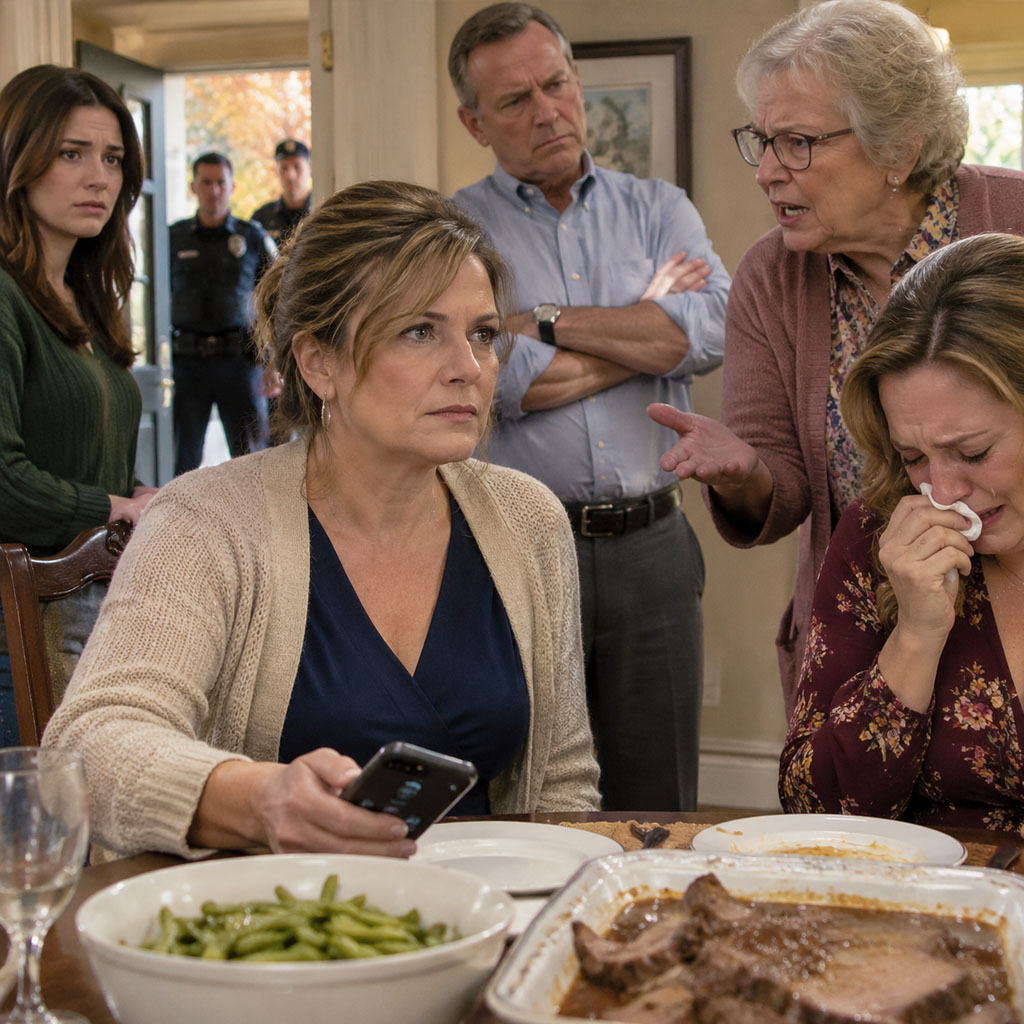
Julian looked toward the doorway, and his expression changed from delight to irritation. “What are you doing here?” he asked, still holding Corinne’s engagement ring. Roland remained seated on the couch with his coffee, while his wife, Alison, moved closer to Corinne as though I might attack her. My stepbrother Owen glanced up from his phone before returning to whatever he was watching. Nobody asked whether I was all right, and nobody seemed surprised that I had discovered a proposal involving the man who had kissed me goodbye that morning.
Alison spoke first, using the patient voice she reserved for people she considered unreasonable. “Mara, sweetheart, Julian and Corinne have developed something very special, and we hoped to discuss it with you privately after the celebration.” Julian rose, closing the ring box, and explained that his relationship with Corinne had grown naturally through their business projects. “You and I barely spend time together anymore,” he added. “Corinne actually understands the future I’m building.” I looked at him, remembering the nights I had rewritten his technical proposals while he and Corinne attended industry events together.
“So when did it start?” I asked. Julian hesitated, then said their feelings had been developing for almost a year. Corinne started crying before I could respond, insisting she had never intended to hurt me. Alison pulled her into an embrace, and Roland finally set down his coffee. “You have a promising career, Mara,” he said. “Corinne needs stability, and this marriage will strengthen the company. Surely you can be mature about that.” His expression suggested that my reaction was the final obstacle to a decision everyone else had already made.
I asked Roland who had written the orbital modeling framework behind Corinne’s award-winning aerospace presentation. He looked away, so I asked who had corrected the calculations in the proposal that brought Julian’s company its largest contract. “We all contributed,” he answered, although the original research existed under my name on my own computer. Corinne whispered that she had worked hard, too, and Julian accused me of deliberately ruining her moment. I understood then that they didn’t merely expect me to surrender my relationship; they expected me to continue making their success possible afterward.
I walked to the telescope and began removing the lights. Corinne protested that the decorations had taken hours, while Alison accused me of embarrassing everyone over an old piece of equipment. Roland said, “Your mother has been gone a long time, Mara. You can’t keep treating everything she owned like a sacred object.” I pulled the last strip of tape from the focusing ring and looked directly at him. “You don’t get to decide what she left me means.” Then I collapsed the tripod, lifted the telescope, and carried it upstairs.
My old room smelled faintly of cedar furniture polish, and the fern on the windowsill had died since my last visit. I packed my birth certificate, Social Security card, diplomas, and the small envelope containing my mother’s remaining photographs. While searching the bottom drawer, I found an old inventory sheet listing the notebooks Roland had collected after her funeral, most of which I’d never seen again. One entry caught my attention: Whitcomb observational archive, volumes one through four—transferred to R. Greer for safekeeping. I folded the sheet and slipped it into my bag.
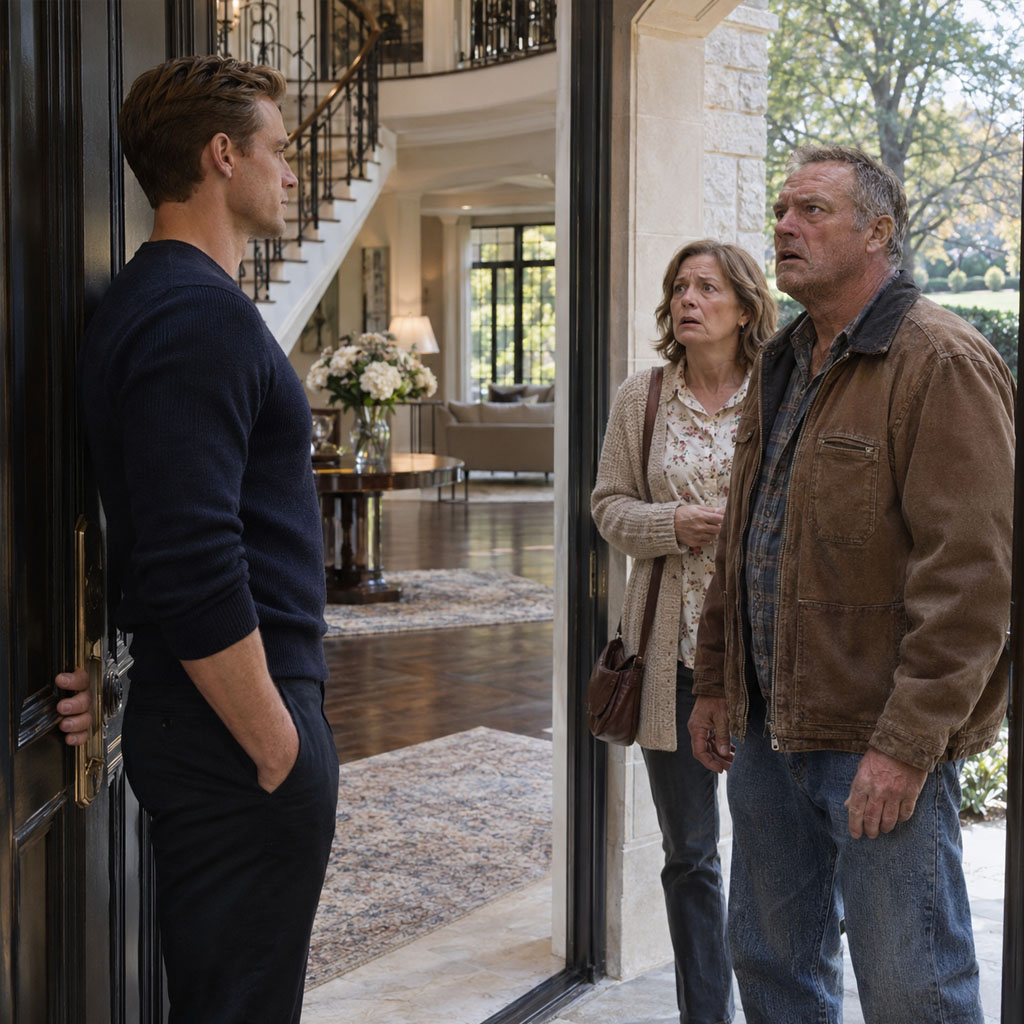
Downstairs, Julian stood with his arms crossed, blocking the front hallway. “Are you seriously leaving because you’re jealous?” he demanded. I moved around him and placed my house key on the console table. “I’m leaving because there is nothing here for me anymore,” I said. Roland warned that I would regret abandoning my family over a romantic disappointment, and Alison called after me that Corinne deserved an apology. I walked outside without giving either of them another word.
A dark government SUV waited at the curb, its driver checking identification beside an open rear door. I carefully placed the telescope on the floor and settled into the seat with my documents against my chest. As we pulled away, my phone filled with messages from Julian demanding that I return, apologize, and stop making his engagement difficult. I turned it off, but not before sending one final message: “Our relationship is over. Do not contact me again.” Two hours later, beneath the lights of a guarded airfield, Commander Elias Shaw introduced himself as the director of Project Farpoint.
He explained that the project was developing a new navigation system for an experimental deep-space mission and that my work on orbital uncertainty had brought me to their attention. When he noticed the telescope, his expression shifted slightly. “Whitcomb,” he repeated, studying the name printed on my identification. “Was your mother Ruth Whitcomb, the observational mathematician?” I nodded, surprised that he recognized someone Roland had always dismissed as an impractical academic. Elias looked toward the aircraft waiting behind us and said, “There’s a historical file at our facility you need to see.”
Part 2/5
The flight to Nevada lasted long enough for exhaustion to catch up with me. I sat beside the telescope, listening to the steady vibration of the engines while Commander Shaw reviewed a binder across the aisle. Nobody asked why I had brought such an impractical piece of luggage, and nobody commented when I quietly wiped the remaining adhesive from its metal barrel. Shortly after midnight, we landed at a secured research facility surrounded by mountains and desert. An American flag snapped above the entrance, illuminated by powerful floodlights, and beyond the security checkpoint stood a collection of low concrete buildings that would become my entire world for the foreseeable future.
My quarters contained a narrow bed, a desk, a bathroom, and a window overlooking the eastern mountains. After signing the final security agreements, I was informed that personal communications would be severely restricted during the assignment. I could arrange emergency contact through an authorized officer, but ordinary calls and messages were out of the question. I had already arranged for my apartment to be cleared, with most of my belongings transferred to storage. When the escorting officer left, I leaned my mother’s telescope against the wall, sat on the floor, and cried harder than I had at any point during the confrontation.
It wasn’t simply Julian’s betrayal that hurt. It was remembering every birthday dinner where Corinne received praise for work I had done, every scholarship payment Roland had persuaded me to contribute toward her career, and every occasion when I had been told that being intelligent meant I didn’t need emotional support. I remembered arriving home after defending my doctoral dissertation and finding the family celebrating Corinne’s first million online followers. Roland had congratulated me while answering an email, barely lifting his eyes from the screen. For years, I had mistaken their willingness to use my abilities for evidence that I belonged.
At eight the following morning, I entered the Project Farpoint computation center and met the team responsible for its navigation architecture. The mission was attempting to demonstrate unusually precise trajectory correction for a probe traveling through the outer solar system, where small errors could accumulate into enormous positional differences. A senior engineer named Sylvia Kent showed me the problem that had delayed their development schedule: their simulations became unstable under certain combinations of gravitational perturbations and navigation uncertainty. I studied the plots for nearly an hour before recognizing a mathematical weakness I’d encountered during my doctoral research. Unlike Julian, Sylvia didn’t ask me to make her look intelligent; she asked whether I could help her understand what was wrong.
For the next several weeks, we rebuilt sections of the numerical model, tested alternative integration methods, and challenged one another’s assumptions. The work was difficult enough that I forgot to eat lunch twice, which prompted Elias to establish a rule requiring everyone to leave the computation room for proper meals. He wasn’t especially warm, but he understood the mathematics well enough to question my conclusions without dismissing them. When our revised framework reduced the navigation error during a demanding simulated trajectory, he ordered an independent validation rather than announcing a miraculous breakthrough. “Good work isn’t enough,” he told the room. “It has to survive somebody trying to prove it’s wrong.”
One evening, after our first successful verification, Elias brought me into the historical records office. He placed a scanned report from 1995 on the table and pointed to the signature beneath a series of handwritten observations. My mother’s name appeared in the same angular handwriting I remembered from birthday cards and grocery lists. The report documented a calibration method she had developed for processing difficult observational measurements, and several of its assumptions resembled concepts I’d independently used in my recent work. I touched the edge of the page, startled by the sudden feeling that my mother had entered the room.
“She was exceptionally careful,” Elias said, showing me the comparison results compiled by the archive team. The government had retained copies of her observational work because it was useful for checking historical measurements, although her contribution had received little public attention. I asked whether the full collection existed, and he explained that the government possessed only selected technical reports. Most of her original notebooks had remained private property, and the archive contained correspondence showing that a relative had taken responsibility for preserving them after her death. The name on the correspondence was Roland Greer.
I stared at the signature, remembering the inventory sheet I’d discovered in my bedroom. Roland had always insisted that my mother’s notebooks were worthless academic clutter, yet he had repeatedly refused when I asked to see them. Elias noticed my expression and asked whether there was a problem. I explained only that some family records appeared inconsistent, leaving out the details of the engagement and my departure. He suggested that I speak with an attorney through the facility’s approved communications process. “Your family circumstances aren’t my business,” he said, “but ownership records are worth getting right.”
With his help, I arranged a confidential consultation with a Seattle attorney named Felicity Ward, who specialized in intellectual property and estate disputes. I authorized her to examine my mother’s probate records, as well as the ownership provisions of the research I had contributed to Roland’s company. The documents I had brought from home included old employment agreements, original correspondence, and enough identifying information for Felicity to begin. She warned me that family relationships did not automatically transfer intellectual property and that the language of individual agreements would matter. For the first time, someone asked what I had actually signed rather than what my family expected me to give away.
Three weeks later, Felicity sent an approved, nonclassified message through the facility’s legal office. Roland had registered a business asset transfer involving my mother’s observational archive, claiming that she had permanently assigned her unpublished research to a company he later folded into his aerospace venture. The transfer document carried what appeared to be her signature. Felicity had checked it against the original death certificate and the dates recorded in the county probate file. The alleged assignment had been executed nine months after my mother died.
Part 3/5
I read Felicity’s message twice before asking for the supporting documents. The signature looked convincing at first glance, but the letterhead belonged to a business Roland hadn’t incorporated until the following year. Felicity had also located an old email from my mother explicitly reserving ownership of her unpublished research for her estate. The evidence suggested something far more serious than a misplaced collection of notebooks. Roland had apparently used my mother’s name to transfer property she could no longer consent to surrender, and I had spent sixteen years believing he was doing me a favor by keeping it safe.
Felicity advised me not to confront him until she had completed the documentary review. I agreed, although I wanted to demand an explanation immediately. My mother’s research had been more than a professional achievement; it was almost everything she had left me. Knowing that Roland might have turned it into a business asset made the memories of his dismissive comments feel deliberate. I wondered how often he had called her work useless while relying on it to establish his company’s credibility. That question followed me into the laboratory, where I had to set it aside whenever the calculations demanded my full attention.
By the end of my third month at Farpoint, our team had produced a revised navigation framework that passed its independent validation campaign. Sylvia’s simulations confirmed that the improvements remained stable under the most difficult conditions in our approved test set. Elias assigned me responsibility for the mathematical verification of subsequent changes, but I continued sharing credit with the researchers who had completed the essential engineering work. At the official readiness review, he introduced me by my full name and listed my contributions without exaggeration. Hearing my work described accurately should have felt ordinary, yet I had to concentrate on the presentation screen to keep my eyes from filling.
Meanwhile, Julian and Corinne were enjoying what looked like the most successful period of their careers. I learned the details months later from their business records and witness statements, but the sequence was painfully familiar. Corinne had secured a sponsorship with Vanguard Launch Systems, a commercial aerospace company preparing an experimental suborbital vehicle. The proposed partnership included educational videos, promotional appearances, and a technical consulting agreement. Julian negotiated a contract worth nearly three million dollars, promising that Corinne’s team could provide sophisticated mathematical modeling for a portion of the vehicle’s guidance and reentry analysis.
There was one problem: Corinne couldn’t perform the work.
For years, she had presented my calculations as if they were hers, memorizing simplified explanations while avoiding the underlying mathematics. With me unavailable, she searched the technical archive on Julian’s company server and discovered a preliminary model I had written before joining Farpoint. It was an experimental study exploring the relationship between flight dynamics, thermal loads, and changes in atmospheric conditions during reentry. The document contained a clear warning that its calculations were incomplete and unsuitable for operational use. Corinne copied it anyway, removed the warning from the presentation version, and submitted the equations as her own original work.
Vanguard’s engineers initially admired the mathematical structure, but their validation tests exposed serious problems. Several crucial variables had been calibrated for conditions different from those expected during their proposed flight, and the model could not reliably predict the vehicle’s behavior across its intended operating range. Their chief engineer requested the original derivations, complete test records, and confirmation that the model had been developed for the specific vehicle. Corinne responded with polished charts that concealed the missing verification rather than addressing it. When the engineering team rejected the submission, Julian demanded more time and assured Vanguard executives that the discrepancies were minor.
He eventually learned what I had known for years: Corinne could repeat my explanations without understanding them. In an argument later documented by their company’s internal messaging system, she admitted that I had written nearly every technical script attributed to her. Julian demanded that she find another mathematician to complete the work, but the consultants they approached refused to certify a model without adequate testing. An outside professor specifically advised them to contact the original author. Instead, Julian authorized Corinne to submit additional calculations assembled from the unfinished files, accompanied by an assurance that the necessary validation had been completed.
That decision transformed an ugly family betrayal into something much more dangerous.
Vanguard’s technical management should have rejected the unsupported assurance, but commercial pressure and an approaching launch deadline influenced the decision to continue testing. The company accepted a provisional version of the model for further integration while requiring additional verification before flight. Julian’s team subsequently submitted a signed statement asserting that the remaining discrepancies had been resolved. When investigators later recovered the underlying correspondence, they discovered that no independent expert had approved that statement. Julian and Corinne had represented incomplete calculations as validated work, knowing that neither could adequately defend the mathematics.
During the same period, Felicity obtained another piece of evidence concerning my mother’s research. Roland’s company had used excerpts from her unpublished notebooks in investor presentations for years, claiming that the work belonged to the Greer family business. The alleged ownership transfer had helped him secure an early investment and had become part of the company’s promotional history. Worse, his corporate records described me as a technical assistant whose contributions were supposedly included in my ordinary family responsibilities. The description made me think of every night I had spent correcting their presentations without receiving a dollar.
Felicity asked whether I wanted to pursue the estate matter despite the disruption it might cause to my classified assignment. I told her to preserve every record and proceed through the appropriate legal channels. I wasn’t interested in punishing Roland for choosing Corinne over me, because no lawsuit could make him become the father I had needed. I wanted him prevented from selling my mother’s accomplishments or my own as though they were family possessions. That evening, I returned to my quarters and examined a faded photograph of my mother beside the telescope. For the first time, I wondered whether Roland’s insistence that I sacrifice everything for Corinne had always been connected to protecting his business.
Part 4/5
Six months after I arrived at Farpoint, the launch vehicle carrying our experimental probe stood on a coastal launchpad under a clear morning sky. Our team was monitoring the mission from Nevada, surrounded by rows of displays showing guidance, propulsion, communications, and environmental data. The flight plan had passed months of testing, including scenarios involving sensor failures and navigation uncertainty. I had spent the previous week reviewing a contingency procedure for a particular class of inertial measurement anomaly, although everyone hoped we would never need it. Elias sat at the mission director’s console, watching the final systems reports appear.
The countdown reached zero at 10:18 a.m., and the rocket climbed into the brilliant coastal sunlight. For the first several minutes, the flight proceeded exactly as predicted, with each stage reporting normal performance. Then a navigation engineer announced a disagreement between two independent attitude estimates. The automated guidance system began rejecting inconsistent measurements, and the uncertainty indicators on my screen rose sharply. I checked the telemetry against our contingency simulations and recognized the pattern associated with one of the sensor fault cases we’d investigated. The backup solution existed, but applying it required confirmation that the remaining measurement sources were reliable.
“Elias, recommend switching to the validated secondary navigation solution,” I said over the internal channel. He requested confirmation from guidance and flight safety, while Sylvia checked the independent measurements against the trajectory model. For several seconds, nobody spoke except the engineers reading their numbers. Once the required checks were complete, Elias authorized the procedure. The navigation system accepted the secondary solution, the uncertainty estimate returned within its approved limits, and the vehicle continued without exceeding its safety constraints. I finally released the pencil I’d been holding so tightly that its edges had left marks across my fingers.
Hours later, mission control confirmed that the probe had entered its intended departure trajectory. The control room erupted into exhausted applause, and Sylvia hugged me hard enough to knock my headset sideways. Elias shook my hand and thanked me for recognizing the anomaly without rushing the decision. He also made sure the guidance and safety teams received credit for their work. Later, when I stepped outside, the desert sky was turning purple beyond the mountains, and I felt something I hadn’t experienced since my mother’s death. I was no longer trying to earn a place at someone else’s table.
Eleven days after Farpoint’s successful departure, Vanguard Launch Systems attempted its experimental suborbital flight. The vehicle developed a serious guidance anomaly, and the flight safety system terminated the mission before it could threaten populated areas. Debris fell within the designated exclusion zone, and nobody was injured, but the loss was public, expensive, and impossible to explain away. Subsequent investigation identified multiple failures in the development and approval process, including the use of unverified modeling supplied by Julian’s company. The disputed calculations had influenced guidance-related test assumptions that should have been independently examined before the launch.
I heard about the accident when Sylvia showed me an industry report during lunch. Initially, the name Vanguard meant nothing to me beyond another commercial launch provider. Then I saw the technical consultancy listed in the article: Beckett-Greer Aerospace Media. My stomach tightened as I remembered the unfinished models on their server, along with Julian’s repeated demands for access to my calculations. I contacted Felicity through the facility’s legal office and asked her to determine whether any of my work had been included in Vanguard’s technical package. Her reply arrived the next afternoon.
“They used one of your files, Mara, and we have evidence of its origin.”
My original documents contained authorship metadata, dated development records, and digital signatures that Felicity could compare against the material recovered during the investigation. The code retained distinctive mathematical structure and comments that matched my archived drafts. Julian’s company had also received written restrictions more than a year earlier, stating that my independent research could not be submitted to clients without an appropriate agreement. Those notices had been acknowledged by the company email system. Now investigators were examining whether the technical consultancy had deliberately misrepresented the model’s ownership and validation status.
The consequences unfolded through formal procedures rather than the spectacular arrests Julian might have expected from a movie. Vanguard terminated the consulting agreement, demanded repayment of certain fees, and filed civil claims arising from the alleged contractual misrepresentations. Federal investigators reviewed statements submitted in connection with the launch, while attorneys examined possible fraud and intellectual property violations. The launch company’s own engineers and managers also faced difficult questions about why unresolved technical warnings had not stopped the flight. Responsibility for the accident would not rest on a single stolen equation, but Julian and Corinne’s false assurances had become an important part of the investigation.
Felicity forwarded me copies of relevant records cleared for my review. One email showed Corinne acknowledging that she did not understand the source model’s mathematical assumptions. Another showed Julian telling her that nobody would question the work once Vanguard’s engineers approved the presentation. The most disturbing document was a purported authorization letter stating that I had granted their company continuing commercial rights to my research. It carried a signature resembling mine, but I had never signed it. The same pattern appeared in the old documents involving my mother’s notebooks: ownership had been asserted through paperwork that seemed designed to silence the person who actually created the work.
Roland initially claimed he had assumed my permission was implied because I had always helped the family business. His position became harder to maintain when investigators discovered that the supposed authorization had been prepared after I left Seattle. Felicity also identified evidence that Roland had personally reviewed the earlier transfer documents concerning my mother’s archive. He could no longer plausibly claim that the disputed property arrangements had been handled by someone else. The company accounts became subject to preservation orders, several commercial partners suspended negotiations, and legal expenses began consuming the money the family had celebrated so publicly.
One afternoon, Elias called me into his office and handed me an envelope delivered through approved legal channels. It contained a notice requesting my testimony in the consolidated proceedings concerning intellectual property ownership and the representations made to Vanguard. I was authorized to discuss my independently developed research, but not the classified details of Farpoint’s navigation system. Felicity’s cover letter explained that Roland would also be questioned about the archive transfer after my mother’s death. Attached to the hearing materials was a copy of the document he had signed claiming that my mother’s estate had knowingly surrendered its research rights.
For sixteen years, Roland had told me that a grieving thirteen-year-old couldn’t possibly understand the paperwork he had handled on her behalf. Now I was going to ask him, under oath, how my mother had signed an agreement nine months after her funeral.
Part 5/5
The hearing took place in a federal courthouse in Seattle, with the civil claims and related investigative matters proceeding through separate legal channels. I arrived wearing a navy suit that I had purchased myself, carrying a slim folder containing my original research records and my mother’s probate documents. Elias accompanied me as an authorized project representative because the proceedings required strict boundaries around protected government information. When we entered the courtroom, I saw Julian seated beside his attorney, his face pale and his expensive suit hanging awkwardly from his shoulders. Corinne sat several feet away, no longer looking at him with the adoration she’d displayed during their proposal.
Roland was seated behind them, his hands clasped so tightly that his knuckles had turned white. Alison sat in the public gallery, staring at me with an expression that combined resentment and desperation. Owen was nowhere to be seen. I felt a brief, instinctive urge to smooth my clothes and avoid upsetting anyone, exactly as I had throughout my childhood. Then Felicity placed the original research records in front of me, and I remembered why I was there. I hadn’t come to convince my family that I deserved their respect.
My testimony began with the technical evidence. I explained when I had developed the disputed model, why the document was explicitly marked as unfinished, and what additional verification would have been necessary before anyone could responsibly consider it for an operational application. I described the relationship between the experimental equations and the commercial flight conditions, carefully distinguishing my preliminary research from the engineering decisions made by Vanguard. When the opposing attorney suggested that I should have anticipated someone might misuse the draft, I explained that an unfinished research file was not permission to certify it as safe. Several of the company’s recovered communications already demonstrated that Julian and Corinne had understood the warnings.
Felicity then introduced the original correspondence establishing restrictions on commercial use of my independent work. The records showed that Julian had opened the relevant notice and subsequently authorized the submission of technical material despite those limitations. Corinne’s messages confirmed that she had knowingly represented equations she couldn’t explain as her own. Neither had been forced to accept a multimillion-dollar contract, and neither had been prevented from telling Vanguard that the necessary expertise was unavailable. Their attempt to preserve the deal had created the paper trail now being examined. I watched Julian study the table instead of meeting my eyes.
The questions concerning my mother’s estate were even harder to hear. Roland admitted that he had taken possession of her notebooks after her death and incorporated portions of their contents into his business presentations. His attorney argued that he had believed his position as my guardian authorized him to manage the material, but that explanation did not establish a valid transfer of ownership. When confronted with the document bearing my mother’s purported signature, he insisted that an employee had assembled the paperwork from older records. Felicity presented the company’s archived correspondence showing that Roland had approved the transfer language himself.
“Mr. Greer,” she asked, “were you aware that Dr. Whitcomb had been deceased for nine months when this agreement was dated?”
Roland stared at the document before answering. “Yes.”
The admission didn’t erase years of deception, but it removed the last plausible misunderstanding about what had happened. The court proceedings established a basis for correcting the estate records and addressing the unauthorized commercial use of my mother’s material. Other claims would require additional hearings, and the investigation into the launch-related representations remained separate. I didn’t leave the courthouse with a magical verdict that solved everything at once. I left knowing that Roland could no longer depend on my silence to keep the history of his company intact.
Julian approached me in the corridor after the session ended. His arrogance had disappeared, replaced by an exhausted uncertainty that might once have made me feel responsible for him. “Mara, I know I handled things badly,” he said, looking toward Elias before returning his attention to me. “But Corinne and I aren’t together anymore, and I’ve been thinking about what we had.” I examined his expression, waiting for the familiar request that I help repair the situation. It came almost immediately when he added, “If you could explain the technical side to Vanguard’s attorneys, maybe we could straighten out some of this.”
“You have lawyers for that,” I replied. Julian stepped closer and said he had never stopped caring about me, but I no longer confused needing my abilities with loving me. I reminded him that he had chosen to propose to someone else while we were still together and had then blamed me for objecting. “I don’t want a relationship with you, Julian, and I won’t repair documents that were falsely presented as validated.” Elias remained nearby without interrupting, allowing me to say what I needed to say. Julian finally moved aside, looking smaller than the man who had once blocked my way out of Roland’s house.
The legal consequences continued over the following year. Julian and Corinne’s business partnership collapsed under contractual claims, disputed payments, and findings concerning their representations to Vanguard. Corinne eventually entered a guilty plea in a federal fraud case arising from false statements and deceptive submissions, while Julian faced separate criminal and civil proceedings connected to his management decisions. Roland’s estate-related actions led to further litigation and a financial settlement involving my mother’s archived research, along with corrections to the company’s ownership records. None of the outcomes depended on my becoming wealthy or powerful; they followed from records the three of them had created, signed, or deliberately ignored.
The settlement allowed my mother’s original notebooks to be recovered from storage and transferred to my possession. Four volumes arrived in carefully packed archival boxes, their covers worn and their pages filled with measurements recorded in her familiar handwriting. Among them, I discovered a letter she had written shortly before becoming ill, addressed to me when I was old enough to understand her work. She described how difficult research could be, how easily a valuable idea could be dismissed, and why accurate records mattered even when nobody was paying attention. Her final paragraph asked me never to confuse another person’s approval with the value of what I had accomplished.
I read the letter in my apartment, beside the telescope I had carried out of Roland’s house. For a long time, I sat without moving, listening to rain strike the window. I had spent years believing that if I became sufficiently useful, sufficiently patient, or sufficiently successful, Roland might finally treat me as his daughter. My mother’s words made that bargain feel terribly small. She hadn’t asked me to spend my life proving that I deserved a family.
I never reconciled with Roland, Alison, Corinne, or Julian. Their occasional letters reached Felicity’s office, where they remained unanswered unless they required a legal response. I didn’t attend Corinne’s later sentencing hearing, and I didn’t inquire whether Julian regretted losing me more than he regretted losing his company. Their lives were no longer mine to organize, finance, or rescue. By then, I had more meaningful responsibilities than monitoring the consequences of decisions I hadn’t made.
At Farpoint, the probe continued its journey through space, and I helped develop the navigation improvements required for its next major course correction. Elias and I remained trusted colleagues, sharing long technical discussions and the occasional late dinner when experiments ran beyond schedule. There was no sudden romance waiting to replace the relationship I had lost, and I was grateful for that. I had finally learned to enjoy a life without making another person its center.
On the anniversary of my mother’s birthday, I arranged for a local astronomy club to host an evening dedicated to her observational research. Her restored telescope stood beside a display of selected notebooks, with her name printed clearly beneath the photographs and calculations. After the presentation, a teenage girl asked whether someone like her could really become a mathematician working on space missions. I showed her how to adjust the focus, then let her look through the eyepiece at Jupiter.
“Absolutely,” I told her. “But keep your work, and make sure people know it’s yours.”
Later that night, I drove home beneath a sky crowded with stars. My apartment was quiet, my work was waiting for me, and my mother’s telescope rested safely in the back seat. I thought about the afternoon I had discovered Julian proposing to Corinne and the final words I had spoken before leaving that house. For the first time, I understood that I hadn’t abandoned a family that loved me. I had stopped allowing people who benefited from my sacrifices to determine the shape of my life.
I hadn’t needed their permission to leave, and I didn’t need their forgiveness to stay gone.
THE END!
Disclaimer: Our stories are inspired by real-life events but are carefully rewritten for entertainment. Any resemblance to actual people or situations is purely coincidental.