“She Carries That Drive Like It’s The Launch Codes,” The Captain Told The Room. 25 Officers Laughed. He Took It Out Of My Hand And Plugged It In. I Didn’t Reach For It. I Looked At The Clock. 14:07. The First Slide Loaded. Two Officers At The Back Stood Without A Word. The Captain Kept Grinning. “Tough Crowd.” “Captain, Do Not Click The Next Slide.”
Captain Adrian Kessler made twenty-five people laugh when he snatched a classified drive from my hand and plugged it into the conference room computer. I told him to stop, but he clicked anyway. Seconds later, every security-controlled door on our floor locked, and his smile vanished. I thought his reckless joke was the worst mistake we would uncover. Three days later, an archived maintenance request revealed that someone had deliberately preserved the very computer feature that made the disaster possible.
## Part 1: Eleven Seconds
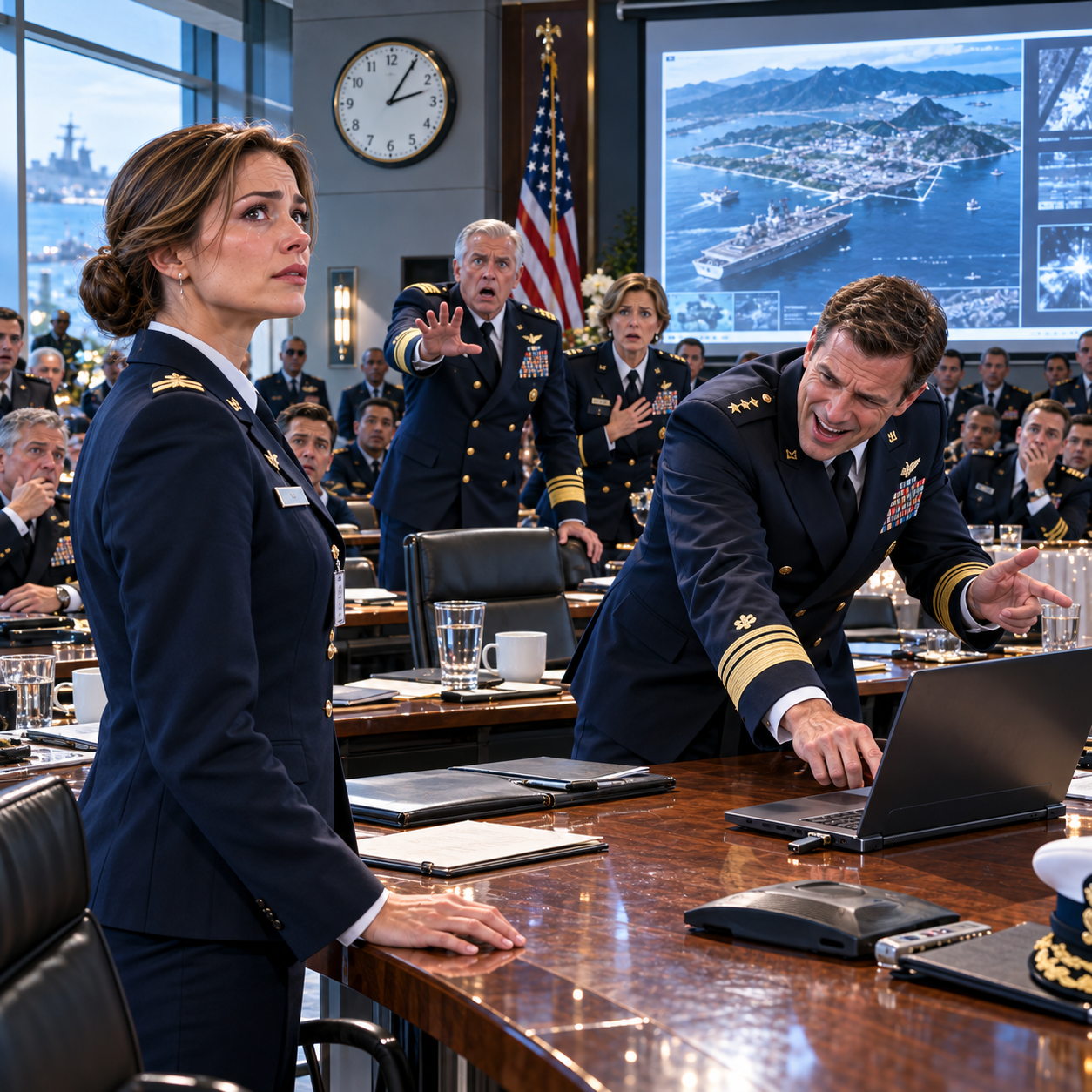
The first thing I noticed was the coffee spilling across the conference table. Captain Adrian Kessler had knocked over his paper cup while reaching for the mouse, and a dark stream was creeping toward Lieutenant Colonel Graham Bellamy’s briefing notes. Nobody moved to clean it up, because the wall display behind Adrian had just filled with a classified briefing that twenty-five people were never supposed to see. Four of them were civilian contractors without the required clearance, and the young captain who had been entertaining the room thirty seconds earlier was still smiling, although his face had gone completely pale.
“Captain, take your hand off that mouse,” I said. My voice was quiet enough that the projector fan remained audible, but Adrian stopped immediately. I reached behind the small conference computer, disconnected its power, and watched the display go black. Then I looked at my watch: 2:07 p.m. and nineteen seconds.
A series of heavy metallic clicks traveled down the second-floor corridor. Through the conference room’s glass wall, I watched the credential readers change from green to red as the security-controlled interior doors locked automatically. The building’s emergency exits remained available, but opening one would trigger an alarm and bring security personnel running. Someone outside tried an office handle twice, apparently believing the first attempt had been a mistake.
“What the hell just happened?” Major Curtis Vale asked.
“We’ve had a classified information exposure,” I answered. “Everyone will remain here until security personnel account for what was displayed and who saw it. Place your phones on the table, and don’t touch the computer.”
Adrian finally took his hand away from the mouse. “Mara, I was joking,” he whispered, using my first name for the first time since I had arrived at the wing.
“I understand that, Captain,” I said. “It doesn’t change what happened.”
My name is Mara Voss, and I was fifty-one years old that May. After twenty-four years in the Air Force, most of them working in intelligence analysis, I had retired as a chief master sergeant and accepted a civilian position as the wing’s special security officer outside San Antonio, Texas. I was responsible for making sure sensitive information reached authorized people without crossing into places where it didn’t belong. It was work that rarely earned anyone a compliment, but one careless shortcut could destroy years of careful effort.
The younger officers called me “the walking padlock.” Adrian had invented the nickname during my second week, after watching me refuse to leave a secured courier pouch unattended while I retrieved a forgotten notebook. He was thirty-two, handsome, articulate, and unusually good at making exhausted people laugh during long meetings. I had seen him calm angry supervisors, organize complicated flight schedules, and remember details about junior airmen that their own commanders overlooked.
Unfortunately, Adrian also believed that a rule became optional when everyone trusted the person breaking it.
Our wing occupied a building divided into two separate working environments. The second floor contained ordinary administrative offices, a conference room, and computers connected to an unclassified network. Behind a secured door at the end of the corridor was a controlled intelligence area where classified material could be accessed under specific procedures. The separation was supposed to be absolute, and I had spent my first three weeks explaining why.
On Tuesday morning, I collected a sealed intelligence briefing from a headquarters facility across town. The drive was documented, protected inside a secured pouch, and intended for an afternoon meeting inside the controlled area. Bellamy was authorized to receive it, but when I reached his conference room, the staff meeting was running late.
He spotted me through the glass and waved me inside.
“Chief, perfect timing,” he said. “Hand me the drive now, and we’ll go straight into the secure room when this wraps up.”
I should have waited outside. Instead, concerned about delaying a lieutenant colonel who already had a crowded schedule, I opened the pouch and removed the sealed device. That small decision was mine, and nothing Adrian did afterward would erase it.
As I approached Bellamy’s chair, Adrian reached up and plucked the drive from my fingers.
“Everybody, we’re witnessing history,” he announced. “Chief Voss has finally released her precious cargo.”
Laughter erupted around the table.
“Captain, give that back,” I said.
He held it above his head. “Relax, Chief. I’m just checking whether it’s actually made of gold.”
Then, before I could move around the corner of the table, he leaned toward the conference computer and inserted it into an available USB port.
The machine automatically opened a folder window.
Adrian clicked the single presentation file.
That was when the room stopped laughing.
The displayed classification markings were unmistakable. Two experienced intelligence personnel stood up without speaking, and Bellamy pushed his chair backward so abruptly that it struck the wall. Adrian turned toward the screen, his expression wavering between confusion and a stubborn determination not to look embarrassed.
“Well,” he said weakly, “that’s certainly more interesting than our calendar.”
His finger moved toward the mouse again.
I ordered him to stop, disconnected the computer, and watched the lockdown activate.
At 2:09, my deputy, Technical Sergeant Tessa Ibarra, called the conference room telephone. She confirmed that the network security team had isolated the workstation, that security forces were securing the corridor, and that no one would leave until the preliminary exposure review was completed.
I glanced toward the dead screen.
The first slide had contained little beyond a title and classification markings. The second slide, however, carried information I had reviewed only inside an approved facility before collecting the sealed briefing.
If Adrian had clicked one more time, the consequences could have reached far beyond the twenty-five people trapped in that room.
And the most frightening part was that he still didn’t understand what I had prevented.
## Part 2: The Room Turns Against Me
By three o’clock, the conference room smelled of old coffee, warm electronics, and the sandwiches somebody had brought for a lunch that was now several hours overdue. Security personnel had secured the affected equipment, and the preliminary interviews were beginning. The people who had laughed at Adrian’s performance were now checking the clock, whispering about missed appointments, and occasionally looking at me as though I had personally arranged their imprisonment.
“This is ridiculous,” a young lieutenant muttered. “It was one slide.”
I heard her clearly, but I continued writing the exposure timeline.
At 3:25, one of the contractors approached me. His name was Emmett Harrow, a broad-shouldered software technician with tired eyes and a wedding ring he kept twisting around his finger. He explained that his twelve-year-old daughter had a piano recital at five, and he had promised to bring her flowers.
“She picked the music herself,” he told me. “She’s been practicing every night since February.”
I wanted to let him leave more than I wanted anything else that afternoon. Instead, I explained that security personnel needed to finish establishing whether anyone had unintentionally retained protected information on an electronic device.
He looked past me toward the parking lot.
“I didn’t even read the thing,” he said. “There was a colored stripe, and then the screen went black.”
“Then that’s exactly what your statement will say.”
He nodded without thanking me.
Bellamy came over after Emmett returned to his chair. His expression had changed from shock to the exhausted look of a man considering a decision he could no longer undo.
“I asked you to bring it inside,” he said quietly.
“You asked me to hand it over, sir. I chose to open the pouch.”
“I’m the director of operations.”
“And I’m responsible for the material.”
He stared at me for several seconds before looking toward Adrian, who had barely moved since the lockdown.
“Is this going to end his career?”
“I don’t know,” I answered. “That depends on what the review establishes.”
Bellamy lowered his voice further. “He didn’t mean any harm.”
“That matters when we decide what to do about him. It doesn’t change what he exposed.”
For the next two hours, Tessa and I interviewed every person who had been present. Some remembered the classification banner, some remembered the title, and others remembered nothing beyond Adrian’s hand moving toward the computer. Nobody reported taking photographs, and the technical review had found no evidence of additional files being opened.
At 5:48, after the necessary controls were in place, the final personnel were cleared to leave.
Adrian remained seated.
When I approached him with his statement, he looked directly at me.
“You let me do it,” he said.
“Captain?”
“You stood there while I plugged it in. You could’ve grabbed the drive, knocked my hand away, done something.”
“I told you to return it.”
“But you didn’t stop me.”
His voice grew louder, carrying through the nearly empty room.
“You spend every day making everybody miserable about regulations, and then when something actually happens, you just watch. Is that what this was? You wanted to prove a point?”
I felt Bellamy shift behind me, but I raised one hand to stop him.
“Once the file was opened, grabbing the drive wouldn’t undo the exposure,” I said. “My responsibility was to stop additional information from appearing and document exactly what happened.”
Adrian pushed the unsigned statement toward me.
“Congratulations, Chief. You got your lesson.”
I left the paper where it was.
At 7:10 that evening, Tessa entered my office carrying two terrible cups of vending-machine coffee. She placed one beside a stack of twenty-five signed forms and told me the affected computer had been moved into secure custody.
“There’s something else,” she said.
She opened a preliminary maintenance record from the network support team. The conference room computer had been configured to display removable-media contents automatically, despite a recent recommendation that the feature be disabled. A systems engineer had submitted the recommendation after noticing that the setting could expose sensitive information if someone connected an inappropriate device.
“Why wasn’t it changed?” I asked.
“Operations requested that it stay active.”
I frowned. “Who authorized the exception?”
“We’re retrieving the approval.”
I studied the report. The risky setting was not a secret, but I had assumed the technicians had already completed the protective changes identified during the last inspection. I had been too occupied with the controlled intelligence area to personally verify that the ordinary conference computers had been updated.
That assumption had just become another uncomfortable fact.
At 8:15, the network team transmitted an archived copy of the approval request. It was dated six weeks before I joined the wing, and its justification was only two sentences long: automatic document previews were necessary for efficient staff presentations, and additional confirmation steps caused unnecessary delays.
Beneath the explanation was an electronic approval.
Captain Adrian Kessler.
I stared at the signature, remembering his furious accusation that I had stood still because I wanted to teach him a lesson. He had personally preserved the feature that allowed his joke to become an exposure, and he hadn’t mentioned the approval during his interview.
Then Tessa pointed to a second attachment.
The technician’s original warning had not merely described a possible inconvenience. It documented an earlier incident involving an unauthorized removable device in the same conference room.
That incident had never appeared in the security records I received when I took the job.
## Part 3: The Mistake I Couldn’t Leave Out
The earlier incident had occurred in January, during a routine software demonstration. A contractor had connected a maintenance drive to the conference computer, expecting to display an installation guide, but the automatic preview had opened a folder containing unrelated internal files. Nothing classified had appeared, and the meeting continued after the contractor closed the window. Nevertheless, the network technician who reviewed the event recognized the vulnerability and recommended disabling automatic previews across the administrative floor.
Adrian rejected that recommendation after two operations officers complained about the additional steps required to display presentations.
There was nothing mysterious about the decision. He had made the same mistake that hundreds of people in comfortable offices make every day: he had treated a warning about something that might happen as less important than an inconvenience already happening. What troubled me was that the January incident had never reached the security office.
At 9:30, Bellamy called to ask whether I needed anything before he went home.
“I found the January maintenance report,” I told him.
He was silent.
“Did you know about it?”
“Adrian mentioned a problem with the presentation computer. I thought the technicians had fixed it.”
“They recommended a correction. He rejected it.”
Another silence followed.
“Chief, I approved the conference room procedures,” Bellamy finally said. “I should have asked what he rejected.”
After we hung up, I opened my incident report and began constructing the timeline. I recorded Adrian’s actions, the automatic preview, the duration of the exposure, and the response of the network security team. Then I reached the section labeled Contributing Factors and sat looking at the empty space.
There was one sentence I could leave out, and the entire report would still read like a convincing account of Captain Kessler’s irresponsibility.
I knew that because somebody had once written exactly that kind of report about me.
In 2008, I was twenty-seven and stationed at an intelligence unit in Nebraska. I had recently returned from a deployment and was working long shifts processing material that demanded concentration even when everyone in the room was exhausted. My section commander, Captain Silas Rourke, was well liked, technically capable, and always in a hurry.
One afternoon, I left my classified workstation unlocked while I went to retrieve coffee from the break room.
That was my mistake.
While I was gone, Rourke sat down at my terminal because his own computer had stopped responding. He attempted to transmit a briefing through an approved channel but selected an incorrect destination, creating an unauthorized disclosure from my account. By the time anyone discovered it, the electronic records showed my credentials, my workstation, and my duty shift.
Rourke knew exactly what had happened.
When the investigators questioned him, he said he could not remember whether he had used my computer that afternoon.
My clearance was suspended.
For fourteen months, I performed administrative duties outside the secure work area while colleagues who once trusted me with their lives avoided sitting beside me at lunch. I missed a career opportunity, postponed a professional certification, and spent nearly every evening wondering whether anyone would believe me. My marriage, already strained by deployments, ended during that period, although I would never claim the investigation was its only cause.
My supervisor, Master Sergeant Leda Morrow, refused to accept the investigation’s assumptions.
She searched old maintenance records, challenged inconsistencies in the access logs, and eventually located a technician’s statement confirming that Rourke had borrowed my workstation. The inspector general’s office ultimately determined that another individual had caused the disclosure during my unlocked session. My clearance was restored, and the findings stated that no further disciplinary action was warranted against me for the transmission itself.
Rourke never apologized.
By then, he had transferred to another installation, and the final report described his conduct without examining why he had allowed someone else to shoulder the consequences for more than a year.
I eventually stopped expecting an explanation.
But I never forgot what an incomplete account could do to the person whose name appeared at the top.
Sitting in my Texas office eighteen years later, I typed the sentence I had been avoiding.
“The responsible custodian removed classified media from its sealed protection inside an unclassified conference room, contrary to established courier procedures.”
I read it twice, then continued.
“Had the material remained sealed until its arrival inside the authorized facility, Captain Kessler would not have had access to the device, and this exposure would not have occurred.”
I identified Bellamy’s request and the uncorrected workstation vulnerability as additional contributing factors. I attached the January maintenance warning and Adrian’s rejection of the recommended change. I also requested an independent review of whether the earlier near miss should have been formally reported.
For Adrian, I recommended a formal security incident finding, temporary suspension of access, and comprehensive retraining. I did not recommend ending his commission, because his conduct, however reckless, had not been deliberate disclosure, and he had obeyed my order before advancing the presentation. Those distinctions mattered.
I included my own procedural violation without asking for special treatment.
At 11:41 p.m., I sent the finished report to Colonel Celia Whitford, our wing commander.
The next morning, I received a request to appear in her office.
She had read the report and wanted to discuss the classified material that had nearly appeared on the conference screen. When I arrived, she closed her office door and asked whether the second slide contained identifying information about a person supporting an ongoing intelligence operation.
“Yes, ma’am,” I said.
“Could disclosure have endangered that person?”
“Potentially, yes.”
She looked down at the report.
Then she said, “Chief, I’m reviewing whether our own command created the conditions for this incident long before Captain Kessler touched that drive.”
It was the first time anyone had described the problem as something larger than one officer’s terrible joke.
## Part 4: What Was Waiting on the Next Slide
On Friday morning, I entered the conference room at 9:45 and found a different atmosphere from the one I remembered. Nobody was joking, nobody had brought coffee near the computer, and several people were quietly studying the security procedures posted beside the door. The workstation had been replaced, its removable-media preview feature disabled, and a new warning label covered the front USB ports. Even Adrian’s usual chair remained empty.
He arrived just before ten wearing his service dress uniform.
Instead of taking his customary seat beside Bellamy, he sat at the far end of the table beneath the air-conditioning vent. He looked older than he had on Tuesday, although I suspected what I was seeing was simply a man who had gone several nights without much sleep. When our eyes briefly met, he looked away.
Colonel Whitford entered with a thick folder and immediately began reading.
She reviewed the sequence of events without embellishment. My decision to remove the drive from its pouch, Bellamy’s request, Adrian’s unauthorized actions, and the network security response were all presented with the same measured attention. When she reached the eleven-second exposure window, she set the report down.
“Several people have described this as an excessive reaction to a single slide,” she said.
Nobody answered.
“What appeared on the screen was not the full briefing. The next page contained identifying information concerning a human source supporting national security work.”
I heard someone shift sharply in a chair.
“I am not sharing that identity with this room, and I don’t expect anyone to ask,” she continued. “But if the captain had advanced the presentation, information that could endanger a person might have appeared before an audience without authorization to receive it.”
Adrian’s hands tightened together.
“The risk was not theoretical merely because the worst outcome did not occur,” Whitford said. “An individual might have needed emergency protection or relocation because someone wanted to entertain his colleagues.”
She turned to the maintenance findings.
Six weeks before my arrival, the network support team had formally warned operations about the conference computer’s automatic preview configuration. Their recommendation was rejected because staff members preferred the convenience of opening presentation files without extra steps. Adrian had approved the exception, and Bellamy’s office had allowed it to remain in effect.
“Captain Kessler made a reckless decision on Tuesday,” Whitford said. “But the organization also accepted a preventable vulnerability because correcting it was inconvenient.”
Bellamy spoke before she invited questions.
“Ma’am, I bear responsibility for that.”
“Yes, Colonel. You do.”
The answer was so plain that several people looked up.
Whitford continued reading. She included the January near miss, the absence of proper escalation, and the failure to independently verify that the workstation’s configuration met security requirements. Then she reached the section describing my decision to break the seal.
I kept my eyes on the folder in my lap while she read my statement aloud.
“Chief Voss identified her own procedural violation,” Whitford said. “She also documented how that violation made the incident possible.”
Nobody looked at Adrian now.
They were looking at me.
I wished they wouldn’t.
Whitford explained that my conduct would receive a formal administrative review and documented corrective counseling. I would also be responsible for implementing revised courier verification procedures, with an independent security officer reviewing the changes. I accepted the decision, because the fact that I had stopped a worse incident did not excuse the mistake that helped create it.
Adrian received a ninety-day suspension of classified access, mandatory security retraining, and a formal finding in his personnel record. His future assignments would depend on successful completion of those requirements and the commander’s assessment of his judgment. Bellamy received documented corrective action for the oversight failures in his directorate, while an independent team would examine previous exceptions and establish a mandatory process for reporting near misses.
Nobody was dismissed that morning.
Nobody received a medal.
I considered that a better outcome than either extreme.
As the meeting ended, Whitford asked Adrian to remain.
I gathered my papers and headed toward the exit, but she stopped me.
“Chief Voss, you too.”
When the room was empty, Adrian stood beside his chair. Whitford told him the most serious part of the incident was not that he had acted impulsively, but that he had initially blamed the person who prevented the damage from becoming greater.
“Did Chief Voss make a mistake?” she asked.
“Yes, ma’am.”
“Did her mistake force you to take the drive?”
“No, ma’am.”
“Did it force you to insert it into an unauthorized computer?”
“No.”
“Then I expect you to stop treating her mistake as an explanation for yours.”
He swallowed.
“Understood, ma’am.”
After Whitford dismissed us, Adrian caught up with me beside the elevators.
“I blamed you because I was scared,” he said. “I kept thinking about what that report would do to my career, and I wanted somebody else to have caused it.”
I didn’t offer him comfort.
“You were responsible for your actions, Captain. I was responsible for mine.”
“I know that now.”
“Knowing it is different from acting on it.”
He nodded and walked away.
That evening, Bellamy met me near the parking lot. He handed me his courier authorization card and requested a temporary removal from the distribution roster until he had completed the revised procedures himself. I told him his written acknowledgment and the commander’s corrective action mattered more than any symbolic gesture, but I accepted the card and initiated the necessary paperwork.
Before leaving, he mentioned that Emmett Harrow had missed his daughter’s piano recital. The contractor had finally received clearance to leave late Tuesday evening and had watched the recording alone in his truck. I thought about the flowers he never delivered, and about the other ordinary costs spread across everyone in that room.
On Monday morning, Adrian appeared in my office without his usual coffee.
“Chief,” he said, standing beside Tessa’s desk. “The colonel told me to find meaningful work while my access is suspended.”
“That’s between you and your commander.”
“I asked her if I could spend those ninety days helping your office.”
Tessa stopped typing.
I looked at the man who had called my procedures ridiculous, then blamed me for failing to save him from his own decisions.
“Why would you want to work here?”
Adrian lowered his eyes toward the secured courier pouch on my desk.
“Because I want to understand why you were the only person in that room who knew what to do.”
## Part 5: The Person Who Stops the Next Click
I let Adrian work in our office, but I made it clear that the arrangement was not a reward for apologizing. He would perform unclassified administrative duties under supervision, begin with the tasks nobody enjoyed, and follow the same procedures as everyone else. If he expected a ceremonial assignment designed to restore his reputation, he had misunderstood what I was offering.
His first job was to inventory every approved storage container in the building and reconcile two years of access records. By the end of his first week, he had discovered three outdated authorization lists and a storage cabinet whose access documentation had not been updated after an employee transferred. He reported each problem without blaming the people who had inherited it. Tessa told me she had never seen a captain spend so many hours checking records without asking whether there was a faster way.
During his third week, Adrian accompanied me on a routine inspection of the administrative offices. We found a young lieutenant preparing to connect her personal phone to a government workstation because the electrical outlet behind her desk had stopped working. Adrian asked her to pause before she connected the cable.
She turned toward him, embarrassed.
“Is something wrong, sir?”
“Not yet,” he answered. “Let’s keep it that way.”
He explained the device restrictions, helped her locate an approved charging station, and documented the encounter as a near miss in accordance with the revised procedures. He did not threaten her career or deliver a speech about responsibility. When he handed me the report, I noticed that he had included his own previous incident as an example in the accompanying training notes.
“You didn’t have to put that in there,” I said.
“Leaving it out would make the lesson less useful.”
For the first time, I believed he understood.
A month later, he asked whether I would teach him how to handle a secured courier pouch properly. We practiced in an empty hallway after most employees had gone home. I showed him how to check the documentation, protect the seals, verify authorized recipients, and refuse requests that would compromise the established transfer process.
“Even if the request comes from a colonel?” he asked.
“Especially if it comes from someone you don’t want to disappoint.”
Adrian adjusted the strap across his shoulder.
“I used to think people followed every procedure because they couldn’t make decisions for themselves.”
“Sometimes following a procedure is the decision,” I said. “It means recognizing that your convenience isn’t more important than somebody else’s safety.”
He walked the hallway carrying an empty pouch while Tessa observed from her desk. When he returned, he checked the closure without being reminded. It was a small improvement, but most of the work that prevents disasters consists of small improvements repeated until they become habits.
Around that time, I searched for Silas Rourke online.
He had retired as a lieutenant colonel and was living in Colorado. His professional biography listed distinguished assignments, leadership awards, and photographs from military reunions. There was nothing about the young sergeant who had spent fourteen months outside a secure facility because he had been unwilling to tell investigators the truth.
I drafted a message demanding that he acknowledge what he had done.
Then I deleted it.
I wasn’t forgiving him. I had simply decided that I would not spend another eighteen years waiting for his conscience to provide something it had already refused to give me.
Instead, I called Leda Morrow.
She had retired to a small town outside Birmingham, Alabama, and answered with a television playing loudly in the background. When she recognized my voice, she accused me of calling only because something had gone terribly wrong.
“Something did,” I told her. “But this time I wrote everything down.”
I explained the meeting, the drive, my own mistake, and the captain who had taken responsibility after first trying to escape it. Leda listened without interrupting, just as she had listened when I was twenty-seven and thought my career was finished.
When I finished, she said, “You finally learned the difference between protecting a person and protecting them from consequences.”
I thought about that sentence for several days.
In June, Emmett invited me to his daughter’s next piano recital. I attended without announcing myself beforehand and sat near the back of a crowded church hall while children waited nervously beside their parents. His daughter, Juniper, played a difficult piece, missed one note, and continued without stopping.
Afterward, Emmett introduced me to her.
“You’re the lady from Dad’s work,” she said.
“That’s right.”
“He said something important happened, and he couldn’t leave.”
I nodded.
“He was upset about missing your first recital.”
She looked toward her father, who was holding a small bouquet of flowers.
“He watched the video four times,” she told me.
There was nothing I could say that would give him back the evening he had missed. But watching him hand Juniper the flowers afterward reminded me why accuracy mattered even when the consequences seemed small. Every name in a security report belonged to a person with responsibilities, relationships, and moments that could not be repeated.
By August, Adrian’s ninety-day suspension was ending. The review had confirmed that the classified exposure was limited to the first slide, with no evidence of additional disclosure, and the independent technical audit had corrected the unsafe workstation configurations. The previous near miss was formally documented, and the wing adopted mandatory review of security-related configuration exceptions.
Adrian’s final requirement was to deliver a briefing to the officers who had witnessed the incident.
He stood beside the same conference table where he had taken the drive from my hand. The new computer displayed a photograph of a sealed courier pouch, and the audience listened as he explained the decisions that had produced the lockdown.
“I used to think being trusted meant I didn’t need somebody checking my judgment,” he said. “I understand now that being trusted means accepting those checks, especially when I’m certain I’m right.”
He described his rejected maintenance recommendation, his impulsive actions, and the warning I had given him before he could open the second slide. He did not make excuses, and he did not turn my role into a heroic story that concealed my own mistake.
Then a lieutenant asked what she should do if she saw a senior officer mishandling protected material.
Adrian looked toward me before answering.
“Tell them to stop,” he said. “Be clear, be professional, and don’t assume someone with more authority understands the risk better than you do.”
When the meeting ended, Colonel Whitford confirmed that Adrian’s access could be restored under the conditions of the completed review. His record would still reflect the incident, and he would have to earn back the confidence he had lost. He accepted both facts without argument.
I was gathering my notes when he approached carrying a properly sealed courier pouch.
“First assignment back,” he said. “Headquarters delivery.”
“Documentation checked?”
“Twice.”
“Recipient verified?”
“Yes, Chief.”
“And if somebody asks you to open it in a hallway?”
“They can wait until we reach the authorized room.”
I examined the pouch and handed it back.
For a moment, we stood beside the table where twenty-five people had once laughed at my caution. Adrian adjusted the strap across his shoulder, then gave me the same small salute he had used to mock me during my first week.
This time, there was no audience waiting for a joke.
“Drive secured, Chief,” he said.
“Drive secured, Captain.”
I watched him leave, keeping one hand against the closed pouch as he walked toward the elevator.
I had spent years believing that the worst thing someone could do was leave me responsible for a mistake that wasn’t entirely mine. What happened that spring taught me something more difficult: the truth does not become less important when it includes our own failures. Adrian was responsible for taking the drive, but I was responsible for making it accessible, and our command was responsible for ignoring warnings that might have prevented the incident altogether.
None of us could change those eleven seconds.
We could only decide what to do with them.
When I returned to my office, I found the final incident report filed beside the revised security procedures. My own statement remained in the record, exactly where I had put it, and I had no intention of removing it. For the first time in eighteen years, I could think about the captain in Nebraska without wishing I had said something different.
Someone had once allowed an incomplete report to define fourteen months of my life. I had been given an opportunity to do the same thing to another officer, and I had refused.
That was enough.
I closed the file, checked the lock on the cabinet, and switched off the light before leaving.
THE END!
Disclaimer: Our stories are inspired by real-life events but are carefully rewritten for entertainment. Any resemblance to actual people or situations is purely coincidental.