### Part 2: The Investigator’s Ninth Page Reveals Who Really Betrayed Our Family
Melissa reached for the folder, but Raymond snatched it away. “I said we’re finished.” His voice cracked. Melissa, forty-six and every bit as stubborn as her father, held out her hand until he surrendered it. As she opened the report, a business card slipped into her mashed potatoes. She wiped it clean, read the name Hank Yoder, and dialed the number printed beneath it.
A gravelly voice answered. Melissa placed her phone beside the ham and explained what her father had done. “Mr. Yoder, what is on page nine?”
The investigator fell silent. Then he asked whether Raymond was listening.
“I specifically warned him to read that page before showing anyone the report,” Hank said. “Your sister-in-law has been visiting Charles Dalton at Pine Hollow Care Home in Coeur d’Alene. Charles is seventy-seven, born in Spokane, and spent decades working in Alaska. I verified his identity through public records. He’s your father’s younger brother.”
A spoon struck the floor.
Eileen turned toward her husband. “Raymond, you told me Charlie died.”
Raymond pointed at me. “She went digging through private medical files!”
“He approached me at my counter,” I answered. “He introduced himself. You can ask his caregiver.”
“He told me he was dead to this family!”
“No, Raymond. You told this family he was dead.”
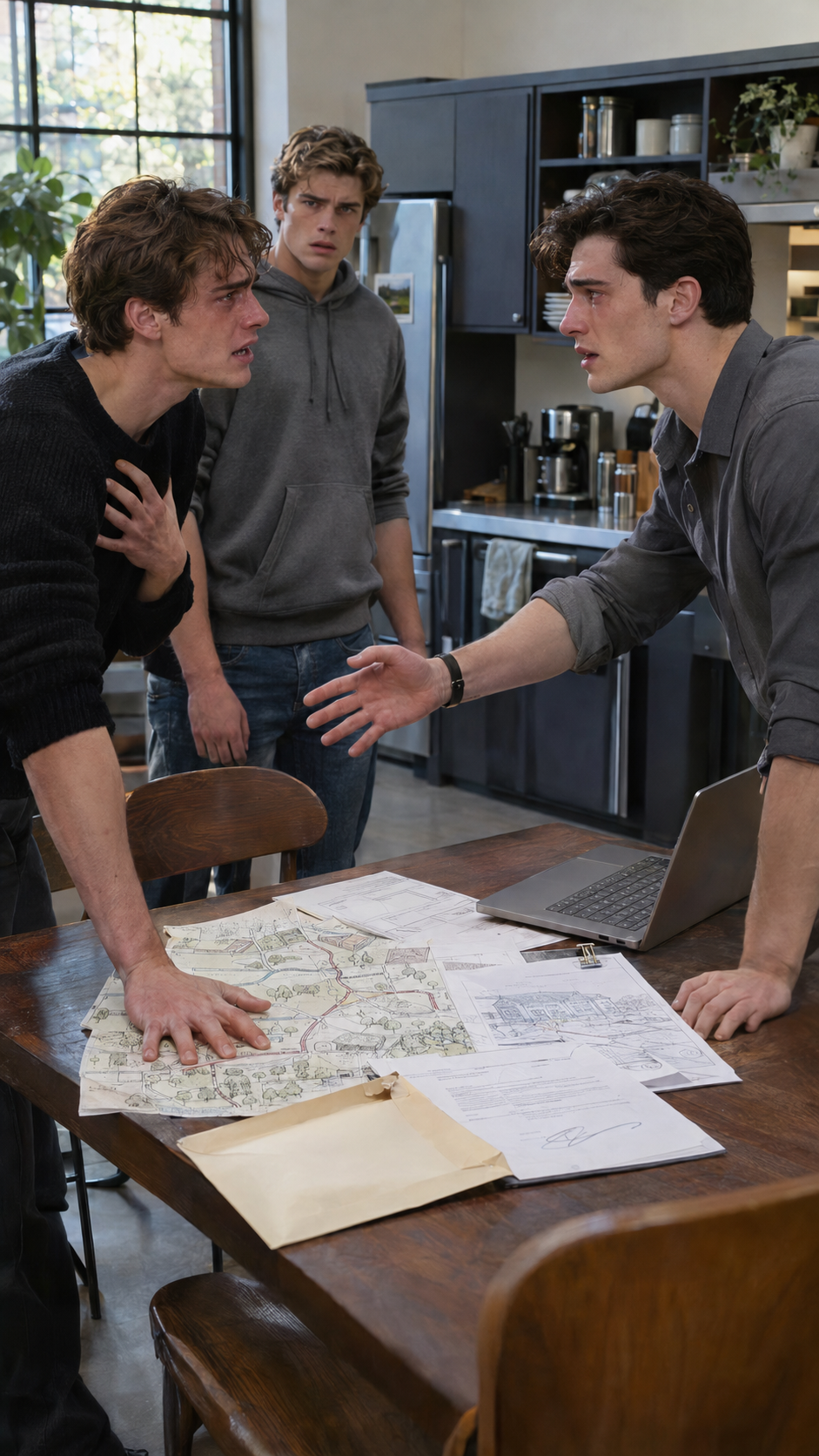
Aaron covered my hand with his. “I’ve met Uncle Charlie, Dad. He recognized me immediately.” His voice hardened. “You hired someone to follow my wife, accused her in front of twenty-six people, and never once asked me whether I trusted her.”
Raymond tried to draw Aaron into the den for a private conversation. Aaron shook his head. “You chose an audience. Now you can answer to it.”
Then Eileen spoke. She had believed Raymond’s story for forty-four years. She had mourned Charlie, watched her husband grieve, and never questioned the absence of a funeral. “Were you grieving your brother,” she asked, “or hiding something you did to him?”
Raymond stared at the tablecloth. Finally, he walked into the den and closed the door.
Christmas dinner collapsed into whispers and half-wrapped leftovers. Conrad, Melissa’s husband, took the children outside to play in the snow. Melissa embraced me, apologizing for years of dismissing Raymond’s cruelty as harmless stubbornness. Eileen remained seated, twisting her wedding ring.
“Is Charlie still kind?” she asked.
“He remembers your yellow dress from your engagement party,” I said. “And he remembers making you laugh.”
Eileen began crying. “I want to see him.”
The following morning, I drove her to Pine Hollow with a tin of homemade date bars on the back seat. Charlie had combed his hair carefully and worn his best navy sweater. When Eileen entered the dayroom, he smiled.
“Eileen Hartley,” he said. “Have you still got that laugh?”
She crossed the room and wrapped her arms around him. Charlie patted her back with his good hand. I quietly walked away to make coffee, giving them the reunion Raymond had stolen from them.
On our drive home, Eileen admitted Charlie had mentioned an old dispute involving the family orchard. She wouldn’t reveal the details because Charlie wanted Raymond to read his letter first. But she repeated one sentence that stayed with me.
“He said losing the orchard wasn’t the worst part. Being told he was dead was.”
On New Year’s Eve, Charlie finished his eleven-page letter. His handwriting trembled across the final signature. He asked me to deliver it personally rather than risk another returned envelope.
On New Year’s Day, I found Raymond alone in his den. He accepted the letter without looking at me. As I reached the door, he spoke.
“Katie?”
It was the first time in twelve years he had used my name.
“What does my brother look like?”
“Like you,” I answered. “And like your son.”
I thought that letter might finally heal the family.
Then, on January 4, Hank Yoder called me before breakfast.
“Mrs. Dalton,” he said, “there’s something else in the investigation. Something your father-in-law never read.”
I gripped the phone.
“It’s page ten. And I think your uncle needs to know what’s on it.”
### Part 3: A Hidden Court Document Forces Raymond to Confess His Greatest Betrayal
Hank waited for me inside a diner on Francis Avenue, his baseball cap resting beside a cup of coffee. I recognized him immediately. He was the man I’d repeatedly seen sitting inside a gray sedan outside Pine Hollow, eating sunflower seeds while watching the entrance.
He pushed a single sheet across the table.
The heading identified a Spokane County Superior Court estate file from 1999. Raymond had served as executor when his mother died. According to a declaration bearing his signature, her younger son, Charles Dalton, could not be located despite diligent efforts to find him.
Consequently, Charles’s $41,312 inheritance had been transferred to Washington’s unclaimed property program in 2000.
“Still unclaimed,” Hank said.
I stared at the paper. Charlie had written Raymond every Christmas from Alaska, always including his return address. Raymond had personally marked those envelopes as belonging to someone deceased.
Yet he had sworn that he couldn’t locate his brother.
Hank leaned forward. “Your father-in-law told one lie to his family and another to the court.”
I suddenly understood something worse. Just days earlier, Tamika had warned me that Charlie’s savings were almost exhausted. His late wife’s life insurance had covered Pine Hollow’s expenses, but the money would run out by February. Without additional funds, Charlie might have to move to another care facility, possibly six hours away in Boise.
That inheritance could buy him precious time beside the lake.
Hank handed me a printout containing the unclaimed property’s reference number. “Your uncle can pursue this himself,” he explained. “But an attorney can help. And your father-in-law may need to correct what he told the court.”
On January 7, Charlie and I visited Miss Oberg, an elderly attorney specializing in estate and elder law. She examined the documents, then looked at Charlie.
“This money belongs to you. We can file a claim immediately, but verification may take eight to twelve weeks.”
“He’s running out of time,” I said.
She tapped Raymond’s sworn declaration. “If the executor corrects this record, we may resolve the claim much sooner.”
Charlie shook his head. “Ray won’t admit what he did.”
I looked at the paper, remembering twenty-six faces watching Raymond humiliate me.
“Perhaps,” I replied, “he needs his family watching.”
The following Thursday, Eileen summoned eleven of us to dinner. Raymond sat at the head of the table looking noticeably thinner. After the pot roast, I placed a red folder beside my plate.
“Raymond, you didn’t finish your investigator’s report on Christmas. I’d like to read the last page.”
He lowered his eyes.
I read the declaration, the dates, and the amount of Charlie’s inheritance. When I finished, nobody spoke.
“Your brother may lose his place at Pine Hollow,” I said. “His money has been waiting for him for twenty-six years. We need you to acknowledge that you knew where he lived.”
I slid Miss Oberg’s prepared correction across the table.
Raymond stared at the signature line.
“Please,” Eileen whispered. “Do one thing right.”
He picked up the pen. His large hand trembled as he signed.
Then he surprised everyone.
“I read Charlie’s letter,” he said. “Every word.”
He looked toward the old photograph above his checkerboard.
“Our father died in 1980 and left the Green Bluff orchard to both of us. Charlie wanted to preserve it. I wanted to sell because a developer from Seattle was offering more money than we’d ever seen.”
Raymond swallowed.
“In 1981, Charlie went to Alaska for the fishing season. He’d given me power of attorney to manage the harvest. I used it to sell the property without his consent.”
Melissa covered her mouth.
“When Charlie returned, the trees had already been marked for removal. We fought in the packing shed. He told me I’d sold our father’s memory.” Raymond rubbed his forehead. “He left his share of the proceeds behind. I kept it and used the money on this house.”
We looked around the dining room, at the walls and windows of the home where we had celebrated every holiday.
Raymond had built his life with money his brother refused to accept.
“Every Christmas, another letter arrived,” he continued. “I couldn’t open them. If Charlie was alive to me, I had to face what I’d done. So I wrote that word on every envelope. Deceased.”
Eileen’s eyes filled. “And you let me mourn him.”
“I’m sorry,” Raymond whispered.
Then he faced me.
“Katie, I accused you of betraying my son. I treated you like an outsider for twelve years. You were the only person willing to sit with my brother while I pretended he didn’t exist.”
His voice broke.
“I embarrassed you in front of everyone. I owe you an apology in front of everyone.”
I didn’t tell him everything was forgiven. It wasn’t. But his confession mattered because he had finally stopped defending the lie.
“Thank you, Raymond,” I said.
He stared at the checkerboard in the den doorway.
“Is it still three forty-five on Thursdays?”
“Yes.”
The next Thursday, Raymond arrived at my house fifteen minutes early. He wore his best coat and a necktie, and carried the old wooden checkerboard wrapped in a dish towel.
He climbed into my passenger seat without speaking.
For forty-four years, he had avoided crossing one particular state line.
That afternoon, he finally crossed it.
### Part 4: Forty-Four Unopened Letters Bring Two Brothers Home for Christmas
Snow covered the fields beside Interstate 90 as Raymond watched Idaho approach through the windshield. He held the checkerboard tightly against his knees. When we passed the Welcome to Idaho sign, he whispered that he hadn’t crossed that border since 1981.
At Pine Hollow, Tamika met us near the entrance.
“He’s been waiting by the window since two,” she said.
Raymond stopped outside the dayroom. Through the doorway, he could see Charlie in his wheelchair, wearing his navy sweater with the red stripe. A checkerboard rested on the table before him. The lake beyond the glass was silver beneath the winter sky.
Charlie looked up.
Forty-four years disappeared from his expression.
“Ray,” he said, smiling. “You still cheat at checkers?”
Raymond made a broken sound, half laughter and half a sob.
“Only when the grandchildren aren’t watching.”
“Then sit down. I’m playing red.”
Raymond placed his board on the floor and pulled up a chair.
Neither brother delivered a speech. They simply began moving checkers across the squares, two old men searching for the familiar rhythm of a childhood they’d lost.
Twenty minutes later, Raymond secretly nudged one of Charlie’s red pieces backward.
Without looking up, Charlie said, “Put that back, Ray.”
Raymond obeyed.
Then they laughed together.
Tamika was sitting beside me in the hallway. Tears ran down her cheeks. I hadn’t realized how alike the brothers sounded until I heard their laughter mingle.
The following Thursday, Charlie placed an old shoebox on the table.
Inside were forty-four envelopes, arranged by year. Every one had been returned from Raymond’s house, marked with the same cruel word.
Deceased.
Charlie pushed the box toward his brother.
“You wrote on them,” he said. “They’re yours to read.”
Raymond lifted the oldest envelope, dated December 1981. With shaking fingers, he opened it.
Inside was a letter from a young fisherman in Alaska. Charlie had written about the weather, his job, their mother’s health, and the dog they’d grown up with. At the bottom, he’d begged Raymond to send any reply, even an angry one.
Raymond read every word aloud.
When he finished, he folded the letter carefully and slipped it into his shirt pocket.
“One each Thursday,” Charlie suggested. “Forty-four letters. You can finish them before next Christmas.”
Raymond nodded. “I will.”
And he kept that promise.
Some Thursdays the brothers laughed over stories about the orchard. Other afternoons, Raymond struggled through a paragraph while Charlie sat quietly with his eyes closed. Sometimes they spoke about forgiveness. Often they didn’t need to.
The money arrived on February 3.
Miss Oberg helped Charlie recover the entire $41,312 inheritance. He could remain at Pine Hollow beside the lake, surrounded by people who knew him.
But Raymond had quietly made another decision.
After learning that Charlie’s money would eventually run out again, he arranged automatic monthly payments to Pine Hollow, beginning whenever his brother needed them. He asked the business office to keep the arrangement private.
Tamika told me anyway.
“Some secrets,” she whispered, “are worth keeping.”
By Easter, the family had begun finding its balance. Twenty-two relatives gathered at Raymond and Eileen’s house. Before the blessing, Eileen tapped her water glass with a knife, just as Raymond had done at Christmas.
“Every Thursday at four o’clock,” she announced, “my husband goes somewhere he doesn’t tell everyone about.”
Raymond turned crimson.
Eileen smiled. “Now you know where.”
Laughter spread around the table. Even Raymond joined in.
But the moment that mattered most came the following Christmas.
Raymond and Conrad had spent November building a wheelchair ramp outside the front entrance. They argued about the measurements, the slope, and the handrails, but finished it before the first heavy snowfall.
Aaron and I collected Charlie from Pine Hollow and brought him to Spokane. For the first time in forty-four years, he entered the family home where his share of the orchard money had once helped pay for the walls.
Twenty-eight relatives crowded around the dinner table.
Charlie sat between Raymond and me, his good hand resting beside his plate. Eileen placed the date bars within easy reach.
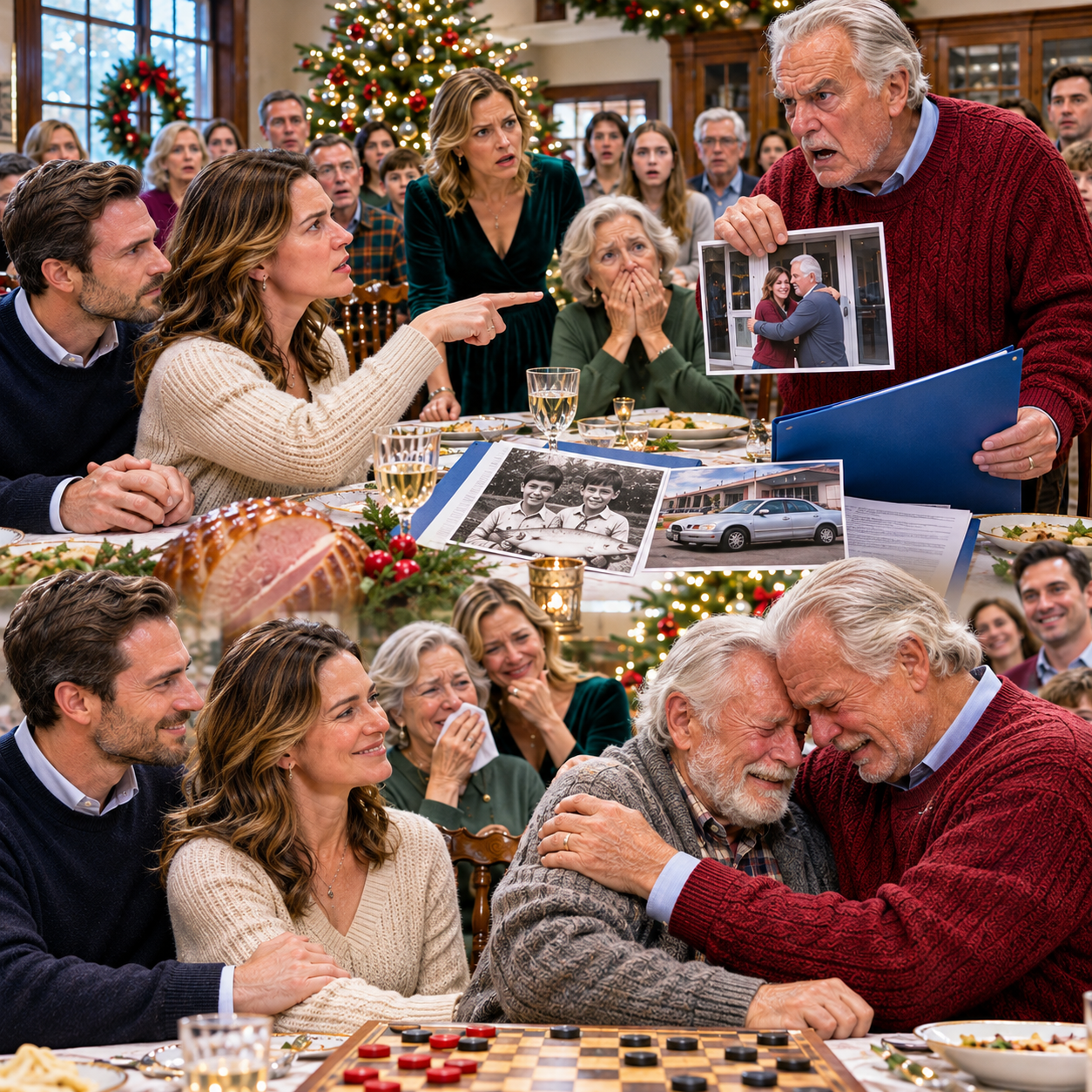
Before anyone touched the ham, Raymond stood.
He was holding a blue folder.
The room went silent.
Melissa slowly lowered her fork.
Raymond opened the folder and removed one sheet.
“Last Christmas,” he began, “I stood here and publicly accused someone who had done nothing wrong. I thought I was protecting this family from a secret.”
He looked at me.
“The truth is, I was protecting myself from mine.”
Raymond’s hand trembled slightly as he turned toward his brother.
“This is Charles Dalton. He’s seventy-eight years old. He was born in Spokane. He’s my brother, and he’s alive.”
He placed his hand on Charlie’s shoulder.
“And after forty-four years, he’s finally home.”
Nobody applauded.
Eileen simply whispered, “Amen.”
The word traveled around the table until Charlie reached up with his good hand and covered Raymond’s.
After dinner, the grandchildren gathered around the old checkerboard. Brady challenged Charlie, while Raymond insisted on serving as referee.
I watched closely.
He didn’t cheat once.
As I stood beside the Christmas tree, Aaron slipped his arm around my waist. “You know,” he whispered, “Dad hired that investigator because he thought you’d been keeping something terrible from me.”
I looked across the room at two brothers laughing over a game they’d played as children.
“I was keeping a secret,” I said. “Just not the one he expected.”
Raymond turned toward us.
“Katie! Come settle something. Charlie says I’m remembering the rules wrong.”
For twelve years, I had been the file clerk, the outsider, the woman who supposedly never spoke her mind.
Now he called me by my name.
And Charlie, who had been declared dead in his brother’s handwriting forty-four times, was sitting alive beneath the Christmas lights.
We could never reclaim the years that had passed. Raymond couldn’t undo the orchard sale, erase his lies, or give Charlie back the Christmas mornings he’d spent alone in Alaska.
But he could show up on Thursday.
He could read another letter.
He could choose, every week, to remain a brother.
The following spring, Raymond introduced me to an old friend at the grocery store. He placed one enormous hand on my shoulder.
“This is Katie,” he said proudly. “My daughter-in-law. She’s the one who always reads to the end.”
I smiled.
Because sometimes the truth doesn’t arrive as a grand confession or a spectacular victory. Sometimes it comes on a single sheet of paper that someone was too frightened to read.
And sometimes, when that paper finally reaches the right hands, it opens a door that has been locked for forty-four years.
THE END.
All characters and events in this story are fictional, created for storytelling and entertainment purposes. Thank you sincerely for reading. Your feedback and support are invaluable and motivate me to continue sharing more stories with you.