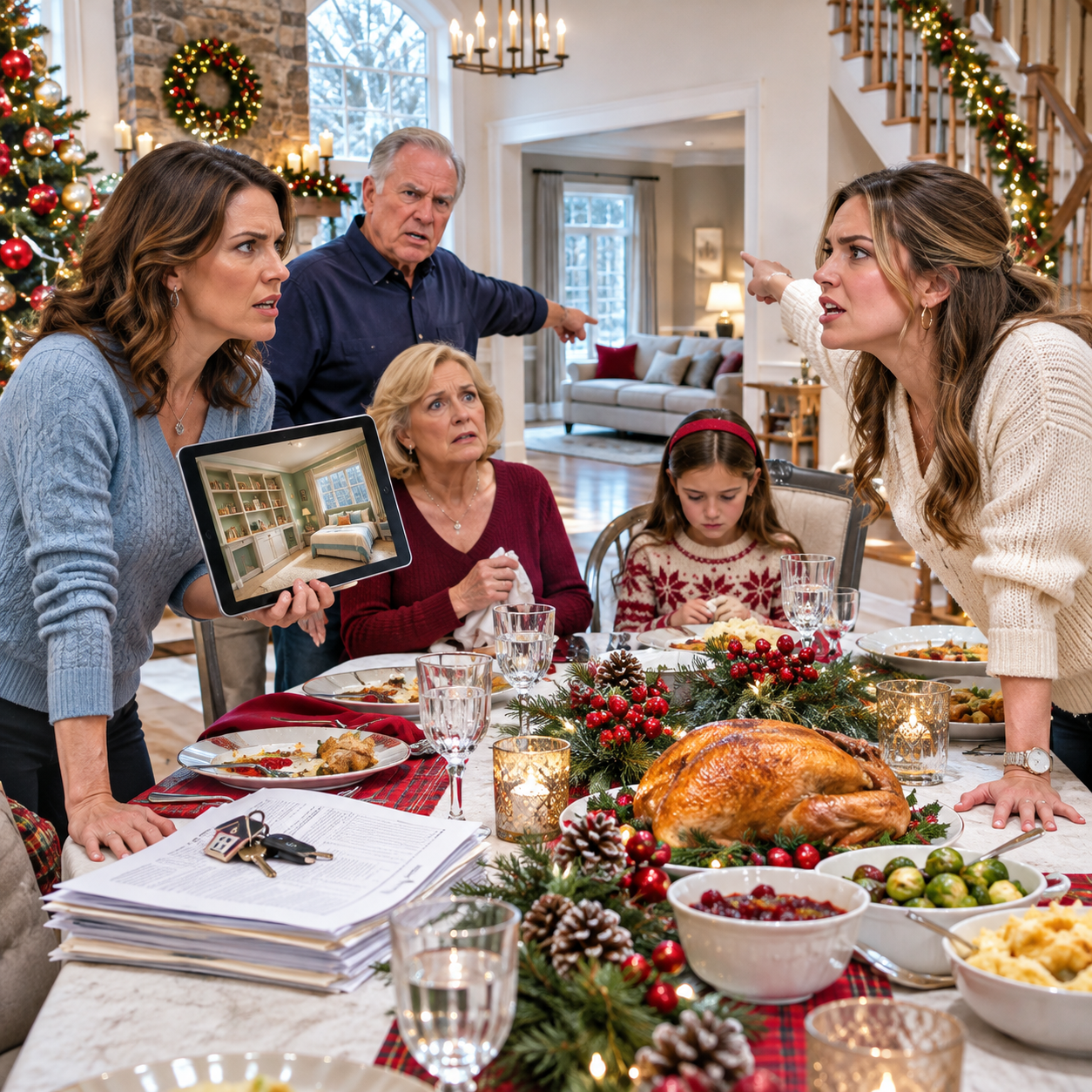
My sister slid the gravy boat across my Christmas table, then announced that my spare bedroom belonged to her nine-year-old daughter starting January 2. I nearly dropped it onto the linen tablecloth. My mother kept chewing. My father watched me with the expectant calm of a man who had already decided what my answer would be.
### Part 1: A Christmas Dinner Turns My Home Into Someone Else’s Plan
“You should clear out the wardrobe before New Year’s,” Karina added, cutting another piece of turkey. I stared at her, waiting for the punch line, but she only raised her eyebrows as though I were being deliberately slow. “Lily loves that room, Angelica, and my lease is ending, so she’ll need somewhere stable while I figure things out.” Beside her, my niece quietly pushed peas around her plate, her little shoulders stiff beneath her Christmas sweater.
Three months earlier, I’d spent $19,000 transforming that neglected upstairs bedroom into the only peaceful corner of my life. It had new hardwood floors, sage-green walls, custom shelves, linen curtains, and a reading nook overlooking the backyard. After twelve-hour shifts performing emergency surgeries at the veterinary clinic, I sometimes sat there in silence, recovering from the grief of losing an animal despite doing everything possible to save it. Karina knew how much that room meant to me because she’d helped choose the lamps.
“You told me your landlord was raising the rent,” I said. “You never mentioned moving into my house.” Dad lowered his fork, and I recognized the disappointed expression he’d used since I was a teenager. “Your sister is going through a difficult transition, Angelica, and family helps family.” Mom touched her napkin nervously and whispered, “Please don’t ruin Christmas over a bedroom.”
I’d worked until nearly midnight on Christmas Eve saving a Labrador that had swallowed part of a plastic toy, then gotten up at six to prepare dinner. Karina arrived forty minutes late carrying an empty container for leftovers, Dad brought wine he knew I didn’t drink, and Mom criticized my decorations before removing her coat. Yet somehow I was the unreasonable person at the table. I looked directly at Karina and asked, “How long are you planning to stay?”
“A few months, maybe longer,” she replied, shrugging. “The housing market is ridiculous.” I glanced toward my father and asked where Karina intended to sleep if Lily occupied the renovated room. He cleared his throat before answering, “Karina can take your bedroom temporarily, and you’ve got that pullout couch downstairs.” For a moment, the ticking clock seemed louder than the fireplace, and I realized three adults were casually discussing how to remove me from both bedrooms in a house I owned.
Karina was thirty-four, and emergencies had followed her for years, usually ending with money leaving my bank account. I’d covered four months of rent after she lost her fitness studio job, transferred $3,200 for an apartment deposit, paid for Lily’s science camp, and helped with car repairs, overdue bills, and an unfinished marketing course. Whenever I hesitated, someone reminded me that Lily shouldn’t suffer because of adult problems. I loved my niece deeply, but my family had learned to use that love like a key to unlock anything I owned.
I raised my glass, looked at the three expectant faces, and said, “All right.” Karina immediately smiled, Mom exhaled with relief, and Dad resumed eating as if he’d successfully settled a minor disagreement. Lily didn’t smile at all. Nobody noticed that I hadn’t actually promised them a single thing.
After dessert, Karina lingered at the front door to explain that she’d bring boxes next weekend and expected me to remove my medical paperwork from the upstairs desk. When I asked whether her boyfriend Marcus was moving in, her eyes flickered before she admitted he might join them later. I closed the door behind them and climbed upstairs, where moonlight washed across the beautiful floorboards I’d paid for myself. On the window seat lay the blanket I’d wrapped around my shoulders after losing an elderly golden retriever during surgery, the night I’d cried there until the room went dark.
At 11:45 p.m., I called Naomi, my oldest friend and the real estate agent who’d helped me buy the house six years earlier. “I want to sell,” I said, and after confirming I wasn’t joking, she warned me that demanding a cash buyer and a fourteen-day closing might cost me money. I told her about the furnished rentals near my clinic and the partnership opportunity Dr. Levan had been offering me for months. By half past midnight, Naomi was sitting at my kitchen island with her laptop, and by 2:30 a.m., my three-bedroom house was listed for sale.
At 6:45 the next morning, Naomi texted that three buyers had already requested showings. I watched from my upstairs window as she planted the FOR SALE sign in my snow-covered lawn, feeling strangely calm. At 7:12, Mom called, demanding an explanation, then blurted out that Karina had already given notice to her landlord. “When?” I asked, and the silence before her answer told me everything. “Last week,” she admitted, revealing that my sister had surrendered her apartment before ever asking whether she could live in mine.
### Part 2: One For Sale Sign Exposes Years Of Family Betrayal
At 7:40 that morning, someone hammered on my front door hard enough to shake the glass. Karina stood outside in sweatpants and an open winter coat, her hair twisted into a messy knot and her face flushed with anger. “What the hell is wrong with you?” she shouted, while a curtain shifted in my neighbor’s window. I stepped onto the porch, pulled the door behind me, and said, “Lower your voice.”
“You said everything was fine!” Karina snapped, pointing toward Naomi’s sign. I folded my arms against the cold and reminded her that saying “all right” wasn’t the same as agreeing to surrender my home. “You’re selling an entire house just to punish me?” she demanded, and I answered that I’d decided to stop living inside arrangements other people made without my permission. She asked where Lily was supposed to sleep, and I told her to find an apartment she could afford.
The front door opened behind me, and Lily appeared, looking frightened because her mother had told her to wait in the car. I let her inside to use the bathroom, then faced Karina again as she accused me of making her daughter homeless. “You ended your lease before asking me,” I said. “That’s your decision, not mine.” Her expression hardened as she delivered the sentence I’d heard in different forms for years: “So you’re choosing money over your niece?”
I reminded her of the rent payments, school fees, dental appointments, birthday parties, and emergencies I’d covered without expecting anything in return. “Name one time you helped me,” I said, watching snow collect on her dark hair. She opened her mouth, then finally muttered that I didn’t need help because I had savings, a career, and a perfect life. “I worked overnight shifts while studying veterinary medicine and spent years paying off student loans,” I told her. “None of this appeared by magic.”
When Lily came back outside, she whispered, “Mom said I was getting your pretty room. Did I do something wrong?” I crouched to straighten her coat and looked into her wet eyes, suddenly angrier about the burden being placed on her than anything said to me. “You did absolutely nothing wrong, sweetheart,” I told her. “Adults made a mistake, and it’s not your job to fix it.” Behind her, Karina turned away without speaking.
By evening, Naomi had received two cash offers, and the strongest came from Mr. Bennett, a widowed retired teacher moving closer to his daughter. He loved the downstairs bedroom because his knees were troublesome, the fenced backyard because he wanted to adopt a dog, and the upstairs reading nook because his granddaughter visited on weekends. His offer required no financing contingency or repairs and promised a fourteen-day closing. I signed the acceptance while standing in the kitchen where my family had tried to assign me a place on the couch.
The following morning, Dad appeared at my veterinary clinic while I was treating an orange tabby named Pumpkin, who’d swallowed part of a Christmas ribbon. My technician, Rosa, explained that he’d been waiting forty-five minutes, looking increasingly annoyed beside the pet dental brochures. Inside the consultation room, he ordered me to cancel the sale, insisting Karina deserved help because she was a single mother. “She has received child support for nine years, she works, and she has options,” I replied, but his expression only grew harder.
I reminded him that I’d paid $4,800 toward Mom’s dental work, covered repairs on his transmission, and loaned him money for property taxes he never repaid. Then I mentioned Marcus might eventually move into the house, and Dad’s startled face confirmed Karina had conveniently hidden that detail from him. “You earn good money, Angelica,” he insisted. “Why is helping your sister such an unbearable sacrifice?” I met his eyes and said, “Because it’s never a sacrifice for the people asking.”
Dad left without saying goodbye, and within days Karina had posted online about relatives who valued property more than family. Aunt Marina called me dramatic, cousin Elena urged me to postpone closing, and Mom sent apartment listings as though finding Karina housing had become my responsibility. I ignored the messages and packed my belongings into boxes. Then, on Sunday morning, I heard a large vehicle reverse into my driveway, and through the window I saw Karina, Marcus, and both my parents standing beside a rented moving van filled with furniture.
### Part 3: A Moving Van Reveals The Lie Behind My Sister’s Plan
I walked outside without a coat, still holding a plate wrapped in newspaper. Marcus was lowering the van’s loading ramp while Karina stood beside two suitcases, Lily’s pink desk chair, and a mattress. “What exactly are you doing?” I asked, and my sister answered as if it were obvious: “Moving in before you do something even more irresponsible.” I told her the house was under contract, but she merely folded her arms and demanded that I cancel the sale.
Marcus stepped forward, rubbing his hands against the cold. “Angelica, maybe we can all talk inside,” he suggested, while Dad moved toward the porch with the same authoritative expression he’d worn at Christmas dinner. I told them nobody was entering my house, and Mom immediately began pleading that Karina had nowhere else to go. “She has an apartment until the end of the month,” I replied, but Karina pointed to the van and complained that she’d already paid for the rental. “Then that was another decision you made without checking with me,” I said.
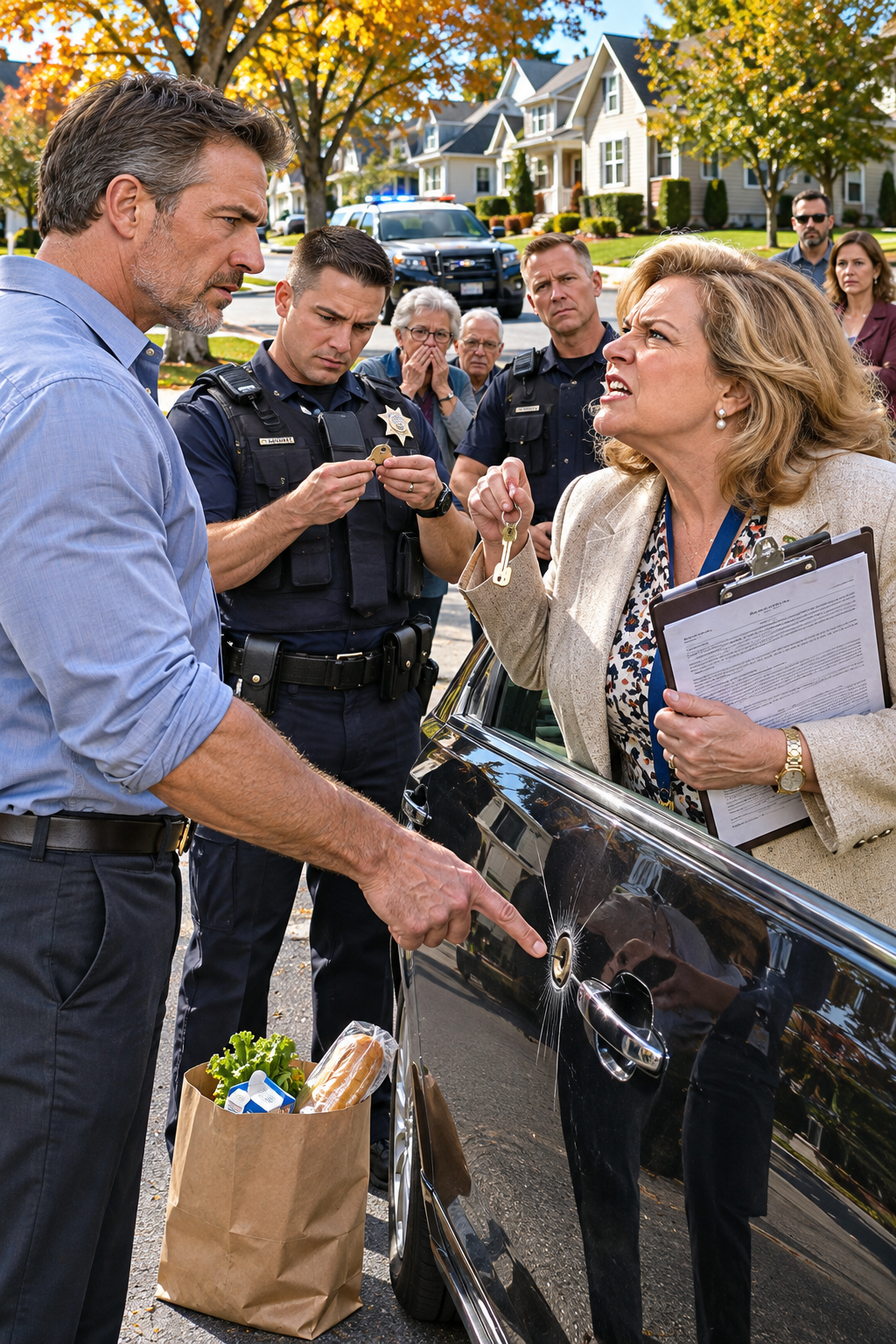
Karina’s face tightened as she started calling me selfish, but I stopped her before she finished. I walked to the garage keypad, entered my new security code, and raised the door just a few inches before closing it again. “I changed the locks yesterday,” I said, looking from my father to my sister. “The old emergency key doesn’t work, the garage code has changed, and the cameras are recording everything.”
Dad stared at me as though I’d betrayed the family. “You changed the locks on your own flesh and blood?” he demanded, his voice rising across the driveway. I glanced toward Karina’s car, where Lily sat safely in the backseat, watching through the window. “Lily will always be welcome in my life, and I’ll still help with important school expenses directly when necessary,” I said, keeping my voice steady. “But nobody gets to use her as a reason to take over my house.”
Marcus stopped unloading the van and looked toward Karina. “You told me Angelica offered us the bedrooms,” he said quietly. Karina stared at him, then snapped, “She would have agreed eventually!” For the first time, I saw Marcus understand that what he’d been told was an agreement was actually a plan to pressure me until I surrendered. His face reddened, and he asked whether she’d also expected me to sleep on the couch while he moved in.
Karina insisted everyone was overreacting, but Marcus stepped away from the van. “You said this was a family property we were welcome to use temporarily,” he told her. “You didn’t tell me your sister was being pushed out of her own bedroom.” He turned toward me, visibly embarrassed, and apologized for coming before ordering a ride. Ten minutes later, Karina watched him leave, and I realized the person she had expected to support her was the first to walk away from the lie.
Mom began crying, Dad accused me of humiliating everyone, and Karina stood beside the loaded van demanding that I reconsider. I pointed toward the security camera and reminded them that the buyer’s inspection was scheduled for that afternoon. “You need to leave now,” I said, without raising my voice. After several minutes of arguments, they finally climbed back into their vehicles, and I stood in the freezing driveway watching the moving van depart without unloading a single box.
Thirteen days after Christmas, I signed the closing documents and handed Mr. Bennett the keys. He shook my hand warmly and said his granddaughter had already chosen the upstairs window seat as her favorite place. When he mentioned wanting an older rescue dog, I gave him the clinic’s number and promised we’d help him find a gentle companion. I drove away without looking back until I reached the corner, where the house disappeared behind snow-covered trees.
By the end of January, I was living in a small two-bedroom cottage near the veterinary practice, with a narrow kitchen, a fenced garden, and a crooked apple tree shading a wooden bench. My first dinner there was takeout noodles eaten on the living room floor among half-open boxes. I had sold a beautiful house and moved somewhere considerably smaller, yet that night I slept more peacefully than I had in years. Nobody had a key they believed entitled them to rearrange my life.
### Part 4: Leaving My Old House Finally Changes What Family Means
In March, Dr. Levan and I finalized the partnership agreement he’d been encouraging me to consider for nearly a year. He intended to retire gradually over the next two years, and for the first time I could help decide the clinic’s future instead of spending every available hour keeping up with emergencies. We hired another veterinary technician, expanded our emergency treatment schedule, and established a small fund to help families afford urgent care for their pets. I also adopted Mabel, an elderly beagle mix with cloudy eyes, aching joints, and a passionate dislike of delivery trucks.
Karina eventually found a smaller two-bedroom apartment twenty minutes from Lily’s school. She took additional shifts at work, and although she complained to Mom about the cramped rooms, Lily had her own bedroom and a safe place to come home to every afternoon. Marcus never moved in, and their relationship ended shortly after the incident with the van. Apparently he’d believed Karina had secured a genuine housing arrangement, not designed a scheme that depended on removing her sister from her own bedroom.
Karina refused to speak to me for almost a month, but one afternoon Lily called from her tablet and asked whether she could visit Mabel. I said yes immediately, and that Saturday we baked cookies, walked the dog slowly around the block, and drank hot chocolate beneath the crooked apple tree. Lily talked about school and her new classmates, occasionally pausing to scratch Mabel behind the ears. For the first time since Christmas, her shoulders looked relaxed.
Before her mother arrived, Lily stood near my front door and nervously asked, “Mom says you sold your house because of us.” I knelt beside her and explained that I had needed a change, but adults also had to ask before making plans involving someone else’s belongings. She considered that for a moment, then whispered, “So Mom should’ve asked you?” When I nodded, she added, “And Grandpa shouldn’t have told you to sleep on the couch.”
I laughed softly, and Lily threw her arms around my neck. “I like your cottage better anyway,” she announced, looking toward Mabel sleeping on her blanket. “It has a dog.” When Karina picked her up, she remained in the car rather than coming to the door, but she waited patiently while Lily hugged me goodbye. That was the first sign that something between us might eventually become different.
Mom visited several weeks later, carrying a lemon cake and an expression I hadn’t seen before. She walked through the cottage, taking in the small kitchen, the quiet garden, and the absence of any family luggage stacked in the hallway. At the table, she admitted that she’d assumed I would calm down and eventually let Karina move in. “Selling the house was extreme,” she said, and I agreed before explaining that nobody had respected my boundaries until there was a legally binding closing date.
Mom stared into her coffee before finally saying, “We shouldn’t have put you in that position.” She admitted that worrying about Karina had made it easier to demand sacrifices from me than to insist her younger daughter make responsible decisions. I told her I would always care about Lily and would never abandon her over an argument between adults, but I would no longer rescue Karina from every consequence. Mom nodded slowly, and although our relationship wasn’t suddenly repaired, she stopped treating my independence as a personal insult.
Dad took longer to acknowledge what had happened. On my birthday, several months later, he sent a message saying he’d driven past my former house and seen a dog playing in the yard. The new owner seemed to be taking good care of the place, he wrote, before adding that he understood why I’d sold it, even if he hadn’t understood at the time. I read those words twice and replied with a simple thank-you, accepting that some apologies arrive imperfectly.
The most surprising change came from Karina during a phone call about Lily’s new glasses. She mentioned their cost, paused, then quickly added, “I’m not asking you to pay for them, Angelica. I already budgeted for it.” It was a small sentence, almost awkwardly delivered, but it meant more than another dramatic apology. For once, my sister had made a plan that didn’t depend on taking something from me.
A few weeks later, Mr. Bennett brought his newly adopted senior rescue dog to the clinic for a checkup. He showed me a photograph of his granddaughter curled up on the sage-green window seat, reading a book while the dog slept peacefully on the hardwood floor beneath her. Looking at the photograph, I felt a brief ache for the room I’d once believed I couldn’t bear to lose. Then Mr. Bennett thanked me for helping him find a house where his family could gather, and the ache gave way to something softer.
I finally understood that the room had never been the most valuable thing I’d built. It had simply been the first place where I’d allowed myself to believe my needs mattered, and selling it hadn’t erased that lesson. My parents had mistaken my generosity for an obligation, while Karina had mistaken my love for Lily as permission to make decisions for me. None of them had expected that the person who always fixed their emergencies would finally choose to stop creating one for herself.
That Christmas, my family announced that I would sleep on the couch in my own home, and by the following morning, the house was for sale. Fourteen days later, I handed over the keys, believing I was leaving something precious behind. But months later, with Mabel asleep beneath the apple tree and Lily laughing in my little kitchen, I realized the final truth. I’d never needed three bedrooms to have a home; I’d needed a life where nobody else could decide which room I was allowed to occupy.
THE END.
All characters and events in this story are fictional, created for storytelling and entertainment purposes. Thank you sincerely for reading. Your feedback and support are invaluable and motivate me to continue sharing more stories with you.