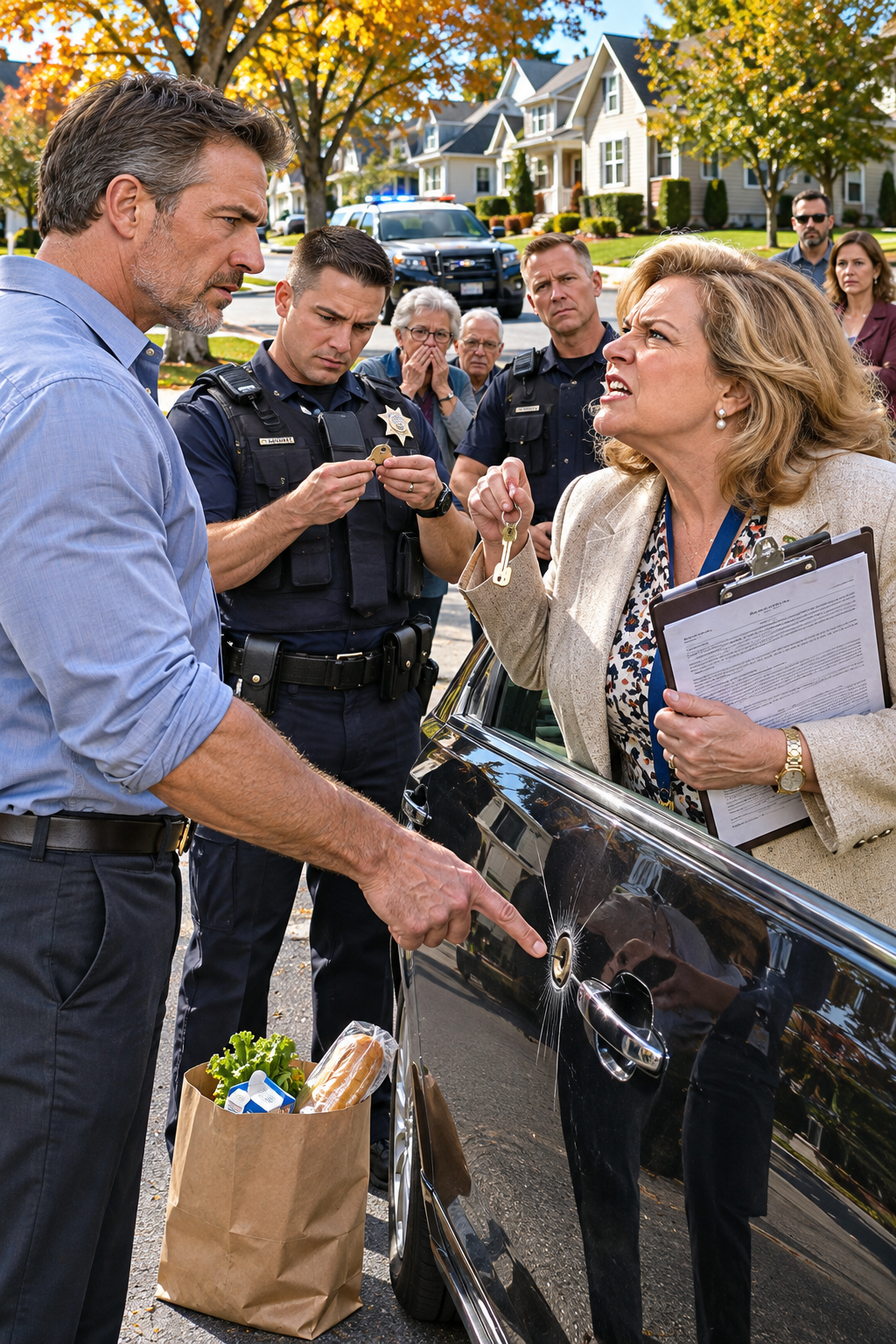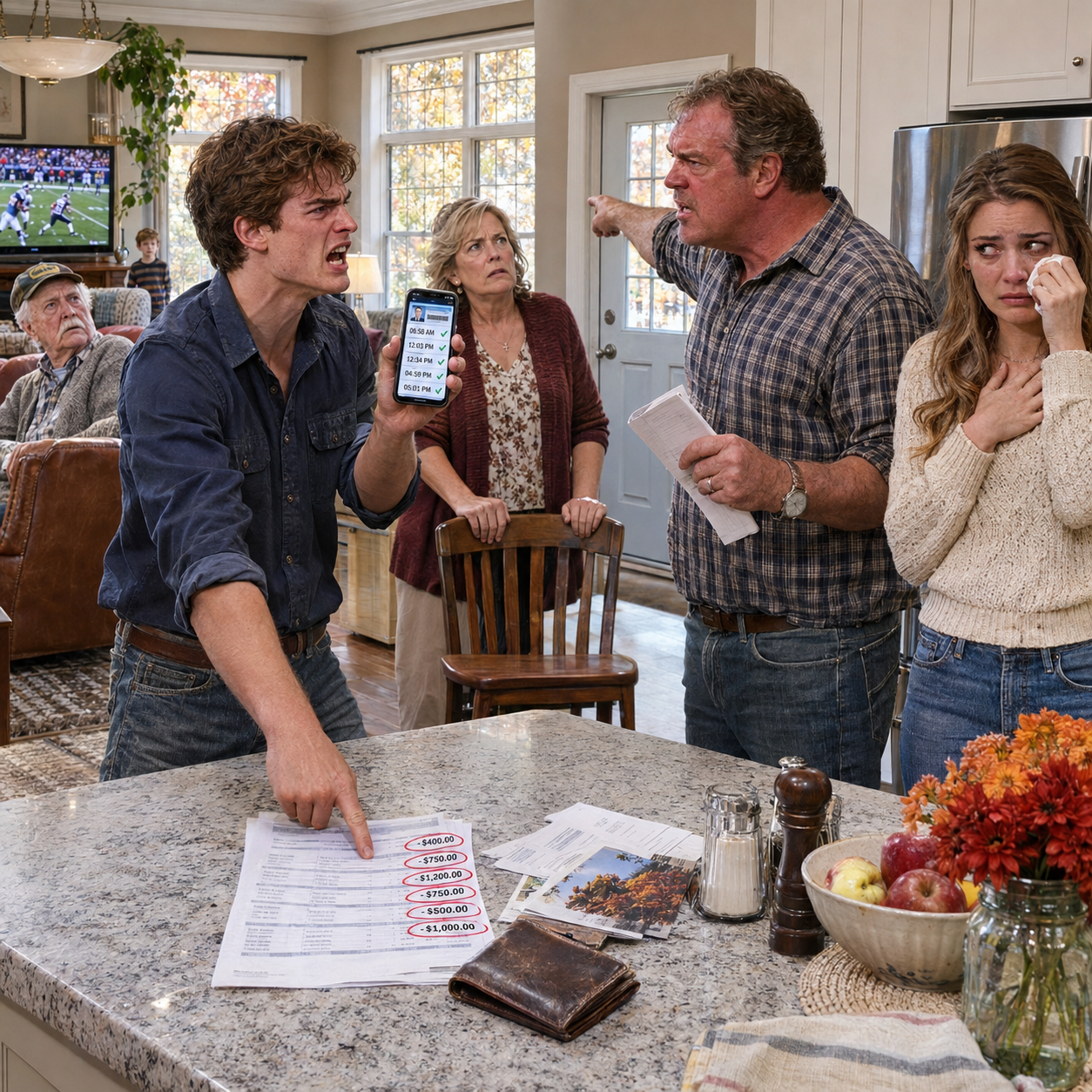
Dad slammed my grandfather’s bank statement onto the kitchen table and stabbed his finger at six withdrawals circled in red. My sister started crying before anyone accused her. Across the room, Grandpa watched football with the captions on, unable to hear a word. Then Dad pointed at the back door and destroyed my family with one sentence.
### Part 1: My Sister’s Lie Cost Me Everything My Family Once Meant
“Liars don’t live under my roof,” my father said. I was twenty years old, standing in our kitchen in Owatonna, Minnesota, with proof of my innocence glowing on my phone. My sister Andrea stood beside the refrigerator, wiping tears from her cheeks, while Mom stared at the table. Ten feet away, Grandpa Irv sat in his recliner, unaware that his missing money was about to tear our family apart.
Grandpa had spent forty-one years working on railroad crews, surrounded by machinery that had gradually stolen his hearing. At seventy-six, he could barely hear a shout, but he could still read a person’s face and recognize kindness. Since Grandma died, he’d lived with us, contributing $600 each month from his railroad pension toward the mortgage. I worked from six until two-thirty at Straight Arrow Lumber and handled his pharmacy trips, groceries, and crossword books.
Whenever I needed his debit card, Grandpa would write the PIN on the back of my hand and grin when I complained. He trusted me completely, which made what happened that October almost impossible to understand. Andrea, twenty-seven, had recently moved home after her divorce, bringing her three-year-old son, Bryson, and several plastic storage bins. Mom gave her my bedroom and moved me downstairs, which I accepted without arguing.
What bothered me was Andrea’s sudden spending. She had no job, yet somehow bought a new phone, an expensive coat, and weekend trips to Minneapolis. When I questioned her, she claimed her ex-husband was finally paying what he owed. Mom told me to stop being suspicious of my own sister.
Then Grandpa’s automatic mortgage contribution bounced.
Dad, Jay, came home from the glass plant and opened Grandpa’s statement. Six withdrawals of $400 each had emptied $2,400 from his account, leaving barely eleven dollars. Every transaction came from a gas station ATM on Cedar Avenue. When I arrived home, Dad was waiting with the statement in his hand.
“You have his card,” he said. I explained that I used it only for Grandpa’s errands, but Andrea suddenly began trembling. “Dad, I didn’t want to say anything,” she whispered, setting Bryson down. “I saw Isaac take the card from Grandpa’s wallet while he was sleeping.”
I stared at her, waiting for the joke to end. Instead, she looked straight into my eyes and said, “I’m not covering for you anymore.” Dad’s expression hardened, and Mom reached for Andrea’s hand. Across the room, Grandpa glanced toward us, saw the commotion, and turned back to his television.
I pulled out my phone and opened a photograph of my punch card from the lumberyard. My boss had once shorted my hours, so I’d developed the habit of photographing every week’s time records. The bank statement listed withdrawals at 10:40, 11:05, and 1:15 on weekdays when I had been loading trucks. “Look at these times,” I begged. “I was working during every withdrawal. Call my boss.”
Dad barely glanced at the screen. “Somebody could have punched you in.” When I asked him to contact the bank, he folded the statement and shook his head. “You want the sheriff involved? You want a criminal record at twenty? I’m trying to protect you.”
“Then protect me by checking the truth.”
Mom finally spoke. “Your sister has no reason to lie.”
“She has twenty-four hundred reasons.”
Andrea gasped, Bryson began crying, and Dad pointed toward the back door. I looked at Grandpa, wishing desperately that he could hear what was happening. He caught my eye and raised his eyebrows, the same expression he’d worn whenever I got into harmless trouble as a child.
I packed my work boots and clothes into one duffel bag. Before leaving, I squeezed Grandpa’s shoulder, and he patted my hand twice without understanding why I was saying goodbye. At the door, I turned toward my father. “When you find out it was Andrea, don’t call me.”
For two weeks, I slept on my friend Leif’s couch in Rochester. His mother, who worked at a bank, explained that I couldn’t access Grandpa’s records without his authorization. Three weeks after Dad threw me out, Mom sent one text: Andrea was taking over Grandpa’s finances, and they had decided not to tell him about the stolen money.
I read that message until the screen went dark.
They hadn’t simply believed my sister’s lie.
They had handed her control of the very money she had stolen.
### Part 2: Ten Years Of Silence Ended With Grandpa’s Secret Letter
I answered a newspaper advertisement for an appliance repair shop in Rochester that promised to train beginners. Its owner, Sig Havland, was sixty-eight, with enormous forearms and the kind of face that made dishonesty feel pointless. When he learned I was sleeping on a couch, he offered me a room above the shop for a hundred dollars monthly. “Don’t argue,” he said, pushing a key across his desk.
Sig taught me to repair machines and, without knowing it, rebuild a life. He talked to broken washers like frightened animals, coaxing them through repairs while I watched. Eventually, I started doing the same thing, and Sig laughed until he had to sit on an overturned bucket. Four years later, I’d saved enough to rent my own apartment.
I wrote Grandpa twice, once at Christmas and again on his birthday. I told him about the repair shop, my new skills, and how much I missed sitting beside him with crossword puzzles. Neither letter received an answer. I assumed my family had convinced him I was a thief.
When I turned twenty-six, Sig retired and offered to sell me his business through monthly payments. I paid him off in three years and kept his name on the sign, adding “Isaac, Owner” beneath it. At twenty-eight, I bought a modest two-bedroom house with a stubbornly damp basement. That same year, I met Sadie, a veterinary technician whose dryer kept destroying her clothes.
During my first visit, I pulled a dog treat and a torn sock from the machine. “You always talk to appliances?” she asked, laughing as I told the dryer to behave. Two weeks later, she invented another problem just to see me again. By thirty, I had a successful business, a woman I loved, and a home of my own.
Then, near the end of May, a letter appeared in my shop mailbox.
The address was written in neat capital letters with a pencil. I’d recognize that handwriting anywhere because Grandpa had used it for decades in his little medication notebook. Inside was a torn page containing a few words: “Saw your picture in the shopper. Washer’s fine. I’m not. Come Wednesday. Everybody’s working. Back door’s open. Irv.”
I rescheduled every Wednesday appointment.
When I entered my childhood kitchen for the first time in ten years, Grandpa stood beside two cups of coffee. He was eighty-six now, smaller and thinner, but his railroad-worker arms still held me fiercely. We sat down with a seed catalog and a pencil, passing handwritten messages back and forth. His first question was simple: “Why did you leave?”
I showed him the photographs I’d kept for a decade. As he studied the original withdrawals alongside my time card, his finger paused on the 10:40 transaction and my 5:58 clock-in. He removed his glasses, wiped them slowly, and wrote, “Nobody told me.”
Then I mentioned the letters.
Grandpa frowned and wrote, “Never got any.”
“Who brings in the mail?”
“Andrea.”
My stomach tightened as he continued writing. Andrea had managed his bills ever since I left, and he hadn’t seen a bank statement in ten years. Every Christmas, she’d made the same joke about me: “Watch your wallet.” Grandpa had laughed along because everyone else laughed, never knowing what those words meant.
I asked why he hadn’t gotten hearing aids.
He explained that Andrea had told him they cost $8,000, weren’t covered by insurance, and weren’t necessary for someone his age. He’d asked twice and been dismissed both times. Then he wrote something that changed everything: “I can’t hear her on the phone either.”
I understood immediately.
A grandfather who couldn’t hear couldn’t question conversations about his money.
I wrote, “I’ll take you for hearing aids. I’ll pay.”
He grinned, took back the pencil, and wrote his own instructions.
“Don’t tell them. I want to hear what they say.”
That Friday, I drove Grandpa to Rochester to see Dr. Pollson, an audiologist who treated him with a warmth he hadn’t experienced in years. She fitted him with tiny in-the-canal hearing aids costing $5,800, plus fitting expenses. When she activated them and spoke softly, Grandpa’s eyes filled with tears.
“You sound like my wife,” he whispered. “She talked quietly like that.”
Outside, he stopped to listen to a robin singing. In my van, he stared at the clicking turn signal and asked whether it had always made that ridiculous noise. I laughed harder than I had in years.
After lunch, I showed him my shop, introduced him to Sadie, and demonstrated how I talked to a broken washing machine. Grandpa leaned toward the appliance and asked, “Does he bother you like this all day?” When the washer made a loud knocking sound, he nodded solemnly. “Sounds like a yes.”
That evening, he returned to my parents’ house.
He hid the hearing aids’ charging case beneath his wool socks.
And for the next three weeks, everybody believed Grandpa Irv was still deaf.
### Part 3: Grandpa Heard My Sister Confess The Betrayal She Thought Safe
Grandpa called me every evening from the garage, where he could speak privately beside an old freezer. The first time, he shouted my name out of habit, then laughed when he realized he could hear my answer perfectly. Some discoveries were harmless: Dad complained about his bathroom habits, and Mom said he needed a haircut. Others were things Grandpa carefully recorded beneath his daily medications.
During the first week, Andrea spoke to a friend in the kitchen. Grandpa heard her say, “I’ll move a little out of Grandpa’s account. He never looks.” He wrote down the date and her exact words. During the second week, he overheard Mom and Dad arguing about their mortgage, with Dad insisting that without Grandpa’s $600 monthly contribution, they could lose the house.
But the third week exposed something far uglier.
Andrea had invited her new boyfriend, Duke, over on a Sunday afternoon. They sat on the deck outside Grandpa’s recliner window, believing he couldn’t hear through the glass. When Duke asked why her brother never visited, Andrea laughed. “Honestly, that card thing was the best thing that ever happened to me. Got Isaac out of the house and Grandpa’s checkbook into my hands. Dad still thinks he did it.”
Grandpa read the words aloud to me that night.
For several seconds, neither of us spoke. Then his voice broke as he remembered laughing along whenever Andrea mocked me at Christmas. “I laughed, too, Isaac.”
“You didn’t know.”
“Well,” he said quietly, “I know now.”
On July second, we entered Grandpa’s bank on Cedar Avenue. He placed his driver’s license before a teller named Carmen and requested every statement available, printed rather than mailed. The bank retained seven years of records. Grandpa waited, eating the free cookies while the printer produced page after page.
Inside my van, we studied transfers from his account into one belonging to Andrea. Usually, she took $300 each month, sometimes $500 near Christmas, and once $1,200 around the time she bought a car. I added the amounts three times. Over the seven documented years, she’d taken $26,400, separate from the original $2,400.
Grandpa folded the statements carefully.
“Lawyer,” he said.
Mrs. Lundy, who had handled Grandma’s will, studied the records and confirmed that Andrea’s power of attorney gave her no right to use Grandpa’s savings for herself. Grandpa revoked her authority immediately and named me instead, despite my objections. Mrs. Lundy arranged a new account at another bank, redirected his pension beginning in August, and prepared a repayment agreement. If Andrea refused to sign, the lawyer would refer the evidence to law enforcement.
I wanted the confrontation handled privately. Grandpa disagreed.
“They threw you out in front of me,” he said, adjusting his railroad cap. “I couldn’t hear a word. This time, I want everybody to hear.”
He chose Mom’s Fourth of July barbecue.
When Sadie and I walked through the side gate at four that afternoon, conversation stopped around the backyard. Mom stood frozen on the deck steps, a bowl of potato salad in her hands, while the serving spoon clattered into the grass. Dad turned from the grill, holding a bratwurst on his spatula. Our neighbors Harvey and Ruthie Clem stared, along with two of Dad’s coworkers, Andrea, Duke, and a now-teenage Bryson.
Grandpa sat beneath the maple tree in his lawn chair, wearing his railroad cap. “That’s my ride!” he announced cheerfully. “Pull up a chair, Isaac. One for Sadie, too.”
Andrea leaned toward Duke at the picnic table.
“Better watch your wallet,” she said loudly.
Duke laughed. A few guests gave uncomfortable chuckles, and Dad returned his attention to the grill. I felt ten years of humiliation rise in my throat, but Grandpa spoke before I could answer.
“Should Duke watch his wallet,” he asked, “or should I watch mine?”
Andrea turned toward him.
Grandpa stood slowly, keeping one hand on the chair. “You’ve been taking my money for ten years, sweetheart. I think I’ve watched long enough.”
“Grandpa, you’re confused,” Andrea said immediately, looking toward Mom. “He doesn’t understand what he’s saying.”
Grandpa tapped his ear.
“Little hearing aids. Isaac bought them five weeks ago.” He smiled at my mother. “And yes, Mary Beth, I know I need a haircut.”
Her face went pale.
Grandpa opened his notebook and read the entry about Andrea moving money from his account. Then he turned another page and repeated her conversation with Duke, including the sentence about getting me thrown out and gaining control of his checkbook. Every word seemed to steal another shade of color from Andrea’s face.
Duke stopped laughing.
Grandpa took the bank statements from inside his shirt and laid them beside the potato salad.
“Seven years,” he said. “Twenty-six thousand, four hundred dollars.”
Nobody moved.
Then Grandpa looked at me and nodded toward the papers.
“Your turn, Isaac.”
### Part 4: The Truth Finally Came Out And Grandpa Chose His Family
I removed two printed photographs from my wallet and placed them beside the bank statements. One showed the six original withdrawals from Grandpa’s account. The other showed my old lumberyard punch card, with the hours proving I’d been at work when the money disappeared. Dad lifted the photographs toward his face, studying evidence he’d refused to examine ten years earlier.
“I showed you this in our kitchen,” I said. “You looked for one second and told me you weren’t a detective.”
Andrea jumped up, knocking over a plastic cup of red soda. It spread across the checkered tablecloth as she accused me of manipulating Grandpa. Duke picked up his sunglasses and quietly announced he was leaving. Ruthie Clem offered to escort him through the gate, while Andrea called after him without getting an answer.
Mom remained by the deck steps, staring at the fallen serving spoon. When Andrea begged her to intervene because she had Bryson to consider, Mom said nothing. Dad finally looked at me and asked why I hadn’t gone to the bank myself. I reminded him that it wasn’t my account, and he’d ordered everyone to keep Grandpa ignorant of the theft.
Grandpa rose from his chair and faced his son.
“Jay, what did you tell Isaac the night you threw him out?”
Dad swallowed. “Liars don’t live under my roof.”
“Your roof. Your rule,” Grandpa answered. “So either you meant it, or you didn’t.”
He handed Andrea the repayment agreement prepared by Mrs. Lundy. She had until July fifteenth to sign the arrangement to return $26,400, or the evidence would be referred to the authorities. His power of attorney was already revoked, and his pension would soon go into an account she couldn’t access. The sudden disappearance of that money made Dad’s face tighten.
“Pop, the mortgage,” he whispered. “We need your six hundred.”
“Ask Andrea,” Grandpa replied. “She’s been collecting plenty of it.”
Then he turned toward me.
“How big’s that spare room of yours?”
“Big enough, Grandpa. I even got rid of the treadmill.”
“Good. I’ll get my things tomorrow.”
He thanked Mom for the potato salad, nodded to the neighbors, and walked out through the side gate with Sadie beside him. I followed carrying his lawn chair because he’d declared it belonged to him. Behind us, nobody said goodbye.
The next morning, we moved Grandpa into my house with two suitcases, crossword books, his notebook, and the hidden hearing-aid charger. Dad stayed in the garage while Mom stood in the doorway asking whether he was certain. Grandpa looked back at the kitchen where he’d spent ten years watching people speak without hearing them. “I can hear now, Mary Beth,” he said. “I’d like to live somewhere I like what I’m hearing.”
Dad telephoned the following morning. I let it go to voicemail and sent one message reminding him what I’d said ten years earlier. That Saturday, however, he appeared at my repair shop while I was working on a Kenmore dryer.
He studied the machines, the organized parts bins, and Sig’s old sign reading, “We Fix What Others Won’t.” After a long silence, he said I had a nice business. Then he asked whether Grandpa was comfortable.
“He’s buying a bird feeder with Sadie,” I answered. “He wants to hear the birds.”
Dad nodded, staring at his shoes.
“I was trying to protect you,” he finally said.
I folded my work rag. “You protected the person who stole from him. You refused to look at evidence because finding the truth was harder than blaming me.”
He opened his mouth, then closed it.
Eventually, he told me Andrea had signed the agreement and was moving out. She’d taken two jobs, one at a dealership and another folding towels at a laundromat. Dad and Mom were selling their pontoon boat to help cover expenses without Grandpa’s monthly contribution.
I didn’t celebrate.
I simply told him I had a dryer to finish.
He left without asking forgiveness, and I didn’t chase him. Some mistakes can be repaired with a replaced part. Others require years of responsibility, and I was finished doing that work for people who refused to begin.
Four months later, Grandpa had become an unexpected attraction at Havland Appliance. He rode along on service calls, sat on a bucket in customers’ laundry rooms, and entertained them with railroad stories while I worked. One customer left a five-star review asking us to send Grandpa back because she still hadn’t heard the ending of his derailment story.
Business improved so much that I hired Kellen, a graduate of the local technical college, and ordered a second van. During his interview, Grandpa asked whether he talked to appliances. Kellen looked confused, and Grandpa winked at me. “You’ll learn.”
Sadie moved in that September. Mom began sending Grandpa cards, which he answered whenever he wanted, and Andrea made her scheduled repayments through the lawyer. Every month, Grandpa entered the amount in his notebook beneath the weather and medication reminders.
One Saturday, I was repairing a Maytag washer with a failing pump while Grandpa and Sadie laughed at the front counter. I told the stubborn machine, “Come on, buddy. We’re almost done.” Grandpa called through the doorway, asking who I was talking to, and I answered that it was the washer. “Well, tell it I said hello,” he shouted.
I found him later beside the shop window, watching sparrows crowd the new feeder he’d hung outside. His hearing aids were in place, as they always were now. I asked why he’d stopped removing them during the day, even when the shop was noisy.
He thought for a moment.
“For ten years, I couldn’t hear what people said in that house,” he told me. “Turns out I wasn’t missing much.”
Then he glanced toward Sadie, who was humming while she organized receipts, and smiled.
“But here? I don’t want to miss any of it.”
He returned to the window, listening to the birds, while I went back to work.
For ten years, I’d believed the happiest moment of my life would be hearing my family admit I was innocent. But standing there, listening to Grandpa laugh as Sadie showed him something funny, I understood that the truth had given me something better than an apology.
It had given us a home where nobody needed to pretend they couldn’t hear.
THE END.
All characters and events in this story are fictional, created for storytelling and entertainment purposes. Thank you sincerely for reading. Your feedback and support are invaluable and motivate me to continue sharing more stories with you.