
## Part 2: Hidden records reveal illegal inspections, frightened neighbors, and escalating retaliation.
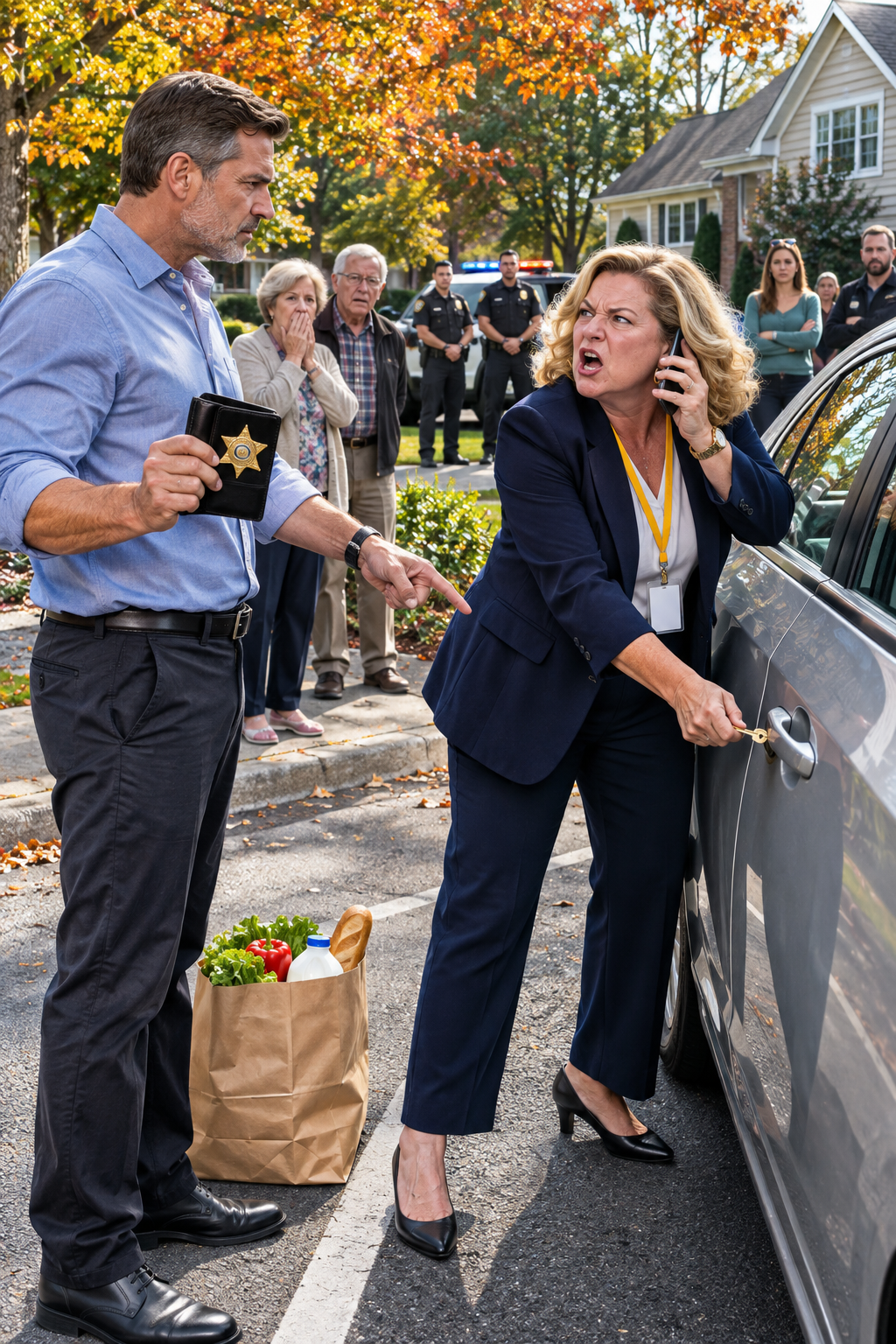
Three evenings later, my kitchen table disappeared beneath county plats, recorded covenants, HOA meeting minutes, and copies of Margaret’s enforcement notices. The supposed vehicle-access policy existed only as an internal memo approved by three board members, although the association’s bylaws required four affirmative votes for changes affecting residents’ property rights. It had never been properly incorporated into the recorded governing documents, and no recorded provision gave Margaret authority to unlock privately owned vehicles. My designated parking space wasn’t common property either; the county plat identified it as an easement attached to Unit 14.
The next morning, I found a $500 obstruction fine beneath my front door, accompanied by another threat of lien proceedings. I carried the notice to Margaret’s makeshift HOA office, a converted garage containing a folding table, a filing cabinet, and a laminated administrative sign. Her husband stood beside the desk with his arms crossed while Margaret slid another copy of the notice toward me. “Pay your fines, register your vehicle, and agree to future inspections,” she instructed. “Otherwise, this becomes very expensive.”
“Show me the recorded covenant authorizing entry into my car,” I requested, resting one hand on the table. Margaret’s smile tightened before she retrieved the same two-page memo the deputies had examined. I studied it, returned it to her, and thanked her for her time. Her husband shifted toward the doorway, but I walked past him without another word, knowing that her inability to produce a valid document mattered more than anything I could have said.
That evening, Dorothy visited with a plastic grocery bag containing thirty-one HOA notices. She’d paid $4,200 over two years because she feared losing the house she’d owned outright since 2009, and several penalties seemed to have no clear basis in the recorded rules. “I can’t afford lawyers,” she admitted, smoothing a wrinkled receipt with trembling fingers. “Margaret knows that.”
Over the following week, I visited six households without mentioning my position at the sheriff’s department. Two teachers showed me an $1,800 fence-color fine, although their paint matched the association’s own approved sample. Another family had been pressured over a properly permitted wheelchair ramp installed for their daughter, with Margaret demanding changes under an architectural rule that conflicted with their accommodation rights. Their signed settlement had left them afraid to challenge any further restrictions.
Then I met Maria from Unit 22. When I asked whether Margaret had ever used a key on her vehicle, she went pale and invited me inside. Four months earlier, Margaret had opened Maria’s sedan with the same brass key, entered without permission, and photographed the interior. Two days later, Maria received a $250 citation claiming her child’s car seat violated HOA safety standards, although nobody could identify any such standard.
“She told me the master key worked on every vehicle the board had approved for inspection,” Maria said, turning a coffee mug slowly between her palms. “I paid because she threatened my home, but I still remember how it felt seeing someone inside my car.” I asked whether she’d provide a signed statement describing exactly what had happened. She nodded, and for the first time during our conversation, the fear in her eyes gave way to determination.
Within days, I had four signed witness statements, Dorothy’s fine records, the teachers’ paint samples, the vehicle-access memo, and certified property documents. I organized everything into a folder with eight labeled tabs, then mailed Margaret a formal dispute requesting a hearing within fourteen days. My letter challenged the fines and demanded that she identify the authority behind her inspections. I signed only my name, without the title she’d never bothered to learn.
Margaret answered by having my car towed.
I discovered the empty parking space after returning from an afternoon errand, a white notice tied to the nearest post announcing that my vehicle had been removed by authorized HOA enforcement. Keystone Towing had it at a lot nineteen minutes away, where I paid $340 to retrieve it. Before driving home, I opened the motion-activated dashcam footage I’d installed after the confrontation. At 2:47 p.m., Margaret appeared beside a flatbed truck, handing the driver a signed authorization before watching him haul my car away.
The towing company supplied a copy of the document the following morning. Margaret had personally certified that the removal was justified under the same unrecorded vehicle-access policy, creating a paper trail connecting her directly to the decision. Then she sent an email to all ninety-six households, proudly announcing the removal of Unit 14’s vehicle as a demonstration of the board’s enforcement powers.
I read that announcement while sitting at the kitchen table, surrounded by documents that contradicted nearly every claim she made. Until then, Margaret’s threats had mostly depended on frightened residents keeping quiet, but now she’d distributed her version of events to the entire neighborhood. I printed the email, opened a ninth tab in my folder, and placed it beside the towing authorization.
Four days later, an emergency HOA meeting notice arrived. Margaret intended to vote on a lien against my property and begin referring the matter toward foreclosure. I circled the meeting date on my calendar, then called the appropriate county offices to verify the association’s filings and obtain certified records. I knew the evidence had to survive scrutiny without relying on my reputation or my badge.
On Thursday evening, I entered the community room and found twenty-three neighbors waiting. Margaret stood beneath the fluorescent lights, smiling over a stack of paperwork, certain she’d finally cornered me. I took a seat in the back row and opened my notebook.
She had no idea how many people she’d frightened into becoming witnesses.
## Part 3: A public lien hearing turns Margaret’s threats into documented evidence.
Margaret called the emergency session to order at 7:02 p.m., with three voting board members beside her and a meeting recorder typing at a laptop. Dorothy sat near the front, Maria was two seats away, and the teachers who’d been fined over their fence occupied the middle row. I counted twenty-three residents, the largest board-meeting attendance anyone could remember in three years. Margaret appeared delighted, apparently believing the audience had come to witness another demonstration of her authority.
She presented $1,200 in alleged outstanding violations, described my conduct as deliberate obstruction, and displayed the towing authorization like a trophy. “Our vehicle-access policy has been active for fourteen months,” she announced, looking directly at me. “Every homeowner accepted these rules upon purchasing property, and the board has full authority to inspect and physically access vehicles parked within this community.” Her words rang through the room while the recorder’s fingers moved across the keyboard.
Dorothy raised her hand. “Which page of the recorded covenants gives the board that authority?” she asked. Margaret’s expression hardened as she informed Dorothy that her question was outside the agenda, but the widow remained standing. “I’m only asking for the page number,” she replied, and several residents turned toward Margaret, waiting for an answer that never came.
Maria stood next. “You opened my car with that key,” she said, her voice carrying across the silent room. “You went inside, photographed my daughter’s car seat, and sent me a fine for a rule that doesn’t exist.” Margaret snapped that personal complaints weren’t permitted during the hearing, but two neighbors nodded in recognition. The room had begun to change, and for the first time, Margaret seemed unable to control the faces watching her.
When she called for a lien vote, I rose from the back row and requested that my challenge to the policy’s legal basis be included in the record. Margaret refused to delay proceedings, and three board members voted in favor while Patricia, who had barely spoken all evening, abstained. I carefully recorded the vote and remained seated until the meeting ended. Near the exit, Margaret leaned toward her husband and murmured that foreclosure papers would show me how brave I really was.
Dorothy heard her. So did Gerald from Unit 31, who stood immediately behind us. Without drawing attention, Dorothy removed a pen from her purse and wrote down the threat before leaving the building. I drove home with the meeting record and another piece of corroborating evidence, aware that any criminal investigation would need to be handled independently of my personal dispute.
Friday morning brought another knock at my door.
Deputy Reeves stood on the porch beside a younger officer, both responding to a second 911 complaint from Margaret about my failure to meet an HOA payment deadline. Margaret hovered six feet behind them, clutching her clipboard, ready to explain why I needed to be punished. Reeves began his standard introduction, then looked directly into my face. His expression shifted from professional courtesy to startled recognition.
“Sheriff?” he said.
The younger deputy glanced at him, then at me, clearly trying to understand what he’d heard. Reeves straightened and addressed his partner. “This is the county sheriff,” he explained, using my full name. Behind them, Margaret’s clipboard tilted in her hand, and the certainty drained from her face as she realized she’d called my own department to confront its elected leader.
“Deputy Reeves,” I said calmly, “I’d like to make a formal complaint as a private citizen, and I want it reviewed through an independent process.” I invited the officers inside and placed the nine-tab folder on the kitchen table. I explained the attempted entry into my vehicle, Maria’s signed account, the disputed fines, the towing authorization, and the board’s threats. I also disclosed my personal involvement and requested that the allegations be referred to outside investigators rather than handled under my supervision.
Margaret tried to interrupt. “The policy was approved by the board,” she insisted, gripping the back of a kitchen chair. “He deliberately concealed his profession to trap us, and none of this would have happened if he’d told me who he was.” Reeves looked up from his notebook and replied, “A resident isn’t required to tell an HOA president his occupation, ma’am.”
Her husband, who had accompanied her to my door, whispered her name. Margaret ignored him and claimed she was being harassed, but the words lost their force as Reeves continued documenting her statements. Patricia arrived carrying a folded page from the board’s records and quietly asked to provide information. Shortly afterward, Dorothy appeared in the doorway, followed by Maria, who handed the deputy her signed statement herself.
My phone vibrated with messages from the neighborhood group chat. Someone had photographed the patrol car, and news of my identity was spreading faster than Margaret could contain it. I silenced the phone, determined that the investigation wouldn’t become a public spectacle or a personal exercise of power. The documents were already stronger than any argument I could make in uniform.
Then Reeves asked Margaret whether she still possessed the master key. For several seconds, she stood completely still, staring at the pocket of her blazer. Finally, she removed the brass key and placed it in his open hand, where he secured it as potential evidence pending investigative review.
That afternoon, I formally referred the matter to the appropriate outside authorities and took no part in directing the resulting investigation. The brass key, the towing footage, and the witnesses’ statements would have to speak for themselves. Margaret could still argue that she’d misunderstood the rules, but her signature on the towing form and her recorded claims before the board would be much harder to explain away.
As I watched the patrol car leave, I thought of something Dorothy had said months earlier: Margaret never stopped until she got what she wanted.
This time, she’d finally reached someone who wouldn’t pay to make her go away.
## Part 4: The investigation uncovers the truth, restores stolen money, and ends Margaret’s reign.
Three months later, a cream envelope bearing the county seal arrived in my mailbox. I carried it into the kitchen, set it beside the folder that had occupied my table since October, and opened it with the same pocketknife I’d used for twenty years. The county HOA regulatory authority had completed its review, and the letter contained four findings that dismantled Margaret Holloway’s carefully constructed system. I read every paragraph twice before allowing myself to believe that the neighborhood might finally be free of her threats.
The first finding declared the vehicle-access policy improperly adopted and unenforceable under the association’s governing documents and applicable requirements. Forty-seven citations issued under that policy were voided, and homeowners who had paid them were entitled to refunds. The second finding established that my vehicle had been towed without valid authority, making Margaret responsible for my $340 release cost and associated damages. The third referred the disputed lien paperwork for further legal review, while the fourth sent evidence of Maria’s unauthorized vehicle entry to the district attorney for a separate determination.
There was no triumphant press conference and no dramatic arrest in the street. The letter didn’t declare Margaret guilty of criminal offenses that hadn’t been tried, and I was relieved that it didn’t pretend to. What mattered was that the documents she’d hidden behind for fourteen months had finally been examined by people who weren’t afraid of her. The authority she’d claimed had collapsed under the weight of her own signatures.
Over the following six weeks, the association’s finances came under independent audit oversight. Nineteen households received refunds totaling $14,800 for penalties tied to the invalid vehicle policy, while a broader examination addressed other questionable fines. Dorothy received a check for $4,200 after her disputed charges were reviewed. When she called, I could hear her crying softly, although she tried to hide it behind a laugh.
“I can finally replace my garden fence,” she told me. “I’ve been putting it off for two years because I was afraid something else would happen.” I looked through my kitchen window toward her home, where the sagging wooden fence surrounded the flowers she tended every morning. “You should have been able to fix it whenever you wanted,” I replied. She was quiet for a moment before saying, “I think I’m going to believe that now.”
The family with the wheelchair ramp received a written determination restoring their modification rights and confirming that the ramp could remain. The teachers who had been fined over their fence were included in the broader financial review. Maria was notified that her complaint had been referred for independent consideration, and she no longer had to pretend the unauthorized entry had been acceptable. Each household received something different, but the most important change was shared: nobody had to treat Margaret’s clipboard as the final word anymore.
Then came the revelation that explained how she’d maintained control for so long.
During the governance review, investigators examined the HOA’s election procedures and discovered that Margaret had repeatedly controlled the nomination process through improperly restrictive practices. Residents had technically been allowed to challenge her, but the procedures surrounding candidacy and notice had made meaningful opposition extraordinarily difficult. Former board member Carol, who had opposed the vehicle-access policy before resigning, supplied records showing that objections had been raised long before my confrontation in the parking lot. Margaret hadn’t merely exploited a confusing regulation; she’d benefited from a system designed to keep dissenting homeowners away from the decisions that affected their property.
The evidence didn’t prove every earlier fine was fraudulent, and investigators treated those questions separately. But it explained why so many residents had believed resistance was pointless and why Margaret’s three loyal board members had rarely questioned her decisions. Within two weeks of the investigation opening, the members who had supported the lien vote resigned. Patricia, the member who’d abstained, remained and helped organize a properly conducted election.
Margaret didn’t put her name on the ballot.
Dorothy did.
Her campaign consisted of a single promise: the association would enforce only valid rules and would explain every significant decision openly to the homeowners. There were no flashy posters or accusations, just a seventy-three-year-old widow knocking on doors and asking neighbors whether they’d like a board that listened. She won the presidency with eighty-one percent of the vote, while Patricia earned a board seat with seventy-three percent. I cast my ballot in the same community room where Margaret had once threatened to take my home.
At Dorothy’s first meeting as president, I sat near the back and watched her examine the policy binder. She opened it to the vehicle-access memo, removed a black pen from her cardigan, and drew a deliberate line through the title. “This policy was never properly authorized,” she said, looking around the room. “It will not be enforced, and any future policy affecting residents’ rights will be reviewed through the correct process.”
The room remained silent for a moment. Then Gerald began applauding, and others joined him until Dorothy’s cheeks turned pink. She raised one hand and smiled. “We still have to discuss the reserve fund and the entrance sign,” she reminded everyone, and laughter spread through the room. For the first time since I’d moved there, an HOA meeting felt like ordinary neighbors working together.
Three weeks after the election, I parked my car outside Unit 14 on a quiet Thursday evening. No warning had been tied to the post, no citation waited beneath my windshield wiper, and nobody stood beside my door holding a brass key. I turned off the engine and sat for a moment, listening to a sprinkler ticking across the grass.
Dorothy was working in her garden when I walked toward the mailbox. Her repaired fence stood straight behind a row of late-season flowers, and she looked up with a smile as I passed. “Evening, Sheriff,” she said, making the title sound less like an office and more like a neighborly joke. “Evening, Madam President,” I answered, and she laughed before returning to her flowers.
That night, I finally carried the nine-tab folder into my spare room and placed it in the bottom drawer of my filing cabinet. The evidence had been preserved, the investigation had followed its proper course, and I no longer needed to see those documents every morning. Somewhere in the sheriff’s department property room, Margaret’s brass key remained sealed as evidence, waiting for whatever decision the district attorney would make.
I thought about that key as I switched off the light. For fourteen months, Margaret had carried it as proof that she possessed authority over people who were too frightened to question her. But the real governing documents had been sitting in the county records office all along, available to anyone willing to read them. She had mistaken obedience for respect and fear for the power to make her own rules.
The most satisfying part wasn’t that she’d discovered I was sheriff. It was that Dorothy, Maria, Patricia, and the rest of the neighborhood had discovered they didn’t need a sheriff living next door to deserve fair treatment.
When I looked out the window one final time, Dorothy’s porch light was glowing, and my car was exactly where I’d left it.
For the first time in months, Maplewood Drive was simply home.
THE END.
All characters and events in this story are fictional, created for storytelling and entertainment purposes. Thank you sincerely for reading. Your feedback and support are invaluable and motivate me to continue sharing more stories with you.

