My mother tapped her wineglass with a fork and demanded that I apologize in front of twenty relatives. I stood beside the folding table where she’d seated me, pulled out my phone, and asked my father a question that made his carving knife stop moving. “Dad, who has been sleeping in Grandma’s room?”
### Part 1: My Mother Had Rooms for Everyone Except My Children
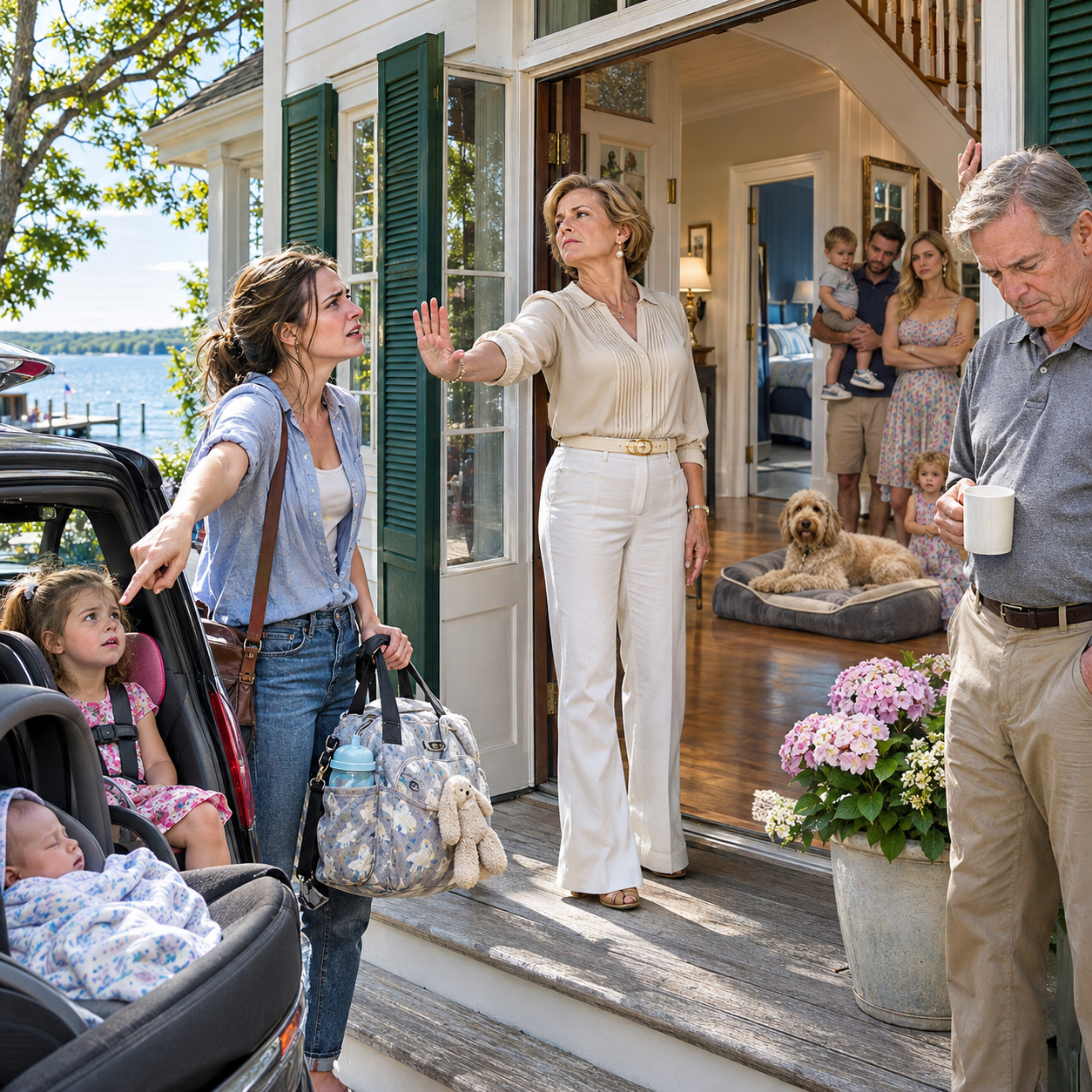
Nine years earlier, I pulled into my grandmother’s cottage driveway on Torch Lake, Michigan, with a screaming newborn and a three-year-old who had been singing about fish for most of the three-hour drive from Lansing. My mother, Sheila Novick, came down the porch steps holding a dish towel, glanced through my windshield, and stopped smiling. “Alyssa, sweetheart, your children aren’t welcome here,” she said, as casually as if she were telling me the grocery store had closed. My daughter Callie pressed her little palm against the window, waiting for Grandma to open the door.
“Mom, it’s the Fourth of July,” I said, stepping out with Elijah’s diaper bag cutting into my shoulder. “You knew we were coming.” She folded the towel and explained that my sister Miriam’s two-year-old twins needed their routines, and a six-week-old baby would disturb everyone. When I suggested Callie and I use Grandma’s empty blue bedroom while Elijah slept in his bassinet, her expression hardened. “That room stays untouched out of respect for your father,” she snapped, just as Miriam’s Goldendoodle, Biscuit, wandered upstairs toward his expensive orthopedic mattress.
The twins each had their own bedroom, Miriam and Tucker had the lake-view suite, and even the dog had a comfortable place to sleep. My children had three car seats’ worth of space between them and a gravel driveway they were apparently expected to leave. I looked toward my father, Marvin, who stood on the porch clutching his coffee mug and staring across the water. He heard everything, but he never came down those steps.
For four summers, the excuses changed while the answer stayed the same. Sometimes the twins were sick, sometimes the plumbing was unreliable, and sometimes Mother simply said it wasn’t a convenient year. I visited alone for a few hours each summer, swam toward the buoy where Grandma once raced me, and sat beside Dad on the dock where she’d taught me to swim. Then I drove home before dark, carrying stories about a beautiful lake my children had never been allowed to touch.
One August evening, Callie waited at our kitchen table with a crayon drawing of the cottage. She’d drawn green shutters, sparkling blue water, and two little faces peering from an upstairs window. “Mommy, why doesn’t Grandma Sheila want us there?” she asked, looking genuinely worried that she’d done something wrong. I held that drawing against my chest and promised her that someday she would have a bedroom near the water that nobody could take away.
That same night, I opened my laptop and began writing a business plan. I’d spent eleven years handling medical billing and insurance appeals, and I knew small clinics were losing money because they couldn’t keep up with rejected claims. My husband, Brooks, an electrician with more patience than anybody deserved, read my notes over my shoulder and asked what we were building. “A house where our children belong,” I answered, and he pulled up a chair.
Five years later, my billing company employed fourteen people and held contracts with three medical groups. We bought an old four-bedroom stilt house in Port St. Joe, Florida, with a screened porch, a view toward the Gulf, and built-in bunk beds. Callie, now eleven, chose the bedroom overlooking the dunes and asked to paint it seafoam green, while eight-year-old Elijah claimed the room where Brooks hung a hammerhead-shark lamp. When we closed in October, I photographed the keys on their little starfish keychain and posted a simple caption: “Every child gets a room.”
Forty minutes later, Mother called, practically bursting with excitement. She wanted to know the number of bedrooms, whether Miriam would like the beach, and how everyone could arrange their Christmas flights. Then she announced that she’d already invited twenty-two relatives and would handle the sleeping arrangements herself. Miriam and Tucker would take the main bedroom, the twins would get the bunks, and my parents would use whatever remained.
“Where would Callie and Elijah sleep?” I asked. Mother softened her voice. “Wouldn’t it be easier for them to stay with Brooks’s mother that week? Then the adults can enjoy themselves.” I stared at the unopened seafoam paint can outside Callie’s bedroom and felt the last of my childhood excuses collapse. “You’re asking me to remove my children from their own home,” I said, and ended the call before she could explain why I was being unreasonable.
In the family chat, her Christmas announcement already had excited replies and two confirmed flight bookings. Brooks found me on the porch writing down nine households, and I spent the evening calling every one of them personally. I apologized for the unauthorized invitations, explained that Christmas wouldn’t be hosted at our house, and reimbursed the two cousins who’d booked tickets for $340 in change fees. Most relatives understood, until my father’s sister in Arizona told me Mother had claimed I was begging her to organize Christmas.
Then my aunt said something that made my fingers tighten around the telephone. “Alyssa, we always thought you were too busy to bring the children to the lake. Sheila said you didn’t want to come.” Four summers of watching my children get turned away, and Mother had told everyone I was the one choosing not to visit. I sat in the darkness beside my sleeping husband, realizing she’d never merely locked a cottage door against my children; she’d made sure the rest of the family believed I had closed it myself.
### Part 2: A Stranger’s Review Exposed the Secret My Mother Hid
By seven the next morning, Mother had posted a photograph of herself with Miriam’s twins on the dock, accompanied by a complaint about daughters who become successful and forget their parents. Brooks read it while making coffee and said, “She’s still charging you for changing your diapers thirty-six years ago.” I laughed despite myself, but the amusement vanished when Miriam called demanding to know why I’d ruined her children’s Christmas. When I reminded her that her twins had enjoyed the cottage every summer while mine weren’t allowed through the door, she complained that Biscuit had been looking forward to Florida, too.
Three days later, Brooks’s mother phoned from her little kitchen in Lansing. My mother had contacted her directly, asking her to keep Callie and Elijah for Christmas so the grown-ups could enjoy our beach house without interruptions. “I told her I’d be spending Christmas with those children,” she said pleasantly, “in Florida, in the bedroom you already promised me.” I laughed until my eyes filled, and she let the silence settle before adding, “Those babies know they’re loved, Alyssa. Don’t let anyone convince you otherwise.”
Ten days later, our property manager in Port St. Joe called with news that chilled me. A woman identifying herself as my mother and a co-owner had requested the house’s entry code so she could send decorators inside before Christmas. When questioned, she’d insisted she was an experienced, highly rated vacation-rental host who understood property management. I immediately changed the codes, sent written instructions that only Brooks and I could authorize access, and asked the manager to alert us if anyone attempted to enter.
But one phrase kept circling my mind: highly rated vacation-rental host. My parents owned their house in Traverse City, and Dad held the deed to the cottage on Torch Lake. As far as I knew, Mother had never rented a property in her life. That afternoon, I opened a vacation-rental website, searched Torch Lake, and nearly dropped my phone when my grandmother’s green shutters appeared on the screen.
The listing advertised a beautiful bedroom in a historic lakeside cottage for $210 a night, hosted by Sheila, with 138 reviews. Behind the advertised bed was Grandma’s handmade wedding-ring quilt, complete with the little blue patch she’d stitched decades earlier. I scrolled through photographs of the familiar hallway and the room my mother had declared too sacred for her own grandchildren. Then I began comparing guest-review dates against old messages on my phone, and the pattern emerged with terrible precision.
Brooks was in the garage repairing a neighbor’s ceiling fan when I showed him the screenshots. He stared at them, lowered his screwdriver, and asked whether my father knew. “I don’t think so,” I whispered, remembering him standing helplessly on that porch with his coffee. Brooks suggested calling him immediately, but I knew Mother would have time to invent another explanation before I could look Dad in the eyes.
That weekend, my father called to invite us to Thanksgiving, explaining that Mother wanted me to apologize to the family for canceling Christmas. I agreed because I wanted everyone who’d heard her stories to hear the same facts at once. Brooks asked whether confronting her publicly would simply become revenge, and I admitted the question deserved an answer. Revenge would have been humiliating her online; I wanted to make sure she couldn’t keep dividing the family with different versions of the truth.
Mother texted the dinner time with one final instruction to bring a pumpkin pie rather than create a scene. Our children would stay safely with Brooks’s mother, away from whatever happened at that table. The night before Thanksgiving, Callie found me packing and handed me her old crayon drawing of the cottage, carefully preserved for five years in a shoebox. “You don’t have to show it,” she said, “but I think you should take it.”
I folded the paper into my coat pocket, beside the phone holding every screenshot. For years I’d worked in medical billing, finding the truth by matching dates, documents, and numbers that other people overlooked. This time, the evidence concerned my children’s childhoods, and I had never needed an answer more.
### Part 3: Twenty Thanksgiving Guests Heard the Truth About Grandma’s Bedroom
Snow dusted the roads when Brooks and I arrived at my parents’ house on Thanksgiving afternoon. Twenty relatives filled the living room, the television showed the Lions game, and Biscuit lay beside the fireplace on a brand-new plaid orthopedic bed. Mother accepted my pumpkin pie without embracing me, then pointed toward a folding card table squeezed beside the kitchen doorway because the main table was supposedly full. My aunt from Arizona noticed where I’d been seated and immediately brought her plate over to join me.
After dinner was served, Mother stood and tapped her glass, smiling as she praised our family’s tradition of making room for everyone. Then she gestured toward me and announced that I had an apology to offer. Twenty faces turned as I rose, but instead of apologizing, I asked Dad why nobody had ever been permitted to sleep in Grandma’s blue bedroom. He confirmed that it had supposedly remained untouched since his mother’s death.
I opened the rental listing on my phone and told everyone about Mother’s attempt to obtain access to my Florida property. “She said she was an experienced rental host, so I checked,” I explained, showing the screen. “Here’s Grandma’s bedroom, advertised for two hundred ten dollars per night, with a hundred thirty-eight guest reviews.” Mother’s smile vanished, and she ordered me to sit down, but I read the first review aloud: a Fourth of July visitor describing the wonderful experience of sleeping beneath Grandma’s handmade quilt.
“That was the holiday I drove here with Callie and newborn Elijah,” I said, facing Dad. “You watched us leave because Mother said the room couldn’t be used.” Another guest had described the friendly Goldendoodle sleeping outside the bedroom door, and a nervous chuckle escaped one cousin before dying away. Mother insisted the pictures could belong to any cottage, so I enlarged the photograph showing the cracked corner of Grandma’s window and the distinctive blue patch in her quilt. Dad came around the table, studied my phone, and whispered, “That’s my mother’s quilt.”
Then I read the review that had hurt most: a guest remembering how the host joked that even her own grandchildren weren’t allowed to sleep in that special bedroom. I laid Callie’s drawing beside the phone, with its two little faces in the upstairs window. “This was the summer my daughter asked what she’d done wrong,” I said. Across the room, even the television seemed silent as nobody looked away from my mother.
She sprang to her feet, demanding to know whether anybody understood the cost of maintaining a lake house. The property taxes, the dock repairs, the roof—someone had to pay for them, she shouted, and she wasn’t sacrificing a profitable guest room to children who might spill juice on the bed. “So my children weren’t excluded because the room was sacred,” I said. “They were excluded because strangers could pay, and my children couldn’t.”
Miriam muttered that it was only a bedroom, but my aunt asked how she’d known about the rentals when the rest of us hadn’t. Tucker turned toward his wife, then realized the money Mother had supposedly given them from her personal savings for their house down payment had come from renting the cottage. Dad’s face darkened as he reminded Mother that the lake association prohibited rentals shorter than thirty days and that the deed was in his name. He held out his phone and demanded that she remove the listing immediately, while everyone watched.
I picked up Callie’s drawing and faced the family one last time. “I didn’t cancel Christmas because I hate any of you,” I said. “I canceled it because my mother tried to give away my children’s home, just as she’d sold strangers the bedroom she wouldn’t let them use.” I invited anyone who genuinely wanted a relationship with Callie and Elijah to contact me directly, then took Brooks’s hand and walked outside.
Dad followed without a coat, snow gathering on his glasses as he insisted he hadn’t known about the rental business. I believed him, but I reminded him that he’d witnessed the first rejection and done nothing. His eyes filled, and he admitted that his silence belonged to him alone. When he asked to see the children again, I told him he could start by calling them, learning about their lives, and discovering why Elijah loved sharks.
For the first time since Grandma died, Dad stepped off that porch instead of remaining behind its railing.
### Part 4: The Doors Finally Opened When My Father Chose His Grandchildren
The rental listing disappeared before Brooks and I reached Lansing. A week later, Dad reported the violations to the lake association himself, accepting an $8,400 fine that he paid from the remaining rental proceeds. By New Year’s, he’d moved into the cottage and arranged for it to be placed in a trust benefiting all four grandchildren equally, with my aunt and me serving as trustees. Mother remained in the Traverse City house, and for the first time, she no longer controlled who received a key to Grandma’s cottage.
Dad began calling Callie every Sunday evening, awkwardly asking about school until their conversations gradually grew longer. He sent Elijah a hardcover encyclopedia of sharks with a handwritten invitation to teach his grandfather something new. Miriam spent Christmas with Mother, while Tucker took their twins to his parents in Ohio. I sent the twins Christmas cards and small gifts because they had never been responsible for their grandmother’s decisions.
On December twentieth, we drove to Florida with Brooks’s mother and a cooler of deviled eggs tucked between her feet. My aunt and her husband arrived two days later, and every bedroom had someone’s name taped to its door. Then, on December twenty-third, Dad pulled into the driveway after driving nearly two days with his bad knee aching. He climbed out carrying a large bundle wrapped in clear plastic, looking more nervous than I’d ever seen him.
Callie met him on the porch, and he carefully uncovered Grandma’s handmade wedding-ring quilt. “Your great-grandmother would have wanted this on your bed years ago,” he told her, his voice trembling. “I should have brought it to you sooner, sweetheart, and I’m sorry.” Callie carried the quilt into her seafoam-green bedroom, spread it beneath the window, and returned to wrap both arms around his waist. I watched my father finally give my daughter something I’d wanted her to have since she was three: the unmistakable feeling that she belonged.
Mother called on Christmas afternoon, demanding to know whether Dad was staying with us and where he was sleeping. “He has his own room,” I answered from the screened porch, watching Elijah explain tiger sharks to his grandfather. Mother grew quiet before admitting that she was alone for Christmas and thought I’d been terribly cruel. I told her my children had spent years wondering why they weren’t welcome, and that I would no longer make them responsible for her feelings.
The following July, Dad invited Callie and Elijah to spend a week with him at Torch Lake. I drove them up the familiar gravel driveway, remembering the newborn crying behind me and the little girl who had once pressed her palm against the car window. This time, Dad was waiting at the bottom of the porch steps, smiling as he helped carry their bags upstairs. That evening, Callie texted me a photograph of herself and Elijah sitting beneath another quilt Grandma had made, their faces framed by the blue bedroom’s old window as golden sunlight spread across the lake.
I opened her childhood drawing and placed it beside the photograph on my kitchen table. The same green shutters, the same water, the same two children in the upstairs window—but this time, it was real. Mother never apologized, and I eventually stopped expecting her to. I had built my children a home where love didn’t come with a nightly rate, and my father had finally learned to open the door.
For years, I’d believed being a good daughter meant accepting whatever space my mother decided I deserved. But watching my children smile from that upstairs window taught me something different. Family isn’t measured by how many rooms a house contains, but by who is welcomed inside.
And sometimes, the most important door you ever open is the one you finally stop begging someone else to unlock.
THE END.
All characters and events in this story are fictional, created for storytelling and entertainment purposes. Thank you sincerely for reading. Your feedback and support are invaluable and motivate me to continue sharing more stories with you.