## Part 2: A hidden land-grab scheme reveals six families’ stolen homes.
By November, Cheryl had transformed me from a lifelong neighbor into Pine Valley’s most feared resident.
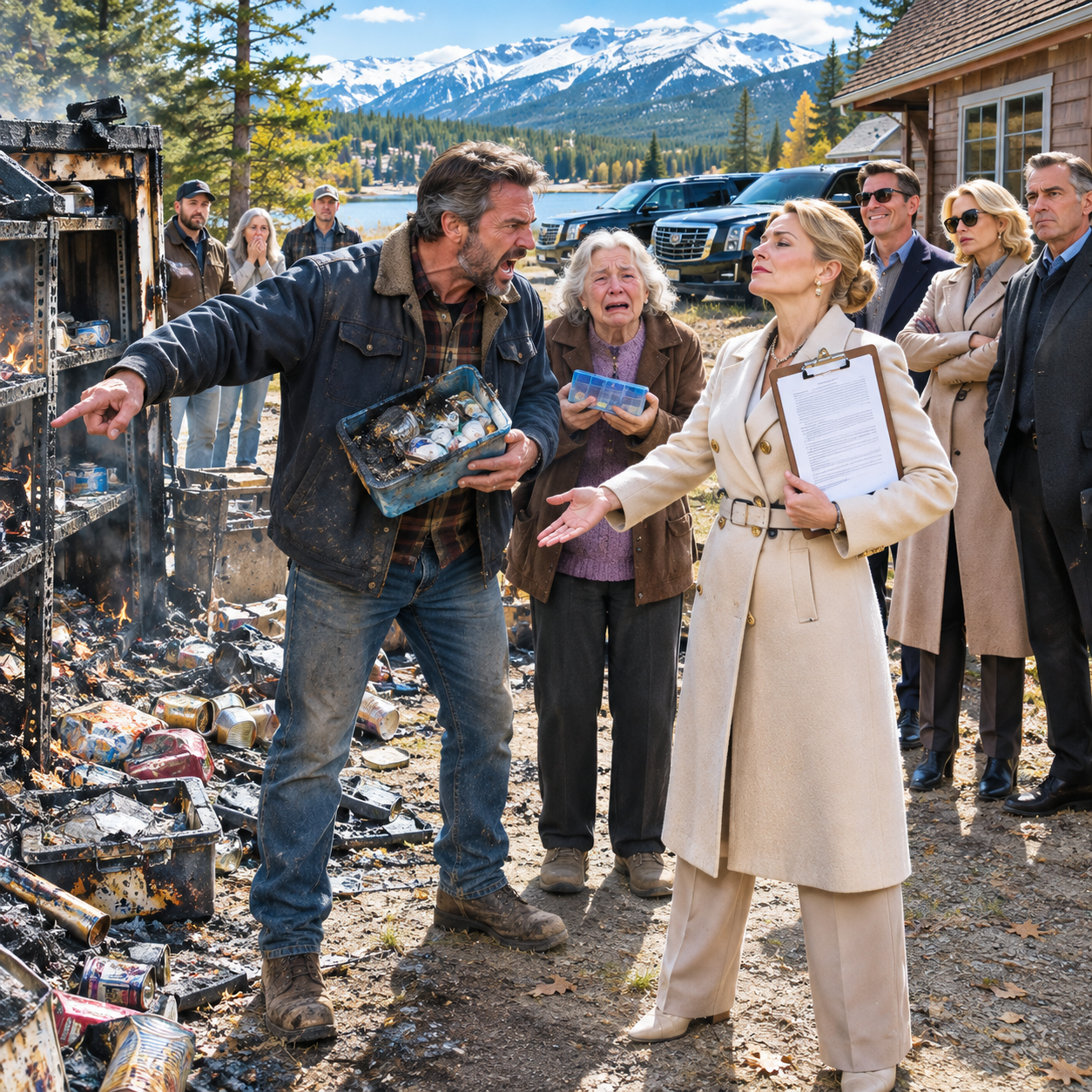
At a crowded HOA safety meeting, she displayed photographs of my burned supplies across a giant screen. Carefully cropped images made propane cylinders look like bombs and neatly stacked food containers resemble filthy garbage. Nobody mentioned that the photographs had been taken after her own contractors destroyed everything.
“Residents deserve protection from dangerous hoarding,” she told the room.
I stood in the doorway, listening as people I’d helped for fifteen years nodded in agreement.
Within days, the hardware store stopped selling me emergency equipment. The pharmacy demanded additional verification for my mother’s prescriptions, and our longtime home health aide resigned after receiving anonymous warnings about unsafe conditions. Neighbors who once waved from their porches suddenly looked away when I passed.
One evening, Mom stood at the kitchen window watching snow gather on the branches.
“Did I do something wrong?” she whispered. “Nobody visits anymore.”
I held her hand until the shaking stopped.
Then I called a property attorney.
We examined three years of land transfers, searching for anything connecting Cheryl’s accusations to the original development agreements. The first suspicious sale belonged to Mrs. Patterson, an elderly diabetic woman who’d surrendered her home after repeated complaints about improperly stored medical supplies.
The second involved Mr. Rodriguez, whose wood-burning stove had supposedly endangered neighboring properties.
Then came the Williams family, an elderly couple cited repeatedly over zoning violations involving their vegetable garden.
Three more families had suffered similar treatment.
All six had faced manufactured violations, escalating financial penalties, and pressure to leave their homes. Each eventually sold to the same company, Pine Valley Properties LLC, at prices thirty to forty percent below market value.
My attorney slid the company’s ownership documents across his desk.
“Look at the managing partners.”
There were four signatures.
Cheryl Kensington. Trevor Ashworth. Marissa Vale. Douglas Whitfield.
I stared at their names, remembering Cheryl’s satisfied expression beside my burning winter supplies.
“They didn’t want me to clean up my property,” I said.
“No,” my attorney replied. “They wanted you desperate enough to sell it.”
The company had generated more than two million dollars in profit by buying distressed properties and reselling them as expensive mountain retreats.
And I was their next acquisition.
In December, I contacted the displaced families. Mrs. Patterson cried when I described my mother’s ruined medicine boxes; Mr. Rodriguez sent photographs of his supposedly dangerous stove. The Williams family provided letters showing how quickly harmless gardening complaints had become threats of foreclosure.
We assembled a growing case file containing property transfers, financial records, correspondence, and coordinated complaints.
Then my attorney discovered another detail.
All four board members had arranged extended Hawaii stays covering much of the winter.
While they condemned my emergency preparations, they left their luxury homes practically empty, trusting automated heating systems to survive the blizzards. They’d destroyed the supplies my mother needed, then escaped to sunshine while year-round residents struggled through storms.
By February, our legal team had referred evidence of the property scheme to federal investigators.
I thought the pressure might finally make Cheryl retreat.
Instead, she escalated.
On a freezing Thursday morning, an Adult Protective Services worker arrived at our house carrying a complaint about my mother’s living conditions.
The woman was polite, but her questions were devastating.
“Can you adequately care for your mother during emergency weather?”
I showed her the new medication schedule, prescription records, backup food supplies, and winter safety arrangements I’d spent months rebuilding.
Mom sat in her favorite chair, twisting a handkerchief.
“Are they taking me away?” she asked.
“No, Mom.”
The worker glanced down at her paperwork.
Cheryl had claimed that my irresponsible behavior endangered an elderly woman with dementia.
A week later, my attorney called with worse news.
The HOA had petitioned for emergency seizure of our property and transfer of the associated water-management authority. Their hearing was scheduled for March 15, when the spring thaw would be approaching its peak.
If they succeeded, my mother’s home would be at risk, and our family’s control of the spillway could be lost.
That night, I walked downstairs and opened the metal cabinet holding the old hydraulic control panel.
My grandfather had maintained the spillway for decades, and I’d helped care for it since boyhood. Every spring, the old machinery kept melting mountain snow from swallowing the homes downstream.
Above the switches hung a faded photograph of him standing beside the original flood channel.
I studied the picture, then glanced at the latest weather report.
Record snowpack covered the mountains, and temperatures were expected to rise sharply in March.
Cheryl believed she was preparing to take away our home.
She hadn’t considered what might happen when spring arrived.
## Part 3: Forged flood maps expose the board’s most dangerous deception.
My attorney dropped four elevation certificates onto our kitchen table and looked at me across the paperwork.
“These houses should never have received those permits.”
The documents belonged to Cheryl, Trevor, Marissa, and Douglas. Each certificate placed its mansion safely above the original floodplain, but independent survey records showed something very different.
Their homes stood directly inside the permanent drainage easement established in 1962.
Someone had altered the elevation information.
Douglas Whitfield, the HOA secretary, had previously worked as an insurance adjuster. He knew exactly how flood classifications affected building permits, insurance rates, and property values. Investigators were now examining whether he’d helped arrange the falsified certificates.
My attorney pointed to the original survey.
“These properties obstruct a drainage route that existed long before the development.”
I traced the blue channel with my finger.
“And when we have a heavy snowmelt?”
“Water still has to go somewhere.”
For forty years, the Garrison spillway had directed excess lake water through that historic channel to protect downstream residents. The system wasn’t a decorative feature owned by the HOA; our family retained its operating rights, and county emergency plans recognized its role during severe weather.
The four board members had bought luxurious homes without respecting the land beneath them.
Worse, their flood insurance relied on inaccurate information.
My attorney’s expression turned grim.
“If the insurers discover these certificates were falsified, their coverage could be invalidated.”
I wanted to smile.
Then I remembered my mother asking whether strangers were coming to take her house, and the feeling disappeared.
This was no longer just about my stockpile.
Six families had lost their homes to people who treated human suffering as a business opportunity.
We submitted the fraudulent records to investigators and expanded our civil complaint. Meanwhile, the board continued insisting that I was mentally unstable, pointing to my weather monitoring and spillway maintenance as evidence of threatening behavior.
Their private investigator was supposed to prove it.
Instead, his report documented months of careful inspections, maintenance records, and forty years of accident-free water management.
During a preliminary hearing, my attorney presented those photographs to the judge.
“Mr. Garrison monitors the weather because the community depends on him doing exactly that.”
The judge examined the records.
“You’re asking me to regard responsible flood monitoring as dangerous behavior?”
Cheryl’s lawyer began explaining my supposed obsession with the lake.
The judge interrupted him.
“Wouldn’t failing to monitor snowmelt be the more serious concern?”
For the first time, Cheryl looked uncertain.
On March 10, her lawyers obtained a temporary order restricting my spillway operations while the property dispute continued. The county water authority immediately challenged it, explaining that preventing emergency drainage during an approaching thaw could put residents at risk.
The order was rescinded within hours.
Three days later, Channel 7 News aired an investigative report about Pine Valley Properties LLC.
Mrs. Patterson described losing her home after false medical storage complaints. Mr. Rodriguez displayed the notices that had forced him to sell, and the Williams family described the threats surrounding their garden.
Cheryl had invited television cameras to our March 15 hearing, expecting them to expose me as a dangerous hoarder.
Instead, she’d invited the world to witness her own unraveling.
The mountains were delivering another warning.
Snowpack measurements were far above normal, and the forecast called for temperatures approaching seventy-two degrees. On March 13, I began preliminary drainage operations under the established emergency plan, opening the spillway to manage the initial runoff.
The county emergency manager reviewed our readings and issued alerts to properties near the flood channel.
Our family home was on higher ground. The four luxury mansions were not.
Two days before the hearing, I drove past Cheryl’s property.
Through enormous windows, I could see her expensive furniture, polished marble floors, and the staircase descending toward her underground wine cellar. A bright real estate sign advertised neighboring lakefront properties as protected mountain investments.
I wondered whether anyone inside those houses had ever read the original flood maps.
That evening, my mother found me studying the weather beside the basement door.
“Your grandfather always worried about the spring water,” she said.
I looked up, surprised by the clarity in her voice.
“He said the mountain remembers where the creek belongs.”
I took her hand.
“Yes, Mom. It does.”
She studied me for a moment before asking, “Is everything ready?”
I glanced at the pressure readings, the county warnings, and the weather reports.
“Everything that can be done safely,” I answered.
Outside, water dripped from the roof in a steady rhythm.
For the first time all winter, the lake sounded restless.
## Part 4: The spillway opens, exposing the truth beneath their mansions.
At 9:45 on March 15, I stood in our basement and placed my hand on the old spillway controls.
The morning sun burned through the mountain haze, and the temperature was climbing toward seventy-two degrees. Overnight, melting snow had swollen the lake and pushed runoff toward levels our valley hadn’t seen in decades.
The county emergency manager had confirmed that the designated flood channel needed to carry the excess water to protect downstream homes. Warnings had gone out, emergency crews were monitoring the affected area, and the most vulnerable properties had been told to stay clear.
I activated the authorized full-release operation.
Deep beneath the hillside, the spillway gates opened.
Water thundered into the old drainage channel.
My grandfather had warned developers decades earlier that no building should obstruct that route. The board’s mansions stood directly in its path.
At ten o’clock, I entered the Pine Valley Community Center carrying a folder of deeds, engineering records, and photographs.
Nearly eighty residents filled the room. Channel 7 cameras faced the podium, where Cheryl stood confidently beside Trevor, Marissa, and Douglas.
She wore the same cream-colored coat she’d worn when my winter supplies burned.
“Mr. Garrison’s conduct has endangered this community,” she announced, gesturing toward me. “We’re asking for intervention before his instability causes permanent damage.”
My attorney rose.
“Before proceeding, Your Honor, we’d like to submit the original flood easement, corrected elevation surveys, and evidence concerning the association’s property acquisitions.”
Cheryl’s smile vanished.
At 10:30, her phone rang.
She ignored it.
It rang again.
Then Trevor’s phone began vibrating across the table.
Marissa stepped outside to answer a call, returning moments later with her face drained of color.
“Cheryl,” she whispered, “there’s water in my basement.”
Trevor jumped to his feet when his property manager reported that the underground garage was flooding.
Douglas stared at photographs appearing on his phone.
The old channel was carrying the released snowmelt exactly where the maps showed it would go. Unfortunately for the four board members, their illegally constructed basements occupied that drainage corridor.
At Cheryl’s mansion, icy water rushed into the wine cellar, surrounding an $85,000 collection of rare bottles.
Trevor’s basement theater, containing $180,000 worth of televisions, leather seating, and sound equipment, disappeared beneath rising muddy water. His oversized heated pool overflowed while his garage filled.
Marissa’s underground spa, with its imported sauna and hot tubs, suffered catastrophic damage to equipment valued at approximately $220,000.
Douglas’s vacation rental basement flooded around more than $150,000 in furniture and equipment.
Across the four properties, the water eventually reached nearly thirty inches in the lowest rooms.
Cheryl turned toward me.
“You knew this would happen!”
The cameras swung in our direction.
“I knew the snow was melting,” I replied. “I knew the county needed the spillway operating, and I knew your houses were sitting in a recorded flood easement.”
“You opened it deliberately!”
“Under the emergency drainage plan. After the county issued warnings.”
I placed forty years of maintenance records on the table.
“My grandfather warned the developers about that flood channel in 1985. Whoever altered your elevation certificates didn’t make the water change direction.”
A silence settled over the room.
My attorney opened another folder.
“And now we’d like to discuss Pine Valley Properties LLC.”
He displayed the financial records connecting the four HOA officers to six below-market property purchases.
Mrs. Patterson stood from the audience.
“That’s the company that bought my house.”
Mr. Rodriguez rose beside her.
“And mine.”
Cheryl looked toward the television cameras, suddenly realizing how many people had come prepared to speak.
The judge halted the property-seizure proceeding and ordered the evidence preserved for further review.
By afternoon, emergency crews confirmed that downstream homes had been protected, although the four luxury properties suffered extensive flooding. Insurance investigators arrived to examine the elevation certificates, followed by federal agents already investigating the land transactions.
Cheryl’s mansion stood behind a barricade, muddy watermarks climbing its basement walls.
She stared at the damage without speaking.
For once, she had nothing to say about property values.
The board’s financial collapse followed quickly. Insurers disputed the claims after discovering falsified elevation records, leaving approximately $2.8 million in uninsured losses.
Federal prosecutors brought conspiracy and fraud-related charges, supported by financial records, witness testimony, and internal company documents describing a strategy of pressuring vulnerable residents to sell.
Cheryl eventually pleaded guilty to conspiracy and elder-abuse-related charges and received a three-year federal prison sentence. Trevor faced additional insurance fraud charges, Marissa’s development company collapsed under investigation, and Douglas lost his real estate license.
But the final revelation arrived during the civil proceedings.
Investigators recovered an internal memorandum describing our property as the last essential parcel needed to consolidate control of the lake and spillway. The board had never planned simply to make me sell my house.
They’d planned to acquire the water rights, change the development restrictions, and eventually market the entire lakeshore as an exclusive luxury resort.
My mother’s home was the final obstacle.
And that explained why they’d been so desperate to remove us.
Our civil case settled for $850,000, with additional restitution bringing our total compensation above one million dollars. The six displaced families received settlements of their own, and the fraudulent purchases became central evidence in further proceedings.
Mrs. Patterson bought another home. Mr. Rodriguez restored his mountain retirement, and the Williams family finally planted a garden without asking anyone’s permission.
The old HOA was dissolved and replaced by a resident council with representation for elderly and disabled homeowners.
I used part of our settlement to establish the Mountain Winter Preparedness Fund, providing emergency supplies, medical equipment, storm transportation, and legal assistance to vulnerable families.
Neighbors who’d believed Cheryl’s lies came to apologize. Some brought food; others helped rebuild the storage shed behind our house.
By the following winter, every shelf was filled again.
One afternoon, I caught my mother carefully arranging her familiar blue medicine containers along the kitchen counter.
She looked up at me.
“Wade, did those people ever take our house?”
I walked to the window and pointed toward the mountains.
“No, Mom. They didn’t.”
She smiled, then returned to arranging her boxes.
That evening, we sat together on the porch overlooking Pine Valley Lake. The water shimmered beneath the setting sun, and the mountains stood quiet beyond the rooftops.
The four damaged mansions were being repaired or reassessed under proper flood restrictions. The spillway remained under lawful management, protecting families who understood that no beautiful view was worth another person’s safety.
Mom rested her hand over mine.
“Your grandfather would be proud,” she said.
I watched the current glide beneath the old bridge.
For months, I’d wanted revenge against the people who burned our winter supplies, threatened my mother’s safety, and tried to steal everything our family had built.
But sitting beside her, I finally understood what mattered.
Cheryl had measured power in property values, bank balances, and the number of people she could frighten.
My grandfather had measured it differently.
He’d believed that a man’s greatest responsibility was protecting the people who trusted him.
The mountain hadn’t taken sides.
The water had simply followed the path it had always known.
And this time, the truth had followed it.
THE END.
All characters and events in this story are fictional, created for storytelling and entertainment purposes. Thank you sincerely for reading. Your feedback and support are invaluable and motivate me to continue sharing more stories with you.