## Part 2: A forgotten military name reveals the truth behind my silence
Rourke didn’t announce what he knew immediately. He simply said we would talk later, then returned to the equipment table while Brooke called everyone together for the final exercise. Daniel approached me with a suspicious look and asked about the coin, but his attention shifted when Brooke reported that the workshop’s livestream audience had doubled. Within seconds, he was smiling again, preparing for the pressure-test demonstration that would put his company before hundreds of potential customers.
The exercise was supposed to teach controlled responses to simulated threats, not reward aggressive performances. Daniel demonstrated several polished movements against Cole, ending with a dramatic wrist lock that brought the former infantryman to one knee. The audience applauded as Daniel invited Brooke, a former police officer, and two donors to participate. Then he turned toward me, raised a rubber knife, and announced that everyone deserved to see what his former wife had learned during her supposedly comfortable military career.
I declined, but he continued talking, turning fifteen years of service into another joke. Lily stood from the bleachers and begged him to stop, while the camera operator shifted closer to capture the confrontation. Daniel ignored her, extended the training knife toward me, and challenged me to prove I had any real experience. I stepped onto the mat because I could see my daughter beginning to mistake my patience for helplessness.
Rourke moved between us before Daniel could begin. His eyes settled on my left hand, where a pale scar crossed the base of my thumb, and suddenly I was remembering a narrow stairwell in Carif Province eight years earlier. Our advisory team had been evacuating a wounded interpreter when an attacker emerged from a doorway carrying a utility knife. There had been no room for elaborate movements, only enough space to pin the blade against a wall, protect the people behind me, and keep moving despite the cut tearing through my glove.
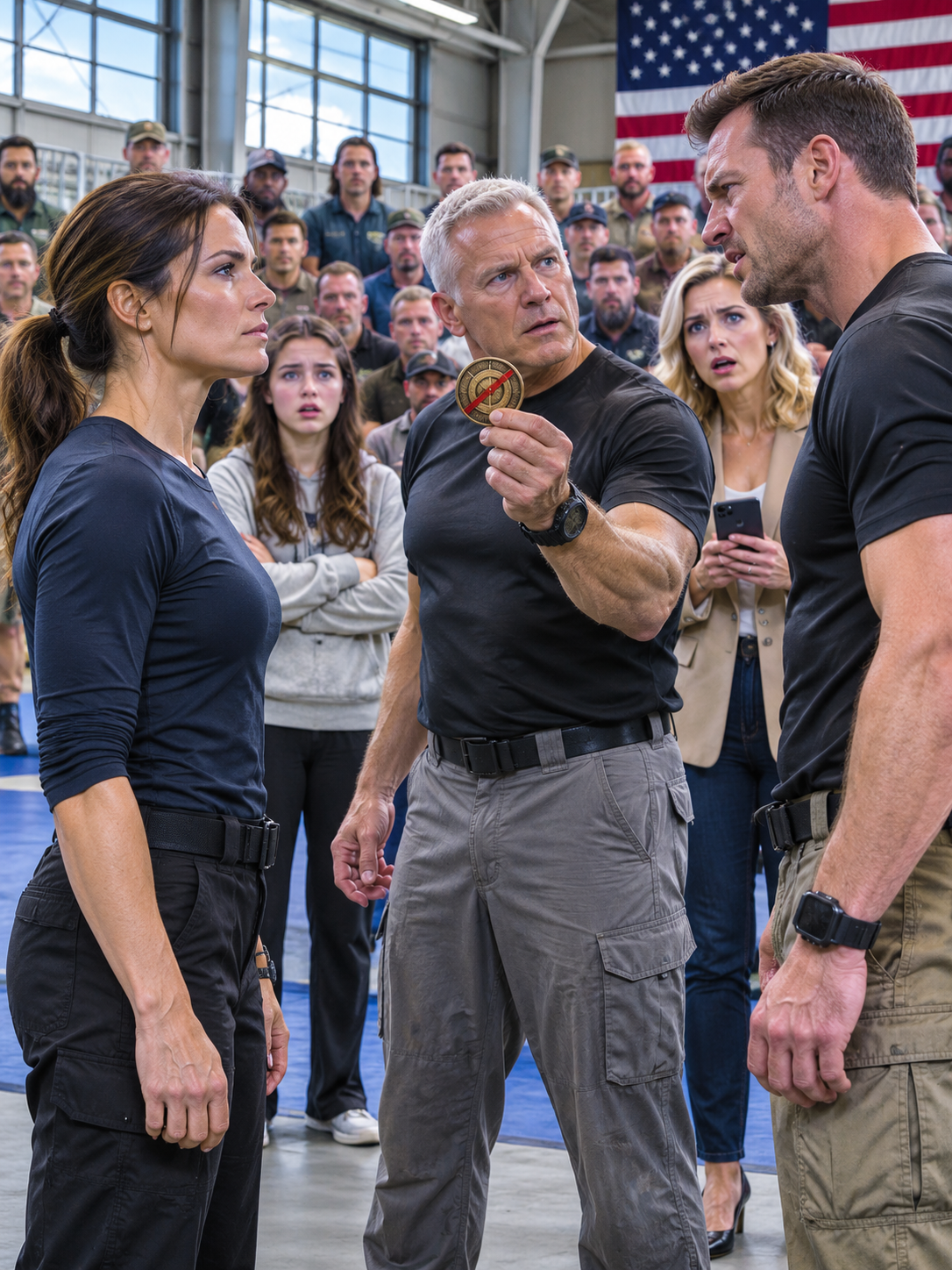
That incident had exposed serious weaknesses in the defensive techniques our teams practiced. Six months later, Colonel Jonah Vale assigned me to a training cell at Fort Halden, where we developed safer close-contact procedures for crowded spaces, injured limbs, and difficult evacuations. Infantry soldiers, military police, medics, and advisers tested every sequence until the movements worked under realistic limitations. Vale called the program Redline because he marked failed techniques with a red stroke, and the first instructors received a bronze coin commemorating the work.
“Major Ellison,” Rourke said, his voice carrying through the hangar, “would you be willing to demonstrate the Redline sequence?”
Daniel chuckled and told him to choose something simple, but the sergeant major’s expression hardened. He explained that the techniques taught throughout the workshop incorporated work developed by my team, including the adjustment I had suggested to Cole earlier. Then he revealed that he had attended the original pilot course, where instructors had spoken with considerable respect about an officer nicknamed Lockstep. “That was you,” he said, and I confirmed it with a quiet nod.
A donor lowered his coffee cup without drinking. Brooke stared at me over her phone, while Daniel insisted that he had always known I worked on training manuals. Rourke corrected him, explaining that I had helped shut down an unsafe early course after three instructors were injured and had rebuilt the program around reliable movement rather than impressive-looking techniques. He added that my team’s findings had helped reduce training injuries and improve preparation across multiple Army formations. For the first time all afternoon, Daniel seemed unable to find anything clever to say.
Rourke offered Cole as my demonstration partner, but Daniel immediately volunteered himself. I agreed only after making the conditions unmistakable: controlled speed, no unexpected resistance, and an immediate stop whenever instructed. Daniel nodded, although the flush rising along his neck told me his pride was already interfering with his judgment. I asked him to make one slow, straight attack with the rubber knife.
He lunged faster than instructed, and I shifted just far enough to secure his weapon hand against my body while turning my hips into a stable position. His forward momentum carried him down onto one knee, with the knife safely immobilized and no painful joint pressure required. I released him immediately and explained that the purpose was to protect vulnerable areas and create an opportunity to escape. Daniel sprang upright, complaining that the exercise had been predictable because I knew his intended movement.
Before Rourke could intervene, Daniel swung the rubber knife from another direction. I moved inside the attack, controlled his arm against his chest, and redirected his balance until the simulated weapon pointed safely away from both of us. A moment later, the knife rested on the mat, and I had already stepped back. Nobody cheered at first, because the controlled simplicity of the demonstration had made Daniel’s earlier performance look unnecessary.
Then Cole began applauding, and the sound spread through the bleachers. Rourke remained motionless until the room quieted, then straightened and offered me a deliberate military salute. I returned it, understanding that the gesture represented respect for shared service rather than ceremony. Daniel stood several feet away, staring at the woman he had spent years describing to others, and realizing that nearly everything he had confidently assumed about me was wrong.
## Part 3: My daughter’s quiet choice exposes the betrayal I endured
Rourke addressed the audience once more, explaining that I had completed three combat deployments as an adviser and operations officer. He made it clear that my training contribution had been practical, tested under demanding conditions, and respected by soldiers who depended on those techniques. When he began mentioning additional accomplishments, I gently interrupted and told him he had said enough. His immediate acknowledgment struck Daniel harder than the demonstration, because the most respected man in the hangar had accepted my boundary without hesitation.
Daniel finally approached me, his voice strained with disbelief. “Why didn’t you ever tell me any of this?” he demanded, looking toward the cameras as though searching for a way to recover the afternoon. I reminded him of the night I returned from Carif, when I had tried to explain that something terrible had happened during an operation. He remembered being angry because I had missed one of his company dinners, but he could not remember asking whether I was injured.
“You told me it was confidential,” he protested, and I studied the man I had once trusted with my entire life. “The operation was confidential, Daniel,” I answered. “Whether your wife was hurting wasn’t.” His expression tightened, and he whispered that we should not discuss our marriage in front of strangers.
I looked toward the bleachers, where Lily was watching with tears shining in her eyes. Daniel had spent hours discussing my supposed inadequacies before donors, instructors, reporters, and our daughter, yet now he wanted the protection of privacy. When he accused me of deliberately allowing him to embarrass himself, I reminded him how many times I had asked him to stop. He could not answer without admitting that he had valued his performance more than my dignity.
Lily crossed the mat and reached for my hand. Her fingers settled gently over the scar on my thumb, and she leaned against my shoulder without speaking. Daniel watched us, his face changing as he understood that the afternoon had not merely damaged his reputation. He had placed his own need for admiration above his daughter’s trust.
The livestream ended shortly afterward, although several attendees had already recorded portions of the exchange. Rourke replaced the remaining pressure tests with a discussion about safe defensive training, and I agreed to help under one condition: nobody would be used as a prop for somebody else’s ego. We spent forty minutes discussing distance, barriers, exits, and the danger of techniques that depended on unrealistic cooperation. Denise demonstrated a modified movement that protected her injured shoulder, while Lily explained why recognizing an exit could be more valuable than winning a confrontation.
At the end, Rourke approached Lily with the original Redline challenge coin. He placed the worn bronze piece in her palm and explained that her mother had helped develop a system designed to bring people safely home. Lily looked toward me for permission, and I nodded as she closed her fingers around it. Daniel stood nearby, listening silently to a lesson that years of marriage had somehow failed to teach him.
Two days later, Vantage Shield released a carefully worded statement apologizing for an uncomfortable personal exchange at the fundraiser. Daniel had drafted it to suggest we shared responsibility, but Brooke refused to approve that version. She called me that evening, her polished confidence replaced by a voice that sounded tired and uncertain. “I believed everything he told me about your service,” she admitted, “and I laughed when I should have questioned him.”
I told her that loving someone often meant trusting their account of events, but trust did not excuse cruelty. Brooke asked whether I had been afraid of physically hurting Daniel during the demonstration, and I explained that my greater fear had been forcing Lily into a public choice between her parents. The line went quiet for several seconds. A week later, Brooke postponed their wedding, not because I had requested anything, but because she had watched Daniel disregard safety instructions and then blame someone else for the consequences.
The rehabilitation center kept the fundraiser’s donations but removed Daniel from its advisory committee. Its director explained that an organization supporting veterans could not comfortably endorse someone who publicly mocked another veteran’s service. Brooke also withdrew from Vantage Shield’s instructor roster, while Daniel accused me of destroying everything he had built. I answered with a short message reminding him that he had been given repeated opportunities to stop, and then I refused to continue the argument.
The video spread through the community anyway. Strangers praised me, while others invented stories claiming I had served in special forces or performed impossible battlefield feats. I corrected those claims whenever possible, because I had served as an Army officer alongside capable soldiers, not as the fictional warrior strangers wanted to celebrate. My Bronze Star remained inside its wooden case, and I wanted it to stay there.
Three weeks after the fundraiser, Daniel requested a meeting with our family counselor. Without cameras, company logos, or spectators, he sat across from me in an ordinary office and admitted that he had embarrassed Lily. When I asked whether he remembered her begging him to stop, he stared at his hands and acknowledged that he had heard her. Then he asked a question I had never expected: “Did you ever respect what I did in the military?”
I told him I had always respected his service. His career had been different from mine, but difference had never made his contribution worthless. The tragedy was that he had spent our marriage treating recognition like a limited resource, as though acknowledging my accomplishments would somehow erase his own. Daniel lowered his eyes, and for once, he did not argue.
## Part 4: A final lesson transforms public humiliation into lasting respect
The counselor helped us establish boundaries that mattered far more than public apologies. Daniel agreed to stop making statements about my military career to Lily without my involvement, and he enrolled in individual counseling to examine the insecurity he had disguised as confidence. He also stepped away from hands-on instruction until an independent assessor could evaluate his teaching and safety practices. I did not mistake those decisions for complete transformation, but they were concrete commitments that our daughter could measure through his behavior.
Six months passed before I returned to the same aircraft hangar. The enormous Vantage Shield banners had disappeared, replaced by modest signs identifying a quarterly training program operated directly by the veterans rehabilitation center. Rourke had invited me to help develop sessions for teenagers and family caregivers, focusing on awareness, escape, and safe responses to emergencies. I had declined similar public opportunities before, but Lily wanted to assist, and her enthusiasm made the decision unexpectedly easy.
On the morning of our first class, I found her standing inside the familiar padded circle. She wore simple athletic clothes, with the Redline coin hanging from a cord beneath her shirt, and she held a rubber knife carefully at her side. “Can we practice that movement again?” she asked, adjusting her feet into a position I recognized from our kitchen rehearsals. I nodded, and she advanced slowly while I guided her arm away from the center of my body.
On her second attempt, she corrected her stance before I touched her. Rourke watched from beside the equipment table, smiling as Lily stepped back and checked the distance between us. He remarked that she learned quickly, and I told him she had always been exceptionally observant. That was when I noticed Daniel entering through the rear doors.
He arrived ten minutes before the session, wearing ordinary jeans and a blue shirt without patches or company markings. There was no photographer following him, no confident announcement, and no attempt to take control of the room. He stopped near the mat and watched Lily complete another careful repetition. Then, instead of correcting her, he asked whether she would mind if he sat and observed.
Lily considered him for several seconds. “You can watch, Dad,” she answered, “but you have to listen to what we’re teaching.” Daniel nodded and told her he understood, then walked quietly to the second row of bleachers. His willingness to accept that small condition did not erase years of hurt, but I saw Lily’s shoulders relax as she returned to the exercise. Sometimes a damaged relationship begins changing through the simple act of honoring a boundary.
The session went better than I expected. A grandmother learned how to position herself near an exit without aggravating an old knee injury, while a father practiced guiding his teenage son away from a simulated disturbance. Denise returned to demonstrate the adaptation we had developed for her shoulder, and Cole helped participants understand why measured movements were safer than forceful ones. As I watched the families practice, I realized that the work I had once considered finished was becoming useful in a different way.
After the final exercise, Daniel waited until the other participants had cleared the mat. He approached Lily first and told her he was proud of the way she had helped the younger students. Then he turned toward me, hesitating as though he had rehearsed something during the entire morning. “I read the instructor assessment of the techniques you developed,” he said quietly, “and I finally understand why Rourke recognized your coin.”
I said nothing, allowing him to continue without rescuing him from the discomfort. Daniel explained that he had found an old training reference describing the Redline testing process and the injuries it had been designed to prevent. He had recognized the distinctive correction involving the weapon hand and rib line—the very detail he had mocked when I offered it during his workshop. Reading that material had forced him to confront an uncomfortable truth: he had spent years dismissing expertise he had never taken the trouble to understand.
“I thought you were keeping things from me because you didn’t trust me,” he admitted. “Now I think you stopped telling me because I never made it safe for you to speak.” His eyes shifted toward Lily, who was helping Rourke stack training pads on the far side of the room. He lowered his voice and apologized for humiliating me, for misrepresenting my service, and most painfully, for making our daughter feel responsible for stopping him. I accepted that he had said the words, but I did not promise forgiveness on demand.
Before leaving, Daniel reached into his pocket and placed a folded photograph on the equipment table. It showed Lily at the workshop six months earlier, standing beside me after the demonstration, her hand wrapped around mine. Brooke had taken it before leaving Vantage Shield, and Daniel explained that she had given him the photograph when they separated. On the back, she had written a simple observation: She wasn’t trying to defeat you. She was trying to protect your daughter.
I stared at the picture for a long moment. Until then, I had remembered that afternoon chiefly through Daniel’s laughter, the rubber knife, and Rourke’s unexpected recognition. But Brooke had captured what mattered most: Lily standing beside me, no longer ashamed of either her fear or her love. I handed the photograph back and told Daniel to keep it somewhere he would see it.
He folded it carefully and slipped it into his pocket. As he turned to leave, Lily called after him and asked whether he would attend the next session. Daniel looked at me before answering, and for once I saw no attempt to claim an authority he had not earned. He told our daughter that he would come if she wanted him there, and that he would sit wherever the instructors asked.
Watching him walk toward the doors, I understood that our marriage would not return and that the trust he had damaged could not be restored by one apology. Yet he had finally acknowledged something he once considered impossible: another person’s accomplishments did not diminish his own. That realization belonged to him now, and what he chose to do with it was no longer my burden.
Rourke joined me beside the empty training circle as Lily gathered the last of the equipment. He glanced toward the coin hanging beneath her shirt and remarked that Colonel Vale would have been pleased to see the Redline principles passed to another generation. I thought about the cramped stairwell in Carif, the soldiers who had helped test our methods, and the wounded interpreter whose evacuation had changed the direction of my career. None of us had developed those techniques to earn applause; we had wanted people to survive difficult moments and return to the families waiting for them.
Lily walked over and slipped her hand into mine. “Mom,” she asked, “did you always know Dad would eventually understand?” I watched the morning sunlight stretch across the mats before answering that I had never known, and that learning to respect someone was a choice no other person could make for him. She squeezed my fingers and told me she was glad I had come to the first workshop.
I smiled because the meaning of that day had finally become clear. For fifteen years, my military training had taught me to recognize danger, protect others, and make decisions under pressure, but my greatest lesson had come long after I took off my uniform. I had learned that keeping peace was not always the same as protecting the people I loved, and that restraint only remained a virtue when it included the courage to establish boundaries.
The Bronze Star would remain in its case, and there were deployments I would never describe over dinner. I would still prefer quiet mornings, ordinary clothes, and a life that did not require explaining myself to strangers. But I would never again allow someone to turn my silence into a false story that wounded my daughter.
Daniel had once laughed because he believed genuine strength needed a loud voice, an impressive uniform, and an audience willing to applaud. Sergeant Major Rourke had recognized something different in a worn coin, an old scar, and the quiet confidence of a woman who had nothing left to prove. And when Lily stepped onto the mat beside me, carrying that little piece of bronze close to her heart, I knew the most important part of my service had never been what I could do to an opponent.
It was what I could teach someone I loved to protect.
THE END.
All characters and events in this story are fictional, created for storytelling and entertainment purposes. Thank you sincerely for reading. Your feedback and support are invaluable and motivate me to continue sharing more stories with you.