Chapter 2
The hospital’s ethics consultant reviewed my case the next day.
There was no evidence that I’d ever refused treatment. My prognosis remained favorable, and the medical team agreed that full treatment should continue.
My nurse that week, Rachel Dunn, found Jenna crying in the family lounge.
“Nobody’s turning anything off,” Rachel told her. “Not on my shift, and not on anyone else’s.”
Then she walked into my room and wrote two words on the whiteboard.
FULL CODE.
My father didn’t return for eight days.
I didn’t know where he’d gone or what he’d been doing. I was still unconscious when they removed the ventilator on Monday, June 22.
The first word I managed to say was Jenna.
She was standing beside my bed and immediately took my hand.
On Wednesday, I was moved to a step-down unit. My mother visited regularly, but Dad didn’t come until Thursday.
He brought grocery store carnations with the price sticker still attached.
He looked at the bruises on my face.
“Well,” he said, “you gave everyone a scare.”
I waited for him to ask how I felt.
Instead, he said, “Kyle’s business deal is still waiting on you, you know.”
I was too exhausted to respond.
The following weeks were harder than anything I’d experienced in my years as a nurse.
I was transferred to an inpatient rehabilitation unit on June 29. For the first week, I saw double whenever I looked to the left. Brushing my teeth exhausted me.
An occupational therapist named Dawn gave me a bowl of dried beans and a spoon.
My assignment was to move the beans one at a time into a plastic cup.
It took nearly fifteen minutes.
I had spent seventeen years starting IVs in veins barely wider than a pencil lead, and now I was crying over a spoonful of beans.
Jenna visited every day after work.
My mother came twice a week, usually bringing homemade chicken soup in a container with a red lid.
One afternoon, she sat beside me, smoothing the blanket over my knees.
“Your father’s nerves were bad that week,” she said.
“What week?”
“In the hospital. Don’t hold it against him.”
I looked at her.
She stood up and started putting things into her purse.
“You know how he gets.”
I was tired. My head hurt, and I didn’t have the energy to argue.
I went home on July 10. Jenna drove me and stocked my refrigerator because I wasn’t allowed to drive yet.
For the next two weeks, I slept twelve hours a night.
Then my parents invited me to Sunday dinner.
It was July 26, and it was the first time I’d been back in my childhood home since the accident.
For an hour, everything felt almost normal. My mother made pot roast. Kyle hugged me at the door, and Dad asked how my ribs were healing.
After dessert, Kyle brought out a folder.
It contained the purchase agreement for the Iron Line Fitness location, financial projections, and a deadline.
“August 21,” he said. “If the money isn’t there by then, I lose the location and my deposit.”
Dad sat quietly, watching me.
I had been home for barely two weeks. My head ached, and I was still struggling with everyday tasks.
But the old feeling returned.
Be less expensive. Make it stop.
“I have a follow-up with my neurologist on August 20,” I said. “I’ll go to the bank afterward.”
Dad smiled.
“Good. We’ll celebrate properly.”
He booked a table at Kesler’s Chop House for seven that evening.
When I got home, I wrote the appointment on a sticky note and put it on the refrigerator.
August 20. Harbor Point. 2:00 p.m.
I had agreed to sign.
Five days later, on July 31, I sat at my kitchen table to complete paperwork for my disability claim and the insurance case involving the driver who had hit me.
I logged into the Mercy Lakes patient portal and began downloading my medical records.
As a nurse, I knew how to read clinical notes. I reviewed the trauma admission, the neurosurgery consultation, and the ventilator settings.
Then I opened a document titled Family Meeting, ICU Day 5.
The note was written by Dr. Kowalski.
It was precise and professional.
Father requested a DNR order and transition to comfort care. When asked about patient’s previously expressed wishes, father could not identify any.
Then came the quotation.
“She’s been a burden since the day she was born. Don’t waste any more money. Let her die.”
I read it three times.
I sent Dr. Kowalski a message asking whether the note was accurate.
She replied the following morning.
“Yes. I documented his exact words. I’m sorry you had to read it this way.”
I sat at my kitchen table for a long time.
My father had asked a doctor to stop treating me while I was unconscious.
My mother had stood beside him and said nothing.
I wanted to call them. I wanted to demand an explanation.
But I knew how the conversation would go.
Dad would deny it. He’d say the doctor misunderstood. He’d tell my mother I was emotional because of the accident.
And eventually, somehow, I would become the problem.
So I stayed quiet.
Instead, I started looking at everything.
The first discovery came from a credit-monitoring alert on August 3.
A new hard inquiry had appeared on my credit report. It was dated July 30 and related to a credit card application.
I hadn’t applied for a credit card.
I downloaded my reports from all three credit bureaus.
Two accounts appeared under my name.
A credit card opened in March 2023 with a balance of $18,400.
A personal loan opened in March of this year for $43,400.
The combined debt was $61,800.
Both accounts listed the same mailing address.
My parents’ house in Carmel.
I froze my credit immediately and contacted both lenders’ fraud departments.
When a representative from the loan company read the telephone number associated with the application, my stomach tightened.
It was my father’s cell phone number.
The representative explained that every payment had been made on time, which was why I had never received a collection notice.
Someone had been using my identity and paying the bills.
I knew who had access to the mail at my parents’ house.
But I needed more than suspicion.
Two days later, I visited the human resources office at St. Ambrose to discuss my return-to-work paperwork.
A benefits coordinator named Denise reviewed my insurance coverage.
When she reached my group life insurance, she paused.
“Your beneficiary is still Wayne Smith. You’ve had him listed since 2009. Would you like to change that?”
I looked at the screen.
My father had helped me complete that form when I was twenty-two.
“Yes,” I said. “Please.”
Denise opened the form.
Then she hesitated.
“There is something I should probably tell you.”
She explained that on June 16, one day before the ICU meeting, a man identifying himself as my father had called the benefits office.
He’d asked about my death benefits.
The hospital had refused to release any information, but the call had been documented.
I stared at Denise.
June 16.
The same day Jenna had seen him pacing outside my ICU room.
The day before he asked my doctor to let me die.
I changed my life insurance beneficiary that afternoon.
Then I called Harbor Point Trust Company and requested a meeting with the senior trust officer.
For the first time in my life, I wanted to know exactly what my father had been doing with Grandma’s money.
Chapter 3
On August 10, I met Joanne Becker at Harbor Point.
She was in her fifties, wore reading glasses on a chain, and had the habit of reading every document twice.
My father disliked her.
He called her a stickler and complained that she made simple financial matters unnecessarily complicated.
I had always thought he was exaggerating.
Now I understood why he didn’t like her.
I asked to review the trust records.
Joanne brought a thick file into the conference room and opened it to a letter written by my father.
It was dated June 19, two days after the ICU meeting.
My daughter has suffered a severe brain injury and is not expected to recover. Please proceed with the pending distribution without her signature.
I read the letter twice.
“Did he attach a doctor’s statement?” I asked.
“No.”
Joanne explained that Grandma’s trust had a specific provision for incapacity. If I became unable to serve as co-trustee, the bank could act alone, but only after receiving written certification from two physicians.
My father had provided neither.
“We refused his request,” Joanne said. “We told him we would wait until you recovered.”
I stared at the letter.
My father had known the doctors expected me to recover. He’d been in the family meeting when they explained it.
Yet two days later, he’d written to the bank claiming I wasn’t expected to survive or regain my abilities.
Joanne removed her glasses.
“Your grandmother was very clear about this trust, Ashley. It doesn’t operate on a father’s opinion. It operates on signatures.”
For five years, I’d believed my grandmother had given me a responsibility.
Now I realized she’d given me protection.
Then Joanne showed me another set of documents.
A company called Brennan Roofing and Exteriors had submitted an invoice for $38,600 in roof repairs on my father’s house.
There were two older invoices from the same company, one for $14,000 in 2024 and another for $17,500 in 2025.
I recognized them.
I’d approved both.
“Have you verified this contractor?” I asked.
“Not yet. But the documents look unusual. The logo appears copied, and I’d like to check the license information.”
She explained that every discretionary payment from the trust required my consent.
I could withdraw that consent at any time.
I had never considered using that authority against my father.
But now I had a reason.
On August 14, I filed an identity theft report with the Federal Trade Commission. I also contacted my neurologist’s office and asked for a written assessment of my decision-making capacity at my next appointment.
I knew my father.
If I stopped the money, he’d claim I wasn’t mentally capable of making the decision.
I wanted that argument settled before he could make it.
On Thursday, August 20, I woke before sunrise.
Grandma’s cream-colored envelope was lying on my kitchen table. I’d taken it from my nightstand the previous evening, but I still hadn’t opened it.
Her instructions had been simple.
Open it the day you need a reason.
I already had a folder full of reasons.
At 8:40, my father texted.
Big day. Don’t be late. 2:00.
No question about my health. No mention of my doctor’s appointment.
Just the bank.
At 9:10, I called Joanne.
“I’m calling as co-trustee of the Evelyn Smith Trust,” I said. “I need to make several changes.”
She asked me to proceed.
“First, withdraw my consent to the $250,000 distribution for Kyle’s business. Cancel this afternoon’s signing appointment.”
“Understood.”
“Second, suspend my father’s $6,500 monthly distribution beginning September 1, pending a full review of the trust’s expenses.”
There was a brief pause.
“Understood.”
“And hold the $38,600 roofing invoice. I want the two earlier payments to that contractor reviewed, too.”
Joanne explained that once my instructions were confirmed in writing, the money would not be transferred without my approval.
I wasn’t taking away the support my father needed for basic living expenses.
I was stopping discretionary payments until we knew where the money had gone.
“That’s all I’m asking,” I said.
Joanne was quiet for a moment.
Then she asked something that wasn’t part of her job.
“Ashley, are you all right?”
Nobody had asked me that in weeks.
Not in a way that made me feel the answer mattered.
“I’m getting there,” I said.
“Good. I’ll handle the paperwork.”
I sent my written confirmation at 10:02.
Then Jenna drove me to my neurology appointment.
Dr. Hargrove tested my memory, attention, and ability to understand medical decisions. He asked me to explain the risks and benefits of a proposed medication adjustment.
I answered everything.
At the end, he smiled.
“Your judgment is intact. Your recovery is ahead of schedule. You can return to work part-time on September 14, and you should be cleared to drive on September 1.”
He also agreed to provide written confirmation of my decision-making capacity.
I put the letter in my purse.
At 2:20, Kyle texted.
Bank says the appointment’s off. Call me.
He had driven to Harbor Point expecting to meet me. The receptionist had informed him there was no appointment.
I replied, “Not today. I’ll see you at dinner.”
By late afternoon, my father had learned what I’d done.
At 4:15, Joanne called him back after he contacted the bank.
She explained that the $250,000 request would not be processed and that discretionary distributions were suspended pending review.
He demanded to know why.
Joanne told him the trustees had not reached agreement.
At 4:21, my phone began ringing.
Dad called once.
Then again.
Then again.
Seven missed calls in forty minutes.
His final voicemail was short.
“Ashley, pick up. Pick up right now.”
His voice was controlled, but I recognized the tone.
It was the voice he used when he was about to open the blue notebook.
For a moment, I considered staying home.
I was still recovering from a brain injury. I had every reason to avoid a difficult confrontation.
But I kept thinking about the ICU meeting.
My father had said the worst thing imaginable in a room where only a few people could hear him. Then everyone had gone home and pretended it hadn’t happened.
I was finished keeping his secrets.
At 6:30, I put a printed copy of Dr. Kowalski’s medical note into my purse.
Jenna drove me to Kesler’s Chop House.
When we reached the parking lot, she turned off the radio.
“You don’t have to go inside,” she said.
“I know.”
“I’ll stay right here.”
I nodded.
Then I opened the door.
Chapter 4
Kesler’s was crowded that Thursday evening.
My family had reserved a large round table in the corner of the dining room. My father sat facing the entrance, with my mother beside him.
Kyle was across from them, wearing a new charcoal sport coat. His fiancée, Lauren, sat next to him. Their business partner, Travis Kendall, and his wife, Dana, completed the group.
A bottle of champagne was chilling in an ice bucket.
Seven glasses had already been poured.
My father stood when he saw me.
He wore his usual public smile, the one he used at church dinners and Rotary meetings.
He came around the table, kissed my cheek, and whispered into my ear.
“Outside. Now.”
I sat down.
For a moment, he seemed unable to understand why I hadn’t followed him.
Travis greeted me warmly and said I looked much better.
My mother stared at her water glass.
Four minutes passed before Dad finally spoke.
“Ashley, the bank called me this afternoon.”
“I know.”
“They said there’s a problem.”
“There isn’t a problem. I withdrew my consent.”
He placed his fork down carefully.
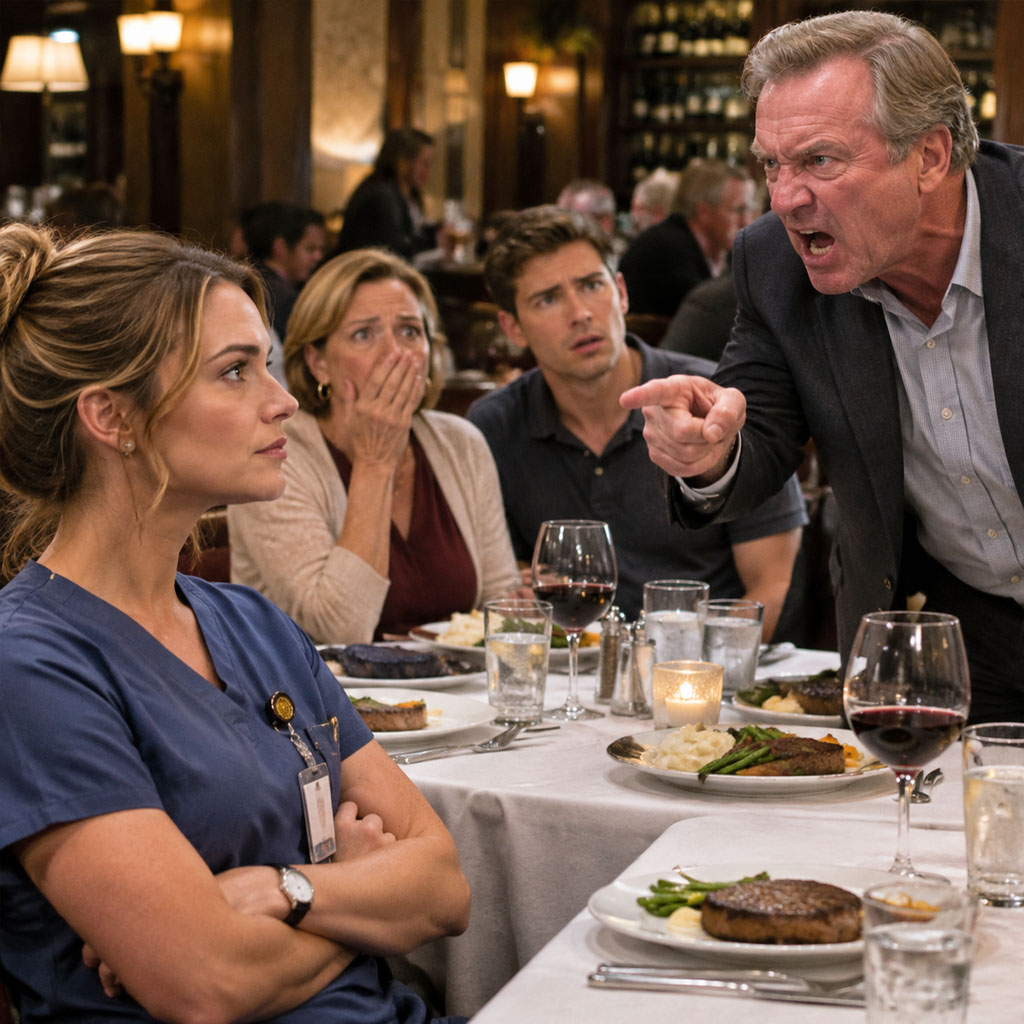
Then he stood so quickly that his chair scraped against the floor.
Both hands landed on the white tablecloth.
“What did you cancel?”
He wasn’t asking.
He was screaming.
The dining room went silent. A waiter stopped halfway across the floor with a tray of plates. At the next table, an older couple turned around to watch.
My mother closed her eyes.
I kept my voice calm.
“I canceled the signing appointment. I withdrew my approval for the $250,000 distribution. I’ve suspended your monthly discretionary payments and requested a review of the trust’s expenses.”
Kyle stared at me.
“Ash, the seller’s deadline is tomorrow. You know that.”
“I know.”
Travis looked uncomfortable.
“I’m sorry, but I’ve got real money involved in this. Can someone explain what’s happening?”
My father opened his mouth, ready to answer for me.
He had done that my entire life.
This time, I spoke first.
“On June 17, I was unconscious in the ICU. A ventilator was breathing for me. My doctors told my parents that I was expected to recover.”
I looked at my father.
“And he told my doctor, ‘She’s been a burden since the day she was born. Don’t waste any more money. Let her die.'”
Lauren covered her mouth.
Dad’s face darkened.
“That’s a lie.”
I took the folded medical note from my purse and laid it on the table.
“It’s in my medical chart. Dr. Kowalski documented your exact words.”
Lauren picked up the paper.
Her eyes moved down the page until she reached the quotation.
She read it slowly.
When she finished, she looked at Kyle.
Kyle looked at our mother.
My mother stared at her plate.
Not one word.
My father straightened his jacket.
Then he tried another approach.
“You have to understand,” he told Travis and Dana. “Ashley suffered a serious brain injury. She’s not thinking clearly. The doctors warned us about personality changes.”
I had expected that.
I took out Dr. Hargrove’s letter and placed it beside the medical note.
“My neurologist disagrees. As of eleven this morning, my judgment is intact, and my decision-making capacity has been formally documented.”
Travis read the letter.
He looked at my father, then back at me.
He didn’t say anything.
I put both documents away and stood.
“Enjoy your dinner.”
I walked through the silent dining room.
Kyle caught up with me in the parking lot.
“Ash, wait.”
He was no longer wearing his sport coat.
“Did Dad really say that?”
I handed him the medical note.
Under the yellow parking lot lights, I watched him read it.
When he looked up, his face reminded me of the little boy who used to climb into my bed during thunderstorms.
“I didn’t know,” he said.
“I know you didn’t.”
Jenna had the engine running.
I got into the car, and we drove home without turning on the radio.
At 9:48, my phone buzzed.
A message from Dad.
You have no idea what you’ve started.
The next afternoon, the seller’s deadline passed.
Kyle lost the Iron Line location and his $25,000 deposit.
I didn’t yet know where that deposit had come from.
Over the weekend, my father called relatives and friends, telling them the accident had changed me. He said I was paranoid, confused, and no longer capable of managing money.
My aunt Linda, my mother’s older sister, called from Fort Wayne.
“Your father says you’re not yourself,” she said. “Are you?”
“I’m more myself than I’ve been in years.”
She was quiet.
Then she said something unexpected.
“Your mother has been crying for three days. And I don’t think it’s about you.”
I didn’t call my mother.
I wasn’t ready.
On Monday, August 24, Joanne contacted me.
The bank had received another letter from Dad. This time, he was formally requesting that I be removed as co-trustee because of my alleged incapacity.
He threatened to take the matter to court.
Joanne wasn’t worried.
“He’ll need evidence,” she said. “And your neurologist’s letter is quite clear.”
She scheduled a meeting for September 3 with my father, the bank’s compliance officer, and me.
Two nights later, my doorbell rang at 10:40.
The camera showed my father standing on the porch in his golf jacket.
I spoke through the intercom.
“It’s late, Dad.”
“Open the door, Ashley.”
“No.”
He moved closer to the camera.
“Do you know what you’ve done to your brother? Your mother? To me?”
“I know exactly what I’ve done.”
“My mother’s money was supposed to be mine,” he said, his voice rising. “It was supposed to come to me. You were supposed to…”
He stopped.
I waited.
“Supposed to what, Dad?”
He stared into the camera.
Then he turned and walked away.
I saved the recording.
The following morning, my mother appeared at my door carrying an old shoebox.
She looked as though she hadn’t slept in days.
Inside were dozens of envelopes: credit card statements and personal loan notices addressed to me at my parents’ house.
“I found the first one last spring,” she said. “I asked your father about it. He told me it was a business matter.”
“Why didn’t you tell me?”
She looked down at the box.
“Because I was afraid.”
I waited.
“After that, I started collecting the mail before he could throw anything away. I kept the statements in the garage, behind the Christmas decorations.”
“Mom, you knew?”
Her eyes filled.
“I didn’t know everything. But I knew something was wrong.”
She told me that Dad had spent two hours writing a letter on his good stationery on June 19, the same letter he’d sent to Harbor Point claiming I wasn’t expected to recover.
She’d also seen him applying for another credit card in my name at the end of July.
“I should have told you,” she whispered. “I should have said something in that hospital room, too.”
For the first time, I understood that my mother hadn’t simply been unaware.
She had been choosing silence.
Then she told me something else.
“What your father said about you in that room… he said almost the same thing about his own father.”
I looked at her.
“What do you mean?”
She shook her head.
“Ask me again when you’re ready. I think there’s something your grandmother wanted you to understand.”
That night, I took Grandma Evelyn’s envelope from the kitchen drawer.
I’d carried it through the accident, rehabilitation, and every painful discovery.
Now I finally understood that the reason she’d given it to me might be more important than anything inside it.
I broke the seal.
Chapter 5
The envelope contained a three-page handwritten letter and a photocopy of an old hospital record.
The patient was my grandfather, Leonard Smith, age eighty-six.
The medical note was dated August 2017.
Patient’s son requested withdrawal of life-sustaining treatment, citing the cost to the estate. Patient’s wife, acting as legal healthcare representative, declined. Treatment continued.
I read the page again.
Then I opened Grandma’s letter.
She explained what had happened that night in the hospital hallway.
My father had told her that Grandpa had lived long enough. He complained that every additional week in the ICU was draining the family’s money.
He wanted her to let him go.
She refused.
“Not today, Wayne. Not in this building.”
Grandpa recovered and lived another fourteen months.
During that time, he attended my charge nurse pinning ceremony at St. Ambrose.
I remembered seeing him in the third row, clapping while I stood on the auditorium stage.
I hadn’t known what it had cost him to be there.
Grandma’s letter continued.
She wrote that she had watched my father measure people by what they cost him. She had seen him do it to me as a child, and she had seen him do it to his own father.
That was why she had given me the second signature on the trust.
The final paragraph made me put the letter down.
“I gave you the second key because I watched my son put a price on his father’s life. I could not leave him alone with anyone else’s. You are the only person in this family I have ever seen refuse to measure people in dollars. That is not a weakness, Ashley. That is the reason.”
I sat on my bed and cried.
For thirty-nine years, I’d believed I was the expensive child. The one who needed to work harder, ask for less, and make herself useful enough to justify the money spent on her.
Grandma had seen something I couldn’t see.
She knew I would need that key someday.
The following Tuesday, September 1, Joanne called with the results of the contractor investigation.
Brennan Roofing and Exteriors wasn’t a registered roofing company in Indiana.
The license number on the invoices belonged to a plumbing business in Evansville.
And the bank account receiving the money belonged to a company called WRS Home Services LLC.
The company had been registered in 2023.
Its initials stood for Wayne Robert Smith.
My father’s name.
The two previous roofing payments totaled $31,500.
The new invoice for $38,600 had never been paid because I’d stopped it.
Suddenly, the fake contractor, the fraudulent loans, and my father’s letter to the bank were beginning to fit together.
On Thursday, September 3, we met in a conference room on the twelfth floor of Harbor Point’s Indianapolis office.
My father arrived wearing a blue suit and carrying a Manila folder.
My mother sat at the far end of the table.
Joanne was there with Mitchell Grant, the bank’s compliance officer.
Dad began immediately.
He spoke about my accident, my confusion, and my alleged personality changes. He described himself as a concerned father who only wanted to protect his mother’s legacy.
Joanne let him finish.
Then she placed Dr. Hargrove’s letter on the table.
Next came my father’s handwritten letter dated June 19.
“You wrote this two days after the doctors told you your daughter was expected to recover,” Joanne said.
My father shifted in his chair.
Mitchell opened a second folder.
Inside were the roofing invoices, the false contractor information, and the bank records showing the payments flowing into WRS Home Services.
Then I placed my own folder beside his.
The credit reports.
The fraudulent loan applications.
The identity theft report.
My mother’s shoebox of statements.
My mother finally spoke.
“I’ll confirm all of it.”
Her voice shook, but she was looking directly at my father.
“I saw the statements. I heard what you said in the hospital. I’ll tell anyone who asks.”
My father stared at her.
For a moment, he seemed unable to recognize the woman sitting across the table.
Then he slammed his palm down.
“That money was mine!” he shouted. “It was my mother’s money! It was always supposed to be mine!”
I looked at him.
I wasn’t angry anymore.
I was simply tired.
“You told my doctor I’d been a burden since the day I was born,” I said. “You told him not to waste any more money on me. Today, I finally understand how much money you thought I was standing between you and.”
Nobody spoke.
Mitchell calmly explained the bank’s position.
The $31,500 paid to WRS Home Services would be treated as an improper distribution, and the bank would seek repayment. Future discretionary payments would remain suspended.
Harbor Point would also oppose any attempt to remove me as co-trustee without proper evidence.
Then Joanne turned to me.
“The trust was established to support your father’s health and basic needs. How would you like us to handle those?”
My father didn’t look at me.
I thought about the blue notebook. The double-underlined totals. The countless times I’d tried to make myself cheaper, quieter, and easier to love.
“Pay his Medicare supplement directly to the insurer,” I said. “Pay his property taxes directly to the county. Pay his utilities directly to the companies.”
Joanne wrote everything down.
“He’ll have what he needs,” I continued. “He just won’t have what he wants.”
My father finally looked up.
For once, he seemed unable to understand me.
He had spent thirty-nine years deciding what I was worth. He had no idea what to do with a daughter who refused to measure his life the same way.
On September 8, I filed an identity theft report with the Carmel Police Department.
A detective named Owen Pruitt reviewed the credit reports, the applications, and the statements my mother had saved.
He explained that he would contact the lenders, interview witnesses, and forward the findings to the Hamilton County Prosecutor’s Office.
The process would take time.
The following evening, Kyle came to my apartment.
He looked exhausted.
He told me that when I’d refused the $250,000 in March, Dad had promised to take out a small loan so Kyle could put down a deposit on the gym location.
That personal loan for $43,400 had been opened in my name.
Dad had given Kyle $25,000 from it.
“I was celebrating with your money,” Kyle said, his voice breaking. “With your name on a loan. And I didn’t even know.”
“Did you know the money was borrowed?”
“I thought Dad was handling it himself.”
I studied his face.
He had been the favored child, the one who got the Jeep and the baseball team and the opportunities I’d never received.
But he hadn’t known what Dad was doing.
“You can’t change what happened,” I told him. “But what you do next matters.”
On Friday, Kyle went to the police station and gave Detective Pruitt a statement. He provided the messages from our father about the loan and explained where the money had gone.
The consequences unfolded slowly.
My father stopped attending Rotary meetings. He resigned as club treasurer and stepped down from the finance committee at his church.
The business partner who had invested in Kyle’s gym deal stopped returning Dad’s calls.
Then the lenders completed their investigations.
The credit card company sent a letter confirming that the account had been opened fraudulently and that I was not responsible for the $18,400 balance.
The loan company sent a similar letter regarding the $43,400.
Both accounts were removed from my credit history.
I placed those letters in a folder beside Dr. Kowalski’s medical note.
It was strange to feel relief over documents confirming that my own father had stolen my identity.
But for three years, a version of me had existed on paper that I’d never met. A woman who owed $61,800 and had somehow managed to pay every bill on time.
Now she was gone.
My father eventually sold his lake house to cover debts he had accumulated through his business arrangements.
My mother packed two suitcases and moved to Fort Wayne to stay with Aunt Linda.
She began seeing a counselor.
She called me every few days, and our conversations slowly became longer.
One night, she said something I had waited years to hear.
“I should have spoken up in that hospital room.”
“Yes,” I said. “You should have.”
She cried.
“I’m not asking you to forgive me. I just need you to know that I understand.”
I didn’t forgive her that night.
But I told her I’d call on Sunday.
And I did.
My father called once more on September 18.
His voice was quieter than I’d ever heard it.
“Your mother’s gone. Kyle won’t speak to me. The police keep calling. I need you to drop that report, Ashley. If not for me, then for your mother’s sake.”
For most of my life, those words would have worked.
For the family. For peace. For your mother.
But I was no longer that little girl sitting at the dinner table, waiting for the notebook to come out.
“It’s not revenge, Dad,” I said. “It’s a record. You spent my childhood writing down what I cost you. This is the first time anyone has written down what you cost me.”
He didn’t answer.
Eventually, the call ended.
That Saturday, Jenna accompanied me to a notary at my bank.
I signed two documents.
The first appointed Jenna as my healthcare representative. If I ever became unable to speak for myself again, she would have the authority to make decisions based on what I wanted.
The second was my will.
When the notary stamped the final page, Jenna slipped her arm through mine.
“Engine running,” she said with a smile. “Always.”
I returned to work on Monday, September 14.
I wasn’t sure I could do it. For three months, I’d been the patient, the person whose body other people measured and discussed.
I stood in the hospital locker room for several minutes before pinning my small silver charge nurse badge back onto my collar.
My first patient was a little girl born at twenty-five weeks, weighing just one pound and four ounces.
Her mother sat beside the incubator, terrified to touch her daughter.
I showed her how to slide her hand through the small opening and gently cup the baby’s head and feet.
“She can feel you holding her,” I explained. “You don’t have to be afraid.”
The mother began crying, then laughed at herself for crying.
“How long before she can come home?”
I looked at the tiny girl beneath the soft hospital lights.
“As long as it takes,” I told her. “We’ll be here every day of it.”
Nobody in that room asked what the baby would cost.
Nobody ever would.
A week later, another mother returned to the NICU with her son, Caleb. I’d cared for him in May, when he weighed less than two pounds and needed a ventilator.
Now he was healthy, loud, and holding his mother’s necklace in his little fist.
Before leaving, she found me at the nurses’ station.
“I don’t know if you remember this,” she said, “but during our worst night, you told me Caleb wasn’t a burden. You said he was a person who needed more help than most for a while.”
She smiled.
“I wrote that down. I’ve read it a hundred times.”
I remembered saying it.
I’d said similar things to dozens of frightened parents over the years.
I’d just never thought to say them to myself.
That evening, I wrote two letters.
One was for Rachel Dunn, the nurse who had written FULL CODE on my whiteboard.
The other was for Dr. Kowalski, the doctor who refused to let my father decide that my life wasn’t worth saving.
I thanked them both.
Dr. Kowalski replied with a simple hospital note card.
“I only wrote down what I heard,” she wrote. “You did the rest. Go take care of your babies.”
On September 27, Jenna drove me to the cemetery in Carmel where my grandparents were buried.
My mother drove down from Fort Wayne and met us at the entrance.
We walked together to the old maple tree where Grandma Evelyn and Grandpa Leonard rested side by side.
I brought Grandma’s letter.
Standing in the grass, I read her final paragraph aloud.
When I finished, my mother held my hand.
It was the first time in a very long time she’d done that without me needing to be sick.
“Your grandmother once told me she worried about you,” Mom said. “Not because you were weak, but because you were so good at disappearing. She thought you’d spend the rest of your life making yourself small unless someone gave you something you couldn’t give away.”
“The key,” I said.
Mom nodded.
“She wasn’t talking about the money, was she?”
“No,” I whispered. “She never was.”
Jenna stood a few steps behind us, giving us the room we needed.
I looked at my grandparents’ names carved into the stone.
Grandpa Leonard had lived fourteen more months because one woman refused to measure his life in dollars.
I was alive because another woman, a doctor I’d never met, had made the same decision.
And years before any of this happened, my grandmother had trusted me with the responsibility of protecting what mattered.
My father’s case remains with the prosecutor’s office. Kyle is working for Travis now and saving his own money. He calls me on Sundays, and our relationship is slowly becoming something different.
My mother is still in Fort Wayne. We’re working on forgiveness, one honest conversation at a time.
As for my father, I don’t know whether we’ll ever have a relationship again.
I’ve finally made peace with not knowing.
For thirty-nine years, I believed my worth was a number in someone else’s blue notebook.
A running total, underlined twice.
Always in the red.
But my grandmother knew something my father never understood.
A person’s value cannot be calculated by what it costs to keep them alive.
Not a little girl who needs braces. Not a grandfather in an ICU. Not a premature baby weighing one pound. And not a grown woman who has spent her life trying to earn the love of people who should have given it freely.
I spent years believing I needed to become less expensive to deserve a place in my family.
Now I understand.
I never needed to become less.
I needed to stop letting other people decide how much I was worth.
THE END.\
⚠️ All characters and events are fictional. Do not imitate or apply them in real life. 😌😌😌