Chapter 2
That afternoon, I drove home without turning on the radio.
I kept thinking about the message, the folder, and Deborah’s strange behavior at dinner. I had spent my adult life believing that family members might disagree, argue, and occasionally disappoint one another, but that they would never deliberately put each other in danger.
Now I wasn’t so certain.
I called my closest friend, Carol Pruitt. We’d known each other since 1983, when she taught fourth grade and I prepared her tax returns in exchange for a case of wine every spring.
We talked about ordinary things for twenty minutes. Her granddaughter’s soccer game, the church organ that needed replacing, and the price of groceries.
Finally, I mentioned Dr. Neil Aldridge.
“Have you seen Neil lately?” I asked. “I haven’t heard from him in months.”
“Actually, I ran into him at the pharmacy last week. He said he wanted to stop by and see you. Said it had been too long.”
I thanked her and ended the call.
Neil had been Walter’s fishing companion for years. He was a gentle man who had treated our family with kindness, and I couldn’t imagine why his name had appeared in that message.
The next morning, I attended church.
After the service, I stood in the fellowship hall with a paper cup of coffee when Deborah approached with two women from the congregation.
“We’re a little worried about Atlee lately,” she announced.
I looked at her.
“I’m standing right here, Deborah.”
She smiled and patted my arm.
“Of course, sweetheart. We just notice things. You know, repeating stories, forgetting little details. It’s nothing to be embarrassed about.”
One of the women gave me a sympathetic smile.
Deborah continued.
“She just keeps the books, bless her. Everyone knows Walter built that store.”
I took a slow sip of coffee.
“Walter built the counter, Deborah. I built the part that kept the lights on.”
The women looked at each other.
Deborah’s smile tightened.
I didn’t argue further. I finished my coffee and went home.
But that afternoon, I pulled a green accordion folder from the hall closet and placed it on the kitchen table.
I’d kept that folder since 1981.
Inside were deeds, trust agreements, bank records, business contracts, and documents that had shaped our family’s future.
One particular document caught my attention.
The Holloway Family Trust.
Walter had arranged for it to be established in October 2019, shortly after a cancer scare. His doctors had caught the illness early, and he eventually recovered, but the experience frightened him.
He wanted everything organized.
I remembered sitting in attorney Gerald Finch’s office while Walter spoke.
“Atlee’s always been the one who can add everything up,” he’d said. “I want her to have control of the paperwork. I don’t want arguments later.”
Gerald had prepared the documents.
I was named the sole trustee, with full discretionary authority over the trust’s assets, including Holloway Hardware and Feed, the business accounts, and the valuable parcel of land beneath and beside the store.
Derek was named as a future beneficiary.
But he did not control the trust.
I had almost forgotten how important that distinction was.
I read the document twice, carefully reviewing every clause. My name was still there. The arrangements had never changed.
Nobody could sell the property without my authorization.
Nobody could sign on my behalf.
And nobody could transfer control of the trust simply because they believed I was getting older.
I closed the folder.
For the first time, I began to suspect that the message on Paige’s phone might have something to do with our family business.
Thursday evening, Derek came to my house alone.
He sat at the kitchen table, turned his coffee mug around several times, and finally cleared his throat.
“Mom, I’ve been thinking about some paperwork.”
“What kind?”
“Just some standard things. Like Dad had done back in 2019.”
I kept my expression pleasant.
“A power of attorney?”
He looked surprised.
“Well, yes. Maybe one for health care and one for property. Just so somebody can help you if you ever need it.”
“That’s thoughtful.”
“It’s for your own good, Mom.”
There it was again.
He mentioned that Dr. Aldridge might visit soon.
“Neil said he hasn’t seen you in a while. He just wants to check in.”
“That would be lovely,” I replied.
Derek looked relieved.
He talked about the children for a few minutes, kissed my cheek, and left.
I remained at the kitchen table long after his truck disappeared.
My son had mentioned a power of attorney.
The message had mentioned a doctor.
And someone had written that once I was declared, a man named Roy would list the lot.
I wasn’t ready to accuse anyone of anything.
But I was ready to pay attention.
On Saturday, my grandchildren came to spend the afternoon.
Mason was ten and loved building elaborate structures out of couch cushions. His younger sister, Ivy, was seven and preferred sitting with me at the kitchen table coloring pictures.
“Grandma,” Ivy said, choosing a purple crayon, “are we still going to get the lake house?”
I looked up.
“What lake house, sweetheart?”
“The big one Mommy told us about. She said we’re moving there soon. Maybe by my birthday.”
I kept my voice light.
“That sounds exciting. Did she say where it is?”
Ivy shook her head.
“Somewhere with a dock. Mommy said it’s going to be beautiful.”
I smiled and helped her color the sun.
But my hands had gone cold.
A seven-year-old doesn’t invent a moving plan and a lake house out of nowhere.
Somebody had already been making arrangements.
And whatever those arrangements were, my grandchildren believed they were happening soon.
Chapter 3
Monday morning, I drove to the hardware store.
Hank Dooley had managed the business for twenty-two years. He was a good man who knew every customer by name and could find a particular screw in the stockroom faster than anyone else in town.
When I walked in, he smiled.
“Morning, Mrs. Holloway. Looking for something?”
“I wanted to ask you something, Hank.”
His expression changed.
“Of course.”
“Have any real estate people been around lately asking about the property?”
He rubbed the back of his neck.
“Actually, yes. Two fellows in nice suits came by a few weeks ago. They walked around the corner lot, took photographs, and asked about the frontage.”
“Did they leave a name?”
“I think one left a business card.”
He searched the front desk drawer and found a cream-colored card.
Whitfield Realty Group.
Russell Combs, Associate Broker.
I recognized the family name immediately.
Roy Whitfield was Deborah’s husband.
“Did Derek send them?” I asked.
Hank shrugged.
“I assumed somebody had arranged it. They seemed to know what they were doing.”
I thanked him and slipped the card into my purse.
On my way home, I drove to Millbrook Memorial Cemetery and sat beside Walter’s grave.
I told him about the phone message, Deborah’s comments, Derek’s questions, and the real estate card.
I didn’t cry.
I simply sat there with my hands folded, looking at his name engraved in the stone.
Walter had always said that you never closed a set of books until every column added up.
I intended to follow that advice.
Two days later, I returned to the store.
Derek was in the back office talking on the phone. He asked me to retrieve a shipping label from his desk.
I stepped inside.
The label was sitting on top of a familiar manila folder.
This time, the folder was open.
I recognized the Whitfield Realty letterhead immediately.
An evaluation sheet lay on top.
The corner lot at Main Street and Fifth Avenue had an estimated market value between $2.35 million and $2.6 million, pending final zoning confirmation.
Beneath it was a document titled POWER OF ATTORNEY.
My full legal name was typed across the top.
The signature line was blank.
A yellow sticky note was attached to the front.
In Derek’s handwriting, it read:
“Don’t show Mom until after POA signed.”
I stood completely still.
My son was preparing a power of attorney using my name, and he had specifically instructed someone not to show it to me until after I signed.
I took photographs of the documents.
Then I picked up the shipping label and returned to the doorway.
“Got it.”
Derek covered his phone receiver.
“Thanks, Mom. You’re a lifesaver.”
I smiled.
“Happy to help.”
I drove home and sat at the kitchen table until nearly midnight.
There were too many questions.
Was the power of attorney intended to give Derek control over my personal affairs? Was someone planning to use a medical opinion to make me appear incapable of managing my property? And why was Deborah involved?
Most importantly, how did Roy Whitfield expect to sell a piece of property that was part of a trust he didn’t control?
I needed someone who understood the legal documents better than I did.
Thursday morning, I called Gerald Finch.
He had represented Walter and me since 1987. He was older now, but still practiced law from the same Charlottesville office.
“Atlee Holloway!” he exclaimed. “It’s been too long.”
“I need to see you, Gerald. It’s about the trust.”
His voice changed immediately.
“Is everything all right?”
“I honestly don’t know.”
“Come Monday morning. Bring every document you have. And don’t sign anything between now and then.”
“I wasn’t planning to.”
“Good. Keep it that way.”
Before I could hang up, I remembered something else.
“Gerald, if somebody wanted to claim that I couldn’t manage my own affairs, how would that work?”
There was a brief silence.
“Atlee, has somebody been suggesting that you’re confused?”
I looked toward Walter’s pocket watch on the windowsill.
“I think they might be.”
“Then we need to talk.”
That Friday, Deborah called me.
“I hear you’ve been asking Hank questions.”
I smiled despite myself.
“Hank has worked at that store for twenty-two years. I ask him questions all the time.”
“Atlee, I think you should listen to Roy. He’s very knowledgeable about the market. That corner lot is worth a fortune right now.”
“I haven’t decided to sell anything.”
“Nobody is asking you to decide tonight. We’re just trying to help.”
“Then stop trying to arrange things before I’ve agreed to anything.”
She went quiet.
Finally, she said, “We only want what’s best for you.”
I had heard those words so many times that week they were beginning to sound like a warning.
Sunday afternoon, Paige dropped the children off.
For once, she stayed for coffee.
She sat at my kitchen table, holding her mug without drinking. I asked whether everything was all right.
“I’m fine,” she answered quickly.
“You seem worried.”
She looked at me for a moment.
I thought she might say something important.
Then her phone buzzed.
She glanced at it, stood abruptly, and said she had to go.
I watched her drive away.
The following Tuesday, Dr. Neil Aldridge arrived at my house carrying a bag of peaches from his garden.
He smiled warmly.
“Atlee, it’s been far too long.”
We talked about Walter, their fishing trips, and the ridiculous smoker they’d once tried to build in Neil’s backyard.
Then his questions changed.
“How have you been sleeping?”
“Fine.”
“Still managing your medications yourself?”
“I take one baby aspirin every morning.”
“Good. And you know today’s date?”
“July 28th,” I answered. “Tuesday. You’ve never visited me on a Thursday in thirty years, Neil.”
He laughed, but his eyes looked uncomfortable.
I offered him another peach and walked him to his car.
After he left, I stood on the porch watching him drive away.
He had come to check on my memory.
But he hadn’t conducted any examination.
And I was beginning to understand why someone had wanted him to visit.
Chapter 4
Gerald Finch read my documents for nearly twenty minutes without speaking.
We sat across from each other in his office, surrounded by old law books and photographs of his late wife.
Finally, he removed his glasses.
“Atlee, I want to be very clear about something. You are the sole trustee of the Holloway Family Trust. You have full discretionary control over the assets inside it. That includes the store, the land, and the trust accounts.”
“I know.”
“Then you also need to know that a power of attorney does not override the trust. Even if you signed that document, it wouldn’t give Derek control over trust property.”
I let out a slow breath.
“And what about the doctor?”
Gerald shook his head.
“A friendly visit from a physician isn’t a legal determination that someone is incapable of managing their affairs. A formal competency proceeding involves evaluations, legal filings, and a court hearing. You would have the right to be represented and to challenge the evidence.”
“So nobody can simply declare me incompetent because they want to sell a property?”
“Absolutely not.”
I looked down at my hands.
For two weeks, I’d been wondering whether my family had found a way to take something Walter and I had spent decades building.
Now I knew the documents didn’t give them that power.
But I still wanted to understand how far they intended to go.
Gerald leaned back.
“What do you want to do?”
I thought about Derek’s handwriting on that yellow sticky note.
I thought about Ivy talking excitedly about the lake house.
And I thought about Walter’s last birthday, when Derek had promised his father that he’d always look after the family business.
“I want to know how far they’re willing to take this.”
Gerald studied me.
“You’re thinking about letting them make their move.”
“My birthday dinner is next week. Derek volunteered to organize it. He wants everyone there.”
“That sounds convenient.”
“I think they intend to present the paperwork in front of the family. They probably believe I’ll be too embarrassed to refuse.”
Gerald nodded slowly.
“Then I’ll come.”
I also made an appointment with my regular physician, Dr. Patricia Obuya, who had treated me for nearly twenty years.
I explained that I wanted a complete cognitive evaluation.
She didn’t seem surprised.
“We can certainly do that. Is there a particular reason?”
“Let’s say I want to be prepared.”
The examination took nearly an hour. She tested my memory, reasoning, concentration, and ability to perform simple calculations. I drew a clock, recalled words, answered questions, and completed several exercises.
Four days later, her letter arrived.
It stated that I showed no signs of cognitive impairment and that my memory and reasoning were fully consistent with normal functioning.
I placed the letter in the green folder.
Behind it went the trust certification, the real estate valuation, and the photographs of the unsigned power of attorney.
Everything was organized.
I wasn’t going to walk into my birthday dinner with accusations.
I was going to walk in with documents.
On Thursday evening, I stopped by Derek and Paige’s house with cookies for the children.
Their kitchen window was open, and I heard Paige speaking before I reached the front door.
“Just get it done, Derek. We don’t have time to keep dancing around this.”
“I’m trying. It’s not that simple. She’s my mother.”
“She’s had plenty of time. It’s for her own good, and you know it.”
There was a pause.
Then Derek spoke.
“It’s for your own good, Mom.”
He repeated the sentence softly, almost as though he were practicing it.
I stood on the porch holding the cookie plate.
For a moment, I couldn’t move.
My son was rehearsing what he intended to say to me.
I knocked.
Paige opened the door with an immediate smile.
“Oh, Atlee! What a nice surprise.”
“The children might like these.”
Derek appeared behind her.
“Thanks, Mom. You didn’t have to.”
“I know,” I replied. “I wanted to.”
I drove home with the radio off.
The morning of my sixty-eighth birthday, I woke before sunrise.
I made coffee and sat at the kitchen table, looking at Walter’s pocket watch.
“I hope I’m doing this the way you would have,” I whispered.
I placed the watch inside my cardigan pocket.
Then I packed the green folder into my canvas bag.
Gerald had promised to arrive at six. Carol was coming, along with two cousins and several longtime family friends.
Derek had invited everyone.
He had offered to handle the food, the decorations, and the arrangements.
I suspected he had another reason for wanting a full dining room.
By 6:30 that evening, my house was full.
Carol arrived first, carrying a small wrapped gift. It was a set of beautiful kitchen towels, something we’d joked about buying for years.
Cousin Dana and her husband came next.
Gerald arrived on time with a gift bag and his usual unreadable expression.
Deborah came without Roy.
Dr. Aldridge arrived last, looking slightly uncomfortable.
Derek and Paige had already been helping with the preparations. They were unusually cheerful, offering to refill everyone’s glasses and rearranging dishes that were already in the right places.
We ate dinner.
We discussed church renovations, the new interchange on Route 9, and a wedding in the next county.
But I noticed Paige checking her watch.
I noticed Derek drinking more water than usual.
And I noticed Deborah watching me whenever the conversation turned to the business.
Finally, Derek stood and tapped his fork against his glass.
“Mom, I want to say something.”
The room grew quiet.
He smiled at me.
“First, happy birthday. Sixty-eight is a wonderful milestone.”
Everyone offered polite laughter.
Then his expression became serious.
“But I also wanted to use tonight, with everyone who loves you here, to discuss something important.”
Paige reached into her bag.
She removed a manila folder and placed it on the table beside my birthday cake.
Derek looked at me.
“We’ve noticed a few things lately, Mom. Little things. And we thought it might be time to make sure you’re properly taken care of.”
Dr. Aldridge shifted in his chair.
Derek slid the folder toward me.
“It’s just standard paperwork. So somebody can help you if you ever need it.”
He paused.
“It’s for your own good.”
I looked at the folder.
I already knew what was inside.
Chapter 5
I didn’t touch it.
Instead, I looked directly at Dr. Aldridge.
“Neil, may I ask you something?”
He nodded uneasily.
“Of course.”
“Did you conduct a formal cognitive evaluation of me? Memory tests, medical documentation, anything that would qualify as a professional assessment of my ability to manage my affairs?”
His face changed.
“No, Atlee. I came by because Derek mentioned he hadn’t seen me in a while and thought it would be nice to visit.”
“So it was a friendly visit?”
“Yes.”
“Not a medical evaluation?”
“Absolutely not.”
He looked toward Derek.
“That’s what I was told it was.”
I nodded.
“Thank you for being honest. I want everyone here to understand that I don’t hold your visit against you.”
Derek shifted in his chair.
“Mom, I don’t understand why you’re making this difficult.”
“I’m not finished, son.”
I turned toward Deborah.
“You’ve told several people that I’ve been repeating myself, forgetting things, and becoming confused. Is that correct?”
She looked offended.
“I only said it because I care about you.”
“Perhaps. But I would like everyone to hear something.”
I reached down and placed my canvas bag on my lap.
“I recently had a complete medical evaluation with my own physician. An independent examination. I brought the results.”
I removed the letter from Dr. Obuya and passed it to Carol.
She read it first, then handed it to Gerald.
The letter clearly stated that I showed no signs of cognitive impairment.
Nobody spoke.
I placed another document on the table.
“This is the Holloway Family Trust. It was established in October 2019, shortly after Walter’s cancer scare. I am the sole trustee, with full discretionary authority over its assets.”
Gerald spoke calmly.
“I can confirm that. The trust remains in full force, and no power of attorney can transfer control of its assets.”
Derek stared at the document.
I continued.
“Now, I have something else.”
I placed the Whitfield Realty valuation sheet on the table.
The number was visible to everyone.
Between $2.35 million and $2.6 million.
Deborah’s face went pale.
I turned to the unsigned power of attorney.
My name was printed across the top.
And there, attached to the front, was Derek’s yellow sticky note.
I read it aloud.
“Don’t show Mom until after POA signed.”
The room became completely silent.
Derek stared at his handwriting.
“Mom, where did you get that?”
“From your desk at the store. You asked me to retrieve a shipping label. I found the folder underneath it.”
Paige’s face tightened.
“You had no right to go through our things.”
“I didn’t go through anything, Paige. The folder was open on the desk, and my name was printed across a document you intended me to sign.”
She pushed her chair back.
“You’re twisting everything.”
I looked at her.
“Then perhaps you can explain the message I saw on your phone.”
She froze.
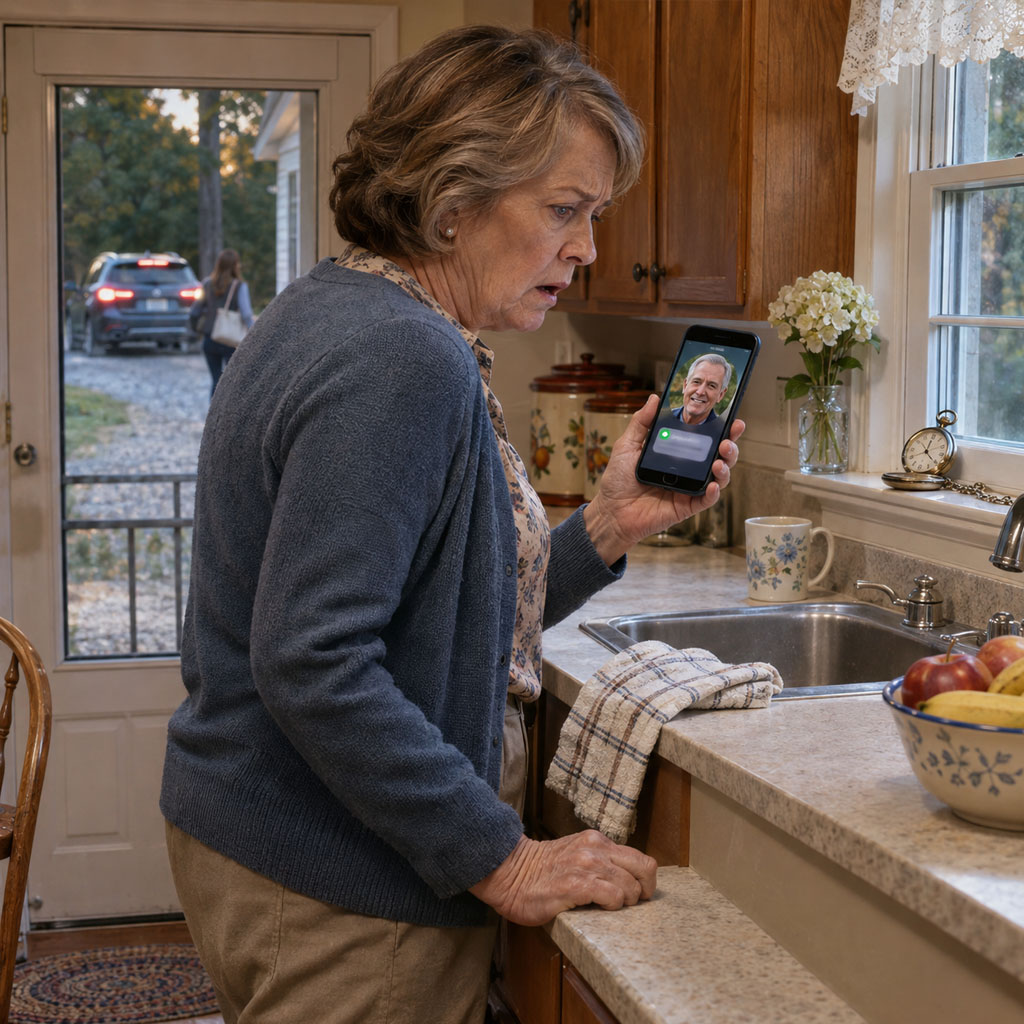
Three weeks earlier, Paige had left her phone on my kitchen counter. It lit up with Walter’s photograph, and a message appeared.
I took out my own phone and opened the photograph I’d saved.
I looked across the table at Deborah.
“That number belongs to you, doesn’t it?”
Deborah said nothing.
I held up the screen and read the message slowly.
“Dr. Aldridge confirmed Friday. Once she’s declared, Roy lists the lot Monday. Don’t tell Derek yet, he’ll cave.”
The silence was unbearable.
Paige stood.
“You went through my phone?”
“I read what appeared on the screen in my own kitchen. I didn’t unlock anything.”
“You had no right!”
“Perhaps you’re angry about how I saw it. But I would rather hear an explanation of what it means.”
Deborah’s expression changed.
“Atlee, this was supposed to stay within the Holloway family.”
I looked at her.
“What was?”
“The business. The property. Walter built that place, not you. You just kept his books.”
I nodded slowly.
“I kept his books for forty-five years.”
My voice remained calm.
“And apparently, I did a good enough job that this family forgot how much the business depended on those books.”
Deborah’s cheeks turned red.
“You were never supposed to have control over everything. Walter should have left things differently.”
I looked at her for a long moment.
“Walter made his decisions while he was alive. He knew exactly what he was doing.”
Then I turned toward Derek.
He was staring at the table.
“Son, do you understand what you’ve been involved in?”
He shook his head.
“Mom, I didn’t think it would get this far.”
I felt something break inside me.
“What did you think would happen?”
He rubbed his forehead.
“Paige said the property was worth a lot of money. Roy had people interested in buying it. We thought it would solve several problems.”
“What problems?”
He didn’t answer.
Paige spoke instead.
“The business has value. The corner lot is worth millions. We could sell it, move somewhere better, and give the children a fresh start.”
I looked at her.
“With whose permission?”
“You’re getting older, Atlee. You don’t need all that responsibility.”
I glanced at the unsigned power of attorney.
“So you planned to have me declared incapable of managing my own affairs, obtain control through paperwork, and sell property you don’t own?”
Nobody answered.
I turned toward Deborah.
“Did Roy know?”
She looked down.
“Roy was only trying to help.”
“Help whom?”
Her lips tightened.
I finally understood why she had spent years telling people that Walter built the business while I merely kept the books.
It wasn’t simply a family rivalry.
She had never accepted that Walter trusted me with the decisions that mattered.
She had wanted the business to remain under her husband’s influence, and the valuable land offered an opportunity she couldn’t resist.
Then I looked at Derek again.
“And you, son? Did you know what they intended?”
He swallowed.
“Paige told me it was just a way to make sure someone could help you. She said you wouldn’t have to worry about anything.”
I picked up the yellow sticky note.
“Then why did you write that nobody should show me the paperwork until after I signed?”
He closed his eyes.
He had no answer.
Chapter 6
I stood and placed both hands on the dining table.
“In 1986, this business was $40,000 in debt.”
Everyone looked at me.
“Walter was a wonderful salesman. He knew every customer, remembered birthdays, and could convince a farmer to buy almost anything. But the books were a disaster. Suppliers weren’t being paid on time, inventory wasn’t being tracked, and customers owed us money that nobody had bothered to collect.”
I looked at Deborah.
“I rebuilt the entire accounting system at our kitchen table. Most nights, I worked after Derek went to bed. Within eighteen months, the business was profitable again.”
I paused.
“Five years later, we bought the lot next door. The same property you were planning to sell for $2.6 million.”
Nobody moved.
“Walter built the counter, Deborah. I built the part that kept the lights on.”
My voice softened.
“I never needed a plaque or a newspaper article. I never needed people to congratulate me. Walter knew what I had done, and that was enough.”
I looked around the room.
“But I will not sit quietly while people who benefited from my work try to convince everyone that I’m incapable of making my own decisions.”
Then I turned toward Derek.
“You wanted this conversation to happen in front of everyone who loves me. You wanted witnesses. Well, now we have them.”
I picked up the unsigned power of attorney.
“I will not sign this document. I will not sell the property. And I will not surrender control of the trust.”
Gerald nodded.
“I would also advise everyone here that any further attempt to obtain signatures or transfer assets without proper authorization could have serious legal consequences.”
Paige looked furious.
“You think a few pieces of paper make you better than us?”
“No,” I answered. “They make the facts clear.”
Then I placed the documents back inside my green folder.
“For my own good, as you’ve all been saying, I’m going to make some changes. Gerald’s firm will become an independent co-trustee for major decisions involving the trust. That way, nobody can ever pretend the door is open for someone to take control without proper oversight.”
I looked at Derek.
“And from now on, business decisions will be made in writing. You may continue working at the store if you wish, but you will not make financial or property decisions on my behalf.”
He looked down.
I turned to Deborah.
“You are no longer involved in discussions about the business or the property.”
She opened her mouth, but I raised one hand.
“I’m not asking for your opinion.”
The room remained silent.
I picked up my fork.
“I believe we should finish the cake. It’s my birthday, after all.”
Nobody laughed.
But Carol reached across the table and squeezed my hand.
The evening ended quietly.
People left in small groups. Carol hugged me at the door and whispered that she was proud of me.
Gerald shook my hand.
“We’ll take care of the paperwork Monday.”
Dr. Aldridge stayed until nearly everyone else had gone.
“Atlee, I’m sorry. I should have asked more questions before agreeing to visit.”
“I know, Neil.”
He looked genuinely ashamed.
Three days later, he sent me a signed letter confirming that he had never conducted any formal examination of my memory or mental capacity. He also stated that he wanted no further involvement in any family arrangement concerning my affairs.
I placed that letter in the green folder behind Dr. Obuya’s evaluation.
Roy Whitfield called Derek once that week, according to my son. The proposed listing was canceled, and Whitfield Realty moved on to other business.
I heard through Carol that Roy was unhappy about losing the commission he had expected to earn.
I wasn’t concerned.
Gerald and I met again that Friday. We completed the arrangements to add his firm as independent co-trustee for major trust decisions.
The paperwork was thorough.
There would be no confusion about ownership, authority, or who had the right to sign.
Deborah still attended family gatherings occasionally, but she no longer discussed the business or property.
I removed her from the store’s management group chat.
I left her in the family group.
Nobody argued.
Derek didn’t visit for almost three weeks.
Then, one Saturday morning, I drove to the store and found him behind the counter helping an elderly customer purchase a bag of nails.
He looked up when the bell rang.
“Morning, Mom.”
“Morning, son.”
He finished with the customer and came around the counter.
“Hank had a family matter today. I thought I’d cover for him.”
“That’s good.”
He nodded.
For a moment, neither of us spoke.
Then he said, “I know I handled things badly.”
I waited.
“I should have talked to you. I should never have let anyone prepare paperwork without telling you what it was for.”
I looked at him.
“Why didn’t you?”
He stared at the floor.
“Because Paige kept telling me it was the best way. She said the money from the property could give us all a better life. I thought I could make things easier for everyone.”
“By taking away my choices?”
He had no answer.
I reached out and touched his arm.
“You’re my son, Derek. I love you. But being my son doesn’t give you the right to make decisions for me.”
He nodded.
“I’m sorry, Mom.”
I didn’t hug him immediately.
Some apologies need time before they can be believed.
But he returned the following Saturday.
And the Saturday after that.
He began showing up at the store more regularly, helping Hank, handling deliveries, and learning the parts of the business he’d previously left to other people.
He didn’t ask about the property again.
Paige and I barely spoke for a while. I didn’t know whether our relationship would ever return to what it had been, and I stopped trying to force an answer.
Mason and Ivy continued visiting every other weekend.
Ivy still sat at my kitchen table with her crayons.
One afternoon, she asked whether Grandpa Walter’s watch would ever work again.
I smiled.
“Probably not, sweetheart.”
“Why do you keep it, then?”
I looked at the silver watch on the windowsill.
“Because some things are worth keeping even when they stop working.”
She considered that for a moment, then returned to her picture.
The store is still open.
The brass bell still rings above the door, just as it has since 1958. Hank still manages the floor, and Derek has slowly begun taking responsibility for the work his father once loved.
Walter’s photograph hangs in the office.
My photograph hangs beside his.
I insisted on that.
Not because I wanted recognition, but because I wanted the truth to be visible.
I still keep the green folder in the hall closet, although Gerald has copies of everything important. The pocket watch remains on my kitchen windowsill, stopped forever at 9:14.
Sometimes I wind it anyway.
Old habits are hard to break.
Looking back, I don’t think the most painful part was discovering that my family wanted to sell the land. Property can be bought and sold. Businesses can change hands. Money can be earned again.
What hurt was realizing how easily people I loved had decided that my age made me less entitled to my own decisions.
They had mistaken my quiet nature for weakness.
They had mistaken my kindness for permission.
And they had mistaken forty-five years of keeping the books for a lifetime of doing nothing important.
I spent most of my marriage standing beside Walter while the town praised him for building the business.
I never minded.
He was a good man, and he loved me. He knew what I had contributed, even when other people didn’t.
But after he died, some members of the family began treating his trust in me as though it were a temporary arrangement they could change whenever they wanted.
They forgot that I had helped build the very foundation they were trying to sell.
The message on Paige’s phone had been intended for someone else.
But it showed me exactly what I needed to see.
I wasn’t confused.
I wasn’t helpless.
And I wasn’t going to let anyone convince me otherwise.
I still love my son. I still want my grandchildren to grow up knowing their family history and understanding the work that went into building their future.
But I no longer confuse love with surrender.
My birthday dinner didn’t destroy my family.
It simply forced everyone to look at the truth.
And the truth was that Walter had trusted me for a reason.
The store was still standing because we had built it together.
The land was still ours because we had protected it together.
And the decisions about its future would remain mine to make.
For forty-five years, I kept every receipt, every contract, and every signature in order.
I wasn’t about to stop now.
THE END.\
⚠️ All characters and events are fictional. Do not imitate or apply them in real life. 😌😌😌