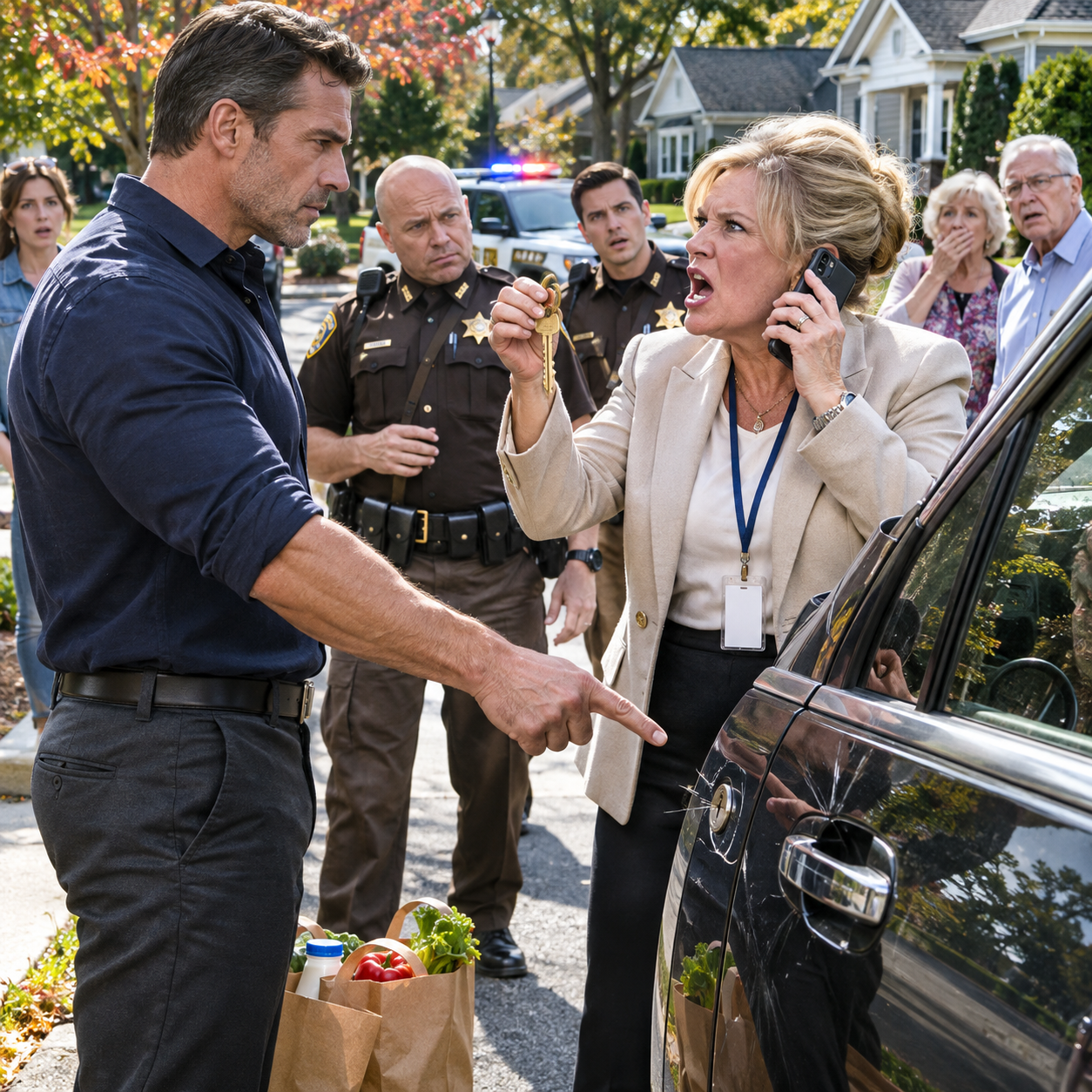
The brass key scraped against my car door for the third time before I set my groceries on the pavement. The woman holding it was our HOA president. She claimed she had the authority to unlock any vehicle in the neighborhood. When I told her to stop, she pulled out her phone and dialed 911. She had no idea whose deputies she was summoning.
### Part 1: An HOA president’s master key exposes a dangerous abuse of power.
“That’s my car.”
Margaret Holloway turned slowly, the brass key still trapped between her fingers. Her HOA identification swung from a blue lanyard, and a clipboard rested against her hip. Twenty feet away, an elderly couple stopped walking and watched as she stepped between me and the driver’s door.
“Your vehicle has been noncompliant for eleven days,” she announced. “I’m conducting an authorized inspection under the board’s vehicle access policy.”
“Take the key out of my lock, Margaret.”
She smiled as though I’d made an amusing mistake. “Perhaps you haven’t read the community covenants. The board has authority over every vehicle parked on association property.”
I looked at the key, then at her face. “This parking space belongs to my property. You have no permission to enter my vehicle.”
Her smile vanished.
“Then we’ll let law enforcement explain your obligations.”
She dialed 911.
My name is Daniel Mercer. I was forty-eight that October, and I’d lived in Unit 14 of Maplewood Estates for ten months. I kept my occupation private, attended no neighborhood gatherings, and had deliberately avoided introducing myself beyond a polite handshake.
I wanted to be an ordinary neighbor. Margaret had made that nearly impossible.
She’d served as HOA president for six consecutive years, controlling a ninety-six-home subdivision through fines, inspections, and threats of legal action. Her three loyal board members rarely questioned her decisions.
In three years, the association had assessed more than $340,000 in penalties.
My first violation was a $75 fine for leaving trash bins visible from the street. Ten days later came $150 because my tires supposedly extended three inches beyond a parking line. The third demanded $200 for a parking sticker Margaret disliked.
I’d paid the first two. The third remained disputed.
Not because I couldn’t afford it.
Because I’d started wondering why everyone else seemed frightened of a woman carrying a clipboard.
“Yes, officer,” Margaret said into her phone. “I have an aggressive resident obstructing an authorized HOA inspection. Maplewood Estates, Unit 14. Please send someone immediately.”
I stood beside my groceries without raising my voice.
Seven minutes later, a patrol car entered the lot. Two deputies stepped out, and Margaret hurried toward them with her clipboard already open.
“This man refuses to comply with our governing documents.”
One deputy examined the brass key in her hand.
“You were trying to open his vehicle?”
“I was exercising inspection authority.”
“May I see the provision granting that authority?”
Margaret produced a two-page memo bearing the HOA letterhead. The deputy read it carefully, then turned it over.
“Is this part of the recorded covenants?”
“It’s a board resolution.”
“That wasn’t my question.”
For the first time, Margaret hesitated.
The deputies gathered our statements and left without issuing a citation. I recognized neither officer well enough to expect them to recognize me, and I had no intention of announcing myself.
Margaret watched their patrol car disappear.
“This isn’t over, Mr. Mercer. You have ten days before we initiate lien proceedings.”
She walked away, her heels clicking against the pavement.
I picked up my groceries.
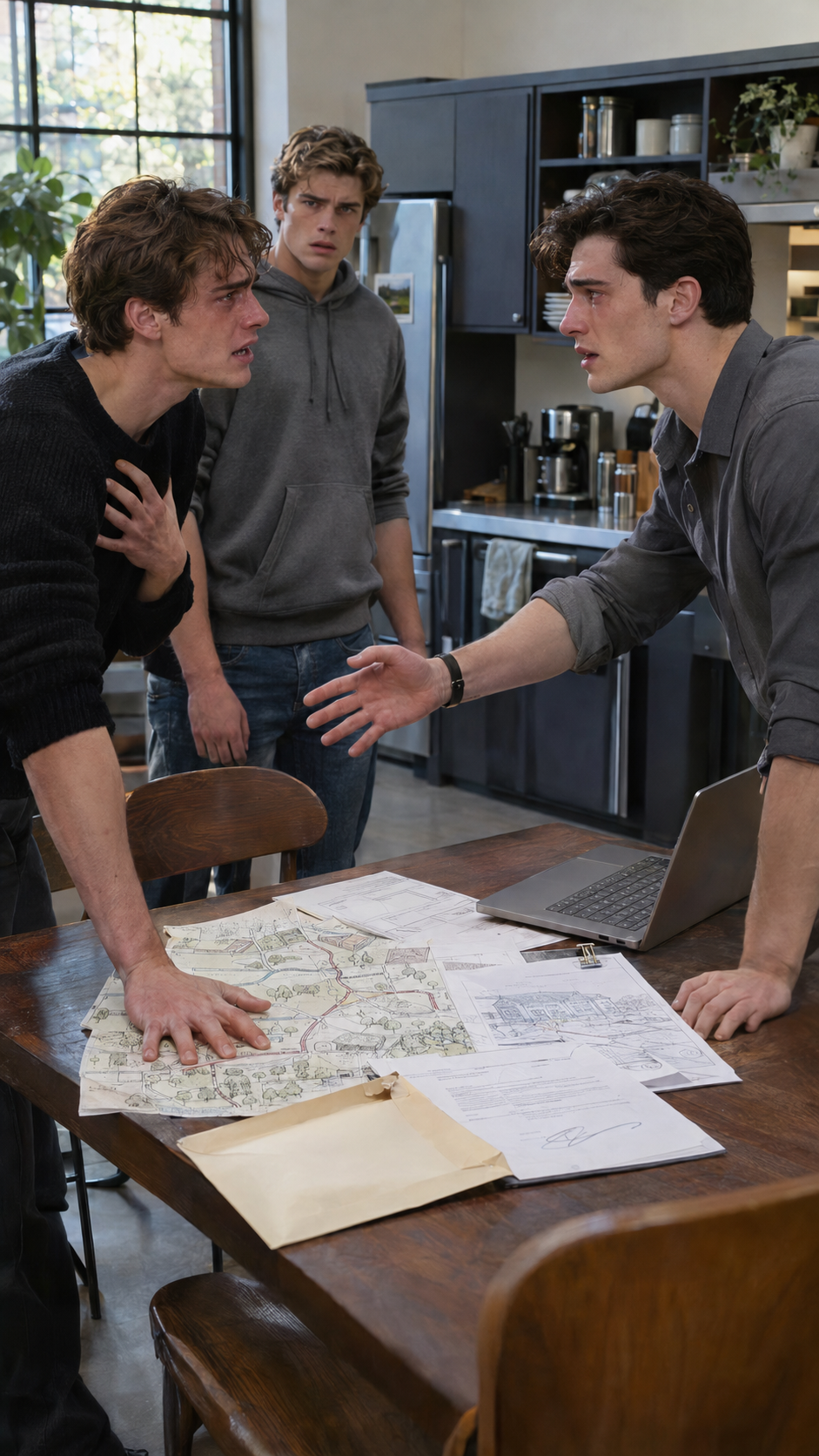
That evening, I spread the association’s recorded governing documents across my kitchen table. The vehicle inspection policy wasn’t there. Neither was any provision allowing Margaret to unlock privately owned cars.
The county property plat showed something even more important: my assigned parking space was a deeded exclusive-use easement attached to Unit 14, not ordinary HOA common parking.
The two-page policy had been approved by only three votes. The association’s own bylaws required four affirmative votes for that category of property-rights restriction.
Margaret had been enforcing a rule her board hadn’t properly adopted.
Four doors down, seventy-three-year-old Dorothy Ellis had spent eighteen years maintaining the same little house. She’d paid $4,200 in HOA penalties over two years because she feared losing the home she’d owned outright since 2009.
When she told me the amount, she gripped her teacup so tightly her knuckles whitened.
“I know some of those fines weren’t fair,” she whispered. “But I couldn’t risk foreclosure.”
Two streets away, another family had received a violation notice for installing a permitted wheelchair ramp for their daughter.
The family had signed away future modification rights just to end the threats.
That was when I stopped thinking about my parking space.
Three days after the 911 incident, Margaret delivered a new $500 obstruction fine. I carried it to the HOA office, which she operated from her converted garage.
Her husband stood near the filing cabinet, arms crossed.
Margaret slid the paperwork toward me.
“Pay, register your vehicle, and agree to future inspections. Otherwise, this gets very expensive.”
“Show me the recorded covenant authorizing those inspections.”
She pushed the same two-page memo across the desk.
I examined it, then returned it.
“Thank you.”
Her eyes narrowed. “Is that all?”
“For today.”
That night Dorothy telephoned. She’d overheard Margaret telling another board member that Unit 14 would become an example for the entire neighborhood.
I asked Dorothy to preserve every fine notice she’d ever received.
“Why?” she asked.
“Because I think we’re going to need them.”
After hanging up, I opened a new folder and wrote one word across the first tab.
EVIDENCE.
What began as a dispute over my car was about to uncover something much worse.
### Part 2: Neighbors reveal the terrifying truth behind Margaret’s mysterious key.
Dorothy answered her door carrying a grocery bag stuffed with thirty-one HOA notices. She had sorted them by date, tied each bundle with string, and written the amounts on a sheet of notebook paper.
“Four thousand two hundred dollars,” she said. “Some days I felt like I was paying rent on my own house.”
I carried the documents home and began visiting other neighbors, introducing myself simply as the man from Unit 14.
Over seven days, six households agreed to talk.
A young married couple showed me an $1,800 fine for painting their fence the wrong shade of brown. They still possessed the approved color sample, which matched the actual fence almost perfectly.
They’d paid because they were teachers with a mortgage, and Margaret had threatened a lien.
Then I visited Maria Alvarez in Unit 22.
Maria was a single mother who worked long shifts and drove an aging sedan. When I asked whether Margaret had ever approached her vehicle with a brass key, her expression changed.
“She didn’t just approach it,” Maria said. “She opened it.”
I stopped writing.
“Tell me exactly what happened.”
Four months earlier, Margaret had unlocked Maria’s parked sedan, entered without permission, and photographed the interior. Two days afterward, Maria received a $250 violation for an allegedly improperly secured child safety seat.
“There isn’t even a car-seat rule,” Maria whispered. “I checked everything they gave us.”
“Did you authorize her to enter?”
“No.”
“Would you put that in writing?”
Maria stared at me for several seconds.
Then she nodded.
Over the following three days, written statements appeared beneath my front door. Dorothy supplied her fine history, Maria documented the vehicle entry, and two more neighbors described threats made during unauthorized inspections.
I compared their accounts with HOA meeting minutes, recorded covenants, property plats, and Margaret’s internal policy.
The folder grew to eight labeled sections.
I sent Margaret a certified letter formally disputing the penalties and requesting a hearing before the full board within fourteen days.
I signed only my name.
Two evenings later, I returned from an errand and found my parking space empty.
A white notice hung from the nearby post.
My vehicle had been removed by Keystone Towing under HOA enforcement authority. The document directed me to a storage facility on Route 9 South.
Margaret’s signature appeared at the bottom.
I stood beneath the parking-lot light, reading it twice.
Then I called a cab.
Nineteen minutes later, a towing attendant led me to my car. It was undamaged, parked in the third row behind a chain-link fence. I paid $340 to retrieve it and requested an itemized receipt.
Before driving away, I opened the application connected to the motion-activated dash camera I’d installed after the brass-key incident.
The recording showed a flatbed arriving at 2:47 that afternoon.
Margaret stood beside the truck, clipboard tucked against her body. She handed the driver a document, pointed toward my car, and watched while he secured it to the flatbed.
Eleven minutes later, my vehicle was gone.
I saved the recording in three places.
The next morning, Keystone emailed me the signed towing authorization. Margaret had certified that the removal was permitted under the HOA’s vehicle access policy.
The same policy missing from the recorded covenants.
She had now put her disputed claim of authority in writing for a third party.
That evening, Dorothy called again.
“Daniel, have you seen what she’s sent everybody?”
Margaret had emailed all ninety-six households.
The subject line announced a completed vehicle compliance enforcement action. Inside, she praised the board’s commitment to neighborhood standards and identified Unit 14 as the property involved.
She wanted everyone to see what happened to residents who challenged her.
I printed the email and filed it beside the tow authorization.
Then I requested certified county property records and verification of the association’s state filings.
Four days later, a cream-colored envelope appeared beneath my door.
EMERGENCY BOARD SESSION.
Thursday. 7:00 p.m. Community room.
The stated purpose was to escalate my unpaid penalties to lien status and begin a foreclosure referral.
I arrived Thursday evening to find twenty-three residents seated in folding chairs.
Dorothy occupied the third row. Maria sat nearby. The teachers with the fence dispute held hands in the middle section.
Margaret stood behind a folding table, dressed in a dark blazer, her familiar clipboard resting beside a thick stack of documents.
She looked directly at me when I entered.
“Mr. Mercer,” she said, smiling for the audience. “I’m glad you’ve decided to face the consequences of your behavior.”
I took a seat in the back row.
My folder rested across my knees.
And for the first time since I’d moved into Maplewood, Margaret had an audience she couldn’t dismiss with a threatening letter.
### Part 3: A foreclosure hearing ends with the sheriff’s identity exposed.
Margaret called the meeting to order at 7:02.
She presented four citations totaling $1,200, described my behavior as deliberate defiance, and displayed the towing authorization as proof of the board’s enforcement powers.
Then she made the statement I’d been waiting to hear.
“Every resident agreed to our vehicle inspection policy when purchasing property here. The association has full authority to access and examine vehicles parked within this community.”
Twenty-three residents heard her.
The meeting recorder typed every word.
Dorothy raised her hand.
“Which page of the recorded covenants says that?”
Margaret stiffened.
“This meeting concerns Mr. Mercer’s violations.”
“I’m asking which page.”
“Your question is outside the agenda.”
Dorothy lowered her hand, but Maria stood before Margaret could continue.
“She unlocked my car,” Maria said. “She went inside without asking. I have a signed statement.”
Someone gasped.
Margaret slammed her palm against the table.
“Public commentary is closed!”
The room fell silent.
When Margaret called the lien vote, three board members voted yes. Patricia Wells, who’d quietly questioned the policy during earlier meetings, abstained.
I recorded every vote.
As residents began leaving, Margaret leaned toward her husband.
“If he hasn’t paid by Friday, we file the lien and send everything to the attorney. Let’s see how brave he is when his house is on the line.”
Dorothy heard it. So did Gerald from Unit 31.
Both wrote down her words.
Friday morning, someone knocked on my front door.
Two deputies stood outside.
Behind them, Margaret waited with her clipboard, eager to witness my humiliation.
“Mr. Mercer,” one deputy began. Then he looked directly at my face.
His mouth stopped moving.
“Sir?”
“Morning, Reeves.”
Senior Deputy Thomas Reeves stared at me for another moment. I’d promoted him two years earlier after watching him handle a difficult domestic crisis with remarkable patience.
His younger partner looked confused.
Reeves turned slightly.
“This is Sheriff Daniel Mercer.”
The younger deputy straightened.
Margaret’s clipboard slipped against her thigh.
“What?” she whispered.
I stepped aside.
“Come in, gentlemen.”
Margaret followed us into the kitchen, her expression shifting from confusion to disbelief.
“He’s the sheriff?”
“Yes, ma’am,” Reeves answered.
“But he never told anyone!”
I laid my evidence folder on the table.
“I moved here to be a neighbor, Margaret. I didn’t think I’d need to announce my profession to keep someone from unlocking my car.”
She opened her mouth, but I continued.
“I’d like to make a formal complaint.”
I showed Reeves the recorded covenants, board minutes, property plat, certified correspondence, Maria’s signed statement, and towing authorization.
Then I played the dash-camera footage.
“The complaint concerns attempted unauthorized vehicle entry, a documented entry into Maria’s car, suspected misuse of emergency calls, and enforcement actions based on disputed legal authority. The towing and lien records require independent review.”
Reeves documented the allegations without interruption.
I made it clear that another office would need to review the criminal allegations independently because I was personally involved.
Margaret pointed at me.
“He deliberately concealed who he was! This is entrapment!”
“Ma’am,” Reeves said, “a resident isn’t required to disclose his occupation to you.”
Her face reddened.
“I have run this association for six years!”
“And you’ve been asked for documentation,” I replied.
Margaret turned toward her husband.
“Harold, tell them.”
But Harold Holloway stood near the doorway with his arms hanging at his sides. For once, he offered no intimidating pose, no threatening stare, no supporting speech.
“Margaret,” he said quietly. “Stop talking.”
She stared at him.
Patricia, the board member who’d abstained, appeared in the hallway. She approached Reeves and asked to provide information.
From her handbag, she removed a folded document.
“I think investigators need to see this,” she said.
I couldn’t hear the rest.
Maria arrived minutes later and handed Reeves her original signed statement. Dorothy stood behind her, watching the exchange with tears gathering in her eyes.
Then Reeves asked Margaret whether she still possessed the brass key.
For a moment, nobody moved.
Margaret reached into her jacket pocket.
The key lay across her palm, its edges polished from use.
“That’s association property,” she said weakly.
Reeves collected it under the applicable evidence procedures and sealed it in a transparent bag.
Margaret watched her precious master key disappear into police custody.
It was the first time I’d seen her powerless without someone else having to become afraid.
Before leaving, Reeves advised her that the allegations would be referred for independent investigation and warned against interfering with witnesses or evidence.
She left without looking at me.
After the patrol car departed, I noticed Dorothy still standing beside the kitchen table.
“Daniel,” she said, voice trembling, “does this mean she’ll finally have to answer for what she’s done?”
“I hope so,” I told her. “But the evidence has to speak for itself.”
I looked at the folder.
Nine tabs. Dozens of documents. One brass key.
And one folded paper Patricia had handed over without Margaret noticing.
That final paper would reveal something none of us had fully understood.
### Part 4: Hidden board records destroy Margaret’s control and restore justice.
Three months later, a cream-colored envelope bearing the county seal arrived in my mailbox.
I carried it inside, made coffee, and sat at the same kitchen table where the investigation had begun.
The review had reached its findings.
The vehicle access policy had not been properly adopted or recorded as required by the association’s governing procedures. All forty-seven penalties issued under that policy were void.
The towing authorization had relied on authority Margaret did not possess, and my $340 towing expense was recoverable.
The lien action was referred for further legal review, while Maria’s vehicle-entry complaint had been forwarded to the district attorney for a separate determination.
But the most revealing discovery wasn’t listed among those conclusions.
It came from the document Patricia had handed Reeves.
It was a copy of an internal board communication written fourteen months earlier, shortly after Margaret first proposed the master-key program.
An attorney consulted by the association had warned that the proposed vehicle-access provision lacked the required approvals and could not override private property protections.
The communication recommended that the board seek proper approval and legal review before attempting inspections.
Margaret had received that warning.
Patricia had preserved it.
And Margaret had continued enforcing the policy anyway.
I sat back in my chair.
All those months, I’d wondered whether Margaret had mistaken her authority for something greater than it was.
The document answered that question.
She had been warned.
She’d chosen to proceed.
The financial consequences unfolded over the following six weeks.
Nineteen households received refunds totaling $14,800 for penalties paid under the invalid vehicle policy. A broader audit examined the other categories of fines, including the charges imposed on Dorothy and the young teachers.
Dorothy eventually recovered her full $4,200 through the combined reviews.
She called me when the check arrived.
“Daniel,” she said, struggling to steady her voice, “I’m going to fix my garden fence.”
I glanced toward the window, where her little front garden was visible across the street.
“The white one?”
“The white one. I’ve been putting it off for two years.”
A week later, another family received long-overdue relief.
The couple who’d installed a wheelchair ramp for their daughter had their modification rights formally restored after housing officials reviewed Margaret’s interference. Their properly permitted ramp could remain, and the settlement they’d signed under pressure was determined to be unenforceable.
I visited them one Saturday afternoon.
The father met me at the front door and showed me the letter. His wife stood beside the ramp, holding back tears.
“We kept thinking we’d have to tear it out,” he said.
“You shouldn’t have been put in that position.”
He nodded, looking toward the smooth concrete leading to his front porch.
“Now she can come home without us worrying about another notice.”
Margaret’s legal troubles continued through separate proceedings, and I kept my distance from the decisions. My responsibility was to preserve the evidence and cooperate as a complainant, not use my office to determine her punishment.
Her personal financial liability included the towing expense and additional legal costs.
But the largest change happened inside Maplewood Estates.
All three board members who’d supported the lien resigned during the investigation. Patricia remained, cooperated with the review, and eventually stood for election.
Margaret didn’t run again.
Neither she nor Harold attended the three community meetings held before the vote.
Dorothy announced her candidacy for HOA president with one simple promise.
“We will follow the recorded covenants, treat our neighbors fairly, and never threaten someone to win an argument.”
She received eighty-one percent of the vote.
Patricia earned seventy-three percent in her board election.
I cast my ballot in the same community room where Margaret had once threatened to take my home.
The folding table remained at the front. The chairs were arranged in familiar rows, and the recorder’s laptop sat beneath the same fluorescent lights.
But nobody was afraid to raise a hand.
At Dorothy’s first board meeting, she reviewed maintenance costs, reserve funds, and repairs to the entrance sign.
Then she opened the HOA policy binder.
She found the two-page vehicle inspection memo and laid it flat.
With a black pen, she drew one clean line through its title.
“This policy is rescinded,” she said.
Nobody applauded.
They didn’t need to.
For the first time in years, the neighborhood could conduct ordinary business without someone threatening a lien.
Three weeks later, I pulled into my parking space just before sunset.
No violation notice hung from the post. No clipboard appeared beside my car. No self-appointed inspector approached with a brass key.
I turned off the engine and listened to a lawn mower humming several houses away.
Across the street, Dorothy knelt in her garden beside a freshly painted white fence. She straightened when she saw me and raised one gloved hand.
I waved back.
For a long time, I’d believed keeping my occupation private would allow me to live without the complications that came with being sheriff.
What Margaret had taught me was something different.
A badge didn’t make my neighbors’ rights worth protecting. Their rights had existed long before I arrived.
Maria had deserved privacy inside her own car. Dorothy had deserved security in the home she’d paid for. The teachers had deserved fair treatment, and that little girl had deserved to use the ramp leading to her front door.
None of them should have needed a sheriff living down the street to be heard.
Later that evening, I opened the bottom drawer of the filing cabinet in my spare room.
The nine-tab folder was still on my desk.
I ran my thumb along its worn edge, remembering Margaret’s voice in the parking lot, the sound of her key scraping against my lock, and her certainty when she called 911.
I placed the folder in the drawer.
Somewhere in an evidence room, that brass key remained sealed and labeled, its actual use subject to the legal process.
And somewhere in the county records, the community’s genuine covenants remained available for anyone to read.
One was a tool Margaret had treated as a symbol of power.
The other was a document she’d spent years pretending to obey.
I closed the drawer and walked back toward the front porch.
Dorothy’s new fence shone softly in the evening light. A neighbor pushed a stroller along the sidewalk, and someone called goodnight from across the street.
For the first time in ten months, Maplewood Estates felt like the quiet neighborhood I’d hoped to find.
I wasn’t thinking about being sheriff.
I was thinking about tomorrow morning, when I’d park my car, carry my groceries inside, and exchange a few words with the people next door.
And nobody would need permission from Margaret Holloway to do any of it.
THE END.
All characters and events in this story are fictional, created for storytelling and entertainment purposes. Thank you sincerely for reading. Your feedback and support are invaluable and motivate me to continue sharing more stories with you.