## Part 2: A Midnight Production Crisis Uncovered An Uncomfortable Family Parallel
The backup interview arrived on my laptop at 11:47 p.m., accompanied by its original production notes and recording date. I pressed play and watched a woman named Claire sit beneath the studio lights, her hands folded tightly in her lap. She was in her fifties, a former accountant who had spent years helping her family financially before refusing to surrender her career to rescue her brother’s failing company. Her parents had responded by withdrawing the support they once promised her.
“They didn’t yell when they told me,” Claire said in the recording. “That’s what I remember. They spoke calmly, almost politely, as though they were informing me that a subscription had expired.”
I stopped the video.
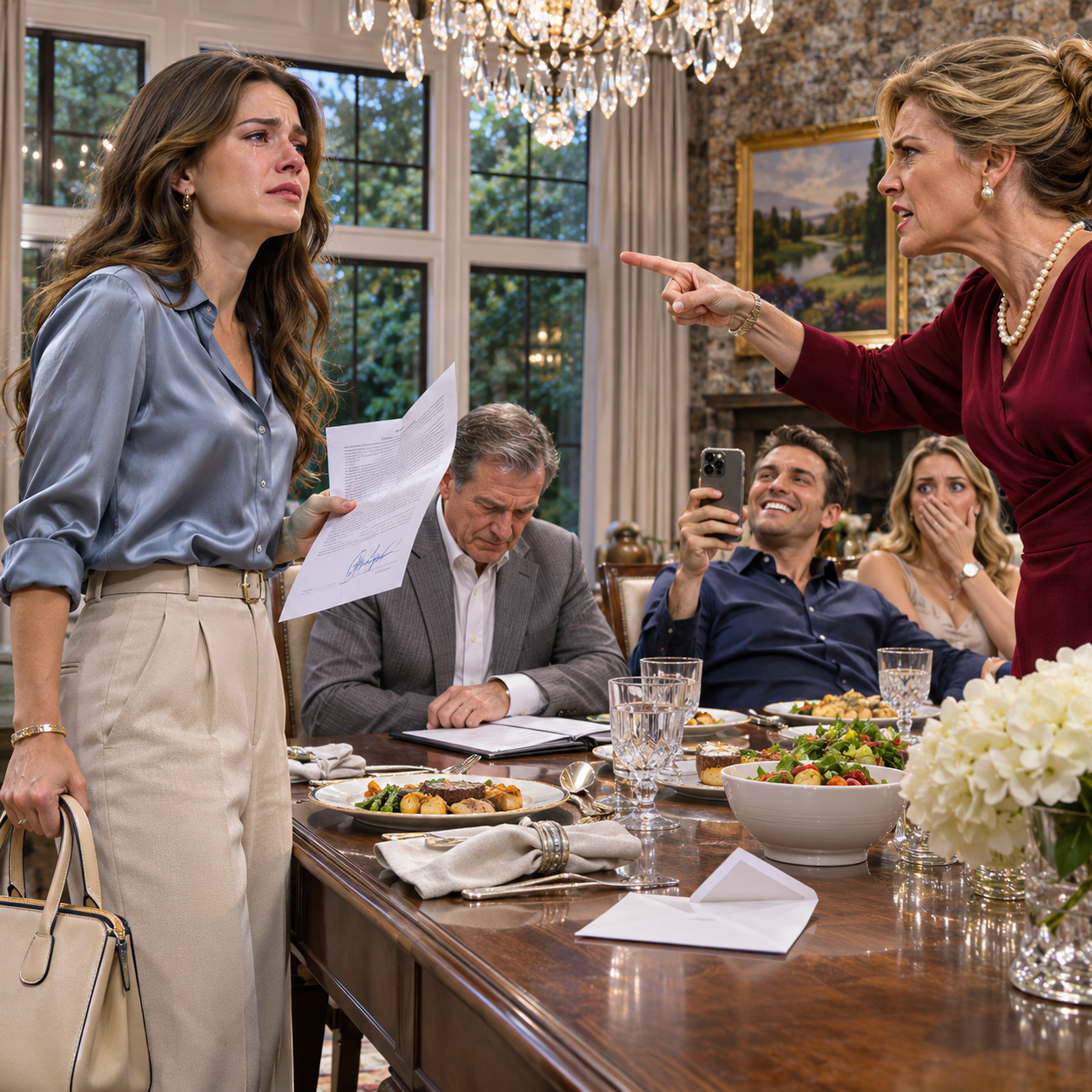
Across the room, my handbag rested on the sofa, the corner of my father’s letter visible through the open zipper. I remembered my mother’s expression when she pushed the envelope toward me, and I remembered Daniel waiting for my reaction with his phone raised. Claire had been interviewed nearly three months earlier. Until that night, her experience had seemed like one of many powerful stories our series would tell.
Now every sentence sounded painfully familiar.
Marcus called again. “The replacement works structurally, but we need to rebuild the introduction and transitions. If we’re doing this, we’ve got maybe six hours.”
“Then we use all six,” I answered.
My assistant producer joined the call from her apartment, and our sound engineer reopened the session from his home workstation. We examined every cut, rebuilt the narration, and adjusted the closing sequence to fit Claire’s interview without distorting her words. Marcus asked whether the similarities to my personal situation made me uncomfortable. I considered telling him about dinner, but the clock on my laptop had already passed midnight.
“This is her story,” I said. “We recorded it long before anything happened to me. We’re not changing that.”
At 3:15 a.m., I stepped into my kitchen and found my father’s letter lying beside the coffee machine. I had removed it from my handbag without remembering when. The pages looked strangely ordinary beneath the overhead light, filled with stiff legal language and a signature I had seen on birthday cards throughout my childhood. For years, I had imagined financial security would eventually prove that my parents valued me as much as Daniel.
Now the letter showed me how easily they could use that possibility to control my decisions.
I slid it into a drawer and returned to work.
At seven, Marcus sent the finished episode to the network’s final review team. We received clearance shortly after eight, leaving barely enough time for me to change into the navy blazer hanging behind my office door. I stood before the dressing-room mirror, concealing the dark circles beneath my eyes, while a makeup artist gently asked whether I was nervous. I smiled because the truth would have taken too long to explain.
At 8:57, I settled into my chair as the studio countdown began. Across the glass, Marcus lifted his thumb, and the floor manager raised one hand. A small red light illuminated above the camera. Eighteen months of rejected pitches, unpaid development work, revised budgets, and late-night negotiations had brought me to that single point.
“Good morning,” I began. “Welcome to Second Chances, a series about people who discover that rebuilding a life sometimes begins when the life they trusted falls apart.”
My voice remained steady.
As Claire’s interview played, I listened from the studio monitor while she described the moment she stopped confusing family loyalty with surrender. She spoke about missing her parents, about wanting their approval long after she understood the price of receiving it. When I asked during the recorded conversation whether she regretted refusing her family’s demands, she shook her head.
“I regret how long I believed love had to be earned by making myself smaller.”
The words settled over the studio.
By the time our closing credits rolled, several members of the crew were wiping their eyes. Marcus leaned against the control-room doorway and smiled without saying anything. The network called before noon, confirming that the premiere had met its initial audience target and that executives wanted to continue the weekly series. After eighteen months of uncertainty, I finally had a future I could build on.
I should have been celebrating. Instead, my phone kept lighting up with unfamiliar numbers and messages from relatives I hadn’t heard from in years.
One aunt wrote, “I watched your show. Your mother should be ashamed.”
Another asked, “Was that interview about what happened at dinner?”
I felt my stomach tighten.
No one outside my immediate family had known the details of the dinner until Daniel distributed his recording. Claire’s interview had been filmed months earlier, and her circumstances were different from mine in numerous ways. Yet the resemblance was close enough for our relatives to recognize the cruelty they had witnessed in Daniel’s video.
At 12:18, Daniel’s name appeared on my screen.
I answered while standing beside the studio window, watching employees cross the courtyard below.
His first words were sharp enough to make me hold the phone away from my ear. “You used our family story on national television?”
## Part 3: My Brother’s Recording Exposed The Secret He Wanted Hidden
“What are you talking about?” I asked.
Daniel made an irritated sound. “Don’t play innocent, Emma. You put that woman on your show to make Mom and Dad look terrible. Everybody knows what happened at dinner.”
I pulled a chair away from the window and sat down. “That interview was recorded three months ago. I didn’t mention your name, Mom’s name, or Dad’s name. I didn’t even discuss our family.”
“Nobody’s going to believe that.”
“The production records have dates, Daniel. Believe whatever you want, but the facts aren’t changing.”
He went silent for a moment before lowering his voice. “People are calling me. Rebecca says I humiliated you on purpose. Aunt Helen thinks Mom and Dad have been manipulating you for years.” Behind him, I heard a door close and someone asking whether he had reached me. Daniel covered the receiver, exchanged several muffled words, and returned angrier than before.
“You made us look like villains.”
I glanced at the episode transcript resting on my desk. “Who told everyone about dinner?”
He didn’t answer.
“Who recorded Mom disowning me and sent the video to our relatives?”
“That was different.”
“How?”
“I wanted them to see how you behaved.”
“And now they’ve seen how everyone behaved,” I replied. “I didn’t distribute that recording, Daniel. You did.”
He ended the call.
For several minutes, I remained motionless with the silent phone in my hand. My brother had spent years presenting himself as the reasonable child, the responsible businessman, the son who understood family obligations. He had recorded my rejection expecting it to embarrass me, never imagining that other people might notice the satisfaction on his face.
By midafternoon, Rebecca called with more details. Daniel had shared the video in the extended family’s group chat shortly after I left dinner, attaching a message claiming I had turned my back on my parents because I cared more about television than family. Several relatives initially sided with him. Then they watched the premiere, listened to Claire’s experiences, and replayed his recording with different eyes.
“Emma,” Rebecca said quietly, “your aunt asked why your father wouldn’t even look at you. Nobody could answer her.”
I pressed my fingertips against my forehead. “I never wanted any of this to become public.”
“I know. But Daniel wanted witnesses, and now he doesn’t like what they saw.”
At four, my father called.
His voice sounded older than it had the previous evening. “Your mother wants that episode taken down,” he said without greeting me. “People are asking questions, and your brother says you’ve used a private family matter for publicity.”
I walked into the empty interview studio and closed the door. Rows of chairs stood beneath the overhead lights, waiting for the next recording. “Dad, the woman on the program is named Claire. We interviewed her months ago. Her family and our family are not connected.”
“That’s not how people see it.”
“Because Daniel sent them a recording of dinner.”
My father exhaled. “He shouldn’t have done that.”
It was the first time I had heard him criticize Daniel’s behavior without making an excuse for it.
“Then tell him,” I said.
Another silence followed. I could hear my mother speaking in the background, her voice tense, asking whether I had agreed to remove the episode. Dad moved somewhere quieter before answering.
“Your mother is very upset. We can forget the letter, Emma. Just come home and we’ll discuss everything.”
I looked toward my handbag, where the folded document had been returned that morning. “Forget it? Dad, you signed a letter removing me from the family because I wouldn’t quit my job.”
“We were trying to make you understand the importance of supporting your brother.”
“You could have asked me to help him without demanding my entire career.”
“Daniel’s business is in trouble.”
“And mine was finally starting to succeed,” I answered. “Did that matter to either of you?”
He said nothing.
I sat in the chair where Claire had told her story and watched the red recording light reflected in the dark camera lens. The silence stretched long enough that I almost apologized for upsetting him, a habit I had carried since childhood. Instead, I remembered standing alone beside the auditorium entrance before my first presentation.
“I wanted you there that day, Dad,” I said. “I looked for you in the audience until the lights went down.”
He understood immediately. “Emma, that was years ago.”
“I know. I wanted you to be proud of me before anyone else was. I wanted you to ask about my work, not just whether it paid enough or when I would get a different job.”
His breathing changed, but he still offered no apology.
“What do you want from us?” he finally asked.
“Respect,” I answered. “Not money, and not an inheritance. I want you to understand that my life belongs to me.”
He remained quiet.
“I’m not leaving my production company to manage Daniel’s business,” I continued. “And I’m not coming home just because people are finally questioning what happened at dinner. You don’t get to reject me when I disagree and welcome me back when your reputation becomes uncomfortable.”
For the first time in my life, my father didn’t argue.
He simply said, “I hear you.”
I ended the call and sat alone until Marcus appeared at the studio door. He handed me a printed audience report, its first page filled with encouraging numbers. Below the totals were several comments from viewers describing their own experiences with rejection, estrangement, and rebuilding relationships.
One message caught my attention.
“My parents aren’t speaking to me because I chose a different life. I thought I was the only one.”
I read it three times, then reached for the next week’s production schedule. My family could keep discussing the letter, but there were people beyond our dining room who needed these stories. I had a series to make, and for the first time, I wasn’t waiting for permission.
## Part 4: My Mother’s Studio Visit Revealed What The Letter Couldn’t Change
Three weeks after the premiere, I was finishing an interview with a retired schoolteacher who had rebuilt her life after losing her home and savings. She spoke with quiet dignity about accepting help without surrendering her independence, and when the cameras stopped, she reached across the table to squeeze my hand. I escorted her toward the studio entrance, still discussing a photograph she wanted to send our production team. That was when I saw my mother standing near the reception desk.
Patricia wore a pale gray coat and carried a leather handbag clasped tightly in both hands. She looked smaller beneath the studio’s bright overhead lights, far removed from the imposing figure at the head of our family dining table. A receptionist had offered her a chair, but she remained standing, watching the technicians dismantle the lighting arrangement. When our eyes met, she took a tentative step toward me.
“Hello, Emma.”
I stopped beside the reception counter. “Mom. I didn’t know you were coming.”
“I called the office. They said you were recording, so I decided to wait.”
For a moment, neither of us spoke. I noticed that she had removed the pearl necklace she wore almost everywhere, and I wondered whether she had considered how different this visit would be from the dinner where she last saw me. She looked through the open studio doorway at the camera equipment, the staff collecting cables, and the large screen displaying the Second Chances logo.
“This is all yours?” she asked.
“The production company is mine. We make the series with a network partner.”
She nodded slowly. “I didn’t realize how many people were involved.”
“You never asked.”
Her expression tightened, but she didn’t challenge me.
We moved into a small conference room, where I poured two glasses of water and sat opposite her. She examined the framed production photographs on the wall, including one from the premiere morning. In the picture, Marcus stood behind me, smiling broadly, while I held a folder of finalized scripts against my chest. My mother studied it longer than I expected.
“I watched the entire first episode,” she said. “And the second one.”
I waited.
“I thought you were making a mistake with this career,” she continued. “I kept expecting you to find something more secure.”
“You might still think that.”
She gave a small, reluctant nod. “Maybe. But I should have listened before deciding I knew what was best for you.”
For a moment, I heard the old familiar opening to another lecture. Then she reached into her handbag and withdrew her phone, placing it faceup between us. On the screen was Daniel’s recording from dinner, paused at the moment my father handed me the letter.
“I watched this again,” she said.
My stomach tightened. “Why?”
“Because your aunt told me to watch it without listening to Daniel explain what happened.”
She pressed play.
My own face appeared, pale and motionless beneath the dining room chandelier. Daniel laughed in the background, and my mother on the screen announced that I no longer belonged to the family. Beside her, the real woman watched without moving. When the recording reached the moment I looked toward Dad and asked him to speak, she stopped it.
“I remember thinking you were being stubborn,” she whispered. “But watching this now, I can see you were waiting for one of us to defend you.”
I felt my throat tighten.
“Why didn’t you?” I asked.
She lowered her eyes. “Because I thought if we made the consequences serious enough, you’d give in and help Daniel.”
There it was, the truth I had suspected but never heard spoken aloud. The letter had not been written after an emotional outburst. It had been designed as leverage, a deliberate attempt to make my independence feel more frightening than surrender.
“And when I didn’t?” I asked.
“We expected you to come back and negotiate.”
I stared at her. “You thought I would beg?”
She swallowed. “I thought losing the inheritance would matter more to you than your career.”
The room seemed unusually quiet. Through the glass, I could see Marcus reviewing a camera setup with a technician, their movements ordinary and practiced. My mother followed my gaze, studying the workplace I had spent six years building without her encouragement.
“I didn’t understand what you had here,” she said.
“You could have understood. You could have visited years ago.”
“I know.”
It wasn’t a complete apology, and I wasn’t prepared to pretend it repaired six years of disappointment. Still, something had changed. My mother was sitting across from me without giving instructions, offering ultimatums, or explaining why Daniel deserved more.
“There’s something else,” I said, opening my laptop.
I showed her the original production file for Claire’s interview. The date appeared clearly beside the recording notes, nearly three months before our family dinner. My mother leaned toward the screen, reading it carefully.
“So you really didn’t make that episode about us.”
“No. The audio problem happened the night before the premiere. Marcus suggested replacing the damaged interview with this one because it was already finished.”
She sat back slowly. “And we thought you were trying to embarrass us.”
“You saw yourselves in somebody else’s story,” I answered. “That doesn’t mean I put you there.”
My mother looked at Daniel’s paused recording, then at the dated production file. The evidence lay between us, and for once she couldn’t turn it into an argument about loyalty. She finally understood that our relatives hadn’t condemned my parents because I had exposed them on television. Daniel had distributed the evidence himself, expecting everyone to applaud.
“I’m sorry, Emma,” she said.
The words came quietly, without a rehearsed speech or a demand that I forgive her. She didn’t blame Daniel, my father, the pressure of running a family, or the difficulties of growing older. She simply sat with what she had done.
I wiped at the corner of one eye. “I needed to hear that years ago.”
“I know.”
We spoke for another twenty minutes. She asked about the next episode, the people who worked with me, and how we selected guests, and I answered without concealing my pride. When she eventually stood to leave, she hesitated beside the conference room door.
“Your father still wants you to come to dinner.”
“I’m not ready.”
She nodded. “I understand.”
“And Mom? I’m not changing my mind about Daniel’s business.”
“I won’t ask you to.”
At the studio entrance, she turned once more. “I’m proud of what you’ve built, Emma. I should have told you that before other people did.”
I watched her walk into the afternoon sunlight, uncertain what our relationship would become. Her visit hadn’t erased the dinner, restored the trust, or produced the apology my father still owed me. But it had given me something I hadn’t received from her in years: a conversation in which my choices were treated as my own.
That evening, I took the disinheritance letter from my handbag and unfolded it across my desk. I read my father’s signature one last time before placing the pages inside a folder marked PERSONAL. I didn’t destroy them, and I didn’t contact an attorney to demand a place in the inheritance arrangements. Whatever legal questions remained could be handled separately; they would no longer determine how I valued myself.
The following morning, Marcus found me in the studio reviewing questions for our next guest. He placed a fresh audience report beside my coffee and pointed to the growing collection of viewer letters attached behind it. At the top was a note from a sixty-eight-year-old woman who had watched our premiere and finally called the daughter she hadn’t spoken to in eleven years.
I sat with that letter for a long moment.
My parents had spent six years telling me that my work wasn’t building a future, and in one evening they had tried to prove I had no future worth supporting. Yet the program they dismissed had reached someone neither they nor I would ever meet, helping her begin a conversation she had postponed for more than a decade. That was the final truth the dinner letter could never change: the life my family considered a failure was already making a difference.
At nine o’clock, the studio lights brightened, and Marcus signaled that we were ready.
I straightened my notes, looked into the camera, and smiled.
“Good morning. Welcome back to Second Chances.”
For years, I had hoped my family would finally give me a seat at their table. Now I was sitting in a chair I had earned, telling stories I believed in, surrounded by people who respected the work I did.
My parents could decide what happened to their inheritance.
They could not decide what I was worth.
THE END.
All characters and events in this story are fictional, created for storytelling and entertainment purposes. Thank you sincerely for reading. Your feedback and support are invaluable and motivate me to continue sharing more stories with you.