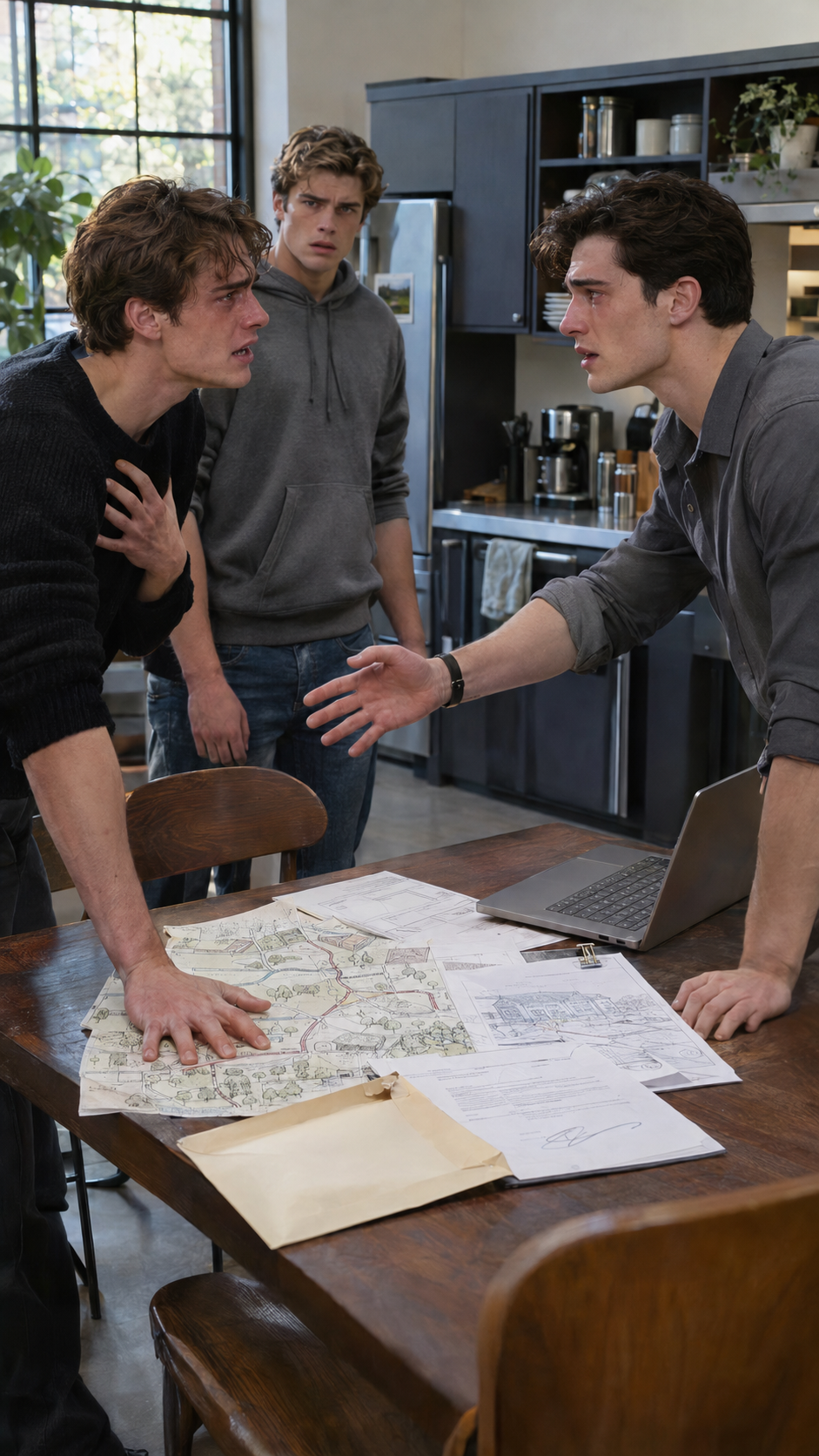
### Part 2: The Groom’s Mother Uncovered Evidence My Parents Could Not Explain
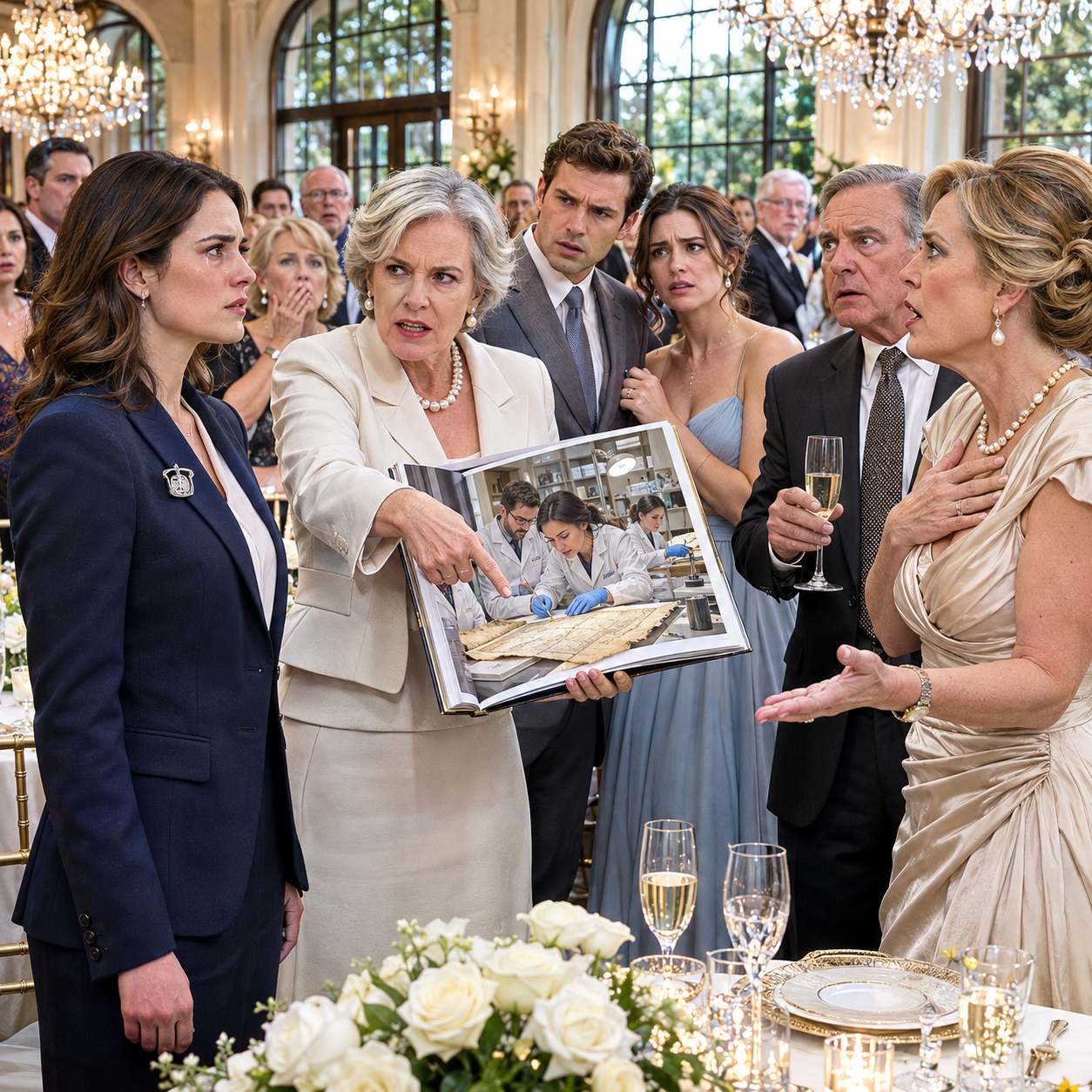
My mother recovered first, lifting her chin as though Catherine had misunderstood a perfectly innocent joke. “Those programs were assembled by volunteers. I’m sure there’s been a harmless mistake.” Catherine kept her finger on the photograph. “Then it should be simple to correct. Samantha, was your company responsible for this restoration?” I met her eyes and answered, “Yes. We completed it under contract with the historical society, and the Carter Family Heritage Initiative was not involved in the financing or execution.”
The conversation around us went quiet. Andrew and Tina approached from the head table, drawn by the sudden tension, and Andrew took the program from his mother’s hands. “Diane told me her initiative was already managing major preservation projects,” he said. Tina immediately turned toward me. “Samantha, please don’t ruin tonight because you’re upset about work.” I looked at her engagement ring, then at her face. “I didn’t bring this up, Tina. Mom introduced me.”
Dad attempted to intervene, claiming there had been several contributors to the maritime project. Catherine asked him to identify them, and he stared into his glass. Andrew looked increasingly uncomfortable, while Diane insisted the disagreement was a private family matter. “Not when our trust’s name appears beside potentially inaccurate claims,” Catherine replied. Then she delivered the sentence my mother had been working for months to avoid. “Diane, our meeting tomorrow about your advisory council appointment will need to be postponed.”
My mother turned toward me with tears gathering in her eyes. “I can’t believe you’d humiliate your own family over a few photographs.” She claimed my parents had supported me for years and accused me of resenting Tina’s success. Tina asked me to apologize so everyone could enjoy dessert. Instead, Catherine suggested we continue the discussion privately, and Andrew quietly instructed the event coordinator to keep dinner service moving.
We entered a small meeting room overlooking the garden. Catherine’s husband, James, joined us with Elaine Porter, the trust’s executive director, who had attended as a family friend. Elaine opened the program beside the initiative’s grant application on her tablet. “The application describes Diane’s organization as a principal sponsor of this project,” she said. “Can you explain what financial support was provided?” Mom smoothed her dress and replied, “We raised awareness and encouraged community participation.”
“That doesn’t answer the question,” Elaine said.
I removed Melissa’s evidence packet from my handbag and laid the original contracts, correspondence, and funding confirmations on the table. The historical society had paid for the restoration using its operating budget and a designated grant, while Heritage Ledger Preservation had performed the technical work. Elaine compared the documents without speaking. My mother stared at the folder as though its existence were a personal attack. “You brought paperwork to your sister’s engagement?” she demanded.
“I brought it because someone was claiming ownership of work my employees spent months completing.”
Dad pushed back his chair. “Families help one another, Samantha. You wouldn’t understand that if everything weren’t about money.” I looked at the man who had taught me to ride a bicycle, helped with my college applications, and then spent years pretending my accomplishments were worthless. “Is that what you called the $85,000 I lent your business?” His face tightened. “That was private.” I nodded. “It was private for five years, Dad. You still owe me $73,000, and I never used that debt to embarrass you.”
Andrew stared at him. “You borrowed money from Samantha?” When Robert admitted it, Andrew turned toward Diane. “Last month you told us she depended on you financially.” My mother opened her mouth but couldn’t find an answer. Tina sat motionless, turning her engagement ring around her finger. I could see her trying to reconcile the sister she’d been taught to pity with the woman sitting across from her.
Elaine returned to the application. “Your initiative claims an established partnership with Heritage Ledger Preservation.” Diane leaned forward desperately. “We’re family. Samantha and I have always had an understanding.” I shook my head. “There is no partnership, formal or informal.” Elaine wrote something in her notebook and explained that the application required an independent review, without implying that any legal wrongdoing had been established.
My mother reached for my hand. For one impossible second, I thought she might apologize. Instead, she whispered, “One phone call could fix this. Just tell them we’re partners.” I looked at her carefully manicured fingers, remembering how often those same hands had straightened my clothes before family photographs while reminding me not to mention my work. “No, Mom. I won’t make a false statement.” Her fingers withdrew. “Then don’t expect this family to welcome you afterward.”
Catherine answered before I could. “Diane, if Samantha telling the truth costs her a place in your family, perhaps your family needs to reconsider what loyalty means.”
I left the meeting room with my coat over my arm. Near the entrance, Andrew caught up and apologized for what had happened. He also revealed that Catherine had been trying to recruit my company for a major archival digitization project, although the selection process wasn’t complete. I told him any contract had to be evaluated independently of our family dispute. Outside, my phone illuminated with a message from Melissa asking whether the correction notice should proceed the following morning.
I typed two words.
“Proceed tomorrow.”
### Part 3: My Sister Revealed Why Mom Had Deliberately Hidden My Success
By breakfast, twenty-three messages crowded my phone. Diane had told relatives that I’d sabotaged Tina’s engagement because I couldn’t tolerate my younger sister marrying into a respected family. One cousin claimed I’d threatened to sue everyone, while another said my mother had spent the night crying over my cruelty. I sat at my kitchen counter with cold coffee and read each accusation without responding. For once, I understood that defending myself to every relative would only give Diane more opportunities to rewrite the truth.
Melissa delivered the formal notices as planned. They requested removal of unauthorized photographs, corrections to the initiative’s promotional materials, and withdrawal of inaccurate claims from pending applications. The Whitmore Cultural Trust placed the application on hold while its governance team examined the documentation. Catherine voluntarily recused herself from decisions involving both my company and my mother’s organization because of the family connection. I welcomed that decision, even though my mother later insisted it proved Catherine and I had planned everything together.
A week later, Elaine contacted my attorney. The review found that the Carter Family Heritage Initiative couldn’t substantiate its claimed sponsorship of the maritime collection or two additional projects associated with my company. The trust rejected the grant application and withdrew Diane’s advisory council candidacy. No criminal finding was made, and I had no interest in turning a professional correction into a public spectacle. But in Charleston’s tightly connected charitable community, the consequences spread quickly.
Two prospective donors postponed their commitments. Another committee asked Diane to step aside temporarily from fundraising duties, and invitations to influential planning meetings stopped arriving. My mother had spent almost twenty years cultivating the appearance of authority, and suddenly the people she’d tried hardest to impress wanted documents instead of assurances. She called me eleven times in two days. I didn’t answer because her voicemails demanded that I repair her reputation without once acknowledging why it had been damaged.
Three weeks after the dinner, Dad requested a meeting at a quiet café near my office. He arrived carrying the original loan agreement and looked older than I remembered. “I should’ve handled this years ago,” he said, sliding a repayment proposal across the table. The remaining $73,000 would be repaid over thirty-six months, beginning with an initial payment from the sale of an investment asset. I told him Melissa would review the terms before we signed.
He nodded, then stared at the traffic beyond the window. “I used to laugh at your mother’s jokes because disagreeing with her was harder.” I waited until he finally looked at me. “Keeping peace in that house always seemed to mean someone else had to swallow the hurt.” His expression collapsed. “I thought I was protecting the family.” I asked, “Who were you protecting, Dad?” He had no answer.
That evening, Tina called. She and Andrew had postponed their wedding, although they hadn’t ended the engagement. They were beginning counseling because Andrew wanted to understand how much Diane’s expectations had influenced their relationship. “I believed Mom when she said you let her use your projects,” Tina admitted. “I even thought you wanted anonymity.” I asked why she’d never checked with me, and her voice cracked. “Because then I’d have to admit I didn’t know anything about my own sister.”
She’d spent the previous week researching Heritage Ledger Preservation. She’d watched my university interview, read about our preservation award, and discovered the employees and contracts I had spent years quietly building. “I’m proud of you,” she whispered. Those words should have felt wonderful. Instead, they made me grieve the years we’d lost while sitting across the same holiday tables.
Then Tina told me something that changed everything.
“Mom knew Catherine was interested in hiring your company before the engagement dinner.”
I sat upright. Tina explained that Diane had seen a message Andrew received about the trust’s archival project, with Heritage Ledger Preservation named among the firms under consideration. Diane told Tina not to mention it because she supposedly didn’t want me turning the engagement into a business opportunity. Suddenly, I remembered being seated near the back, being told to remove my award pin, and being ordered not to discuss my profession.
My mother hadn’t merely mistaken my success for failure. She knew recognition might come from Catherine, and she wanted to control what Catherine heard first.
I didn’t call Diane to confront her. I forwarded the information to Melissa for documentation and continued the formal correction process. I also wrote Tina a short message, telling her that I loved her and hoped she and Andrew could build a marriage where neither person had to pretend. She answered with something I’d wanted to hear since childhood.
“I want to know who you really are, Sam. Not who Mom says you are.”
### Part 4: The Final Revelation Changed What Family Loyalty Meant Forever
Two months after the engagement dinner, the Carter Family Heritage Initiative published a formal correction acknowledging inaccurate project attribution in its promotional materials. It removed my company’s photographs, updated its website, and credited Heritage Ledger Preservation and the historical society for the maritime restoration. Diane resigned from her remaining fundraising committee position, publicly explaining that she wanted more time for personal matters. She never called me to apologize. For the first time, I didn’t chase an explanation she wasn’t willing to give.
Meanwhile, the Whitmore Cultural Trust completed its independent procurement process. With Catherine excluded from the decision, Heritage Ledger Preservation received a limited initial contract to assess nineteenth-century correspondence and develop a digitization plan. Our proposal had earned its technical score through months of preparation. When I told my employees we’d won, the laboratory erupted in applause, and our senior conservator, Ellen, squeezed my shoulder. “We earned this one,” she said.
At the project kickoff, Catherine approached while the others gathered their documents. She asked how I was doing, and I thanked her for speaking up that evening. “I recognized someone’s work and corrected an inaccurate description,” she replied. “That should be ordinary.” I admitted it hadn’t felt ordinary to me, and her silver eyebrows drew together with something like sadness. “Then perhaps you’ve spent too much time around people who needed you to be smaller.”
I carried those words home.
Tina and Andrew eventually planned a smaller wedding, with fewer guests and no committees directed by Diane. Tina asked me to help choose a historical venue because she wanted to learn why old buildings and forgotten records mattered so much to me. We toured three properties, ate lunch at a crowded café, and argued good-naturedly about whether a restored carriage house could accommodate the ceremony. It was the first afternoon I could remember when Tina seemed interested in my opinion without needing something from me.
Dad followed his repayment schedule. When he missed one payment, he called beforehand and caught up the following month. Our relationship wasn’t instantly repaired, but he began asking about my projects instead of changing the subject whenever I mentioned work. He even visited the laboratory and spent an entire afternoon listening to technicians explain how damaged papers could be stabilized. Watching him ask careful questions, I felt something unfamiliar: the possibility of building an honest relationship with my father.
Six months after the dinner, a four-page letter arrived from Diane.
She described the humiliation she’d experienced, the friends who’d distanced themselves, and the opportunities she believed had been unfairly taken away. Near the bottom of the final page, she wrote, “I suppose I could have been more thoughtful about how I described your work.” I read that sentence three times. She still couldn’t acknowledge the false project claims, the borrowed money, or the years she’d spent encouraging people to dismiss me.
I placed her letter beside the original conservation award on my desk and wrote back. “I’m willing to have a relationship based on honesty and mutual respect. I’m not willing to return to the way things were.” Diane never answered. Her silence hurt, but I didn’t mistake it for a problem I was responsible for solving.
The following spring, Heritage Ledger Preservation hosted an open house celebrating a completed archival recovery project. Sunshine streamed through the tall laboratory windows, illuminating restored documents that researchers hadn’t been able to examine for decades. Employees brought their families, students crowded around digital displays, and Ellen demonstrated how her team repaired a damaged ledger without disturbing its original handwriting. I watched people lean forward with genuine interest, fascinated by the work my mother had always dismissed.
Tina arrived carrying flowers, with Andrew smiling beside her. Dad appeared twenty minutes later and quietly joined a tour. My mother didn’t come. I noticed her absence when the photographer gathered us together, but it didn’t overshadow the afternoon. The people standing around me knew what we’d accomplished because they’d helped accomplish it.
Near the exhibition entrance, Tina stopped before a photograph of our original five-person team. In it, I was wearing protective gloves and holding a crumbling nineteenth-century ledger. “Mom used to show people that picture,” Tina said softly. “She’d tell them you spent your days cleaning up old junk.” I nodded, remembering every uncomfortable laugh that followed.
“I laughed too,” Tina admitted.
“I remember.”
She turned toward me, tears gathering along her lashes. “I’m sorry, Sam. I should’ve asked you what you loved about this work instead of believing what I was told.” There was no excuse attached, no request that I forget everything, and no suggestion that I was being too sensitive. I reached for her hand. “Thank you for saying that.”
Andrew joined us, carrying a printed copy of the day’s exhibition guide. On the first page, beneath the project title, was the name of my company and a photograph of the team responsible for the restoration. Tina looked from the guide to the old photograph, then smiled. “You’ve been preserving everyone else’s history while we were busy getting yours wrong.”
Her words stayed with me long after the last visitor departed.
That evening, I stood alone in the laboratory, switching off the display lights one by one. My silver award pin rested beside the archival ledger we’d spent eleven months restoring. I thought about Catherine confronting my mother, Dad acknowledging his debt, and Tina finally seeing the sister who’d been standing beside her all along. For years, I’d believed love required silence whenever the truth made someone uncomfortable.
But the most important revelation wasn’t that my mother had known about my success or tried to conceal it. It was that I had spent years helping her maintain the lie by making myself easier to dismiss. I could love my family without surrendering my accomplishments, and I could accept an apology without pretending the past had never happened. My mother’s choices had consequences, but they were not mine to carry.
I picked up the old ledger and carefully returned it to its protective case. Its pages were faded, scarred by water and time, but the original handwriting remained visible beneath the damage. I smiled at the thought that history didn’t need to be perfect to deserve preservation. It simply needed someone willing to tell the truth about what had happened.
My mother once introduced me as the family cleaning lady.
In the end, I didn’t have to destroy her reputation, win her approval, or make a speech defending my worth. I only had to stop allowing her to use my silence as permission.
And for the first time in my life, when someone asked who I was, I could answer without hearing my mother’s voice in my head.
I was Samantha Carter.
And the life I’d built finally belonged to me.
THE END.
All characters and events in this story are fictional, created for storytelling and entertainment purposes. Thank you sincerely for reading. Your feedback and support are invaluable and motivate me to continue sharing more stories with you.